




Abstract
Background and aims
Language abilities vary greatly across children with autism spectrum disorders (ASD). In the present study, we investigate passive sentence comprehension, which has been underexplored among individuals with autism spectrum disorders and found to be delayed among other clinical populations. This study is the first to assess grammatical comprehension among Danish-speaking adolescents with autism spectrum disorders.
Methods
Fifteen Danish-speaking adolescents with autism (mean age: 14.9 years; age range: 13–18 years) participated in a picture selection task assessing comprehension of passive sentences relative to active sentences. We compared our findings for adolescents with autism spectrum disorders to those of 15 typically developing Danish-speaking adolescents matched for age and nonverbal reasoning as measured by the Matrix subtest of the WISC-IV/WAIS-IV. We also analyzed associations between passive comprehension and nonverbal reasoning.
Results
The results showed ceiling effects for both groups on all sentence types indicating that Danish adolescents with autism spectrum disorders do not face problems comprehending passive sentences. However, when considering variation within the autism spectrum disorder group, correct passive comprehension was highly significantly associated with nonverbal reasoning for the autism spectrum disorder group (r = .75), while this was not the case for the typically developing adolescents. Analyses of the few errors produced showed a preference for Theta-role reversal errors in the autism spectrum disorder and the typically developing groups.
Conclusions
Danish-speaking adolescents with high-functioning autism spectrum disorders do not show impairment in passive sentence comprehension. Correlation analyses however show that for adolescents with autism spectrum disorders, passive sentence comprehension is associated with nonverbal reasoning. We discuss how these results can be viewed as consistent with the few previous studies on passive comprehension in individuals with autism spectrum disorders.
Implications
Our study provides additional cross-linguistic evidence that passive comprehension is not problematic for individuals with high-functioning autism spectrum disorders. The finding of the relationship between nonverbal reasoning and passive sentence comprehension may inform clinical best practices as children with autism spectrum disorders who underperform in measures of nonverbal reasoning may benefit from additional receptive language screening.
Introduction
Autism spectrum disorders (ASD) are neuro-developmental conditions which affect social communication and social interaction and are characterized by certain behavioral symptoms, such as having restricted yet intense interests or repetitive behaviors (Diagnostic and Statistical Manual fifth edition [DSM-5], American Psychiatric Association, 2013; International Statistical Classification of Diseases and Related Health Problems [ICD-10], World Health Organization, 1992). The onset of symptoms is identifiable within the first years of life and these symptoms last throughout the person’s lifetime, although they may be eased through therapeutic interventions or abate with age (Seltzer et al., 2003). Language outcomes are highly variable among individuals with autism. As many as 30% of individuals with ASD may remain minimally verbal throughout their lifetime (Tager-Flusberg & Kasari, 2013) while those who do develop language do so with varying degrees of grammatical impairment and difficulty navigating language use in interactions with others.
In recent decades, there has been a wealth of research dedicated to characterizing the linguistic profiles of the autism spectrum. Comprehension studies of children with ASD have yielded findings suggesting impairment in understanding object clitics and reflexive pronouns (Terzi, Marinis, Kotsopoulou, & Francis, 2014; Terzi, Marinis, & Francis, 2016), accusative clitics (Durrleman & Delage, 2016) and definite articles (Modyanova, 2009). Studies on passive sentence comprehension have shown conflicting results in children with ASD. An early study by Perovic, Modyanova, and Wexler (2007) suggested impairment in passive comprehension, while more recent studies suggest intact comprehension (Gavarró & Heshmati, 2014; Terzi et al., 2014), despite the fact that the participants in the more recent studies were younger than those in the earlier study (mean age 11;06 years for the Perovic et al. study and mean age of 6;08 and 8;09, respectively, for the Terzi et al. or Gavarró & Heshmati study). This difference in results may relate to differences in the cognitive profiles of the participants in these studies, specifically in functioning level, 1 or relate to the different languages being acquired (so far English, Greek, or Persian). The purpose of this paper is to investigate the comprehension of verbal passives in Danish adolescents with ASD to disentangle these seemingly contradictory results.
The grammatical characteristics of speech of individuals with ASD include pronoun reversals (Tager-Flusberg & Caronna, 2007) or avoidance (Jordan, 1989; Lee, Hobson, & Chiat, 1994; Shield, Meier, & Tager-Flusberg, 2015) and errors in tense and person marking (Bartolucci, Pierce, & Streiner, 1980; Tager-Flusberg, 1989; Modyanova, Perovic, & Wexler, 2017). Eigsti, Bonnetto, and Dadlani (2007) evaluated grammatical complexity in the language of children with ASD as measured through the Index of Productive Syntax (IPSyn), a tool which calculates syntactic complexity in speech by evaluating the occurrence of 56 syntactic and morphological structures (relative clauses, wh- questions, complex infinitives, etc.). They found that, even when adjusting for nonverbal mental age, 2 levels of syntactic complexity were reduced in children with ASD. The Eigsti et al. study also corroborates claims found elsewhere in the literature (e.g. Burack, Iarocci, Flanagan, & Bowler, 2004) that the lexicon is relatively preserved in comparison to syntax, although anomalies such as a high rate of jargon were noted.
Syntactic difficulties form part of the broader profile of communicative impairments in ASD. Successful linguistic communication depends on processing discourse-level meaning and managing the changes that come with real-time conversation. Adults with autism self-report that asynchronous communication, such as e-mail, is easier to manage than face-to-face exchanges, as it is possible to review the interlocutor’s text, therefore having more time to process and adequately plan a response (Benford & Standen, 2009). This finding corroborates other findings widely identified in the literature that individuals with autism can have difficulty processing their interlocutor’s intended meaning as well as adapting to their interlocutor’s needs, such as providing sufficient information (Volden, 2002). Further difficulties include processing language information in tandem with emotional cues (Angeleri, Gabbatore, Bosco, Sacco, & Colle, 2016), drawing inferences from contextual information to process nonliteral meaning or homographs (Jolliffe & Baron-Cohen, 1999; Loukusa & Moilanen, 2009), and understanding figurative expressions (Chahboun, Vulchanov, Saldaña, Eshuis, & Vulchanova, 2016).
Children with ASD are less likely to initiate communicative acts with caregivers (Loveland, Landry, Hughes, Hall, & McEvoy, 1988) and have a general reduction of declarative pointing (Baron-Cohen et al., 2000), a gesture which is associated with word learning (Colonnesi, Stams, Koster, & Noom, 2010). Response to and initiation of these moments of joint attention (along with gaze-shifting) correlate with language gains in ASD and are better predictors of language development than amount of intervention hours alone (Bono, Daley, & Sigman, 2004). Other kinds of behavior regulating gestures such as imperative pointing are less impaired (Baron-Cohen, 1989; see Sparaci, 2013 for a review on pointing gestures in ASD) and therefore are more readily part of the child’s communicative repertoire. A child’s early language profile may mirror the general severity level as higher language abilities in toddlerhood are closely related to nonverbal cognitive abilities (Luyster, Kadlec, Carter, & Tager-Flusberg, 2008; Weismer, Lord, & Esler, 2010).
Specific aspects of language that are affected may take a different shape depending on the specific language being acquired by the child. For example, studies in Greek and French have identified difficulty related to clitic pronoun comprehension (Durrleman & Delage, 2016; Terzi et al., 2016), a finding that would otherwise be unknown in English-only research as clitics are not part of the referential repertoire in English. While cross-linguistic differences are important in allowing us to develop a thorough picture of linguistic impairment across the autism spectrum, it is similarly important to track the consistency of impairment or strengths in shared underlying grammatical structures, such as passives, across different languages, as is the focus of the present study.
In typical development, passive sentences are among the later acquired constructions (see Borer & Wexler, 1987, 1992; Maratsos, Fox, Becker, & Chalkley, 1985, and much subsequent work). The study of passives is therefore relevant to the question of how complex syntax is acquired by individuals with ASD.
Passive acquisition among typically developing children
Passive sentences are acquired relatively late compared to active sentences. This has been attributed to the relative infrequency of passives in child-directed speech (Gordon & Chafetz, 1990) or the effect of grammatical maturation. Among other grammatical proposals, it has been argued that there is delay in A-chain formation (Borer & Wexler, 1987, 1992); more recent proposals in line with current linguistic assumptions are those of Wexler (2004) and Snyder and Hyams (2015). All these accounts are based on the idea that some basic movement operation that gives rise to passives (and related constructions) is unavailable to children; to the extent that the operation is syntactic, under the assumptions of modularity, one would not expect its maturation to be related to nonverbal reasoning. The question is whether the study of ASD can challenge those assumptions.
Danish, the language of our current study, is similar to other Scandinavian languages in having two verbal passives: one in the form of a morphological passive (1b), which relies on a suffix specific to passives, and one in the periphrastic form (1c), which relies on an auxiliary verb followed by a participle (see Engdahl, 1999 for a description, and Heltoft & Falster Jakobsen, 1996 for an explanation of semantic differences between the two passives, relating to aspect). For both passive forms, the external by phrase argument is optional, as shown in the examples (1b) and (1c).
3
(1) a. Lillesøster kysser mor.
Illustration of the materials used in the experiments. little.sister kiss.PRES mother “Little sister kisses mother.” b. Lillesøster kysses (af mor). little.sister kiss.PASS (by mother) “Little sister is being kissed (by mother).” c. Lillesøster bliver kysset (af mor). little.sister become PRES kiss.PART (by mother) “Little sister is being kissed (by mother).” (2) a. Pigen er puttet (af mor). girl.DEF be.PRES.3.SG cover.PART (by mother) “The girl is covered (by mother).” b. Pigen bliver puttet (af mor). girl.DEF become.PRES cover.PART (by mother) “The girl is being covered (by mother).”
Danish-speaking children’s comprehension of passives was again tested as part of a cross-linguistic study by Armon-Lotem et al. (2016). In this study, Danish 5-year-olds performed nearly at ceiling in the comprehension of short and long periphrastic passives. In some languages, comprehension of short passives was reported to be earlier than that of long passives (as was the case for, e.g., Catalan and German), although for Danish-acquiring children both types of passive constructions were acquired by 5 years of age.
Passive comprehension among individuals with ASD
Studies of passive comprehension among children with language impairment have showed a delay for English-speaking children (Marinis & Saddy, 2013; Norbury, Bishop, & Briscoe, 2002; van der Lely, 1996), although this has not been identified in Danish-speaking children (Jensen de López, Sundahl Olsen, & Clasen, 2010) when focusing on morphological passives. Explanations for the delay have relied on grammatical or processing limitations (see Marinis & Saddy, 2013 for an overview). On the other hand, studies investigating passive acquisition among children with autism show conflicting results as to whether passive constructions are also challenging for this clinical group. At the onset of our study, three investigations of passive comprehension among individuals with autism were available.
The first study, by Perovic et al. (2007), showed impairment in passive comprehension, based on the investigation of an English-speaking sample consisting of 12 children with ASD (mean age: 11;06) and 8 children with Asperger’s syndrome
5
(mean age: 13;01) as well as three control groups, matched on verbal and nonverbal mental age (as measured, respectively, by the PPVT-3 and the KBIT-1)
6
as well as chronological age. In this study, they used a two-picture selection task to compare comprehension of long passives (3) and short passives (4) as well as active sentences. (3) Bart is pushed by Lisa. (4) Bart is pushed.
In a study of grammatical abilities in Greek-speaking children with ASD, Terzi et al. (2014) explored various syntactic constructions, including passives, in 20 children with ASD. The children were younger than those in Perovic et al.’s sample (mean age 6;08) and all children had nonverbal reasoning within their age range or above (80 or above), as measured by Raven’s Progressive Matrices (Raven, 1998). In Greek, there are two passive forms, one with a reflexive form of the verb and one with a morphologically passive verb, exemplified, respectively, in (5) and (6). The study tested comprehension of both passive and reflexive forms of actional verbs, and consisted of a three-picture selection task. (5) O Giorgos skepazete. the Giorgos 3SG.NON-ACT.cover “Giorgos is being covered.” (6) O papus taizete. the grandpa 3SG.NON-ACT.feed “Grandpa is being fed.”
Gavarró and Heshmati (2014) explored passive comprehension in Persian-speaking children. They tested 10 children with ASD, aged 5–13 years. Five of the children were clinically classified as having high-functioning autism (HFA) (mean age: 8;04) while the other five children were clinically classified as having low-functioning autism (LFA) (mean age: 8;08). Ten younger TD children (aged: 5;05–6;05 years, mean age: 6;02) participated as a comparison group. The task was the same used in the present study and in the Armon-Lotem et al. (2016) study, consisting of a four-picture selection task, which measures comprehension of long and short actional passives, as well as their active counterparts (see examples (7) and (8)). (7) Madær boosid-eh mi-šævæd. mom kiss-PART DUR-become-3SG “Mom is kissed.” (8) Dokhtær-e bozorg (tævæsote dokhtære koochæk) nævazesh mi-šævæd. girl-EZ big (by girl little) stroke DUR-become-3SG “The big girl is stroked (by the little girl).”
In summary; the two previous studies in which children with ASD did not face problems comprehending passives (the Greek and the Persian study) involved children with age equivalent nonverbal reasoning, while the study (English) that showed impairment in passive comprehension involved a heterogeneous cognitive functioning group.
Heterogeneity of verbal and nonverbal abilities in ASD
As discussed above, previous research on passives suggests that nonverbal reasoning may play a role in passive sentence comprehension in ASD. However, the underlying relation between nonverbal reasoning and language level is less clear. When looking at performance on standard IQ assessments, individuals across the spectrum tend to score lowest on measures of (lexical) comprehension and highest on measures of perceptual reasoning (Siegel, Minshew, & Goldstein, 1996), suggesting that these skills may maintain a consistent rank-ordering while the discrepancy between abilities may range from minimal to profound.
Deficits in comprehension, also referred to as receptive language impairments, affect wide swaths of the autism spectrum—ranging from severe impairment in the nonverbal pole of the spectrum yet also extending into the Asperger’s syndrome profile (Noterdaeme, Wreidt, & Höhne, 2010), where language is often considered to be unimpaired. For individuals with autism and intellectual disability (LFA) receptive language is argued to be inevitably impaired ranging from mild to profound deficits (Boucher, Mayes, & Bigham, 2008) and notably more impaired than expressive language—a pattern that is not found in typical development or among individuals with intellectual disability (ID) who are not on the autism spectrum (Maljaars, Noens, Scholte, & Berckelaer-Onnes, 2012). Turning to the high end of the spectrum, where ID is absent, Noterdaeme et al. (2010) found receptive language deficits in 77% of their participants with HFA (n = 55) and in 30% of their participants with AS (n = 57). For the HFA group, expressive and receptive language was impaired roughly equally, while in the AS group expressive language was generally unimpaired. Therefore, while there is some variability with regard to discrepancies between receptive and expressive language abilities, we see that receptive language impairment is prevalent throughout the spectrum. Furthermore, given that the participant groups in the Noterdaeme et al. (2010) study did not differ in nonverbal IQ, the differences in rate of language impairment that emerged between the HFA and AS group suggests that other factors such as a history of language delay may play role in the likelihood that a child with ASD has language impairment. However, it is important to note that, as children with HFA and AS reach puberty, these differences begin to dissipate (Howlin, 2003), suggesting that language delay may be a greater predictor of language impairment in childhood than in adolescence or adulthood. In their seminal article, Kjelgaard and Tager-Flusberg (2001) proposed two distinct ASD subgroups, autism language normal (ALN) and autism language impaired (ALI) as a classification which is independent from IQ levels. While they identified correlations between IQ (full-IQ scores comprised of both verbal and nonverbal measures) and language level, they also identified double dissociations between IQ and language level: that is to say, they had among their participants children with low IQ and within-norm language levels as well as children with within-norm IQ and language impairment. This provides evidence that while correlations do emerge at the group levels, a categorical link between IQ and language level is less certain, as some individuals with ASD buck these trends. It is important to note that for the ALN + low IQ group in the Kjelgaard and Tager-Flusberg (2001) study, the language assessments taken into consideration were restricted to expressive and receptive vocabulary. This was due to the fact that, in general, the children with LFA were unable to pass the more exhaustive syntax-based language assessment. Therefore, it remains open whether the LFA participants who were classified as ALN according to lexically driven measures would likewise score within age-norms on more comprehensive language assessments. Recently, Modyanova et al. (2017) also report some participants classified as ALN (as measured by receptive grammar and expressive/receptive vocabulary) as having low nonverbal abilities (standard scores < 70), therefore corroborating the possibility of this double dissociation, even though at the group level the ALN participants had nonverbal reasoning standard scores within norms (m = 108, r = 65–151).
In sum, the correlation between IQ and language level reflects group-level trends across the spectrum, which may help predict which children present concurrent language impairment. Those with normal IQ and no history of language delay appear to be most resistant to language impairment, while lower nonverbal IQ or history of language delay may increase the likelihood of language impairment. This tendency in ASD, that low nonverbal reasoning skills pattern with a greater likelihood of impaired receptive language skills, falls in line with the mixed findings in passive sentence comprehension studies across high and low functioning profiles of the autism spectrum.
Research questions
The motivation for our study is twofold: first, to broaden our knowledge of active/passive comprehension in ASD groups across different languages; and second, to investigate the source of the apparent inconsistency between the results of the previous studies reported. Differences in passive comprehension may stem from grammatical differences in the derivation of passives in different languages, but since to our knowledge this is not the case for English, Greek, and Persian, we turn to differences in the ASD groups investigated. We hypothesize that comprehension of passives relates to nonverbal reasoning in ASD groups, as suggested by the contrast found between HFA and LFA in Persian, and also the contrast between the findings for English and Greek. Our research questions are motivated by the emerging patterns from the literature; however, it is not within the scope of this paper to hypothesize on the underlying relation between nonverbal reasoning and grammar. To test our hypothesis, we address the following research questions: (i) do adolescents with ASD differ in comprehension of short and long passives in Danish relative to their TD peers? (ii) if a difference is identified, are the error patterns similar to those seen in TD children and adolescents (i.e., Theta-role reversal errors)? and (iii) is there an association between nonverbal reasoning and accurate passive comprehension among adolescents with ASD?
Method
Participants
Thirty monolingual Danish adolescents participated in the study: fifteen adolescents with ASD (Chronological Age (CA): 13.0–18.02 years; 5 girls), 8 and fifteen typically developmenting adolescents (CA: 13.06–17.0 years; 8 girls).
The adolescents were recruited from two mainstream schools and two special schools for children and adolescents with ASD in Denmark. Recruitment was carried out through personal contact by the first author to the school principal with information about the study and selection criteria for the participants. All ASD participants were selected by the school psychologists and teachers, and were previously diagnosed according to the International Statistical Classification of Diseases and Related Health Problems (ICD-10 World Health Organization, 1992), which is the standard diagnostic manual used in Denmark (Socialstyrelsen, 2014). Based on professional knowledge, each participant was informally classified as HFA by their teachers and the school psychologists, and HFA was a formal selection criterion. Thirteen participants were diagnosed with infantile autism disorder, and two participants were diagnosed with atypical ASD. Of the participants with infantile ASD, one holds a co-morbid diagnosis of Tourette syndrome and one a diagnosis of mixed (expressive + receptive) language impairment.
The parents of all participants gave written consent for their children to participate in the research, and the adolescents gave informed consent to participate as well. Aalborg University does not have a local ethical board. The research was conducted following the Ethical Principles for Nordic Psychologists.
Mean scores (standard deviation (SD)) and range for age and nonverbal reasoning matrix scaled score (SS) for the whole sample and the subsample per group.

Note: The whole sample includes all participants regardless of matrix scaled score. The subsample group includes participants whose nonverbal reasoning is within norms (matrix scaled scores ≥ 7).
There was no standardized syntax-based language assessment available in Danish which was suitable for our age range, so it was not possible for us to evaluate whether the overall language profile of our participants was within the typical range.
The typically developing adolescents in the control group were matched to the ASD participants on the scaled score of the Matrix Reasoning test, on age and, when possible, on gender (see Table 1). 10 The two groups did not differ statistically in age: ASD mean = 14.9 years, SD = 1.33; TD mean = 15.4 years, SD = 1.45, t(28) = –.92, p = .37, nor in scaled scores of the Matrix Reasoning test, t(28) = –.27, p = .79.
Materials
The materials used in this study consisted of the Danish version of the passive comprehension experiments developed by Armon-Lotem et al. (2016) and originally used to explore passive comprehension of TD 5-year-old speakers of eleven different languages under the auspices of COST Action A33. The experiments test the comprehension of short and long periphrastic passive sentences as well as comprehension of active sentences. Active constructions are known to be acquired much earlier than passive constructions and therefore the comparison of performance on passives relative to actives can inform us as to whether the participants are overall delayed in their language or whether the delay is specific to syntactic operations, in this case to the syntax of passives.
The short passive and long passive experiments consisted of a picture selection task and followed identical designs. Participants were instructed to choose the picture (from a set of four) that matched the sentence they heard. A total of four characters (e.g., grandmother, mother, big sister, and little sister) appeared in each set of pictures. Each sentence was matched with one picture depicting the target action and three mismatched pictures. For these three foil pictures, the following events were depicted: (i) role reversal between subject and object (Theta-role reversal), (ii) substitution of the agent or patient by a third character (substitution), and (iii) lack of any action (neutral). The presentation of the four pictures on the picture set was pseudorandom. See Figure 1 for an example of a picture from the experiments. In the long passive experiment, the stimulus used with this picture was Lillesøster bliver madet af bedstemor corresponding to the English “Little sister is being fed by the grandmother” and with the following three mismatched events depicted:
Theta-role reversal: picture shows “The little sister is feeding the grandmother” (bottom right-side picture) Substitution: picture shows “The big sister is feeding little sister” (top right-side picture) Neutral: picture shows the three characters performing no action (bottom left-side picture)
The top left-side picture matches the target stimulus.
The two passive experiments were presented to each participant. Each participant completed a total of 88 items across the two experiments (44 items for each experiment; 22 passive items counterbalanced with 22 active items). A total of 22 actional verbs were presented in each of the experiments (once in an active sentence and once in a passive sentence).
All sentences were semantically reversible and all verbs were actional (see Armon-Lotem et al., 2016 for the full list of verbs). In order to assure that the participant understood the task, the first two sentences of each experiment were active constructions. All participants were presented with the short passive experiment first.
As mentioned above, the nonverbal reasoning tasks selected, WISC-IV/WAIS-IV, have been standardized for Danish (Wechsler, 2010, 2011).
Procedure
All participants were tested individually, in a quiet room at their respective schools, by a graduate student of psychology from Aalborg University’s Clinic for Developmental Communication Disorders, who was naïve with respect to the hypotheses of the study. The task was administered using a laptop computer, and participants were seated in front of the computer screen next to the experimenter. Prior to presenting the linguistic stimuli the participant was told that he or she would be shown a set of pictures of different activities that were performed by a large family. They were then introduced carefully to each of the characters. Once showing confidence in identifying the characters, the procedure of identifying the picture matching the sentence was explained. The adolescents’ picture choice was noted by the experimenter on a score sheet.
Results
Statistical analyses were carried out using SPSS statistics version 25. Given the small sample size, skewness of the data and large within-group variation, nonparametric statistics were applied using Mann–Whitney’s U-test for group comparison. Results are first presented for the group comparison and followed by error analyses to answer the first and second research questions: (1) do adolescents with ASD differ in comprehension of short and long passives in Danish relative to their TD peers? and (ii) if a difference is identified, are the error patterns similar to those seen in TD children and adolescents (i.e., Theta-role reversal errors)? Then, results from correlation analyses are presented in order to answer the third research question: (iii) is there an association between non-verbal reasoning and accurate passive comprehension among adolescents with ASD? As the groups were heterogeneous in regard to their nonverbal reasoning, results are presented in two steps; first for the whole group (n = 15 for each group) and then for the subgroup of adolescents performing within the norms, scaled score ≥ 7 (n = 12 for the ASD group and n = 10 for the TD group). By comparing the results of the whole sample and the subsample, descriptive inferences may be drawn regarding the relation between passive comprehension and nonverbal reasoning.
Descriptive results for each group
Percentage correct comprehension of actives and passives for the two groups (whole sample and subsample).

As expected, the results showed that comprehension of active sentences was not problematic for either group, with correct scores ranging from 97% to 99%. Similarly, both groups performed near or at ceiling for the short and long passive responses, with correct scores ranging from 96% to 99%. The results for the TD adolescents were overall slightly higher than those for the ASD children except for the actives in the long passive experiment.
Similar to the results for the whole sample, performance of the adolescents with Matrix performance within their age range was at or near ceiling in short and long passives for both groups, with correct scores ranging from 97% to 100% for active sentences and from 98% to 100% for short and long passives.
Between and within group comparisons of passive and active sentences
Median and ranges for correct passives and actives in each experiment and by group (whole sample) with U-, z-, and p-values (two-tailed).

Median and ranges for correct passives and actives in each experiment and by group (subsample) with U-, z-, and p-values (two-tailed).

Similarly to the whole sample, the subgroups performed equally well on all measures, and there were no statistically significant differences between the groups. The ranges remained different between the two groups reflecting the larger individual differences in the ASD group compared to the TD group. However, the large gap in the ranges of the groups for the long passive experiment was now reduced substantially; 20–22 for the ASD group and 22–22 for the TD group respectively.
Within-group analyses for the whole sample (n = 30) were carried out comparing correct responses on actives and passives, respectively, for each experiment, and comparing correct responses on actives and passives within each experiment. The purpose of this analysis was to investigate whether either of the passive constructions was more difficult for each group and whether actives were more difficult when presented in either of the passive contexts. A set of Wilcoxon-Signed Ranks tests indicated that there were no statistically significant differences between the performance of each group on actives or passives compared, respectively, across the two passive experiments; ASD: actives Z = −1.8, p = .06, passives Z = −.17, p = .86; TD: actives Z = −.96, p = .33, passives Z = −.44, p = .65. Similarly, the Wilcoxon-Signed Ranks tests indicated that there were no statistically significant differences between the active and passive responses within the two groups for the two experiments; ASD: actives versus passives for short passive experiment Z = −.06, p = .95 for long passive experiment Z = −.1.7, p = .08, TD: actives versus passives for short passive experiment Z = −.81, p = .41 for long passive experiment Z = −.70, p = .48.
Error patterns for passive comprehension
Percentage of the three error types for active and passive sentences by group (whole sample).

The main error type for the ASD group in both the short and the long passive experiment was Theta-role reversal, which accounted for 78% of the total errors in passive comprehension across both experiments, 80% and 77% for short and long passives, respectively. Errors of the type substitution (of agent) accounted for the remaining 22% of the total errors: 20% and 23%, respectively, for the short and long passive sentences. No other error types were found for the passive sentences. When comparing these results with the error pattern of the TD adolescents it can be observed that the error patterns of the two groups overall resemble each other, with Theta-role reversal being the main error type. However, the TD group produced Theta-role reversal errors exclusively in the long passive experiment, while the ASD group in addition produced substitution errors. These substitution errors were produced by three of the adolescents with ASD of which only one held a Matrix Reasoning score below the age norm.
Turning to the error patterns found in the active sentences, the TD adolescents presented a uniform error pattern: Theta-role reversals were the main error type in both experiments, while no substitution errors occurred. For the ASD adolescents, however, the errors to the active sentences were more evenly distributed across the three error types.
Correlational analyses
Pearson’s bivariate correlation analyses were performed to respond to our third research question, namely, whether there is an association between verbal performance and nonverbal reasoning for adolescents with ASD. Specifically, these analyses assessed whether correct performance on passives was associated with age or with nonverbal reasoning (as measured by scaled scores). The correlations were carried out for both the whole sample and the reduced sample of ASD participants who scored within the age norms for nonverbal reasoning.
For the whole ASD sample, correlations were computed between correct passive responses for total passive items as well as for each of the passive experiments and age and nonverbal reasoning, respectively. Age was weakly and nonsignificantly correlated with total correct responses for passives, and short and long passives, whereas passive comprehension and nonverbal reasoning were strong and highly significantly associated; total correct passive r = .75, p = .001 (short passives r = .58, p = .02, long passives r = .65, p = .008). For the TD group, however, correlations for correct passive comprehension and nonverbal reasoning were nonsignificant and weak (ranging from .19 to .39). Age was also not correlated with passive comprehension for the TD group.
Correlation analyses were then carried out with the group of 12 ASD participants that performed within their norms for their age in the nonverbal reasoning task. Nonverbal reasoning was now weak and nonsignificantly associated with passive comprehension; total passives r = .18, p = .56 (short passives r = .16, p = .62, long passives r = .16, p = .62).
Qualitative analysis of error profiles for ASD participants
Individual error profiles in relation to nonverbal reasoning for adolescents with ASD (n=15).
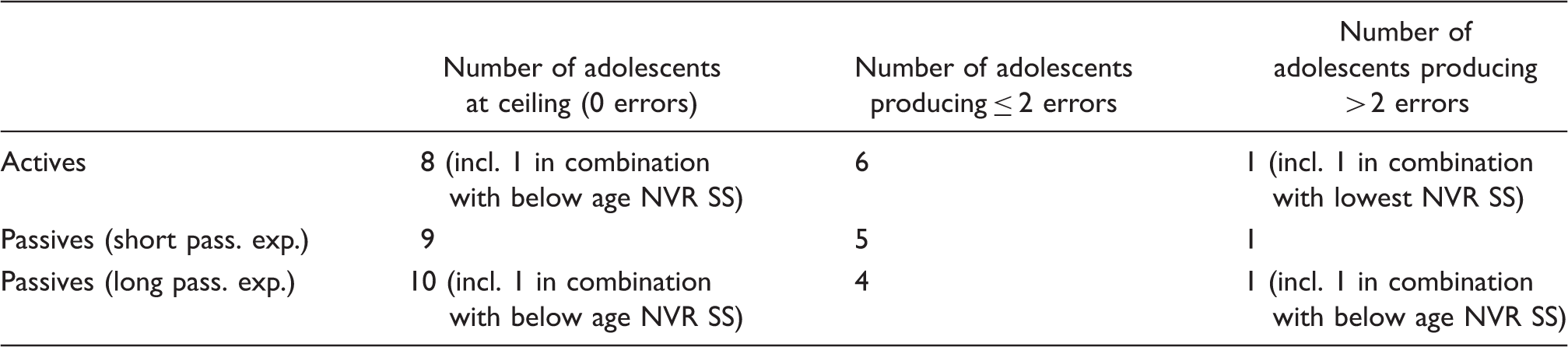
NVR: nonverbal reasoning; SS: scaled scores.
The overall results for the short passive sentences also showed a ceiling effect. A total of nine participants performed 100% correct. Five participants produced one or two errors and one participant produced three errors. In the long passive experiment, a total of 10 participants performed 100% correct, seven of whom had also performed 100% in the short passive experiment. A total of four participants produced one or two errors and one participant produced seven errors. Importantly, the participant with the greatest total number of errors (eight errors with passives and three errors with actives) was the participant with the lowest nonverbal reasoning score. Of these eight passive errors, seven occurred with long passives and one occurred with a short passive, suggesting that the participant faced relatively more persistent problems comprehending long passives compared to short passives. All seven errors in the long passive experiment were Theta-role reversal errors. Theta-role reversal was also the most common error type in the TD group, and was the most frequent error produced by TD 5-year-olds across 11 different languages in the Armon-Lotem et al. (2016) study.
Discussion and conclusion
Our findings show that, overall, passive comprehension is unimpaired in adolescents with ASD. They also show that correct performance on passive comprehension within our ASD group is associated with nonverbal reasoning: passive comprehension was not associated with age, but rather correlated to standard scores of the Matrix Reasoning subtest. Even though the TD controls were matched on nonverbal reasoning scaled scores, no correlation between passive comprehension and nonverbal reasoning was identified. Under closer scrutiny, the correlation disappeared in the ASD group once the participants with below-norm nonverbal reasoning scaled scores were excluded. This shows that the correlation identified in the whole ASD sample was driven by the participants with lower nonverbal reasoning skills. It is important to note that their overall competence in passive comprehension was not low, nevertheless there is a relationship between nonverbal reasoning and passive comprehension among these participants that is not found in TD peers with similar nonverbal reasoning skills. Additionally, more errors of the type substitution were identified for the ASD group compared to the TD group in the active sentences.
We can now discuss how our results compare to previous studies on passive comprehension in individuals with autism (Perovic et al., 2007 on English, Terzi et al., 2014 on Greek, Gavarró & Heshmati, 2014 on Persian). Our results give clear support to the findings of Terzi et al. (2014) and the findings of Gavarró and Heshmati (2014), which investigated younger children with HFA. Together these three studies from typologically different languages (Danish, Greek, and Persian) provide evidence that passive constructions are not problematic per se for individuals with ASD to understand. There are some methodological limitations to this comparison; Terzi et al. (2014) relied on a three-picture selection task and Gavarró and Heshmati (2014) relied on a subset of the items from the Armon-Lotem et al. (2016) experiment, which was the experiment used in our study. Despite these methodological differences, similar error patterns emerged across these three languages, namely Theta-role reversals. However, for the Danish and Persian youths, the errors mainly consisted of reversals involving the same characters, whereas for the Greek children the error patterns included reversals involving same as well as different characters. This may be due to the difference in experimental tasks (specifically related to the kind of distractors used in the Greek three-picture selection task). In all cases, errors were quantitatively marginal, so the results should be interpreted with caution.
At first sight our results seem at odds with those of the English-speaking children with ASD reported by Perovic et al. (2007) who found impaired comprehension of passives. It was hypothesized that the reason for this stems from differences in the participants, since the subjects of Perovic et al.’s experiments exhibited a wide variation, in particular in their nonverbal reasoning abilities (from 40 to 103, mean 67 in the KBIT, which is below the threshold for intellectual disability). Therefore, our findings are not necessarily inconsistent, but rather fall in line with the results from our correlational analysis showing that nonverbal reasoning is associated with successful passive comprehension in ASD. The only study in which both HFA and LFA children were analyzed in two separate groups (albeit with few subjects per group) is the study by Gavarró and Heshmati (2014). The results of that study showed that passives were spared in HFA children, while LFA children failed in passives. The results by Perovic et al. (2007) stem, in our interpretation, from the wide range of non-verbal reasoning skills in their sample.
It is important to stress that verbal passives are construed in essentially the same way across the languages considered here (Danish, Greek, English, and Persian) and therefore the successful performance of participants is indicative of a common ability to process this syntactic structure. Passive structures that may yield differing results (such as earlier acquisition) would include adjectival passives in English or reflexive passives in Greek, which do not involve derived subjects, as discussed earlier. The finding that verbal passives are unimpaired across languages speaks to the robust nature of the acquisition of this syntactic structure when nonverbal reasoning is intact. When nonverbal reasoning is impaired there seems to be a wider heterogeneity in passive comprehension. In our sample, even though participants with below-age nonverbal reasoning performed well, they still lagged behind the ASD participants with nonverbal reasoning within norms; however, nonverbal reasoning in itself did not predict low passive performance on long passives, as shown in our qualitative individual analyses.
Modyanova et al. (2017) found that knowledge of finiteness related to the distinction between Autism Language Impaired (ALI) and Autism Language Normal (ALN), rather than nonverbal IQ. However, the ALI group in their study was characterized as having a low verbal and nonverbal IQ. In our study, the general language competence of our participants was not evaluated, due to lack of standardized tests in Danish. This may be a crucial factor in fully understanding language abilities in participants with ASD, and remains for future research. However, our findings fit within the body of previous literature showing that lower IQ is associated with low language performance (Boucher et al., 2008). A limitation of our study is that our design only included one measure of nonverbal cognition. Further measures of other domains of cognitive functioning such as nonverbal working memory or cognitive flexibility could provide additional knowledge of possible cognitive constraints relating to language delay in adolescents with autism.
In the same vein, due to the relatively high age of our participants, it is not possible to discern whether there is a delay in the acquisition of passives at an earlier age, as seen for general grammatical development in Eigsti et al. (2007). Likewise, we have not evaluated whether psychological passives would be more difficult to comprehend for our population, as only actional passives were tested. Recent work by Durrleman, Delage, Prévost, and Tuller (2017) shows that French-speaking children with ASD do indeed comprehend actional and psychological passives at different rates, unlike what was seen with English-speaking children (Perovic et al., 2007). The fact that actional passives are not homophonous with adjectival passives in Danish would make us expect little (or no) contrast between actional and nonactional passives—but this remains for future research.
To conclude, our study presents results showing ceiling comprehension of long and short passives (as well as actives) in Danish adolescents with ASD. In addition, the participants in our study whose nonverbal reasoning was lower than expected at their age were the only ones with some difficulties in the comprehension of passives. The error pattern of those participants was similar to that of the control group, and so their performance was not deviant. One can therefore conclude that individuals with ASD (with the age and nonverbal reasoning profile in our study) do possess the underlying representations required for comprehending verbal passive constructions. However, correlations between nonverbal reasoning and passive performance among the ASD participants (not present among the TD participants) suggest that lower nonverbal reasoning relates to a reduction in receptive syntax in ASD, though not necessarily reaching the threshold for impairment. This may contribute to best practices in clinical settings as children with ASD who underperform on measures of nonverbal reasoning may benefit from additional receptive language screening. Finally, although our experiments were presented in a context that resembles an everyday setting (looking into a photo album), it remains to be seen whether passive constructions are also intact in more natural language settings such as in discursive language comprehension, in language production as well as in written and reading abilities of children and adolescents with ASD.
Footnotes
Acknowledgements
We would like to thank the special schools for children and adolescents with ASD and the mainstream schools for permitting us to recruit the participants, and most importantly the participants and their parents for taking part in the study. We also thank the master students from the Clinic for Developmental Communication Disorders for assisting with the testing, the Center for Developmental & Applied Psychological Science, Aalborg University, for supporting the data collection. We also thank the anonymous reviewers for their constructive comments.
Declaration of conflicting interests
The author(s) declared no potential conflicts of interest with respect to the research, authorship, and/or publication of this article.
Funding
The author(s) disclosed receipt of the following financial support for the research, authorship, and/or publication of this article: The work was supported by the Danish Agency for Science Technology and Innovation (FKK) through grant 273-07-0495 to the NASUD project led by Kristine Jensen de López for funding of the materials as part of the Cost Action A33. The third author wishes to acknowledge the financial support of projects FFI2014-56968-C4-1-P and FFI2017-87699-P.