




Abstract
Background and aims
Children with autism spectrum condition often have specific difficulties with narrative comprehension, a skill which has a strong association with both concurrent and longitudinal reading comprehension. A better understanding of narrative comprehension skills in autism spectrum condition has the potential to provide insight into potential later reading comprehension difficulties and inform early targeted intervention. In the current study, the main objective was to investigate how differences in the medium of story presentation (paper-book vs. e-book) and differences in story narration (adult narration vs. in-app narration) would influence narrative comprehension in general, and between groups (autism spectrum condition and a receptive language-matched control group). We were also interested in how task engagement (visual attention and communication) differed between group and conditions and whether task engagement was related to narrative comprehension.
Method
Forty-two children with autism spectrum condition and 42 typically developing children were read a story either via a paper-book or an e-book with interactive and multimedia features. The e-book was either narrated by the experimenter (adult narrated iPad condition) or narrated by an in-app voiceover (e-book narrated iPad condition). Children’s behaviour during storybook reading was video recorded and coded for engagement (visual attention and communication). They then completed two measures of narrative comprehension: multiple-choice questions (measuring recall of literal information) and a picture ordering task (measuring global story structure).
Results
Contrary to predictions, we did not find any significant group or condition differences on either measure of narrative comprehension, and both groups demonstrated a similar level of narrative comprehension across the three conditions. We found differences in engagement between conditions for both groups, with greater visual attention in the e-book conditions compared to the paper-book condition. However, visual attention only significantly correlated with narrative comprehension for the typically developing group.
Conclusion
Overall, this study suggests that children with autism spectrum condition are just as able as language-matched peers to comprehend a narrative from storybooks. Presenting a story on an iPad e-book compared to a paper-book does not influence narrative comprehension, nor does adult narration of the story compared to in-app narration. However, on-task engagement is linked to narrative comprehension in typically developing children.
Autism spectrum condition (ASC) is a lifelong condition that affects around 1% of the population, beginning early in development (Lai et al., 2014). It is characterised by diverse symptoms of varying severity, with cognitive impairments and learning difficulties present in over half of individuals (Solomon et al., 2011). Children with ASC often have specific difficulties with narrative comprehension (Diehl et al., 2006), which involves the successful coordination of language knowledge bases and skills, such as vocabulary and the generation of inferences, to make sense of the relations between events in a story and the character’s motivations and responses to those events (Perfetti et al., 2005; Silva & Cain, 2015). Narrative comprehension concerns the understanding of narrative texts as opposed to expository (or informational) texts (Cain, 2010). There is a strong association between narrative comprehension and concurrent and longitudinal reading comprehension scores in typically developing (TD) populations (Cain et al., 2004; Oakhill & Cain, 2012). Given the high incidence of reading comprehension difficulties in children with ASC (Nation et al., 2006) better understanding of their early narrative comprehension skills has the potential to provide insight into these later reading comprehension difficulties and inform early targeted intervention.
Before learning to read, four- to five-year-old TD children demonstrate successful comprehension of basic spoken and pictorial narratives (Trabasso & Nickels, 1992). This skill becomes more advanced with age and continues to develop into adulthood (van den Broek et al., 1996, 2003) with older children acquiring the ability to comprehend more complex narratives as they become sensitive to the underlying causal structure of a narrative – how events within a story causally relate to one another (Lynch et al., 2008; Zwaan et al., 1995). However, children with ASC often do not follow this developmental trajectory, demonstrating poor narrative comprehension into later childhood (Baron‐Cohen et al., 1986; Loveland et al., 1990; Nuske & Bavin, 2011).
Children with ASC can have receptive language difficulties (Manolitsi & Botting, 2011; Weismer et al., 2010), processing biases (Norbury & Bishop, 2002) and attentional difficulties (Noterdaeme et al., 2001) compared to TD children, each of which may contribute to their poor narrative comprehension. Vocabulary knowledge is a key predictor of narrative comprehension (Lepola et al., 2016), explaining up to 8% unique variance in narrative comprehension (Sénéchal et al., 2006). Without understanding the meaning of individual words children cannot extract the overall meaning from a story (Nation et al., 2006).
Aside from receptive language difficulties, weak central coherence, the tendency to prioritise the processing of local detail over the gestalt (Frith, 1989), has been used to explain narrative comprehension difficulties (Diehl et al., 2006). The relevance of weak central coherence to narrative comprehension can be understood in relation to the Construction Integration Model (Kintsch, 1988). Comprehension of text (either narrative or expository) requires the individual to combine information across sentences to create a coherent mental representation of the text (Zwaan, & Radvansky, 1998), typically referred to as a situation model. Creating a coherent situation model requires temporal sequencing of events within the story alongside inference making abilities, such as the integration of text information with the participant’s own knowledge. Children with ASC often demonstrate weak central coherence, potentially impairing comprehension by disrupting the creation of a coherent and integrated mental representation of the narrative (Norbury & Bishop, 2002). This contrasts with TD children, who can utilise both local processing (for individual facts) and global processing (for inference-making) depending on their reading goals (Booth, 2006).
Much research has posited a link between weak central coherence in ASC and narrative comprehension (Norbury & Bishop, 2002; Nuske & Bavin, 2011). Norbury and Bishop (2002) compared the narrative comprehension of children with ASC and TD children for both literal (fact-based) and inferable information from stories. TD children outperformed the ASC group on questions tapping both types of information. Children with ASC demonstrated particular difficulty answering inferential questions, often making inferences that were not relevant to the overall context of the story. Norbury and Bishop theorised that this may be due to individuals with ASC failing to integrate their knowledge with the global context of the story. Moreover, Nuske and Bavin (2011) found that four- to seven-year-old children with ASC had greater difficulties with inferential questions regarding a narrative compared to TD controls. The researchers proposed that, while weak central coherence may lead to difficulty comprehending events within a global context, a tendency towards local processing may lead to an advantage at tasks requiring the participant to recall individual facts out of context, such as non-inferential comprehension questions. Indeed, studies have found that children with ASC often match the performance of their TD peers on fact-based questions (Jolliffe & Baron-Cohen, 2000) while scoring poorly on questions requiring inference-making and sequencing of key events in the story (Baron‐Cohen et al., 1986; Loveland et al., 1990). In the current study, we assessed narrative comprehension with two tasks: questions that tapped story facts and a picture ordering task to assess understanding and memory of global story structure.
Children with ASC often exhibit attention dysfunction (Mayes & Calhoun, 2007) which may contribute to poor narrative comprehension in this population. Attention is here defined as the ability to focus and actively engage with a task, with low distractibility and behavioural problems (Language and Reading Research Consortium (LARRC) et al., 2018; Miller et al., 2014). Comprehension of spoken narratives is found to be impaired in children with low attentional abilities (McInnes et al., 2003). Studies of TD children show that weak attention is associated with weaker reading and listening comprehension (Cain & Bignell, 2014). A recent study by LARRC et al. (2018) found that behavioural attention was a significant predictor of listening comprehension in six- to eight-year-old children. A potential explanation is that individuals with weak attention cannot successfully allocate attention to relevant information (Pennington & Ozonoff, 1996), leading to reduced narrative comprehension in populations with known attentional problems including ASC.
The desire to focus children’s attention and engagement on learning tasks has driven the popularity of tablets such as the iPad in the classroom and home (Kagohara et al., 2013; Neumann, 2018). Presenting information on a screen has been found to help children with ASC to focus attention on relevant stimuli and ignore distractions (Mineo et al., 2009). Studies demonstrate the efficacy of iPad-based learning to promote the learning of key language skills, including expressive language (Xin & Leonard, 2015) and vocabulary knowledge (Ganz et al., 2014). However, such studies have the disadvantage of small sample sizes and do not investigate the efficacy of e-books relative to paper-based alternatives to promote narrative comprehension in this population. Thus, research to date has not demonstrated the extent to which e-books might benefit narrative comprehension in general.
For TD children, the efficacy of e-books as a learning tool is very much in debate. Whilst an e-book may focus attention away from external distractors (Mineo et al., 2009), many e-books are programmed with interactive features that are not related to the central plot line or events in the text. This may explain why interactive games within narrated e-books are correlated to poorer narrative comprehension in TD primary school children, with 43% of time spent playing games rather than listening to the story (De Jong & Bus, 2002). This, and other research, suggests that controlling the interactivity available within storybooks is essential for adequate narrative comprehension (De Jong & Bus, 2002). However, a meta-analysis of over 2000 young children across 43 studies, which compared learning from stories presented via technology and traditional storybooks, demonstrated greater narrative comprehension for stories presented via digital technology (Takacs et al., 2015).
Technology may be used to support and enhance narrative comprehension when used in targeted ways. For example, Takacs et al. (2015) found that multimodal features (the combination of auditory and visual features) were associated with greater learning, potentially through increasing learner engagement and reinforcing key information through different modes of representation. In contrast, interactive features (such as touch-screen exploration and games) were found to significantly reduce learning, potentially distracting the child from key information. When carefully designed to control for extraneous information, presenting learning material on an iPad has the potential to improve the narrative comprehension of children with ASC through highlighting central information through multimodal features (Omar & Bidin, 2015) and maintaining attention through increased engagement with touch-screen media (Mineo et al., 2009).
Shared reading of storybooks, in which an adult narrates the story, has been found to benefit the literacy development of young TD children and children with ASC (McLeod & McDade, 2011; Robbins & Ehri, 1994). Shared reading is considered to support greater learning/comprehension by enabling joint attention and a personalised learning experience compared to solitary learning, thus facilitating greater comprehension and the scaffolding of literacy skills (Hindman et al., 2008; Mucchetti, 2013; Sénéchal & LeFevre, 2002). A common feature of multimodal e-books is the availability of in-app narration of text (Schugar et al., 2013), but the efficacy of replacing adult narration with in-app narration is in debate. Whilst some studies show that computer narration of a story can be as beneficial to narrative comprehension as adult narration, at least for five-year olds (Segers et al., 2004), others propose that adult involvement is critical for maintaining learner attention (Falloon & Khoo, 2014). However, very little research to date compares the influence of adult and in-app narration on narrative comprehension in typical development. In addition, it is possible that in-app narration may complement the preferred learning style of children with ASC, a population that often has low social motivation and a preference for solitary learning experiences (Chevallier et al., 2012). However, no research to date investigates this in ASC. Therefore, whether in-app narration is as successful as adult narration for eliciting narrative comprehension in the context of e-books is an open and essential question for both typical and atypical development (Schugar et al., 2013).
With a controlled multimodal design, e-books have been found to successfully aid the narrative comprehension of young children (Takacs et al., 2015), with e-books widely credited with increasing learner engagement (Moody et al., 2010). It is possible that engagement may be the mechanism through which e-books result in better comprehension in typical development (Richter & Courage, 2017). One claim is that iPads foster more active involvement for young children, rather than passively listening to information in the classroom (Kucirkova et al., 2014). Radesky et al. (2015) found that on-screen presentation increased reading skills in young children and concluded that touch-screen mediums provide real-time feedback and appropriately timed responses which are more engaging and similar to real-life interactions. Indeed, children consistently express a preference towards iPad-based learning compared to paper-based alternatives (Dixon et al., 2015; Kucirkova et al., 2014).
Moody et al. (2010) compared paper-book and e-book mediums of storybook presentation in terms of pre-schooler task engagement (measured through visual attention, persistence and communication). Results showed greater attention and persistence in the e-book condition, however more instances of communication in the paper-book condition. Although attention and persistence (which were greater in the e-book condition) were considered important for learning, the researchers stressed that communication during storybook reading (which was greater in the paper-book condition) was also an important means to support and facilitate comprehension. Roskos et al. (2012) coded the behaviour of 12 pre-schoolers during the shared-reading of an e-book and created a typology for engagement consisting of control behaviours (operating the e-book), multisensory behaviours (such as looking and gesturing) and communication (such as making noises and using language). This engagement coding system was expanded by Richter and Courage (2017), who compared engagement and narrative comprehension between e-books and paper-books in a sample of pre-schoolers. Engagement was measured through visual attention (looking time at the book/screen, adult and off-book/screen), communication (such as labelling and speech relevant to the story), and ‘persistence, enthusiasm and compliance’. Children were then tested on their narrative comprehension. Results showed greater on-task looking time for the e-book compared to the traditional book and higher persistence, enthusiasm and compliance. Low levels of communication were reported across both conditions, which the authors note may be due to the young age of the participants. Despite higher engagement in the e-book condition, storybook comprehension did not differ between conditions. It was concluded that e-books may be beneficial for motivating and engaging learners, although the researchers did not examine the relationship between engagement and learning.
To date, research on narrative comprehension and engagement with e-books has focussed on typical development and has not investigated this in ASC. Neither has it examined the role of an adult facilitator during story reading in this population. Very little research attempts to define engagement into measurable categories (Moody et al., 2010; Richter & Courage, 2017; Roskos et al., 2012), with no research to date examining the relationship between engagement and narrative comprehension. With the increasing popularity of iPads as a learning tool in specialist education (Chmiliar, 2017; Whitehouse et al., 2017), it is crucial to investigate the educational value of e-books in ASC and whether engagement with this medium of presentation benefits learning.
Our main objective was to investigate whether narrative comprehension would differ between the ASC and TD group, and how differences in narrative presentation would influence performance in general, and between groups. Children were read a story from an e-book or a paper-book. The paper-book was narrated by the experimenter, and there were two iPad e-book conditions: one in which the story was narrated by the experimenter (adult narrated iPad condition) and one with in-app narration (e-book narrated iPad condition). Thus, we were able to determine whether the medium of presentation influenced performance on two assessments of narrative comprehension (multiple-choice questions that tapped literal information from the narrative and a picture ordering task that assessed memory of global story structure), and also whether the narrator had an effect. A secondary objective was to examine how engagement with the task (Moody et al., 2010; Richter & Courage, 2017; Roskos et al., 2012) differed by group, presentation and narration medium, and whether this influenced narrative comprehension. As the current study includes children with ASC, who may have varying expressive language abilities, gesture (which was first included by Roskos et al., 2012) was also coded as a non-verbal component of communication.
As children with ASC have difficulties with global information processing (Diehl et al., 2006; Hudrey et al., 2010; Nuske & Bavin, 2011), it was hypothesised that TD children would have greater narrative comprehension than children with ASC on the picture ordering task (requiring the sequencing of temporal information to create a coherent story), but similar scores on the fact-based multiple-choice questions (requiring local information processing) across all conditions. Furthermore, as previous research provides conflicting evidence regarding the efficacy of e-books to enhance narrative comprehension compared to paper-books (Takacs et al., 2015), we anticipated a difference in narrative comprehension between the mediums for both groups, but did not make directional predictions. Moreover, if children with ASC benefit from both adult and computer narration in a similar way to TD children, both groups should show no difference in comprehension when the experimenter narrates the story (paper-book and e-book) compared to when the app narrates the story (Segers et al., 2004). As iPad learning has been found to complement the preferred learning style of children (Highfield & Goodwin, 2013), it was expected that, in line with Richter and Courage (2017), children in both groups will exhibit greater engagement (through increased visual attention and communication) in the e-book conditions compared to the paper-book condition. Finally, due to consistent user-preference towards touch-screen mediums (Dixon et al., 2015) accompanied with the active learning experience provided by e-books (Kucirkova, 2014) we expect greater engagement to be contingent with narrative comprehension.
Method
Participants
Eighty-four participants (19 female) were recruited for this study. There were 42 children with ASC (6 female) whose ages ranged from 6 years 5 months to 12 years 5 months (Mage = 9 years 1 month, SDage = 17.24 months). 1 They were recruited from six schools in North Wales and the north west of England and had been assessed by a qualified psychologist using standardised measures (Autism Diagnostic Observation Schedule, Autism Diagnostic Interview-Revised), subsequently receiving a clinical diagnosis of autism. Teachers’ scores on the current version of the Social Communication Questionnaire further characterised the functioning of our ASC group (Mscore = 18.38; SDscore = 5.60; range = 10–32). 2 iPads/tablets were used in the classroom by 97.20% of children with ASC. Forty-two TD children (13 female) also participated in the study, with ages ranging from 2 years 11 months to 8 years 3 months (Mage = 5 years 10 months, SDage = 22.00 months). They were recruited from one nursery school and two primary schools in the North Wales area and 64.30% used iPads/tablets in the classroom. As shown in Table 1, children with ASC were more frequent users of iPads or touch-screen devices (once a week or more) in school, χ2 (1, N = 78) = 12.90, p < .001.
The percentages (and frequencies) of iPad/tablet use in school/nursery for participants with ASC and TD participants.

ASC: autism spectrum condition; TD: typically developing.
Children with ASC and TD children were matched on a pairwise basis for receptive language and non-verbal IQ (NVIQ; see Table 2) and participants were assigned to conditions based on their receptive language and NVIQ raw scores. Raw scores were used instead of standardised scores as many children with ASC scored too low to fall into an average range of performance for their chronological age (see Table 2 for the standardised scores of remaining participants). The same absolute level of performance on each measure was used to match each child with a control (see Table 3), ensuring that there was a range of abilities in each condition and a non-significant difference in performance between each group. Where score ranges differ between groups, the two lowest and two highest performing children from each group were pairwise matched. Receptive language for all participants was measured using the British Picture Vocabulary Scale-3 (BPVS-3; Dunn & Dunn, 2009). The mean receptive language raw score for the BPVS-3 was 71.67 (range = 24–129) in the ASC group and 79.38 (range = 28–134) in the TD group, a non-significant difference, t(82) = 1.24, p = .22, d = 0.27. Age-equivalent scores cannot be reported here as some children were younger than the lowest age-equivalent of 45 months. However, the standardised scores for those in the TD group over the age of 36 months were all within an age-appropriate (average) range.
The mean (M), standard deviation (SD), range and number (N) of chronological age (in years) and raw and standardised scores of participants for the British Picture Vocabulary Scale 3 (BPVS-3), Raven’s Coloured Progressive Matrices (CPM) and Wechsler Preschool and Primary Scale of Intelligence (WPPSI-3).

ASC: autism spectrum condition; TD: typically developing.
The distribution of age (in months), Gender, British Picture Vocabulary Scale 3 (BPVS-3) Scores, Raven’s Coloured Progressive Matrices (CPM) Scores and Wechsler Preschool and Primary Scale of Intelligence (WPPSI-3) Scores across groups and conditions.

ASC: autism spectrum condition; TD: typically developing.
*Significant differences in age between groups for each of the conditions.
NVIQ was measured using either the Raven’s Coloured Progressive Matrices (CPM; Raven, 2003) or, if the participant found the CPM too difficult and could not complete the assessment, the Block Design task of the Wechsler Preschool and Primary Scale of Intelligence – third edition (WPPSI-3; Wechsler, 2002). Twenty-five children with ASC (59.52%) completed the CPM and 17 children with ASC (41.48%) completed the WPPSI-3. They were matched on a pairwise basis with TD children who completed the same NVIQ assessment. The mean CPM raw score for children with ASC was 22.04 (range = 9–31) and 22.56 for TD children (range = 13–31), a non-significant difference, t(48) = 0.32, p = .75, d = 0.09. The mean WPPSI-3 raw score for children with ASC was 18.94 (range = 6–32) and 16.76 for TD children (range = 6–32), a non-significant difference, t(32) = −0.83, p = .41, d = −0.29. The standardised scores for the TD group were all age-appropriate for both the CPM and WPPSI-3.
Experimental task materials
Storybook/e-book
The storybook ‘Who Stole the Moon?’ by Helen Stratton-Would (2010) was selected to measure narrative comprehension. The story concerns a child’s quest to find the missing moon with the help of nocturnal animals. The story was either presented via the iPad e-book or a printed picture-book version (between-subjects design). The e-book allowed for interactive picture pages (responsive to touch), sound effects and a male voice over narration. There were two conditions involving iPad e-book presentation: experimenter-narrated or e-book-narrated. All of the interactive e-book features were available in both conditions, the only difference being the narration. For both e-book conditions, ‘Who Stole the Moon?’ was downloaded as an application from the Apple App-Store and presented on a 32 G iPad air 2. A third non-interactive paper-book condition was created by taking a screenshot of each individual page. Pages were then printed, laminated and bound single-sided with comb binding to create an A5 book (approximately the same size as the iPad screen).
Comprehension questions
Two tasks were created to assess narrative comprehension: multiple-choice questions and a picture ordering task. Ten multiple-choice questions were created to test the memory of facts from the story. The distribution of correct answers was counterbalanced between three options (two distractor options) and no questions were directly linked to one another. The two distractor options for each question did not reference other facts from the story and were not repeated for different questions. Questions were presented one to a page. Participants could either verbally answer the questions or point to their answer selection. Answers were read out twice, and a third time if participants did not make a selection after 10 seconds. After each question, the experimenter recorded the participant’s answer on paper and moved on to the next question. If a participant did not answer, they were excluded from the task. To check that the target responses were passage-dependent rather than passage independent (Keenan & Betjemann, 2006), a group of 10 children who had not heard the story completed 10 multiple-choice questions. Two of the questions were answered by seven or more children and so were excluded from the analysis. The remaining eight questions were selected by only 0 to 3 children. Thus, the total correct score was calculated out of the eight questions where the target answer was not obviously correct.
The picture ordering task was created to test memory of global story structure (as per Oakhill & Cain, 2012). The task included six A6 laminated images from the story, which were selected to represent three episodes of the story – with two from the beginning, two from the middle and two from the end. The images were presented in a fixed, incorrect order and participants were asked to put the pictures in the order they saw in the story. Up to three verbal prompts of ‘can you put the pictures in order?’ were given if the participant did not make an attempt to order the pictures. If the participant had not made an attempt to order the pictures within 60 seconds they were excluded from the task. As with the multiple-choice questions, a separate group of 10 children who had not heard the story completed the picture ordering task to check that the task was passage-dependent. No picture was placed in its correct position by more than three children (range = 1–3) and so all six pictures were included in the task and a correlational score was calculated comparing the participant’s order to the correct order.
Four children with ASC did not make a response in either comprehension task due to behavioural difficulties and fussiness and so were excluded from the experiment. An additional four children were recruited to maintain a total of 42 children. One child with ASC, after successfully completing the multiple-choice questions, did not attempt the picture ordering task alone due to behavioural difficulties and fussiness and so was excluded from that particular task. All TD children made a response in both comprehension tasks. None of the excluded participants are included in the matching data above or the descriptive statistics of the overall sample.
Procedure
Testing took place individually over two consecutive days. On the first day, participants were administered the receptive language and NVIQ measures. On the second day, participants were taken individually to the testing room, sat adjacent to the experimenter and were told that they were going to hear a story. A Samsung camcorder was positioned on a tripod to record participant engagement throughout the experiment. The participants heard the story read them in one of the three conditions: paper-book, adult narrated iPad or e-book-narrated iPad. The participants were administered the comprehension measures (multiple-choice questions and picture ordering task) immediately after the storybook reading.
As participant engagement was measured in this study, the experimenter followed a strict protocol during the storybook reading to prevent encouraging additional engagement in the task. The experimenter could only redirect the child’s attention towards the story if the child removed themselves from their chair. The experimenter did not engage the child in conversation. If the child attempted to make conversation with the experimenter a short reply was given and the story was continued. The experimenter did not encourage touching the page. Finally, if the child skipped a page, the experimenter would not turn the page back.
Engagement coding
Engagement is here defined as a child’s ability to maintain visual attention throughout the storybook reading and spontaneously communicate about the content of the story (Kaderavek et al., 2014; Moody et al., 2010; Richter & Courage, 2017; Roskos et al., 2012). Engagement categories were adapted from the coding scheme proposed by Richter and Courage (2017; see Table 4). Videos of participants during storybook presentation were analysed for engagement by two independent video-coders. Video coding was split between the two video-coders (half each), with an overlap of 20 videos to check for inter-rater reliability. An intra-class correlational analysis with fixed effects and absolute agreement was conducted between the video-coders for each sub-category separately and all ratings were found to be greater than .98. This represents high agreement according to Cicchetti (1994) where scores on or above .75 are classified as ‘excellent’.
Description and examples of the two engagement categories and their sub-categories.

Results
Storybook comprehension
Scores from the two tasks to assess narrative comprehension were analysed in separate two-way ANOVAs. Group and condition were between-subjects factors. In each analysis, performance on the task was the dependent variable.
Multiple-choice questions
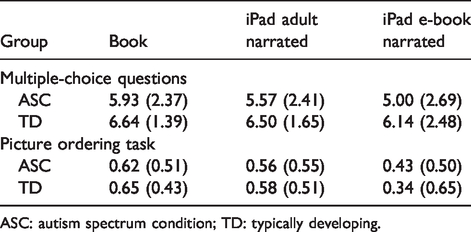
Table 5 shows the scores for each group and condition. Performance was negatively skewed, with participants scoring highly across groups and conditions. Each condition had a score range between 1 and 8, showing that some children obtained a perfect score, with 31.0% of participants with ASC and 40.5% of TD participants achieving a score of 8. The TD group consistently scored higher than the ASC group, with higher scores in the paper-book and adult narrated iPad conditions compared to the e-book-narrated iPad conditions for both groups.
Mean (and standard deviation) of multiple-choice question scores and picture ordering task correlations split by group and condition.
ASC: autism spectrum condition; TD: typically developing.
Despite the TD group obtaining higher scores than the ASC group, the main effect of group did not reach conventional levels of statistical significance, F(1,78) = 3.69, p = .06, η2 = .05. Although scores were highest for the paper-book and adult narrated iPad conditions for both groups, the main effect of condition was not significant F(2,78) = 0.75, p = .48, η2 = .02. The same pattern was found for both groups with the highest scores in the paper-book and adult narrated iPad conditions and lowest scores in the e-book-narrated condition, and the interaction between group and condition was not significant F(2,78) = 0.07, p = .94, η2 = .002.
Picture ordering task
Table 5 shows the correlational scores for each group and condition. Performance was negatively skewed, with participants scoring highly across groups and conditions. The maximum score of 1 was achieved by 34.1% of participants with ASC and 33.3% of TD participants. Both groups had similar performance and the main effect of group was not significant, F(1,77) = 0.01, p = .91, η2 < .001. There were higher scores in the paper-book and adult narrated iPad conditions compared to the e-book-narrated iPad conditions for both groups, but the main effect of condition did not reach significance, F(2,77) = 1.70, p = .19, η2 = .04. No significant interaction was found between groups and conditions, F(2,77) = 0.12, p = .89, η2 = .003.
Participant engagement coding
This section examines participant engagement during the storybook in terms of visual attention and communication (as per Moody et al., 2010; Richter & Courage, 2017; Roskos et al., 2012). Both the adult narrated iPad condition (M = 709.24 seconds) and the e-book narrated iPad condition (M = 696.82 seconds) took longer to read than the paper-book condition (M = 358.09 seconds), a significant difference, F(2,75) = 31.83 p < .001, η2 = .46. Due to the variability in reading time, subsequent analysis of visual attention was conducted on proportional time values.
Visual attention
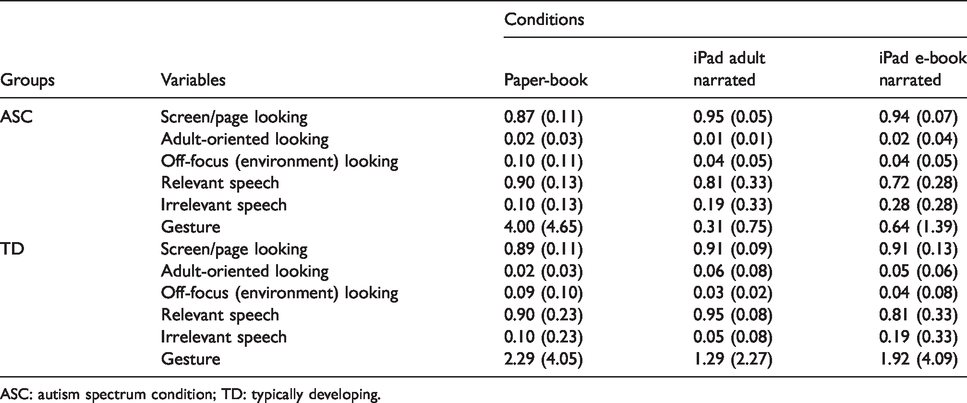
For both groups, the majority of time was spent looking at the screen/page, indicating a high level of engagement in the task (see Table 6 for all visual attention and communication proportions). Children with ASC spent 92.15% of time looking at the screen/page compared to 1.86% looking towards the adult and 5.95% looking off-focus (environment). TD children spent 90.54% of time looking at the screen/page compared to 4.29% looking towards the adult and 5.12% looking off-focus (environment).
Mean (and standard deviation) of visual attention and communication proportions (gestures reported in instances) split by group and condition.
ASC: autism spectrum condition; TD: typically developing.
A two-way ANOVA was used to examine differences in the proportion of time spent looking at the screen/page between group and conditions. The effect of group was not significant, F(1,75) = 0.51 p = .48, η2 = .01. Despite a greater proportion of looking time at the screen/page in the adult narrated iPad condition (M = 0.93) and the e-book narrated iPad condition (M = 0.93) than the paper-book condition (M = 0.88), no significant main effect of condition was found, F(2,75) = 2.28, p = .11, η2 = .06. No significant interaction was found between group and condition, F(2,75) = 0.58, p = .56, η2 = .02.
Off-screen looking was split into adult-oriented looking and off-focus (environment) looking. As these measures are mutually exclusive, only the proportion of off-focus (environment) looking is reported here. Differences in the proportion of time spent looking off-focus (environment) were analysed using a two-way ANOVA with group and condition as factors. No effect of group was found, F(1,75) = 0.30, p = .59, η2 = .004, with a similar proportion of off-focus (environment) looking for both groups. A main effect of condition was found, F(2,75) = 5.60, p = .01, η2 = .13, with a greater proportion of time spent looking off-focus (environment) in the paper-book condition (M = 0.10) compared to the adult narrated iPad condition (M = 0.03) and the e-book narrated iPad condition (M = 0.04). No interaction was found between group and condition, F(2,75) = 0.14, p = .87, η2 = .004.
Communication
Communication is here reported in terms of relevant and irrelevant speech and instances of gesture. No relevant or irrelevant speech was made by 17.5% of participants with ASC and 31.7% of TD participants. For the remaining participants, the majority of speech was task-relevant, indicating a high level of engagement. For children with ASC, 81.73% of speech was task-relevant and 18.27% was task-irrelevant. For the TD children, 88.86% of speech was task-relevant and 11.14% was task-irrelevant. The following sub-sections analyse differences in speech proportions and instances of gesture by group and condition using two-way ANOVAs (see Table 6).
Speech
Speech was split into relevant and irrelevant speech. As these measures are mutually exclusive, only relevant speech is reported here. Despite a slightly larger proportion of relevant speech in the TD group compared to the ASC group, no significant effect of group was found, F(1,75) = 1.39, p = .24, η2 = .03. Children produced more relevant speech in the paper-book and adult narrated iPad conditions compared to the e-book narrated iPad condition, although this effect of condition was not significant, F(2,75) = 1.70, p = .19, η2 = .06. No interaction was found between group and condition, F(2,75) = 0.45, p = .64, η2 = .02.
Gesture
On average, children produced 1.73 instances of gesture during the storybook. No difference in gesture was found between groups, F(1,75) = 0.07, p = .80, η2 = .001, but a main effect of condition was found for gesture, F(2,75) = 4.01, p = .02, η2 = .10. Participants produced more instances of gesture in the paper-book condition (M = 3.14 instances) compared to the adult narrated iPad condition (M = 0.80 instances). No interaction was found between group and condition, F(2,75) = 1.78, p = .18, η2 = .05.
Correlates of narrative comprehension
This section examines whether participant characteristics (BPVS score and chronological age) and participant engagement during the storybook reading (visual attention and communication) are related to comprehension scores on the multiple-choice questions and the picture ordering task for each group. Because there was no significant overall effect of condition in terms of narrative comprehension, here we combine conditions for the analyses. However, as there was a difference between groups (although non-significant) for the multiple-choice questions, we analyse groups separately. All correlations for both groups can be found in Table 7.
Correlations for the ASC (upper diagonal) and TD (lower diagonal) groups for participant characteristics, engagement measures and narrative comprehension performance.

ASC: autism spectrum condition; BPVS: British Picture Vocabulary Scale; TD: typically developing.
*p < .05.
**p < .01.
Participant characteristics
For the ASC group, BPVS scores were strongly positively correlated to performance on both the multiple-choice questions and the picture ordering task, however chronological age was not. Neither BPVS score nor chronological age was correlated with the engagement measures. BPVS scores and chronological age were also not correlated. For the TD group, BPVS score and chronological age were also strongly positively correlated to performance on both the multiple-choice questions and the picture ordering task. BPVS score and chronological age were strongly positively correlated to visual attention towards the page/screen. In contrast to the ASC group, BPVS scores and chronological age were also strongly positively correlated.
Engagement measures
Visual attention
For the ASC group, visual attention measures (proportion of page/screen looking, proportion of adult-looking and proportion of off-focus looking) were not correlated with performance on the comprehension tasks. In contrast, for the TD group, the proportion of page/screen looking time was moderately positively correlated to performance on the multiple-choice questions, and strongly positively correlated to performance on the picture ordering task. The proportion of adult looking was moderately negatively correlated to performance on the picture ordering task alone. Moreover, the proportion of off-focus looking was moderately negatively correlated with performance on both the multiple-choice questions, and the picture ordering task.
Communication
For the ASC group, no correlation was found between communication measures (instances of gesture and relevant speech) and performance on the comprehension tasks. In contrast, for the TD group, instances of gesture were moderately negatively correlated with performance on the picture ordering task alone. No correlation was found between instances of relevant speech and performance on the comprehension tasks.
Discussion
This study investigated how differences in the medium of presentation of a narrative (paper-book vs. e-book), and different forms of narration (adult narration vs. in-app narration) would influence narrative comprehension and task engagement for children with ASC and a TD control group. Contrary to predictions, we did not find any significant group or condition differences on either measure of narrative comprehension; both groups demonstrated a similar level of narrative comprehension across the three conditions. We found differences in visual attention and communication between conditions for both groups, but engagement only significantly correlated with narrative comprehension for the TD group. We discuss these findings in turn.
As expected, we found no significant difference in performance on the multiple-choice questions between groups, despite the TD group scoring approximately 1 point higher across conditions. This is in line with previous research, suggesting that the narrative comprehension of individual story facts is not impaired in ASC (Jolliffe & Baron-Cohen, 2000), potentially due to intact local information processing despite an impairment in global information processing in this population (Nuske & Bavin, 2011). However, contrary to our hypothesis, we also found no significant difference in performance on the picture ordering task between conditions. Our results suggest that children with ASC in this sample do not have a deficit in narrative comprehension on either fact-based or event sequencing tasks compared to TD children.
A possible explanation is that our tasks are not fully tapping into the inference-making abilities of children with ASC, who often exhibit weak central coherence, potentially leading to a failure to create a holistic mental representation of meaning (Norbury & Bishop, 2002). The comprehension tasks used in this study measured both the participant’s knowledge of individual facts from the story (multiple-choice questions) and the memory of the global story structure (picture ordering task), the latter requiring some inference-making ability to allow for the integration of temporal story information to create a coherent narrative (Oakhill & Cain, 2012). While our picture ordering task measured the integration of information across the story, it did not require the integration of text information with the participant’s own knowledge – another key element of inference-making (Cain & Oakhill, 2014; LAARC & Muijselaar, 2008; Tarchi, 2015). Therefore, this task may not sufficiently tap the construct of inferential comprehension. Future research could expand the multiple-choice question task to include both literal questions (as with the current study) and questions that require inference-making to capture a more complete picture of narrative comprehension in ASC.
Contrary to our hypothesis, no difference in narrative comprehension was found between conditions for both groups. The same pattern of performance was found for both narrative comprehension tasks, with higher scores in the paper-book condition, followed by the adult narrated iPad condition and then the e-book narrated iPad condition, however, this did not reach significance. This suggests that the medium of presentation (paper-book vs. e-book) does not influence the narrative comprehension of both groups. One possibility is that our tasks are not sufficiently difficult to capture variability amongst the more-able participants in our sample. Indeed, approximately a third of participants were scoring full marks in the both comprehension tasks. However, it is important to note that although the paper-book did not have a significant advantage in terms of performance, children took half the time to finish the book compared to the e-book conditions and had scored slightly higher on the multiple-choice questions. This suggests that overall time on the story does not benefit performance and a paper-book may elicit the same narrative comprehension as an e-book in a shorter time.
Aside from no comprehension differences between presentation mediums, no difference in performance was found between types of narrations (adult vs. in-app) for both groups. Although children in the adult narrated iPad condition scored slightly higher on both comprehension tasks than those in the e-book narrated iPad condition, this did not reach significance. This finding supports previous research which suggests that computer-based narration can be as successful as adult narration at eliciting narrative comprehension (Segers et al., 2004), and extends this finding to ASC. However, our finding contradicts previous research which suggests that shared-reading is beneficial for narrative comprehension and early literacy more-so than reading alone in typical and atypical development (Boyle et al., 2019; Hindman et al., 2008; Mucchetti, 2013). For example, Boyle et al.’s (2019) meta-analysis of 11 studies investigating the efficacy of shared-reading interventions with children with ASC showed a significant increase in narrative comprehension amongst children with ASC who took part in the shared-reading exercise.
In the current study, although the adult was not narrating the story in the e-book narrated iPad condition (and the experimenter followed a strict protocol to avoid adding any additional guidance or communication) the adult was still present during the experiment for the child to interact with if they chose to. In the e-book narrated condition, 2% and 5% of time was spent looking at the adult for the children with ASC and TD children respectively. This is comparable to the adult narrated iPad condition (ASC = 1%, TD = 6%). Moreover, we found a comparable average of instances of relevant speech (particularly for the ASC group) between the adult narrated iPad condition (ASC = 9.92 instances, TD = 10.57 instances) and the e-book narrated iPad condition (ASC = 9.00 instances, TD = 7.92 instances). These findings demonstrate similar levels of adult interaction regardless of narration. Despite removing the adult narration, the presence of the adult beside the child may be sufficient to create a shared-reading situation, which is beneficial to the narrative comprehension of both typically and atypically developing children (Mucchetti, 2013; Zevenbergen & Whitehurst, 2003). Future research could examine this theory by creating another condition in which the child experiences the e-book narrated iPad condition without the adult sitting beside them during the story, investigating whether the presence of the adult alone is sufficient to create a shared-reading environment.
Consistent with our hypothesis, we found a high level of visual attention across all conditions for both groups, with greater off-focus looking in the paper-book condition compared to the e-book conditions. Our results suggest that children in the e-book conditions were more engaged than those in the paper-book condition, consistent with previous research (Moody et al., 2010; Richter & Courage, 2017) demonstrating that interactive and multimodal features can prevent distraction from external stimuli (Holmes et al., 2012), leading to less looking away from the screen and potentially allowing for synchronisation of narrative information with visual pictorial information (Takacs et al., 2015). However, it is important to note that although greater visual attention was found in the e-book conditions compared to the paper-book condition, most time was spent engaged in the task across all conditions. Moreover, although not proportionally, more time was spent off-focus in the e-book conditions as children spent approximately twice the time to finish the story. As mentioned earlier, this is a potential advantage for the paper-book medium of storybook presentation, allowing for the same level of narrative comprehension with less overall reading time.
We found no significant difference in relevant speech across conditions for both groups. Although this finding contrasts with our hypothesis, that we would observe more instances of communication in the e-book conditions compared to the paper-book condition, it is consistent with Richter and Courage (2017), who also found no difference in communication between presentation media. Our finding suggests that e-books are no more successful at eliciting social communication than paper-books. However, for the ASC group alone we found that instances of relevant speech dropped in the adult narrated iPad condition (M = 9.92) and the e-book narrated iPad condition (M = 9.00) compared to the paper-book condition (M = 13.15). We also found more instances of gesture in the paper-book condition compared to the e-book conditions for both groups. Therefore, it is possible that e-books may not be the optimal method to foster social communication and engagement between the teacher and the learner, a skill that is typically diminished in children with ASC (Wodka et al., 2013), potentially due to the increased cognitive load provided by interactive touch-screen features (Kirkorian, 2018). Another possible explanation for the fewer instances of gesture observed in the e-book conditions is that children may have been occupied manipulating the interactive features on-screen and did not have their hands free to make communicative gestures (Kirkorian, 2018).
As expected, we found that visual attention (page/screen looking time) was positively correlated with performance for the TD group. This suggests that greater on-task engagement is linked to narrative comprehension in typical development. However, contrary to our hypothesis, we found no link between engagement and narrative comprehension in ASC. This suggests that, despite a high level of visual attention across all conditions, on-task engagement does not benefit narrative comprehension for this group.
However, we do not know what children are visually attending to during the task. Although children may demonstrate a high level of visual attention towards the screen/page across all groups, it may be that the groups are focussing on different things. The weak central coherence exhibited by children with ASC may mean that children are not attending to the central plot of the story and are instead visually engaged with miscellaneous interactive features that are not relevant to the narrative (Frith, 1989; Norbury & Bishop, 2002), despite similar comprehension scores to the TD group. The story used in the current study had a mixture of relevant and irrelevant multimodal features and interactivity, which may not have successfully highlighted the essential learning information to children with ASC (Mineo et al, 2009; Omar & Bidin, 2015) while still providing a high level of engagement and interest. This would explain the high overall on-task engagement in the absence of a positive correlation to narrative comprehension. Future research could investigate this by highlighting either relevant or irrelevant information with multimodal and interactive features and examining whether this influences narrative comprehension in ASC. Moreover, eye-tracking could be used to examine which features on the screen/page children are visually attending to during storybook reading and compare those who are attending to central or peripheral information on narrative comprehension score and engagement.
For the both groups, receptive language score was positively related to performance on both comprehension tasks. However, chronological age was only related to performance for the TD group alone. This may be because children with ASC who possess language and cognitive impairments are very distinct from younger TD children and often do not follow the same developmental trajectory, demonstrating different strengths and weaknesses from TD children in areas of language and cognition (Baron-Cohen, 1991; Baron‐Cohen et al., 1986; Loveland et al., 1990; Nuske & Bavin, 2011; Shah & Frith, 1993). For children with ASC, some skills may be age-appropriate, whereas others may be delayed or deviant compared to typical development (Baron-Cohen, 1991). Therefore, it is important to note that young TD children may not be cognitively comparable to older children with ASC.
For the TD group, receptive language score related both positively (screen/page looking) and negatively (adult looking, off-focus looking and gesture) to engagement measures. However, for the ASC group, receptive language score was not related to any engagement measures. A possible explanation for this is that, for the TD group, chronological age related to engagement measures in the same way as receptive language ability, with receptive language ability and chronological age also strongly positively correlated. As receptive language ability was age-appropriate for the TD group, it may be that TD children with greater receptive language ability were older and thus had a greater capacity for sustained attention and inhibition control (Betts et al., 2006; Reck & Hund, 2011). Betts et al. found that sustained attention rapidly increased with chronological age throughout early childhood until the age of 10. Moreover, Reck and Hund found that inhibitory control significantly increased with age, with six-year olds demonstrating greater inhibitory control than three-year olds. For the ASC group, receptive language scores were not age-appropriate and receptive language ability and chronological age were not correlated. This may explain why children with ASC did not demonstrate the same link between receptive language ability and engagement measures.
Limitations
In addition to limitations about question type and task performance discussed above, we also note the limitation of using two different measures of NVIQ in this study (WPPSI Block Design and Raven’s CPM) as some children failed to complete the CPM – a task designed for older children – due to difficulty. However, the Block Design Task may be biased towards proposed processing strengths of children with ASC – an advantage towards local detail processing due to weak central coherence (Shah & Frith, 1993). In contrast, the Raven’s CPM may be biased against this processing style, requiring the participant to create a whole pattern by selecting the correct missing segment (Raven, 2003). Despite this, children with ASC were pairwise matched with TD children, minimising this influence. Future research may work with a different ability range to ensure the same test can be used with all the participants.
Moreover, the sample of children with ASC used in the current study had poorer receptive vocabulary and NVIQ scores compared to previous research investigating narrative comprehension in this population (Diehl et al., 2006; Norbury & Bishop, 2002; Nuske & Bavin, 2011). Norbury and Bishop (2002) used participants with ASC who scored within standardised norms on the BPVS and Raven’s CPM, in contrast to the current study in which many children with ASC scored too low to calculate a standardised score. Moreover, Diehl et al. (2006) only included participants who had a NVIQ greater than 80 and Nuske and Bavin (2011) included participants with ASC who scored approximately 9 points higher on the Block Design Task of the WPPSI-3 compared to the current study. Therefore, this suggests that the current sample of participants with ASC have a different receptive vocabulary and NVIQ profile to previous studies and consequently the results of this study cannot be directly compared.
Conclusion
Overall, this study suggests that children with ASC are just as able as language-matched peers to comprehend a narrative from a storybook. Presenting a story on an iPad e-book compared to a paper-book does not influence narrative comprehension, nor does adult narration of the story compared to in-app narration. Children learn just as well from paper-books in half the time it takes for them to finish the same story on an e-book, potentially providing an advantage for paper-based mediums. Consistent with previous research, both groups exhibit greater visual attention when viewing an e-book compared to a paper-book (Moody et al., 2010; Richter & Courage, 2017), with visual attention related to narrative comprehension for the TD group alone. No difference in relevant speech was found between conditions for both groups, potentially due to the increased cognitive load provided by interactive touch-screen features (Kirkorian, 2018). Taken together, our findings suggest that e-books may be more successful than paper-based mediums at encouraging visual attention towards the story, but no better at eliciting narrative comprehension and communication.
Footnotes
Ethical approval
All procedures performed in studies involving human participants were in accordance with the ethical standards of the institutional research committee (Lancaster University Faculty of Science and Technology Ethics Comittee, reference number: FST16071) and with the 1964 Helsinki declaration and its later amendments or comparable ethical standards.
Declaration of conflicting interests
The author(s) declared no potential conflicts of interest with respect to the research, authorship, and/or publication of this article.
Funding
The author(s) disclosed receipt of the following financial support for the research, authorship, and/or publication of this article: This study is funded by the Leverhulme Trust Doctoral Scholarship Programme in Interdisciplinary Research on Infant Development.
Informed consent
Informed consent was obtained from all parents of participants included in the study and all children assented.
