




Abstract
Background and Aims
Children with autism spectrum disorder (ASD) without intellectual disability often face challenges in understanding written text. However, considerable variability in this area underscores the need to examine their reading profiles and the factors influencing the development of reading comprehension (RC). This study investigates the RC of upper elementary school children with ASD compared to typically developing (TD) peers and explores the role of broader linguistic abilities in RC, with a specific focus on pragmatic competence (e.g., figurative language comprehension). Nonlinguistic factors such as age and nonverbal cognitive capacity are also considered. A secondary aim is to assess the potential heterogeneity in RC and linguistic abilities within the ASD sample.
Methods
In total, 35 children with ASD and 35 TD controls (mean age = 10.7 years, SD = 0.97) were matched for age, gender, and nonverbal cognitive ability using Raven's Colored Progressive Matrices. Both groups completed assessments of RC, structural language skills (receptive vocabulary and morphosyntax), and figurative language competence. To evaluate variability, the ASD group was divided into two subgroups based on RC performance.
Results
Participants with ASD scored significantly lower than their TD peers in RC, morphosyntactic skills, and figurative language comprehension, but no significant differences were observed in receptive vocabulary. For children with ASD, chronological age, nonverbal cognitive ability, and receptive vocabulary accounted for significant variance in RC. In contrast, RC in TD children was predicted by morphosyntactic ability and figurative competence. Furthermore, the substantial heterogeneity within the ASD group was evident, highlighting their variability across the range of examined variables.
Conclusions and Implications
The findings indicate that children with ASD as a group experience notable difficulties in text comprehension and language processing at the morphosyntactic and pragmatic levels, despite achieving receptive vocabulary and nonverbal cognitive scores comparable to those of their TD peers. The two groups appear to employ distinct strategies for deriving meaning from text. The pronounced variability in RC and linguistic abilities among ASD participants underscores the complexity of their reading and language profiles, highlighting the importance of tailored educational assessments and interventions, which are further discussed.
Introduction
Reading comprehension (RC), defined as the capacity to derive both literal and implicit meaning from written texts, is essential for academic success and broader socioemotional, cognitive, and professional development (Lervåg et al., 2018; van den Broek & Kendeou, 2022). It is characterized by its multifaceted and complex nature, requiring the simultaneous coordination of diverse cognitive, linguistic, and pragmatic abilities (Castles et al., 2018; Kim, 2020; Nation, 2019; Tunmer & Hoover, 2019). Difficulties or impairments in this domain markedly increase the risk of academic failure or underachievement. This is evident across the full spectrum of children with special educational needs, including those with autism spectrum disorder (ASD; Davidson, 2021).
RC is closely tied to language skills and is crucial for cognitive development and academic success, particularly for children with ASD who face linguistic and literacy challenges. Studies emphasize the variability of RC among children and adolescents with ASD (e.g., McIntyre, Solari, Grimm, et al., 2017). While some perform on par with their typically developing (TD) peers, others face significant challenges in grasping textual meaning (e.g., Sorenson Duncan et al., 2021). Moreover, their developmental trajectories as regards processing linguistic information, especially at the semantic and morphosyntactic levels follows similar pattern (e.g., Sukenik & Friedmann, 2018 Tager-Flusberg, 2015). There is broad agreement among researchers that pragmatic language abilities of children with ASD often differ from those of neurotypical peers (e.g., Andreou et al., 2022; Reindal et al., 2023). Still, these differences are not uniform across all areas of pragmatics (i.e., figurative language comprehension) or consistent among all individuals with ASD (e.g., Schaeffer et al., 2023). Additional empirical evidence from diverse language systems is needed to identify strengths and weaknesses in language abilities (e.g., Tuller et al., 2017) and to explore how various linguistic domains interact in individuals with ASD (e.g., Sukenik & Tuller, 2023).
This approach could provide deeper insights into the relationship between linguistic and reading profiles, as well as the role of core language skills, such as vocabulary and morphosyntax, in RC performance of children with ASD. Furthermore, while pragmatics shares a bidirectional relationship with RC (e.g., Troia, 2021), the link between RC and figurative language comprehension in individuals with ASD remains underexplored (e.g., Sorenson Duncan et al., 2021).
Theoretical Framework of RC Development
Several models seek to explain the processes underlying the complex task of RC. The simple view of reading (Gough & Tunmer, 1986; Hoover & Gough, 1990) posits that RC relates to two fundamental components that is, word reading and listening (or linguistic) comprehension. Word reading entails accurate and fluent decoding of words, while listening comprehension relies on core language components (phonology, semantics, syntax) and pragmatic skills (inference ability and background knowledge; Cognitive Foundations Framework, Tunmer & Hoover, 2019).
Efficient RC is further shaped by syntactic and discourse capacities (Triangle Model Extended, Bishop & Snowling, 2004) and the depth and precision of word knowledge (lexical quality hypothesis, Perfetti, 2007). Word knowledge and morphosyntax interact with linguistic and higher-order cognitive systems to help readers construct a coherent mental representation of text (reading systems framework model; Perfetti & Stafura, 2014). Advanced cognitive functions, such as reasoning, may also influence RC indirectly by enhancing word reading and listening comprehension (direct and indirect effects model of reading; Kim, 2020).
Word-level and linguistic comprehension skills are both essential for successful text comprehension, and deficits in either or both can lead to RC difficulties (e.g., Snowling & Hulme, 2021). Developmentally, younger children's RC relies heavily on decoding skills, but as they age—particularly between 8 and 10 years—the link between RC and language comprehension strengthens, with structural language abilities like vocabulary and grammar playing a more prominent role (e.g., Foorman et al., 2018; García & Cain, 2014; Verhoeven & van Leeuwe, 2008). This pattern is especially pronounced in languages with transparent orthographic systems (e.g., Swart et al., 2017).
Vocabulary knowledge and morphosyntactic abilities exert a profound influence on the RC process, serving as robust concurrent and longitudinal predictors of RC among TD readers (e.g., Deacon & Kieffer, 2018; Language and Reading Research Consortium [LARRC] & Chiu, 2018; Lervåg et al., 2018; Poulsen & Gravgaard, 2016; Quinn et al., 2020).
Figurative competence—the ability to interpret and use figurative language expressions like idioms and proverbs—may strongly correlate with RC, as it involves inferring meaning beyond literal interpretations (e.g., Castles et al., 2018; Vulchanova et al., 2019). The global elaboration model (Levorato & Cacciari, 1992) conceptualizes the development of figurative competence as a gradual, multifaceted process that unfolds in parallel with comprehension abilities. It suggests that understanding figurative language relies on metacognitive and higher-order language skills, which are also essential for RC. For instance, both skills demand integration information from immediate and broader linguistic contexts. During early childhood (ages 4–8), figurative language is primarily interpreted in a literal sense. By ages 9–10, children start to grasp nonliteral meanings by relying on contextual cues. As they approach preadolescence (ages 11–12) and beyond, their understanding becomes more refined, allowing for a more advanced interpretation of figurative expressions (e.g., Levorato et al., 2004; Nippold et al., 2001).
However, the developmental aspects reported above pertain to typical trajectories. The extent to which atypical patterns, such as those observed in individuals with ASD, follow a similar or markedly different course remains a subject of further investigation.
RC and Linguistic Profiles of Children with ASD
Research indicates that 38%–73% of children with ASD experience RC difficulties compared to their TD peers (Brown et al., 2013; Davidson et al., 2018; McIntyre, Solari, Gonzales, et al., 2017; Ricketts et al., 2013; Solari et al., 2019; Sorenson Duncan et al., 2021). Their RC profile often mirrors that of “poor comprehenders,” characterized by deficits in linguistic comprehension despite strong word recognition skills (Chen et al., 2019; Fernandes et al., 2015; Henderson et al., 2014; Vale et al., 2022).
Recent studies have revealed more diverse and specialized reading profiles among children with ASD. For instance, Solari et al. (2019) analyzed data from 64 English-speaking children and adolescents with ASD aged 8–16 and identified four categories: (1) typical readers performing within the average range in word reading and comprehension (18%); (2) individuals with comprehension deficits despite adequate word reading skills (24%); (3) those with poor performance in both word reading and comprehension but average receptive vocabulary scores (23.6%); and (4) participants with low performance in word reading, comprehension, and structural language skills (receptive vocabulary and grammar; 34.3%).
Davidson’s review (2021) identifies five primary RC profiles in children and adolescents with ASD. These profiles range from skilled (typical) readers, who constitute a minority, to poor comprehenders, further subdivided into two categories. The first category, discrepant poor comprehenders, includes those with adequate word reading skills but lower comprehension abilities, which may still fall within age-appropriate levels. The second, below-average poor comprehenders, comprises individuals with average word reading skills but significantly reduced comprehension. Davidson also describes readers with a mixed-deficit profile, performing one standard deviation below average in both decoding and comprehension, and a severe mixed-deficit profile, scoring 1.5 or more standard deviations below average in these areas. Furthermore, a study of Greek-speaking school-aged children with ASD found that approximately 32% of them with a normal cognitive profile continue to experience moderate to severe RC deficits (Peristeri et al., 2024).
Core language skills, particularly vocabulary and morphosyntax, are strong predictors of RC in children with ASD (e.g., Davidson et al., 2018; Lucas & Norbury, 2014; McIntyre et al., 2018; Ricketts, 2011; Sorenson Duncan et al., 2021). Semantic abilities, such as receptive vocabulary during the preschool years, explain a substantial proportion of the variance in RC observed during third grade for English-speaking children with ASD (Paynter et al., 2024). Meta-analytic reviews corroborate these findings, showing that receptive vocabulary alone accounts for up to 57% of the variance in RC among children with ASD (Brown et al., 2013). Sorenson Duncan et al. (2021), analyzing data from 26 studies, found significant correlations between vocabulary, morphosyntactic skills, and pragmatic abilities with RC outcomes in children and adolescents with ASD (aged 6–18 years).
Beyond linguistic abilities, RC in ASD is linked to cognitive functioning and higher-order mechanisms like theory of mind, central coherence, and executive functions (Kimhi et al., 2024). Theory of mind difficulties can hinder inference making and understanding implied meanings (e.g., McIntyre et al., 2018), whereas weak central coherence may cause a focus on local details over global meaning, impairing context integration (e.g., Davidson & Ellis Weismer, 2017; Norbury & Nation, 2011). Additionally, executive function deficits, including working memory, planning, and mental flexibility, can further impact RC performance in ASD (e.g., Davidson et al., 2018; Kimhi et al., 2014; May et al., 2015). However, linguistic skills, especially structural language abilities, are generally found to be more strongly tied to RC profiles in children with ASD than cognitive mechanisms (Wang et al., 2023).
Structural Language Skills in ASD
Children with ASD are at a heightened risk of experiencing language impairments (e.g., Baird & Norbury, 2016; Friedman & Sterling, 2019; Wittke et al., 2017), though extensive research underscores significant variability, particularly in structural language abilities (e.g., Loucas et al., 2008; Silleresi et al., 2020). A recent study examined the linguistic profiles of 40 Greek-speaking children with ASD and intact cognitive capacity (ages 6–12) in comparison to 28 children with developmental language disorder (DLD) and 35 TD peers (Georgiou & Spanoudis, 2021). The results revealed that children with ASD with co-occurring language deficits and those with DLD scored significantly lower on core language measures than both TD peers and children with ASD without language impairments. However, pragmatic language difficulties were consistently observed in the ASD group, regardless of their language status, when compared to the TD sample.
Lexical knowledge appears to be a relative strength for some children with ASD, occasionally operating independently of other linguistic domains (e.g., Brynskov et al., 2017; Kwok et al., 2015; Schaeffer et al., 2023). Findings in this area remain inconsistent. A recent review highlighted an equal distribution of studies reporting outcomes ranging from impaired to intact lexical–semantic abilities in children and adolescents with ASD (6–18 years). Notably, this variability cannot be attributed solely to factors such as age, cognitive functioning, task type, or linguistic level (Sukenik & Tuller, 2023). Furthermore, children with ASD identified as “poor readers” or “poor comprehenders” demonstrate significantly lower performance in receptive vocabulary compared to skilled readers with the same condition (Åsberg Johnels et al., 2019). These findings highlight the complex interplay between structural language abilities and RC profiles of individuals with ASD.
Morphosyntactic abilities also show considerable variability among children with ASD aged between 6 and 14. While some exhibit skills comparable to their TD peers (e.g., Novogrodsky & Edelson, 2015; Walenski et al., 2014), others encounter significant challenges in processing morphosyntactic structures of varying complexity (e.g., Brynskov et al., 2017; Meir & Novogrodsky, 2020; Silleresi et al., 2020; Wittke et al., 2017). Despite these differences, empirical evidence consistently demonstrates that both lexical knowledge and syntactic skills are strong predictors of RC in children with ASD (e.g., Jacobs & Richdale, 2013; Sorenson Duncan et al., 2021).
Pragmatic and Figurative Language Skills in ASD
Pragmatic language is widely recognized as one of the most severely impaired linguistic dimensions across the autistic spectrum (e.g., Baixauli-Fortea et al., 2017; Levinson et al., 2020). School-aged children with ASD (6–12 years old) develop pragmatic and figurative language skills at a slower rate than their TD peers (e.g., Chahboun et al., 2016; Whyte & Nelson, 2015). They often struggle to accurately interpret conventional forms of figurative language, including metaphors, idioms, and proverbs (e.g., Morsanyi et al., 2020; Morsanyi & Stamenković, 2021).
Research on the figurative competence of children with ASD has largely centered on metaphors (Lampri et al., 2024). Moreover, the extent and underlying causes of pragmatic language deficits in ASD remain a topic of debate. In some cases, school-aged children with ASD (6–12 years) effectively comprehend figurative language, particularly when vocabulary and grammar skills are intact (e.g., Kalandadze et al., 2018; Norbury, 2004; Whyte et al., 2014). However, persistent challenges are frequently observed, even among those with well-developed structural language and RC skills (e.g., Chahboun et al., 2016; Saban-Bezalel & Mashal, 2019). Studies investigating the relationship between pragmatic language skills and RC in children with ASD have yielded conflicting findings. Jacobs and Richdale (2013) found no significant correlation between pragmatic skills and RC in school-aged (6–8 years old) English-speaking children with ASD without intellectual disabilities. Conversely, McIntyre et al. (2020) reported that pragmatic competence, particularly the ability to infer meaning and explain idioms, was significantly associated with RC in English-speaking participants with ASD aged 8–16 years.
Figurative language is shaped not only by universal cognitive mechanisms but also by language-specific factors and culturally embedded conventions. The prevalent reliance on English-speaking samples in ASD research concerning figurative language development introduces a significant risk of linguistic and cultural bias (Kalandadze et al., 2018). Within this context, and considering both the conflicting findings on figurative competence, and the considerable heterogeneity of RC and linguistic profiles within the ASD population, the present study aims to explore this issue further, employing a Greek-speaking sample. Additionally, it sheds light on the underlying factors that may account for individual differences in aspects of oral and written language among children with ASD.
Current Study
This study examined the linguistic and reading profiles of upper-elementary children with ASD. Specifically, it explores their RC skills in relation to key linguistic factors, including receptive vocabulary, morphology–syntax, and pragmatic abilities. A comparison group of TD peers is included to establish age-appropriate benchmarks. The study also considers the influence of nonlinguistic variables such as chronological age and nonverbal cognitive ability, providing a comprehensive view of factors impacting RC. Given the substantial heterogeneity in RC, linguistic skills and cognitive abilities reported in the literature among participants with ASD, subgrouping children based on RC performance allows for a more nuanced analysis of within-group differences, rather than treating ASD as a single, homogeneous profile.
The aim of the present study is twofold:
To examine the relationship between RC, linguistic factors, and figurative language proficiency in children with ASD. Specifically, this involves: (a) comparing children with ASD to TD peers in terms of RC, receptive vocabulary, morphosyntactic abilities, and figurative language proficiency and (b) determining the extent to which specific language skills—namely receptive vocabulary, morphosyntax, and figurative language—contribute to RC in both groups while controlling for chronological age and nonverbal cognitive ability. To investigate the variability in RC and language abilities within the ASD group. This objective focuses on analyzing how potential differences in RC performance among children with ASD are reflected in their figurative language proficiency and what is the overall linguistic profile of these children. To accomplish this, two subgroups within the ASD group were formed based on RC performance and each subgroup's structural and figurative language abilities were examined separately.
It has been hypothesized that, if children with ASD demonstrate significantly lower performance in RC compared to TD controls, this disparity will be accompanied by notable differences in the underlying linguistic mechanisms supporting RC. A potential divergence in RC and linguistic performance will be associated with a distinct set of predictors driving RC in the ASD group. Besides, if the inspection of means and standard deviations within the ASD group reveals a subset of participants whose performance scores of RC and subsequent variables approximate that of TD peers, this pattern is likely to extend to pragmatic abilities.
This approach provides a clearer understanding of the diverse cognitive–linguistic characteristics within the ASD population. Additionally, in light of the bidirectional relationship between RC and figurative competence (e.g., Troia, 2021), understanding how individuals with ASD process figurative language could reveal important aspects of their overall cognitive and linguistic profiles.
This investigation can inform researchers and practitioners on how mechanisms underlying language processing in ASD differ within the spectrum and across groups. The findings of this study carry significant implications for both diagnostic assessments and intervention strategies. A more refined classification of RC profiles in ASD can inform the development of tailored, evidence-based educational and therapeutic approaches, ultimately supporting more effective language and reading interventions for children on the spectrum.
Method
Participants
In the present study, a total of 70 native Greek participants were included, comprising 35 individuals with ASD and 35 TD peers. The sample consisted of 58 boys (82.9%) and 12 girls (17.1%), with an average age of 10.7 years (SD = 0.97). Each group included 29 boys and six girls. Participants were matched for chronological age, gender, and nonverbal cognitive ability, assessed using Raven's Colored Progressive Matrices test (RCPM; scores ≥ 85; see Table 1). Among the 70 participants, 20 (28.6%) were in fourth grade (16 boys and four girls; average age 9.9 years, SD = 0.49), 20 (28.6%) were in fifth grade (16 boys and four girls; average age 10.7 years, SD = 0.50), and 30 (42.9%) were in sixth grade (26 boys and four girls; average age 11.7 years, SD = 0.48).
Comparisons of ASD and ΤD Samples in the Examined Variables.

ASD: autism spectrum disorder; TD: typical development; max.: maximum variable value.
Nonverbal reasoning ability was measured by Raven's Colored Progressive Matrices test (RCPM).
Following the criterion of one standard deviation above and below the mean of the TD group in RC measurement, two ASD subgroups have been identified: the ASD high-achievement subgroup (ASD-HA subgroup; n = 17; 15 boys, 88.2% and 2 girls, 11.8%), scoring ≥ 11 on the RC task, and the ASD low-achievement subgroup (ASD-LA subgroup; n = 15; 13 boys, 80% and three girls, 20%), scoring ≤ 9 on the RC task. Three participants with an RC score of 10 were not exploited statistically in order to have clear-cut criterion on the formation of the two subgroups. Subsequently, the RC and linguistic profiles of participants within the two ASD subgroups were examined.
All participants were recruited from public primary schools in large rural cities (Athens and Heraklion, Greece). Most children with ASD received special education support within the classroom, learning language and reading alongside their TD peers. Some were additionally assisted by special education teachers in integration classes (separate classrooms within general education schools) for up to 15 h per week while engaging with the same grade-level materials.
Participants with ASD had been formally diagnosed by authorized state services. None of the participants exhibited comorbidity with intellectual disability (intellectual developmental disorder), attention deficit/hyperactivity disorder, or other neurological or sensory disorders.
Materials
Reading Comprehension
RC was assessed using the Test-A RC subscale (Padeliadu & Antoniou, 2008). Test-A is a standardized battery specifically developed to identify children with difficulties in literacy development. It has been constructed in Greek language and standardized for populations aged 8–15 years. The two texts of graded difficulty (one narrative and one expository, 250 words each), suitable for primary school children, were administered. After reading each text either silently or aloud, participants responded to seven multiple-choice (MC) questions per text, each offering four alternative answer options. The examiner read the questions and answers aloud, and the children indicated their chosen response. The MC questions assessed the participants’ ability to derive meaning at both literal and inferential levels, drawing upon contextual cues and prior knowledge. Specifically, three items evaluated literal comprehension (e.g., “Which poet did Alexander the Great admire?”), three assessed inferential reasoning (e.g., “Choose an appropriate title for the text”), and one targeted vocabulary knowledge (e.g., “What does ‘hound dog’ mean?”). Children's responses were scored as either 0 for wrong answers or 1 for correct answers, with the total score reflecting the number of correct responses. Cronbach's alpha for the present sample was α = .71.
Vocabulary
Receptive vocabulary knowledge was assessed using the English version of Peabody Picture Vocabulary Test (Dunn & Dunn, 2007), which is a reliable and valid instrument for assessing vocabulary breadth across a wide age range (2 years 6 months through 90 years and older). In this study, the tasks for children 9–12 years old were used, consisting of 36 items, during which the examiner orally presents a target word, and the participant selects the picture from four options that best matches the word's meaning. Children's responses were scored as either 0 for wrong answers or 1 for correct answers and the total number of correct responses was the raw score. Cronbach's alpha for the present sample was α = .83.
Morphosyntactic Knowledge
To measure morphosyntactic ability, a MC test was administered, developed after conducting a pilot study. Specifically, a larger pool of items was administered to a group of TD children (n = 48) of similar age and from a similar geographical location as those in the current study. This process aimed to establish discriminant validity of the items and to identify and exclude those that displayed ceiling or floor effects. In its final form, the test consisted of 20 items (Cronbach's α = .76), covering morphosyntactic phenomena prescribed by the Curriculum of Modern Greek Language for primary school grades third to sixth (e.g., subordinate clauses, passive voice, morphosyntactic markers of verbs, nouns, and adjectives, adjective–noun conjunctions). For each item, four possible answers were presented (e.g., “Try to always do __________ pleases you”: (a) as much as, (b) whatever, (c) that, (d) when). Children's responses were scored 0 (incorrect), 1 (correct), and raw scores presented the total number of correct responses. Cronbach's alpha for the present sample was α = .80.
Figurative Language Comprehension
Figurative competence was measured using a MC test developed following a pilot study, in line with the procedure described above for the construction of the morphosyntactic ability test. To distill initial pool of idioms, exploratory factor analysis with varimax rotation was conducted to identify expressions with higher factor loadings and stronger alignment with the experimental task. The analysis revealed that 23 out of 45 idioms loaded onto a single factor, explaining 74.24% of the total variance, Kaiser-Meyer-Olkin = .91; Bartlett's test of Sphericity = χ²(286) = 4097.33, p < .001. In its final version, the test was composed of 23 idioms (α = .75) and 15 proverbs (α = .87; for the 38 items, α = .86), retrieved from primary school textbook sources. All figurative language expressions were presented out of context, and for each expression, four alternative answers were provided (e.g., “The apple doesn’t fall far from the tree”: (a) Children often resemble their parents, (b) Children should eat healthily, (c) The fruits should be gathered before winter comes, (d) The apple doesn't fall away from the tree). Each correct response was awarded one point, while incorrect answers received zero, resulting in a total score based on the number of correct answers. Cronbach's alpha for the present sample was α = .93.
Nonverbal Cognitive Ability
To evaluate nonverbal reasoning ability, the RCPM test, standardized in Greek by Sideridis et al. (2015), was used, assessing analogical reasoning and abstract thinking through visual stimuli. It consists of three sets—A, AB, and B—that progressively increase in difficulty. Each set contains 12 items, resulting in a total of 36 tasks. For each item, participants are presented with six possible options and are required to select the one that correctly completes a given pattern. Participants’ responses were scored as either 0 for wrong answers or 1 for correct answers and the raw score was the total number of correct answers. Cronbach's alpha for the present sample was α = .85.
Procedure
The research was conducted following approval from the Institute of Educational Policy (Φ15/118216/176668/Δ1) and parental permission. Data collection was individually carried out by the first author. Participants were assessed individually in a separate, quiet room within the schools’ setting, and tests’ administration time did not exceed two teaching hours. There was no time limit for the tasks used in the present study. Tasks measuring morphosyntactic ability and figurative language comprehension were presented orally by the examiner in order to avoid comprehension problems. Moreover, all participants were informed that the process was anonymous, and they retained the right to discontinue and withdraw from the research at any time.
Data Analysis
Data were processed using raw scores for all key variables. Statistical significance was set at p < .05. To evaluate the magnitude of group differences, effect sizes were reported. For t test comparisons, Cohen's d was used (small = 0.2, medium = 0.5, large = 0.8), while partial eta-squared was used for between-group comparisons in analysis of variance (small > .01, medium > .06, large > .14; Cohen, 1988).
For objective 1, to assess between ASD and TD group differences in examined variables, independent samples t tests were conducted. Next, to examine the contribution of linguistic abilities on RC, multiple regression analyses with two steps were performed separately for each group, controlling for nonlinguistic variables, to identify potential similarities or differences in key predictors between the two samples. Furthermore, for objective 2, to explore heterogeneity within the ASD group in RC and language skills, one-way analysis of variance analyses were conducted with Bonferroni corrections applied for multiple comparisons between the three groups (i.e., ASD-HA subgroup, ASD-LA subgroup, and TD controls). In addition, to illustrate the linkages between RC and competence in figurative language a scatter plot was generated, depicting the spread of scores for ASD. All statistical analyses were conducted using IBM SPSS Statistics 26.
Results
To assess objective 1a, four independent samples t tests were conducted (see Table 2). Statistically significant differences were observed between the two groups in tasks measuring RC (p < .001), morphology–syntax (p = .001), and figurative language (p < .001), indicating lower performance among children with ASD. However, no statistically significant differences were found between the two groups in receptive vocabulary (p = .07).
Comparisons of ASD and ΤD Groups in the Examined Variables.

ASD: autism spectrum disorder; TD: typical development; max.: maximum variable value.
Reading comprehension was measured by Test-A.
Receptive vocabulary was measured by Peabody Picture Vocabulary Test.
Morphology–syntax was measured by Morphosyntactic Ability test.
Figurative language was measured by Figurative Language Comprehension test.
Prediction of RC for Participants with ASD and ΤD
Furthermore, to investigate objective 1b, two separate multiple regressions were conducted. For each regression model, chronological age and RCPM scores were entered first. Scores from the three linguistic measures followed (see Table 3).
Multiple Regression Analyses Predicting ASD and TD Children's RC.

ASD: autism spectrum disorder; TD: typical development.
Nonverbal reasoning ability was measured by Raven's Colored Progressive Matrices test (RCPM).
Receptive vocabulary was measured by Peabody Picture Vocabulary Test.
Morphology–syntax was measured by morphosyntactic ability test.
Figurative language was measured by Figurative Language Comprehension test.
*p < .05; **p < .01; ***p < .001.
Regarding the ASD group, nonlinguistic independent variables made a significant contribution to the model, explaining 49.4% of the variance in RC, F(2, 32) = 15.64, p < .001. The three linguistic variables (receptive vocabulary, morphology–syntax, and figurative language) accounted for an additional 15.9% of the variance in RC, and this increase in R² was statistically significant, F(5, 29) = 10.95, p = .011. The findings indicate that RC was positively predicted by age (β = .31, p = .014), nonverbal reasoning ability (β = .36, p = .018), and receptive vocabulary (β = .35, p = .019).
Regarding the TD group, in Step 1, nonlinguistic independent variables explained 24% of the variance in RC, F(2, 32) = 5, p = .013, with RCPM being the only significant predictor (β = .45, p = .013).
The three linguistic variables (receptive vocabulary, morphology–syntax, and figurative language) accounted for an additional 41.1% of the variance in RC, and this increase was statistically significant, F(5, 29) = 10.7, p < .001. The findings indicate that RC was predicted by morphosyntactic ability (β = .53, p = .004) and figurative language (β = .43, p = .023).
To investigate objective 2, a scatter plot graphically representing scores of ASD sample in RC and figurative language comprehension was created, highlighting the relationship between these two variables. Notably, figurative competence was the greatest source of variability within the ASD group.
The scatterplot in Figure 1 shows RC performance in relation to figurative competence illustrating the variability within the ASD sample.

Grouped Scatter Plot for ASD Sample—Reading Comprehension by Figurative Language Comprehension.
The ASD-HA subgroup is classified within the upper quadrant. This subgroup scored between 11 and 14 in RC task (L = 3; maximum variable value = 14), with a median and mode of 12. In figurative language task, scores ranged from 13 to 34 (L = 21; maximum variable value = 38), with a median of 25 and a mode of 22. Receptive vocabulary scores spanned from 27 to 36 (L = 9; maximum variable value = 36), with both the median and mode at 34. Morphology–syntax scores spanned from 3 to 18 (L = 15; maximum variable value = 20), with a median of 15 and a mode of 17. Finally, nonverbal cognitive ability scores ranged from 24 to 36 (L = 12; maximum variable value = 36), with a median of 34 and a mode of 32.
Conversely, the ASD-LA subgroup was situated in the lower quadrant. This subgroup scored between 5 and 9 in RC task (L = 4; maximum variable value = 14), with a median and mode of 8. In figurative language task, scores ranged from 2 to 29 (L = 27; maximum variable value = 38), with a median of 12 and a mode of 9. Receptive vocabulary scores spanned from 17 to 36 (L = 19; maximum variable value = 36), with a median of 29 and a mode of 22. Morphology–syntax scores spanned from 5 to 16 (L = 11; maximum variable value = 20), with a median of 8 and a mode of 7. Finally, nonverbal cognitive ability scores ranged from 22 to 36 (L = 14; maximum variable value = 36), with a median of 26 and a mode of 25.
Subsequently, the two subgroups with ASD have been compared with each other and with the TD controls across the full ranges of variables examined (see Table 4). Due to unequal samples’ sizes, the Welch's F test was used. Post hoc tests revealed no statistically significant differences between TD group and ASD-HA in all examined variables except figurative language proficiency (p = .026). On the contrary, statistically significant differences were observed between the TD group and the ASD-LA group in RC and all linguistic variables, except for chronological age and nonverbal cognitive ability.
Comparisons of ASD-HA and ASD-LA, and Both Subgroups with ASD and TD Controls in the Examined Variables.
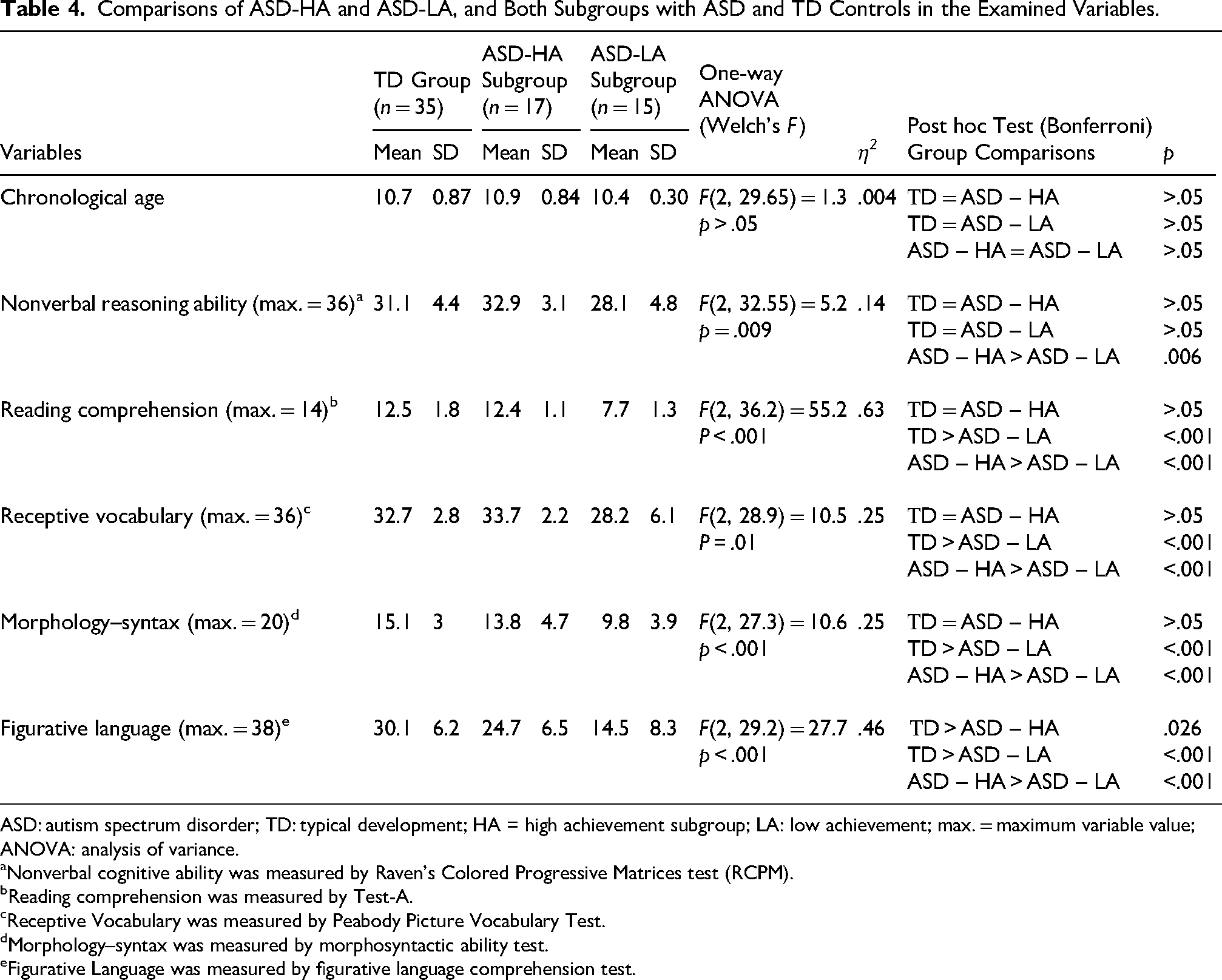
ASD: autism spectrum disorder; TD: typical development; HA = high achievement subgroup; LA: low achievement; max. = maximum variable value; ANOVA: analysis of variance.
Nonverbal cognitive ability was measured by Raven's Colored Progressive Matrices test (RCPM).
Reading comprehension was measured by Test-A.
Receptive Vocabulary was measured by Peabody Picture Vocabulary Test.
Morphology–syntax was measured by morphosyntactic ability test.
Figurative Language was measured by figurative language comprehension test.
Post hoc tests between the two subgroups of ASD revealed that the ASD-HA subgroup significantly outperformed the ASD-LA subgroup across all the examined variables excluding chronological age.
Discussion
The present study aimed to examine RC of 9–12-year-old children with ASD (without intellectual disability) in comparison to TD peers. It focused on linguistic factors such as receptive vocabulary, morphology–syntax, and figurative competence while also considering non-linguistic variables, including chronological age and nonverbal cognitive ability. Additional purpose was to test the hypothesis of heterogeneity within the ASD sample concerning RC and broader language competencies.
The results showed that, compared to TD controls, children with ASD performed markedly lower in RC indicating that they struggle to achieve age-appropriate competence in complex and demanding academic tasks, such as extracting meaning from written texts (e.g., Brown et al., 2013; Davidson, 2021; Johnels et al., 2021; Liu et al., 2023; McIntyre, Solari, Grimm, et al., 2017; Norbury & Nation, 2011; Sorenson Duncan et al., 2021). However, age was found to be a significant predictor of RC performance in the ASD group, indicating that RC skills improve with increasing age. The findings imply that, while children with ASD exhibit gradual gains in RC skills during upper elementary years, their progress remains slower relative to their TD peers. Despite matching the two groups on nonverbal cognitive ability, it was a strong predictor of RC performance for the ASD group.
The strong relationship between cognitive ability and RC can be explained by the intrinsic cognitive load theory (Sweller, 1994), which suggests that the connection between cognitive processes, such as nonverbal reasoning, and academic achievement becomes more evident in complex tasks like RC. Nonverbal reasoning likely underpins key comprehension mechanisms, such as inference making, analogy identification, and the integration of prior knowledge (e.g., Peng, Fuchs et al., 2019a; Ribeiro et al., 2016). Thus, its inclusion in a reading model is well justified.
The significant contribution of nonverbal cognitive ability on ASD participants RC status is in accordance with the theoretical framework of the direct and indirect effects model of reading (Kim, 2016, 2020), which posits both direct and indirect pathways between RC and higher-order cognitive functions such as relational reasoning. This association is further corroborated by the meta-analysis conducted by Wang et al. (2023), demonstrating that cognitive abilities of children and adolescents with ASD are strongly correlated with RC, probably compensating for their language deficits. To explore this assumption, two hierarchical multiple regression analyses were conducted (see Appendix, Table A1, for further details about these analyses). After controlling for chronological age and linguistic skills, nonverbal cognitive ability accounted for an additional 7.4% of the variance in RC, maintaining its predictive significance in RC. This effect was not observed in the TD group. Therefore, it can be speculated that ASD children of the present study may employ cognitive mechanisms during RC process to overcome their morphosyntactic and pragmatic language difficulties, which can influence their overall RC performance (e.g., Jacobs & Richdale, 2013; Lucas & Norbury, 2015; Sorenson Duncan et al., 2021).
Children with ASD demonstrated receptive vocabulary skills comparable to their TD peers, indicating that certain linguistic domains remain relatively unaffected, particularly among participants with mild autism and average or above-average cognitive abilities (e.g., Tager-Flusberg, 2015; Tek et al., 2008). Therefore, difficulties in RC appear to persist not only in the presence of intact cognitive functioning but potentially alongside preserved semantic linguistic skills as well (Solari et al., 2019). However, although children with ASD exhibit semantic proficiency comparable to TD controls, they may struggle to extend this knowledge in more complex reading tasks. RC requires a constellation of advanced skills beyond lexical knowledge, including integration of context-based information, inference making, and interpretation of implied meanings, such as figurative language (e.g., Castles et al., 2018; Oakhill & Cain, 2012). These higher-order processes may impose demands that cannot be adequately supported by receptive vocabulary alone. However, these results should be interpreted cautiously given the large standard deviation in receptive vocabulary scores indicating considerable variability in vocabulary breadth among ASD participants.
Notably, receptive vocabulary emerged as a significant predictor in children with ASD, implying that those with stronger vocabulary breadth may be better equipped to compensate for other cognitive challenges in reading. Vocabulary serves as a cornerstone for textual comprehension, sharing a direct or reciprocal relationship with RC development (e.g., Castles et al., 2018; Oakhill et al., 2015; Quinn et al., 2015; Quinn et al., 2020). Empirical evidence across various developmental stages consistently shows a strong link between RC and receptive vocabulary in children with ASD, with vocabulary's predictive power surpassing that of morphology and syntax (e.g., Brown et al., 2013; Davidson et al., 2018; Lucas & Norbury, 2014).
Conversely, for the TD sample, morphosyntactic ability and figurative competence uniquely and positively explain a significant proportion of the variance in RC. Consequently, TD children seem to be in a developmental stage, where fundamental and high-order linguistic skills become essential for effectively comprehending the meaning of texts. These results align with RC models, such as the triangle model extended (Bishop & Snowling, 2004), which emphasize the synergy of pragmatic rules and structural language abilities like syntax for accurately interpreting the content of sentences and passages.
Within the reading systems framework (Perfetti & Stafura, 2014), morphosyntactic knowledge is crucial for RC, as understanding text requires not only decoding the meanings of individual words but also realizing how they are organized into coherent sentences. Familiarity with morphosyntactic rules enables readers to identify semantic relationships among words, comprehend the overall textual meaning, and construct a cohesive representation of the text by establishing connections between the ideas presented across its sentences (e.g., MacKay et al., 2021; Zheng et al., 2023). This relationship has been empirically supported by studies (e.g., Brimo et al., 2018; Gottardo et al., 2018; LARRC & Logan, 2017; Poulsen & Gravgaard, 2016).
Similarly, the influence of figurative competence on RC in the TD group supports the global elaboration model (Levorato & Cacciari, 1992) , which posits that figurative language comprehension draws on analogous cognitive processes involved in broader language understanding. This establishes a bidirectional relationship between figurative competence and RC, both of which depend on higher-order skills, including context-based meaning retrieval, managing polysemy, suppressing irrelevant information, and monitoring comprehension (e.g., Levorato et al., 2004; Nippold, 2006; Troia, 2021). The results are in agreement with studies demonstrating a connection between figurative competence and RC in TD children (e.g., Cain et al., 2009; Levorato et al., 2004; Nippold et al., 2001).
In contrast to their semantic competence, participants with ASD scored significantly lower than TD peers on the task assessing morphosyntactic ability. Research on morphosyntactic capacity in ASD has yielded mixed results, with much of the focus on English-speaking children (see Al-Hassan & Marinis, 2021 for an overview). Furthermore, many prior investigations into morphosyntax in alphabetic languages involving participants with ASD have predominantly focused on a single grammatical domain or assessed only a narrow range of structures (e.g., Durrleman et al., 2017; Durrleman & Delage, 2016; Janke & Perovic, 2015; Prévost et al., 2018; Terzi et al., 2014; Terzi et al., 2016). This focus complicates the identification of broader patterns of strengths and weaknesses.
In the present study, a task was utilized to assess a variety of both simple and more complex morphosyntactic phenomena (i.e., possessive case, subject–verb agreement, noun–adjective agreement, subordinate clauses, passive voice, direct and indirect object, pronouns, prepositions, etc.). Ultimately, consistent with previous studies (e.g., Abd El-Raziq et al., 2024; Meir & Novogrodsky, 2020; Sukenik & Friedmann, 2018), the findings indicate that the ASD sample encounters difficulties in effectively processing and comprehending diverse morphosyntactic structures, which differ in terms of complexity.
As regards pragmatic ability, significant differences were observed between ASD and TD participants, with the former demonstrating notably reduced performance. Specifically, children with ASD scored approximately 1.5 standard deviations below their TD peers on a task assessing figurative language comprehension, suggesting a slower pace of figurative competence development compared to TD controls. A developmental delay in figurative language acquisition among elementary-aged children with ASD, particularly those without intellectual disability, has been well documented (e.g., Chahboun et al., 2017; Whyte & Nelson, 2015). However, the need for longitudinal studies remains pressing to clarify the developmental pathways of figurative competence in ASD. Considering the limited research on certain aspects of figurative language in ASD, such as idioms and proverbs (Lampri et al., 2024), our findings underscore the significant difficulties ASD students face in accurately interpreting these nonliteral constructs (e.g., Kalandadze et al., 2018; Morsanyi & Stamenković, 2021; Whyte et al., 2014). These difficulties may be related to the nature of nonliteral expressions. For example, children with ASD often find proverbs more challenging than idiomatic expressions (Chahboun et al., 2016), as proverbs demand more advanced cognitive and comprehension skills (Nippold, 2006).
Moreover, the ASD-HA subgroup (48.6% of the ASD sample) demonstrates a RC and linguistic/cognitive profile similar to that of their TD peers. Specifically, their performance on tasks measuring RC, receptive vocabulary, morphology–syntax, and nonverbal cognitive ability is comparable to that of TD participants, underscoring robustness of text comprehension and core language and cognitive skills. Regarding figurative language proficiency, the data trend indicates that their performance is approaching typical levels, suggesting they are on the verge of bridging the gap. However, targeted support could enable them to realize their full potential more quickly.
On the other hand, the ASD-LA subgroup (42.8% of the ASD sample) demonstrates RC and linguistic/cognitive marked deficits compared to both TD peers and the ASD-HA subgroup. These discrepancies were particularly evident in their ability to understand figurative language, where the gap from typical developmental limits was substantially wider, highlighting more pronounced challenges faced by the former in grasping nonliteral language.
Our results align with those of Georgiou and Spanoudis (2021), who identified two distinct subgroups among elementary school-aged Greek-speaking children with ASD: one demonstrating typical language development and another exhibiting significant language impairments similar to that of children with DLD. The present study confirmed their results, indicating the complexity of language development in this group and by adding a RC measurement, provided insights into the contribution of broader language abilities on RC outcomes for children with ASD.
Interestingly, significant differences were found between the two ASD subgroups on RCPM test, with the ASD-LA subgroup performing lower than the ASD-HA subgroup. When combined with the observed contribution of nonverbal cognitive ability to RC in the ASD sample, these findings imply a potential bidirectional interaction between nonverbal reasoning and RC abilities. According to mutualism theory (van der Maas et al., 2006), cognitive skills, such as nonverbal cognitive functioning, and academic performance, including RC, exert reciprocal influences on one another, with their interconnections strengthening progressively over time. Previous research in both typical and atypical populations supports this theory (e.g., Peng, Wang et al., 2019b). However, persistent language difficulties have the potential to affect not only RC skills but also nonverbal cognitive capacity (Botting, 2005).
The scatter diagram showed that performance scores of RC and figurative language were distributed along a continuum of mild to severe difficulties. However, there was considerable variability both between and within ASD groups in the examined factors, underscoring heterogeneity a characteristic of children with ASD across multiple domains (Masi et al., 2017). Although figurative language comprehension emerged as a common challenge for both ASD subgroups, the severity of impairments varied significantly among participants, emphasizing that distinct aspects of language can be differentially affected in children at risk for language impairments (Schaeffer et al., 2023).
Limitations and Future Research
This study provides insights into RC and linguistic abilities in children with ASD; yet, several limitations should be noted. The sample was relatively small and included only children without intellectual disability, which limits the generalizability of the findings to the broader ASD population, particularly those with co-occurring cognitive impairments. Moreover, assessment of word-level skills, crucial for a comprehensive understanding of RC achievement, should be considered. Although both narrative and expository texts were used in the RC task, genre-specific effects were not explored, which could be a subject of further research. Future work should examine larger and more diverse ASD samples and incorporate longitudinal designs to examine how broader linguistic and cognitive factors influence RC development over time. Further investigation into instructional strategies tailored to the heterogeneous profiles observed in readers with ASD could also enhance educational interventions.
Conclusions and Implications
While TD children predominantly rely on core and higher-order linguistic skills for text comprehension, children with ASD draw on a combination of semantic and analogical reasoning abilities to derive textual meaning.
Specifically, the present results underscore the need for a multifactorial and interdisciplinary approach to understanding reading profiles of children with ASD, one that incorporates multiple dimensions of language comprehension while considering cognitive abilities in relation to age (e.g., Davidson, 2021; Paynter et al., 2016). In this context, a comprehensive evaluation should consider not only semantic but also morphosyntactic and pragmatic skills, as intact vocabulary knowledge and nonverbal cognitive ability may obscure underlying difficulties in RC, grammar, and pragmatic language among children with ASD. Additionally, tasks assessing figurative language comprehension, such as idioms and proverbs, could become valuable supplementary tools for diagnosis.
The present findings offer valuable insights for designing tailored educational assessments, interventions, and instructional strategies for children with ASD. Given the diversity of reading and language profiles within this population, an individualized approach is crucial, addressing both specific RC abilities and the broader spectrum of language strengths and weaknesses.
These interventions should prioritize the enhancement of foundational linguistic and cognitive competencies, with particular emphasis on vocabulary growth and analogical reasoning, alongside targeted strategies to bolster morphosyntactic and figurative competence. By cultivating these multifaceted skills, educators can facilitate the bridging of the gap between explicit and inferred meanings in textual material, thereby augmenting the child's capacity to comprehend and interpret both overt and implicit content across various levels of linguistic complexity.
Footnotes

Ethical Approval and Informed Consent Statements
The study was approved as a Ph.D., by the Hellenic Institute of Educational Policy of the Greek Ministry of Education (Φ15/118216/176668/Δ1) on October 22, 2018. All participants provided written informed consent prior to participating.
Funding
The author(s) disclosed receipt of the following financial support for the research, authorship, and/or publication of this article: This work was supported by the State Scholarships Foundation of Greece (grant number: 2017–050–0504–9917).
Declaration of Conflicting Interests
The authors declared no potential conflicts of interest with respect to the research, authorship, and/or publication of this article.
Appendix
Hierarchical Multiple Regression Analyses Predicting ASD and TD Children's RC.

| ASD Group (n = 35) | TD Group (n = 35) | |||||||||
|---|---|---|---|---|---|---|---|---|---|---|
| Independent Variables | ΔR2 | Β | SE B | t | β | ΔR2 | Β | SE B | t | β |
| Step 1 | .089 | .064 | ||||||||
| Chronological age | .72 | .40 | 1.8 | .30 | .52 | .34 | 1.6 | .25 | ||
| Step 2 | .491*** | .580*** | ||||||||
| Chronological age | .75 | .32 | 2.4 | .31* | −.35 | .26 | −1.3 | −.17 | ||
| Receptive vocabulary | .23 | .08 | 3 | .44** | .04 | .09 | 0.52 | .07 | ||
| Morphology–syntax | −.04 | .09 | −0.44 | −.08 | .29 | .09 | 3.1 | .49** | ||
| Figurative language | .11 | .05 | 2.5 | .40* | .12 | .05 | 2.3 | .41* | ||
| Step 3 | .074* | .006* | ||||||||
| Chronological age | .76 | .30 | 2.6 | .31* | −.34 | .26 | −1.3 | −.17 | ||
| Receptive vocabulary | .18 | .07 | 2.5 | .35* | .05 | .09 | 0.61 | .08 | ||
| Morphology–syntax | −.08 | .09 | −0.90 | −.14 | .31 | .10 | 3.1 | .53** | ||
| Figurative language | .08 | .04 | 1.8 | .29 | .12 | .05 | 2.4 | .43* | ||
| Nonverbal reasoning ability | .20 | .08 | 2.5 | .36* | −.04 | .06 | −0.70 | −.10 | ||
| Total R2 | .654* | .651 | ||||||||
ASD: autism spectrum disorder; TD: typical development; RC: reading comprehension.
Nonverbal reasoning ability was measured by Raven's Colored Progressive Matrices test.
Receptive vocabulary was measured by Peabody Picture Vocabulary Test.
Morphology–syntax was measured by morphosyntactic ability test.
Figurative language was measured by Figurative Language Comprehension test.
*p < .05; **p < .01; ***p < .001.