




Abstract
Background and aims
Phonological processing skills measured by nonword repetition, are consistently found to be hampered in children with severe/profound hearing impairment and cochlear implants, compared to children with normal hearing. Many studies also find that grammar is affected. There are no studies exploring grammar in the Swedish population of children with cochlear implants. Documentation is also sparse regarding if and how language development in children with cochlear implants at the group level has changed over time with for example earlier implantation. The aim of the present study is to explore nonword repetition, grammatical production and sentence comprehension in an older generation of Swedish children with cochlear implants implanted during the 1990s and in a younger generation implanted after 2004. We also wanted to find out if and how nonword repetition is associated with grammatical production and comprehension in the two generations, taking the role of speech perception into consideration.
Methods
Thirteen adolescents with severe/profound hearing impairment and unilateral cochlear implants, aged 11;9 to 19;1 at the time of testing (age at implant 2;5 to 11;11) and 16 children with severe/profound hearing impairment and cochlear implants, aged 5;3 to 8;0 (age at implant 0;7 to 5;6, ten bilateral) participated. All participants used oral communication. They were tested with nonword repetition and sentence comprehension tasks. Language samples for grammatical analysis were collected during a referential communication task. Transcriptions were analysed with respect to mean length of utterance and grammatical accuracy.
Results
The two groups performed similar to each other and to reference data from much younger children with normal hearing and language development on nonword repetition. Both groups showed problems in grammatical accuracy. The majority of grammatical errors involved grammatical morphemes. All participants in the older group had significant problems with sentence comprehension, whereas variation was large in the younger group, some children performing at age level. In both groups, nonword repetition was associated with grammatical accuracy and in the younger group also with sentence comprehension.
Conclusions
Phonological processing skills are significantly hampered in children with cochlear implants, with consequences for language processing and development. Their grammatical problems involve the use of grammatical morphemes, similar to what is found for hearing children with specific language impairment. In spite of early implantation, the results from the younger group indicate that this is still a group at risk for problems with language learning.
Implications
Careful follow-up and support of language development in children with cochlear implants is crucial to identify children, whose problems are persistent. It is important for speech-language pathologists to take the interdependency of speech perception, phonological processing skills and other language skills into account.
Introduction
Much has changed since cochlear implants (CIs) were introduced for children with severe/profound hearing impairment (SPHI) more than 25 years ago (1991 in Sweden). The implants are technically more sophisticated, children receive bilateral implants, age at implant is lower and less variable, oral language is most often the main communication mode, the majority of these children attend mainstream schools and the support offered to parents is more informed. Much of this is the consequence of considerable research efforts, where one of the main aims has been to identify factors that can explain or predict language, learning and communication. Furthermore, the population with CI is larger, parents and individuals with CI have longer experience with the device, which facilitates the sharing of experiences and access to role models. It is, however, important to remember that in spite of all the advances made, the auditory input that the children receive is still degraded, since the CI(s) cannot restore hearing capacity to normal levels (Nittrouer, Caldwell-Tarr, Sansom, Twersky, & Lowenstein, 2014; Svirsky, Robbins, Kirk, Pisoni, & Miyamoto, 2000). This is true for both earlier and later generations. A common finding in studies of different aspects of language skills in children with CIs is that within group variation is large and that it is impossible to identify a single factor that can explain the whole range of this variation (e.g. Casserly & Pisoni, 2013; Geers, Moog, Biedenstein, Brenner, & Hayes, 2009; Peterson, Pisoni, & Miyamoto, 2010; Schorr, Roth, & Fox, 2008; Young & Killen, 2002). However, there is consensus that age at implantation has a significant impact on cognitive and linguistic outcome (e.g. Nicholas & Geers, 2007; Schorr et al., 2008; Sharma & Glick, 2016; Tobey et al., 2012). Due to the dynamic functioning of the brain, areas intended for processing of auditory stimuli are taken over by other sensory functions (for example vision) in early hearing loss. With earlier sensory restoration with a CI, these reorganization processes may be interrupted (Kral, Kronenberger, Pisoni, & O’Donoghue, 2016; Sharma & Glick, 2016).
In this paper, we explore the consequences that an SPHI and hearing with CI(s) can have on phonological processing as assessed with nonword repetition (NwRep), and on grammatical production and comprehension skills. We also investigate the associations between grammatical skills, NwRep and speech perception. In order to also take into account the importance of different background factors for language development (e.g. age at implantation, uni- versus bilateral implants), we included participants from an earlier, older generation and a later, younger generation of children with SPHI and CIs.
Nonword repetition
The ability to repeat novel words, as measured by NwRep tasks, has been shown to be significantly associated with language skills. Nonword repetition is a complex measure tapping phonological processing skills, for example, phonological working memory (Gathercole, 2006a, 2006b). In studies of young children with typical language development, this measure has been identified as a predictor of later lexical as well as grammatical development (Adams & Gathercole, 2000; Baddeley, Gathercole, & Papagano, 1998). Phonological processing skills like phonological WM are important for the establishment of phonological representations, which are linked to lexical/semantic representations in long term memory. The more precise the phonological representations (i.e. words) in long-term memory are, the easier new phonological forms can be processed, which facilitates learning new words and word forms. Thus the dependency relationship between phonological processing skills and other language skills is bidirectional (Chiat, 2006; Gathercole, Willis, Emslie, & Baddeley, 1992).
Nonword repetition has been found to present significant problems for hearing children with specific language impairment (SLI) and is considered a clinical marker of SLI (Bishop, North, & Donlan, 1996; Botting & Conti-Ramsden, 2001; Gathercole & Baddeley, 1990). Nonword repetition skills have also been found to be particularly hampered in children with CI, compared to children with normal hearing and typical language development (e.g. Carter, Dillon, & Pisoni, 2002; Dillon, Burkholder, Cleary, & Pisoni, 2004; Dillon, Pisoni, Cleary, & Carter, 2004; Ibertsson, Willstedt-Svensson, Radeborg, & Sahlén, 2008; Ingvalson & Wong, 2013; Nittrouer, Caldwell-Tarr, et al., 2014; Willstedt-Svensson, Löfqvist, Almqvist, & Sahlén, 2004). In children with CI, associations have also been found between NwRep skills and lexical and grammatical skills (e.g. Nittrouer, Caldwell-Tarr, et al., 2014; Willstedt-Svensson et al., 2004). Difficulties with NwRep may be indicative of imprecise phonological representations leading to difficulties in processing and temporary storage of linguistic information. That is, imprecise phonological representations have negative consequences for the ability to create lexical/grammatical representations from spoken language input (Casserly & Pisoni, 2013; DeCaro, Peelle, Grossman, & Wingfield, 2016).
Grammatical skills
Grammatical skills require both stable phonological and stable semantic/lexical representations (Adams & Gathercole, 2000; Baddeley et al., 1998). According to the constructivist view of language, grammatical development is dependent on lexical development to the extent that a critical mass of words in the lexicon (which in turn is associated with phonological processing skills) is a prerequisite for grammatical development (Locke, 1997; Marchman & Bates, 1994; Tomasello, 2003). A large amount of studies on different languages have found difficulties with grammar regarding both production and comprehension in children with CI. These studies are either based on data from formal assessment (e.g. Boons et al., 2013; Coene, Govaerts, Rooryck, & Daemers, 2010; Geers et al., 2009; Nittrouer, Sansom, Low, Rice, & Caldwell-Tarr, 2014; Schorr et al., 2008; Spencer, 2004; Svirsky, Stallings, Lento, Ying, & Leonard, 2002; Szagun, 2001; Willstedt-Svensson et al., 2004; Young & Killen, 2002) or on language sample analyses (e.g. Coene et al., 2010; Guo, Spencer, & Tomblin, 2013; Nittrouer, Sansom, et al., 2014; Szagun, 2004). The results of these studies indicate that children with CI show difficulties which are similar to what has been found for children with SLI, that is, difficulties with bound grammatical morphemes like tense-markers (e.g. Guo et al., 2013; Nittrouer, Sansom, et al., 2014; Svirsky et al., 2002) and free grammatical morphemes like articles, conjunctions and pronouns (e.g. Coene et al., 2010; Nittrouer, Sansom, et al., 2014; Svirsky et al., 2002; Szagun, 2004). Interestingly, cross-linguistic research on children with SLI has shown that the type of grammatical difficulties seen in this group varies depending on the structure of the target language (e.g. Leonard, 2014a). This has contributed to the theoretical basis of this field and points to the importance of studying different languages. Examining how problems are manifested in different languages will help us understand the nature of the problems at a more general level. Therefore we investigate grammatical skills in Swedish-speaking children and adolescents with CI. We use speech sample data from a semi-structured communication task. We found that this type of data is also useful for the analysis of structural grammatical aspects of language, since it is a task that is efficient for eliciting spoken data that may be compared across participants.
Sentence comprehension
Finally, we include a formal assessment of sentence comprehension. Sentence comprehension as measured by a structured task included in speech pathology practice, is a complex linguistic skill, dependent on all the earlier mentioned skills, that is phonological processing, lexicon and grammar, which has also been found to be hampered in children with CI (e.g. Conway, Deocampo, Walk, Anaya, & Pisoni, 2014; Geers et al., 2009; Schorr et al., 2008; Spencer, 2004; Young & Killen, 2002). Importantly, problems in sentence comprehension have been found to be associated with more severe language impairment and to be a better predictor of long-term outcome than expressive skills (e.g. Bishop & Edmundson, 1987; Bruce, Kornfält, Radeborg, Hansson, & Nettelbladt, 2003; Bruce & Sahlén, 1996). Language comprehension, typically assessed with sentence comprehension tests is also an important prerequisite for literacy development, i.e. reading comprehension (Hagtvet, 2003; Sahlén, Hansson, Ibertsson, & Reuterskiöld-Wagner, 2004). As suggested above, problems with comprehension may be due to difficulties to create lexical/grammatical representations as a consequence of imprecise phonological representations. This task, like the NwRep task, is also highly dependent on on-line speech perception, i.e. the added effect of weak representations and difficulties to perceive the input in the test situation due to imperfect hearing acuity.
Factors related to outcome
Although age at implant has been shown to be one important factor for outcome in children with CI in some studies (e.g. Nicholas & Geers, 2007; Schorr et al., 2008; Tobey et al., 2012), others are less conclusive (e.g. Dunn et al., 2013; Geers, Nicholas, Tobey, & Davidson, 2016). Furthermore, documentation is sparse regarding if and how grammatical development in children with CI has changed from older to younger generations of children receiving CIs, with not only earlier implantation, but also higher likelihood for bilateral implants which are technically more sophisticated, mainstreamed school placements, more exposure to spoken language, and more informed support to parents.
To summarize, the literature suggests that at the group level, children with CI have significant weaknesses in NwRep, grammatical aspects of language production and sentence comprehension. Within group variation is large, and age at implantation is only one possible contributing factor. Here we investigate NwRep skills, aspects of grammar in language samples and sentence comprehension using a theoretical framework from research on SLI, where deficits in these areas are considered clinical markers or strong predictors of language impairment. Using similar frameworks for the exploration of language development in different clinical groups will contribute to our understanding of mechanisms in typical and impaired language development. Exploring whether the difficulties in different groups are the same or different has clinical implications for what to include in assessment.
Aim
The focus in the present study is on NwRep skills, some general aspects of grammatical production skills based on language samples, and on sentence comprehension in two different cohorts of participants with CI who use spoken Swedish as their main mode of communication. One is a group of adolescents, among the first to receive CIs in Sweden (during the 1990s), the other is a group of children aged 5–8 who received their implants more recently (after 2004). The data were collected consecutively and used for two different research projects at different points in time. We took advantage of the fact that similar assessment instruments and data collection methods were used. Given small sample sizes and large variability, analyses at the group level are complemented with more descriptive analyses at the subgroup level (Lyxell et al., 2013). Our aim is not to make a group comparison in the strict sense between the two generations. They differ due to the considerable advances described above over the years. Still, we were interested in how each of the two groups perform on assessments of phonological processing, grammatical production and sentence comprehension and how these measures are related to each other. Our expectations are that both groups perform lower than age reference data and demonstrate large within-group variation. We also expect the younger group to differ less from reference data than the older group, due to earlier, technically more advanced intervention, better and more well-informed counselling and possibly more exposure to spoken language input. Further, we expect similar associations between speech perception, NwRep, grammatical production and sentence comprehension in each of the groups.
Method
Participants
In total 29 children and adolescents with CI participated, all consistent CI-users, forming two groups: an older group operated before 2000 and a younger group operated after 2004. Inclusion criteria for all participants were bilateral severe-profound hearing impairment and one or two CIs, spoken Swedish as the first language and nonverbal IQ within normal limits as assessed by a psychologist prior to implantation or as reported by parents, that is, there were no concerns of nonverbal IQs below normal limits. None of the participants had any additional disabilities.
The older group consists of 13 adolescents (seven boys, six girls) ranging in age from 11;9 to 19;1 (years; months) at the time of testing. Age at diagnosis ranged from 1;0 to 11;0. Six were pre-lingually deaf (i.e. before age 3) and seven were post-lingually deaf (i.e. after age 3). Seven had progressive hearing impairment. Of these, five were post-lingually deaf and two prelingually deaf. They all had unilateral implants and age at implantation ranged from 2;5 to 11;11. The duration of device usage ranged from 4 years 2 months to 13 years 6 months. According to medical records, deafness was caused by infectious disease in four cases, inner ear anomaly in one, unknown etiology in six and hereditary sensorineural hearing impairment in two cases. All subjects wore a Nucleus 22 device and have hearing parents. They all used oral communication as their main communication mode. Nine subjects attended mainstream education, three attended special schools but used oral communication, and one subject attended mainstream education but had access to sign language in the classroom if needed.
Median values and range for time factors and speech perception in the two groups.

CI: cochlear implant.
Group comparison using Mann–Whitney’s test showed that age at implantation was significantly higher in the older group (U = 10.0, p < .001, z = −4.123). Age at diagnosis was also significantly higher in the older group (U = 16.5, p < .001, z = −3.846). There was no significant group difference with respect to speech recognition measured as percent words correctly repeated (U = 69.0, p = .206, z = −1.265). Variability with respect to age at diagnosis/onset of deafness was substantial in the older group which consisted of both pre-lingually and post-lingually deaf participants. There was also variation with respect to whether the HI was progressive or not. To check the influence of these variables we compared subgroups using Mann–Whitney’s test. The results showed that the post-lingually deaf and progressive subgroups respectively performed slightly higher on NwRep than the pre-lingually deaf and non-progressive subgroups. There were no other significant differences and no significant correlation between age at diagnosis and the performance on NwRep. We judged that these factors do not in any substantial way affect the results and therefore did not exclude any of the participants.
Data
Speech perception
Speech perception in the older group was measured using a Frequency Balanced List test where the subjects listened to pre-recorded lists of single words (in total 50). The words in the lists are monosyllabic and balanced for frequency of occurrence of speech sounds in Swedish. They are presented by a recorded voice. The score was the percent correctly repeated words. Data were missing from one participant in the older group. Information on speech perception in the younger group was retrieved from their medical records. In all cases it was assessed using the same task as for the older group.
Nonword repetition
The participants were assessed with a NwRep task consisting of 24 words of 3–4 syllables length (Sahlén, Reuterskiöld-Wagner, Nettelbladt, & Radeborg, 1999; Wass et al., 2008). Eighteen of the words followed Swedish phonotactic rules, the remaining six contained consonant clusters which are not permitted in Swedish. The words were presented to the participants by a pre-recorded voice via a computerized test platform at a sound level they found comfortable. The responses were recorded and later transcribed. Transcription and coding was carried out by the first, second and third authors, who also collected the data. They were quantified as percent consonants correct (PCC). Consistent phonological substitutions were not taken into account when scoring PCC since it is impossible to determine if they are dependent on production restrictions or problems in perception. To assess reliability of transcription of the participants’ responses to the NwRep task, an independent judge transcribed the nonwords for 20% of the data (six children). Inter-rater reliability was measured as the percentage of cases where both judges agreed on whether a consonant or a vowel was correctly reproduced or not. Agreement for consonants correct was 90%.
Language samples
The data for the grammatical analyses were language samples collected during the performance of a referential communication task requiring the description of faces. This task was performed with a same-age peer with normal hearing. The participant with CI was seated in front of a screen displaying 16 pictures of faces. The conversational partner was seated on the other side of the screen and had 24 pictures of faces in front of him/her, among them the 16 pictures on the screen. The task was for the participant with CI to describe each face on the screen, so that the partner could identify it among his/her cards and place it in a position corresponding to its position on the screen. The entire conversations were transcribed orthographically using Codes for the Human Analysis of Transcripts (MacWhinney, 2000) conventions. The transcriptions were segmented into utterances, or Communication-units (C-units; Loban, 1976). A C-unit consists of a main clause and any attached subordinate clauses. The first 50 utterances (yes/no answers, interjections, repetitions and imitations excluded) were selected for analysis. The samples for three participants in the older group and five in the younger group did not reach 50 utterances. The samples from the older group thus contained 22–50 utterances and from the younger group 41–50 utterances. The samples were analysed with respect to mean length of utterance (MLU) using the Computerized Language Analysis (CLAN) programs (MacWhinney, 2000). MLU was computed as the total number of words in the 50 first utterances divided by the number of verbal utterances. MLU was computed in words and not in morphemes for simplicity and due to the difficulties deciding whether inflected words are processed via whole-word or productive inflection strategies and how to handle irregular forms based on vowel change and no inflection added.
Grammatical errors were identified and categorized into the following four different types:
Noun phrase errors, either agreement errors (Swedish requires agreement for gender, number and definiteness between the article, adjective and the noun; Leonard, Salameh, & Hansson, 2001) or omission of indefinite or definite articles Copula verb errors, omission of copula or substitution with the verb har (‘have’), which, like in English, also functions as an auxiliary Preposition errors, omission or substitution of prepositions Other
Grammatical accuracy was quantified as the number of errors per utterance (excluding yes/no answers, interjections, repetitions and imitations). The distribution of error types was quantified as the percentage occurrence of each type of error out of the total number of errors in each group.
The recordings from the younger group were all transcribed by the third author. An independent judge transcribed 20% (three) of the language samples from the younger group. Inter-transcriber reliability on a morpheme-by-morpheme basis was 89% and for utterance segmentation 80%. For the older group, the second author or a research assistant (trained speech-language pathologist) transcribed the samples. The first author checked all the transcriptions from the older group. Cases of disagreement were solved through discussion, listening to the recordings together. Like for the younger group, disagreements were more often related to utterance segmentation than to transcription of word (forms). Identification of grammatical errors was made independently by the first and third author in 20% (six) of the transcriptions. The two judges agreed on 85% of the errors identified.
Sentence comprehension
The participants also performed a sentence comprehension task, using Swedish translations of the Test for Reception of Grammar (TROG). Since data collection was made at different points in time, the older and younger group were tested with two different versions of the test. The older group was assessed with the first version of TROG (Bishop, 1983; Holmberg & Lundälv, 1998). For the younger children, a later version, TROG-2 (Bishop, 2009) was used. Both versions have Swedish norms. The children’s task is to listen to sentences and choose which picture out of four matches the sentence heard. The test consists of 80 test items arranged in 20 blocks, where each block assesses a specific structure. In the original British version, the degree of complexity of the test items is increasing. This does not strictly correspond to increasing degree of difficulty for Swedish, but is very close (Haake, Hansson, Schötz, Gulz, & Sahlén, 2014). The child has to respond correctly to all four items in a block in order to score correctly. Because the two versions differ, only percentile ranks are reported. Data were missing from one child in the younger group, who refused to carry out the task.
All assessments were administered in a quiet room in the children’s/adolescents’ homes, in their school or at the research department. All instructions were given orally and all tasks were performed orally. The tests were video- and audio-recorded.
The study was approved by the Regional Ethical Review Board at Lund University.
Statistical analyses
Given the small sample size and large within-group variation, non-parametric statistical methods were applied, using Mann–Whitney’s U-test for group comparisons and Spearman’s rank order correlations to explore associations between different variables.
Results
We first present the results on the test variables for each group including results from a group comparison to answer the first expectations. Then we present the results from correlation analyses between time factors, speech perception, NwRep and the grammatical variables to answer the third expectation.
Descriptive data for each group
The performance of the two groups on each of the variables is presented as boxplots in Figure 1. The medians and minimum and maximum scores for NwRep, the grammatical production variables and sentence comprehension for the two groups are shown in Table 2. Speech perception was slightly (but not significantly) higher in the younger group. Variation was also larger in the younger than in the older group. On NwRep the older group had PCC values similar to children with normal hearing and typical language development in the age range 3–4 (Göransson & van der Pals, 2004). Their median MLU in words was 7.26, which is similar to hearing peers performing the same task (Ibertsson, Sandgren, Sahlén, & Hansson, 2012). They produced .18 grammatical errors per utterance and all performed at or below the 10th percentile rank on TROG, i.e. showing significant problems with both grammatical accuracy and language comprehension. The younger group had PCC values close to those of the older group (i.e. similar to children around or below age 4). Their median MLU in words was 5.96, which is not different from non-published data from hearing children in the same age performing the same task. They produced .07 grammatical errors per utterance. The variation in results from TROG was extremely large, from 1st to 96th percentile rank.
Boxplots showing the distribution of the results (minimum, first quartile, median, third quartile, and maximum values) for each variable for the older and younger group. Median and ranges for speech perception, NwRep, grammatical production and language comprehension variables for each group along with U-, z- and p-values. PCC is percent consonants correct (in 24 nonwords), the values for MLU are the average number of words per utterance, grammatical errors per utterance and for TROG percentiles. NwRep: nonword repetition; PCC: percent consonants correct; MLU: mean length of utterance; TROG: Test for Reception of Grammar.
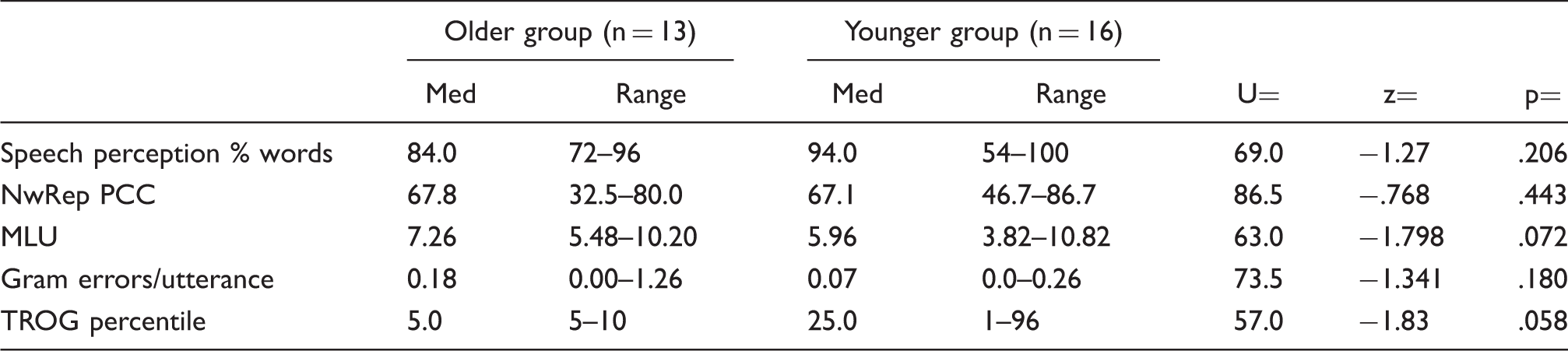
Table 2 also presents U-, z- and p-values from a group comparison. The older group tended to have higher MLU (i.e. longer utterances), to make more grammatical errors and to perform at a lower percentile rank on TROG than the younger group, but none of these differences reached significance. The groups performed very similar on NwRep PCC.
The distribution of different types of grammatical errors in the two groups. The total number of errors in the older group was 176 and in the younger group 62.

Further analysis of the NP errors showed that the majority of errors (75% in the older group and 88% in the younger group) were agreement errors, consisting of wrong adjective form, either with respect to gender- or number agreement with the noun. This was, in fact, the prevailing type of error. They were numerous in some of the participants in the older group. There was no consistency in which form was used as a substitute and often the same participant produced different forms of the same adjective (i.e. it was not a question of an unmarked or default form being used).
Correlations between background variables, speech perception, nonword repetition, grammatical production and sentence comprehension
Partial correlations controlling for age at assessment between age factors, speech perception, NwRep and the grammatical variables. The values on the top of each cell are for the older group (n = 13) and the values at the bottom are for the younger group (n = 16).

NwRep: nonword repetition; PCC: percent consonants correct; MLU: mean length of utterance; TROG: Test for Reception of Grammar. *p < .05. **p < .01.
Discussion
In spite of the better conditions for the children in the younger generation (earlier diagnosis and implantation, bilateral implants, etc.), we find difficulties in NwRep compared to children with normal hearing and typical language development, who are expected to achieve 80–90% consonants correct in the same age range (Ibertsson et al., 2008; Willstedt-Svensson et al., 2004). Both groups in this study performed at the level of children aged 3–4 (Göransson & van der Pals, 2004; Ibertsson et al., 2008). In children with normal hearing and typical language development, accuracy of NwRep increases with age, so that by age 10 most children reach ceiling (Simkin & Conti-Ramsden, 2000). Both groups with CI in this study perform far from ceiling, at the group as well as at the individual level. The findings are in line with Willstedt-Svensson et al. (2004), another study of Swedish children with SPHI and CI in the age range 5–11 years implanted at between two and six years of age, as well as with many studies of other languages (e.g. Carter et al., 2002; Dillon, Burkholder, et al., 2004; Dillon, Pisoni, et al., 2004; Nittrouer, Caldwell-Tarr, et al., 2014). Even if the CIs dramatically enhance the access to spoken language, hearing is not restored to normal levels (Nittrouer, Caldwell-Tarr, et al., 2014; Svirsky et al., 2000), which has consequences for the development of phonological representations (Casserly & Pisoni, 2013). This is true for the younger as well as the older group. We would, however, need follow-up data from the younger group in order to be able to judge whether they resolve phonological processing problems better than the older group in the long-term perspective.
At the grammatical level, MLU tended to be higher in the older group, although variation is large particularly in the younger group. No norms exist for this highly context-dependent measure, so conclusions are difficult to draw. However, comparing with other studies and unpublished data neither of the groups seem to differ from hearing children performing the same task. There is also large variation within the groups with respect to the frequency of grammatical errors in the language samples, particularly in the older group. All of the children in the younger group and 10 out of the 13 participants in the older group produce some errors in the samples analysed. In children with normal hearing and typical language development, grammatical errors would hardly be expected to occur at all, or only marginally, after the age of 5 (e.g. Hansson, Nettelbladt, & Leonard, 2000). This is thus an area, like NwRep, where both groups show weaknesses. Although there is no significant difference at the group level due to the large variation, the problems seem more severe in some individuals (seven) in the older group, who produce grammatical errors much more frequently than any of the children in the younger group.
The types of grammatical errors and the distribution of types of grammatical errors are very similar in the two groups. The errors are mostly found in noun phrases. This is at first glance in contrast to findings from children with SLI who are often found to have problems predominantly with verb forms, although for Swedish problems with noun phrases have also been shown (e.g. Leonard et al., 2001). The high prevalence of noun phrase errors may, however, be an artefact from the task, which requires the description of faces. The data contains a multitude of noun phrases (adjectives + nouns) but very little variation in verb use (mostly copula and ‘have’). Almost all grammatical errors involve the use of grammatical morphemes, i.e. inflections and function words like articles, auxiliaries and prepositions. These can all be characterized as having ‘low phonetic substance’, i.e. they are unstressed and short (Leonard, 2014b) and could thus be expected to be particularly challenging for children with CI, given their perceptual limitations. Imprecise phonological representations and a heavier load on working memory due to degraded input (DeCaro et al., 2016) restrict their ability to create stable and precise lexical/grammatical representations from the input they receive.
The general pattern of difficulties with free and bound grammatical morphemes seems to be the same in studies of English-speaking children with CI (e.g. Nittrouer, Sansom, et al., 2014; Svirsky et al., 2002), as well as in studies of German (Szagun, 2004) and Dutch (Coene et al., 2010). The same types of errors as reported here have also been found in studies of Swedish-speaking children with SLI (Hansson et al., 2000; Leonard et al., 2001). Interestingly, word order errors are found in some Swedish-speaking children with SLI (Hansson et al., 2000), but occur only very occasionally in the data in the present study. Again, this may be due to the specific task at hand, which encourages a quite uniform word order pattern, typically subject – verb – object (‘He has yellow hair’; ‘He has green eyes’). Other elicitation procedures would be needed to investigate word order and verb forms, for example, a narrative task.
Degraded input and impaired central processes hampering the development of precise phonological representations might explain the findings for children with CI with respect to difficulties with NwRep and grammatical production (e.g. Burkholder & Pisoni, 2003; Casserly & Pisoni, 2013; Coene & Govaerts, 2014). In the NwRep task, hearing acuity in the actual test situation is, of course, the first factor to take into account when interpreting the participants’ performance, and also confirmed in the significant correlation between speech perception and NwRep in both groups. On the other hand, given that the task measuring speech perception is a word repetition task, language skills may be implicated. Thus both tasks may be dependent on both hearing acuity and language skills. Even if our results do not provide definite evidence, we agree with those researchers arguing that NwRep taps into more complex functions than hearing acuity and that difficulties with NwRep are also likely to mirror long-term consequences of degraded input due to the hearing impairment (Kral et al., 2016).
Sentence comprehension as measured here, finally, is a complex skill that taps into all language processing levels. It involves a range of top-down and bottom-up processes, both auditory and visual. In this off-line task, the children listen to single sentences of increasing linguistic complexity read aloud by the test leader. The pictures the children have to choose between differ minimally. The task is de-contextualized, and does not reflect on-line comprehension in daily life, where contextual cues, for example, gestures and the surrounding context, support comprehension. Thus, here too both phonological processing skills and hearing acuity are implicated. We found low performance and little variation in percentile scores in the older group, whereas variability was extreme in the younger group, although 10 out of 15 children (data are missing from one) performed above the 20th percentile. The five children performing below the 10th percentile vary widely with respect to background factors as well as NwRep and grammatical performance. Geers et al. (2009) found that about 2/3 of children with CI aged 5–7 (age at implant 1;3 to 8;2) scored one standard deviation or more below controls on language comprehension. Schorr et al. (2008) reports similar results for children with CI aged 5–14 (age at implant 0;11 to 5;1). In the present study, all participants in the older group scored more than one standard deviation below the mean for the norm data (i.e. at or below the 10th percentile) and in the younger group, this was true for only 1/3 of the children. At least one contributing factor to the better performance of the younger group in the present study, compared to other studies, may be that the age at implant seems to be slightly lower than in the Geers et al. (2009) and Schorr et al. (2008) studies, although within the group there is no significant correlation between age at implant and sentence comprehension.
We expected to find similar associations between speech perception, NwRep and the grammatical variables in the two groups, which was mainly confirmed. The correct use of grammatical morphemes is an important aspect of grammatical skills. Grammatical morphemes often have low phonetic substance, which taxes phonological processing skills. Thus weak phonological processing skills should have consequences for processing these elements. We find some support for this in a significant correlation between NwRep and the frequency of grammatical errors in both groups. As pointed out above, the grammatical errors made in our study indicate difficulties in the use of grammatical morphemes with low phonetic substance, taxing phonological processing skills. The children in the younger group make grammatical errors fairly infrequently, and within-group variation is lower than in the older generation. We don’t know if their slightly higher grammatical accuracy can be explained by better speech perception and/or phonological processing skills as compared to the older group at the corresponding age, due to the generally more favourable conditions: earlier age at implant, bilateral implants, etc., which may help to compensate for degraded input and phonological processing difficulties.
MLU in words, on the other hand, is not associated with NwRep in either of the groups. MLU measures a different aspect of grammar, the syntactic ability to combine words into sentences. It seems logical that morphological aspects of grammar are more closely associated with phonological processing than with more syntactic aspects of grammar (e.g. word order, the use of complex structures like subordinate clauses), as discussed by Nittrouer, Sansom, et al. (2014).
It is to be expected that with weaknesses in perceptual processing (hearing acuity), children with CI will be more dependent on phonological short term memory for sentence processing. We find support for this in the strong correlation between NwRep and sentence comprehension in the younger group. A possible interpretation of the absence of such an association in the older group is that this is a reflection of the adolescents having developed strategies for language comprehension which are more independent of phonological processing skills. Alternatively, it is due to small variation and close to floor performance on TROG in this group. An interesting finding in Nittrouer, Caldwell-Tarr, et al. (2014) indicated that NwRep performance may be related to good language outcome but not to poor outcome. Looking at individual data in the present study, our findings seem to corroborate those by Nittrouer, Caldwell-Tarr, et al. (2014). The participants in the younger generation with the highest NwRep scores tend to have better sentence comprehension and to make fairly few grammatical errors. There is no corresponding tendency in the subgroup with comparatively weaker NwRep skills to perform lower at the grammatical variables.
Conway et al. (2014) and Pisoni, Kronenberger, Chandramouli, and Conway (2016) explored underlying cognitive factors that might explain both differences in language skills between children with CI and controls with normal hearing and the large variation in language skills within the group of children with CI. They propose that children with CI have problems with implicit (sequential) learning as well as deficient cognitive control, i.e. the ability to update interpretations and prohibit early interpretations in online sentence processing. The former proposal is in line with Ullman and Pierpoint’s (2005) explanation of background mechanisms to SLI. According to these authors, SLI can be explained by a general deficit in procedural memory (i.e. in implicit learning). These proposals are interesting and further point to the relevance of investigating the similarities and differences between children with CI and children with SLI, both with respect to symptoms and background mechanisms.
Finally a note on background variables. Controlling for age at assessment, we see no associations within groups between age at implantation/age at fitting and the language variables. This is in contrast to many other studies (e.g. Nicholas & Geers, 2007; Schorr et al., 2008; Tobey et al., 2012), although evidence is inconclusive (Dunn et al., 2013; Holt & Svirsky, 2008). The lack of significant associations with the age variables does, however, not lead us to the conclusion that age at implantation does not affect language development. We agree with López-Higes, Gallego, Martín-Aragoneses, and Melle (2015) who argue that age at implantation should not be treated as an isolated independent variable, but as a construct also implying associated factors like likelihood for bilateral implants, more advanced technology, more informed support to parents, etc. The trend towards better sentence comprehension and higher grammatical accuracy in the younger group in our study may be the consequence of the combined effect of these background variables.
Methodological considerations
We have very little information on the participants’ residual hearing or of prior consistent use of hearing aids (in Sweden all children with SPHI are first fitted with bilateral hearing aids before receiving a CI). These are important confounds. Neither do we have any information on electrode insertion or coding strategies, which would have made a group comparison more informed. The data from the two generations are collected consecutively at different points in time, and in different projects. However, the data collection was carried out by the same researchers and the methods used were mostly identical, except that two different versions of TROG were used, but both with Swedish norms. This gave us the opportunity to investigate the two data sets to explore NwRep skills and grammatical skills and how they are associated in the two generations. Longitudinal studies are needed to answer the questions with more certainty. Furthermore, as in most studies of CI, the populations are small, which makes it impossible to draw any firm conclusion based on the correlation analysis. It is therefore important to be very careful when discussing the influence of age at implant in the present study in relation to the findings from other studies. When comparing different studies it is important to take into account for example when in time the data were collected, because of the changing context and intervention strategies. Variation with respect to age at implant is, for example, likely to be larger in older studies, and smaller in coming studies, where most children will have received their implants at an early age. Not only has age at implant changed, there is also a higher likelihood for bilateral implants and technical sophistication. The growing knowledge regarding language development in children with CI probably influences how the children and their families are taken care of, with more and more evidence based intervention. Children/adolescents with CI is thus a dynamic and changing population. A further weakness is that we have not included data from controls for direct comparison and only refer to reference data from children with normal hearing to assess the severity of difficulties in the two participant groups. Individual controls would have given a more exact picture of this. Finally, we have not controlled for SES. More engaged and informed parents may be more willing to participate and there is reason to suspect that both the younger and the older children in the study represent a higher performing part of the population of children/adolescents with CI.
Conclusions
Our expectations for the results were largely met: the two groups do perform lower than age references on all measures except MLU and within-group variation is large. There are indications that, at least at group level, the older group differs more from age references. We find similar patterns of associations between the variables in the two groups.
In spite of the tendency for better sentence comprehension and higher grammatical accuracy, the most important finding is that the group of 5–8 year olds from a younger group of children with CIs, with earlier implantation and high probability for bilateral implants seems to have significant difficulties with NwRep, grammatical production and sentence comprehension at the group level. On the other hand, there is a trend towards better sentence comprehension and higher grammatical accuracy in the younger earlier implanted group (although below the expected level in most cases), which may indicate that they have been able to make better use of language input to construct grammatical representations. However, it remains to be seen how persistent the problems are both at the group and individual level. It is possible that children due to early implantation manage fairly well at the early stages of language development, but encounter more severe problems at higher ages, as found for example by Guo et al. (2013). It is important that the results are not taken as evidence that no progress has been made, but they strongly suggest that this is still a group at risk for language problems. There are signs, both in the generally low performance on NwRep, in the variable performance in sentence comprehension and in the frequency of grammatical errors. Interrelationships between different processing levels are difficult to disentangle. A certain symptom may have a range of causes and language learning problems may co-occur with the hearing impairment without being caused by it. The children may have limitations in bottom-up as well as in top-down processing. The multi-directional interrelationships between speech perception, working memory and language skills imply that stronger language skills also support speech perception and working memory.
From a theoretical point of view, exploring if and how formal aspects of language, like grammatical skills, are associated with underlying lower level skills, like speech perception and phonological processing, is interesting because it adds to our understanding of the process of language use and language development. This in turn has clinical implications for diagnosis and intervention and the need for interdisciplinary collaboration.
Future research on children with CI can benefit from research on children with SLI. As suggested by the results of the present study as well as other studies (e.g. Nittrouer, Sansom, et al., 2014; Svirsky et al., 2002), the two groups seem to present similar profiles with respect to phonological processing problems and which grammatical forms cause difficulties. This calls for analyses of grammatical production in different contexts, formal as well as informal in clinical assessment. Furthermore, within speech-language pathology there are evidence-based methods for grammatical training (e.g. Ebbels, Marić, Murphy, & Turner, 2014) which might be applicable to children with CI as well.
Our study contributes to the knowledge on language learning in Swedish-speaking children with CI(s) and thus to cross-linguistic research within the area, which is strongly called for today. We need more specific knowledge about which grammatical forms are particularly challenging in different languages to design assessment instruments that can help identify children most at risk for problems and to design intervention methods that can support the children in learning those forms based on theoretically well informed empirical studies.
Footnotes
Acknowledgements
The authors wish to thank the Swedish parent association for children with CI, Barnplantorna, and all participating children and their parents.
Declaration of conflicting interests
The author(s) declared no potential conflicts of interest with respect to the research, authorship, and/or publication of this article.
Funding
The author(s) disclosed receipt of the following financial support for the research, authorship, and/or publication of this article: This work was financed by the Bank of Sweden Tercentenary Foundation, project number P10-0107. The authors also gratefully acknowledge the support from the Linnaeus Centre Thinking in Time: Cognition, Communication, and Learning, financed by the Swedish Research Council, grant no. 349-2007-8695.