




Abstract
Background and aims
The procedural deficit hypothesis attributes the language phenotype in children with specific language impairment to an impaired procedural and relatively intact declarative memory system. The declarative compensatory hypothesis is an extension of the procedural deficit hypothesis which claims that the declarative system in specific language impairment compensates for the procedural deficit. The present study’s aim was to examine the claims of the procedural deficit hypothesis and declarative compensatory hypothesis by examining these memory systems and relation between them in specific language impairment.
Methods
Participants were children aged 8–13 years, 30 with specific language impairment and 30 typically developing controls, who spoke Kannada (an agglutinating language of the Dravidian family). Procedural learning was assessed using a serial reaction time task. Declarative memory was assessed using two non-verbal tasks that differed at the level of encoding and retrieval: a recognition memory task after incidental encoding using real and novel object images and a recall task after intentional encoding using visual paired associates. Retrieval was examined after short (10 min) and long (60 min) delays after encoding on both declarative tasks.
Results
Findings confirmed that children with specific language impairment (SLI) have impaired procedural memory on a non-verbal serial reaction time task. On recognition memory task after incidental encoding though children with specific language impairment encoded less well, they recognized items as well as typically developing controls. Both the groups retrieved more at short compared to long intervals and retrieved real (verbalizable) objects better than novel objects. On visual paired associates (recall task with intentional encoding) children with specific language impairment retrieved less than typically developing children (even after controlling for non-verbal ability and age). Furthermore, across retrieval types of declarative tasks, although children with specific language impairment did less well than typically developing, their pattern of performance was comparable to typically developing children. Finally, the correlation between memory systems did not support a trade-off between memory systems in children with SLI as predicted by the compensatory wing of procedural deficit hypothesis.
Conclusions
The findings supported the major claim of the procedural deficit hypothesis – a procedural learning deficit in specific language impairment and an intact declarative system, however, only if measured on task that was designed to be undemanding. Furthermore, there was no evidence for a trade-off between these systems.
Implications and future directions
Some interventions with specific language impairment use explicit teaching of grammar, an approach that uses the declarative rather than the procedural system. Our findings cast doubt on whether this is likely to be the most effective strategy.
Keywords
Introduction
Many contemporary models of memory draw a distinction between declarative and non-declarative systems (e.g. Eichenbaum & Cohen, 2001). The declarative memory system deals with memories for facts whereas the non-declarative procedural system deals with memories for skills (Cohen & Squire, 1980). These memory systems are implicated in children with specific language impairment (SLI), a neurodevelopmental condition characterized by language impairment with no associated neural, sensory and non-verbal intelligence issues (American Psychiatric Association, 2013; Leonard, 2014). The typical language phenotype in SLI involves poor grammar and relatively intact word learning (e.g. Ullman & Pierpont, 2005). This pattern of skills led to the postulation of the procedural deficit hypothesis (PDH) (Ullman & Pierpont, 2005), which attributes the profile of compromised grammar and relatively intact word learning to an impaired procedural memory system and a preserved declarative system. The PDH further claims that incompetence in the procedural system may result in enhancement of the declarative system (Ullman, 2004; Ullman & Pullman, 2015).
Since the PDH was first formulated, there have been several studies of procedural and declarative memory in SLI. Most studies have confirmed procedural memory deficits in SLI; however, agreement is yet to be reached on the status of the declarative system, in part due to methodological differences across these studies (see Lum & Conti-Ramsden, 2013 for review). In the present study, we test predictions of the PDH with a particular focus on one of its extension, namely the declarative compensatory hypothesis (DCH).
Procedural memory in SLI
The procedural memory system underlies implicit learning of perceptual, motor and cognitive skills such as sequencing (e.g. Fletcher et al., 2005) and probabilistic categorization (e.g. Poldrack et al., 2001). Learning through procedural memory occurs gradually after several repeated exposures. Nevertheless, once skill/knowledge is acquired, it can be executed rapidly without awareness. For instance, riding a bicycle is largely a procedural skill. In language learning, implicit learning ability has been directly linked to syntax acquisition (Kidd, 2012).
The serial reaction time (SRT) task (Nissen & Bullemer, 1987) has been used to study motor sequence learning in children (e.g. Lum, Conti-Ramsden, Page, & Ullman, 2012), tapping the visuospatial domain of procedural memory (Howard, Mutter, & Howard, 1992). On a typical SRT task, on each trial four horizontal shapes appear on the screen. Participants are asked to track the location of a stimulus (e.g. picture of a dog) that appears in one of the shapes by pressing the spatially corresponding button on a response pad as fast and accurately as possible. Two kinds of blocks are presented: random, where the stimulus location is random, and pattern, where, unknown to the participant, the series of locations follows a repeated predetermined sequence. The usual finding is that as the participant implicitly learns the underlying pattern the reaction time (RT) gradually drops. Thus, the average RTs for pattern blocks are faster than for random blocks, providing evidence of implicit sequence learning. An index of sequence learning (ISL), reflecting the RT difference between random and repeated blocks, can be used as a measure of procedural memory (Cleeremans & Jiménez, 1999; Nissen & Bullemer, 1987; Sengottuvel & Rao, 2013a). Studies examining procedural memory using this method showed poorer motor sequence learning in children with SLI compared to their TD peers (Conti-Ramsden, Ullman, & Lum, 2015; Desmottes, Meulemans, & Maillart, 2016; Gabriel et al., 2013; Lum, Gelgic, & Conti-Ramsden, 2010; Lum et al., 2012; Tomblin, Mainela-Arnold, & Zhang, 2007). These findings held up after controlling for attention and general motor speed (Lum et al., 2010; Sengottuvel & Rao, 2013b, 2013c) and were also obtained in verbal sequence learning (i.e. reduced Hebb effect: Hsu & Bishop, 2014a) and artificial language learning tasks (Evans, Saffran, & Robe-Torres, 2009; Mayor-Dubois, Zesiger, Van der Linden, & Roulet-Perez, 2012; Plante, Gomez, & Gerken, 2002). An exception is Gabriel et al. (2011), who reported intact procedural memory in SLI on a SRT task. Nevertheless, when they increased the complexity of the sequences (using second-order sequences – see below) they confirmed poor sequence learning in SLI (Gabriel et al., 2013).
One objective of the present study is to examine possible declarative compensation for the procedural impairment in children with SLI. For this, we need a procedural task that minimizes any contribution from the declarative system. On the SRT task, even though the sequencing blocks are not indicated to the participant (i.e. learning is incidental) it could be argued that the repeating sequence could be learned via the declarative system by applying explicit verbalization or visualization strategies. The sequences in SRT tasks can vary as to how far elements in a given location bear first-order conditional (FOC) or second-order conditional (SOC) statistical information (Robertson, 2007). FOC sequences are considered lower order sequences, in which each element in the sequence can be at least partially predicted from the preceding element. For example, ‘132342134142’ is a sequence set with predominantly FOC transitional information where one item usually predicts the immediate next item. For instance, ‘3’ usually predicts ‘4’ (i.e. two out of three times or 67%). In contrast, SOC sequences are considered higher order sequences, where predicting the next event within a sequence requires knowledge of the two immediately preceding events. For example, ‘121342314324’ is a set with SOC predictive elements where one can predict that the location 2 is followed by 1 only if it is also preceded by 1. Robertson reported that performance of an SRT task with FOC sequences activates basal ganglia and frontal circuits (i.e. underlying procedural) (e.g. Torriero, Oliveri, Koch, Caltagirone, & Petrosini, 2004), whereas the medial temporal structures are engaged while performing higher order sequences like SOC (e.g. Schendan, Searl, Melrose, & Stern, 2003). Therefore, to better evaluate the procedural capacity independent of the declarative system the present study uses a 12-item FOC repeating sequence.
Declarative memory in SLI
The declarative memory system principally underlies encoding, storing, consolidating, and retrieving knowledge or memories pertaining to personal events and general information (e.g. Cabeza & Moscovitch, 2013). This includes, for instance, knowing particular events that occurred at a birthday party (episodic memory) and knowing the arbitrary association between a word ‘chair’ and its attributes (semantic knowledge). Learning (encoding) in the declarative memory system can be fast, even after a single exposure to the information. Retrieval of information from the declarative system is often conscious through the processes of recognition and recall (Squire & Knowlton, 1995). A task that presents word or picture associations and requires participants to remember as many associations as possible during later retrieval is a typical declarative task.
Several studies have found evidence for spared declarative memory in SLI on non-verbal tasks (Baird, Dworzynski, Slonims, & Simonoff, 2009; Bavin, Wilson, Maruff, & Sleeman, 2005; Lum et al., 2010; Riccio, Cash, & Cohen, 2007). On verbal declarative tasks, children with SLI perform worse than TD children (Baird et al., 2010; Dewey & Wall, 1997; Duinmeijer, De Jong, & Scheper, 2012; Lum et al., 2010, 2012; Nichols, 2004; Records, Tomblin, & Buckwalter, 1995; Riccio et al., 2007; Shear, Tallal, & Delis, 1992). However, normal-range performance has been reported in children with SLI on verbal declarative tasks after controlling for phonological or working memory deficits (statistically, Lum et al., 2010, 2012; experimentally, Lum, Ullman, & Conti-Ramsden, 2015). For more details on declarative performance of children with SLI, see Lum and Conti-Ramsden (2013). Recently, Bishop and Hsu (2015) studied the declarative system in a group of children with SLI, age-matched controls and younger grammar-matched controls using auditory-visual paired associate learning. They used analogous tasks for verbal materials (vocabulary learning) and non-verbal materials (associating meaningless patterns and sounds). On the vocabulary task, the age-matched controls outperformed the other two groups, but only at the starting level of the task; the learning rate across groups was similar. Further, the findings did not show a reliable difference in learning of non-verbal paired associates across groups. Nevertheless, studies using other methods have found evidence of poor performance on non-verbal declarative tasks in SLI (see Collisson, Grela, Spaulding, Rueckl, & Magnuso, 2014; Poll, Miller, & Van Hell, 2015). Collisson et al. and Poll et al. used a Visual Paired Associate (VPA) task (Vakil & Herishanu-Naaman, 1998) which has an encoding phase that exposes the participants to abstract shape and colour associations and a recall phase where they are required to recall the associations. The inconsistencies within non-verbal declarative tasks suggest that there are factors beyond the modality of tasks that might contribute to the variation in findings across declarative studies in SLI.
The answer may lie in the nature of encoding and retrieval invoked in the declarative tasks. One factor is whether the encoding phase involves incidental or intentional learning, i.e. whether participants are informed about the subsequent retrieval phase. An intentional task allows participants to consciously plan the strategy to store the item for later retrieval whereas incidental tasks are free from such conscious processing demands (Stuss & Knight, 2002). A second factor is whether retrieval is examined through recall or recognition (judgments of familiarity) (see Haist, Shimamura, & Squire, 1992). Recalling an item from memory requires more information in storage than recognizing an item (e.g. Postman, Jenkins, & Postman, 1948). In other words, recall requires greater reinstatement of the learning event compared to recognition (Haist et al., 1992; Roediger, Weldon, & Challis, 1989). All the studies discussed above used intentional encoding and a retrieval type that involves explicit recall.
We are not aware of any published study that used recognition after incidental encoding in children with SLI as a measure of their declarative memory. Hedenius, Ullman, Alm, Jennische, and Persson (2013) used a recognition memory task after incidental encoding (RMIE) procedure with children with developmental dyslexia, who share some common underlying cognitive deficits with SLI (Bishop & Snowling, 2004). They found that children with dyslexia did better than typically developing (TD) peers in learning and consolidating the information in the declarative system. A recent study (Lukács, Kemény, Lum, & Ullman, under review) used a similar procedure with non-verbal and verbal items in two separate tasks to investigate declarative memory in SLI. In the encoding phase, participants categorized pictures (non-verbal task) or spoken words (verbal task), as real or novel. Participants during the encoding stage were not forewarned that there would be a recognition task; hence, the encoding was incidental. Recognition was tested at delays of 10 min (short) and 24 h (long, and after sleep), by asking participants to say if they had previously seen or heard the picture or word presented. The number of items accurately recognized and RT were used to index declarative ability. On this task, the children with SLI improved significantly on both real and novel objects between the short and long delays, whereas there were no significant changes for the TD children. Moreover, at the long delay the children with SLI did not differ from the TD children at remembering non-verbal information, though an impairment at remembering verbal items was still observed. Overall, the findings were the first to suggest an enhanced consolidation in declarative memory, as indexed by the improvement from the short to the long delay, in children with SLI.
We are not aware of studies comparing the effect of encoding and retrieval types in declarative performance in children. One study that came close is by Brown, Weighall, Henderson, and Gareth Gaskell (2012) who found that without sleep, that is within a short delay of 3–4 h of encoding, retrieval of novel words examined through recognition, but not recall, improved in typical children. Brown and colleagues’ findings show that even before sleep, declarative memory undergoes off-line consolidation (see also Dumay & Gaskell, 2007) and performance can vary with respect to the retrieval type. Considering the effect of retrieval type within 3–4 h on declarative performance, it would be interesting to examine such effects at even shorter delays. Therefore, 10 and 60 min retrieval intervals were used in the present study, to probe group differences between SLI and typical controls in processes underlying information storage in declarative memory.
In sum, there is a gap in the literature with regard to whether the encoding and retrieval type of non-verbal tasks contributes to the difference among declarative findings in SLI. Further, the inclusion of the RMIE task in this study gives an opportunity to detect any enhancement in declarative potential at short delays.
Declarative-procedural trade-off
Our review of memory systems in SLI supports at least one major claim of the PDH, i.e. children with SLI have impairments of the procedural system. Further, it offers partial support for the second postulate, namely that children with SLI have an intact declarative system. Another integral argument of the PDH that has not been examined extensively is whether there is a trade-off between these memory systems – the DCH (Ullman & Pullman, 2015). This claims that the declarative mechanism is overused due to procedural attenuation in children with SLI, and as a consequence, will have enhanced potential.
In children with SLI, frequency effects for regular verbs (claimed to result from chunking and storing of root plus bound morpheme together as a single unit in their declarative system) (Oetting & Horohov, 1997; Poll et al., 2015; Thordardottir & Ellis Weismer, 2002; Ullman & Gopnik, 1999; Ullman & Pierpont, 2005; Van der Lely & Ullman, 2001) and good grammar-declarative correlations (Conti-Ramsden et al., 2015; Lum et al., 2012) are taken as evidence that the declarative system has been recruited for learning some aspects of language which are normally acquired by the procedural system in typical children. Recently, Lukács and colleagues (under review) have found some evidence that children with SLI have enhanced declarative potential at the consolidation level. It remains to be seen, however, if enhanced declarative potential is linked to the amount of procedural deficit (i.e. trade-off in memory functions in SLI).
The present study
We first aimed to confirm the procedural learning deficits in SLI using a SRT task. We also assessed declarative learning using a range of tasks with a specific focus on whether declarative learning in SLI is influenced by type of encoding (incidental versus intentional) and retrieval (recognition versus recall). In addition, we consider how retention interval affects declarative memory performance by comparing retention over short (10 min) and long (60 min) intervals. The predictions based on the procedural deficit and declarative compensatory hypotheses are as follows:
Children with SLI will be impaired on procedural learning relative to TD controls. Children with SLI will show an intact declarative system as measured by recognition memory after incidental encoding (i.e. RMIE) task, especially at a long interval. A group × interval interaction is predicted, with SLI performance at a long delay showing lesser deficit than at a short delay. Furthermore, SLI performance should be strongest with materials that are less verbalizable, resulting in a group × object type interaction. Prior research with VPA learning has given mixed results, and predictions are less certain, but we would anticipate that this task would be more likely to reveal declarative deficits in SLI than the RMIE task, because it uses an intentional encoding procedure and assesses retrieval through recall. Comparison between the two retrieval types (recognition versus recall) will show performance superiority on recognition over recall, at least for SLI group (i.e. group × retrieval type interaction). Further, if the predictions for RMIE (see second point) are true (i.e. a group × interval interaction at RMIE), we might expect a group × retrieval type × interval interaction. In line with the DCH, we predict a trade-off between declarative and procedural performance in SLI, indicated by a negative correlation after partialling out age and non-verbal ability.
Methods
Participants
Thirty children each with and without SLI participated in the study. All the participants came from middle to upper socio-economic backgrounds and spoke Kannada (a language of the Dravidian family) as their first language. TD participants were selected from schools and SLI participants were selected from the case registry of All India Institute of Speech and Hearing (AIISH). None of the SLI participants in the study were receiving intervention at the time of the study. All the participants’ parents signed an informed consent and the AIISH ethical committee approved the study.
Pretesting
Parents were administered the WHO 10 disability parental questionnaire (Singhi, Kumar, Malhi, & Kumar, 2007) to rule out any general disability in their children. All the participants were administered Gesell’s drawing test (GDT) (Venkatesan, 2002) as a measure of their non-verbal ability. This is a paper and pencil task, where figures varying in complexity are shown to the participants for copying. The copying is not timed and items are scored as correct or incorrect. Participants were also administered the Linguistic Profile Test (LPT) (Suchitra & Karanth, 1990) as a measure of phonological, semantic and syntactical abilities in Kannada. LPT includes sections testing phonology, semantics and syntax which are scored based on the participants’ ability to judge/name/repeat (depending on the specific task) the orally presented stimuli. Each of the three sections had a maximum score of 100; thus, the combined language score (CLS) was 300. LPT has normative scores developed for the age range of 6–15 years (Suchitra & Karanth, 1990, 2007). LPT has not been evaluated for its sensitivity and specificity in detecting language disorder, but was chosen as it was the only suitable normed language test material in Kannada. The LPT examines some phonological and semantic aspects through the expressive mode but it does not examine expressive syntax, and so we cannot rule out the possibility that some participants might have had undetected expressive deficits in syntax. However, note that the dependent variables in the present study did not require any expressive language. We justify the validity of LPT for detecting SLI based on earlier published studies where the participants selected this way showed the hallmark clinical characteristics of SLI, i.e. poor non-word repetition (Kuppuraj & Rao, 2012), normal non-verbal ability, poor sentence construction (Sengottuvel & Rao, 2014) and poor sequence learning (Sengottuvel & Rao, 2013b, 2013c).
Inclusion of participants
Mean (SD) age, language, and non-verbal IQ by groups.
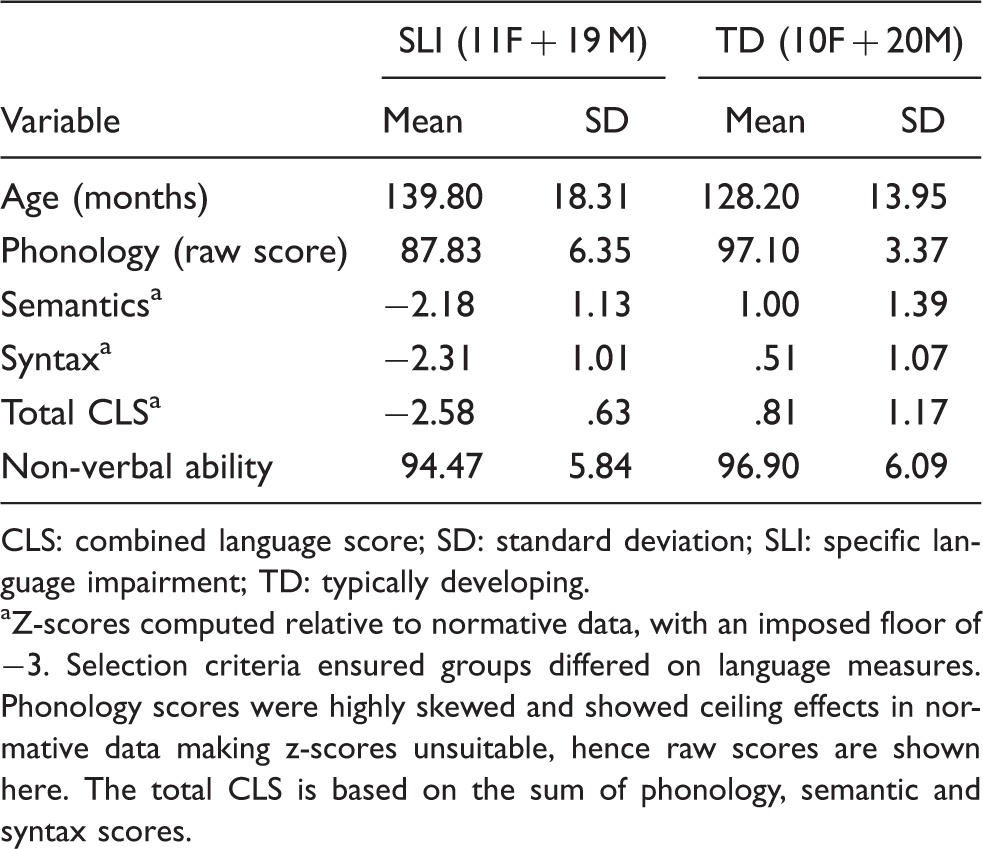
CLS: combined language score; SD: standard deviation; SLI: specific language impairment; TD: typically developing.
Z-scores computed relative to normative data, with an imposed floor of −3. Selection criteria ensured groups differed on language measures. Phonology scores were highly skewed and showed ceiling effects in normative data making z-scores unsuitable, hence raw scores are shown here. The total CLS is based on the sum of phonology, semantic and syntax scores.
Experimental tasks
We used a procedural (SRT task) task as well as two declarative tasks that differ on encoding (incidental versus intentional) and retrieval types (recognition and recall). All three experimental tasks were designed using the trial version of the Paradigm software (www.paradigmexperiments.com/).
SRT task
Procedural memory was measured using a version of Nissen and Bullemer’s (1987) SRT task. On the SRT task, participants tracked the stimulus (an image of a puppy) appearing in any one of four horizontally aligned locations using spatially corresponding response keys on the key board (‘C’, ‘V’, ‘N’ and ‘M’) as rapidly and accurately as possible. The participants were asked to use the left middle finger and index finger to respond for locations ‘C’ and ‘V’ and right index and middle finger to respond for ‘N’ and ‘M’ locations. This was a self-paced task where the stimulus moved to the next circle only after a correct button press. At the beginning of each trial a cross appeared on all four locations for 250 ms to prime the appearance of the stimulus, followed by the stimulus in one of the four locations until a correct button is pressed. RT for each trial was measured as the time gap in milliseconds between stimulus appearance and a press of the correct button. Thus, we did not measure accuracy, but rather had a single measure of RT reflecting both speed and accuracy, because when errors were made, they led to delayed RTs on that trial (see Sengottuvel & Rao, 2013a for similar design). Prior to the actual task, participants were given a practice set (about 25 trials) to familiarize them with the task. The task consisted of four blocks: two random (R) and two sequences (S) (i.e. 1stR–1stS–2ndR–2ndS). On the random blocks (100 trials in each), the stimulus appeared randomly on any of the four locations. There was, therefore, no scope for sequence learning, although RT could get faster due to general motor learning (Deroost & Soetens, 2006) (see Sengottuvel & Rao, 2013a for original version of the task). On the sequence phases, stimulus locations followed a predetermined 12-item first-order sequence, namely ‘421323413412’, in which all the locations have equal probability of occurrence (.25). Twelve sequence sets were repeated 20 times for each sequence block, giving 240 trials per block. A free recall (explicit) task followed the SRT task in which participants were asked if they observed any pattern; if so they were asked to generate the sequence verbally.
RMIE
The RMIE task was similar to the task developed at the Brain and Language Lab at Georgetown University by Ullman and colleagues (see Hedenius et al., 2013 for details). A similar task was shown to engage the network of brain structures underlying declarative memory for both verbal and non-verbal stimuli (Henson, 2005; Kim & Cabeza, 2009). Our task used black-and-white line drawings of real objects and novel objects (Figure 1(a) and (b)) of the size of 351 × 481 px. We excluded some objects (real and novel) from the original set used by Hedenius and colleagues, because they would be unfamiliar to Indian middle-class children. An equal number of novel objects were also excluded to balance the stimulus pool. A final set of 120 images (60 real and 60 novel) were derived and divided into three object sets – one for the encoding phase and one each for two recognition phases. The object set for the encoding phase consisted of 30 real and 30 novel images. Because the recognition phases required the objects from the encoding phase to be used again (to say ‘seen’ or ‘not seen’), we added 30 of the objects from the encoding phase (15 real and 15 novel) and used another 30 new foils (15 real and 15 novel) for each recognition phase (see Figure 1(c)).
(a) Example of a real item. (b) Example of a novel item. (c) Illustration of item selection. One hundred and twenty items selected (60 real and 60 novel). Thirty each from real and novel were shown during encoding for novel categorization as real or novel. After 10 min break, a recognition phase followed: 15 real items and 15 novel items presented during encoding were presented again with 30 new items (15 real and 15 novel). Participants categorized them as ‘seen’ or ‘not seen’. After 60 min, the second recognition phase followed using different items from those in the first recognition phase. (d) Timeline for trial presentations.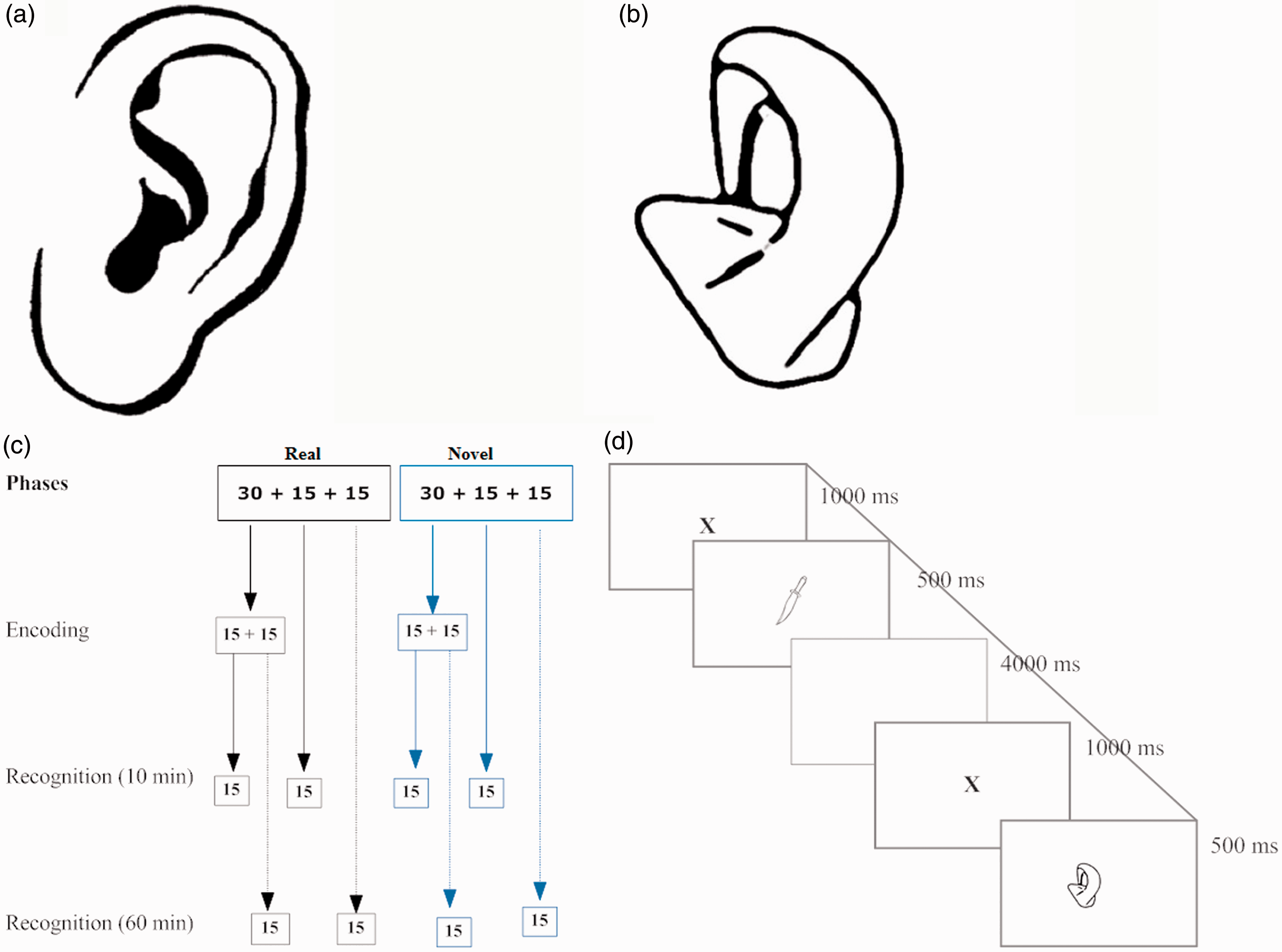
Preceding each stimulus, a crosshair (X) appeared in the centre of the screen for 1000 ms, followed by the item (object image) for 500 ms in the centre. The item remained on the screen for 500 ms regardless of the response of the child, to equalize presentation duration across stimuli and subjects. If the child did not respond after 500 ms, the screen went blank until a response was made or 4 s had elapsed. Thus, including the 500 ms presentation time the response window was 4500 ms (see Figure 1(d)). Irrespective of the accuracy of the response the next stimulus then appeared preceded by the cross hair. Items were presented in the same order to all the participants. No more than three consecutive real or novel objects were presented in sequence.
RMIE had three phases: an encoding phase where the participants categorized the drawings as ‘real’ or ‘novel’ (not nameable), and two recognition phases (10 and 60 min after encoding) where they categorized the objects as ‘seen during encoding’ or ‘not seen during encoding’. During the encoding phase participants were asked to press ‘1’ if they thought the object was real and ‘0’ if they thought the object was unreal (i.e. novel). Children were not warned about the following recognition phases; hence learning in this phase was incidental. The dependent measures were categorization accuracy and RT for correct responses. During the subsequent recognition phases, new drawings and already-seen drawings were presented. Children used a button press to respond (‘seen’ – press ‘1’, ‘not seen’ – press ‘0’). Different item sets were used for the two recognition phases. The dependent measures were categorization accuracy and RT for correct responses for each phase.
VPA learning task
We used a VPA task based on Vakil and Herishanu-Naaman (1998) to measure recall from declarative memory after intentional encoding. The task consisted of a training phase and two testing phases. In the training phase (equivalent to the encoding phase in RMIE), participants were presented with six cards, each containing a colour and an abstract shape. The cards were presented for 3 s each with an interstimulus interval of 1 s (see Figure 2(a) and (b)). The cards were presented three times consecutively in a different order with a time gap of 1 s between sets. The instruction for the participants was to remember as many pairs as possible for later recall (hence intentional). Ten minutes after completion of the training phase, the testing phase followed, in which the abstract shapes were presented alone, one at a time, along with a card with eight colours (six from the training phase and two foils). The child’s task was to match the shape to the colour (using a computer mouse to click on the associated colour). The cards were presented until a response was made. After 60 min, another testing phase was conducted where the same procedure was repeated (delayed recall). No feedback about accuracy was provided to the participants. Each correct association was given a score of ‘1’ (i.e. maximum score for each phase was 6). The accuracy and RT were measured by the software.
(a) Shows the presentation of items during the training phase of VPA. Every shape and colour association was presented for 3 s with ISI of 1 s between presentations. The association sets were presented thrice in different orders. (b) Shows the testing phase (after 10 and 60 min of encoding). VPA: Visual Paired Associate. Schematic illustration of ISL calculation from SRT task. ISL: index of sequence learning; SRT: serial reaction time.

Test environment and schedule
Children were tested in a quiet room either at school or at home under normal lighting conditions during daytime. Experiments were run on a Compaq 510 notebook with 14″ screen display and Intel core 2 Duo Processor. The distance between the participant and the laptop screen was approximately 50 cm for all the experiments. The participant selection (language test and non-verbal ability, approximately 2 h) and experimental task administration occurred over two sessions. In the experimental session, children were first given the encoding and immediate recognition phases of the RMIE task, followed by the SRT task, followed by delayed recognition of RMIE. The VPA encoding and recall sessions were done after that on the same day.
Data analysis
On SRT, for each participant, we calculated the mean RT in each block (R1, S1, R2, S2) after excluding extreme values, i.e. RTs <300 ms and >4500 ms, because they were considered dubious (see Lum et al., 2012). The difference between R1 and S1 (d1), R2 and S2 (d2) were averaged [(d1 + d2)/2] to derive the ISL (see Figure 3) (e.g. Willingham, Nissen, & Bullemer, 1989). The ISL was taken as the index of procedural sequence learning in the SRT task (Sengottuvel & Rao, 2013a, 2013b, 2013c).
On RMIE, for each participant we first calculated the number of accurate responses during encoding and averaged the RTs for them. From the immediate recognition phase, we calculated the number of accurately recognized responses (out of 60) and their RTs. For each recognition interval, we calculated the proportion of accurate responses for real objects (i.e. n/30) and novel objects (i.e. n/30) separately; we anticipated that these items might be of differential difficulty for children with SLI, as they varied in how easy they were to name. On the VPA no measures were taken during the training (encoding) phase. In the recall stages, we calculated the accuracy and average RT for accurate responses. Where covariates (age and non-verbal ability) were included in the analysis, these were first centred to ensure accurate estimates in repeated measures analyses (Delaney & Maxwell, 1981).
Results and discussion
Procedural memory
We first calculated the mean RT from each of the four blocks for all the participants. Then we transformed the values to log 10 to reduce non-normality. There were a few extreme outliers with very slow RTs; children who had extremely slow RTs on any one of the four blocks were excluded using the method of Hoaglin and Iglewicz (1987). This led to removal of one child from the TD group and three from the SLI group. Therefore, for the further analysis, the N for TD and SLI groups are 29 and 27, respectively. Figure 4 shows the mean RTs (log 10 transformed) for remaining participants in the two groups for the four blocks.
Log 10 RT means and SDs for TD and SLI across blocks on SRT task. Error bars are standard errors. RT: reaction time; SD: standard deviation; SRT: serial reaction time; TD: typically developing.
The main derived dependent variable was the ISL, which was the mean difference in non-transformed RT for random versus sequence blocks in milliseconds. The ISL was normally distributed and no outliers were detected using Hoaglin’s procedure, therefore, all the values reported are non-transformed. The TD group had a mean ISL of 27.6 (SD = 49.9) whereas the SLI group had a mean score of 1.98 (SD = 32.2). Because the ISL values could be negative the SDs are extreme despite the normality. ISL across groups was compared using ANCOVA with centralized age and non-verbal ability as covariates, and effect size computed as generalized eta squared,
Discussion
The ISL showed that children with SLI were not as effective as TD in learning the FOC sequences. This could not be accounted for by differences in non-verbal ability between groups, since this was covaried in our analysis. This result is in agreement with previous studies that used the SRT task and showed poor procedural memory in SLI (e.g. Lum et al., 2012) and supports the major claim of the PDH.
RMIE
Encoding
The encoding stage of the RMIE simply involved judging whether a presented picture was real or novel. We included an analysis of these data to indicate children’s ability to do the task, as failure to process stimuli at this level might impact their performance in the retrieval stage. For 60 two-choice items, the binomial theorem indicates that a score of 36 or less correct is no better than chance (50% correct). Accordingly, we excluded four children (2 TD and 2 SLI) who scored at this level, who appeared either not to understand the task or to be non-compliant. Performance was generally high for the remaining children, with mean of 92% (SD = 4.53) correct for the TD group and 87.85% (SD = 4.59) for the SLI group. However, removing cases who performed at chance did not remove the skew. Therefore, we used log error scores (log after subtracting correct score from 101) to remove the skew. The group difference on encoding was tested using a one-way ANCOVA with centralized age and non-verbal ability as covariates. This gave a significant difference, F (1, 52) = 5.64, p = .021,
Recognition
We excluded the four children (2 each in TD and SLI) who had 36 or fewer items correct at the encoding stage in the analysis of recognition memory. We ran a 2 (groups, TD and SLI) × 2 (intervals, 10 and 60 min delay) × 2 (object type, real and novel items) ANCOVAs (one each for accuracy and RT) with centred covariates of age, non-verbal ability and log errors on encoding.
For accuracy, there was no main effect of group, F (1, 51) = 3.30, p = .07,
Findings on log RT showed a main effect of group, F (1, 51) = 34.03, p < .001,
Discussion
The present findings showing affected incidental encoding is in line with Lukács et al. (under review) who, using a similar task, showed that children with SLI were significantly poorer than TD children on incidentally encoding verbal (word versus non-word) as well as non-verbal (real versus novel) information.
Children with SLI performed similarly to TD children on RMIE on both the recognition sessions (with the discrepancies between groups at encoding controlled for). Further, the absence of a group × interval interaction suggests that children with SLI were just as good as TD (but not superior as predicted) across sessions on recognition memory. The present finding showing intact declarative memory in SLI on an incidental declarative task is in agreement with results of Lukács et al. However, one of the key differences between these studies is that Lukács study used a 24 h delay between recognition (included a period of sleep) which showed enhancement in SLI. We found that both TD and SLI performed better at recognizing real objects than novel objects at short and long intervals, and real objects were retained well between intervals during which the novel objects degraded. This effect could be attributed to the advantage that real objects have over novel objects with regards to labelling and representation. The lack of any interactions with group suggests that children with SLI used similar processing mechanisms to TD children; we did not find the predicted advantage for novel item recognition by this group. We also found that children with SLI responded more slowly than the TD group, which is consistent with general processing slowness reported in SLI (Leonard et al., 2007).
VPA task
There were no outliers for this task and all children were included in the analysis. A 2 (group: between subject factor) × 2 (interval, 10 and 60 min: within-subject factor) ANOVA was run for accuracy and RT measures separately with centred covariates of age and non-verbal ability. On accuracy, the main effect of group was significant, F (1, 56) = 4.87, p = .03,
On RT, the main effect of group was significant, F (1, 56) = 7.49, p = .008,
Discussion
The lower accuracy of children with SLI on the VPA (an intentional declarative task) is similar to findings of Collisson et al. (2014), who, using a similar task, showed impaired declarative memory in SLI. We suggest the following explanatory perspective for this result. As we had predicted, the children with SLI might have encoded the information (i.e. abstract shape and colour association) less accurately, because the task was intentional. Intentional tasks are bound by capacity limits for information processing (for evidence on processing capacity limits in SLI, see Bishop, 1994; Vissers, Koolen, Hermans, Scheper, & Knoors, 2015). That is, on the intentional task, the whole capacity is divided between attending to the stimuli, allotting working mental space to register the association and selecting the appropriate strategy (e.g. rehearsal) for registering (e.g. Marois & Ivanoff, 2005), therefore, it is possible that the constraints on total capacity in SLI children might have affected their recall in VPA. The exposure duration to register a stimulus was only 3 s in the VPA task, which could have overloaded the processing capacity. Further, note that, unlike RMIE, encoding accuracy was not measured on VPA, so it was not possible to estimate the impact of poor initial encoding on recall. The current task differs from the errorless learning procedure adopted by Bishop and Hsu (2015), where children could not proceed until the correct response had been selected, with cueing being used if necessary. This richer encoding context may explain why Bishop and Hsu found a typical learning rate in their SLI participants on an intentional declarative task (i.e. novel picture and sound association learning).
In contrast to the impairment in accuracy, children with SLI were faster than their TD peers on VPA. This is a surprising result, given that, as noted above, processing speed is usually reduced in SLI compared to controls, and we found slower responses on other tasks in our study. We considered whether this might reflect impulsive responding that would lead to a speed-error trade-off, but there was no evidence of this. We are aware of one other study with a similar result: Bavin et al. (2005) reported significantly faster RT for children with SLI compared to TD on pattern recognition and spatial recognition tasks where the participants had to remember and recognize previously seen spatial pattern on the screen. Note that in the same study, children with SLI were slower than TD on motor latency. We can only speculate that children with SLI may have used a different recall strategy that required less time to execute, perhaps relying more on visual imagery than verbal coding.
Type of retrieval effect
Results
In a further analysis, we directly compared retrieval accuracy in the two declarative tasks, RMIE and VPA. The accuracy scores were converted in to percentages so that the scores were on a common scale. Note, however, that the probability of getting an item correct by chance does differ between tasks, so main effects of tasks are not of interest. Our focus, rather, was whether there were interactions with group, which would indicate that the type of declarative task might be differentially difficult for those with SLI. Normality was checked and a 2 (group, TD versus SLI) × 2 (interval, 10 and 60 min) × 2 (retrieval type, recognition and recall) ANOVA was run. The main effect of group, F (1, 52) = 7.45, p = .009,
Discussion
Children with SLI were generally poorer than TD children on declarative tasks when compared across retrieval types and intervals. We were particularly interested in the three-way (group × retrieval type × interval) interaction which was absent, showing that both the groups performed better on recognition type of retrieval compared to recall type of retrieval. This could be attributed to differences in representational requirements between these tasks (Postman et al., 1948). The absence of a retrieval type × interval interaction fails to support Brown et al.’s (2012) finding that declarative memory examined through recognition memory (but not recall) undergoes off-line consolidation. That is, the information was lost alike on both the retrieval types. However, caution must be applied in comparing the present finding with Brown’s study, since those authors used a 3–4 h retention period whereas our study used 60 min retention.
Trade-off
To examine whether or not these memory system’s potentials are commensurate with each other, we ran a partial correlation (with centralized age and non-verbal ability as covariates) between the ISL and the percentage of accuracy scores of the intervals (10 and 60 min) of each declarative task (i.e. RMIE and VPA).
Partial correlation between procedural and declarative memory scores of SLI group.
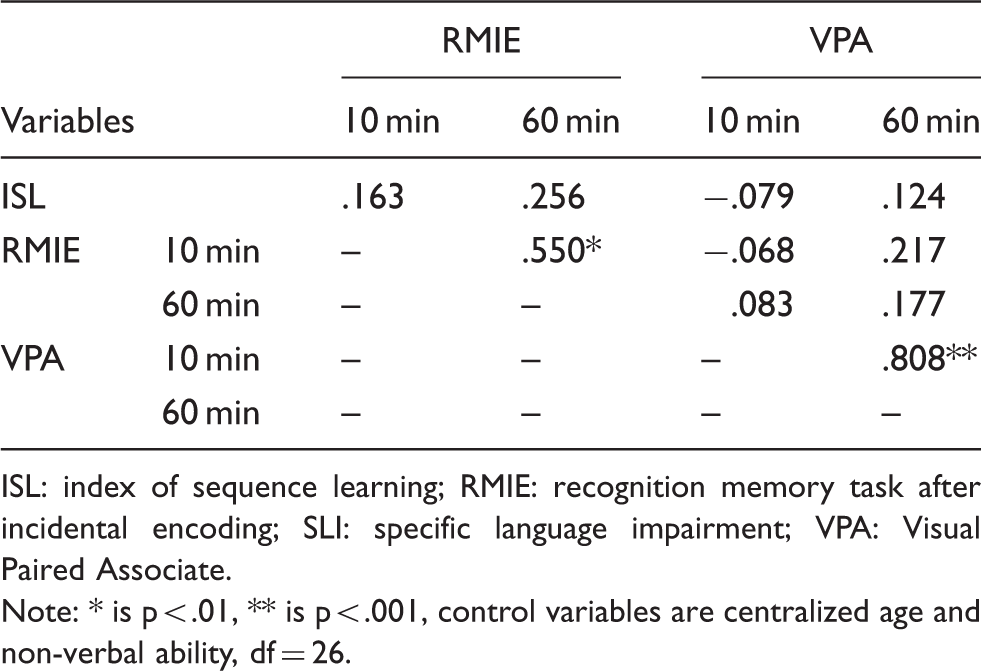
ISL: index of sequence learning; RMIE: recognition memory task after incidental encoding; SLI: specific language impairment; VPA: Visual Paired Associate.
Note: * is p < .01, ** is p < .001, control variables are centralized age and non-verbal ability, df = 26.
Discussion
The present findings showing no significant correlation between measures of procedural and declarative scores failed to support the compensatory hypothesis of PDH (Ullman & Pierpont, 2015) which claims that the relatively intact system could enhance its potential to compensate for the attenuated system. Since the SLI were at least preserved in their recognition memory a negative correlation between RMIE and ISL was predicted and would have suggested trade-off. Note, however, that the present tasks did not encourage simultaneous engagement of the two memory systems; trade-offs may be easier to observe within a single task. There is, for instance, some evidence that children with SLI do use declarative learning to master some aspects of grammatical morphology (e.g. Conti-Ramsden et al., 2015). Nevertheless, our data do not support the more radical prediction of Ullman and Pullman (2015) of a ‘seesaw effect’, whereby there is general enhancement of the declarative memory system as a consequence of a deficient procedural system.
Concluding remarks
We examined predictions made by the PDH and its compensatory hypothesis and confirmed that children with SLI have impaired procedural memory on a non-verbal SRT task. As predicted children with SLI showed intact (but not enhanced) declarative performance on a recognition memory task that employed incidental encoding of items (i.e. RMIE task), but not on a paired-associate task that employed intentional encoding of items and recall type of retrieval (i.e. VPA task). Furthermore, across retrieval types of declarative tasks, the pattern of performance was comparable in SLI and TD (see Bishop and Hsu (2015) for similar findings). Finally, the correlation between memory systems did not support a trade-off between memory systems as predicted by the PDH.
The present study has limitations that could be addressed in future studies examining compensation. First, we did not examine consolidation in procedural memory, but only in declarative memory (for studies reporting procedural consolidation deficits in children with SLI, see Desmottes et al., 2016; Hedenius et al., 2011). Second, encoding on the VPA task was not measured in the present study. Having a measure of intentional encoding would have resulted in a more comprehensive picture of where in the process the deficit lies in children with SLI. Finally, the findings on type of retrieval effects have to be interpreted with caution, since the tasks differed with respect to encoding and also stimuli use. Nevertheless, the present findings showing intact recognition but affected recall in SLI suggests that future experiments investigating declarative memory in SLI should use recognition paradigms to demonstrate declarative potential.
One limitation of any study looking at correlations between memory tasks concerns test reliability. An index derived from an experimental measure, such as the SRT task or a declarative learning task, is unlikely to be as reliable as a psychometric test. Variation in test results will result from uncontrolled factors, such as effects of guessing in multiple choice tests or fatigue in tasks relying on RT. Inter-correlations between test measures cannot be higher than the test–retest correlation of the test itself, and this is generally unknown for commonly used declarative and procedural measures. The lack of significant correlations between measures from two declarative tests cautions against assuming that different tests are all indexing a unitary system. On the other hand, there will also be influences that may drive spurious correlations between measures. No task gives a pure measure of the procedural or declarative system. Motivation and attentional variations are common confounding factors that may lead to measures being correlated. In our study non-verbal ability scores and age were used as covariates in partial correlation, but there could be other factors such as working memory (Oberauer, 2010) or attention (assuming SRT and RMIE partly involved attentional processing, see Jiang & Chun, 2001; Jiménez, 2003; Nissen & Bullemer, 1987; Turk-Browne, Jungé, & Scholl, 2005) that could influence the correlation findings. One conclusion from the current study is that there is a need for more basic research establishing measures of procedural and declarative learning that are reliable and valid enough for assessment of stable individual differences.
Clinical implications
There has been debate about whether explicit or implicit (recruiting declarative and procedural systems respectively) instructions yield better results in grammar intervention of children with SLI. Some language therapy techniques use predominantly explicit approaches (e.g. using shapes and colours to teach grammatical relations), which could capitalize on strengths in their declarative system (for review see Ebbels, 2013). Our findings, however, cast outside doubts on whether explicit grammar teaching is the best strategy for the following two reasons. First, children with SLI’s declarative memory is at its best only when explored more incidentally, that is, when children with SLI intentionally attempt to process information (i.e. associations in the present study) they are not as effective. Second, grammar relations in natural language are probabilistic, which makes them well suited for learning by the implicit memory system. There is certainly a need for more exploration in this direction. For example, it may be preferable to recruit the system that is readily made for learning grammar, i.e. the procedural system. Clinical experiments that contrast the effectiveness of grammar training in children with SLI using implicit and explicit methods would help us address this important issue.
Open questions for future research
At least two open questions are ripe for future investigation. First, if examining procedural and declarative systems separately does not reveal any trade-off, would it be more informative to engage the systems simultaneously in a single task (such as artificial language learning), where they can compete for learning? If we could find a way to quantify the contribution of each system, we may find more evidence of a trade-off. Poll et al. (2015) attempted this approach with some success by designing an experiment that engaged both the systems in natural language.
Second, we need studies that explore the nature of procedural deficits in SLI. Lum et al. (2014) reviewed work on studies that examined procedural memory using SRT and showed that sequence learning in SLI got better as a function of age and number of trials in the SRT task. To explore their nature of the procedural deficit further, at least two types of deficit within the procedural sequence learning mechanism could be worth examining. One possibility is an ‘efficiency deficit’ which assumes that the full range of the procedural learning is functional but inefficient. In which case, repeated exposures to procedural specific information (such as less predictable but linked elements in grammar, ‘a’ predicts ‘b’ only if the interelements are ‘x’ and ‘y’) would result in improved learning. Another, a ‘capacity deficit’ where the mechanism is limited in its range. In which case, despite repeated exposures to procedural specific information the learning saturates well before average. Such studies will closely tie the procedural deficits to nature of language being learned because procedural complexity varies both within and across language structures.
Authors’ contributions
SK: Conceived the idea and designed the experiments, analysed the data, wrote the paper, prepared figures and/or tables, reviewed drafts of the paper.
PR: Conceived the idea and designed the experiments, reviewed drafts of the paper.
DVMB: Analysed the data, assisted in writing the paper, reviewed drafts of the paper.
Footnotes
Acknowledgments
The authors thank the Director of AIISH for sanctioning the fund and Ms Sandya for helping with data collection and analysis. The authors also thank the participants for their time. Authors extend their gratitude to Lukács et al. and colleagues for sharing their ‘in preparation’ manuscript with us. Special thanks to Michael T Ullman and Paul Thompson for offering suggestions in theoretical basis and statistical analysis of this work respectively.
Declaration of Conflicting Interests
The author(s) declared no potential conflicts of interest with respect to the research, authorship, and/or publication of this article.
Funding
The authors disclosed receipt of the following financial support for the research, authorship, and/or publication of this article: The work was funded by All India Institute of Speech and Hearing (AIISH), Research fund, Sanction No. SH/CDN/ARF-13/2014- 15, to the first and the second author. The first author is currently supported by the Newton Fund.. The last author is supported by a Wellcome Trust Principal Research Fellowship (grant 082498/Z/07/Z).
Supplementary materials
The data in SPSS, SPSS syntax and syntax for analysis of data using R (for effect sizes) can be accessed from Open Science Framework link osf.io/svzf2.