




Abstract
Background and aims
Impaired production of third person accusative pronominal clitics is a signature of language impairment in French-speaking children. It has been found to be a prominent and persistent difficulty in children and adolescents with specific language impairment. Previous studies have reported that many children with autism spectrum disorder also have low performance on these clitics. However, it remains unclear whether these difficulties in children with autism spectrum disorder are due to structural language impairment or to pragmatic deficits. This is because pragmatics skills, notoriously weak in children with autism spectrum disorder, are also needed for appropriate use of pronouns. Use of pronouns without clear referents and difficulty with discourse pronouns (first and second person), which require taking into account the point of view of one’s interlocutor (perspective shifting), have frequently been reported for autism spectrum disorder.
Methods
We elicited production of nominative, reflexive and accusative third and first person pronominal clitics in 19 verbal children with autism spectrum disorder (aged 6–12, high and low functioning, with structural language impairment, or with normal language) and 19 age-matched children with specific language impairment. If pragmatics is behind difficulties on these elements, performance on first-person clitics would be expected to be worse than performance on third person clitics, since it requires perspective shifting. Furthermore, worse performance for first person clitics was expected in the children with autism spectrum disorder compared to the children with specific language impairment, since weak pragmatics is an integral part of impairment in the former, but not in the latter. More generally, different error patterns would be expected in the two groups, if the source of difficulty with clitics is different (a pragmatic deficit vs. a structural language deficit).
Results
Similar patterns of relative difficulties were found in the autism spectrum disorder language impairment and specific language impairment groups, with third person accusative clitics being produced at lower rates than first-person pronouns and error patterns being essentially identical. First-person pronouns did not pose particular difficulties in the children with autism spectrum disorder (language impairment or normal language) with respect to third-person pronouns or to the children with specific language impairment. Performance was not related to nonverbal intelligence in the autism spectrum disorder group.
Conclusions
The elicitation task used in this study included explicit instruction, and focus on perspective shifting (both visual and verbal), allowing for potential pragmatic effects to be controlled. Moreover, the task elicited a variety of types of clitics in morphosyntactic contexts of varying complexity, providing ample opportunities for employment of perspective shifting, which may have also curtailed perseveration of third person over first person. These properties of the task allowed for the grammatical nature of children’s difficulties with third-person accusative clitics to emerge unambiguously.
Implications
Assessment of structural language abilities in children with autism spectrum disorder requires careful consideration of task demands. The influence of pragmatic abilities on structural language performance can be circumvented by making the pragmatic demands of the task explicit and salient. Filtering out this potential influence on structural language performance is fundamental to understanding language profiles in children with autism spectrum disorder and thus which children could benefit from which kinds of language intervention.
Some verbal children with autism spectrum disorder (ASD) have difficulties with structural aspects of language (Allen, 1989; Eigsti et al., 2007; Tuchman et al., 1991; Wittke et al., 2017). However, little is known about the nature of these difficulties. One of the issues investigated in the literature on language development in ASD is to what extent the difficulties with formal language experienced by some children with ASD resemble specific language impairment (SLI) and whether the two conditions share similar etiologies (Bishop, 2010; Tager-Flusberg, 2006). SLI refers to a disorder affecting language only, i.e. when no other primary disorder has been diagnosed, such as intellectual disability, sensory impairment, or obvious neurological dysfunction (Leonard, 2014). Although few studies so far have directly compared language performance in children with ASD and children with SLI, studies investigating language impairment in children with ASD have revealed language difficulties similar to what is found in SLI, for example, grammatical marking of tense in English (Roberts et al., 2004), and complex constructions, such as relative clauses (Riches et al., 2010), wh-questions (Prévost et al., 2017) and passives (Durrlemann et al., 2017).
However, establishing the nature of language difficulties of children with ASD is not an easy task, as it is not always possible to tease apart language difficulties due to formal language impairment and those related to problems with pragmatics, namely the ability to use language in context, as the two are so densely intertwined. There is general consensus in the literature that children with ASD have severe difficulties with pragmatic aspects of language (Baron-Cohen, 1988; Boucher, 2003; Tager-Flusberg, 1981). These difficulties have typically been related to these children’s impaired social relations, and more generally to theory of mind (ToM) deficits, that is the ability to understand that people’s behavior is governed by feelings, thoughts, and beliefs (Capps et al., 1998; Happé, 1993; Tager-Flusberg & Sullivan, 1995).
The question that arises is therefore whether language errors or unexpected productions in children with ASD are due to pragmatic shortcomings (the children fail to understand the conversational situation) or whether they result from a linguistic breakdown. In a study of elicited production of wh-questions, children with ASD were found to produce many more unexpected answers than children with SLI (Prévost et al., 2017). For example, when prompted to ask a wh-question about what he/she is doing of a character presented in a drawing (e.g., What are you pushing?), some children with ASD tended to guess the answer to the question instead (e.g., a coconut) or to ask a yes/no question including a potential answer (e.g., Are you pushing the hedgehog?). Others displayed perseveration of one particular type of question (e.g., one form of objet wh-question used for a whole series of consecutive items and thus even for contexts eliciting a subject or an adjunct wh-question). Such answers were not characteristic of the children with SLI.
Another question raised by the investigation of structural language difficulties of children with ASD is the impact of nonverbal intelligence on language performance. Although links between nonverbal IQ (NVIQ) and general language abilities have been found in very young children with ASD (Ellis Weismer & Kover, 2015), studies that have examined older children across the whole spectrum have not reported any clear relationship between nonverbal development and language performance; some (verbal) “low functioning” children with autism (LFA) have been reported to perform within the typically developing (TD) range and some “high functioning” children with autism (HFA) have been reported to display low performance (Perovic et al., 2013; Roberts et al., 2004; Tuller et al., 2017). However, it is difficult to draw conclusions about the impact of cognitive development on language skills in ASD as most of the studies to date that have looked at language skills in individuals with ASD aged six and above have focused on HFA.
In this paper, we investigate these issues in a study of pronominal clitics in French in a population of verbal children with ASD. Difficulties with third-person accusative clitics (e.g., le “it” in Pierre
One way to address the question of whether difficulty producing pronominal clitics is due to pragmatics or syntax is to investigate children’s behavior with respect to elicitation of clitics other than third person, for example first-person clitics. If structural language difficulties in ASD have similar origins as in SLI, low performance on object clitics should be limited to third person; it should not extend to first-person object clitics. If, on the other hand, their difficulties are pragmatic in nature, then general low performance on object clitics should be observed, including first-person clitics. Interestingly, production of first-person clitics in the elicitation task used in this study involved a change of perspective on the part of the child, who had to identify with a character presented in a picture. Children with ASD may find this change of perspective particularly difficult. Changing perspective in this context, by asking children to identify with a character in a picture, is akin to some characteristics of pretend play, which has been reported to be particularly difficult for children with ASD (Hess, 2006). This may lead them to give unexpected or erroneous answers, in contrast to children with SLI. Performance on first-person clitics would then be expected to be lower than on third-person clitics, for both subjects and objects.
To our knowledge, the only published report to date on production of first-person clitics compared to third-person clitics in ASD is that by Durrlemann and Delage (2016). They administered a shortened version of the PPPC (Production Probe for Pronoun Clitics, Tuller et al., 2011), the complete version of which was used in this study, to 21 individuals with ASD aged 5–16 (M = 9;7) and 22 individuals with SLI of the same age range. On this shortened version of the PPPC, they found that while both groups performed worse than TD controls on third-person accusative clitics, only the ASD group performed below TD controls for first-person accusative clitics, and the SLI group, but not the ASD group, performed significantly better on first person than on third-person accusative clitics. They also found that a subgroup of seven participants with ASD and normal syntactic abilities (determined by a standardized test) performed much better on both first- and third-person accusative clitics than the 14 participants with subnormal syntactic scores, though the latter group was not compared to the SLI group. Finally, participants with ASD with low ToM abilities (n = 9) were found to score much lower on first-person accusative clitics than participants with intact ToM abilities (n = 5). Importantly, this study focused exclusively on accusative (first and third person) clitics. However, Durrleman and Delage’s conclusion that individuals with ASD have more difficulties with first-person clitics than with third-person clitics (because of impaired ToM) predicts that such a difference should also be found for nominative and reflexive clitics. In fact, given that accusative clitics are difficult in and of themselves (and thus some individuals would have difficulty in all persons), the putative first-person/third-person dissociation ought to be even stronger in non-accusative clitics, which have been shown not to be subject to difficulties the way accusative clitics are in young children and in children and adolescents with SLI (Tuller et al., 2011).
The present study sought to explore whether pragmatic difficulties and/or nonverbal cognitive level could account for structural language difficulties in children with ASD or whether, rather, structural language difficulties in children with ASD are fundamentally similar to those experienced by children with SLI.
Pronouns: Grammar and pragmatics
In French, subject (nominative), direct object (accusative) and reflexive personal pronouns are considered clitics due to their phonological, morphological, and syntactic properties as weak elements which do not have the status of independent words (in contrast with strong pronouns, such as moi “me”). Gender is marked on third-person nominative (3NOM) and accusative (3ACC) clitics, but not on first- and second-person forms, or third-person reflexives (3REF). Moreover, accusative and reflexive forms are homophonous in the first and second persons (me and te respectively). Finally, we note that clitic clusters consisting of a nominative clitic followed by an object clitic are relatively frequent in spoken French, even in sentences with a lexical DP subject (either with or without left-dislocation prosody and syntax), as in (1a), given that both nominative and object clitics occur to the left of the verbal element, illustrated in (1b–c).
(1) a. Max (il) lave son enfant. Max he washes his child ‘Max is washing his child.’ b. Max (il) le lave. Max he him washes ‘Max is washing him.’ c. Max (il) se lave. Max he himself washes ‘Max is washing himself.’
It has been argued that pronominal clitics involve different levels of complexity (Tuller et al., 2011). According to this view, 3ACC clitics are the most complex clitics since they show gender agreement, their reference must be established via syntax/discourse (in contrast to first- and second-person forms, which are deictic pronominals unambiguously referring to the speaker and the addressee), and they occur before the verb in French, which disrupts the canonical SVO word order in that language (1a).
For some scholars, this noncanonical positioning involves a dependency relationship between the clitic and its base-generated postverbal position, as a result of movement (Belletti, 1999), which increases the complexity of the derivation of the underlying structure. Object clitics differ from nominative clitics in that the latter occupy the canonical position for subjects in French. No extra operation is therefore required for their appearance. Accusative clitics also involve more complexity than reflexive clitics, although both refer to the object of the verb and appear in a preverbal position. For one, reflexives do not involve a gender distinction in French. Second, the antecedent of a reflexive clitic is always found within the same clause—it is the subject of the verb (e.g., Peteri sei regarde “Peter is looking at himself”). In contrast, accusative clitics refer to entities found outside of the clause in which they appear, either higher up in the same sentence (e.g., Peteri wants Mary to look at himi) or in the preceding discourse (e.g. Peteri is a boring person. Why does Mary like himi?). In sum, the cumulative effects of several different morphosyntactic properties (see Delage et al., 2016; Haiden, 2011; Tuller et al., 2011) argue that pronominal clitics can be placed along a complexity scale, schematized in (2), with subject clitics appearing at the bottom (the least complex elements) followed by reflexive clitics, which are more complex, and then accusative clitics, the most complex elements.
(2) Complexity scale for clitics:
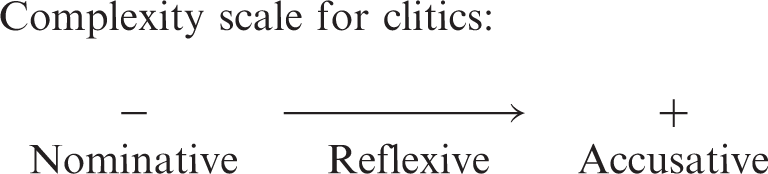
Development of pronominal clitics in French (and other clitic languages such as Italian) seems to be subsumed by this complexity scale, since subject clitics have been shown to emerge very early in child French, while accusative clitics are delayed by several months (Hamann et al., 1996). In elicited production, 3NOM clitics are produced at very high rates by young children, whereas use of 3ACC clitics is much lower, and production of reflexives falls somewhere in between (Zesiger et al., 2010). Instead of 3ACC clitics, children use object lexical noun phrases (DPs) (e.g., Il prend le jouet “He’s taking the toy” instead of Il le prend “He’s taking it”) or they omit the object altogether (e.g., Il prend). In children with SLI, these tendencies are exacerbated, with the production of 3ACC clitics remaining low after age 6 (Jakubowicz et al., 1998). Using the same elicited production protocol as in the present study, Tuller et al. (2011) reported that adolescents and young adults with SLI aged 11–20 (M = 14;8) produced significantly fewer 3ACC clitics than TD children aged 11 (49.7% vs. 97.9% respectively).
Few studies have looked at the development of pronominal clitics in ASD. As indicated above, some French-speaking children with ASD have been found to behave like children with SLI with respect to pronominal clitics, with particularly low production of 3ACC clitics (Durrlemann & Delage 2016; Tuller et al., 2017). In Greek, Terzi et al. (2014) reported lower comprehension and production rates for 3ACC clitics in a group of children with HFA aged 5–8 compared to TD age/IQ controls. Despite this difference, production and comprehension rates were high, 87.4% and 88.3% respectively (compared to 97.7% and 99.2% for the TD children). The lower performance of the children with ASD was attributed to impairment at the pragmatics–syntax interface (specifically, the pragmatic conditions which license use of a pronominal rather than a lexical DP). However, the tasks only included 3ACC clitics, thus preventing any generalization to other contexts. We also note that Greek being a null subject language, the targeted answers in the production task did not lead to the production of a clitic cluster in the preverbal position, in contrast to the probe used in this study and in Durrlemann and Delage (2016).
One potential source of difficulty that children with ASD may have with pronouns in general is that, as deictic terms, pronouns do not have a fixed reference. Deictic terms have been shown to pose particular problems for children and adolescents with ASD (see Hobson et al., 2010). With respect to pronouns, different forms, such as I and you, may refer to the same speaker within a conversation, which may lead to pronoun reversals in some (young) children with ASD, including high-functioning children, i.e. use of you by the child to refer to him/herself and use of I to address the interlocutor (Evans & Demuth, 2012; Naigles et al., 2016). This “pronoun atypicality” has been found in older individuals as well, in particular avoidance of first-person pronoun I in six-year-olds (Sterponi & Kirby, 2015). Moreover, neurolinguistic data from adults have revealed differences between individuals with ASD and neurotypical participants in processing of deictic shifting required by pronouns, and in particular reference to oneself (Mizuno et al., 2011).
These difficulties may be related to broad social deficits, in particular impaired social and communicative skills, including conceptual perspective-taking (Loveland, 1984). Not being able to adopt the point of view of others may lead certain children to misunderstand how pronominal elements are used in conversations. Failure to adopt the perspective of the interlocutor may ultimately be due to impaired ToM, which has been argued by some to be at the core of pragmatic difficulties in children with ASD (Baron-Cohen, 1988; Happé, 1993). Perspective shifting also requires cognitive flexibility, which may be impaired in ASD (Kissine, 2012). Accordingly, shifting perspective may be particularly difficult for children with ASD. Under these approaches, children with ASD should perform worse in a task eliciting the production of pronouns which require a switch in perspective taking versus pronouns which do not involve such a switch. Moreover, the predicted weakness with first-person pronouns being related to the use of the first person, it should extend to all such pronouns, whether they are nominative, reflexive or accusative. In a language like French, difficulties with first person are crossed with difficulties due to the morphosyntactic complexity of clitics, which is highest for accusative clitics. In order to determine whether difficulties are due to person or to clitic type (accusative, reflexive, nominative), it is fundamental, we argue, to test first person clitics in all of these syntactic functions.
Methods
Participants
Participant characteristics.

RPM: Raven’s Progressive Matrices. Results are given in percentiles. For statistical convenience, we converted percentile ranges provided by norms into midpoint percentiles (e.g., 5th to 10th percentile was transformed into percentile 7.5), as suggested by Botting and Conti-Ramsden (2008).
Based on 16 children with autism spectrum disorder (ASD) and 17 children with specific language impairment (SLI).
Word repetition subtest (z-scores) from Bilan informatisé de langage oral au Cycle III et au collège (BILO-3; Khomsi, Khomsi, Parbeau-Guéno, & Pasquet, 2007).
Sentence completion subtest (z-scores) from BILO-3.
Receptive vocabulary (z-scores) from Evaluation du langage oral de l'enfant aphasique (ELOLA; De Agostini et al., 1998).
The 19 children with SLI (12 boys and 7 girls) all had a diagnosis of phonological–syntactic impairment, and, following usual exclusionary criteria, had IQs within norms. An MLU analysis of spontaneous production on 17 of the children with SLI revealed no significant difference with the children with ASD-LI (U(28) = 75.5, p = .395).
Finally, there were three control groups of TD children, a group of 14 children aged 4, in order to provide information on early typical development, another group comprising 12 children aged 6, the age of the youngest children in the ASD and SLI groups, and a third group of 12 8-year-olds, the mean age of the ASD and SLI groups. The TD children were all monolingual French-speaking children, recruited in ordinary schools. They were all at grade level for their age; moreover, they were not experiencing any learning difficulties, and were not receiving any specialized therapy (speech–language, psychological, etc.). These children were however not given any of the standardized tests (IQ or language).
Material and procedure
Number of first- and third-person object clitics elicited in the accusative and reflexive conditions (subject clitics were elicited in all 32 items of the task).

Figure 1(a) and (b) illustrate items eliciting third-person and first-person accusative clitics, while examples of items eliciting third-person and first-person reflexive clitics are shown in Figure 1(c) and 1(d). In items designed to elicit a first-person clitic, it was explained to the child that he/she was supposed to be a character shown on the picture, and that this character was being asked a question, which appeared in a carton bubble (Figure 1(b) and 1(d)). In order to prompt the child to answer, the bubble for the question disappeared and a blank bubble appeared out of the mouth of the character that he/she was supposed to be. The answer was expected to include je “I” and me, the first-person pronominal form (in either the accusative or reflexive condition – recall that first-person nonreflexive and reflexive forms are homophonous in French). In both the accusative and the reflexive conditions, production of first-person clitics was expected to be particularly difficult for children with ASD since it involved a switch in perspective.
(a) Elicitation of third-person nominative and accusative clitics. (b) Elicitation of a third-person nominative clitic and a first-person accusative clitic. (c) Elicitation of third-person nominative and reflexive clitics. (d) Elicitation of first-person nominative and reflexive clitics.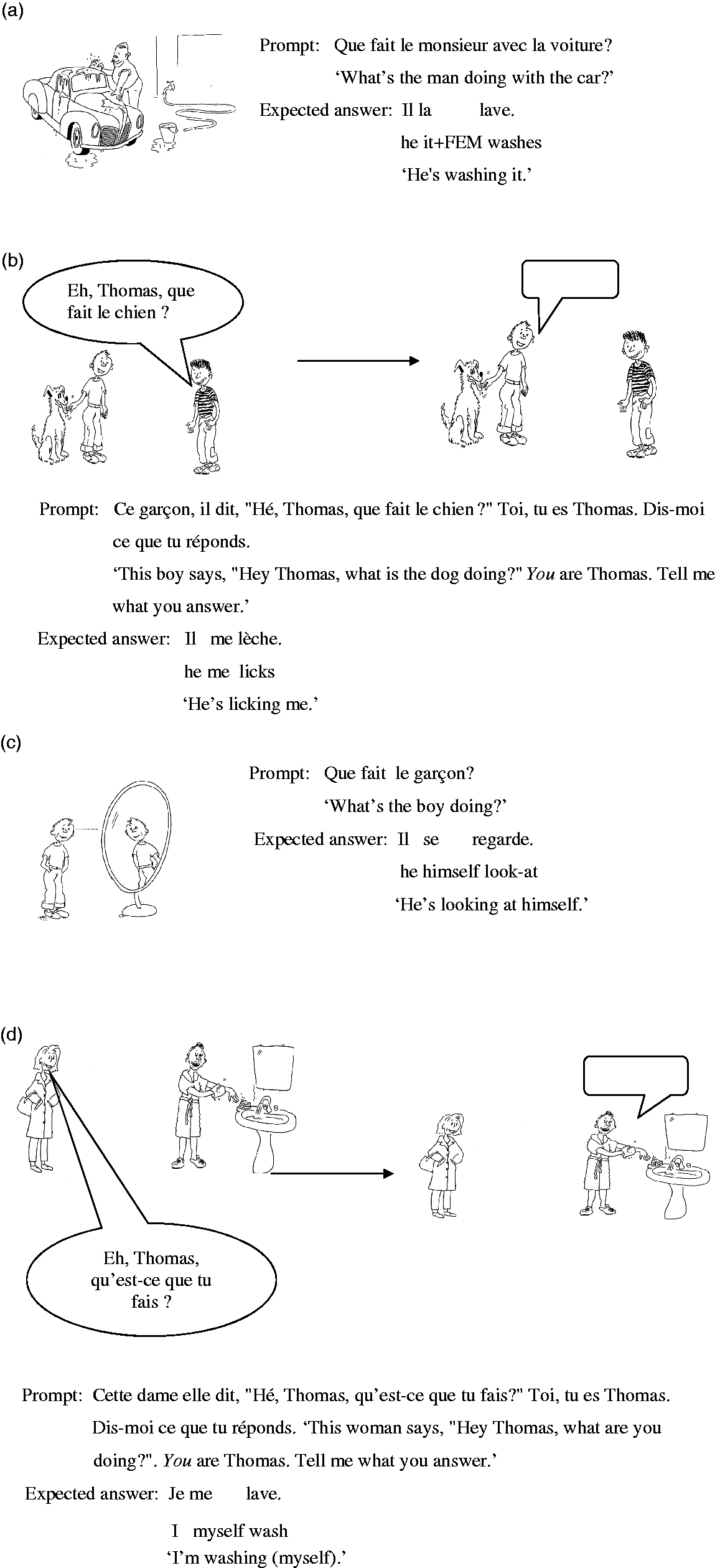
All experimental sessions were audio-recorded and transcribed. All answers obtained for the elicited production task were coded for clitic production and errors. Both transcription and coding were verified entirely by expert psycholinguists, and all points of divergence were resolved via discussion.
The specific research questions were as follows:
Do children with ASD (with or without LI) have specific difficulties with first-person clitics, compared to children with SLI and to TD children? Do children in the ASD-LI group behave like children with SLI with respect to clitic production? In particular, are they worse at 3ACC clitics compared to 1ACC clitics? Do the children in the ASD-LN group behave like TD children aged 8? Do children in the ASD-LI group behave like the children with SLI with respect to error patterns? Do the children in the ASD-LN group behave like TD children aged 8 regarding errors? Is the performance of the children with ASD and of the children with SLI related to their nonverbal cognitive level?
Results
Shapiro–Wilk tests revealed non-normal distributions for most measures in each group. Hence, nonparametric statistical tests were used in this study. We first report the results on the production of first-person clitics (Figure 2), which is then compared to performance on third-person clitics (Table 2). Production here refers to the production of target clitic forms as well as production of first (and third) person dative (DAT) clitics, which although they were not targeted by the task, are nonetheless correct, and are homophonous with ACC clitics, as illustrated in (2) for first-person forms.
1
(2) Elle me mord le doigt. (BRL, ASD, 6;10) she me.DAT bites the finger ‘She bites my finger.' (Target: Elle me mord) she me.ACC bites ‘She bites me.' Production rate of first-person nominative (1NOM), reflexive (1REF), and accusative (1ACC) clitics in each group.

Production of first-person clitics
Mean production rates for first-person clitics in each of the six groups of children (ASD-LN, ASD-LI, SLI, TD4, TD6, and TD8) are given in Figure 2.
Kruskall–Wallis analyses revealed significant between-group differences on first-person reflexive clitics (1REF) (X2 (5, N = 76) = 17.048, p = .004) and 1ACC clitics (X2 (5, N = 76) = 19.821, p = .001). No significant between-group differences were found on first-person nominative (1NOM) clitics (X2 (5, N = 76) = 10.064, p = .073). Interestingly, the ASD-LI and SLI groups performed similarly on all three clitic forms: 1REF (U(33) = 115, p = .504), 1ACC (U(33) = 118, p = .480), and 1NOM (U(33) = 104.5, p = .284). At the individual level, no differences could be found between the two groups either. In particular, the number of children not producing a single first-person clitic was almost the same in each group: for 1NOM there was one child with ASD and two children with SLI, for 1REF there were three children with ASD and three children with SLI, and for 1ACC there were one child with ASD and three children with SLI.
The children in the ASD-LN group had relatively high performance on the three types of clitics (75–80%), much higher than the results on 1REF and 1ACC in the ASD-LI group (around 55%), but lower than what was observed in the TD8 group (over 90%). However, no significant differences were observed, which was presumably due to the small size of the ASD-LN group (n = 5).
Comparisons with the TD groups revealed comparable tendencies for the ASD-LI and SLI groups on 1REF and 1ACC, the two conditions for which both groups performed most similarly (see Figure 2). No significant differences were found between either of these groups and the TD4 group for 1ACC, but one was found for 1REF between the TD4 group and the ASD-LI group (U(27) = 53, p = .030, r = −.409). In contrast, the ASD-LI and SLI groups performed significantly lower than the TD8 group for both types of pronominal clitics. Finally, while both the ASD-LI and SLI groups performed significantly lower than the TD6 group for 1REF (ASD-LI: U(25) = 31.5, p = .004, r = −.559; SLI: U(30) = 58, p = .015, r = −.435), only the children in the ASD-LI group performed significantly lower than the TD six-year-olds for 1ACC as well (U(25) = 33, p = .008, r = −.524). For 1NOM, no significant differences were found between the ASD-LI group and the three TD groups, but the SLI group performed significantly below the children in the TD6 group (U(25) = 61, p = .025, r = −.402) and the TD8 group (U(25) = 50.5, p = .007, r = −.485).
In sum, it was not the case that the children with ASD, be they with our without language impairment, produced fewer first-person clitics than the children with SLI did. The performance of the ASD-LI group for 1NOM forms was in fact better than that of the SLI group (and close to that of the TD6 group), while for 1REF and 1ACC the two groups performed almost identically. The performance of the ASD-LN group for 1REF and 1ACC was better than that of the ASD-LI group, but lower than TD children, although not significantly so.
Comparing production of first- and third-person clitics
Mean production rates (and SD) of first- and third-person nominative, reflexive, and accusative clitics in each group.

ASD-LI: autism spectrum disorder with structural language impairment; ASD-LN: autism spectrum disorder with normal language; SLI: specific language impairment; TD: typically developing.
Number of children with low production (<−2 SD w.r.t. TD6 group) and higher production (≥−2 SD w.r.t. TD6 group) for 1ACC and 3ACC in each group.

ASD-LI: autism spectrum disorder with structural language impairment; ASD-LN: autism spectrum disorder with normal language; SLI: specific language impairment; TD: typically developing.
Note: For 1ACC and 3ACC, low production corresponded to production rates below 50.5% and 39.6%, respectively.
Error patterns
Did the children in the ASD-LI group behave similarly to the children with SLI when they did not produce a (first person) clitic? Figures 3 to 5, which display the percentages of the different strategies used based on the total number of items targeted, show that strategies differed according to clitic type and that the ASD-LI children behaved like the children with SLI. For nominative forms (Figure 3), two main strategies were found, those labeled “non-target/no response,” which included verbless utterances and responses unrelated to the prompt (and which were not contexts for clitic production), as in (3), and substitutions involving either person, as in (4a), or gender, as in (4b).
1NOM and 3NOM: types of errors produced over total responses, in each group. 1ACC and 3ACC: types of errors produced over total responses, in each group.
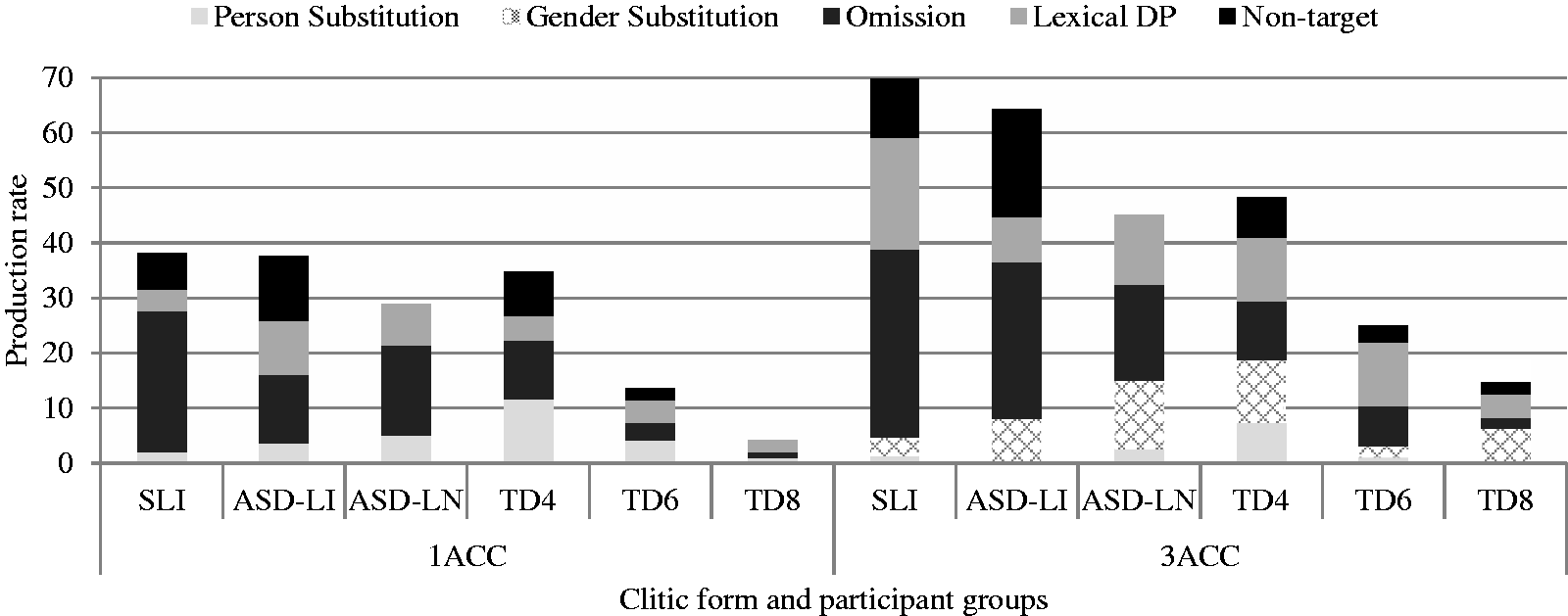
Nontarget/no response responses were found both for 1NOM and 3NOM forms, especially in the ASD-LI and SLI groups. They were used to a similar extent for each form by each group (around 14% in the ASD-LI group and around 9% in the SLI group). No significant differences were found between these two groups on either form (1NOM: U(32) = 132, p = .968; 3NOM: U(32) = 86, p = .081). There were also no significant differences between use of nontarget forms for 1NOM and 3NOM in either group (SLI: Z(18) = −.727, p = .467; ASD-LI: Z(13) = −.089, p = .929).
(3) a. Balance. (JOC, ASD, 6;4) scale (Target: Il se pèse) he himself weighs ‘He's weighing himself.' b. é prend un bain. (ROA, SLI, 6;8) she (?) takes a bath (Target: Je me sèche) I myself dry ‘I'm drying myself.' (4) a. Il se regarde. (FRA, ASD, 6;3) he himself look-at ‘He's looking at himself.' (Target: Je me regarde) I myself look-at ‘I'm looking at myself.' b. Elle me lèche. (MAB, SLI, 7;0) she me.ACC licks ‘She's licking me.' (Target: Il me lèche) he me.ACC licks ‘He's licking me.'
Person substitutions were mainly observed when 1NOM forms were targeted, and they always involved use of 3NOM clitics instead (4a). These were mainly found in the SLI, ASD-LN and TD4 groups, and in each group they were due to very few children. In each of the ASD-LN and TD4 groups, one child used a 3NOM clitic in all his/her answers where a 1NOM form was expected; in the SLI group, one child used 3NOM forms in seven of the eight items targeting 1NOM. Although fewer cases of person substitution were found in 3NOM items (most substitution cases involved gender errors, see (4b)), it is worth noting that some children used a 1NOM clitic to a relatively large extent: one child in the ASD-LI group (6 cases) and one in the SLI group (11 cases). In sum, no particular trend could be identified in the children with ASD, in comparison to the children with SLI, with respect to person substitution involving subject clitics. Finally, relatively few cases of omission and substitution by a full DP were found for nominative clitics, in any group.
For reflexive contexts, the main strategy was omission, and this was mostly observed in the ASD-LI and SLI groups. As can be seen in Figure 4, this occurred in both 1REF and 3REF contexts, to a roughly similar extent (between 20% and 30% for each person in each group). No significant ASD-LI/SLI difference was found for either person regarding omission (1REF: U(32) = 132.5, p = .984; 3REF: U(32) = 126.5, p = .803), and no significant difference was found between 1REF and 3REF omission within either group (ASD-LI: Z(13) = −.071, p = .943; SLI: Z(18) = −1.725, p = .084). Nontarget/no response strategies were also found, mainly in the ASD-LI and SLI groups, but no particular trends could be established there either: they occurred in both 1REF and 3REF contexts and were due to very few individuals (e.g., three children in the ASD group and one in the SLI group for 1REF). Person substitution was rare, except for one child in the ASD-LN group, the same child who had substituted all 1NOM clitics by 3NOM forms (see above). Similarly, he used 3REF clitics instead of 1REF clitics (4a).
1REF and 3REF: types of errors produced over total responses, in each group.
In accusative contexts, the alternative strategies observed were similar to those found in reflexive contexts: predominance of omission errors and presence of nontarget/no responses (see Figure 5). These tendencies were exacerbated in 3ACC contexts, where the omission rate was at around 30% in both the ASD-LI and SLI groups. Again, no significant difference could be found between these two groups on either 1ACC (U(32) = 126.5, p = .803) or 3ACC (U(32) = 129.5, p = .897). Finally, there was very little person substitution, in any group.
Correlation coefficients for Raven’s Coloured Progressive Matrices (RPM) scores and the production of clitics in the autism spectrum disorder (ASD) and specific language impairment (SLI) groups (rs).

For all coefficients, df = 18, p > .05.
For all coefficients, df = 13, p > .05.
Discussion
The objective of this paper was to investigate the nature of language difficulties experienced by children with ASD. In particular, we set out to examine to what extent structural language performance in this population is influenced by pragmatics, which we know is impaired in ASD, or whether (some) structural language difficulties in ASD are similar in nature to those observed in SLI. Production of first and third person nominative, reflexive, and accusative clitics in French was elicited in a group of 19 children with ASD (aged 6;3 to 12;9), divided into two subgroups depending on whether they had language impairment (the ASD-LI group) or not (the ASD-LN group), based on standardized test scores, a group of 19 age-matched children with SLI, and three groups of TD children aged 4, 6, and 8.
The performance of the children in the ASD-LI group and of the children in the SLI group was quite similar, both in terms of production rates for the different types of clitics and in terms of error types. In both groups, performance was the lowest on 3ACC forms, and no difference was observed between the two groups on first-person clitics, be they nominative, reflexive, or accusative. Interestingly, the production rate for 1ACC was in fact higher than that of 3ACC, significantly so in the ASD-LI group. Concerning error types, first-person forms did not lead to significantly more substitution or omission errors in the ASD-LI group compared to the SLI group, or to production of more nontarget responses. Errors on first-person clitics were mainly due to a few individuals in each group. A few children in the ASD-LI group substituted most or all of the first-person forms with third-person forms, or produced a large number of nontarget answers; we also found children in the SLI group with exactly the same behavior. Moreover, a couple of children produced the opposite substitution (first person in place of third person), suggesting that person substitution might in fact be task-related, as items eliciting first and third person were interspersed and in equal proportion. In short, difficulties in clitic production were neither specific to first-person forms compared to third-person forms (on the contrary), nor was production (rate or error type) of first-person clitics any different in the ASD-LI group compared to the SLI group. Furthermore, no significant SLI/ASD-LI differences were found for production of nontarget responses (responses that entailed avoidance of a pronominal), on any elicited form, including first-person clitics.
In contrast to the children in the ASD-LI group, the children with ASD considered to have normal structural language skills (ASD-LN) performed much more like the TD children (see also Durrlemann & Delage, 2016; Terzi et al., 2014). ASD-LN production rates for all clitics were higher than those of the ASD-LI group. It should be recalled, however, that the ASD-LN group had only five children (and Durrleman & Delage’s only seven). Needless to say, future research exploring language capacities of children with ASD would benefit from exploration of sufficiently large groups of individuals with and without language impairment in order to determine precisely how they compare with TD children.
While particular problems with first-person clitics could have been expected for the children with ASD, as explained above, due to the perspective shifting required by the elicitation of these forms, we believe that difficulties with perspective shifting may have been alleviated by what the children were explicitly asked to do. In our production task, the pragmatic situation for eliciting first-person clitics was made particularly salient, both via directions given to the child (Now
We believe that a similar process was at play in our elicitation task. In contrast, when too little information is given to the child about the pragmatic situation and what is expected of him/her, performance decreases and non-target responses are observed. This, we claim, is what happened in another study examining language proficiency in the same children as the ones involved here. In that study, reported in Prévost et al. (2017), production of wh-questions was elicited by showing the children pictures in which a character was performing an action and part of the event was invisible. The child was instructed to ask a question of the character about what he was doing (e.g., Look! The rabbit is pushing someone, but we don’t know who. Ask him). Although, as the example shows, the child was provided with the target verb and the target wh-word (which should have triggered the expected answer Who are you pushing?), no other clue, verbal or visual, was given to the child. In that study, the percentage of non-target responses was significantly higher in the ASD group (39.4%) than in the SLI group (12.1%). The difference between that study and the study reported in the present paper strongly suggests that in order to evaluate the language skills of children with ASD, in tasks where context is crucial, this information must be provided in a salient way. If not, researchers run the risk of triggering a high number of (nontarget) responses which will be difficult to interpret as they may result from impaired structural language or impaired pragmatic skills. These results echo previous findings showing that individuals with ASD may be particularly sensitive to the difference between “open-ended” tasks and tasks including explicit instruction (Happé & Frith, 2006; Koldewyn et al., 2013). 2
The results of our study suggest that children with language impairment (with SLI or with ASD) find it especially hard to produce constructions involving higher levels of computational complexity, such as that entailed by 3ACC forms in French. As explained above, such pronouns not only disrupt the canonical word order in this language, in contrast to nominative clitics, they require their referent to be found outside of the clause in which they appear, in contrast to reflexives, and their forms differ according to gender, in contrast to all other pronominal clitics (see Tuller et al., 2011). The findings reported in this study are in line with other findings suggesting the children with ASD and language impairment have difficulties with complex constructions (see Condouris et al., 2003; Durrlemann et al., 2017; Riches et al., 2010; Tuller et al., 2017).
As suggested above, our study suggests that tighter control of the pragmatics involved in the linguistic phenomena under scrutiny may lead to more meaningful assessment of the language capacities of children with ASD. In turn, conducting a thorough investigation of the linguistic phenomena in question provides better insight into the role pragmatic deficits could play in the performance of these children. Pragmatic deficits constitute one of the usual suspects for explaining lower performance of children with ASD with respect to (age-matched) TD children on language tasks, and this seems to be quite legitimate when the two groups of children differ (by definition) in pragmatic skills, with otherwise comparable language and nonverbal capacities. However, when deeper/more fine-grained investigation of the same linguistic phenomenon is possible, in particular when pragmatic deficits make clear predictions as to the outcome, then more fine-grained understanding of the effect of pragmatics can be gained. This is, we believe, what is at stake in the investigation of pronominal forms in ASD. By investigating both third-person and first-person clitics, nominative, reflexive and accusative, and by using an elicitation task which provided explicit and salient information to participants about what was expected of them, our study yielded results which suggest that the difficulties with production of pronominal clitics may in fact be more syntactic in nature. We are, of course, not suggesting that the explicit instruction about perspective shifting in this elicitation task means that it is devoid of any possible pragmatic effects, and indeed the few substitutions involving production of a third-person pronoun instead of a first-person pronoun could be imputed to pragmatic issues (but notice that such errors were encountered in few individuals not only coming from ASD-LI group, but from the SLI group as well). We are merely suggesting that a language task can be more or less bound to pragmatic properties and that the potential effects of pragmatics can be considerably reduced when they are directly taken into account in the design of the task.
Durrlemann and Delage (2016) also compared clitic production of 1ACC and 3ACC clitics, and suggested that impaired ToM was responsible for the performance on 1ACC in their ASD group. This suggestion was based on two results. First, there appeared to be a difference in performance on 1ACC among the 14 children for whom ToM scores were available: five children with intact ToM scores tended to perform better than nine children with impaired ToM scores (but no correlation was reported between the two scores). Second, although their ASD group as a whole (n = 21) did not produce fewer correct 1ACC clitics than 3ACC clitics, and did produce 3ACC clitics at a similar rate as the SLI group, they produced fewer correct 1ACC clitics than did the SLI group and the TD controls, which did not differ from each other. Individual results, provided only for the 14 (/21) children who had ToM scores, do not seem to reveal any dominant profile: several children performed well ( > 75%) on both clitics (n = 5), some very poorly on both (n = 4), a couple of children showed good performance on ACC1 and poor performance on ACC3 (n = 2), and a couple the opposite (n = 3). These results are difficult to interpret because the ASD group, as well as the two ToM subgroups, included both ASD-LI and ASD-LN participants, and thus there may have been confounds. The results from our study argue that the ASD-LI and ASD-LN groups may show very different patterns, the performance of the former resembling that of children with SLI, the performance of the latter looking like that found in TD children, and no child in either group displaying low performance on 1ACC and high on 3ACC. The diverging results reported in the two studies on 1ACC clitics may be related to a fundamental difference in the tasks that were used, and which is in fact related to our major conclusion about the sensitivity of children with ASD to task design. As explained in Pronouns: Grammar and pragmatics and Methods sections, the original PPPC task, used in the present study, included a variety of first person contexts, nominative, reflexive and accusative, whereas the shortened version used in the Durrlemann and Delage’s study included only eight items eliciting a first person pronoun, and only 1ACC. In the original task, eight items also elicit 1REF (and 1NOM) clitics, entailing a configuration in which the person of the two clitics of the cluster agree in person (je me “I myself”), and eight items elicit 1ACC clitics, in a configuration in which there is number mismatch (il/elle me “he/she me”). As Delage et al. (2016) have shown (see also Haiden, 2011), morphological features of the clitic cluster influence performance even in TD children, with mismatch increasing the complexity of the required calculation. The original task includes the simpler configurations alongside the more complex ones, whereas Durrlemann and Delage’s task includes only the more complex ones. There is reason to believe that at least some children with ASD may be particularly sensitive to frequency/priming effects, perhaps related to their tendency to perseverate (see Prévost et al., 2017). It is therefore not inconceivable that a task requiring children to change perspective for such a small number of (complex) items (8/20 compared to 16/32 in the original version, used here) may have been especially difficult for some participants with ASD. We believe that the difference in results from these two studies illustrates the potential subtle factors that may influence syntactic performance in children with ASD. If this line of reasoning is on the right track, the possible link with ToM abilities takes on a new dimension. Our study did not include a ToM task, however; potential links between ToM and pronoun use in ASD clearly deserves to be explored in future research in greater detail.
Another variable often raised as a potential explanation for language impairment in children with ASD is that of nonverbal intelligence. Our participants and those in the Durrlemann and Delage’s study had mixed levels (impaired and normal). It is remarkable that in neither the Durrlemann and Delage’s study nor in ours was any relation with NVIQ found. This suggests that language performance, and more particularly complex language skills (as evidenced by the lack of significant correlations involving accusative clitics), may be independent from nonverbal capacities of children who have language (see also Condouris et al., 2003; Perovic et al., 2013).
We believe that the results presented here have shown that particular testing methods may circumvent potential effects of weak pragmatics on morphosyntactic performance in children with ASD. It does not seem to be the case that these children are devoid of pragmatic competence, but rather that tapping into it may require more explicit avenues than in TD children. It has therefore not been suggested that pragmatics cannot in principle affect morphosyntactic performance in these children. In order to understand this influence, however, future work on structural language impairment in ASD will benefit from careful consideration of experimental design, as well as careful recruitment of large and diverse groups of participants with ASD.
Footnotes
Acknowledgments
We are grateful to clinicians at autism centers at university teaching hospitals in Tours and in Brest: C. Barthélémy, M. Bataille, P. Dansart, E. Lemonnier, and J. Rozec. The comparison with SLI was possible thanks to E. Sizaret and A.-G. Piller, and A. Galloux at the Language Reference Center of the children's hospital in Tours. We'd also like to thank the students involved in this study: M. Aillet, C. Damourette, L. Dupuy, S. Galès, E. Léger, and E. Morin.
Declaration of conflicting interests
The authors alone are responsible for the content and writing of the paper.
Funding
This research was supported by French National Research Agency grant BLAN-0328-01.