




Abstract
This article examines how blending both traditionally masculine and feminine traits in an organizational culture might create value for a company. The article examines workplace defaults and compares and contrasts masculine and feminine traits. Then, the results of an analysis of the research on how masculine defaults create and destroy value in organizations are examined. Next, the article presents the findings from research examining how masculine and feminine traits and behaviours can create and destroy value. Finally, the article examines the impact of hybrid or androgynous traits and behaviours and presents directions for future research.
Introduction
In today’s work environments, culture is seen as an important, though elusive, determinant of success. ‘Culture eats strategy for breakfast’, attributed to Peter Drucker, suggests it is the culture of the company that determines the organization’s success, beyond the effectiveness of the organization’s strategy (Engel, 2018). One facet of workplace culture that organizations could benefit from examining is which gendered norms and traits create value for organizations and which destroy value.
Culture is commonly described as ‘the desires, end goals, and customary practices of the corporation’ and the culture influences the actions and communications of all employees (DeTienne et al., 2004, p. 29). As Geert Hofstede put it, ‘culture is the collective programming of the human mind that distinguishes the members of one human group from those of another. Culture, in this sense, is a system of collectively held values’ (1980, p. 24). Perhaps the most popular definition of culture is Ed Schein’s definition as ‘a pattern of shared basic assumptions that was learned by a group as it solved its problems of external adaptation and internal integration, that has worked well enough to be considered valid and, therefore, to be taught to new members as the correct way to perceive, think, and feel in relation to those problems’ (Schein, 2018, p. 17).
Culture affects how power is distributed within organizations, the priorities organizations pursue, how those within the organization view others’ capabilities, how behaviour is rewarded, and whether those within the organization will cooperate with business directives (Hofstede, 1980). So how do gender norms and traits play into organizational cultures and outcomes? Through an analysis of the most recent decade of research, our research answers the following questions:
Q1: How do masculine workplace defaults create and destroy value?
Q2: How do masculine and feminine traits and behaviours create and destroy value?
Q3: What is the impact of integrated or androgynous traits on value creation?
In other words, when is it preferable to have competition or cooperation, taking or giving and striving or nurturing? Instead of charging ahead, when is it time to reflect? This is where a discussion around masculine, feminine, and hybrid or integrated cultures becomes valuable.
There is significant political debate about sex, gender and biological mutability. Rather than weigh into this debate, our research focuses on stereotypical traits—masculine, feminine and integrated—the ways they impact workplaces, and the ways each of these traits could be beneficial to individuals within an organization. By doing so, we draw on Wheadon and Duval-Couetil’s (2021) charge to move from a “fixed mindset” that assumes traits according to sex, to a “growth mindset” (Dweck, 2008) ‘that emphasizes learnable skills that differ according to context’ (Wheadon & Duval-Couetil, 2021, p. 321).
Our analysis shows that very little research has been done to examine workplace defaults and gender norms, alongside stereotypical gender traits, to determine which create value and which destroy value, and which depend on the context. This article’s unique theoretical contribution is that it aggregates these traits and their relative value potential in a single source. This article also synthesizes the research that has been done, highlights the gaps in the literature, and suggests directions for future research.
To further understand the ways gender traits impact the workplace, we conducted a literature review to examine themes and patterns. This article first goes over theoretical frameworks we considered with masculine workplace defaults, gender norms and gender traits. We then discuss the parameters and methods we used in selecting the literature for this article. After this, the article examines the literature from the past decade related to masculine workplaces, gender norms and masculine, feminine and integrated traits, including which of these create or destroy value, how to attenuate value destruction, and which traits depend on the context. Finally, we present directions future researchers could take in expanding the findings in this field.
Theoretical Framework
In defining whether or not a trait creates or destroys value, we pull from the eight principles of value creation given by Mahajan (2017), namely that value and creating value: (a) are necessary for society to thrive; (b) go beyond what is expected; (c) are cocreated between producers and users; (d) impact all stakeholders; (e) allow all within an organization to thrive; (f) can be tools organizations use to make decisions and solve problems; (g) must be conscious and outweigh value destruction; and (h) are created through strong values (such as honesty, integrity and fairness). Considering this framework, in this review we considered ‘value creation’ for workplaces to include improving an organization’s profitability or contributing to transformational leadership or psychological safety.
Masculine Workplace Defaults
The past few decades have seen drastic shifts in what many in the United States see as acceptable gender norms and practices, and much progress has been made towards creating more egalitarian workspaces. However, masculine defaults still persist, and many in the workplace still engage in behaviours that have been historically, or are currently, defined by researchers as masculine or feminine (Campuzano, 2019; Chau & Quire, 2020; Cheung et al., 2016; Mui & Hill, 2023; Powell & Butterfield, 2017; Schock et al., 2019; Swail & Marlow, 2018; Wang et al., 2023; Wheadon & Duval-Couetil, 2021; Zhang et al., 2019).
Leaders and researchers need to be aware of the common, and often unquestioned ways, gender plays out in the workplace (Acker, 1990; Britton, 2000; Cheryan & Markus, 2020; Hentschel et al., 2021; Kanter, 2008). Acker (1990) argues organizations are masculine by default, and while many organizations claim to be gender neutral, ‘gender is difficult to see when only the masculine is present’ (Acker, 1990, p. 142). In other words, being a professional is often equated with stereotypically masculine qualities (Kelan, 2010).
Within workplaces, there is also an archetype of what Acker calls a ‘perfect worker’. Acker’s work describes a perfect worker as someone who fits masculine norms and who has few needs outside of work. She notes ‘masculinity is clearly distinguished from actual men, who may differ in their practice of masculinity from this consensus’ (Acker, 2006, p. 186).
Some of the drawbacks of a masculine workplace are being recognized and there are calls for more sustainable work environments everywhere. People want to feel productive, supported and at their best every day, and research suggests supplementing a traditionally masculine culture with qualities from feminine or integrated cultures can create this type of environment (Westbrook & Peterson, 2022; Westbrook et al., 2022). Mindfully retaining select masculine traits while also adding feminine and integrated characteristics can support the long-term success employees are looking for and beginning to expect.
At the same time, we point to the continued popularity of masculine leadership styles, represented by books like Jocko Willinck’s ‘Extreme Ownership’, and the recent ‘Alpha Con’ that celebrated hypermasculinity (Walter, 2022). Workplaces that are more masculine may lose out on benefitting from employees who do not meet these norms (Cheryan & Markus, 2020). While ownership, strength and other traditionally masculine traits are laudable, we argue they alone are insufficient for business success. As discussed below, evidence suggests that even when a workplace is predominantly masculine, it is more effective and valuable when paired with traditionally feminine traits.
The default language of business is full of aggressive metaphors, with an ‘eat or be eaten’ mentality. In workplaces that embrace a masculine norm, an aggressive culture can spread throughout the workplace, and negatively affect employees (Restubog et al., 2015). On the other hand, workplace cultures may face challenges if the default masculine culture were replaced by a solely feminine one. For instance, research suggests that passive leadership, a trait signalled by Heilman (2012) as being stereotypically feminine, significantly contributes to incivility in workplaces (Harold & Holtz, 2015).
Our analysis, described below, suggests that a more deliberately balanced culture would harmonize complementary gendered traits; an effective culture would successfully blend key complementary elements.
Gender Norms
Enacting gender norms within the workplace, a process Acker (1990) describes as ‘gendering’, happens through five processes: separating labour according to expected gender norms; creating symbols that embody this separation; through interactions; choices of work type, words, attire and other ways to indicate awareness of the first three processes; and through how social systems are continually reinvented.
As shown with Acker’s gendering, in some cases researchers did not separate men from masculine behaviour and women from feminine, in part because these gender norms are so prevalent. Social Role Theory posits that gendered behaviours and traits are developed through a combination of observation and biology (Eagly & Wood, 2012; Koenig & Eagly, 2014). Eagly et al. (2020) report a lack of consensus regarding whether these gendered traits are biological or socialized and point to a U.S. Pew Research poll that showed 87 per cent of respondents said men and women shared their feelings differently from each other, and of these, 58 per cent said these differences were societal, and 42 per cent said they were biological. Eagly and Wood (2012) distinguish gender roles from occupational duties. For instance, all doctors must treat their patients according to protocol, but physicians must also exercise discretion in determining which gender roles and traits they enact such as the stereotypically feminine traits of warmth and caring (Eagly & Wood, 2012).
Many within organizations, including leaders, subscribe to gender norms, and at times penalize those who deviate from those norms. The following section further defines the differences between what are traditionally seen as masculine, feminine or integrated traits.
Defining Masculine Versus Feminine Traits
Often the terms ‘female’ and ‘feminine’ and ‘male’ and ‘masculine’ are ill-defined. For purposes of this article, ‘gender refers to psychological and behavioral aspects associated with (the) biological distinctions’ of male or female (Cheung et al., 2016, p. 45). It is important to note that many contemporary researchers implicitly equate men with masculine norms and women with feminine norms, such as when talking about the balance of men and women in the workplace—asserting that more women means a more feminine workplace and more men means a more masculine workplace. Our research touches on this balance, but primarily focuses on traits and behaviours stereotypically associated with Western masculinity, femininity, or a blend of the two.
So, what do we mean by ‘feminine’, ‘masculine’ or ‘integrated’ cultures in corporations? When it comes to a discussion of masculine and feminine, it is important to separate the qualities from the sexes. As Hofstede (1998) argues, many of these qualities differ between societies, and economic forces often play a role in their formation. At least some research points to these differences beginning at a young age and being influenced by the larger culture and other factors (Hofstede, 1998; Van Rossum & Timmer, 1985). Everyone inherently possesses both masculine and feminine qualities (Cheryan & Markus, 2020). Rather than add to the considerable amount of research about women and men (Davidson & Burke, 2016), we focus on traits or qualities stereotypically associated with each (Table 1).
A Few Complementary Qualities of Masculine and Feminine Traits.
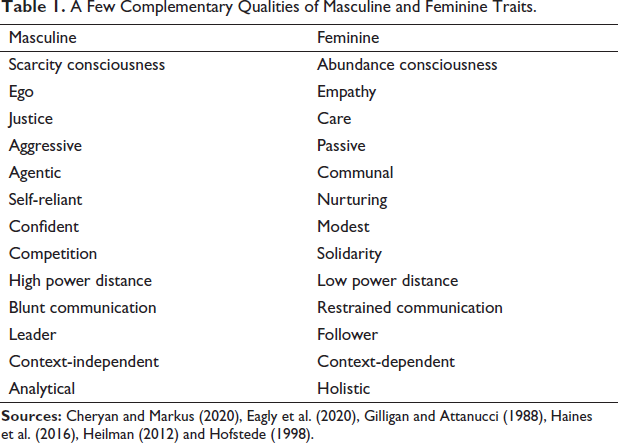
The masculine traits refer to more agentic behaviour. Self-assertion, logical intelligence, and strength are considered by researchers to be more masculine traits (Cheryan & Markus, 2020; Heilman, 2012; Heisler, 1970; Hentschel et al., 2021), even though these traits are not limited to men, and indeed some men do not possess these traits. Masculine cultures are tough-minded, ego-enhancing, competitive, and celebrate objective performance (Cheryan & Markus, 2020; Draguns, 2007; Heisler, 1970; Hofstede, 1998).
The stereotypically feminine traits are more communal. Features that are more feminine are gentle, warm, empathetic, and sensitive. Feminine traits are more aligned with emotional intelligence, solidarity, quality of work life, compromise, and nurturing (Heilman, 2012; Heisler, 1970; Hofstede, 1998). Feminine cultures are marked by tender-mindedness and assign a high value to caring (Cheryan & Markus, 2020; Draguns, 2007; Heisler, 1970; Hofstede, 1998).
When discussing masculinity and femininity in culture in organizations, scholars examine how much an organizational culture revolves around either stereotypically masculine or stereotypically feminine traits (Bolman & Deal, 2021). When we refer to ‘masculine’ and ‘feminine’, the concepts are similar to the ancient views of the Yin and Yang. Yin and Yang are often seen as complementary opposites (Cheng, 2008). It is this collaboration of two different approaches that brings success.
Depending on the situation, individuals could adopt traits and behaviours to help them reach their goals and create value. In other words, ‘it is important to remember that gendered acts are fluid, contradictory, performative, and situationally dependent’ (Young, 2017, p. 1354).
In many workplaces, male and female roles are clearly differentiated (Martin, 2003). In countries highest in masculinity, men tend to feel strong pressures for success, relatively few women hold high-level positions, and job stress is high. The opposite is true in countries low in masculinity (Bolman & Deal, 2021). Even in organizations where an aggressive masculine approach might be necessary during specific events, a feminine communal culture could help with debriefing or processing these events (O’Neill, & Rothbard, 2017).
Without the masculine attributes of competition, businesses may fail to reach their potential. Conversely, without the feminine attributes of collaboration and vulnerability, isolation can exacerbate the aggression-built anxiety of workers (Schat & Frone, 2011).
It is important to note that these traits, and perceptions of these traits, are not necessarily fixed over time. A study of opinion polls from 1946 through 2018 indicates that survey respondents over the years increasingly indicated as time went on that women were seen as more collaborative and more competent than they had been seen in previous years, and that men were consistently rated as higher in agency than women (Eagly et al., 2020).
Some argue that those who develop both the masculine and feminine, or what we are calling an integrated approach, have better mental health, and in some cases, are more successful in their businesses (Lefkowitz & Zeldow, 2006; Moudrý & Thaichon, 2020). Bringing a nurturing and balanced environment into the office can help organizations make effective support systems a reality (Wicks et al., 1994).
Before organizational leaders will be motivated to question the status quo, which may require change and intentional effort, they need to understand how their organizations stand to benefit from cultural change. One study found that employees who were also caregivers—a stereotypically feminine task—brought value to their organizations in the form of increased concern for others, productivity and what they termed ‘cognitivity’ (e.g., foreseeing and managing small problems before they become big, awareness of the needs of others, etc.) They concluded that with the rise of artificial intelligence and other forms of automation, there will be more need than ever for all employees, leaders and organizational cultures to demonstrate these so-called soft skills (Kaplowitz & Mangino, 2023).
Leaders who have integrated traits, or what some researchers refer to as androgynous traits (meaning both masculine and feminine), are more flexible: they can pivot depending on the situation, and are strong leaders because they can shift between the masculine and feminine—making it important for researchers and practitioners to determine the ways specific gendered traits might bring value to organizations (Xiong et al., 2022).
With these baseline frameworks of masculine, feminine, and balanced gendered traits and behaviours, and gender norms, we move to the literature review that includes a focused review of these topics from the past decade.
Literature Review
Using both EBSCO and Web of Science databases, we searched for key terms related to masculine and feminine in business. Appendix A includes a complete list of the searches used. Because this topic is widely covered, we limited our review to peer-reviewed articles published between 2013 and 2023. To ensure a focus on high-quality journals, we included publications with a JCR journal impact factor score of three or higher. To reduce bias from cultural differences, we also limited our search to studies that were conducted in the United States. To further enhance the quality of our results, we limited our search to articles that contained a literature review, or studies or surveys where the sample size was 40 or larger.
The data were then screened to exclude articles that studied subject appearance or examined factors relating to being male or female. After this, we screened the articles to determine whether they related to masculine defaults in a workplace, gender norms, male, female or integrated traits, and transformational leadership, psychological safety or entrepreneurial success.
Although our research specifically focuses on traits and behaviours, we found it almost inescapable to find research that does not conflate relative rates of men and women employees with either masculine workplace defaults or masculine, feminine, or integrated traits. However, our review found that some articles that discuss relative rates of men versus women in the workplace also discuss identifiable traits or behaviours that line up with a masculine- or feminine-stereotyped workplace. Those that have met these criteria are included in the literature review. After applying these limitations and deduplication, our final sample size was 28 total articles. Appendix B contains a list of these articles in alphabetical order and a short summary of each article.
Our research distinguishes between workplaces that (a) carry masculine defaults because the workforce is predominantly male, and workplaces that (b) may purport to be gender neutral but perpetuate stereotypically masculine environments regardless of workforce composition (Campuzano, 2019; MacNeil et al., 2022; O’Neill & Rothbard, 2017; Seeley, 2018; Wu, 2020).
How Do Masculine Defaults Create and Destroy Value?
Stereotypically masculine characteristics, such as emotional detachment, aggressiveness, strength, competitiveness, self-reliance, decisiveness and risk-taking, persist in the mores of many workplaces (Campuzano, 2019; O’Neill & Rothbard, 2017). Cheryan and Markus (2020) define masculine defaults as the practices and behaviours that are recognized, appreciated and seen as natural or ideal in an organization (Cheryan & Markus, 2020). These gender defaults can even show up in workplace language, subsequently affecting hiring and promotions.
In the United States, some industries that tend to have masculine defaults include construction, business, sports management, higher education, media, firefighting, bartending, the military, and the technology industry (Campuzano, 2019; O’Neill & Rothbard, 2017; Starr, 2022). Entrepreneurship, and particularly technology (tech) entrepreneurship, tends to also have more masculine environments (Wheadon & Duval-Couetil, 2021). Consider, for example, the current use of the moniker of ‘tech bro’ for women and men in software development.
How Masculine Workplace Defaults Can Destroy Value
Some of the masculine characteristics that may chip away at value include aggression, pranking, risk-taking, emotional detachment, and dominance (Borhart & Terrell, 2014; O’Neill & Rothbard, 2017; Wu, 2020). Those who adapt to these masculine defaults create different identities that may leave them either feeling isolated at best or at risk of danger to themselves or others at worst (Knights, 2019; Starr, 2022).
Masculine workplaces or environments repeatedly showed up in entrepreneurial and high-tech entrepreneurial ventures. Entrepreneurship was seen as a predominantly masculine environment that tends to exclude women and ethnic minorities, many of whom do not exhibit the traits and behaviours expected of employees within stereotypically masculine workplaces (MacNeil et al., 2022). One study of entrepreneurial accelerator programmes studied what norms showed up on co-ed versus all-female groups and found the co-ed groups were more masculine and did not work well for many of the female group members, in part because they encouraged overconfidence and a stoic toughness that did not feel natural to women. Researchers indicated that within such organizations, stereotypically masculine traits and behaviours are negatively affecting the well-being of female founders (MacNeil et al., 2022).
Elsewhere in the tech industry, masculine defaults revealed themselves in different ways. Research indicated that the presence of masculine workplace defaults possibly interfered with women succeeding in these spaces (Wheadon & Duval-Couetil, 2021; Wu, 2020). In one study, teams were made up of what researchers referred to as ‘brogrammers’, ‘tech hobbyists’, ‘tech peasants’, and ‘women’. The study showed that within this environment, many felt the need to assert their masculinity: brogrammers asserted their dominance and aggression through various pranks, and tech hobbyists countered by pranking back through their technical knowledge and ability to work long hours. Tech peasants displayed their masculinity through being responsible and reliable as their family’s wage earner, and felt pressure to participate in the pranks (Wu, 2020). As the authors concluded, burnout was common, and those who did not fit the masculine workplace norm felt marginalized. In other words, the stereotypically masculine behaviour existed at the expense of those who did not fit within masculine norms (Wu, 2020).
How Masculine Workplace Defaults Can Create Value
The literature did not have much to say about the ways masculine workplaces created value, but one study in particular offered insight into why they may seem necessary, and about traits within some masculine cultures that could mitigate some of the negative impacts of a more masculine culture (O’Neill & Rothbard, 2017). In their investigation of firefighters, researchers O’Neill and Rothbard (2017) examined what they referred to as the ‘emotional cultures’ that exist in masculine workplaces. They saw that rather than stoicism, as is often described as existing in masculine workplaces, many workers in these environments instead showed evidence of workers pushing down their emotions or dissociating so they could deal with the difficult situations they faced at work. As one firefighter told them, the firefighters felt intense and extreme emotions, but learned to automatically hide or numb those emotions (O’Neill & Rothbard, 2017).
To stave off the loneliness and deal with the difficult parts of the job, the firefighters in the study used two consistent strategies. The first was a culture of what researchers called joviality—or good-natured humour, teasing, and pranks—and the second was companionate love, displayed through affection, caring, tenderness, and compassion. Their study showed that the combination of these traits helped people feel seen, heard, and included, which alleviated some of the negative sides of hypermasculinity, such as isolation and health risks. As the researchers pointed out, too much joviality without companionate love might result in unnecessary risk-taking; some of the pranks might in other contexts be seen as bullying. When deployed together, however, joviality and companionate love can create healthier cultures than would exist without these traits (O’Neill & Rothbard, 2017). The researchers suggest that practitioners could benefit from implementing these traits, since the existence of companionate love and joviality within stereotypically masculine cultures shows the culture’s subtleties (O’Neill & Rothbard, 2017).
The laws of physics may help answer why many workplaces retain masculine defaults despite decades of scholarship and movements: ‘Male-dominated [masculine] organizational cultures can be equated with inertia, as they have maintained a consistent, traditional set of underlying assumptions, behaviours, and norms and direction over time’ (Campuzano, 2019, p. 443).
Thus, it may create value for practitioners to be mindful of which defaults still exist within their workplaces. In the next section, we explore masculine, feminine and integrated traits and behaviours in the workplace.
How Do Masculine, Feminine or Integrated Traits and Behaviours Create and Destroy Value?
This analysis showed that what Amanatullah and Tinsley (2013) called ‘gendered behaviours’, and how others interpret these behaviours, either create value or destroy value, depending on the situation in which they occur (Amanatullah & Tinsley, 2013; Chin, 2016). The literature also revealed that individuals were penalized or received benefits according to how closely they adhered to expected gender norms, thus creating the motivation for some to adopt certain traits or behaviours professionally that were seen as appropriate for their expected gender norms (Carpini et al., 2023; Reid, 2015). Some traits, such as compassion or transformational leadership, brought value to organizations and individuals regardless of the agent or situation, while research showed other traits, such as servant leadership, seemed to depend on the context (Cheryan & Markus, 2020; Lemoine & Blum, 2021).
The research revealed various ways gendered stereotypes showed up in the workplace. While we have taken special care to distinguish the sexes from traits, other researchers often correlate men with masculinity and women with femininity. Where this is present in the research, we do our best to note it and extract traits that are more widely applicable.
How Masculine or Feminine Traits Destroy Value
One way gendered traits more broadly destroy value is through the existence and persistence of gender norms within many organizations and occupations, along with the penalties for those who deviate from these norms (Amanatullah & Tinsley, 2013; Cheung et al., 2016; Lemoine & Blum, 2021; Starr, 2022). However, as suggested earlier, many individuals do not fit within these norms, which could destroy value in creating cultures that are not particularly suited to support individuals with different traits (Cheung et al., 2016).
For instance, evidence suggests that women who violate gender norms by being too masculine, dominant, or self-promotional, such as when they are a leader, face backlash in the form of being judged as being less honest, and more angry and resentful, than their male counterparts (Amanatullah & Tinsley, 2013). This backlash not only occurs when individuals exhibit a trait others view as inconsistent with their gender role, but also when they fail to exhibit traits seen as desirable for their gender role. For instance, Amanatullah and Tinsley (2013) found that women who showed stereotypically masculine traits of assertiveness and self-advocacy were socially isolated.
Scholars speculate that these negative outcomes are because the women were viewed as stepping too far into male roles. Women who advocated for others in their negotiations but were not assertive in doing so were also characterized negatively, which researchers said indicated these negotiators were not seen as meeting stereotypically feminine norms (Amanatullah & Tinsley, 2013). These stereotypes continue to show up in the workplace ‘because gender stereotypes are directly embedded in the everyday rules that control how power is distributed’ (Chin, 2016, p. 38).
Several of these traits were shown to either create or destroy value in organizations. For instance, the more masculine traits of teasing and pranking can feel hostile to people being pranked or can isolate people who are not interested in these behaviours (Wu, 2020). Similarly, the expectations for working long hours or inflexible hours or having few competing priorities outside of work, prove to destroy value both for individuals who do not fit these norms within organizations and for organizations that may fail to attract these employees (MacNeil et al., 2022).
The stereotypically masculine traits of suppressing emotion and disassociating were also associated with health problems and troubled interpersonal relationships, destroying value for the individuals who engaged in these behaviours (O’Neill & Rothbard, 2017).
Like the masculine-typed workplaces, these stereotypes and norms were particularly evident in the entrepreneurial sector (Gupta et al., 2019; MacNeil et al., 2022). Indeed, much of the research focuses on women’s experience in a stereotypically masculine profession and does not account for those who do not otherwise fit these norms. As such, we can only conclusively comment on the experiences of women, except in cases in which those who do not adhere to these gender norms are explicitly mentioned in the research.
Even though entrepreneurship is a stereotypically masculine profession, women entrepreneurs tend to make decisions that are stereotypically feminine. For instance, female entrepreneurs, and women more largely, are often perceived as risk averse and act in ways that match this stereotype, although one paper indicated this tendency towards risk aversion was context dependent (Filippin & Crosetto, 2016). Female entrepreneurs are more likely than their male counterparts to pay for their own entrepreneurial ventures and avoid loans, and when revenue is low, female entrepreneurs are less likely than males to purchase new technology for their businesses; male entrepreneurs will likely invest in new technology (Bendell et al., 2020; Kiefer et al., 2022). Risk aversion was also seen among women CEOs (Zalata et al., 2022). This trait could destroy value for organizations led by women by keeping them away from opportunities that could potentially help them grow their businesses.
One study showed that the pressure to be masculine extended to the accelerator space, where budding entrepreneurs received training and coaching. In this study, participants were either part of a women only accelerator or a co-ed accelerator. Those in the co-ed accelerator found that they often felt belittled, excluded, or were otherwise unable to have access to the same networking and funding as their male counterparts (MacNeil et al., 2022).
The masculine stereotypes of aggression, individualism, and competitiveness extended to leaders in other realms as well, and over time have grown to be associated with various high status leadership positions (Mui & Hill, 2023). In contrast, those CEOs who were women were also expected to exhibit communality and attractiveness; however, not all women CEOs showed the same level of adherence to feminine norms, and the authors argued that ‘coarsely viewing all as the same overlooks such nuanced differences and thus builds on a faulty assumption (i.e., that all female CEOs are ‘the same’ and defined by gender as a simple, binary concept only)’ (Mui & Hill, 2023, p. 6).
In some instances, the same behaviour was viewed differently depending on whether the leader was male or female, again underscoring the power of gender norms. As leaders perform behaviours not seen as compatible with their gender norms, followers may feel conflicted and ultimately deem their leaders as not as credible, which would interfere with these followers’ ability to learn from their leaders (Lemoine & Blum, 2021).
One surprising finding was that servant leadership is not broadly viewed as beneficial. In contrast to other leadership forms that may depend on a leader’s use of power, servant leadership revolves around helping others grow, attending to group members’ needs, and positively influencing the organization and society more broadly (Lemoine & Blum, 2021). However, one study showed that groups where there were low levels of stereotypically feminine traits did not benefit from servant leadership. The researchers noted that ‘this suggests that some groups may be ill-suited to servant leadership and might even actively resist it’ (Lemoine & Blum, 2021, p. 21).
In one study, survey respondents indicated entrepreneurs who ran high-growth ventures were more masculine, and those who ran low-growth ventures were more feminine. This finding is problematic for women or others who may not fit a masculine norm, but who would be interested in running a high-growth enterprise. This puts pressure on those who do not fit this norm to show they have enough masculinity to run a successful venture and could consequently destroy value by excluding otherwise capable entrepreneurs from the field (Gupta et al., 2019). One deviation from this was within the social entrepreneurship sector, whose entrepreneurs were seen by survey respondents as being more gender neutral (Gupta et al., 2019).
Masculine norms seemed to be in play in at least some instances in which men worked in more feminine-typed roles, such as being an administrative assistant. One study that looked at male administrative assistants found that some men in these roles tried to find ways to assert power, were critical of their peers, or critical of the role itself, which destroyed value in the organizations by reinforcing hierarchy and inequality. Only the men who had accepted the stereotypically feminine traits of aiding or assisting were successful in the long term as administrative assistants (Seeley, 2018).
How Masculine or Feminine Traits Create Value
The perception of ‘think manager, think male’ or ‘think masculine’ seems to persist, and some individuals found ways to leverage this and create value (Amanatullah & Tinsley, 2013; Manian & Sheth, 2021; Powell & Butterfield, 2017). For instance, when one study measured whether passive or assertive language was more convincing, they found that what they termed ‘self-promotional assertive’ language, which is more stereotypically masculine, was shown to make a speaker more believable and improve the likelihood study respondents would take their advice (Manian & Sheth, 2021). In contrast, some individuals specifically integrated stereotypically feminine traits to counteract the effects of working in a predominantly masculine environment (MacNeil et al., 2022; O’Neill & Rothbard, 2017).
One way stereotypically feminine or masculine traits brought value was when individuals leaned into the gender norms expected in a certain profession (Seeley, 2018). For instance, men who worked in the stereotypically feminine role of an executive assistant found success when they leaned into the stereotypically feminine traits of communalism and helping (Seeley, 2018). However, in other instances, individuals needed to lean away from their profession’s norms and toward their own expected gender norms. For example, women leaders needed to mitigate the agentic, self-advocating, male stereotype of leadership, and were successful when they expressed the stereotypically feminine trait of humility to get organizational buy-in and meet their goals. Another example is the women who succeeded at negotiating when they were seen as advocating for others, which moderated negative impacts of not adhering to gender norms (Amanatullah & Tinsley, 2013; Campuzano, 2019).
Researchers found that when ‘directed towards a socially sanctioned end state (protection and nurturance of others), the perception of norm violation will be mitigated’ (Amanatullah & Tinsley, 2013, p. 111). These behaviours challenge the perceptions of leaders as being solely masculine, and instead recognize the ‘nuanced, inter-variation’ between individuals, and the value of intentionally blending in stereotypically feminine traits as well (Mui & Hill, 2023, p. 5).
A culture characterized by the stereotypically feminine traits of caring, compassion, and the ability to adapt their roles and behaviours within their teams as changes arise can benefit an organization in myriad ways (Carpini et al., 2023). Research has shown that organizations attract a wider variety of talent and improve as they challenge their norms and intentionally incorporate feminine traits into their culture (Cheryan & Markus, 2020).
Servant leadership is an area that, other than with the exceptions noted in the section above, brought value to organizations and individuals. One study found that groups overall became more likely to act in others’ best interests, had higher levels of servant leadership, and performed better when the team itself had high levels of those who fell within stereotypical feminine gender roles (Lemoine & Blum, 2021). This leadership style seems especially suited to those who may not fit gender norms or expectations, or who struggle to perform stereotypically masculine forms of leadership (Lemoine & Blum, 2021).
The stereotypically feminine traits of inclusion, communal participation, and open communication, which lead to transformational leadership, create value by increasing employees’ sense of worth and encouraging greater respect for others’ thoughts and ideas (Galbreath et al., 2020).
What is the Impact of Integrated or Androgynous Traits on Value Creation?
Few studies examined approaches that integrate both masculine and feminine. However, the analysis did find a some studies that examined how a more androgynous approach could be beneficial. For example, recent research has found that a ‘good manager’ was described by undergraduate and MBA students as both having masculine and feminine traits (Powell et al., 2021).
Varghese et al. examined what they described as ‘hybrid’ interview behaviours by people who were seeking high-level management roles. These scholars found that a hybrid tactic where the candidate displayed blended gendered traits was more effective at portraying the candidate’s competence than a solely feminine one. Similarly, when a candidate was seeking to convey warmth, a hybrid tactic was more effective than a solely masculine one (Varghese et al., 2018). When individuals intentionally display a blend of traits, it also creates value by helping them be perceived as more potent and influential (Varghese et al., 2018).
The stereotypically masculine trait of showing high levels of courage was, in one study, positively associated with job performance. Even moderate displays of courage were shown as being beneficial for women’s job performance, likely because it was combined with the stereotypically feminine norms of working with others and putting others’ needs first (Tkachenko et al., 2020).
As leaders and decision-makers recognize that effective leaders both have masculine and feminine traits, this may lead to better decisions and could lead towards greater gender equity in leadership (Powell et al., 2021).
Limitations and Directions for Future Research
This study was narrowly focused on identifying recent themes in the literature surrounding masculine workplace defaults, and the ways gendered norms and traits create and destroy value in organizations. Thus, it does not consider the impacts of race, ethnicity, or socioeconomic status, which limit broader application. It also does not explicitly focus on those who do not fall within a gender binary, including those who are transgender or nonbinary. To be more broadly applicable, future researchers could examine the impact those factors have on creating value in organizations.
Future research could build on earlier work that examines how different genders and traits are perceived at work, and what challenges might await leaders looking to embrace more feminine styles (Davidson & Burke, 2016; Ely & Rhode, 2010; Griffiths et al., 2018; Mateo & Kaplan, 2018; Miller, 2005; Paris et al., 2009; Schein, 2001). Specifically, this research could look at the ways feminine traits are often devalued (Acar & Sümer, 2018; Brough et al., 2016; Tak et al., 2019; Yan, 2016).
Future research could also empirically investigate the impact gender stereotypes have on organizational culture, and in what ways creating a blended culture might create perceptions that individuals are working in ways that are opposed to their expected gender role (Duehr & Bono, 2006; Eagly & Karau, 2002; Rudman & Phelan, 2010). With this addressed, leaders could better navigate those who might react negatively to adopting feminine traits.
More research is needed to determine what combination of traits and behaviours contribute to an ideally blended workplace that creates the maximum amount of value. This could build on work done on advantages of feminine leadership by Eagly and Karau (2002), integrative research by Chemers (1997), and research on spotting and controlling for masculine bias in workplaces by Cheryan and Markus (2020), among others. Similarly, research could examine which toxic combinations tend to destroy value, and why.
Conclusion
Many organizations may benefit from creating a harmony between the masculine and feminine present in work cultures. Leaders like Pepsi CEO Indra Nooyi have thrived, in part because of some of their more feminine traits such as recognizing interdependence and empowering employees (Novak, 2018).
Gender traits and expectations have shifted over time. In some ways, so have how these traits are performed, perceived and rewarded or penalized. Rather than focus on gender norms more broadly, or select traits specifically, our research revealed the ways many workplaces retain masculine defaults, the ways these can be mitigated, and the ways specific gendered traits create and destroy value. We uniquely showed the ways many of these traits create or destroy value for organizations.
Blending the feminine traits of empathy, a flattened hierarchy, collaborative teamwork, and listening, with the masculine traits of competition and strength, will lead to improved outcomes for organizations and may create value for more businesses.
Appendix A: List of Search Terms Used in Research
feminine OR masculine AND business culture
feminine AND masculine AND organizational leadership
feminine AND organizational leadership OR masculine AND organizational leadership
feminine AND profit OR masculine AND profit
work culture AND gender
work culture AND feminine OR work culture AND masculine
gender attributes AND work
gender attributes and business
masculine AND workplace OR feminine AND workplace
masculine AND business OR feminine AND business
gender in workplace
business AND gender
gender defaults AND work
androgyny AND business
androgyny AND work
gender AND profit
(masculine OR feminine) AND transformational leadership
(masculine OR feminine) AND psychological safety AND workplace
(masculine OR feminine) AND decision making AND workplace
(feminine OR masculine) AND decision making AND workplace
(masculine OR feminine) AND work
masculine default AND organizations
masculine default AND workplace
masculine default AND business
Appendix B: Articles Used in Research

Footnotes
Acknowledgment
The authors wish to thank Ben Quist and Rachel Wasden for their research assistance.
Declaration of Conflicting Interests
The authors declared no potential conflicts of interest with respect to the research, authorship and/or publication of this article.
Funding
The authors received no financial support for the research, authorship and/or publication of this article.
