




Abstract
Professional cultures—distinct systems of meanings, rituals, and hierarchies—can reinforce social closure processes and can be a potent source of social inequality. This paper examines gender inequality in the faculty hiring process in academic engineering. This is a theoretically useful case in which a strong professional culture with meritocratic ideals exists alongside the underrepresentation of women. Previous studies of faculty hiring often find that women are devalued, yet few studies examine this process in real job searches nested within professional communities. We analyze the introductions of 175 finalist candidates by department faculty hosts, just before the candidates begin their high stakes job talks on their original research. We find that, compared to statements introducing men candidates, those introducing women are less likely to acknowledge and proclaim their research excellence, and they are more likely to contain irrelevant and inappropriate content. We argue that the professional cultural schema of scientific excellence is culturally masculine and can either highlight or obscure the introducers’ framing of candidates’ research competence, potentially anchoring audience expectations. The job talk ritual also helps socialize early career engineers into professional norms and understandings. We develop theoretical and policy implications for the study of gender barriers to employment in and beyond academic STEM.
Previous research finds that societal and organizational cultural understandings matter for gender inequality at work. For example, societal cultural beliefs include gender-normative, assumptions that men are more agentic and competent than women as well as the “ideal worker norm,” which privileges workers who are seen as unencumbered by caregiving obligations (Acker, 1990; Mickey, 2022; Thébaud & Taylor, 2021; Turco, 2010). Less well studied is the role of professional culture in reinforcing gender inequality (Cech, 2013a). Professional cultures—distinct systems of meanings, rituals, definitions of competence, and hierarchies—reinforce social closure processes, which raise barriers against those judged to lack the requisite expertise, competence, and values of the profession or move into its higher ranks (Abbott, 1988; Cech et al., 2011). Despite being less homogenous and cohesive than in past decades, professions continue to uphold professional cultural beliefs about their expertise, autonomy, and ethical norms (Gorman & Sandefur, 2011). Professional culture remains potent in academic STEM, which is largely buffered from the outside pressures of politics, profit, and bureaucratic control (Stephan, 2012). We build on literatures on five professional culture, organizations, and academic evaluation to argue that profession-level cultural schemas interact with society-wide gendered expectations and specific workplace practices to reinforce gender inequality in faculty hiring.
We focus on faculty hiring in academic engineering in two public, R1 (research intensive) universities. 1 This is a theoretically useful case in which meritocratic ideals and a strong professional culture exist alongside the underrepresentation of women (Blair-Loy & Cech, 2022). We investigate a key aspect of faculty recruitment: faculty host introductions of finalist candidates to the department, before the candidate gives their presentation (job talk) on their original research. The candidate's job talk is the most significant opportunity for them to demonstrate the trait most valued in R1 faculty recruitment: research productivity, including its brilliance and impact.
Earlier studies of academic hiring have found gender bias in the evaluation of CVs and scientific abstracts and in the composition of recommendation letters. Most of these studies use an experimental laboratory or audit design, devised to isolate and measure the presence of bias within individual decision makers. Yet these studies have limitations. Empirically, they strip evaluations from the actual social context. Theoretically, they overlook how individual bias is nested within and affected by dynamics at other levels of analysis, including workplace interactions and professional cultural norms. Our study helps fill these gaps.
The introductions we study provide a slice of departmental interaction. We ask whether there are patterned gender differences in how finalist candidates are introduced. On the one hand, since several previous studies have found gender bias in earlier stages of faculty search, there is reason to expect bias in the introductions of candidates. On the other hand, these finalists are among the very few in large applicant pools who have received an invitation to an on-campus interview. Women finalists might be particularly strong, as they have risen to the top of competitive searches despite the bias likely affecting earlier steps of the job search process. Voluminous information about each candidate is available to the introducers, which could reduce the quick from-the-gut thinking that relies on societal gender stereotypes to fill in gaps in knowledge (O’Meara et al., 2020).
To preview our novel results, compared to the introductions of men, introductions of women are only half as likely to acknowledge candidates’ CV-listed research awards and less than half as likely to have a strongly positive tone, yet they are far more likely to contain remarks that are irrelevant and even inappropriate. These findings are broadly consistent across the two R1 universities in our study. For some outcomes, only men introducers displayed these biased patterns. For other outcomes, men and women introducers similarly did so.
Our interpretation of these results attends to the analytical level of professional culture, which includes the profession's meaning systems, rituals and hierarchies (Abbott, 1988; Cech, 2015). A key element of academic STEM culture is the “schema of scientific excellence” (Blair-Loy & Cech, 2022). This is a cultural yardstick believed to measure merit based on ostensibly objective and meritocratic qualities of research competence, including brilliance and assertive impact. However, this yardstick is warped by broad societal beliefs about heteronormative masculinity. The candidate’s scientific excellence could either be either highlighted or obscured by the introducers’ framing of candidates’ research competence, potentially anchoring audience expectations of the talk.
Although we do not have data on hiring outcomes, we argue that the introductions could have a primacy effect (Strawn & Thorsteinson, 2015), in which the audience's interpretation of the talk is influenced by its first element, the introduction. We expect that this primacy bias “sticks” because it references an already salient set of meanings in the professional culture.
The next section presents our theoretical framework. Following that, we present our original archival data set—the introductions to 175 engineering job talks across two universities—and explain our methods. We then present our findings. Next, the Discussion section provides a table, induced from our results, to orient researchers studying the impact of societal and professional culture on gender inequality in hiring. Finally, we conclude with implications of our results for future research on organizations and professions and for policy.
Our focal independent variable is candidate gender. Race/ethnicity is also an important, intersecting axis of inequality in STEM (Ginther, Basner et al., 2018; Ginther, Schaffer et al., 2011). We present information on candidate race descriptively, but data limitations prevent us from drawing conclusions.
Theoretical Framework
This section first discusses the literature on gender bias in academic evaluation. Many previous studies treat bias as an individual cognitive process, removed from the social context of real faculty searches. In contrast, our focus widens to include workplace interactions and cultural understandings. The section then turns to literatures on organizations and professions.
Gender and Academic Evaluation
Women remain underrepresented in many STEM fields (NSB & NSF, 2020). Previous research has found social and cultural structures that tend to bar, discourage, or devalue women throughout the STEM pipeline, including in college (Cech, 2013b; Cech et al., 2011; Moss-Racusin et al., 2012), internships (Wynn & Correll, 2018), industry (Cech & Blair-Loy, 2019; Xie & Shauman, 2003), and in academic careers (Ecklund & Lincoln, 2016; Fox, 2001; Fox et al., 2011; West et al., 2013).
We focus on the job interview process for engineering faculty candidates. Engineering remains one of the most male-dominated STEM fields nationally (NSF, 2016) and in our case study. Nationally, only 17.4% of engineering faculty positions are held by women (Roy, 2019). The proportion of women engineering doctorates has increased from 6.7% in 1987 to 23.1% in 2016 (NSF, 2016). It is crucial to examine the treatment of women PhDs who are in applicant pools for faculty positions, particularly, as in our study, those who have reached finalist status. If women PhDs are discouraged or discriminated against in academic job markets, their gains in education will not be matched by gains in entering the professoriate.
Research productivity is one of the most important criteria in the evaluation of faculty (NRC, 2010, p. 62; Wenneras & Wold, 1997). Broadly held societal stereotypes about men's agentic competence exceeding that of women in men-dominated fields (Heilman et al., 2004; Isaac et al., 2009) have seeped into academic STEM (Leslie et al., 2015; Moss-Racusin et al., 2012), leading to cognitive bias in the minds of those evaluating academics.
Studies have examined the evaluation of abstracts of academic papers, the assessment of CVs, rubrics, questions during job talks, and recommendation letters. Relatively few of these studies have been on real faculty searches (O’Meara et al., 2020). An analysis of the evaluation of abstracts of social scientific articles found that when the abstract author had a masculine name, it received a higher rating of scientific quality than when the identical abstract was given a feminine name (Knobloch-Westerwick et al., 2013).
Other research has examined evaluations of CVs. Moss-Racusin et al. (2012) found that faculty evaluators of hypothetical CVs for a student laboratory manager position evaluated CVs with masculine name as more competent, more hirable, and deserving of a higher salary than identical CVs with the feminine name. Steinpreis et al. (1999) found that psychology faculty study participants rated redacted, pre-tenure faculty CVs with a masculine name as more hirable and having a stronger research record than an identical CV with a feminine name. In an unusual contrasting set of results, one study in which faculty evaluated hypothetical search committee notes rather than CVs found a preference for hiring women for STEM tenure-track positions (Williams & Ceci, 2015).
Research comparing recommendation letters written for men and women faculty candidates also show patterns of gender bias. Consistent with societal stereotypes, letters for psychology candidates were more likely to portray men as agentic (e.g., aggressive, independent) and to depict women as communal (e.g., helpful, warm). Applicants with letters with more communal descriptors were evaluated more poorly (Madera et al., 2009). Letters are more likely to portray men as intellectuals and competent researchers and women as helpful teachers (Madera et al., 2009; Trix & Psenka, 2003). Letters for men contain more standout adjectives, such as outstanding, unparalleled, and exceptional (Schmader et al., 2007; Trix & Psenka, 2003).
Recommendation letters for women are more likely to contain “irrelevancies,” suggesting the recommender had nothing more positive to say (Trix & Psenka, 2003, p. 203) and “doubt raisers,” such as negativity, hedges, and faint praise; further, applicants with letters with doubt raisers received lower evaluations (Madera et al., 2019; Trix & Psenka, 2003). Some research found that letters for women were shorter on average (Trix & Psenka, 2003), yet other work found no average gender differences in length (Schmader et al., 2007).
A few studies investigate evaluation in the context of real faculty searches. In a classic article analyzing evaluations of real applications for a medical research postdoctoral fellowship, Wenneras and Wold (1997) showed that women candidates received significantly lower evaluation scores and were less likely to receive the fellowship than men with the same impact factor of publications. An analysis of professors’ evaluation rubric ratings of research productivity for actual semifinalist faculty candidates found that women received lower rubric quantitative ratings than men, net of candidates’ seniority and number of publications and impact factors. Further, women received more negative rubric comments, while men received more positive comments, including standout language (Blair-Loy et al., 2022).
Studies of real job talks in engineering (Blair-Loy et al., 2017) and economics (Dupas et al., 2021) found that the talks given by women candidates received more questions and interruptions than the talks given by men, suggesting that women's competence is more likely to be questioned. Another study revealed that real faculty search committees viewed marital status and presumed geographic immovability of women but not men as reasons to oppose a hiring recommendations (Rivera, 2017).
In sum, the academic evaluation literature reveals that men candidates are more likely to be considered intellectually competent, productive, brilliant and hirable. When similar levels of research competence are displayed by women candidates, they often go unnoted.
Organizations, Occupations, and Professions
Most studies of academic evaluation treat gender bias as an individual cognitive shortcut, often privately expressed, which is assumed to be based on societal biases that have regretfully seeped into faculty evaluation. Yet this literature generally lacks an analysis of individual bias as nested within and potentially amplified or mitigated by the interactional and organization workplace context. Most studies of gender inequality in the broader labor market analyze societal or organizational cultures. We respond to these gaps by analyzing job talk introductions as workplace interactions that transmit and reinforce professional culture in ways that shape gender inequality in faculty recruitment.
Professions are semi-closed social groups that claim for themselves “jurisdiction,” a set of socially valued tasks associated with their distinctive knowledge and expertise, over which they enjoy relative autonomy and self-governance (Abbott, 1988). Much previous research on the evaluation of employes focuses on managers with supervisory authority over their subordinates (Castilla, 2008; Correll et al., 2020). Managers in Human Resources staff divisions can strive to ensure that organization practices are formalized and equitable (Stainback et al., 2010). In contrast, professionals often claim that only they have the expertise to legitimately evaluate other professionals as colleagues or applicants (Gorman & Sandefur, 2011).
“Social closure,” including social and legal barriers that restrict entry into the profession, can limit the supply of workers and increase their rewards (Abbott, 1988; Weeden, 2002). Once individuals have been hired into a profession and organization, work unit interactions help direct more rewards to some members and fewer rewards to others (Cech & Waidzunas, 2022). Indeed, “much of the day-to-day decision-making and interactional dynamics relevant to gender inequalities unfold at [the] smaller scale” of work units (Fuller & Kim, 2023, p. 327), which in our case are academic departments.
We examine an important slice of work unit interaction: faculty host introductions of finalist candidates. The candidate's job talk presentation to the hiring department is the most significant part of their job interview. The choice of whom to hire for a tenure-line faculty position—which could be held by that person for decades—is one of the most significant decisions departments make.
A key mechanism for social closure is education credentialing (Weeden, 2002). Yet when considering a large number of applicants who have all attained the required education credentials (such as a PhD from a research university and research experience), professions rely on societal and professional cultural definitions of merit to select the top candidates.
Broad societal culture includes beliefs about masculinity and femininity get layered onto particular occupations and jobs (Fuller & Kim, 2023; Tilcsik, 2011). These beliefs include the assumption that men are more agentic and competent than women (Heilman et al., 2004; Isaac et al., 2009). They also include ideal worker norms, which render applicants and employes (especially men) more desirable if they are believed to be unburdened by current or future caregiving obligations (Thébaud & Taylor, 2021; Turco, 2010). Workplace inequality is shaped by workers’ tendency to draw on societal-level cultural repertoires about gender and about the “fit” of the worker to the job, which varies depending on organizational context (Mickey, 2022; Nichols et al., 2023; Thebaud & Pedulla, 2022).
In addition, professional workers are influenced by professional culture: a distinct “web of values, norms, rules, beliefs, … taken-for-granted assumptions” and rituals (Barley & Tolbert, 1997, p. 93) associated with professionals and their distinctive tasks. Professional culture is semiautonomous from societal cultures, since it is developed in partially closed off and self-governing communities (Cech et al., 2011). Professional culture is learned via socialization in higher education and early career positions; it is then disseminated across organizations and reinforced by professional associations (Abbott, 1988; Cech, 2015; Schleef, 2006).
Previous research has delineated a key element in academic STEM professional culture: the schema of scientific excellence, a cultural yardstick used to measure the worthiness of scientists (Blair-Loy & Cech, 2022). STEM faculty members claim the exclusive, expert ability to evaluate the scientific and technical value and productivity of other researchers in their field. They regard highly the candidates they view as creative, brilliant, assertive, impactful and competitive, sometimes identified as “cowboys and rockstars”. Across different STEM disciplines with somewhat different demographics, faculty believe these qualities signal scientific excellence (Blair-Loy & Cech, 2022).
These characteristics of professional culture are also culturally aligned with white, heteronormative masculinity (Cech & Waidzunas, 2022; Des Jardins, 2010; Ecklund & Lincoln, 2016; Leslie et al., 2015). Faculty are most likely to recognize these qualities when embodied by majority race, heterosexual men. Research shows that across the STEM disciplines, women and other underrepresented STEM faculty are often evaluated as falling short and so receive less respect and credit for their research than white and Asian men in the same department and job level with similar publication rates (Blair-Loy & Cech, 2022).
For eight reasons we analyze job talk introductions as a potential site for reproducing gender inequality. First, faculty recruitment provides an opportunity for tightening or loosening social closure, and faculty reaction to the job talk is a key factor affecting who will be offered a professor appointment (Rivera, 2017). Second, job talks are important annual events in the life of a department. Introductions are spoken out loud, in public, by department leaders who are often striving to make a good impression—on the candidate and for the candidate. Patterns of gender bias in introductions would indicate that these disparities are either seen as legitimate or are so taken-for-granted that they barely rise to conscious awareness.
Third, a semester's series of job talks assembles the department to witness, communicate, and enact the schema of scientific excellence as part of disciplinary culture. The quality most valued in R1 faculty recruitment is research productivity, including its perceived brilliance and assertively-promoted impact. Candidates strive to perform scientific excellence in presenting their talks. Professors in the audience evaluate this effort and strive to demonstrate their own excellence by interrupting, asking questions, and making comments throughout the talk (Blair-Loy et al., 2017). The introducer may also be communicating something about their own version of scientific excellence by endorsing the candidates they think should win the competition while refraining from endorsing others.
Fourth, sequencing matters. We do not have data on which candidates received a job offer. Yet the literature suggests that a positive introduction would frame the candidate as aligning with the schema of scientific excellence and prompt the audience to view the talk and the candidate favorably. 2 Previous laboratory research on the order of unfavorable and favorable responses to interview questions has found a “primacy effect”; information presented early in the interview has a disproportionate effect on evaluator ratings (Blakeney & MacNaughton, 1971; Strawn & Thorsteinson, 2015). Primacy effects are most likely to appear when the evaluator considers a long series of evidence items and renders a final evaluation at the end of this sequence, consistent with our study's setting. In our case, the initial information is not from the candidate but rather from a colleague, often from the department recruitment committee. Thus, introductions could function as a cognitive anchor (Furnham & Boo, 2011; Rezaei, 2021), influencing faculty audience expectations and interpretations of the talks’ content. This anchor would be particularly effective because it references an already salient set of meanings in the professional culture. Introducers may frame the audience's “sensemaking processes” (Correll et al., 2020, p. 1044), by signaling the extent to which they think the candidate lives up to standards of scientific excellence.
Fifth, professional culture is upheld by “informal methods of socialization and social control” (Gorman & Sandefur, 2011, p. 277), which include the annual ritual of the job talks studied here. The introductions of a series of candidates over a recruitment season help infuse graduate students, post-docs and new assistant professors with cultural understandings about who is deemed worthy to enter the professoriate in this department and who is not. This research complements previous studies of women undergraduates in engineering, who suffer initiation rituals and informal anticipatory socialization in internships that reduce women's confidence that they belong in the field (Seron et al., 2016).
Sixth, the job talk seminar, including the introduction, provides information to candidates about the warmth or chilliness of the department, which they are considering as a future professional home. Chilly climates are interactional environments that are less respectful toward non-dominant groups, and research finds that women are more likely than men to experience them in STEM (Wynn & Correll, 2018). Chilliness erodes a sense of collegiality, which faculty candidates highly value when deciding whether to accept a job offer (NRC, 2010, p. 62).
Seventh, an analysis of gender bias in the treatment of finalists, who have all accumulated the education and other credentials required by the profession, helps us better understand the workings of social closure in this profession. On the one hand, a finding of gender bias in introductions would show the enduring cultural barriers women face, even when their accomplishments are manifold and manifest, and even within scientific disciplines that value merit and objectivity. On the other hand, if we find no evidence of bias, this could be due to several possible reasons, which should be explored in future research. Women finalists have risen to the top of competitive searches despite the bias likely affecting earlier steps of their education and job search process, and their strong portfolios could counteract any bias among introducers. Previous experimental research subjects suggest that strong evidence of equal competence neutralizes gender biases in evaluation (Heilman et al., 2004). The detailed scholarly records available to the department could reduce the introducer's reliance on gender stereotypes to fill in missing information (O’Meara et al., 2020).
Eighth, we investigate whether the gender of the senior faculty host making the introduction matters. Most studies find that women and men evaluators are similarly likely to exhibit gender bias when evaluating women and men generally (Isaac et al., 2009) and in academic contexts (Knobloch-Westerwick et al., 2013; Madera et al., 2009; Madera et al., 2019; Moss-Racusin et al., 2012; Steinpreis et al., 1999; Trix & Psenka, 2003). Women in engineering fields may be likely to believe their field is meritocratic and so reinforce the field's norms and behaviors (Seron et al., 2016). On the other hand, other studies find that women are less likely than men to enact gender bias, including when rating women for male-dominated jobs (Koch et al., 2015), when making decisions about pay in male-dominated work units (Fuller & Kim, 2023), and when explaining gender disparities in STEM (Cundiff & Vescio, 2016). To borrow two phrases from Cohen and Huffman (2007), women introducers could function either as “change agents,” who reduce gender inequality in their units, or as “cogs in the machine,” who help perpetuate it.
Research Questions
This is novel research, and we do not formulate formal hypotheses. Our primary empirical research question is whether there are patterned gender differences in how highly-vetted finalists are introduced. If answer is no, this would suggest that gender bias is less salient in this context, perhaps due to its public nature or because detailed candidate records provide convincing evidence that women and men finalists are equally excellent. Yet if we do find patterned gender differences, we pose two additional empirical questions. First, are the differences in introductions consistent with research on previous evaluation stages, namely greater respect for men's research competence than for women's? Second, are men and women introducers equally likely to display gender bias in their introductions of candidates? Theoretically, we ask why a publicly proclaimed bias would persist, given the meritocratic norms of academic science.
Data and Methods
Our archival data set consists of faculty introductions to 175 engineering job talks in recent years at two R1 universities in the United States. We conduct an in-depth qualitative analysis of a theoretically significant case. Case-oriented research like ours identifies a nonrandom sample and investigates it thoroughly to unveil the complexity of an important phenomenon (Ragin, 1987). This research is not meant to be statistically generalizable but rather aims to generate new insight and add nuance to our understanding of social reality (Lamont & White, 2005, p. 157).
We selected the two universities based on their structural similarities. Both are research universities with large engineering programs ranked nationally in the top 20. Both are public universities with relatively transparent hiring policies and pay scales. Both practice “shared governance,” between faculty and administration and a division of labor in which faculty largely maintain control over evaluating research and hiring new colleagues. Similar patterns across both universities would suggest that these results are not idiosyncratic to a particular campus.
Job Talk Context
In faculty searches, department search committees evaluate a large candidate pool, often in the 100s, and filter it down to a fairly small number of semifinalists. At this point, either the search committee or the entire department then chooses a small number of finalists—often 3 or 4 per position—who are invited to campus for a few days to meet with faculty members. The most important part of this interview is the candidate's job talk on their original research. Job talk seminars are public events advertised via e-mail and campus flyers to academics in the hiring department and to others with similar research interests. The seminar starts with an introduction of the candidate (with a median length of about 1 min), often given by a member of the recruitment committee. Next, the candidate gives a 45–55 min presentation, which is often interrupted by questions. The final portion of the seminar is a 5- to 15-min question and answer session. In the departments under study, job talk seminars are generally videorecorded for the department's use, such as for faculty who missed the seminar. 3
Data
We collected recent years’ video recordings of in-person job talks given in five engineering departments across two R1 universities with highly rated STEM programs. 4 We collected two additional data sources: candidate CVs; and a subsample of flyers that advertise the job talks in the hallways of university engineering buildings. The Appendix Figure A1 summarizes the number of cases at each stage of data set construction, which yielded our sample of 175 job talk introductions.
In Stage 1, we collected a population of 324 videos (28.4% women) with all the recorded job talks we could obtain in five engineering departments in six recent years. The talks occur across 23 department search events; this term refers to the set of faculty searches that occurred in a particular department in a given year, regardless of whether the department was aiming to fill one or more than one position that year. Not every department had a search every year.
Coding these videorecorded talks is time intensive. To manage this within our resources, in Stage 2 we kept all the talks of women candidates (except for one case lost to poor recording quality) but took a stratified random sample of about 80 percent of the men (stratified by department). 5 This sampling excluded 44 men and yielded a job talk sample of 279 (32.6% women).
In Stage 3, we created the sample of introductions. In three department search events, the department did not record the introduction. We lost 104 cases (37 women and 67 men) for which introductions were not recorded or were incompletely recorded, yielding a complete introduction sample of 175 candidates (30.9% women) across 20 department search events.
Coding Process
As a novel study, our content analysis combines inductive and deductive insights (Correll et al., 2020; Griswold, 1987). Our analytic coding contains inductive themes that emerged organically from the data and deductive themes informed by earlier studies of recommendation letters and rubric comments. Often, the literature's codes required translation into the rhetorical style of oral introductions. We used hand-coding, which yields more complete and nuanced results than computer-assisted coding for novel research (Nelson et al., 2018). All names are pseudonyms, and we redact personal details.
We explain our coding process in detail, as it may serve as a useful example for other researchers. First, our primary coder, YZ (redacted), transcribed the introductions in our sample (Appendix Figure A1) without names or other gender indicators. Several weeks later, using only the redacted transcripts, YZ began to code job talk transcripts inductively, letting themes arise from the data. After coding a subset of introductions, she consulted with the rest of the coauthor team—comprised of sociologists and an engineering professor—which suggested further exploration of inductive and deductive codes in the data. Then, YZ conducted additional coding; the team reviewed coding decisions and adjudicated boundary cases by consensus. The coding proceeded iteratively through approximately five rounds, as the team assessed the language categorized by inductive codes and suggested deductive codes to be applied, followed by coding refinement and more team collaboration. 6 Our codebook contains three candidate attributes (e.g., coder-assigned gender and race/ethnicity), two CV-derived variables (seniority, research award), 18 codes of introduction content, and 16 other codes (e.g., year, department, university, and introducer gender).
Inductively, we discovered that introductions are unscripted or loosely scripted yet have a set of conventions. An introduction typically includes the candidate's name, educational history, current position, and broad research interests, and zero or one positive remarks. Inductively, we created a code for positive tone introductions, which have more than one positive remark. Mention of a research award was a separate inductive code. 7
We also applied deductive codes, including the gender of the introducer, and the length in seconds, analogous to letters’ word count (Schmader et al., 2007; Trix & Psenka, 2003). Madera et al.'s (2019) “doubt-raisers” and Trix and Psenka's (2003) irrelevancies guided our construction of the irrelevance code. As a subcategory of irrelevance, our code for inappropriate language expands on Trix and Psenka's (2003) brief illustration. The next section describes our codes in detail.
Measures
Focal Independent Variable: Candidate Gender: The videos do not provide a candidate's self-identified gender. Our coder-assigned measure was based on the first name, physical appearance in the video footage, and pronouns used by the introducer and in online biographies, yielding values of man and woman. We found no ambiguity in signals of gender identity, nor did we note anyone who seemed to have a nonbinary expression.
We also created a coder-assigned measure of each candidate's race/ethnicity based on coders’ assessment of the candidate's appearance, name, and speaking accent. At least two coders, from different racial/ethnic backgrounds, coded this variable. When their assignments diverged, a coauthor (YZ) reviewed all materials and did additional research if necessary to assign a code. We report these measures descriptively but do not draw conclusions about racial patterning of introductions. Given the complexity of racial/ethnic identity, the coders’ assignment of this identity could lead to errors. Our sample is 10% historically underrepresented (URM) Latinx, Black, and Native American engineers, consistent with the approximately 8% in the national population (NCSES, 2019: authors’ calculations, Table 9-25; NSF, 2013).
Outcome Variables: Our outcome variables include the following: Mention of research award; Positive tone; Irrelevant information; Inappropriate information; and Length. We also examine whether outcomes are associated with the gender of the introducer. Introducer gender was coder-assigned as man or woman, based on the person's appearance in the video plus any names or pronouns used. We did not note anyone who appeared to us to be nonbinary.
Research competence, including its quality and impact, is a key criterion for R1 faculty candidates (NRC, 2010, p. 62; Wenneras & Wold, 1997). After considering coding for “standout” adjectives (Schmader et al., 2007; Trix & Psenka, 2003), we inductively determined that the introduction's mention of a research award was a more concrete indicator of acclaim specifically for research competence, particularly its quality and impact. We separately coded candidates on whether a research award was listed on their CV and on a subsample of flyers advertising job talks. Finally, among candidates with CV-listed research awards, we coded their introductions as either (1) mentioning a research award or (0) not mentioning a research award. The recognition must use the word “award” in the title and be linked to a research achievement or paper recognized by an academic journal, conference, or organization. Most examples are best paper awards. 8
Recall that typically, the introduction genre includes the candidate's name, educational history, current work position, and broad research interests. The majority of introductions provide neutral information about the presenter's background, with zero to one explicitly positive comment. For example, here is a typical, neutral introduction. Okay, let's get started. It's my pleasure to introduce Priya Patel. She did her bachelor's degree at [university] in [year]. She did her [degree at university in department] finishing in [year]. Since then, she's spent two years doing a postdoc at [a company] that's doing [projects], and she's working on [topic] among other things there. Her talk today is going to be on [topic] but also [topic 2]. So, take it away, Priya.
One-third of introductions contain two or more explicit positive comments about the candidate. Inductively, we coded these as “positive” introductions. After trying different coding schemes,
9
we chose a dichotomous measure of Positive tone = 1 for introductions with two or more positive comments about the candidate. This measure distinguished between typical introductions and those with high acclaim. These include mentions of a research award (discussed above), other professional recognitions, fellowships, grants as well as compliments about the research and its (potential) impact. Examples of positive introductions follow.
Luca Meier: “One of the things he developed was [a new and efficient method called name]. And subsequently … he has introduced a new area of the field, … His work has led to a lot of impact in areas such as [two research areas named], where there have [also] been significant impacts in real world scenarios.” Amir Nassar: “… He won their … dissertation award. Actually, Amir has won more awards than anyone his age has any right.” Rebecca Strauss: “She's had support from [national funder] … So you're going to find out that she is multi-talented and full of potential … She has over a dozen conference papers and posters and demos, pretty extensive, in all the top conferences … her CV is even out of date because she got [number of] new [conference] papers this year, so she's on a roll.” Joanne Cho: “Joanne has done a bunch of groundbreaking work on [topic] and in particular, I've always really liked Joanne's work because I think she's trying to systemize what really makes [topic] work … She's earned several awards at conferences, and also in addition to writing a number of papers. Really impressive for a junior person.”
Each example above shows at least two positive elements. These include articulating the candidate's distinct accomplishments e.g.,: “dissertation award,” discussing the work's “impact,” and specific compliments, using phrases such as: “really impressive,” “more awards than anyone his age has any right.”
Our measure of irrelevant information expands on Trix and Psenka (2003) finding that recommendation letters for women often contained “irrelevancies,” such as “she is quite close to my wife” (Trix & Psenka, 2003, p. 203). In the short introductions studied here, irrelevant information could be harmful because it removes the focus from the candidate, brings in confusing information, or raises doubt (Madera et al., 2019) by implying that the introducer could not find enough to say about the presenter's professional record. We define the introductions as containing irrelevant information (=1) if they include one or more statements which would not be on a CV and are not related to the following: the candidate's education, position, research experience, professional achievements, research interests, professional relationship to others, and the position for which the candidate is applying.
Examples of irrelevant information in our data set include:
Harleen Persaud: “I don't know if Harleen remembers—, but do you know where you first met me?! I met you when you were an undergrad, and I was a grad student at [university]!” Ada Schneider: “One other thing to mention - this is Ada's second visit to this [geographical area] in about a week. In between she went home, which is in [a geographically distant country].” Khalida Al-Hashimi: “… It's been a little challenging filling her schedule, because people are like, ‘I know her, I don't need another half hour meeting.’” “After the seminar, I'll send an email to our colleagues to say: ‘Guys, the seminar was indoors, [so the poor weather] … is no excuse for not showing up to what will probably be a very nice presentation.’”
Trix and Psenka (2003) found that some recommendation letters contain statements that were not only irrelevant but also “inappropriate doubt-raisers,” such as awkward, private information. We ask whether the job talk introduction genre—a public summary of professional experience as the candidate stands nearby—would also contain intrusive, negative comments. Here is one example from our data.
This comment is inappropriate because it emphasizes the low turn-out as professors’ choice not to attend instead of ignoring it or explaining it in a way that protects the presenter (e.g., “unfortunately, this visit was scheduled at the same time as [a major conference], and so many colleagues will be listening to the recording.”)
Here is a second example of an inappropriate comment. “I don't know if you remember from my own job talk, I had my very first slide with sort of two heavenly virtues of [field of study]. You need, first of all, to develop things like principled approaches, you need [toolset] to develop these kinds of [solutions] with these [types of] datasets, but on the other hand, through [disciplinary specialty], you need to understand what's going on in my data.”
The introducer spends the majority of his time recalling his own job talk from years ago. It is self-focused and minimizes the qualifications of the candidate.
We measured the length of the introduction in seconds. The median length is 59 s. We separately examine the shortest (25th quartile) introductions and the longest (75th quartile) to see if there are gender differences in how the time is filled.
Variables from candidate CVs: research awards, seniority and productivity: In this sample of finalists, large majorities of women and men presenting at each university have research awards, an indicator of research impact, listed on their CVs. From CVs, we also measured seniority, defined as the number of years between earning a PhD and the year of the talk. We also measured numerical productivity as the number of published articles divided by their seniority. 10
Analytic Strategy
This is an in-depth, qualitative analysis of a case. Through five rounds of iterative coding of gender-masked transcripts of job talk introductions, we identified and analyzed multiple themes. We also present frequency counts and percentages as efficient summaries of qualitative differences by gender and by university, not as inferential statistics for quantitative prediction. As descriptive heuristics, we provide Chi square statistics as an indicator of whether gender differences seem to exceed what we would expect by chance alone and Fisher's exact test results when expected cell counts are below 5. 11 Cell sizes are small, and we do not reify these numbers.
Results
Our results section contains six subsections. Subsection A describes the data set. Subsections B through F present results on five outcomes, namely: B. acknowledging research awards in introductions; C. positive tone; D. irrelevant and inappropriate comments; and E. introduction length. F. examines associations between these outcomes and the gender of the introducer.
Descriptives
Table 1 presents descriptive information on our data set. Overall, 31% of talks are given by women candidates, with roughly similar proportions in each university. The median seniority is 2 years since earning the PhD, which often means that the candidate is in the second year of a post-doctoral position. On average, men's seniority is longer than women's. Gender differences in numerical scholarly productivity are small and inconsistent: Men have greater average productivity than women in University 1, while women have greater productivity than men in University 2 (see Table 1). The median lengths of introductions are similar across genders. Section E will examine introductions at the upper and lower ends of the length distribution.
Sample Description.
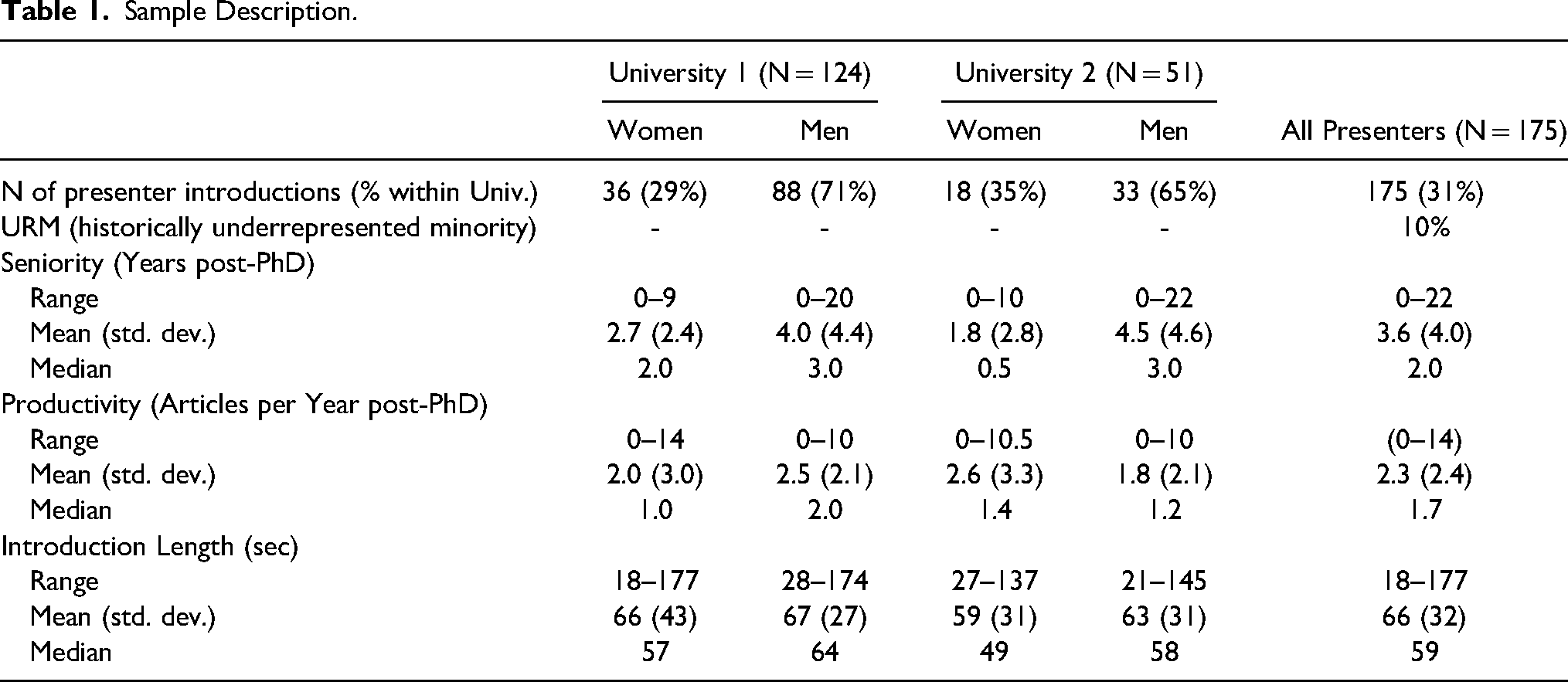
The two universities have similar proportions of women on the faculty in engineering, which, aggregated, is 13.5%. In line with this, 13.7% of introducers are women. To provide more information on the diversity of the sample, we report our coders’ assignment of candidate race/ethnicity across both universities and combining U.S and international candidates. 57% are white, 35% are Asian, and 10% are historically underrepresented minority (URM) candidates (Latinx and Black academics), roughly similar to national proportions of about 8% (NCSES, 2019; NSF, 2013). A very small number of candidates are URM women.
Research Award Acknowledged
Research awards are one indicator of research impact. We coded CVs of all 279 job talk presenters for the presence of research awards. Presenting at University 1, 74% of women and 78% of men had research awards; in University 2, 86% of women and 83% of men did. Among our data set of 175 complete introductions, 136 candidates (64% of women and 78% of men at University 1, and 83% of women and 88% of men at University 2) have CV-listed research awards.
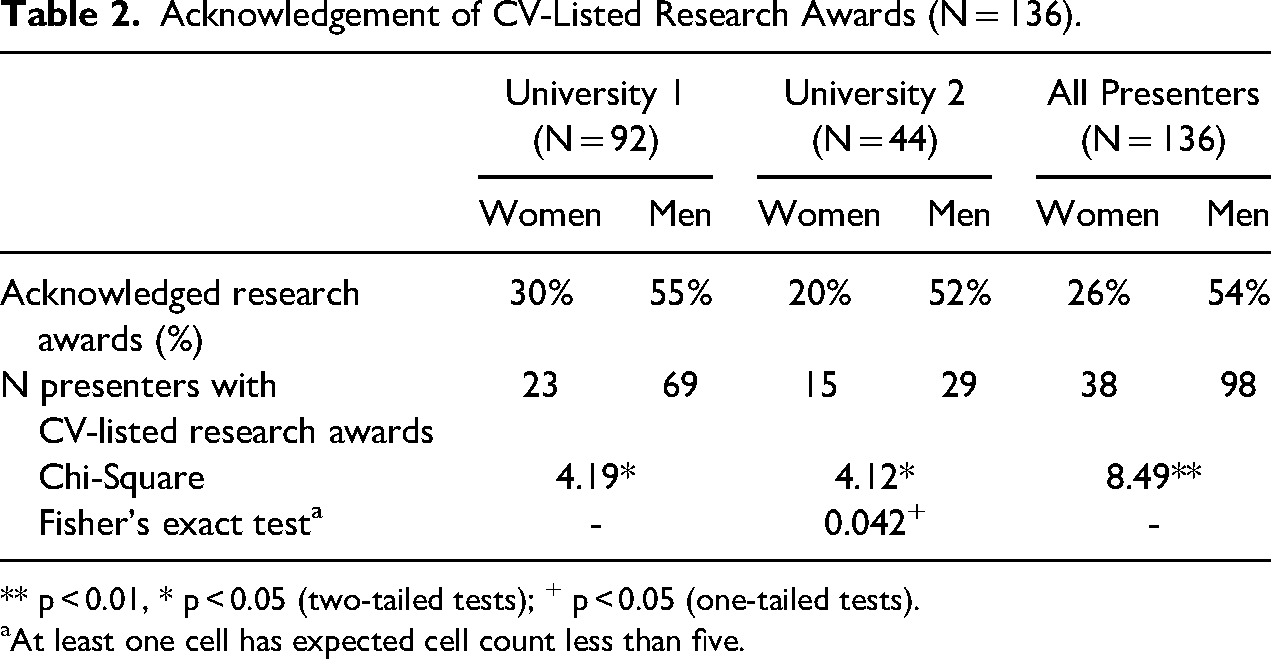
In a roughly one-minute introduction, mentioning a research award is a compelling way to bring attention to a candidate's research excellence. Table 2 shows the percent of introductions that acknowledge a research award among candidates with CV-listed research awards, by university and by gender.
Acknowledgement of CV-Listed Research Awards (N = 136).
** p < 0.01, * p < 0.05 (two-tailed tests); + p < 0.05 (one-tailed tests).
At least one cell has expected cell count less than five.
At both universities, faculty introducers are less likely to acknowledge CV-listed research awards for women candidates. In University 1, they mention existing research awards for only 30% of women, compared to 55% of men. In University 2, the difference is even starker: only 20% of women, compared to 52% of men, have their existing research awards noted in faculty introductions. Combining the two universities, introducers are twice as likely to acknowledge men's CV-listed research awards.
We examine an alternative explanation, other than introducers’ gender bias, for these patterns. Job talks are advertised with flyers posted in engineering buildings. Candidates are typically asked to provide a short biography, photo, seminar title, and abstract, from which departmental staff construct a flyer. It is possible that some introducers get their information on the candidate from flyers rather than from CVs. We reasoned that, since self-promotion is often more socially risky for women than for men (Trix & Psenka, 2003), women might be less likely to advertise their research awards. If introducers read the flyer but not the CV, and if women candidates were less likely to put their research awards on the flyer, that could help account for why only half as many women as men have their awards mentioned by the introducers.
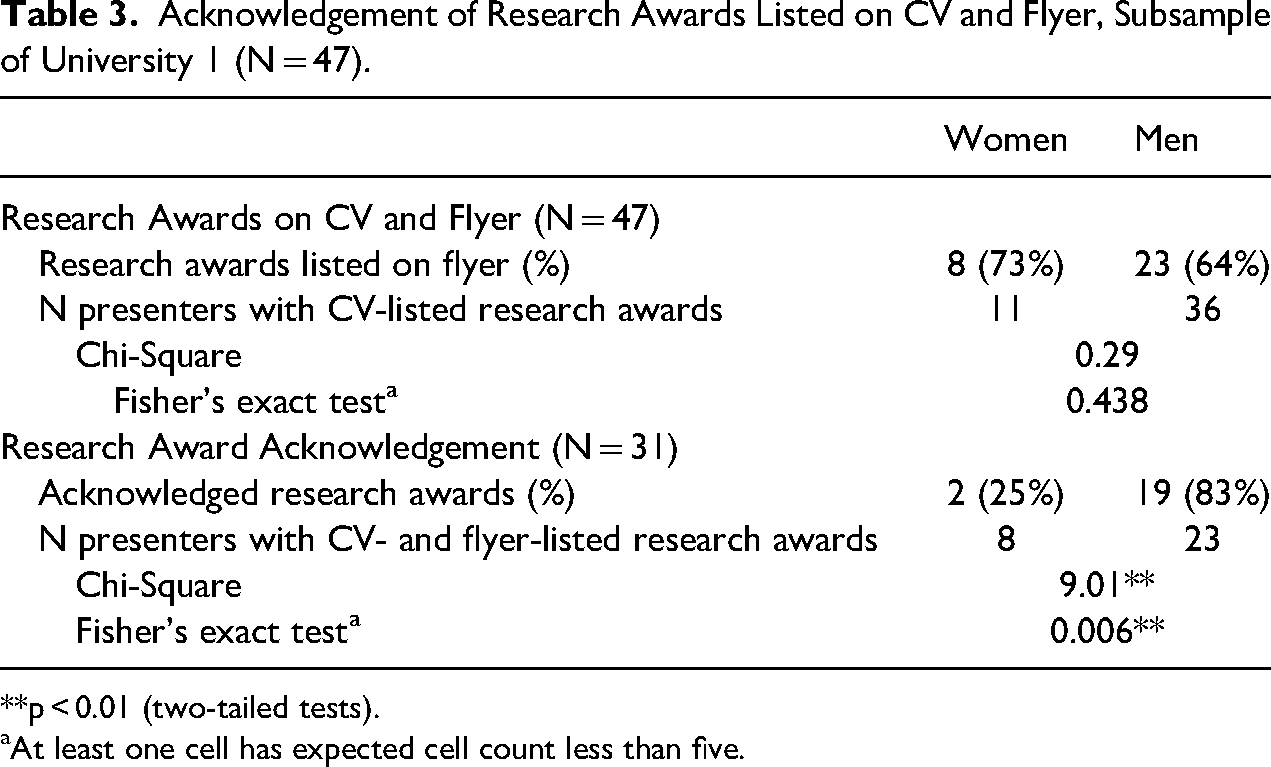
We collected a subsample of job talk flyers from two departments in University 1 in a recent year and screened them to contain only the 47 candidates with CV-listed research awards. This subsample seems to rule out the alternative explanation. Table 3 presents results.
Acknowledgement of Research Awards Listed on CV and Flyer, Subsample of University 1 (N = 47).
p < 0.01 (two-tailed tests).
At least one cell has expected cell count less than five.
In this subsample, eight of 11 women (73%) and 23 of 36 men (64%) with a CV-listed research award listed their research award in their flyer biography. Thus, women in this group seem as likely or more likely than men to include their research award in their biography. Next, we counted the number of candidates with flyer-advertised awards whose award was also noted in the introduction. Of the eight women with flyer-advertised awards, only two (25%) had their award acknowledged in the introduction. Yet 19 of the 23 men (83%) had their flyer-advertised award noted in the introduction. So, in this subsample, introducers were three times more likely to highlight men's flyer-advertised research award than women's. Stated differently, faculty introducers ignored the research award for 75% of the women yet for only 17% of the men. Thus, the frequent silence about women's awards in their introductions does not seem to be caused by women's reluctance to promote their awards on their biographies.
Positive Tone
Positive remarks include mentioning the following: a research award; any other award, fellowship, or grant; research quality; impact; and other compliments about the research. This section focuses on the 32% of all introductions (56) with two or more positive comments, our conservative indicator for positive tone introductions. Here are two examples, with positive comments in italics. “… The seminar of soon to be Doctor Antonia Reiter. So Antonia … did her undergrad work in [country] and then came to the United States, [university] to do her PhD. She works in the area of [fields]. And for her work that she's done for her PhD, which she is going to receive [soon], she's won several awards, including a [specific name of] fellowship, she's a [name of fellowship] scholar, [and] several other fellowships. So welcome, Antonia.” [woman, PhD candidate] “Why don't we get started? I'm very happy to welcome today's speaker, George Flores, who did his PhD at [university]. Under the direction of [person], he was one of the lead students on the [specific] project, which has been very influential, it led to a whole host of research papers and follow on from other groups. It's a point of reference in the space for sure academically. It also led to a [type of] company that George has been involved in and he's been with us here at the [name] lab as a postdoc, working with folks here very productively as well. So many of us have met him, but for those of you who haven't, there's an introduction, and I'll let him take it from here.” [man, 1–3 years post-PhD].
Some introductions contain far more than two accolades. Here are two examples, with positive remarks indicated in italics. “Good morning, everyone. I am thrilled today to introduce James Robinson. James comes to us from [university] and [university 2]. James is wrapping up his PhD currently, notably for somebody who is still a PhD student, James … [has] 18 publications, including 4 best paper awards. I checked last night, his work — PhD student — his work has already received [large number of] citations and he has an H-index of [large number]. So, if you'll excuse me, I need to go start doing research again (laughs). But these are just numbers—but what I think is really exciting about James’ work, and what all of you that have met with him already know, is he has this wonderful, infectious curiosity … he has great research ideas about all sorts of things, and you'll see lots of examples of this in his talk.” [man, PhD candidate] “Alright, great, welcome everyone. I'm really excited to introduce to you, Rebecca Strauss, who is going to be talking about a bunch of exciting work. Let me tell you a bit about her history first. She's been a postdoc researcher here working with a number of our colleagues and collaborators. And I'm sure you'll hear about some of the work that's connected with that during her talk. Before that, she got her PhD at [university] in [field]. She was advised by [person] there. And she's had support from [national funder] … So you're going to find out that she is multi-talented and full of potential and she's going to showcase a lot of work, but there's hidden things she won't talk about, like [her work in a different subfield], so she has a lot of interesting work. She's had internships at [tech company] and [other tech company]. She has over a dozen conference papers and posters and demos, pretty extensive, in all the top conferences in our field of [department]. In fact, her CV is even out of date because she got [number of] new [conference] papers this year, so she's on a roll. She also is an amazing educator and her work touches on education. At [university], she had a teaching fellowship . … I'm really excited to see her work, let's give her a welcome—Rebecca Strauss” [woman, 1–3 years post-PhD]
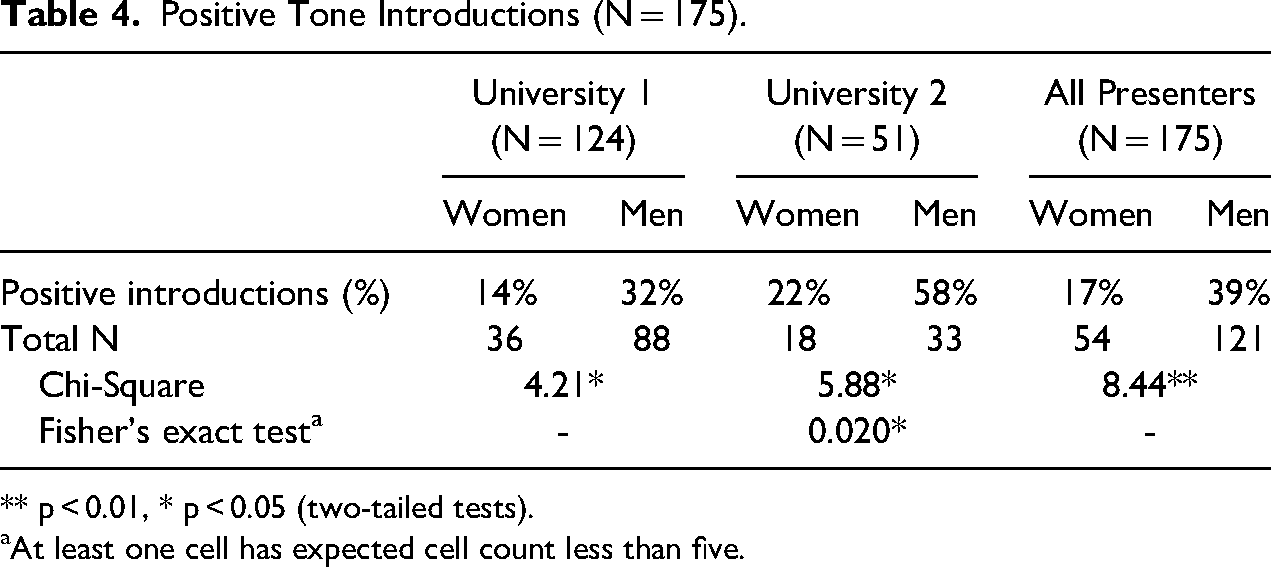
Table 4 shows that positive tone introductions are relatively rare for women candidates (given to only 14% of women in University 1 and 22% of women in University 2). Within each university, men are more than twice as likely to receive them.
Positive Tone Introductions (N = 175).
** p < 0.01, * p < 0.05 (two-tailed tests).
At least one cell has expected cell count less than five.
Men have on average more seniority than women in our sample (Table 1). Therefore, we investigated alternative explanations that the Table 4 genders patterns are primarily due to seniority or due to scholarly productivity (the number of CV-listed articles published, divided by seniority). To provide an efficient descriptive summary, we constructed supplemental logistic regression models of the likelihood of receiving a positive tone introduction, predicted by gender, university, and either candidate seniority or productivity (results not shown). We find that positive tone introductions do vary substantially by gender but do not vary by candidate seniority or by productivity.
The first supplemental model finds that the odds of receiving a positive tone introduction for women candidates are 72.3% lower than for men, net of seniority and university, a statistically significant result. 12 The second supplemental model finds that the odds for women of receiving a positive tone introduction are similarly 71.8% lower than for men's, net of productivity and university. 13 These results provide an efficient descriptive summary of this dimension of our case study: for the introducers, candidate gender trumps productivity in the framing of the candidate's excellence.
Our qualitative data analysis reveals that positive tone introductions sometimes convey a sense that the introducer is implicitly or explicitly personally endorsing the candidate. This endorsement may leverage the introducer's own excellence and credibility as they try to encourage the audience to share their positive view of the presenter. Examples follow, with those elements italicized. “I've always really liked Joanne's work because …”. “[George Flores’ project] has been very influential, it led to a whole host of research papers and follow on from other groups. It's a point of reference in the space for sure academically. And he's been with us here at the [name] lab as a postdoc, working with folks here very productively as well” “I checked last night, … his work has already received [large number of] citations and he has an H-index of [large number]. … But these are just numbers—but what I think is really exciting about James’ work, and what all of you that have met with him already know …” “[Rebecca] has over a dozen conference papers … in all the top conferences in our field of [department]. In fact, her CV is even out of date because she got [number of] new [conference] papers this year, so she's on a roll.”
The latter two examples illustrate how positive comments sometimes provide details about candidates’ research records, which may not even be on the CV. This contrasts with the finding in section B above that some introducers miss mentioning important material such as research awards that are on the CV.
Irrelevant and Inappropriate Comments in the Introduction
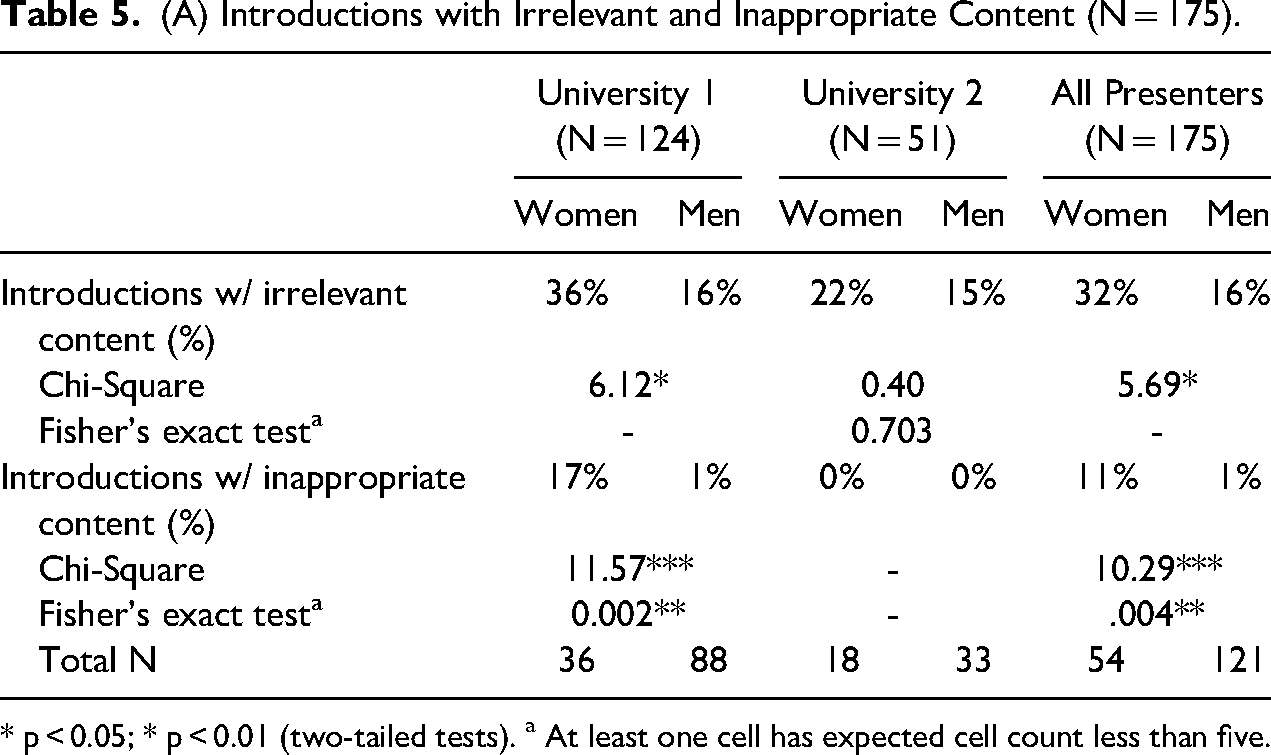
Irrelevant Comments. Only 36 introductions (21%) contain irrelevancies. Irrelevancies are not necessarily negative, but they can be distracting and can subtly raise questions about why the introducer does not have more substantive information to convey. Table 5A presents the percentages of introductions with irrelevancies by candidate gender.
(A) Introductions with Irrelevant and Inappropriate Content (N = 175).
* p < 0.05; * p < 0.01 (two-tailed tests). a At least one cell has expected cell count less than five.
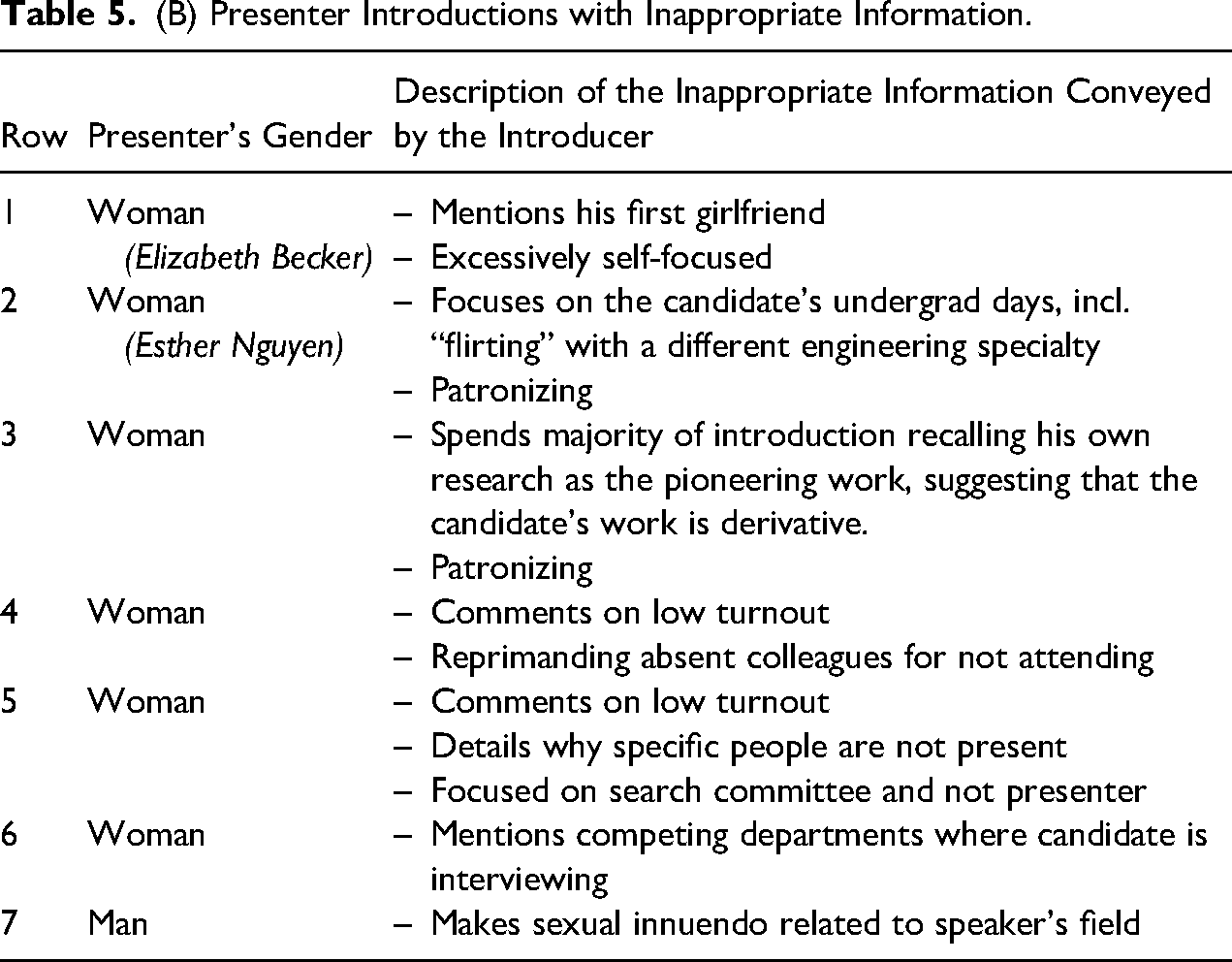
(B) Presenter Introductions with Inappropriate Information.
At University 1, introductions of women are more than twice as likely as introductions of men to contain irrelevancies. At University 2, introductions of women are somewhat more likely to contain irrelevancies. Across both universities combined, 32% of women and 16% of men candidates receive introductions with irrelevant information. Here are examples from introductions of two women (Kira Anderson and Khalida Al-Hashimi) and one man (Tim Bernstein). “So you know Kira and I—Last night, I was looking for [her] email to reply to her to meet and so on, so I was going through my search … and type Kira and I see an email from Kira [six years ago] saying, ‘I'm interested in your research.’” “And she [Khalida Al-Hashimi] has two advisors on her paper, but she's worked with [several other people here at host university], so because of that, it's been a little challenging filling her schedule, because people are like, ‘I know her, I don't need another half hour meeting.’” “Tim worked with another Tim, Tim Stevens, who actually many of us know at [host university]. I think there's a lot of Tims. There's another Tim in the group.” Timothy Bernstein, candidate, speaks up: “Yeah, there are. There's Tim Reynolds.” The introducer continues: “There are very many Tims, very popular name at [university].”
In these three examples, the time would have been better spent saying something specific and relevant about the presenter. The introducer of Khalida Al-Hashimi rather awkwardly stated that it was hard to fill her schedule during the interview, because several faculty were already acquainted with the candidate. (In contrast, recall the introductions of two host university postdocs in Subsection C, George Flores and Rebecca Strauss, which stated more positively that several faculty knew the candidate and did not suggest people were unwilling to spend time with them during the interview.)
Inappropriate Comments. Table 5A reports that at University 1, six introductions (17%) of women and one introduction (1%) of men contain inappropriate content. Table 5B summarizes these seven cases qualitatively.
The introduction of Elizabeth Becker (Table 5B, row 1) goes on to say: “Elizabeth, Dr. Elizabeth, graduated from one of the best universities in the world in [country], and then she went to [university] and I can tell you that [university] is like an awesome place. It's amazing. My first girlfriend was from [university]. And then she left [university], which is like the best place on earth, to come to [different university] …”
In this example, the introducer mentions his own first girlfriend when introducing the candidate, which is inappropriate in a job hiring setting. Esther Nguyen's (row 2) talk: “She is a [subfield] engineer almost through and through except for one year of flirting, as a freshman with [different field], right? —which actually really, really shows in her record. Before becoming a PhD student at [university], she earned her undergraduate degree in [subfield] engineering at [university], and boy, was she a busy undergraduate student, she just couldn't sit still, so let me tell you a little bit about her internships …”
This introducer's comment of “except for one year of flirting” sexualizes the candidate's exploration of another STEM field. Spending time during a short introduction discussing her college days casts doubt on whether there is enough in her current PhD candidate record to discuss. The comment “boy, was she a busy undergraduate student, she just couldn’t sit still!” is particularly infantilizing.
All seven instances of inappropriate introductions contain material that could be embarrassing to the job candidate. Some are patronizing; others contain sexual overtones. The first five cases listed (five of the six women candidates) contain comments that are focused on people other than the candidate, such as the introducer's own research or all the people who did not make it to the candidate's talk. All instances are in University 1; University 2 hosted no talks with inappropriate introductions.
We now consider whether the other patterns analyzed look similar or different across the two universities. In both universities, introductions of men candidates were significantly more likely than those of women to mention CV-listed awards (Table 2), and to have a positive tone (Table 4). Additionally, in both universities, introductions of women candidates were more likely to contain irrelevancies (although this result is not statistically significant for University 2, where cell sizes are very small for this outcome, Table 5A).
Length of Introductions
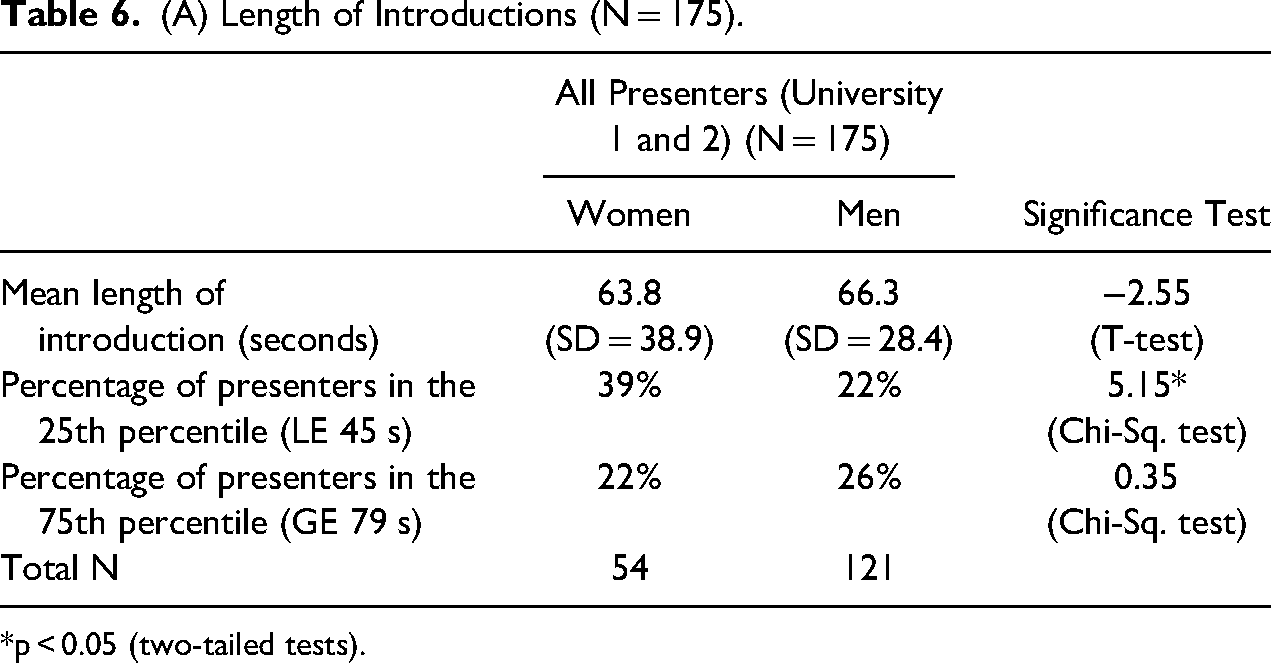
The median introduction length is 59 s. Given the roughly similar medians and means by university (Table 1), we aggregate the length data across the two campuses. Table 6A presents the percent of introductions of women and of men candidates in the shortest introductions (the 25th percentile, 45 or fewer seconds) and the longest (the 75th percentile, 79 or greater seconds).
(A) Length of Introductions (N = 175).
p < 0.05 (two-tailed tests).
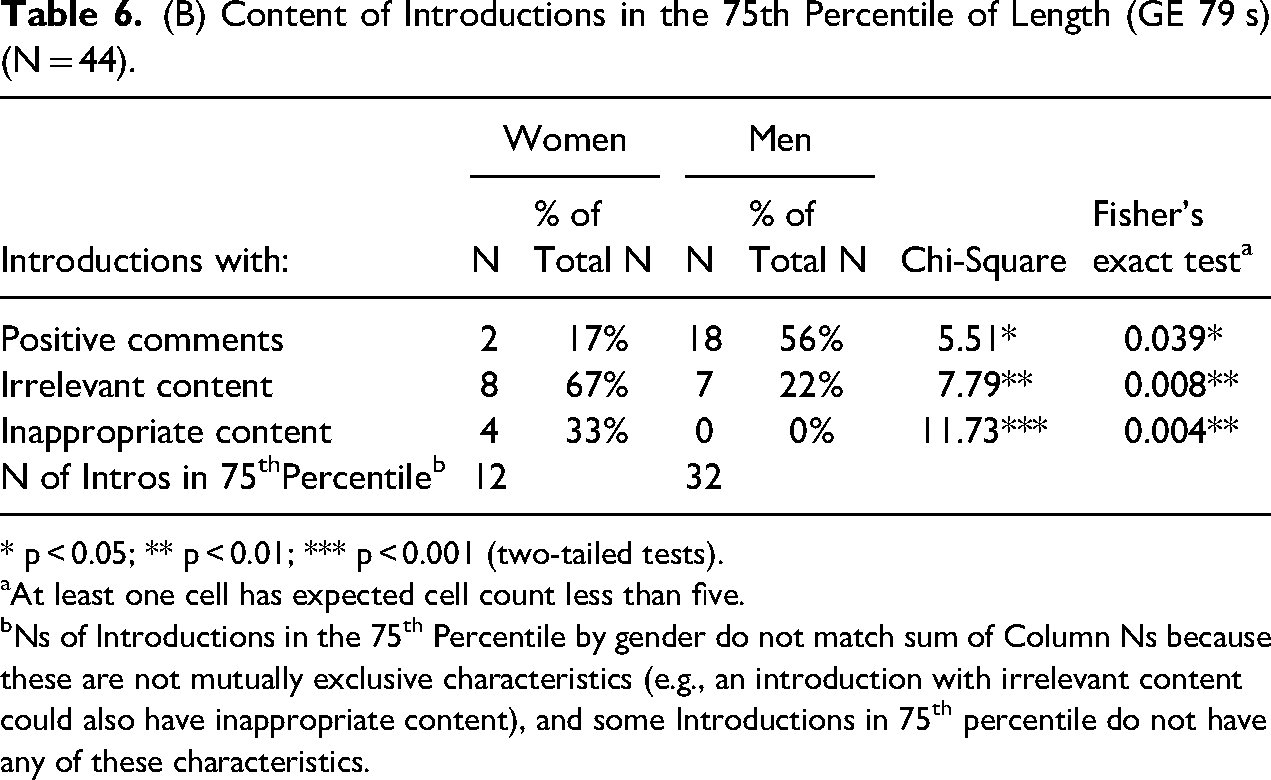
(B) Content of Introductions in the 75th Percentile of Length (GE 79 s) (N = 44).
* p < 0.05; ** p < 0.01; *** p < 0.001 (two-tailed tests).
At least one cell has expected cell count less than five.
Ns of Introductions in the 75th Percentile by gender do not match sum of Column Ns because these are not mutually exclusive characteristics (e.g., an introduction with irrelevant content could also have inappropriate content), and some Introductions in 75th percentile do not have any of these characteristics.
Shortest introductions. Women candidates’ introductions were more likely than men's to be in the 25th percentile (Table 5A, row 2). The content of these shortest introductions seems similar by gender. For both men and women, the shorter the introduction, the lower the proportion that mention three essential aspects of the candidate's record: education, current position, and research interests beyond their presentation title. Over half the introductions under 45 s for both genders leave out these three pieces of key information.
Longest introductions. Women and men candidates are about equally likely to be represented in the longest introductions (Table 6A, Row 3). When faculty introducers in our data spend more time talking about the candidates, do they use this extra time in the same way for men and for women? Table 6B shows that the answer is no. Among the longest introductions, 56% of men but only 17% of women receive positive tone introductions. Faculty who introduce women tend to fill up the time with irrelevant and sometimes inappropriate information. Specifically, 67% (8) of the long introductions of women contain irrelevant information and, of these, half (4) contain inappropriate information. In contrast, only 22% of the long introductions of men contain irrelevancies and none contain inappropriate content.
Gender of Introducer
We now examine whether the gender of the faculty member making the introduction is associated with these patterns. Table 7 combines results from both universities and presents analyses of four outcomes by the gender of the introducer.
Content of Introductions by Gender of Faculty Host Introducer (N = 175).
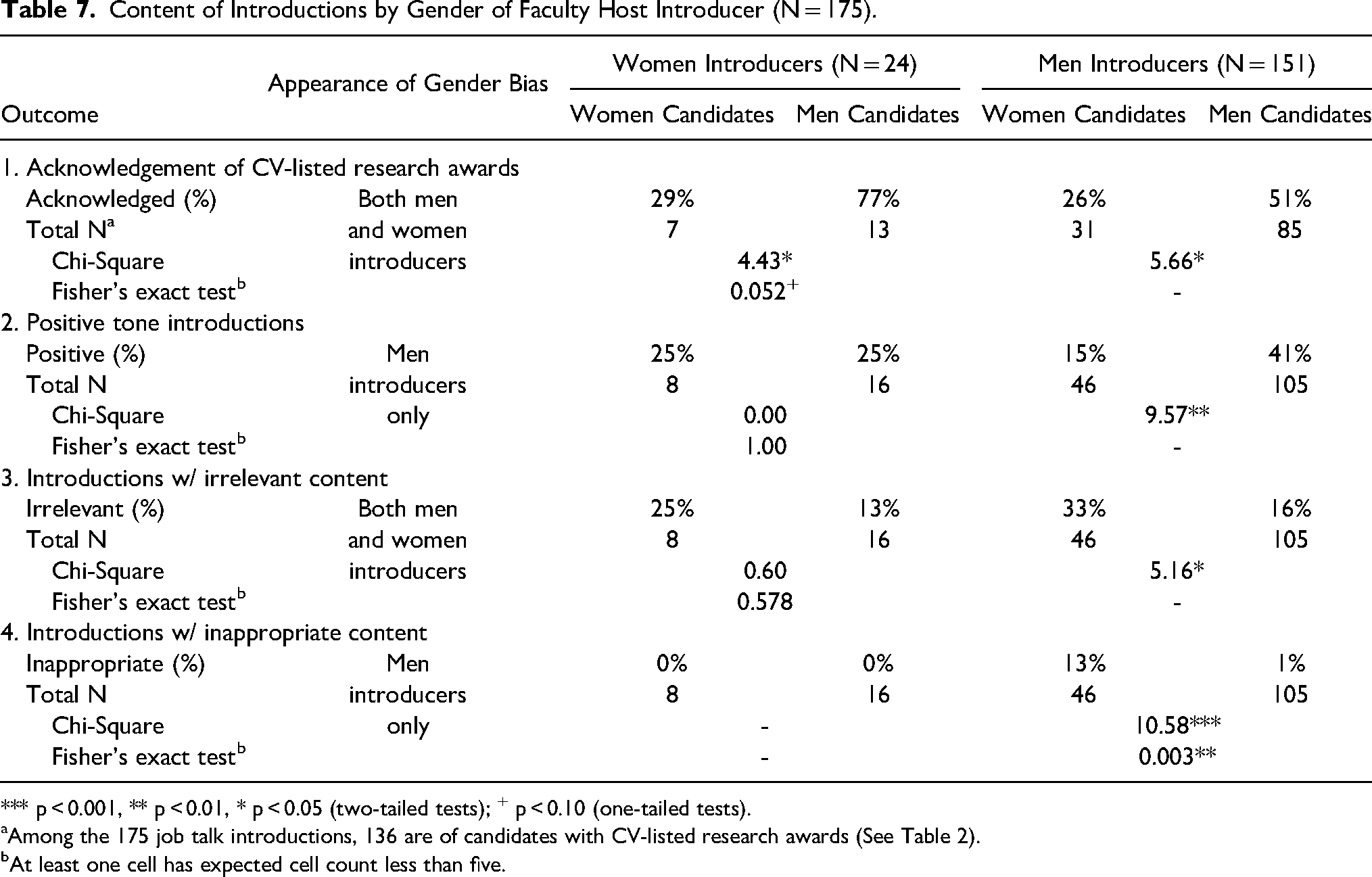
*** p < 0.001, ** p < 0.01, * p < 0.05 (two-tailed tests); + p < 0.10 (one-tailed tests).
Among the 175 job talk introductions, 136 are of candidates with CV-listed research awards (See Table 2).
At least one cell has expected cell count less than five.
We find that for two outcomes, introductions seem biased across the board, regardless of introducer gender. Both men and women introducers acknowledge CV-listed research awards about twice or more times as often for men candidates (Table 7, outcome 1) and mention irrelevant information twice as often for women candidates (outcome 3).
For two outcomes, men appear to give biased introductions and women introducers do not. Women introducers give positive tone introductions to 25% of candidates of each gender. Men introducers are 2.7 times more likely to give positive tone introductions for men than for women (outcome 2). Additionally, all introductions with inappropriate elements (outcome 4) came from men introducers.
Discussion
This section briefly summarizes the paper's novel empirical results. It then offers a typology to sensitize researchers to gender barriers in hiring smuggled in under the guise of societal cultural assumptions and professional cultural schemas. The section then acknowledges limitations.
This study is one of very few to examine faculty recruitment bias in public, interactional settings in real searches. Our research question asked whether there are patterned gender differences in how finalists are welcomed and introduced before they begin their original job talks. Indeed, we find that the introductions tend to magnify the research competence of men candidates, while diminishing it for women. The introductions of women are two to three times more likely to overlook the research awards, which candidates had listed on their CVs and their flyers. Introducers are more than twice as likely to give positive introductions for men than for women, and this result persists when controlling for candidate productivity. Further, among the longest quartile of introductions, those of men tend to be rich in accolades, while those of women often run out the clock with irrelevant and sometimes inappropriate and embarrassing remarks. Women are more likely than men to receive very short introductions, which often missed the basic aspects of their record. Our results align with studies finding gender bias in earlier stages of the evaluation process, such as in recommendation letters and rubrics.
Our investigation into the gender of the introducer found that both men and women introducers mention the research awards earned by men far more often than those earned by women. In contrast, we found that women faculty hosts evenly gave positive tone introductions to one quarter of both women and men candidates, while men were 3.4 times more likely to give men candidates a positive introduction compared to women candidates. Six women candidates (17%) but only 1 man received inappropriate introductions, which could embarrass the candidate by being patronizing, uncomfortable, and/or focusing on people other than the candidate. In sum, professional-level schemas interact with societal gendered beliefs and department practices to reinforce gender inequality in faculty recruitment.
Our results provide insights for future research on the recruitment of professionals in men-dominated professions like the one studied here. Table 8 induces from our results a typology for how societal and professional culture can infuse hiring. The typology can be used a set of dimensions that future researchers should attend to.
How Culture Can Help Reproduce Gender Inequality in the Hiring of Professionals a .
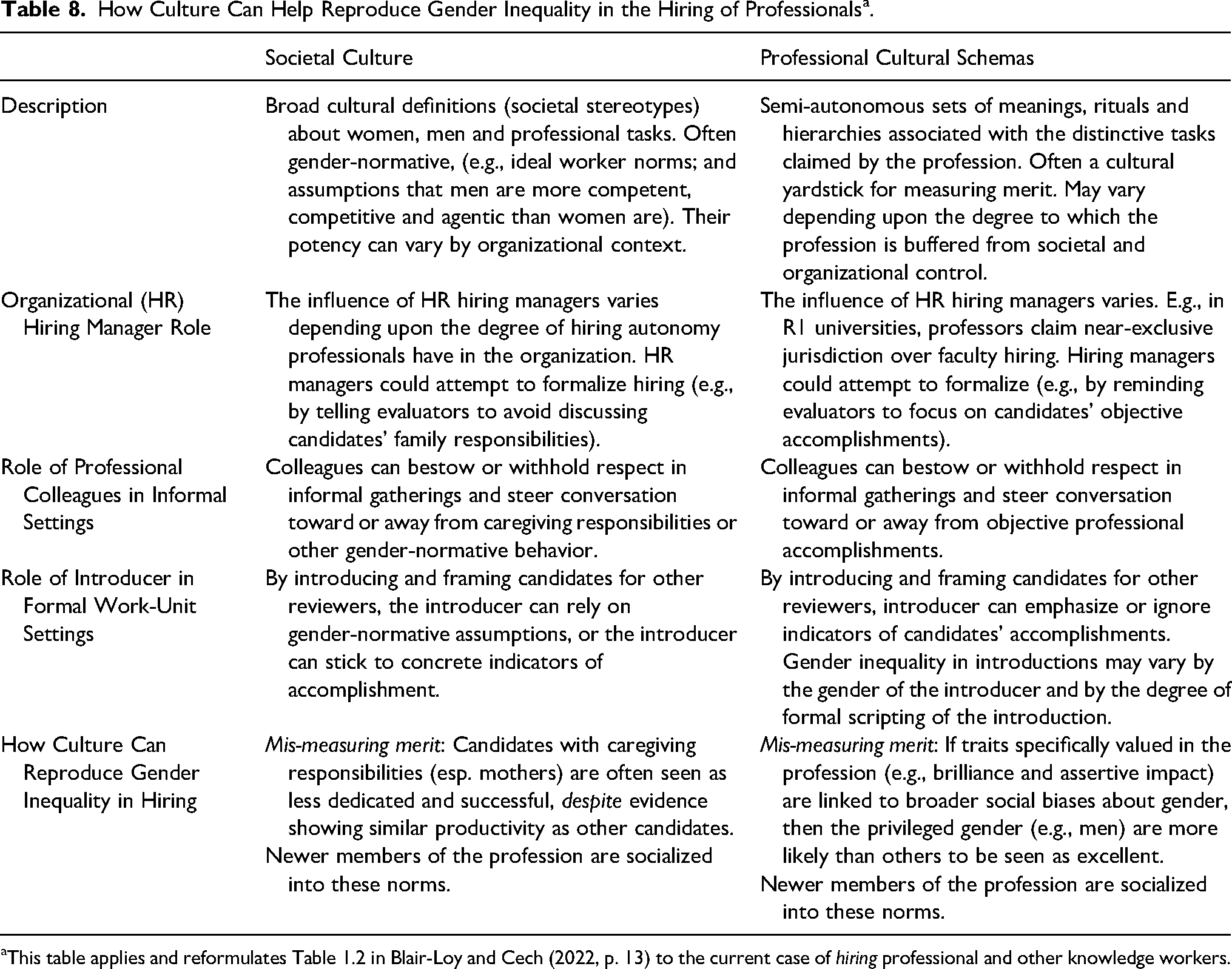
This table applies and reformulates Table 1.2 in Blair-Loy and Cech (2022, p. 13) to the current case of hiring professional and other knowledge workers.
Much previous research on employe evaluation studies the ratings of managers with formal supervisory authority over their subordinates. Yet in cases like ours, hiring managers and the Human Resources (HR) staff division have less influence over hiring than peer professionals, who claim autonomy, peer evaluation and self-governance (see Table 8). Colleagues, especially those at or above the applicant's levels of seniority and prestige, influence how applicants are presented and framed.
How does culture infuse this process? In an overreliance on or unfair application of societal ideal worker norms, department members might emphasize the 24/7 availability and commitment of some applicants (e.g., men and childless women) while raising questions about the future productivity of other candidates who are seen as involved caregivers. If particular traits within the profession's schemas of excellence (such as being viewed as a brilliant, productive, and impactful researcher) are broadly linked to societal beliefs about gender (e.g., men are more likely to be brilliant and impactful in STEM), then concrete indicators of productivity and effectiveness could be highlighted for men applicants and overlooked when discussing or introducing women applicants. These biases could emerge at many stages of the recruitment process, including departmental introductions of and interactions with a candidate and in closed-door personnel meetings evaluating all candidates.
Limitations
This study has some limitations. Our archival data set does not include measures of candidate-identified race and sexual identity. We did not identify any candidates who appeared to us to be nonbinary. We do not find race/ethnicity differences or within-gender race/ethnicity differences in outcomes. However, our coder-assigned measures and the small numbers of URM candidates limit our ability to draw conclusions.
We argue that a professional cultural level of analysis helps explain the similarity in results across the two universities. Earlier research finds that culturally masculine beliefs about excellence are present across many academic STEM fields, despite their demographic differences. The small number of cases within each department and limitations of the department-level data available to us prevent us from analyzing in detail if and how specific departments moderate patterns of professional culture. We encourage future research on larger samples to investigate possible distinctions in how this professional culture manifests, for example by disciplinary specialty or department demography, including the proportion of faculty members who are women.
Finally, our data do not allow us to measure whether more or less positive introductions are associated with subsequent decisions by a department to offer a position or by a candidate to accept an offer. Direct study of the consequences of biased introductions in recruitment processes within and beyond STEM is needed.
Conclusion
In academic engineering, a profession with a commitment to an objective and fair meritocracy, we find evidence of gender bias in the introductions of finalists. It is puzzling that gender bias would remain so entrenched in public introductions designed to welcome and showcase the top candidates already vetted and chosen by the department. To understand this puzzle, we expand the theoretical purview beyond individual cognitive bias and bring in the analytical level of professional culture as enacted in departmental interactions across both universities. Introductions often articulate the qualities aligning with the schema of scientific excellence expected among the top candidates the community has gathered to hear.
Our findings indicate the gendered nature of this schema. Introducers often see and proclaim the research excellence of men candidates and often overlook identical indicators of excellence in women. The level of analysis of professional culture helps explain the similarity in results across the two universities. In these gatherings over several job talk seasons, the elevation of the research excellence of many men and diminishment of that of many women contributes to professional socialization and reinforces gender inequality in the engineering disciplines.
Implications for Research on Academia
We hope our detailed inductive and deductive coding serves as a useful example for future research. Research on the consequences of introductions is needed. Previous studies show that faculty candidates whose recommendation letters have doubt raisers receive lower evaluations (Madera et al., 2019). Similarly, we anticipate that when job talk introductions fail to equitably acknowledge the strengths of women faculty candidates, women will be less likely to be offered positions.
We encourage studies of faculty candidates’ experiences of and reactions to their interviews, particularly the job talk experience. Research shows that culturally masculine elements in undergraduate recruitment into STEM industries can chill the environment for women (Wynn & Correll, 2018). We anticipate that when introductions of women are less likely to showcase their strengths, or even contain irrelevant or inappropriate information, this may signal a less welcoming department and may reduce the chances that women would accept a job offer, thereby helping to reproduce men's domination of engineering departments where these behaviors are the most entrenched.
Some scholarly associations are striving to diversify highly visible roles that signal scientific competence, such as prominent panels and keynote speakers at scholarly meetings. We advocate for studies of the introductions of these speakers to see whether there are differences in the degree to which the introducer is respectful and knowledgeable about the specifics of the speakers’ accomplishments.
Implications for Broader Research on Hiring Barriers
Most previous studies find that men and women evaluators are similarly biased. Our results are more nuanced. Mentioning a research award seems to be an objective remark on a clear indicator of research competence. Yet since men but not women finalist candidates are viewed as automatically aligning with the culturally masculine schema of scientific excellence, men's research awards are recognized while women's are often unseen and unremarked upon, regardless of the introducer's gender.
We find a different pattern by introducer gender for the use of positive tone. The positive tone introductions often implicitly or explicitly include a sense of familiarity with investment in, and personal endorsement of the candidate. Women faculty hosts gave positive tone introductions to one quarter of both women and men candidates. In contrast, men introducers were gave positive introductions to half of the men applicants but only 15% of the women applicants. This could be an example of women's attempt at even-handed professionalism while many men indulge in homophilic preference for other men. Men introducers outnumber women introducers six to one in our data, multiplying this bias.
Women's evenhandedness in giving positive tone introductions to about a quarter of women and men candidates is consistent with previous research on physicians’ introductions of colleagues at medical meetings: women introducers are equally likely to formally introduce men and women presenters as “Doctor,” whereas men introducers are much more likely to use the title for men but not women presenters (Davids et al., 2019; Files et al., 2017). Further, we found that only men introducers touched on inappropriate themes, and this was almost always done when presenting women candidates Our findings and the previous studies of physicians may each convey ways in which women signal equal respect to all genders, a carefully calibrated behavior that may be more likely in an underrepresented and undervalued group.
In contrast, men introducers were more likely to give men candidates a positive introduction (compared to women candidates). This finding is consistent with studies showing the extra support, sponsorship and mentoring, which senior men in academic STEM are more likely to bestow on early career men than on early career women (Fox & Stephan, 2001; Sheltzer & Smith, 2014). This pattern of in-group favoritism (Halrynjo & Blair-Loy, 2022) creates a boost for many men, despite the “illusion of male autonomy” (Kemelgor & Etzkowitz, 2001) in their work. These dynamics should be explored in other professions.
Gender inequality is not only maintained not only by cognitive biases that violate meritocratic norms but is also perpetuated by attempts to enact cherished professional values and celebrate esteemed colleagues. We call for more research on whether and how individual-level bias is exacerbated and justified at the level of professional culture. For example, future laboratory studies could measure whether introductions—by priming listeners about the candidate's competence –elicit primacy bias and affect subsequent perceptions of candidate quality and whether this varies by candidate gender and by disciplinary or occupational field (cf. (Uhlmann & Cohen, 2005). As another example, field-based studies could examine whether resume screeners are less likely to bring the accomplishments of women applicants to the attention of decision makers. Such research could systematically compare these individual and interactional processes across fields with different demographics and distinct norms of excellence. Other studies should use participants who are actual professionals, socialized into their fields’ values and dealing with real, high-stakes decisions.
Overall, this vein of research would further illuminate the different professional and cultural contexts within which women and men's accomplishments are equitably recognized and when they are not. This would help us better understand when and how professional culture serves as an equitable or inequitable source of social closure. More broadly, we encourage more field studies of the introduction and evaluation of job candidates in order to capture the webs of meaning and interaction in which evaluators do evaluative work.
Policy Recommendations
In some situations, such as a roast or retirement party, it is common to embarrass or surprise the main guest. This is not appropriate in faculty talks that are professional and consequential. One of the authors (redacted), recalls how she was once blindsided right before beginning a technical talk. Years before that talk, in the context of a collegiate award, a photo was published in Glamour magazine, featuring her in a swimming pool holding a water polo ball. At a different university years later, an introducer ended the introduction by saying that this was surely the only time in the history of that statistics department that the colloquium speaker “had a swimsuit photo in Glamour magazine” (“Top Ten College Women,” 1987). Intended to discomfit the speaker, this was a literally accurate but an unexpected and misleadingly sexualized reference to a head-and-shoulders photo.
Gender bias in job candidate evaluations tends to be greater when interactions are unscripted and spontaneous (Ridgeway & Correll, 2004). Formalized procedures are often more equitable ones (Stainback et al., 2010). Therefore, we encourage introducers to create standardized introductions for all candidates, and to expunge gendered patterns in their remarks. Crafting equitable and appropriate introductions should be considered basic professional literacy and included in ongoing faculty training. An introduction serves multiple purposes. An equitable and positive introduction makes members of the audience feel privileged to be in attendance, makes the speaker feel welcome, reinforces a respectful climate, models professional behavior for students and other early career scholars, and shows the department in a favorable light. We encourage departments, national disciplinary associations, and multi-disciplinary associations such as the National Academies of Sciences, Engineering, and Medicine, to develop and publicize templates of such trainings. Although gender inequality is often reinforced on multiple levels of analysis, it can begin to be dismantled one level at a time.
Footnotes
Declaration of Conflicting Interests
The authors declared no potential conflicts of interest with respect to the research, authorship, and/or publication of this article.
Funding
This research is supported by the National Science Foundation (#1661306). Any opinions, findings, and conclusions or recommendations expressed in this material are those of the authors and do not necessarily reflect the views of the National Science Foundation.
