




Abstract
Since the value co-creation (VCC) concept was introduced as an alternative to the traditional value creation model, VCC has been studied in various contexts. The literature has mostly focused on a specific research context or a specific type of stakeholder group, leaving a comprehensive view of the stakeholders’ value elements in VCC poorly understood. To address this research gap, we conducted a systematic literature review to provide an overview of the conceptualization of VCC as well as stakeholders’ expected and realized value through collaboration. In accordance with the literature review, six value dimensions (economic, experiential, functional, relational, personal growth and corporate sustainability) are identified. On the basis of the findings of our literature review, we identify gaps in the literature and suggest an agenda for future research.
Introduction
In the twenty-first century business context, where the society is facing severe sustainability challenges, focusing only on maximizing the value for shareholders or customers is not enough. Thus, how to create collective and sustainable value for the whole group of stakeholders has become a hot topic in the academic debate on value creation (Dyllick & Muff, 2016). Meanwhile, the focus of value creation has shifted from the linear model of a value chain, where the firm is the primary value creator, to the collaborative approach of value co-creation (VCC), where various resources of different actors are integrated (Grönroos et al., 2011; Ranjan & Read, 2016; Vargo et al., 2020). This implies a more systemic perspective on VCC where the focus is not only on the dyadic relationship between the service provider and the customer but more broadly on the whole ecosystem of different stakeholders, that is, on collaborative VCC. Value is always co-created through the cultivation of complex networks within an ecosystem comprising not only firms and customers but also their contextual communities and stakeholders (Altinay et al., 2016; Lusch & Vargo, 2014; Merz et al., 2009). Gouillart (2014) argued that firms now compete based on the value produced by their networks as a whole.
Collaborative stakeholder-oriented perspective on VCC has thus been recognized. However, a comprehensive view on what value elements stakeholders may expect and gain from collaborative VCC is still lacking. Though researchers have discussed VCC in different fields, such as marketing (Merz et al., 2009; Ranjan & Read, 2016), management (Chang et al., 2013; Gouillart, 2014; Grönroos, 2017), service (Mayangsari & Novani, 2015; Ramadhan et al., 2015), sustainability (Arnold, 2017; Biggemann et al., 2014), technology and innovation (Han & Hong, 2016; Herrera, 2016) and knowledge management (Aarikka-Stenroos & Jaakkola, 2012). Prior research has mainly focused on a specific research context or a specific type of stakeholder group, leaving a comprehensive view of the stakeholders’ value elements in VCC in vague.
To address this research gap, we take a stakeholder perspective by focusing on VCC literature that not only understands customers as actors in VCC alongside businesses but also considers stakeholders more broadly. Specifically, this study aims to answer the research question: What value elements do stakeholders expect and gain from VCC? The current study contributes to the VCC research by providing a comprehensive explanation of the value elements in VCC from a stakeholder perspective.
Methodology
In the current study, we conducted a systematic literature review to overview the current state of the VCC literature, following guidelines for a structured literature review (Gabbott, 2004). Gabbott (2004) divided the literature review process into five consecutive stages: (1) identifying research gaps; (2) retrieving relevant literature; (3) reviewing the retrieved literature; (4) documenting findings and (5) formulating research questions based on the findings. We retrieved relevant literature for our review from three databases: The Business Source Complete (EBSCO), ABI/INFORM Collection and Scopus. We selected these databases based on the following two primary criteria: (1) these databases include business-centric peer-reviewed journals; and (2) these databases offer an advanced search function to obtain precise search results.
Our initial database search terms included the keywords ‘value co-creation’ or ‘value co-production’ and ‘stakeholder’ in publications’ title, abstract or keywords. Because of the VCC-related research streams’ broadness, our article selection process had to be restricted by inclusion criteria (Gabbott, 2004). In this study, we selected only peer-reviewed articles published in English between January 2009 and May 2022. In total, we retrieved 405 articles through our search. After screening their titles, abstracts and keywords, we included a total of 112 articles in our literature review, having excluded irrelevant articles and duplicate articles included in multiple databases.
We analyzed these 112 selected articles by reading them in full. Our analysis focuses on two aspects: the definition of VCC and VCC dimensions and elements. Since the VCC concept was introduced by Prahalad and Ramaswamy (2004), more and more articles have addressed stakeholder participation in VCC. The research interest in VCC has been steadily increasing in the reviewed years. VCC has been an attractive research topic since 2013 since most of the identified articles have been published after 2013. Conceptual articles were more popular at the beginning of the specific review period; however, empirical studies have become more dominant after 2012, accounting for more than 70% of the total reviewed articles.
More than half of the total reviewed articles (around 55%) addressed the B2B field, whereas approximately one-tenth focused on B2C. Five articles discussed both B2B and B2C contexts. The public sector was also a prominent research context, addressed by 19% of the total reviewed articles. Additionally, nine articles focused on other related perspectives, such as a general literature review.
Findings
Definition of VCC
Academics have used the term co-creation in different contexts over time, making the phrase an ambiguous buzzword (Ramaswamy & Ozcan, 2018; Roncha & Thomas, 2016; Vargo et al., 2017). Table 1 summarizes the VCC definitions presented in the reviewed literature. Most VCC definitions have emphasized collaborative activities (Galvagno & Dalli, 2014; Merz et al., 2009) in which effective engagement and interactions foster collaboration, consistent with the initial VCC concept proposed by Prahalad and Ramaswamy (2004). Regarding actors’ participation in VCC, some articles have emphasized stakeholders (Galvagno & Dalli, 2014; Gouillart, 2014; Merz et al., 2009; Ramaswamy, 2009; Tossavainen, 2017), while Ng (2010), Méndez and Gummesson (2012) and Grace and Iacono (2015) have emphasized solely customers in a narrow view of stakeholders.
The Definitions of Value Co-creation.
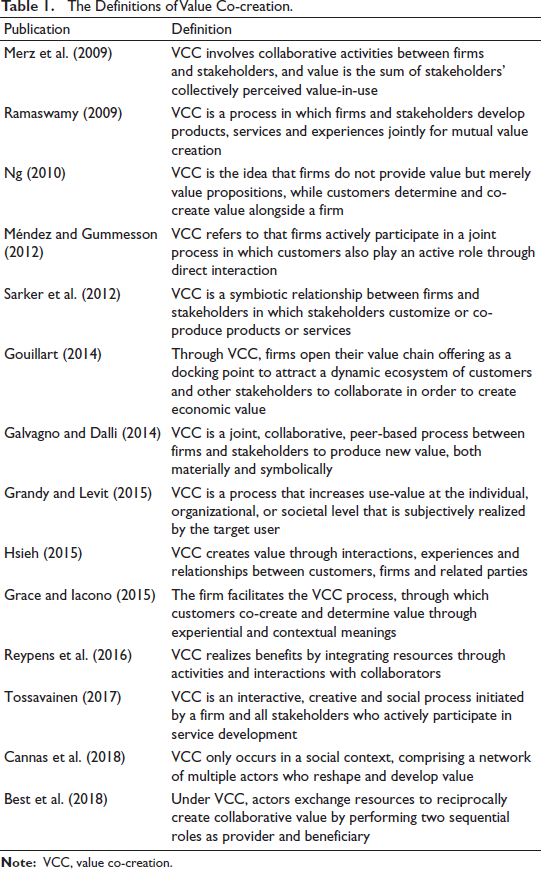
Based on these varying definitions, we propose that VCC can be defined from stakeholders’ perspective as an intensive, collaborative process of engaging and integrating stakeholders through sharing a common platform (face-to-face or virtual) in order to realize the expected value of collaboration for each stakeholder. Firms facilitate the VCC platform, and all stakeholders act as resource integrators to further determine the realized value (at the individual, organizational or societal level) from their own perspective. This definition recognizes the important aspects of VCC: collaborative activities, participating actors, the engagement platform, resource integration and the value’s nature. After stakeholders have shared a common platform, their continuous interaction, negotiation and compromises will determine their realized value in VCC (Cannas, 2018).
Value Dimensions in VCC
Of the 112 articles we reviewed, 36 discussed value elements directly or indirectly. Terminological complexities were noted in that these publications used different terms to refer to these value elements—for example, value expectations, value drivers, value motivations, value perceptions, value outcomes or captured value. To categorize these value elements, we grouped all the identified elements as expected value (described as value expectations, value drivers or motivations) and realized value (described as value outcomes, value perceptions, or captured value).
Most of the value elements discussed in the reviewed literature can be categorized into six value dimensions: economic value, experiential value, functional value, relational value, personal growth and corporate sustainability. These value dimensions, along with their respective elements, are presented in Table 2.
Value Dimensions and Elements.
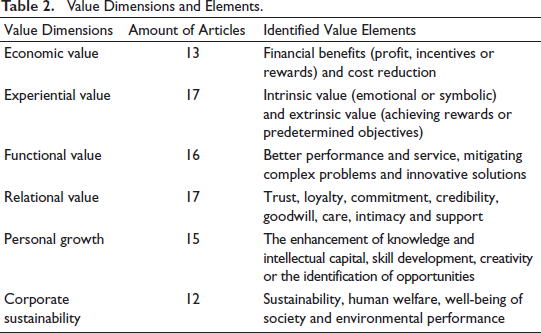
The economic value dimension refers to financial benefits and costs, and it includes such value elements as economic incentives and cost reduction. Though financial incentives are generally assumed to be the easiest and most utilized practice of realizing the value for stakeholders (Pedrosa, 2009), considering only economic value may obscure the actual reasons for stakeholders’ collaboration (Best et al., 2018). As Biggemann et al. (2014, p. 310) noted, ‘value is derived from what is gained from using the money, not only the fact of having the money’. Several scholars mentioned expected economic values, such as financial incentives and rewards (Best et al., 2018; Grace & Iacono, 2015; Pyatt et al., 2017), as well as realized economic values, such as economic growth, industry growth or revenue growth (Cannas, 2018; Leavy, 2013; Permatasari et al., 2021).
Regarding the experiential value dimension, many researchers suggested that co-created value is perceived through the lens of stakeholders’ experiences (Merz et al., 2009; Ramaswamy & Ozcan, 2016; White et al., 2009). Experiential value can include either intrinsic or extrinsic value (Best et al., 2018; Fedorenko & Berthon, 2017; Hong & Lee, 2015; Sarmah & Rahman, 2017). Intrinsic value comprises emotional and symbolic value (Fedorenko & Berthon, 2017; Grandy & Levit, 2015). Examples of emotional value include a sense of belonging, enjoyment, pleasure, entertainment, excitement or fun (Biggemann et al., 2014; Cannas, 2018; Grace & Iacono, 2015; Grandy & Levit, 2015). Meanwhile, symbolic values include psychological achievements through collaboration (Cannas, 2018; Frow & Payne, 2011)—such as privilege, social status, recognition, identity and legitimacy within society (Biggemann et al., 2014; Fedorenko & Berthon, 2017; Grace and Iacono, 2015; Sarmah & Rahman, 2017). In contrast, extrinsic value is related to the outcome of financial targets and the achievement of rewards, predetermined goals or objectives (Fedorenko & Berthon, 2017; Pera et al., 2016; Sarmah & Rahman, 2017). Most of the reviewed authors emphasized intrinsic value’s impact on stakeholders’ active participation (Grace & Iacono, 2015; Ramaswamy & Ozcan, 2016; Ranjan and Read, 2016; Wiltshier & Clarke, 2016); however, some also argued that stakeholders are greatly motivated by extrinsic value (Cannas et al., 2018; Pera et al., 2016).
The functional value dimension includes offerings’ overall performance, such as better service (lead time reduction, inventory management and increased flexibilities), mitigating complex problems and innovative solutions (Leone et al., 2021; Polat, 2022; Schiavone et al., 2021). Ramaswamy and Ozcan (2016) argued that stakeholders mostly consider functional, emotional and self-expressive benefits as expected values of collaboration. Biggemann et al. (2014) also indicated functional benefits as a major expected value for stakeholders; such realized functional values were mostly related to performance improvements, reduced associated risks and stimulating innovation (Grace & Iacono, 2015; Reypens et al., 2016; Rojas et al., 2018).
Describing the relational value dimension, Ranjan and Read (2016, p. 294) stated that ‘relationship manifests in the form of collaboration, outside-in perspective, engagement and use of the mutual resources, and reciprocity’. Stakeholders mostly seek trust, loyalty, commitment, credibility and goodwill from a relationship. Rojas et al. (2018), Pera et al. (2016) and Hsieh (2015) also particularly emphasized the relational value dimension in understanding stakeholders’ expectations. Some scholars mentioned trust, commitment, goodwill, loyalty and credibility as the primary relational value elements (Ciasullo & Troisi, 2013; Kennedy & Guzmán, 2016; Raman et al., 2017; Sarker et al., 2012; Thiruvattal, 2017), while others emphasized establishing a new relationship, care, intimacy and support (Hsieh, 2015; Pedrosa, 2009; Pera et al., 2016; Reypens et al., 2016).
The personal growth value dimension involves the potential for stakeholders’ own development as a result of collaboration. Knowledge advancement and intellectual capital enhancement were cited more frequently as value elements for both expected (Herrera, 2016; Pedrosa, 2009; Sarker et al., 2012) and realized personal growth value (Arnold, 2017; Chang et al., 2013; Kruger et al., 2018; Reypens et al., 2016). Other value elements—specifically, learning, skill development, creativity and identifying opportunities—were also mentioned in the literature as elements of stakeholders’ personal growth (Kennedy & Guzmán, 2016; Kinnula et al., 2018; Nudurupati et al., 2015; Park & Kohler, 2018; Wiltshier & Clarke, 2016).
Finally, the corporate sustainability value dimension reflects an approach of offering environmental, ethical, societal and cultural benefits to stakeholders for long-term value creation. Improved sustainability, sustainable values and social legitimacy are considered as expected values (Arnold, 2017; Best et al., 2018; Ciasullo & Troisi, 2013; Kennedy & Guzmán, 2016), whereas corporate social responsibility, conscious citizenship, human welfare, well-being of society, sustainability and environmental performance are considered as realized values (Cannas et al., 2018; Juriett et al., 2017; Leavy, 2013; Line et al., 2018; Park & Kohler, 2018).
These value elements can be interchanged or overlapped with different value dimensions to fulfil different objectives, depending on the collaboration context. For example, Jaakkola and Alexander (2014) considered legitimacy as an improved experiential value in a community, while Kruger et al. (2018) emphasized social legitimacy as a valuable element in enhancing corporate sustainability. Hsieh (2015) argued that utilitarian value (accomplishing or learning new things) are experiential value; however, some other scholars considered learning as a value element of the personal growth dimension (Fedorenko & Berthon, 2017; Park & Kohler, 2018).
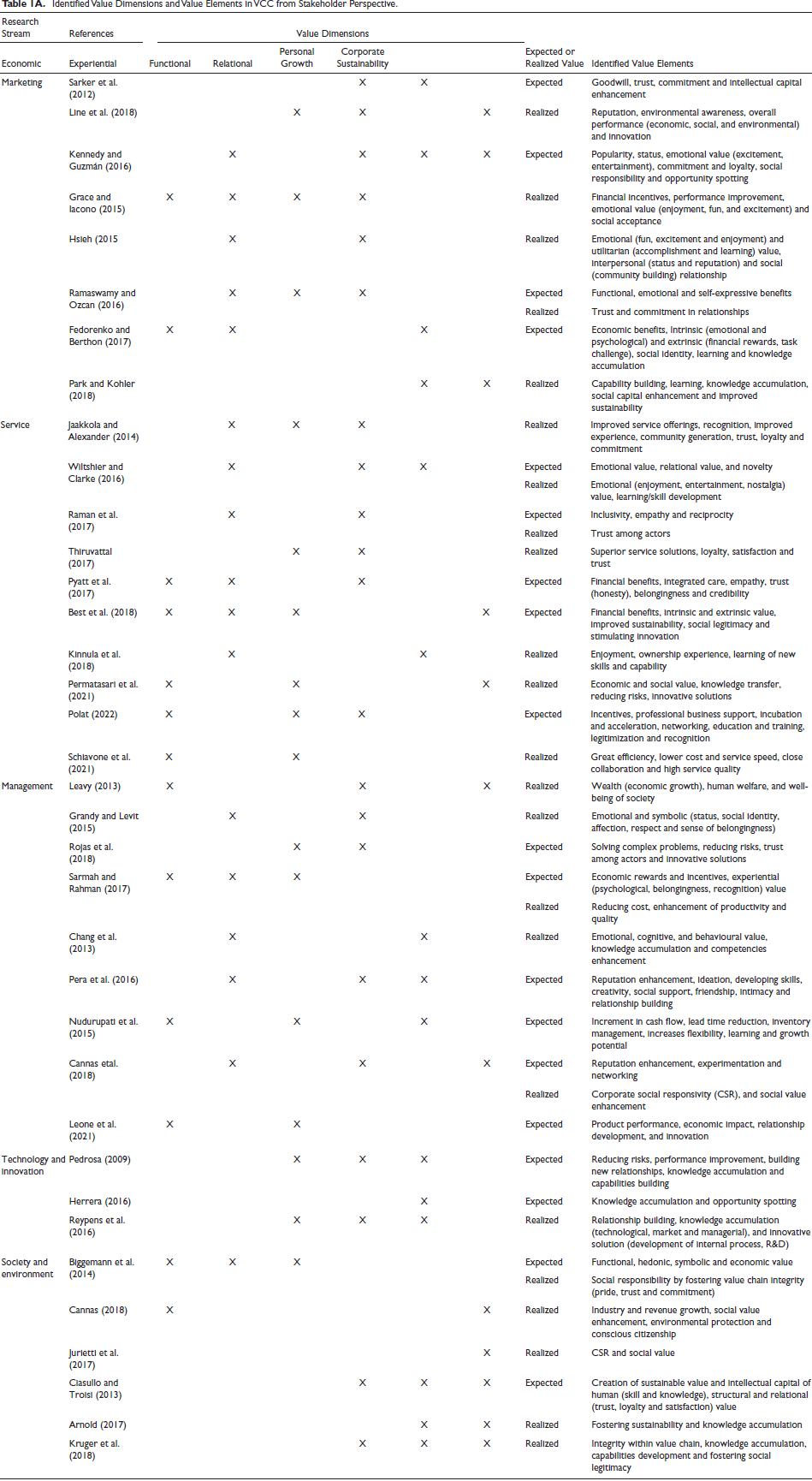
The reviewed articles discussed both expected and realized value for stakeholders. Realized values in VCC were mentioned in the reviewed literature more than expected values (Appendix A). Expected values include stakeholders’ own expectations for a VCC collaboration, whereas realized value comprises actual achievements from collaboration as outcomes for the stakeholder. Because the expected outcome of one stakeholder can dissatisfy other stakeholders, such expectations may lead to conflicts during collaboration (Cannas, 2018; Raman et al., 2017; Sarker et al., 2012). Another possible VCC outcome is that the expected value is not realized or captured due to value slippage or value co-destruction (Chang et al., 2013; Millspaugh & Kent, 2016; Yngfalk, 2013). Importantly, realized values do not always match expected values (Kinnula et al., 2018; Kumar & Rajan, 2017).
Future Research Agenda
Our findings from this literature review suggest potential new avenues for future VCC research. Because we have identified the value elements of collaborative VCC from a stakeholder perspective, including expected and realized value elements, it would be meaningful to apply these identified value dimensions among different stakeholders in different VCC contexts and study the generalizability of the emerged value typology.
Even though we reviewed studies that discuss stakeholders in VCC, prior literature did not explore stakeholders’ value broadly. Future research is needed about VCC in contexts where stakeholders are broadly recognized and studied. That may induce changes to the emerged value typology as well.
In addition, some of the reviewed studies have focused on both expected and realized values. The variation between expected and realized value elements that we identified in this study also merits further research exploring the reasons for this discrepancy from stakeholders’ perspective. This analysis could provide new insights on how to realize value through different collaboration strategies in VCC.
Furthermore, among the different value dimensions discussed in the reviewed literature, the corporate sustainability value dimension has been found to be related to different elements but has not been investigated in depth. Future research could consider about investigating the specific value elements regarding corporate sustainability value in VCC across contexts.
Stakeholder collaboration in VCC aims at different expectations (Darškuvienė & Bendoraitienė, 2014; Näsholm & Blomquist, 2015). Currently, such differences commonly spark conflicts and cause value co-destruction or value slippage (Yngfalk, 2013). However, little research has attempted to examine such occurrences in VCC. However, the reasons for value co-destruction or value slippage—and how to manage and mitigate these challenges—must be explored further.
Conclusion
In this article, we have overviewed state-of-the-art VCC studies from a stakeholder perspective. The current study offers two important theoretical contributions to VCC research. First, it enriches the VCC literature by identifying the value dimensions and value elements in VCC process from the stakeholder perspective. Second, this study presents avenues for future research in the area of expected and realized value across research contexts, and the meaning and practice of value slippage or value co-destruction in VCC process for stakeholders.
Based on our review of 112 articles published between 2009 and 2022, we have discussed different value dimensions and their elements in VCC. All the value elements emphasized in the literature can be grouped into six value dimensions: economic, experiential, functional, relational, personal growth and corporate sustainability. The experiential value dimension was emphasized more in the reviewed studies than the other value dimensions, followed by the relational value elements. The review further indicates how stakeholders’ conflicts of interests can cause value slippage or value co-destruction in the VCC process (Chang et al., 2013; Millspaugh & Kent, 2016; Yngfalk, 2013).
As a literature review, this study has faced some limitations that must be considered while generalizing our findings. We have focused on peer-reviewed scientific articles published between 2009 and 2022 that used the terms ‘value co-creation’, or ‘value co-production’ and ‘stakeholder. ’ Relevant articles outside these criteria may have been excluded. Finally, the main motive in this study was to provide a multi-stakeholder perspective on VCC that covered all possible research streams. Thus, we have not selected a specific research stream in our literature searching. Future research can consider about focusing on a specific research stream when conducting literature review on VCC.
Appendix A
Identified Value Dimensions and Value Elements in VCC from Stakeholder Perspective.
Footnotes
Declaration of Conflicting Interests
The author(s) declared no potential conflicts of interest with respect to the research, authorship and/or publication of this article.
Funding
The author(s) disclosed receipt of the following financial support for the research, authorship, and/or publication of this article: This research was supported by the Strategic Research Council’s Project CORE (313013 +313016) funded by the Academy of Finland.