



Abstract
Conceptual clarity is fundamental to accumulating knowledge in marketing science. This study investigates the construct of value co-creation to assess its conceptual clarity in the academic literature and inform broader theory development in marketing. Drawing on a systematic literature review and statistical analysis of 1224 peer-reviewed articles, we find that while conceptual clarity has improved over time, it remains fragmented. Surprisingly, marketing- and service-focused journals do not exhibit higher conceptual clarity than adjacent fields; moreover, journal ranking correlates negatively with conceptual clarity, whereas author affiliation with prestigious institutions correlates positively with conceptual clarity. To advance the field, we propose a conceptual framework that distinguishes between process and systems perspectives of value co-creation and outline future research avenues grounded in this distinction. We contribute to marketing theory by delineating the value co-creation concept and offering actionable tools for enhancing conceptual clarity, thus supporting more coherent further theorizing and empirically robust research.
Keywords
Introduction
Scientific progress in marketing, as in other disciplines, relies on developing clear and robust concepts (MacInnis, 2011; Suddaby, 2010). Well-defined concepts enable rigorous theorizing, empirical testing, and cumulative knowledge development. In contrast, conceptual ambiguity fosters analytical fragmentation and weakens theoretical coherence (Fry and Smith, 1987; Podsakoff et al., 2016). Marketing research has long faced issues of overlapping and inconsistently applied constructs, undermining construct validity and stalling theoretical advancement (MacKenzie, 2003; Yadav, 2010).
To address these challenges, this study adopts the lens of conceptual clarity—the extent to which a concept is coherently articulated, distinct from related constructs, and systematically organized to support empirical inquiry (Bringmann et al., 2022; Schmidt and Kochan, 1972). Conceptual clarity thus stands as the antonym of ambiguity. We apply this lens to value co-creation, treated here as a conceptual construct rather than an empirical phenomenon. Despite two decades of prominence since Vargo and Lusch’s (2004) seminal SDL article, value co-creation remains inconsistently defined and operationalized. Rooted in early service marketing (Grönroos, 2008; Zeithaml, 1988) and widely adopted across disciplines (Vargo and Lusch, 2017), it still suffers from terminological imprecision (Chandler and Vargo, 2011; Grönroos and Voima, 2013). Although its inclusiveness is appealing, persistent definitional and operational ambiguity (Leroy et al., 2013; Ramaswamy and Ozcan, 2018; Ranjan and Read, 2016) undermines its analytical utility and limits the development of a cohesive theory.
Following MacInnis’ (2011) call for conceptual contributions that organize and advance theory, the paper delineates the dimensions and varied usages of value co-creation and synthesizes them into a framework that enhances its precision and theoretical coherence. Beyond this focal case, the study uses value co-creation to reflect on how marketing theories evolve, diffuse, and stabilize over time. Conceptual clarity is thus treated not as a technical criterion but as a dynamic feature of theorizing that shapes the development of marketing knowledge. In line with Weick’s (1989) view of theory construction as disciplined imagination, clarity provides the structure enabling creative recombination and theoretical advancement. Finally, by introducing and applying conceptual clarity to marketing science, this study offers broader insights into how scholarship can enhance conceptual rigor, coherence, and cumulative knowledge development (Zeithaml et al., 2020). To this end, we pose the following research questions:
To address these questions, we combine conceptual analysis, a systematic literature review, and statistical analysis. For RQ1, we synthesize major research streams to develop a framework distinguishing process and systems perspectives of value co-creation, clarifying its foundational dimensions and reconciling diverse interpretations. For RQ2 and RQ3, we evaluate the conceptual clarity of value co-creation across 1224 peer-reviewed articles using two novel measures—Coverage of Definitions (CD) and Clarity of Conceptual Relationships (CCR). For RQ4, we integrate these insights into a research agenda that enhance theoretical coherence and guide future scholarship.
This study advances research on value co-creation within SDL and service marketing while contributing to broader theory development in marketing. First, we integrate process and systems perspectives into a unified framework positioning value co-creation as a structured umbrella concept (Storbacka et al., 2016). Second, we provide the first systematic, statistically grounded analysis of its application in the SDL literature, highlighting the need for more structured conceptual work (cf. Hulland and Houston, 2020; Mizruchi and Fein, 1999). Third, we propose a research agenda to advance the field by unpacking sub-processes, clarifying actor roles, and identifying outcome dimensions—transforming value co-creation from a metaphorical idea into a more operational construct. Fourth, we contribute to meta-theoretical debates on concept formation by showing how institutional factors (e.g., journal prestige and author affiliation) influence conceptual clarity. To this end, we introduce two novel measures—Coverage of Definitions (CD) and Clarity of Conceptual Relationships (CCR)—which operationalize conceptual clarity in a transparent and replicable way (Kozlenkova et al., 2024). CD captures how explicitly authors define focal constructs, while CCR assesses the clarity of relationships between related concepts. Together, they turn conceptual critique into systematic diagnostics, revealing patterns across disciplines and journals while remaining parsimonious and transferable to other research domains.
The next section introduces the foundational concepts of value and value co-creation and presents the integrative framework (RQ1). It also outlines the notion of conceptual clarity and introduces the measures CD and CCR. The following section details the literature review methodology and presents statistical results (RQ2, RQ3). The final section discusses contributions, implications, and future research pathways (RQ4).
Organizing the theoretical perspectives on value co-creation
Value and value co-creation
Value is a foundational construct in marketing, yet views on how it is created and realized vary widely. Two dominant perspectives prevail: one sees value as a trade-off between perceived benefits and sacrifices (Menon et al., 2005), and the other adopts a means–ends framework, defining value by how offerings enable goal achievement (Woodruff, 1997; Zeithaml, 1988). Although intuitive, these views overlook how benefits and outcomes are generated and interpreted. Value is both subjective and contextual, yet anchored in tangible referents such as products, services, and practices.
Recent research distinguishes between value propositions and value-in-use (Prohl and Kleinaltenkamp, 2020). A value proposition reflects the provider’s intentional offer of potential value (Payne et al., 2017; Skålén et al., 2015), marking the shift from manufacturing-based value-in-exchange toward service-oriented logics, where value emerges through use (Grönroos and Voima, 2013; Vargo and Lusch, 2004). In SDL and Service Logic, value is co-created through beneficiary use within specific contexts rather than embedded in offerings (Grönroos, 2011; Vargo and Lusch, 2016). This service- and use-centric perspective emphasizes the subjective, contextual, and dynamic nature of value (Chandler and Vargo, 2011). Scholars further distinguish between expected and experienced value-in-use—the former reflecting anticipated benefits and the latter those realized through actual usage (Eggert et al., 2019; Kleinaltenkamp et al., 2022; Macdonald et al., 2016). Value-in-context extends this view by showing how social, institutional, and technological settings shape value realization (Chandler and Vargo, 2011).
Building on these foundations, value co-creation has become central in marketing, emphasizing the joint roles of customers and providers in creating value-in-use (Ranjan and Read, 2016; Tuunanen et al., 2023). Value arises through interactions, resource integration, and reciprocal learning among multiple actors (Vargo and Lusch, 2008). To advance conceptual clarity within this evolving paradigm, we distinguish between process and systems perspectives on value co-creation—analyzing it both as actor-level interaction and as a systemic phenomenon embedded within broader ecosystems and institutional contexts.
The process perspective on value co-creation
Early marketing theories, rooted in classical economics, viewed value as a firm-produced attribute embedded in products and realized through exchange (Vargo and Lusch, 2004). This value-in-exchange perspective was later challenged by service scholars, who reconceptualized value as value-in-use—realized by customers through integrating offerings into their own contexts (Holbrook, 1999; Zeithaml, 1988). Building on this collaborative view, notions such as value constellations (Normann and Ramírez, 1993) and value co-production (Ramírez, 1999) laid the groundwork for the current value co-creation paradigm, which repositions firms as facilitators rather than sole creators of value (Grönroos, 2008). Figure 1 (adapted from Grönroos and Voima, 2013) illustrates three value creation spheres: the provider sphere (closed to customers), the customer sphere (closed to providers), and the joint sphere, where interaction and collaboration occur. Vertically, the framework depicts marketing’s evolution from offering-centric to process-oriented understandings of value—marking the transition from value-in-exchange to value-in-use within service-dominant and relational perspectives. The process perspective on value co-creation.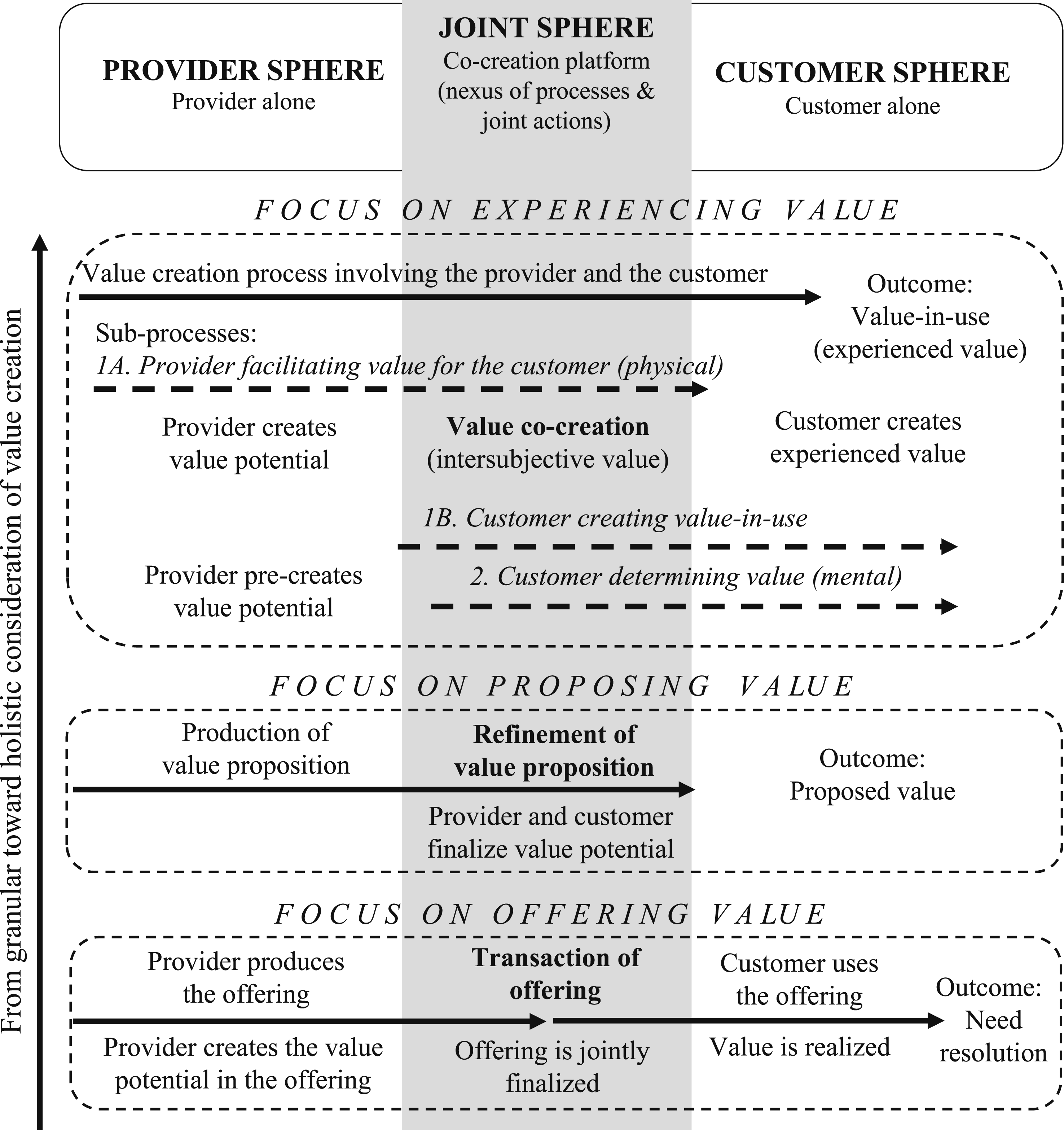
This framework offers a lens for understanding how actors exercise agency across three value creation spheres. At the foundational level, value resides in the potential embedded in offerings. Early service research emphasized the distinctive nature of services as requiring customer participation (Shostack, 1977). Although providers remained central, recognizing customer involvement marked a major shift later elaborated in studies of service encounters (Pöyry et al., 2024; Zhao et al., 2018, see). The second level focuses on value proposition development, highlighting the interplay between production and use and the customer’s role in realizing value through integrating offerings into their own practices (Holbrook, 1999; Zeithaml, 1988). Proposing value is therefore a dynamic, reciprocal process in which customers and providers jointly refine propositions through iterative interactions. This interactive process is well established in service and marketing research, including work on reciprocal value propositions (Frow et al., 2014), platform-based models (Fehrer et al., 2018), and adaptive engagement processes that enhance value-in-use (Edvardsson et al., 2011).
The top tier—experiencing value—offers the most holistic view of value creation by integrating provider and customer perspectives. Here, value emerges through the mutual shaping of expectations, offerings, and usage practices over time. In the provider sphere (Arrow 1A), value propositions are designed to facilitate customer value (Grönroos, 2011). Customers engage with these propositions (Arrow 1B), integrating them into their activities to co-create value-in-use (Arrow 2) through ongoing cognitive and experiential processes. While value creation (1B) is practical and value determination (2) cognitive, both occur concurrently. In service contexts where production and use coincide, provider–customer interaction becomes central. These reciprocal interactions allow customers to shape facilitation and providers to influence perceptions. Yet, in service logic, co-creation requires a deliberate platform for joint value formation rather than mere interaction (Grönroos and Voima, 2013). Ultimately, value-in-use arises from the interplay of provider actions (facilitation, co-creation) and customer actions (creation, determination), highlighting the systemic and dual—practical and cognitive—nature of value creation.
In summary, Figure 1 illustrates value co-creation as a holistic, multifaceted process. Value-in-use arises in the customer sphere through active value creation, while the provider facilitates value by designing and delivering offerings. When these spheres intersect, a co-creation platform emerges, enabling joint production and mutual value creation.
The systems perspective on value co-creation
Research on value co-creation accelerated with the emergence of Service-Dominant Logic (SDL), which reframed value creation as a collaborative, interactional process where customers and providers co-create value through resource integration and mutual service exchange (Vargo and Lusch, 2004). While early SDL studies focused on dyadic interactions, later work broadened the perspective to multi-actor configurations, recognizing that value emerges within complex, interconnected systems (Akaka and Vargo, 2015; Lusch and Vargo, 2006; Vargo, 2008). This systems-oriented view reflects SDL’s aim to provide a unifying lens across multiple levels of analysis (Vargo and Lusch, 2016). A key advancement is the actor-to-actor (A2A) orientation, which sees all economic and social entities as resource-integrating actors engaged in reciprocal service exchange (Vargo and Lusch, 2011). This reframes traditional roles (e.g., firms, customers, and suppliers) as fluid and context-dependent, situated within dynamic service ecosystems shaped by interdependence and evolving institutional arrangements (Akaka et al., 2023; Kleinaltenkamp et al., 2023). As a result, SDL has developed into a meta-theoretical framework that views markets as service ecosystems—configurations of actors, resources, and institutions continuously shaped through interaction, innovation, and adaptation (Akaka et al., 2021; Vargo and Lusch, 2016, 2017). From this perspective, value co-creation is not just a dyadic process but a systemic phenomenon embedded in institutional and contextual dynamics. Figure 2 illustrates this systems perspective on value co-creation. The systems perspective on value co-creation.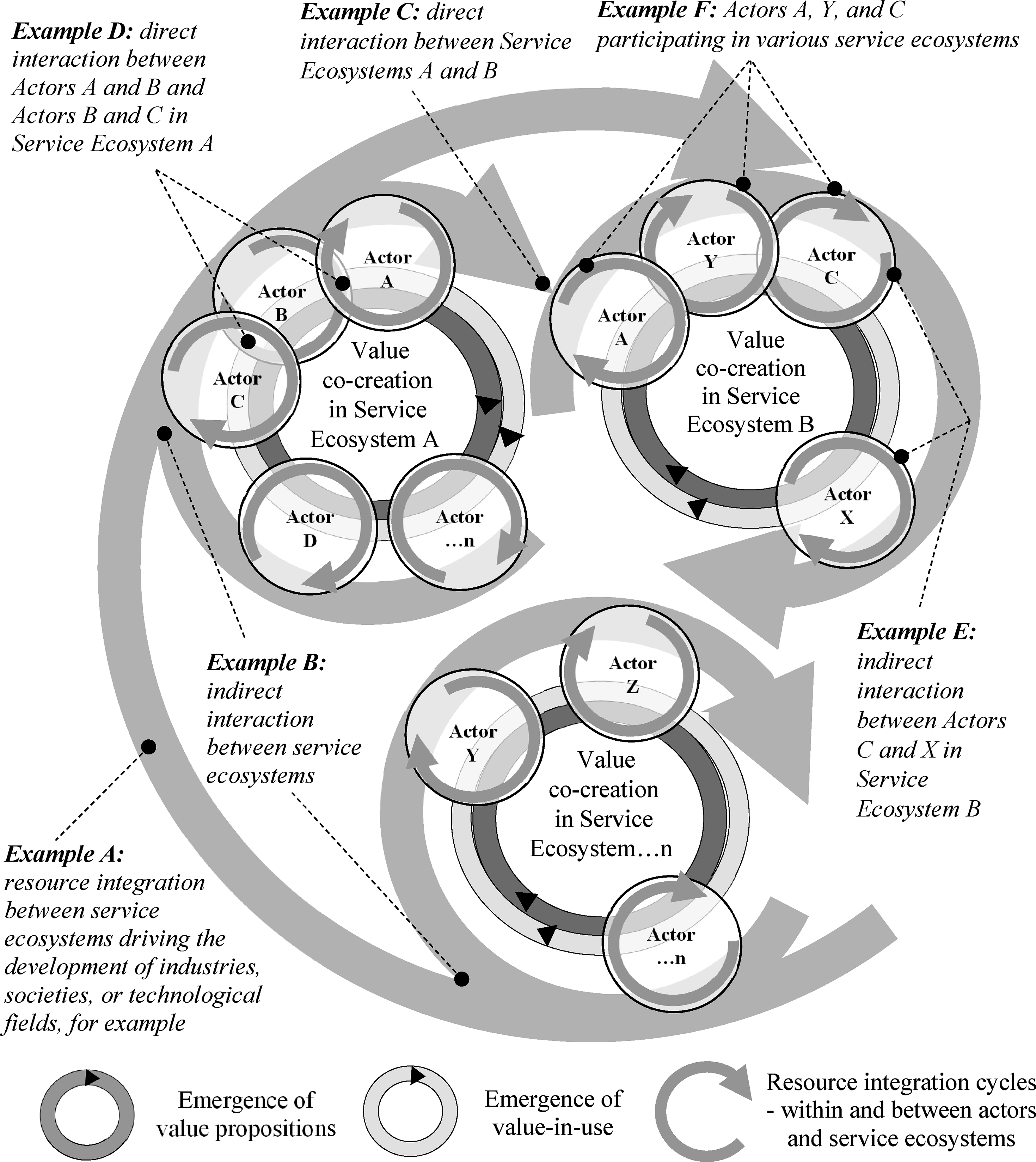
The framework in Figure 2 illustrates value co-creation as a systemic phenomenon embedded within multi-level ecosystems. The framework depicts value co-creation as occurring across all levels—from individual actors to ecosystems. Within this perspective, value co-creation results from resource integration cycles (represented by gray circular arrows) comprising various types of activities and events that occur within and between actors and ecosystems over direct and indirect interactions. These interactions give rise to the emergence of value propositions and value-in-use, depicted as circles in Figure 2.
To operationalize the systems perspective, the framework offers illustrative examples labeled A through F. Example A corresponds to the overarching circular arrow, representing resource integration among ecosystems at the broadest analytical level. This level encompasses developments across entire industries, societies, or technological fields. Makkonen et al.’s (2022) study exemplifies such large-scale integration, which explores inter-ecosystem interactions between distinct fields of autonomous solutions (e.g., autonomous driving and autonomous shipping). Example B illustrates indirect interactions between service ecosystems. For instance, Siltaloppi et al. (2016) examine how institutional change in one ecosystem can indirectly influence others, highlighting the role of shared institutional arrangements in shaping cross-ecosystem developments. In contrast, Example C depicts direct interactions between ecosystems. Makkonen et al. (2022) provide a relevant example of how servitization processes foster collaboration and integration across ecosystems. Shifting to the actor level, Example D illustrates direct interactions among actors within a single service ecosystem. Akaka et al. (2013) analyze such intra-ecosystem value co-creation processes, and Barile et al. (2016) further explore actor-level interactions within service ecosystems. Further, Example E highlights indirect actor interactions mediated by broader ecosystem structures. In this context, Wieland, Koskela-Huotari, and Vargo (2016) demonstrate how institutional and structural arrangements enable indirect forms of value co-creation among actors. Finally, Example F captures how individual actors can participate in multiple ecosystems, underscoring the nested and overlapping nature of contemporary value creation. Chandler and Wieland (2020) elucidate this complexity through the lens of market-making across overlapping systems, where actors are engaged in multiple, interconnected arenas of value creation.
An integrated value co-creation framework
The review of the process and systems perspectives highlights both their divergences and convergences in terms of underlying assumptions and analytical focus on value co-creation. To support more conceptually rigorous future research, Web Appendix 1 provides a detailed comparison of how each perspective interprets key concepts related to value co-creation. Below, Figure 3 presents an integrative conceptual framework that unites the two perspectives, offering a structured foundation for analyzing value co-creation across multiple levels of interaction and context. An integrative framework: the process and systems perspective on value co-creation.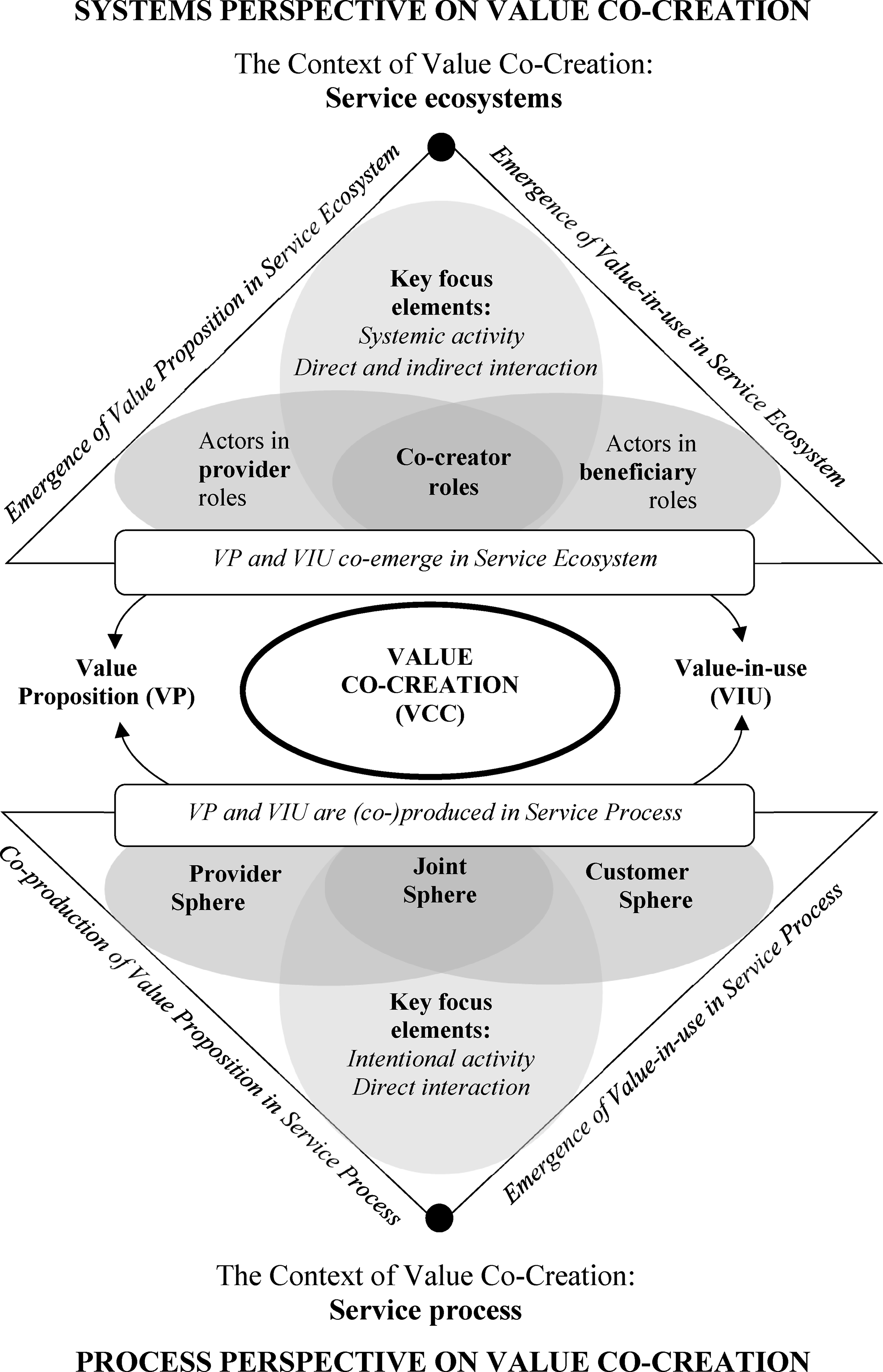
The lower panel of the figure represents the process perspective, while the upper panel captures the systems perspective. At the framework’s core, value co-creation is disaggregated into two foundational dimensions shared across both perspectives: value proposition and value-in-use 1 (Brodie et al., 2019; Eggert et al., 2019; Ranjan and Read, 2016). These two dimensions serve as the analytical basis for examining value co-creation as a dynamic interaction process and a systemic configuration. Although both perspectives share these foundational dimensions, they differ significantly in how value propositions and value-in-use are conceptualized, generated, and interrelated. The following explores these distinctions in more depth.
Within the process perspective—depicted in the lower section of the framework—value co-creation is conceptualized as a specific mode of value creation that arises through direct interaction between provider and customer. This interaction, often described as co-production, forms the foundation for the emergence of value-in-use (Grönroos and Voima, 2013). Service marketing approaches such as service logic (Grönroos, 2011; Grönroos and Voima, 2013) and customer-dominant logic (Heinonen and Strandvik, 2015) emphasize that co-production of the value proposition is a necessary condition for value co-creation to occur (see also Edvardsson et al., 2011).
In the absence of co-production, value creation is understood as taking one of two alternative forms: value facilitation, in which the provider independently delivers a value proposition without direct involvement in its use by the customer, or independent value creation, wherein the customer realizes value autonomously through interacting with the offering (Grönroos and Ravald, 2011). In this perspective, co-production is considered an intentional and collaborative activity in which the supplier actively engages in the customer’s usage process—cognitively, emotionally, and behaviorally—to support the realization of value-in-use. This view repositions the supplier from a passive value facilitator to an active co-creator of value, participating in the service process to influence the customer’s experience and outcomes (Grönroos and Voima, 2013; Heinonen and Strandvik, 2015).
By contrast, the systems perspective conceptualizes value as emerging not only from deliberate, dyadic interactions but from the broader, dynamic configuration of service ecosystems (Chandler and Vargo, 2011). Within these multi-actor contexts, customers, firms, institutions, and other stakeholders continuously co-create value through direct and indirect interactions (Akaka and Vargo, 2015; Chandler and Vargo, 2011). Unlike the process perspective—which treats co-creation as a distinct subset of value creation—the systems perspective posits that all value is inherently co-created (Vargo and Lusch, 2016). This fundamental distinction arises from a broader conceptualization of interaction, where value emerges not solely through intentional co-production but through distributed, emergent, and often unstructured systemic activities. These activities are embedded within and shaped by institutional arrangements and the interdependencies among actors in the ecosystem. As such, value propositions and value-in-use may co-emerge in unanticipated ways, influenced by ongoing institutional evolution, networked interrelations, and contextual contingencies (Akaka et al., 2023; Vargo and Lusch, 2017).
Conceptual clarity of value co-creation
To assess how value co-creation has been used in prior research, we draw on the notion of conceptual clarity—the extent to which a concept is consistently defined, differentiated from related constructs, and organized around clear dimensions enabling empirical investigation (Bringmann et al., 2022; Podsakoff et al., 2016). Earlier studies have evaluated clarity through comparative analysis of related concepts such as conflict vs. competition (Schmidt and Kochan, 1972), information vs. knowledge (Kettinger and Li, 2010), and extrinsic vs. intrinsic motivation (Brief and Aldag, 1977). Following this approach, we examine articles that explicitly reference both value co-creation and co-production, assessing how clearly these are defined, distinguished, and linked.
We select co-production as the comparison concept due to its central role in the process perspective and distinct conceptual identity. Traditionally, co-production refers to the service-provision activities undertaken by firms to generate value propositions—a subset of value co-creation. However, its interpretation remains contested. Vargo and Lusch (2016) note that equating co-creation with co-production is a “common misinterpretation” that reduces the systemic nature of co-creation to momentary interactions. These contrasting interpretations highlight co-production’s controversial nature as a conceptual tool: Its use may indicate a nuanced understanding and precise application of value co-creation, or conversely, a misguided and reductionist interpretation, making co-production a valuable conceptual mirror for examining how clearly value co-creation is defined and applied in the literature.
Our analysis therefore targets articles using both terms, examining (1) how each is defined, (2) how they are differentiated, and (3) how their relationship is articulated. Guided by prior work (Podsakoff et al., 2016; Tafreshi et al., 2016), we operationalize conceptual clarity through two measures introduced in the following section.
Coverage of definitions (CD) of co-production and co-creation
Despite the extensive, cross-disciplinary attention to SDL and value co-creation (Vargo and Lusch, 2016), the literature often lacks consistent and shared definitions of key terms (Leroy et al., 2013; Ramaswamy and Ozcan, 2018; Ranjan and Read, 2016; Storbacka et al., 2016). In particular, substantial variation exists in how “value co-creation” and “co-production” are defined (Degnegaard, 2014). To address this issue, we evaluate whether articles provide explicit definitions of these terms, a dimension we refer to as Coverage of Definitions (CD). We operationalize CD as an ordinal variable, assigning a score of CD = 0 when neither term is defined, CD = 1 when only one term is defined, and CD = 2 when both terms are explicitly defined. This categorization enables a systematic assessment of how consistently articles define the focal concepts and quantifies the extent of definitional clarity within the literature.
Clarity of conceptual relationship (CCR)
The second dimension of conceptual clarity is the Clarity of Conceptual Relationship (CCR). In the context of value co-creation and co-production, CCR captures how clearly an article explains the relationship between these two concepts (Brief and Aldag, 1977; Schmidt and Kochan, 1972). We operationalize CCR as an ordinal variable, following the same logic as CD. The lowest level (CCR = 0) is assigned when both terms appear but their relationship is not discussed—for instance, when they are mentioned in different sections without any explicit linkage. This reflects limited conceptual rigor, as applying two closely related concepts without clarifying their connection undermines both clarity and parsimony. A slightly higher level (CCR = 1) occurs when a link between the concepts is acknowledged but remains ambiguous, leaving it unclear whether the terms are treated as similar or distinct. A higher degree of clarity (CCR = 2) is reached when the article treats the concepts as synonyms, which provides a clear relationship but lacks parsimony because the conceptual distinction between the terms is lost. The highest level (CCR = 3) is assigned when the article explicitly distinguishes between value co-creation and co-production while clarifying how they are connected. In this case, both concepts are used deliberately and non-redundantly, resulting in the highest level of conceptual precision and parsimony.
Statistical analyses of conceptual clarity in the use of value co-creation concept
Searching for and identifying articles for the dataset
Web Appendix 2 summarizes the methodological protocol used to identify relevant journal articles (see Kitchenham et al., 2011). The search, covering Steps 1–2, assumed that SDL-related studies on value co-creation would explicitly reference the work of Stephen Vargo and/or Robert Lusch. We employed a twofold approach: (1) searches in ISI Web of Science for articles citing key SDL publications (Vargo and Lusch, 2004, 2008, 2016) and (2) searches in journal databases (e.g., ProQuest, EBSCO, and ScienceDirect) for occurrences of “Vargo” and “Lusch” anywhere in the text. From the results, we excluded non-journal items such as conference papers and book chapters (Step 3), articles unrelated to SDL or referring to other individuals named Vargo or Lusch (Step 4), and papers authored or co-authored by Vargo or Lusch themselves, as our aim was to examine how the wider academic community has used the terms value co-creation and co-production. Finally, each remaining article was manually screened in PDF format (Step 5) to ensure full compliance with inclusion criteria and eligibility for the final dataset.
After compiling the relevant articles, we recorded key bibliographic information—authors, journal, and publication year—in an Excel spreadsheet (Step 6). To align the dataset with our research questions, we added several contextual variables: the journal’s ranking in the CABS Academic Journal Guide (AJG) (CABS Chartered Association for Business Schools, 2021) and the University of Dallas Journal List, and whether the corresponding author’s institution appeared in the University of Dallas Top 100 Business Schools Ranking. We also created a binary variable for co-creation-intensive journals, defined via a median split: journals publishing nine or more relevant articles were classified as such. Journals were further categorized by disciplinary orientation—marketing and service journals (MSJ) versus other journals (OJ) (see Web Appendices 3–4). Finally, we measured scholarly impact as the average annual number of Google Scholar citations per article up to August 2024.
Coding the articles for coverage of definitions and clarity of conceptual relationships
We enhanced the article dataset with data on each article’s CD regarding co-production and value co-creation, as well as data about the CCR between co-production and value co-creation. We first established an initial coding scheme (Step 1) specifying the conditions for identifying different levels of CD and CCR within each article (see Web Appendix 5). To capture diverse expressions of these concepts, we employed a manual multi-coder approach. Automated tools such as Leximancer were considered but deemed unsuitable due to limited contextual sensitivity. Although labor-intensive, manually reading and coding over 1000 articles was essential for ensuring reliability and accuracy in assessing conceptual clarity. In Step 2, the initial coding scheme was pilot tested by two independent coders. The test highlighted the need for reflexivity—careful reading and contextual interpretation of how key terms appeared within each article. Terms such as co-production and co-creation could vary in form, for example: (i) appearing consecutively (“value co-creation”), (ii) separated by other words (“value is always co-created”), or (iii) expressed as nouns, verbs, or adjectives (“co-creation,” “co-created,” “co-creative”).
To code for CD, each article was examined to determine whether it provided explicit or sufficiently clear definitions of value co-creation and co-production. For CCR, we analyzed how authors used these terms and articulated their relationship within the article’s context. Two independent coders tested the scheme on 200 articles, after which one author compared their results and incorporated feedback to refine and improve the coding framework.
In Step 3, the full dataset was divided into five subsets, each coded independently by two of five coders who were unaware of their pairing to prevent bias. Inter-coder reliability was assessed through mismatch analysis (Step 4), showing high agreement across all subsets: A (88.4%), B (92.5%), C (92.5%), D (93.9%), and E (91.0%), with an overall reliability of 90.8%. Coding discrepancies were resolved by a third coder, who determined the final code (Step 5).
Results
RQ2: Conceptual clarity over time
Figure 4(a) presents the temporal distribution of SDL articles and the share providing explicit definitions (CD) of co-production and/or co-creation. From 2004 to 2013, more than half of the articles lacked clear definitions. After 2014, however, the share defining either concept increased markedly—from 26.0% in 2013 to 53.2% in 2019. Articles defining both terms rose from 10.4% to 21.6% over the same period. Yet even at this peak, a quarter of SDL articles (25.3%) still failed to define either concept. (a) Coverage of Definitions (CD) of co-production and co-creation over time; (b) Clarity of Conceptual Relationship (CCR) between co-production and co-creation over time.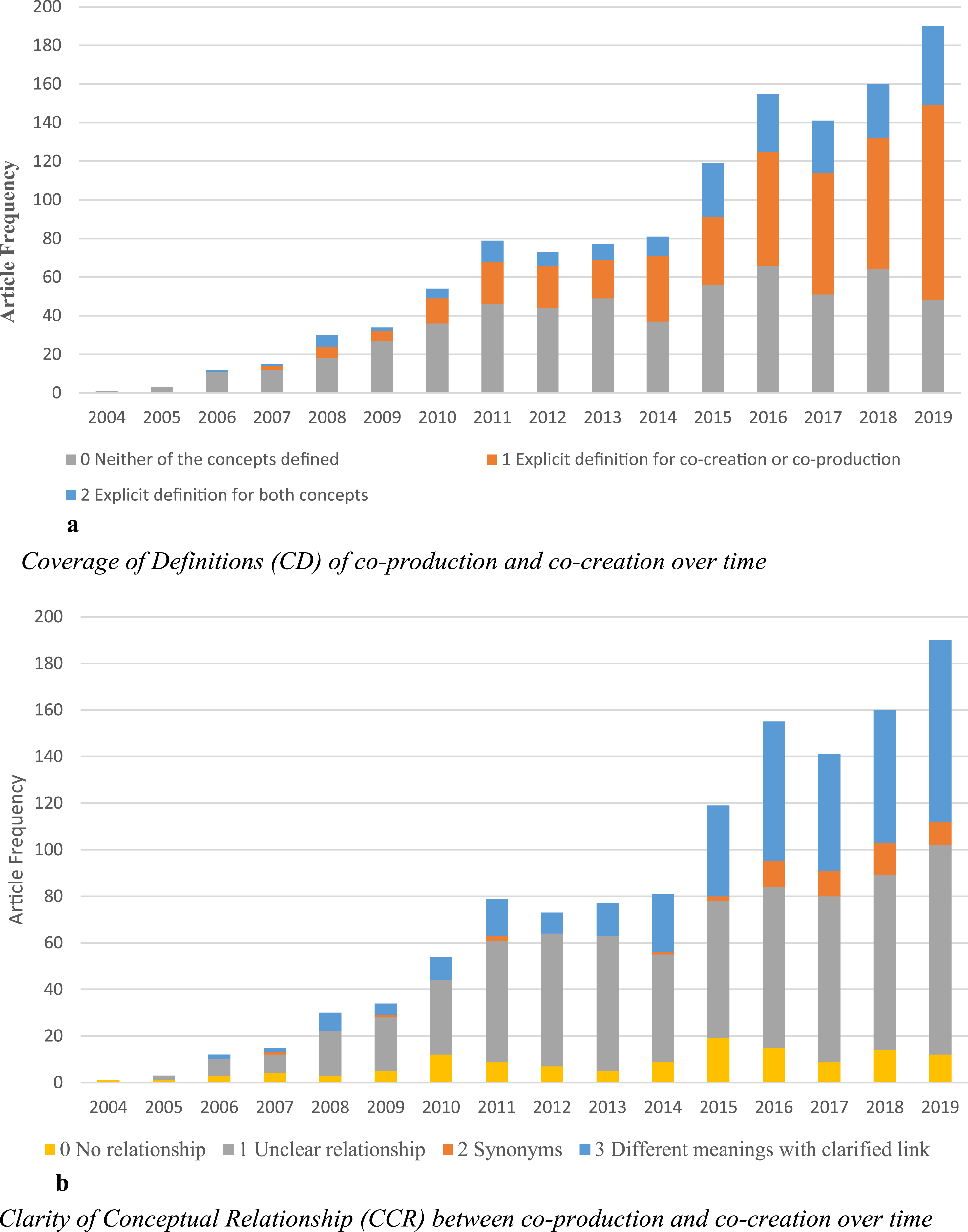
Figure 4(b) illustrates the evolution of Clarity of Conceptual Relationships (CCR) between co-production and co-creation in SDL articles from 2004 to 2019. Across the full period, nearly two-thirds of articles either omitted the relationship (10.5%) or discussed it unclearly (54.6%). Toward the end of the period, the share of articles clearly distinguishing and relating the two concepts increased from 18.2% in 2013 to 41.1% in 2019. Still, by 2019, more than half (53.7%) of the articles left the relationship undiscussed (6.3%) or unclear (47.4%).
RQ3: Institutional factors as antecedents of conceptual clarity
Results of ordinal probit regression of CD and CCR.
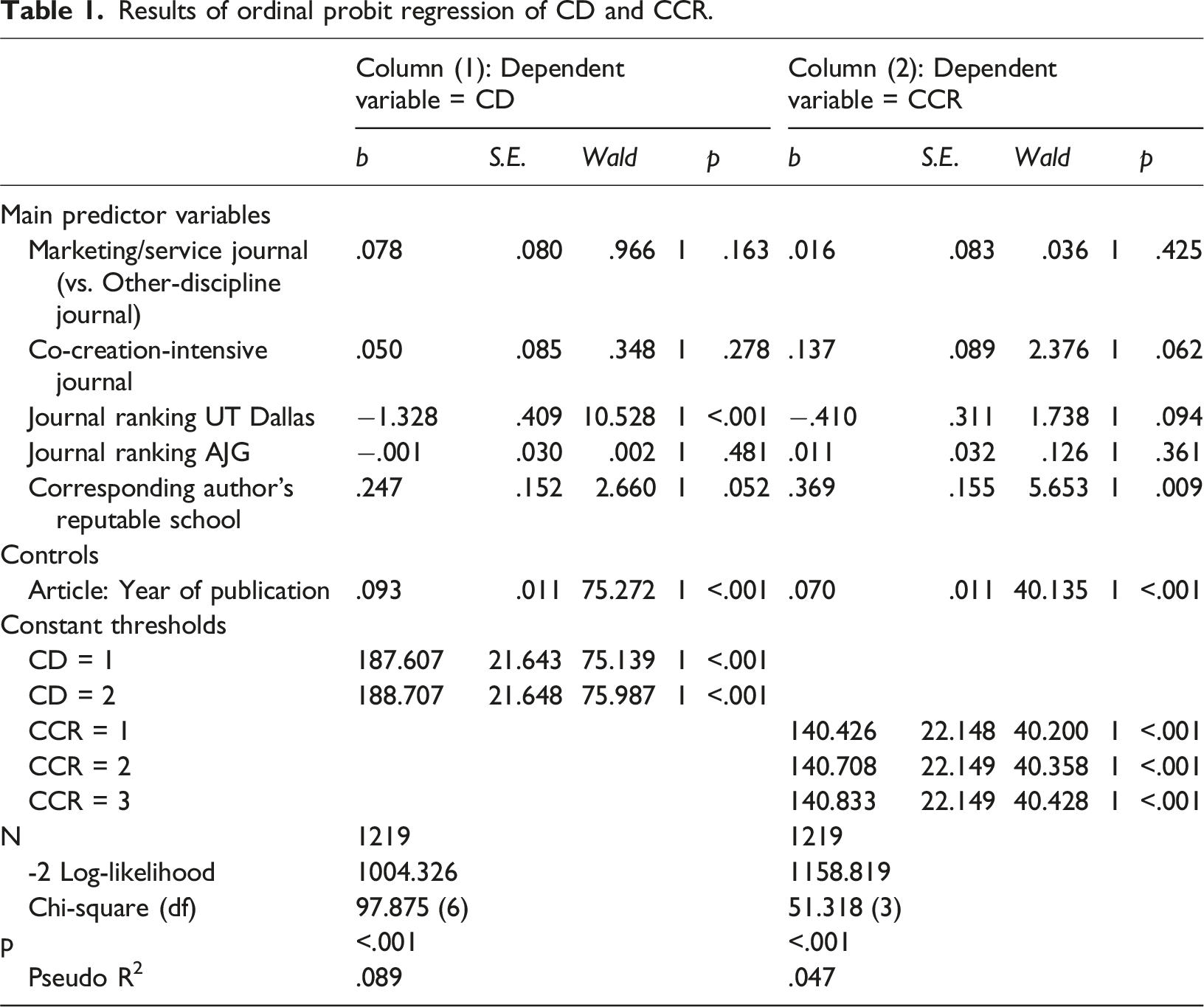
As shown in column (2) of Table 1, several antecedents significantly predict CCR. Consistent with the CD results, journal ranking (UT Dallas List) has a marginally negative effect on CCR (b = −.410, SE = .311, p = .094), while the corresponding author’s affiliation with a highly ranked institution shows a strong positive effect (b = .369, SE = .155, p = .009). Thus, articles in higher-ranked journals tend to discuss the relationship between co-production and co-creation less clearly, whereas authors from top institutions exhibit greater clarity. Additionally, journals with higher value co-creation intensity show a marginally positive effect on CCR (b = .137, SE = .089, p = .062), suggesting that frequent engagement with the topic may slightly enhance conceptual clarity.
RQ3: Scientific impact consequences of conceptual clarity
The second (b) part of RQ3 examined whether an article’s conceptual clarity—CD and CCR—correlates with its scientific impact, measured by yearly citation counts. As shown in Table 1, both bivariate correlations are positive and significant: CD (r = .025) and CCR (r = .072). Thus, articles offering clearer definitions and more explicit conceptual relationships tend to receive more citations per year, suggesting that greater conceptual precision enhances an article’s academic visibility and influence.
Results of poisson regression analysis of articles’ yearly citation count.
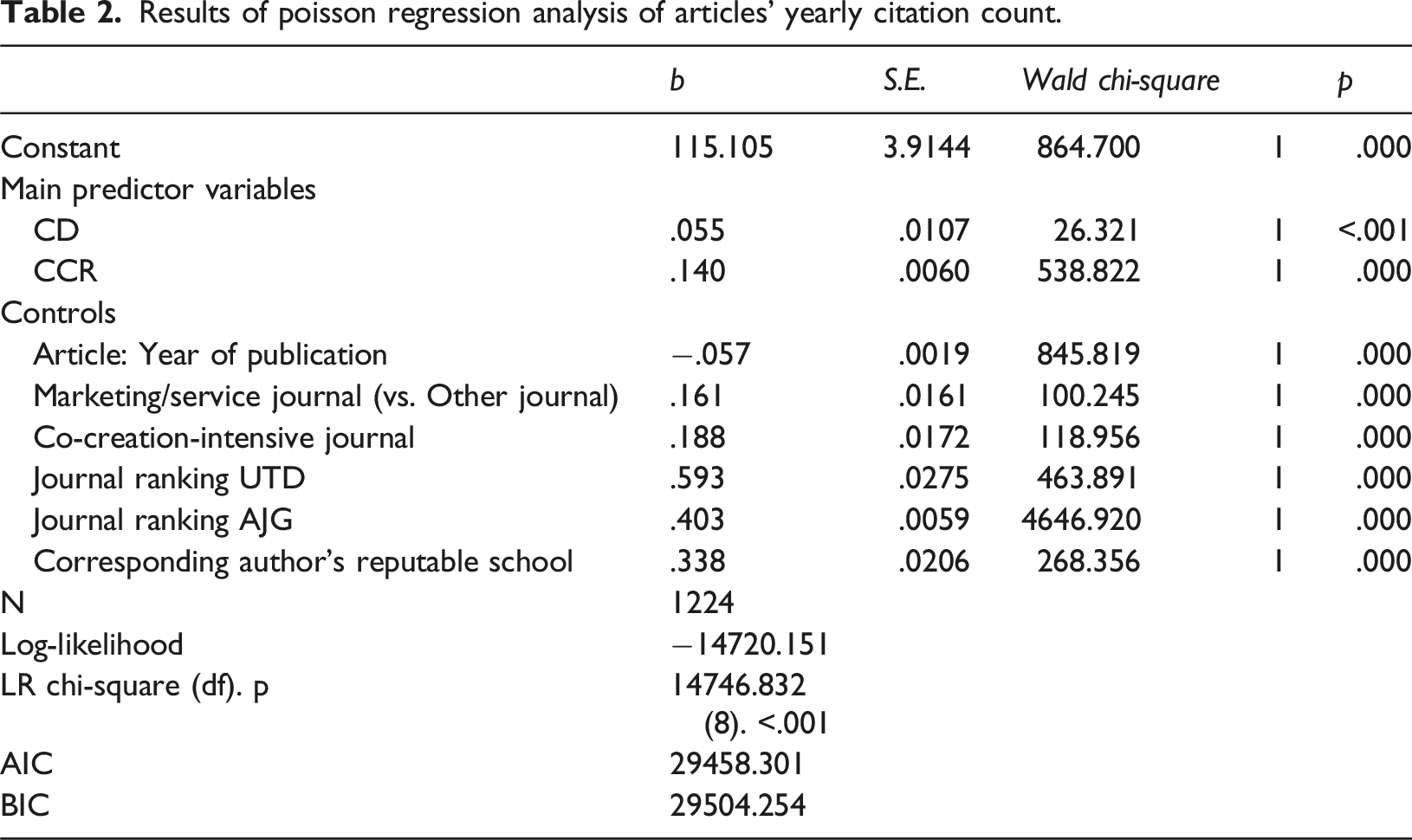
Among the control variables, journal rankings on CABS/AJG (b = .403, SE = .006, p < .001) and UT Dallas (b = .593, SE = .028, p < .001), as well as the author’s affiliation with a top institution (b = .338, SE = .021, p < .001), positively influenced citation counts. This is expected, as articles in prestigious journals and by well-affiliated authors attract greater scholarly attention. Citation counts also increased for marketing or service journals (b = .161, SE = .016, p < .001) and journals with high co-creation intensity (b = .188, SE = .017, p < .001), suggesting that topic-focused scholarly communities tend to cite within their own domain. Finally, the article’s publication year exhibits a negative effect on its average yearly citation count (b = −.057, SE = .002, p < .001). This finding is reasonable, as newly published articles typically attract fewer citations in the immediate years following publication, with citation numbers beginning to accumulate disproportionately only a few years after an article’s release.
In summary, these results demonstrate that both the extent to which an SDL article provides explicit definitions for co-production and co-creation (CD) and the clarity with which it discusses the conceptual relationship between these two concepts (CCR) are predictive factors for the later scientific impact of the article. Of these, CCR is a more influential predictor than CD.
Discussion
Conceptual clarity is a vital yet often overlooked prerequisite for scientific progress, including in marketing science. Focusing on value co-creation, this study examines how clarity manifests and varies across the literature. Quantitative results show modest improvement over time, yet clarity remains low in the end of the studied period. Unexpectedly, marketing and service journals do not display higher clarity than other disciplines. Institutional ranking is positively associated with clarity, whereas journal ranking shows a negative relationship. To inform the future research agenda (RQ4), we extend our framework distinguishing between the process perspective—emphasizing interactional and experiential dynamics—and the systems perspective, which situates co-creation within broader structural and institutional contexts.
Distinguishing between process and systems perspectives enhances both the rigor and relevance of value co-creation research (MacInnis, 2011). By clarifying interactional versus systemic mechanisms, our framework sharpens definitional precision and delineates analytical boundaries, advancing rigor through conceptual clarity. Simultaneously, linking micro-level co-creation activities with macro-level ecosystem and institutional structures increases relevance by explaining how value creation unfolds across levels and conditions. In line with Weick’s (1989) view of theory construction as “disciplined imagination,” clarity and creativity are mutually enabling: clarity provides the discipline that makes imagination productive, allowing scholars to recombine concepts and extend theory. The process–systems framework thus strengthens the explanatory power of value co-creation, showing how actors, structures, and contexts jointly shape value realization and why outcomes differ across situations. It bridges abstract theorizing and applied inquiry, offering both conceptual coherence and managerial relevance. The next section elaborates the research agenda.
Research agenda: Advancing value co-creation through process and systems perspectives
Clarifying actor roles and agency in value co-creation
Actor involvement is central to both process and systems perspectives on value co-creation, yet research often remains vague about actor roles, frequently reducing co-creation to provider–beneficiary dyads (Vargo and Lusch, 2016). The process perspective, in particular, has not fully explained how different forms of agency—such as initiating, mediating, or resisting—emerge and evolve among actors (Edvardsson et al., 2011; Grönroos, 2008). Future studies should move beyond abstract role typologies to explore how actors enact, negotiate, and contest roles in situated co-creation processes. From a process perspective, this calls for examining the interactions, adaptations, and relational work shaping value outcomes. From a systems perspective, research should address how institutional norms, platform governance, and resource asymmetries configure context-dependent roles (Chandler and Vargo, 2011; Vargo et al., 2023). Key future research questions include: F-RQ1: How do different types of individual and collective actors enact agency in value co-creation processes, and what distinct actor roles emerge as a result? F-RQ2: What mechanisms enable or constrain actor participation and influence in the co-production of value propositions? F-RQ3: How does the distribution of agency among actors shape value outcomes and perceptions of fairness in value co-creation settings?
Emerging technologies—especially generative AI and robotics—are redefining the boundaries and distribution of agency in value co-creation. From a sociomaterial perspective, non-human actors such as technologies, algorithms, and artifacts (see Pöyry et al., 2024) also exert agency by configuring interactions, mediating meanings, and shaping outcomes (Kleinaltenkamp et al., 2025; Orlikowski and Scott, 2008). Future research should explore how human and non-human actors jointly perform and redistribute agency in co-creation. For instance, how do AI-based agents or robots engage in co-production, influence perceptions of trust and fairness, or reshape customer and employee roles in hybrid service systems? Integrating sociomaterial and actor–network perspectives can clarify how agency is co-constituted in human–technology assemblages and how these dynamics transform the relational basis of value creation.
Methodologically, comparative case studies, social network analysis, and interaction-level approaches offer promising avenues. Platform ecosystems such as Uber and Airbnb enable investigation of role negotiation—how drivers respond to algorithmic incentives or hosts co-develop service norms with guests. Social network analysis can map actor configurations in collaborative innovation settings (e.g., B2B R&D consortia and public–private health networks) to reveal influence patterns. Likewise, digital ethnography or conversation analysis on platforms like GitHub or Discord can uncover micro-level dynamics of coordination and role formation in value co-creation.
Exploring the temporal dynamics of value co-creation
Despite its dynamic nature, the temporal evolution of value co-creation remains underexplored. Although conceptual models have addressed processual aspects (e.g., Grönroos and Voima, 2013), few longitudinal studies capture how co-creation unfolds over time. From a process perspective, key gaps concern the interplay between activities in co-producing value propositions and determining value (Prohl and Kleinaltenkamp, 2020), as well as between expected and experienced value-in-use (Eggert et al., 2019; Kleinaltenkamp et al., 2022). From a systems perspective, further research should examine how contextual events and broader dynamics interact with actors’ intentional efforts, jointly shaping value propositions and value-in-use (see Makkonen et al., 2022). Relevant research questions include: F-RQ4: How do value co-creation processes unfold over time, and what are the key phases or inflection points in their development? F-RQ5: How does the temporality of value co-creation (e.g., duration, pacing, and sequencing) affect the nature and quality of value outcomes? F-RQ6: How do learning mechanisms and feedback loops shape the evolution of value co-creation practices over time?
In digital and AI-augmented service contexts, temporality is especially salient as machine learning models adapt through ongoing user interaction. Longitudinal studies could explore how generative AI–based personalization systems co-evolve with user expectations of value-in-use. Likewise, robotized environments such as healthcare or logistics offer opportunities to examine how automation reshapes the temporal rhythms of co-creation and human adaptation.
Future research could employ longitudinal and experiential methods to capture how value co-creation evolves over time. Longitudinal case studies of digital transformation initiatives (e.g., predictive maintenance in manufacturing) can trace changing value expectations and role adaptations. Temporal process tracing can reveal cycles of learning, misalignment, and resolution in customer–provider interactions. Experience sampling, diary methods, or data scraping on platforms like Duolingo or Reddit could track shifts in perceived value-in-use following updates or gamification changes. Similarly, panel studies of subscription-based models (e.g., SaaS or fitness platforms like Peloton) can examine how engagement patterns and critical events influence value perceptions over time.
Unpacking the structural and institutional embeddedness of value co-creation
Recent scholarship underscores the institutional and systemic nature of value co-creation, recognizing that norms, rules, platforms, and shared beliefs structure how actors operate (Akaka et al., 2013; Vargo and Lusch, 2016). Yet many studies fail to connect micro-level co-creation with macro-level institutional logics or market structures, leaving key issues of structure and agency unresolved. From a systems perspective, research should explore how institutions both shape and are shaped by value co-creation through mechanisms such as institutional work, legitimacy formation, and resource access (Vargo et al., 2023). From a process perspective, scholars could examine how actors interpret, navigate, and resist institutional arrangements in co-creation contexts. Relevant research questions include: F-RQ7: How do institutional arrangements enable or constrain system-level value co-creation? F-RQ8: What role do intermediaries and orchestrators play in shaping value co-creation systems? F-RQ9: How do systemic asymmetries, for example, power, access, and data, impact creating value propositions and determining value among actors?
Sustainability and circular economy contexts offer rich settings for examining institutional embeddedness. Emerging circular service ecosystems—such as reuse platforms, repair networks, and product-as-a-service models—show how value co-creation is shaped by evolving institutional logics emphasizing resource regeneration and shared responsibility (Anzivino et al., 2023; Fehrer et al., 2023). Future research could explore how these logics are negotiated among public, private, and civic actors, and how institutional work fosters alignment between economic and environmental value creation.
Potential methods include institutional ethnography, case studies, and discourse analysis to examine the institutional embeddedness of value co-creation. Institutional ethnographies of platform labor ecosystems (e.g., Uber) could reveal how drivers navigate and contest algorithmic control, ratings, and governance norms. Case studies of circular economy initiatives (e.g., plastics reuse or battery recycling) can uncover how public and private actors co-develop new rules and norms. Discourse analyses of sustainability platforms such as Patagonia’s Worn Wear or Loop could show how environmental and economic logics are framed and mobilized to construct value propositions.
Mastering multi-level research designs and advancing operationalization
Advancing value co-creation conceptually requires empirical strategies that reflect its multi-level nature. Existing measures often focus on individual-level constructs such as customer participation, offering limited insight into systemic or processual dynamics. Collective constructs (e.g., collective engagement) also struggle to define their focal objects and connect individual and collective dimensions, such as cognitive, affective, and behavioral (Brodie et al., 2019). Future research should therefore adopt multi-level designs integrating dyadic, network, and system perspectives, and employ multi-actor measures capturing role heterogeneity. Longitudinal, real-time, and mixed-method approaches can further illuminate temporal shifts and feedback effects in co-creation systems. Relevant future research questions are thus primarily methodological: F-RQ10: What new research designs can capture value co-creation dynamics across different levels of dyadic, network, and service ecosystems? F-RQ11: How can longitudinal and mixed-method designs better capture the complexity of co-creation processes and systems?
Sustainability and circularity provide rich contexts for advancing multi-level operationalization. Connecting individual behaviors—such as repairing, reusing, or sharing—to collective and ecosystem outcomes reveals how sustainable value emerges across levels. System dynamics modeling and mixed-method designs integrating environmental metrics (e.g., carbon reduction and material reuse) can clarify how circular initiatives generate multi-dimensional value over time.
Promising approaches include system dynamics modeling, agent-based modeling, and multi-level surveys, to capture the complexity of value co-creation. System dynamics modeling in mobility-as-a-service ecosystems can simulate feedback between regulation, user behavior, and innovation (e.g., shared e-scooter programs). Agent-based modeling can reveal how distributed agency drives emergent outcomes in platform markets (e.g., online labor or collaborative consumption systems). Multi-level surveys can link frontline interactions with strategic orchestration in B2B ecosystems (e.g., aerospace maintenance or smart farming).
Theoretical contribution
This study advances value co-creation research within SDL and service marketing while contributing to broader theory development in marketing. First, we introduce a systematic framework distinguishing process and systems perspectives on value co-creation. Whereas prior research often treats the concept monolithically, our framework clarifies key distinctions: the process perspective centers on situated, interactional, and experiential dynamics, while the systems perspective emphasizes structural and institutional arrangements in multi-actor contexts. Explicating these views enhances analytical precision, enables clearer positioning of studies within a coherent conceptual architecture, and resolves ambiguities among related constructs (e.g., value co-creation vs co-production). Moreover, by elaborating value proposition and value-in-use as foundational dimensions, the framework offers a unifying basis for coherence across fragmented literature.
Second, this study provides the first large-scale quantitative analysis of how value co-creation is applied across the SDL literature. While prior critiques have noted conceptual vagueness and definitional inconsistency (e.g., Grönroos, 2008; Leroy et al., 2013; Ramaswamy and Ozcan, 2018), our analysis empirically confirms these concerns. The results show that value co-creation still lacks conceptual clarity—even in top journals and within SDL’s theoretical core—constraining cumulative knowledge development and practical relevance. This finding reinforces the need for the structured conceptual intervention advanced in this study.
Third, we propose an actionable research agenda to open the “black box” of value co-creation. It offers concrete directions for advancing the field by unpacking sub-processes, clarifying actor agency, and identifying outcome dimensions. This agenda helps transform value co-creation from a largely metaphorical idea into an operational and theoretically grounded construct, fostering cumulative knowledge development in marketing and related domains.
Fourth, drawing on the sociology of science (Hulland and Houston, 2020; Mizruchi and Fein, 1999), this study contributes to meta-theoretical discussions on concept formation and theory building in marketing. Beyond the case of value co-creation, it offers broader insight into how marketing theories evolve, diffuse, and stabilize within academic communities. Using value co-creation as an illustrative example, we present a data-driven account of conceptual clarity as a socially embedded phenomenon shaped by institutional forces such as journal prestige and author affiliation. The uneven diffusion of conceptual clarity across journals and institutions demonstrates how theoretical ideas transform through social and institutional processes. Value co-creation illustrates this trajectory: introduced as an open, generative idea, its productive ambiguity fostered creativity and adoption but later constrained cumulative theorizing. Following Weick’s (1989) notion of disciplined imagination, we view clarity and ambiguity as mutually enabling dimensions of theorizing—clarity providing discipline that channels imagination into coherent theoretical progress. By empirically examining conceptual clarity, the study advances understanding of how marketing knowledge develops through cycles of conceptual expansion and refinement, positioning conceptual clarity as a central mechanism in the evolution of marketing science. Methodologically, we introduce two diagnostic tools—Coverage of Definitions (CD) and Clarity of Conceptual Relationships (CCR)—for assessing conceptual clarity. Although applied here to value co-creation, these measures are transferable to other evolving concepts, enhancing the rigor and cumulative potential of marketing scholarship (Zeithaml et al., 2020).
Limitations
Despite a robust research design, some limitations remain. First, our focus on the terms “value co-creation” and “co-production” provides only a partial view of conceptual clarity. This approach emphasizes the dimension of proposed value, while the dimension of value determination receives less attention. Initially, we considered comparing articles focused on value proposition versus value determination, but this proved problematic due to inconsistencies in how these dimensions are conceptualized. Given the prominence and frequent misinterpretation of the terms “co-creation” and “co-production” (e.g., Vargo and Lusch, 2016), we focused on their relationship as a fruitful entry point, enabling the development of the CD and CCR measures and ensuring a manageable, transparent coding process. Second, coding for conceptual clarity involves an element of subjectivity. To reduce this, we developed a detailed coding framework, thoroughly trained coders in SDL and value co-creation, and tested their understanding before coding. We also monitored coding quality through inter-coder reliability, with independent pairs achieving consistently high agreement (84.9%, 90.0%, 88.4%, 87.7%, 87.2%), resulting in an average reliability of 87.0%. Third, we aimed to provide an extensive, cross-disciplinary, and longitudinal overview of the conceptual clarity of value co-creation. Our focus was on identifying differences in clarity across selected variables, which could indicate varying capacities to apply the concept consistently and support its role as an analytical construct. However, this broad approach was mutually exclusive with conducting a more nuanced, journal- or discipline-specific qualitative analysis.
Supplemental material
Supplemental material - Advancing conceptual clarity in marketing science: Delineating process and systems perspectives on value co-creation
Supplemental Material for Advancing conceptual clarity in marketing science: Delineating process and systems perspectives on value co-creation by Hannu Makkonen, Jaakko Aspara, Christian Grönroos, and Matti Mäntymäki in Marketing Theory.
Footnotes

Funding
The authors received no financial support for the research, authorship, and/or publication of this article.
Declaration of conflicting interests
The authors declared no potential conflicts of interest with respect to the research, authorship, and/or publication of this article.
Supplemental material
Supplemental material for this article is available online.
Note
Author biographies
References
Supplementary Material
Please find the following supplemental material available below.
For Open Access articles published under a Creative Commons License, all supplemental material carries the same license as the article it is associated with.
For non-Open Access articles published, all supplemental material carries a non-exclusive license, and permission requests for re-use of supplemental material or any part of supplemental material shall be sent directly to the copyright owner as specified in the copyright notice associated with the article.
