



Abstract
Universities play a crucial role in fostering innovation and entrepreneurship ecosystems, particularly in emerging regions where economic development depends on effective knowledge transfer and strategic leadership. This study examines the role of university leadership in building innovation ecosystems through a contextualised approach that integrates universities, businesses and the State. Using a qualitative grounded theory methodology, we conducted in-depth interviews with six university executives, six business leaders and two government officials (one local and one national). Additionally, a policy document analysis was performed to assess the alignment between academia, industry and government in fostering innovation in the Magdalena region. Findings reveal that while universities are increasingly promoting entrepreneurship, a lack of coordination with government and industry hinders the formation of a robust innovation ecosystem. Businesses report limited awareness of government support programmes, and policymakers have not established effective mechanisms to facilitate collaboration. Regulatory barriers and communication gaps further restrict the implementation of innovation policies. This study proposes a contextualised strategic model for university leadership that strengthens the Triple Helix framework by emphasising the need for greater alignment between academia, industry and government. The model provides practical strategies for improving collaboration, enhancing policy dissemination and fostering financial support mechanisms for entrepreneurship. By addressing these structural gaps, universities in emerging regions can play a more proactive role in driving economic growth and innovation-led development.
Keywords
Introduction
Universities have become central actors in the configuration of innovation and entrepreneurship ecosystems, particularly in emerging economies where structural transformation depends on knowledge generation, institutional coordination and strategic leadership (Castells, 2002; Etzkowitz & Leydesdorff, 2000; OECD, 2010). The evolution of the university mission—from primarily teaching institutions to entrepreneurial and regionally engaged actors—has been widely documented (Arraut, 2011; Beraza & Rodríguez, 2007; Etzkowitz, 1998). In this expanded role, universities are expected to articulate productive sectors, public policy frameworks and scientific capabilities in ways that stimulate sustainable development (Acs et al., 2017; Audretsch et al., 2007; Etzkowitz et al., 2000; Kuhlmann & Rip, 2020; Mason & Brown, 2014; Neck et al., 2004; Saltos Briones et al., 2018; Stam & Spigel, 2016).
In regions characterised by high socio-economic inequality, weak competitiveness structures, limited State capacity and fragmented institutional relationships, ecosystem coordination often remains fragile (Cheah & Ho, 2019; Heaton et al., 2019; Kabbaj et al., 2016; Lombana & Rozas, 2009; Ramírez & García, 2010; Rouschop et al., 2015; Spilling, 1996; Zeng et al., 2010). Under these conditions, innovation does not fail because of the absence of actors but because mechanisms of alignment, trust-building and long-term strategic articulation remain underdeveloped. Ecosystem models developed in institutionally mature contexts often underestimate these coordination gaps when applied to emerging regions.
The Department of Magdalena in the Colombian Caribbean reflects these tensions. With a poverty rate of 47.6% (DANE, 2024) and an economy concentrated in agriculture and tourism, the region remains only partially integrated into the knowledge economy (Consejo Privado de Competitividad, 2024; Meisel-Roca & Ricciulli-Marin, 2018). Although innovation-led growth is emphasised, interactions among universities, businesses and government remain fragmented. Entrepreneurial ecosystems require not only the presence of actors but also relational density and coordination aligned with local capacities and socio-environmental realities (González & Katonáné, 2018; Max-Neef et al., 1986). Initiatives often emerge through isolated efforts instead of sustained governance structures capable of consolidating a regional innovation ecosystem (Franco-Leal et al., 2020; Mirvis & Googins, 2018).
Within this context, Higher Education Institutions (HEIs) face a strategic inflection point. Research on entrepreneurial universities suggests that HEIs must move beyond supplying human capital and assume a proactive role in shaping territorial transformation through sustained collaboration among academia, industry and government (Drucker, 2009; Granstrand & Holgersson, 2020; Hayter, 2016; Huang-Saad et al., 2018; Lamine et al., 2018; Schumpeter, 1934). Studies in emerging contexts further emphasise the importance of local partnerships and territorially grounded innovation strategies (Bezerra et al., 2017; Chepurenko et al., 2019; Mukesh & Rajasekharan Pillai, 2020).
Despite these advances, prevailing ecosystem frameworks—such as the Sábato Triangle and the Triple and Quintuple Helix models—often assume levels of institutional cohesion and policy stability that are not always present in emerging territories (Carayannis & Campbell, 2009; Etzkowitz & Leydesdorff, 1996; Sábato & Botana, 1968). While these models provide valuable analytical foundations, they offer limited guidance on how coordination emerges under fragmented governance, limited trust and resource constraints. As Ramírez and García (2010) argue in the Latin American context, university–industry–State alliances require deliberate strategic articulation mechanisms rather than spontaneous collaboration. Against this background, this study addresses the following research question:
How can universities strategically lead the development of innovation and entrepreneurship ecosystems in emerging regions characterised by fragmented institutional coordination?
To answer this question, the study adopts a qualitative grounded theory approach, analysing the perspectives of university executives, business leaders and government officials in the Magdalena region. Based on the empirical findings, it proposes the Bridge Strategy Model, a contextual framework that situates university leadership at the centre of relational governance processes. Rather than positioning universities merely as knowledge providers, the model conceptualises them as strategic articulators capable of fostering alignment, strengthening trust among actors and promoting territorially embedded innovation strategies.
The contribution of this research is twofold. Theoretically, it extends ecosystem literature by highlighting relational coordination and strategic alignment as mediating mechanisms in low-capacity institutional environments. Practically, it provides context-sensitive guidelines for strengthening collaboration among universities, businesses, government actors and civil society in emerging regions, responding to calls for territorially grounded innovation strategies that integrate economic development with social inclusion and sustainability (Baskaran et al., 2019; Peer & Stoeglehner, 2013; Villa-Enciso et al., 2023).
Education for Innovation and Entrepreneurship
In emerging economies, HEIs are not merely knowledge producers but institutional platforms where innovation capabilities, civic agency and regional transformation intersect (Audretsch & Belitski, 2022; Belitski et al., 2019; Kivimaa et al., 2017; Martin, 2010; Schaeffer et al., 2018; Secundo et al., 2020; Shil et al., 2020; UNESCO, 2015). However, in fragmented territories, the educational function alone is insufficient to activate sustainable entrepreneurial ecosystems.
Entrepreneurship education has evolved from skill-based training towards ecosystem-oriented frameworks integrating experiential learning, industry engagement and policy alignment (Bazan et al., 2019; Bergmanna et al., 2018; Centobelli et al., 2019; Drucker, 2009; Guerrero et al., 2006, 2016, 2020; Ierapetritis, 2019; Igual et al., 2020; Isenberg, 2010, 2011; Oftedal et al., 2018). More recent contributions emphasise that effective entrepreneurial education requires systemic integration with regional actors and institutional structures (Chohra, 2019; Huang-Saad et al., 2017; Juvonen & Kurvinen, 2018; Mason et al., 2020; Shekhar & Bodnar, 2020; Suryanto, 2019).
A territorial approach to entrepreneurship education demands structured collaboration among universities, industry, government and increasingly, citizens (Birch et al., 2017; Link & Sarala, 2019; Meoli et al., 2019; Miller et al., 2018; Pano & Gjika, 2020; Portuguez-Castro et al., 2019; Thomsen et al., 2018; Wadee & Padayachee, 2017). In regions characterised by institutional fragility and socio-economic inequality, this integration cannot be assumed—it must be strategically constructed (Boh et al., 2016; Fuster et al., 2019).
Recent literature on citizen entrepreneurship recognises citizens as co-creators of innovation rather than passive beneficiaries. Citizen entrepreneurship conceptualises innovation as a public and social good emerging from collective agency and community-driven problem-solving (Mitra et al., 2020; Schikarski, 2024; Schneider, 2024; Wollschläger, 2024). This perspective aligns with the view that knowledge and innovation possess public-good characteristics and require institutional mechanisms to translate them into societal value (Hogenschurz, 2021).
Entrepreneurship education in emerging territories must move beyond curricular reform and foster relational infrastructures connecting academic capabilities with local problem-solving capacities. Universities thus operate as mediating arenas where knowledge, institutional actors and citizen initiatives converge to generate territorially embedded innovation (McKelvey & Zaring, 2017).
Transformational and Strategic Leadership in HEIs
Leadership constitutes the enabling mechanism that translates educational capacity into ecosystem coordination. Classical strategic management literature (Keller, 1983; Miles & Snow, 1978; Porter, 1996; Sporn, 1996) and transformational leadership theory (Bass, 1999; Garbanzo & Orozco, 2010) emphasise vision alignment, organisational change and institutional adaptation. However, in emerging economies, leadership must operate under constraints: regulatory inefficiencies, weak cross-sector trust, fragmented governance and limited financial resources.
In such contexts, leadership must construct coordination mechanisms. Romero (2020) highlights that context-sensitive governance and adaptive institutional strategies are essential for universities operating in low-capacity environments.
Recent discussions on university impact metrics stress that HEI performance should be assessed not only by research output but also by collaborative engagement, regional spillovers and societal value creation (Alexiou & Saridakis, 2025). This reinforces the need to conceptualise leadership as a mediating structure through which HEIs address resource constraints, fragmented governance and limited cross-sector collaboration while facilitating territorial engagement and ecosystem coordination.
In line with evidential pluralism, causal understanding in complex social systems requires identifying both correlations and mechanisms (Saridakis, 2025). Applied to university leadership, this implies that demonstrating statistical associations between HEIs and regional innovation is insufficient. One must also uncover the mechanisms through which leadership practices foster alignment, trust-building and cross-sector articulation.
Models of Innovation and Entrepreneurship Ecosystems: Beyond Structural Presence
The Sabato Triangle (Sábato & Botana, 1968), Triple Helix (Etzkowitz & Leydesdorff, 1996), Quadruple Helix (Ahonen & Hämäläinen, 2012) and Quintuple Helix (Carayannis & Campbell, 2009, 2014; Carayannis et al., 2012; Didriksson & de la Fuente, 2012) models have significantly shaped innovation ecosystem theory. Recent refinements of the Triple Helix framework emphasise that the effectiveness of university–industry–government interactions depends not only on institutional presence but also on the quality of coordination mechanisms and governance structures that enable knowledge circulation and collaborative innovation (Cai & Lattu, 2021; Ranga & Etzkowitz, 2013).
However, these models largely assume institutional stability, governance coherence and policy continuity. In emerging regions, these assumptions frequently do not hold. While the Quadruple and Quintuple Helix incorporate civil society and sustainability, they offer limited guidance on coordination under fragmented governance conditions. The presence of actors does not guarantee alignment. Research on emerging innovation ecosystems shows that universities often assume catalytic roles in coordinating fragmented institutional environments, particularly where governance capacity and policy continuity are limited (Morais-da-Silva et al., 2020; Sihlobo & Mbatha, 2022; Vera, 2015). As González and Katonáné (2018) suggest, relational density and functional articulation are decisive for ecosystem maturity.
Citizen entrepreneurship literature enriches this debate by conceptualising citizens not merely as stakeholders but as active producers of innovation, capable of mobilising collective efficacy, commons-based governance and collaborative capabilities (Schikarski, 2024; Schneider, 2024; Wollschläger, 2024). Moreover, innovation understood as a public and social good requires institutional arrangements that facilitate knowledge diffusion and socially embedded value creation (Hogenschurz, 2021).
Therefore, the central limitation of existing helix-based models in emerging territories lies not in actor inclusion but in the absence of explicit mechanisms explaining how alignment is constructed. Recent scholarship further highlights the need to understand ecosystem dynamics through systemic and relational perspectives that account for institutional complexity, cross-sector collaboration and evolving governance mechanisms (Arthur et al., 2023; Hailu, 2024; Leydesdorff & Ivanova, 2021; Schmieder-Ramirez, 2023).
Drawing from evidential pluralism (Saridakis, 2025), this study argues that ecosystem effectiveness depends on identifying and strengthening the mediating mechanisms—such as relational coordination, trust formation, policy alignment and institutional bridging—that connect actors across structural divides.
The proposed Bridge Strategy Model builds on helix frameworks but shifts the analytical focus from structural configuration to relational governance processes. Universities are conceptualised not simply as one helix actor among others, but as strategic articulators capable of constructing alignment in contexts where spontaneous coordination is unlikely.
Methodology
Research Approach
This study adopts a qualitative and explanatory research approach aimed at understanding how universities can strategically lead the development of innovation and entrepreneurship ecosystems in emerging regions characterised by fragmented institutional coordination. Qualitative approaches are suitable for examining complex and context-dependent phenomena, such as the interaction dynamics between universities, businesses, and government actors within territorial innovation systems (Hurtado, 2010).
Beyond describing institutional relationships, the study seeks to uncover the mechanisms through which university leadership influences ecosystem coordination, consistent with evidential pluralism in entrepreneurship and policy research.
Qualitative inquiry enables the exploration of relational dynamics and governance practices not captured through purely quantitative indicators. The approach, therefore, enables an in-depth examination of how leadership practices within HEIs shape collaboration, trust and alignment among actors in Magdalena’s regional innovation ecosystem.
Research Design
The research design is based on grounded theory (Corbin & Strauss, 1990; Glaser & Strauss, 1967), an inductive methodological strategy that allows theoretical constructs to emerge from empirical data. Grounded theory is particularly appropriate when existing theoretical models do not fully explain the phenomenon under study—in this case, the functioning of innovation ecosystems in emerging regions with limited institutional cohesion.
While models such as the Triple Helix or Quintuple Helix provide structural frameworks for understanding university–industry–government interactions, they offer limited insight into how coordination emerges in fragmented institutional contexts. Grounded theory helps identify the patterns and processes shaping these dynamics.
Consistent with the principles of evidential pluralism, the study does not aim to establish universal causal laws but rather to identify context-sensitive mechanisms that explain how university leadership contributes to ecosystem articulation. This approach allows empirical observations to inform the development of the Bridge Strategy Model.
Units of Analysis
The study focuses on three interconnected institutional domains that constitute the core structure of the regional innovation ecosystem.
HEIs
Public and private universities located in the Department of Magdalena, particularly those involved in regional innovation initiatives and collaborative programmes.
Business Sector
Companies with active participation in university–industry collaboration initiatives, particularly those engaged in the University–Business–State Committee (CUEE), which serves as the primary regional coordination platform.
Government Sector
Public institutions are responsible for designing and implementing innovation and entrepreneurship policies at the local and national levels.
These units of analysis reflect the institutional configuration of the regional innovation ecosystem and allow for the examination of cross-sector interaction dynamics.
Data Collection Techniques
To ensure methodological rigour, the study applied triangulation until theoretical saturation was reached. Three primary techniques were employed.
Semi-structured Interviews
Fourteen semi-structured interviews were conducted with key informants representing the three stakeholder groups: university directors, business representatives and government officials.
The interview protocol consisted of 15 open-ended questions designed to explore:
Leadership practices within HEIs. Strategic orientations towards innovation and entrepreneurship. Collaboration mechanisms among ecosystem actors. Perceived barriers to ecosystem coordination.
Semi-structured interviews allowed participants to provide detailed insights into institutional practices and interaction dynamics within the regional ecosystem.
Document Analysis
Document analysis was conducted to complement and validate the interview data. The reviewed materials included: Institutional strategic plans. Regional and national innovation policies. Minutes of the CUEE. Official reports related to innovation and entrepreneurship programmes.
This analysis provided contextual evidence on policy frameworks, institutional priorities and collaboration initiatives shaping the ecosystem.
Non-participant Observation
Non-participant observation was conducted during sessions of the CUEE. These observations allowed the researcher to document interaction dynamics among actors, including negotiation processes, leadership roles and collaboration challenges.
Field notes from these sessions were systematically recorded and later incorporated into the coding process.
Sample and Informant Selection
Participants were selected through purposive sampling, ensuring the inclusion of individuals with direct involvement in regional innovation initiatives and decision-making processes. This approach is commonly used in qualitative research when the objective is to obtain in-depth insights from actors with relevant experience and institutional knowledge (Patton, 2002).
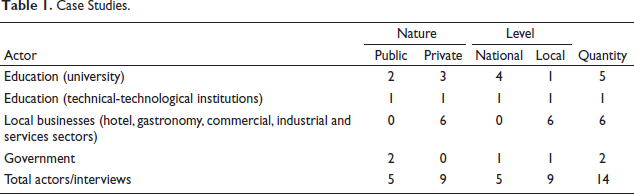
The final sample consisted of 14 key informants, distributed as follows:
Six directors from HEIs, representing both public and private universities in the Magdalena region.
Six business sector representatives, actively engaged in university–industry collaboration initiatives.
Two government officials, one at the local level and one at the national level, responsible for policies related to innovation and entrepreneurship.
Although the sample size is limited, it captures key institutional perspectives within the regional innovation ecosystem. The selected participants occupy strategic roles within the CUEE platform, which serves as the principal coordination mechanism between academia, industry, and government in the region.
This sample is considered sufficient as it captures diverse institutional perspectives, ensuring a multi-actor analysis of the regional ecosystem. The selection was guided by relevance to innovation policies and their influence in decision-making processes (Patton, 2002). The composition of the sample is summarized in Table 1.
Case Studies.
Data Analysis
The data were analysed using grounded theory procedures supported by NVivo software. The analysis followed three iterative stages.
Open Coding
Initial identification of concepts and categories emerging directly from the interview transcripts, observation notes and documentary sources.
Axial Coding
Grouping related categories to identify patterns, relationships and interaction dynamics among ecosystem actors.
Selective Coding
Integration of the most significant categories into a coherent explanatory framework describing the mechanisms through which university leadership influences ecosystem coordination.
Through this process, the analysis identified key relational mechanisms—including strategic alignment, trust-building and institutional bridging—that form the foundation of the Bridge Strategy Model proposed in this study.
To enhance reliability and validity, findings from interviews, document analysis and observations were systematically compared through data triangulation, ensuring consistency across multiple sources.
Methodological Limitations
As a qualitative case study, the findings are context-specific and cannot be generalised statistically to all emerging regions. However, the study provides analytical generalisation by identifying mechanisms that may be relevant for similar institutional contexts characterised by fragmented governance and limited coordination.
Future research could expand the empirical scope by incorporating additional regions or employing mixed-method approaches to test the proposed model quantitatively.
Research Ethics
The research adhered to established ethical standards for social research. All participants provided informed consent prior to the interviews and were assured that their identities would remain confidential. The collected data were used exclusively for academic purposes.
Results
University Leadership as a Coordination Mechanism
Findings indicate that HEIs are widely perceived as best positioned to articulate the regional innovation and entrepreneurship ecosystem. Across interviews, universities were recognised for generating knowledge, training human capital and mediating between the public and private sectors. However, this leadership was also described as constrained by limited resources, discontinuous public support and weak institutional alignment. As one university executive stated, ‘The university can serve as a bridge, but we need more State support to consolidate these connections’ (University 1). From the business sector, this bridging role was acknowledged but also questioned in terms of practical impact: ‘Universities generate ideas, but those ideas don’t always translate into projects that benefit the community’ (Business 3).
These findings indicate that university leadership is recognised as necessary but insufficiently supported. Leadership, therefore, emerges less as a formal institutional position and more as a relational coordination mechanism that aligns interests, mobilises trust and sustains collaboration over time.
Fragmented Collaboration and Weak Institutionalisation
Data from interviews and CUEE sessions revealed that the main obstacle to ecosystem consolidation is not the absence of actors, but the weakness of coordination mechanisms among them. While some initiatives have emerged through university leadership, participants repeatedly emphasised that these efforts remain isolated and weakly institutionalised. One recurrent concern was that leadership depends too heavily on individual initiative rather than on stable structures: ‘Leadership should not depend on individuals but rather institutional commitment’ (CUEE Session, 2021).
This pattern reflects insufficient policy support, low business engagement and slow trust-building across sectors. Participants highlighted that firms do not consistently view universities as strategic partners and that the State has not yet assumed an effective coordinating role. These perceptions point to a fragmented ecosystem in which collaboration is often reactive, transactional and project-based rather than strategic and sustained.
Strategic Misalignment Between Universities and Territorial Demands
A second major finding concerns the disconnect between academic strategies and regional needs. Document analysis showed that universities in Magdalena increasingly incorporate innovation and entrepreneurship into their institutional discourse, yet these priorities are not always translated into operational programmes, measurable indicators, or durable partnerships. One institutional document explicitly acknowledged this limitation: ‘The university will promote innovation and entrepreneurship, but we lack clear indicators to measure its impact’ (Strategic Document, University 2, 2022).
This strategic gap was also visible in interview data. Both business and government actors insisted that ecosystem development must be more closely linked to Magdalena’s productive profile, especially tourism and agriculture, and to its infrastructure constraints. As one public official noted, ‘We cannot replicate models from other regions without considering our specificities’ (State Official 1). Similarly, a business representative argued that innovation efforts should prioritise ‘projects that enhance agricultural productivity and promote sustainable tourism’ (Business 6).
These findings reinforce the importance of contextualised strategic orientation. Innovation policy and university action must therefore be territorially grounded and responsive to regional economic and institutional conditions.
Weak Knowledge Translation and Limited Demand Alignment
Another recurrent theme was the perceived mismatch between university training and the practical demands of the ecosystem. Business actors recognised the value of academic knowledge, but they questioned its applicability to local productive challenges. This was reflected in statements such as: ‘Graduates acquire a lot of knowledge, but not necessarily those that companies require’ (Business 1), and ‘We need technical and practical training to address local problems’ (Business 3).
This finding links educational strategy with ecosystem performance. The issue is not only one of curricular relevance, but of institutional translation: the capacity of universities to convert teaching, research and outreach into solutions that are perceived as useful by external actors.
From Fragmented Interaction to the Bridge Strategy Model
Taken together, the findings reveal an ecosystem characterised by three interrelated constraints: fragmented collaboration, weak policy support and insufficient strategic alignment between academic capacities and territorial needs. At the same time, the data also show a clear willingness among actors to strengthen relationships, particularly through universities as ecosystem articulators.
Based on these empirical patterns, the study proposes the Bridge Strategy Model as a contextual response to low-coordination environments. Rather than assuming that collaboration naturally emerges from the presence of universities, firms and government, the model emphasises the need for deliberate mechanisms of relational coordination, including trust-building, policy alignment, multi-actor dialogue and territorially grounded strategic planning. In this model, universities occupy a central role not simply as knowledge producers, but as facilitators of ecosystem integration.
Comparative Relevance of the Proposed Model
The empirical findings suggest that existing frameworks such as the Sábato Triangle, Triple Helix and Quintuple Helix remain useful as structural references, but they do not fully explain how coordination is built in fragmented institutional contexts. The proposed model differs by focusing explicitly on the mechanisms required to make collaboration viable in emerging regions. In this sense, its contribution lies less in adding new actors than in clarifying how alignment can be constructed where institutional trust, policy continuity and collaborative routines remain weak.
Figure 1 presents the relational structure identified in Magdalena’s innovation ecosystem. The diagram illustrates how five strategic dimensions—transformational leadership, strategic orientation, interdisciplinary education, multisectoral collaboration and environmental sustainability—interconnect to shape ecosystem dynamics.
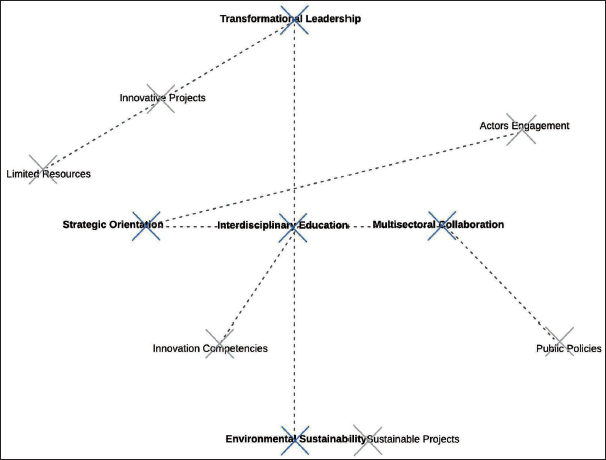
The analysis also reveals associated conditions, including limited resources, actor engagement, public policies, innovation competencies, innovative projects and sustainable initiatives. Interdisciplinary education appears as a connecting element between leadership, strategic planning and collaboration.
Overall, the figure shows that ecosystem performance depends not only on institutional actors but on the alignment between leadership capacity, collaborative governance and innovation competencies within the territory.
Figure 2 presents the Bridge Strategy Model derived from the findings. The model positions HEIs as central articulators connecting businesses, the State, civil society and environmental sustainability within the regional innovation ecosystem.

Unlike traditional helix-based models, this framework emphasises universities’ role in facilitating interaction among actors, promoting knowledge transfer and aligning innovation initiatives with territorial needs. Civil society mediates between institutional actors and societal demands, while environmental sustainability guides ecosystem development.
The model conceptualises innovation ecosystems in emerging regions as relational systems where coordination, trust-building and multi-actor engagement are essential to translate knowledge into sustainable regional development.
Comparing the Bridge Strategy Model with Existing Frameworks
Existing innovation ecosystem models—such as the Triple Helix, Quintuple Helix and the Sábato Triangle—provide valuable theoretical foundations but do not fully address coordination challenges in low-institutional-capacity regions. Table 2 summarises the differences between these frameworks and the Bridge Strategy Model proposed in this study.
Comparative Analysis of Innovation Ecosystem Models.

Compared with existing frameworks, the Bridge Strategy Model emphasises relational coordination and trust-building mechanisms necessary in fragmented institutional environments. While the Triple Helix highlights structural collaboration and the Quintuple Helix incorporate societal and environmental dimensions, the proposed model focuses on how alignment among actors can be constructed in emerging regional ecosystems.
Conceptually, the Bridge Strategy Model extends helix-based ecosystem frameworks by positioning universities as relational governance actors rather than simply structural participants. This perspective emphasises that the effectiveness of innovation ecosystems in emerging regions depends on the ability of institutional actors to construct alignment mechanisms across fragmented organisational and policy environments.
Discussion and Conclusions
The findings show that innovation ecosystems in emerging regions cannot rely solely on structural actor configurations; their effectiveness depends on coordination mechanisms capable of aligning actors under fragmented governance conditions. In the case of Magdalena, universities emerge not only as knowledge producers but also as strategic articulators capable of connecting institutional resources, policy frameworks and regional development priorities.
This result complements and extends existing literature on entrepreneurial universities and regional innovation systems (Centobelli et al., 2019; Ierapetritis, 2019; Igual et al., 2020). While previous studies emphasise the role of universities in knowledge-intensive economies, this research shows that their influence in emerging ecosystems depends less on knowledge production and more on mobilising collaborative networks and facilitating institutional alignment. Transformational leadership and territorially oriented strategic planning, therefore, become key conditions for translating academic capabilities into regional innovation outcomes.
The empirical evidence confirms that entrepreneurship education must evolve from isolated curricular initiatives towards systemic ecosystem engagement. Studies such as Chohra (2019), Huang-Saad et al. (2017), Juvonen and Kurvinen (2018), Mason et al. (2020), Shekhar and Bodnar (2020) and Suryanto (2019) emphasise the importance of experiential learning, interdisciplinary education and university–industry collaboration in fostering entrepreneurial competencies. However, the Magdalena case demonstrates that these educational initiatives achieve greater impact when embedded within broader territorial innovation strategies.
Consistent with previous research on entrepreneurial education (Bazan et al., 2019; Bezerra et al., 2017; Bergmanna et al., 2018; Oftedal et al., 2018), the study shows that universities influence entrepreneurial behaviour not only through formal training but also through the creation of collaborative environments where students, firms and public actors interact. Such environments strengthen the relational infrastructure necessary for innovation ecosystems to emerge in fragmented institutional contexts.
The findings further highlight the importance of multisectoral collaboration between universities, businesses and public institutions. As noted by Belitski et al. (2019), Boh et al. (2016), Fuster et al. (2019), Kivimaa et al. (2017) and Schaeffer et al. (2018), universities can serve as key nodes within regional innovation networks by facilitating knowledge transfer and supporting collaborative innovation processes. In emerging regions such as Magdalena, however, these interactions tend to remain discontinuous unless supported by institutional leadership capable of sustaining long-term collaboration.
These results also reinforce the argument that innovation ecosystems must be analysed in relation to their territorial and socio-institutional context. In regions characterised by economic inequality, institutional fragility and historical social challenges, ecosystem models developed in highly institutionalised environments cannot be transferred without adaptation. Scholars such as Rouschop et al. (2015), Baskaran et al. (2019), Cheah and Ho (2019), Heaton et al. (2019), Kabbaj et al. (2016) and Mirvis and Googins (2018) emphasise the need to contextualise innovation strategies in order to address local development priorities and societal challenges.
The Bridge Strategy Model contributes to ecosystem theory by shifting attention from structural actor inclusion to relational governance mechanisms. Rather than assuming that the presence of universities, businesses and government actors automatically produces innovation, it emphasises how alignment, trust formation and strategic coordination are constructed among stakeholders.
For Magdalena and emerging regions, the Bridge Strategy Model offers a practical framework for strengthening innovation ecosystems through coordinated collaboration among universities, businesses, government institutions and civil society. By emphasising university leadership and policy integration, the model offers a pathway to transform fragmented interactions into stable ecosystem dynamics.
Practical Implications and Limitations
This study has several limitations that should be acknowledged. First, the research relies on a qualitative case study focused on the Magdalena region, which limits the generalisability of the findings. While the qualitative approach allows for an in-depth understanding of contextual mechanisms, future research could expand the analysis to additional regions in order to compare ecosystem dynamics across different institutional environments.
Second, the relatively small number of interview participants reflects the exploratory nature of the study. Although theoretical saturation was achieved within the selected case, larger samples could provide a broader representation of ecosystem actors and perspectives.
Third, the proposed Bridge Strategy Model represents a conceptual framework derived from qualitative analysis. Future studies could test the model through comparative case studies or mixed-method approaches that combine qualitative insights with quantitative indicators of ecosystem performance.
Further research could explore the role of international collaborations between universities in emerging and developed economies as a mechanism for strengthening innovation capacity. Additionally, integrating citizen entrepreneurship more deeply into ecosystem analysis could provide valuable insights into how communities contribute to regional innovation and sustainable development.
Footnotes
Acknowledgements
The authors would like to thank Dr Alexander Steffanell, Professor at Lee University, Cleveland, TN, USA. The authors also extend their gratitude to the University of Magdalena and the Doctorate Programme in Education Sciences. Finally, the authors acknowledge the Higher Education Institutions, companies and State entities that participated in this study.
Author Contributions
Milagro Patrón-Noriega: Principal investigator, bibliographic review, data collection, and analysis, findings, and conclusions, manuscript writing. Vanessa Pertuz: Advice and support throughout the research process, manuscript writing and style review.
Data Availability Statement
The data supporting the findings of this study are available in the supplementary information for this article.
Declaration of Conflicting Interests
The authors declared no potential conflicts of interest with respect to the research, authorship and/or publication of this article.
Ethical Declaration
The study adhered to ethical principles of informed consent, confidentiality and respect for participants. All informants signed an informed consent form, assuring them that their data would be used exclusively for academic purposes.
Funding
The authors received no financial support for the research, authorship and/or publication of this article.
Supplementary Material

References
Supplementary Material
Please find the following supplemental material available below.
For Open Access articles published under a Creative Commons License, all supplemental material carries the same license as the article it is associated with.
For non-Open Access articles published, all supplemental material carries a non-exclusive license, and permission requests for re-use of supplemental material or any part of supplemental material shall be sent directly to the copyright owner as specified in the copyright notice associated with the article.
