



Abstract
The complex adaptive systems that produce and sustain local innovation and entrepreneurship in particular geographic contexts are known as local innovation systems and entrepreneurial systems and, from a perspective informed by ecology, as local innovation and entrepreneurial ecosystems. Over the past decade, scholars and practitioners have increasingly focused on clarifying what these systems are and why they are important for local and regional economic development. There is relatively scant scholarship, however, focused on describing how to strengthen these systems, in terms of specific processes for developing missing or weak system components, improving the relationships between components and clarifying the purpose of the system. This paper describes an approach to innovation ecosystem strengthening developed from case studies of successful sustainability-oriented entrepreneurial ecosystems in the United States, and how this approach was adapted and applied to an online ecosystem-strengthening process in Accra, Ghana. Drawing on programmatic data and a post-project survey, we find that the approach achieved its primary objective of developing and launching an ecosystem-strengthening initiative, indicating its applicability beyond the context in which it was developed. However, we also identify that ecosystem capacity strengthening effects were weaker than predicted and conclude that this type of ecosystem-strengthening process is best suited to in-person work.
Keywords
Introduction
The complex adaptive systems that produce and sustain processes of innovation and innovation-driven entrepreneurship in specific geographic contexts have been described in the literature as innovation systems and entrepreneurial systems since the 1980s (Freeman 1987; Neck et al. 2004; Nelson & Winter 1982). Drawing inspiration from biological ecosystems, Moore (1993, 1996) introduced the concept of a ‘business ecosystem’ into the management literature and this ecosystem framing has since become the predominant way to refer to local systems of innovation and entrepreneurship, particularly among practitioners and within the management and entrepreneurship literature (Alvedalen & Boschma, 2017). Since around 2010, practitioner and scholarly interest in and publishing on innovation ecosystems (IE) and entrepreneurial ecosystems (EE) has grown exponentially, as documented in reviews of these concepts conducted by Alvedalen and Boschma (2017) and Spigel et al. (2020).
Within the past decade, governments, multilateral agencies, and international funders have focused increased attention and resources on ecosystem approaches to fostering local innovation and entrepreneurship, as reflected in the proliferation of guides, resource manuals and conference sessions devoted to these topics (Spigel et al., 2020). The World Economic Forum (2013, 2014), the OECD (Mason & Brown 2014), the Kauffman Foundation (Motoyama & Watkins, 2014; Stangler & Bell-Masterson, 2015), the World Bank (Mulas, et al., 2015), the German development agency GIZ (Carlos-Guhl et al., 2020; Kreuzer et al., 2018) and the International Development Innovation Alliance (IDIA, 2021), among others, have each produced their own guidebooks and approaches for how to analyse, ‘map’, diagnose and engage with IE and EE as a first step towards strengthening them.
Stronger IE and EE, it is argued, contribute to job growth, local economic dynamism—as locations diversify what they can produce—and long-term productivity increases, leading to improved regional competitiveness and GDP growth (Isenberg, 2010; Spigel et al., 2020). As an economic development intervention, strengthening IE and EE offers a less resource-intensive, bottom-up alternative to more established agglomeration strategies such as cluster and innovation district-based approaches, further contributing to the interest in ecosystem strengthening (Spigel et al., 2020). As ecosystems develop, they have been found to produce new public goods, such as shared infrastructure, new common resources, a local culture that is more accepting of innovation and entrepreneurship, and a more favourable institutional and policy environment for innovation-oriented entrepreneurship, which make the locations of these ecosystems more attractive to existing innovators and entrepreneurs as well as those from other locations (Feld, 2012; Hoffecker, 2014; Mack & Mayer, 2016).
While economic development practitioners, policymakers, governments and donors share a growing interest in strengthening local IE and EE, the current scholarly literature on IE and EE does not offer a clear path forward (Alvedalen & Boschma, 2017). Due perhaps to the relative newness of the EE and IE concepts, most of the scholarly literature to date has been conceptual and descriptive in nature, grappling with what IE and EE are, what their respective conceptual lineages are and to what extent they differ from each other (Ács et al., 2017; Brown & Mason, 2017; Scaringella & Radziwon, 2017), how to bound these systems and at what scales to study them (Ritala & Almpanopoulou, 2017), what the relevant system components are and how they are related to each other (see Spigel, 2017) and other conceptual issues.
What has not yet been adequately addressed in the literature is the processes through which IE and EE emerge or are catalysed and how they develop over time (Jacobides et al., 2018; Roundy et al., 2018). Despite the growing policy interest in strengthening IE and EE, very little of the existing scholarship has focused on the ecosystem-strengthening process. Some scholars have identified various aspects of IE and EE, in terms of specific components, capabilities and relationships between components, which should be the focus of ecosystem-strengthening efforts (Isenberg, 2011; Mack & Mayer, 2016; Murray & Budden, 2017), but studies addressing how ecosystem-strengthening occurs in places where it has been accomplished or describing methodologies for ecosystem-strengthening and the results of their use are scarce. In their recent practitioner-oriented guide on innovation ecosystem-strengthening, the International Development Innovation Alliance noted that successful strategies for ecosystem-strengthening are in the very early stages of being identified and that this is still an ‘exploratory space’ (IDIA, 2021, p. 8).
Aims and Organisation of the Paper
This paper addresses this underdeveloped area of the literature by focusing on the ecosystem-strengthening process. It introduces a participatory, multi-actor methodology for catalysing IE and EE-strengthening based on detailed case studies of successful examples of sustainability-oriented entrepreneurial ecosystem development in five cities in the United States. The paper describes how this methodology was piloted through in-person workshops in cities across Central and South America and Western Europe in 2019 and its subsequent adaptation and implementation during the COVID-19 pandemic in the context of a programme focused on strengthening the innovation-oriented entrepreneurial ecosystem for Sustainable Development Goals (SDG)-oriented enterprises in Accra, Ghana. The primary question informing this work was: To what extent is this ecosystem-building approach relevant and adaptable beyond the contexts in which it was developed, and can the process be facilitated remotely?
The remainder of the paper is organised as follows. The first section reviews the existing literature on IE and EE, as well as the scant literature on ecosystem-strengthening processes. The Methods section introduce the ecosystem-strengthening process that was implemented in this study, describing the empirical origins of the process, how it was piloted and subsequently adapted to an all-remote process, and how we assessed the process during and after its implementation. Drawing on programmatic data and an ex-post survey of members of the ecosystem-strengthening working group, we find that the process achieved its intended objectives, despite various challenges posed by the transition from an in-person to a fully remote process. However, the survey reveals that the relationship-strengthening benefits of the process were weaker than anticipated, and the discussion section identifies several factors contributing to this result. The concluding section highlights lessons from this process that can inform subsequent IE- and EE-strengthening efforts and research.
Conceptual Foundations from the Literature
Entrepreneurial and Innovation Ecosystems
The literature on IE and EE has framed these as distinct, yet closely related, concepts that have emerged from different conceptual lineages and literature. The concept of EE is traced loosely to the work of Schumpeter (1949) and more directly to the work of Moore (1993, 1996), who introduced the concept of a ‘business ecosystem’ into the management literature, drawing on biological ecosystems as an analogy (Malecki, 2017; Scaringella & Radziwon, 2017). Scholars working from within the management literature proceeded to develop this into the concept of a ‘market-oriented ecosystem’ (Prahalad, 2005, p. 65), an ‘innovation ecosystem’ (Adner, 2006)—which as Adner defines it still refers to the concept of a business ecosystem (Grandstrand & Holgersson, 2020), and more recently, the ‘entrepreneurial ecosystem’ (Isenberg, 2010), which has since become the dominant way to refer to this concept in the scholarly and practitioner literature (Alvedalen & Boschma, 2017; Malecki, 2017). Along a parallel path, scholars working from within the regional development literature described related ideas of regional systems of innovation and entrepreneurship, which have been studied using a variety of terms (Ács et al., 2017; Alvedalen & Boschma, 2017; Scaringella & Radziwon, 2017). While numerous related definitions of these terms have been offered and no single definition has been agreed upon in the literature (Malecki, 2017; Stam, 2015), the type of system that the current literature on ‘entrepreneurial ecosystems’ refers to is generally understood to be a complex, place-based system (usually local or regional in scale) that is comprised of the various different interacting actors and elements that are essential for the creation, support and success of entrepreneurial activity (Isenberg, 2011; Spigel, et al., 2020; Stam & Spigel, 2016). It is worth noting that several scholars who have written on EE state that their understanding of entrepreneurship presumes innovation, as they are focused on innovative, growth-oriented or ‘ambitious’ entrepreneurs rather than traditional, necessity-oriented entrepreneurs (Isenberg, 2010, 2011; Spigel et al., 2020). From this perspective, much current literature on ‘entrepreneurial ecosystems’ can be seen to also describe ‘innovation-oriented entrepreneurial ecosystems’, and there is some conceptual fuzziness between the EE and IE concepts, as some scholars use these terms interchangeably to refer to the same type of system (Grandstrand & Holgersson, 2020), while others use them to refer to distinct types of systems.
Moving to the literature on IE, it has been noted that this literature also draws on two distinct conceptual lineages (Grandstrand & Holgersson, 2020). The first is rooted in the field of innovation studies and work on national and regional systems of innovation and traces its roots to the work of Freeman (1987) and Lundvall (1992). This stream of literature has much in common with the above-mentioned literature on regional development. A distinct stream of literature has been developed within the management field that—like the entrepreneurial ecosystem literature—builds on the work of Moore (1993), Adner (2006) and Adner and Kapoor (2010). This latter stream of work appears to use the term ‘innovation ecosystem’ to refer to what is actually an innovation-oriented entrepreneurial ecosystem or business ecosystem, e.g., the same type of system described above in the entrepreneurship and management literature (Grandstrand & Holgersson, 2020).
The former stream of work, however, uses the ‘innovation ecosystem’ term to refer to what has traditionally been termed an ‘innovation system’ in the literature. This concept has a longer usage and, while still acknowledged to be a ‘fuzzy concept’ (Freire-Gibb & Gregson, 2020; Ritala & Almpanopoulou, 2017), has generally been understood in the literature to refer to the set of actors, components and other elements within a defined geography (e.g. local, regional, national) that, through their dynamic interactions, influence the extent to which innovation is generated and brought into use within that geographic context (Grandstrand & Holgersson, 2020). In contrast to definitions of EE, IE as understood in this lineage refer to the systems that are required to produce and sustain innovation, regardless of whether that innovation is brought into use through the vehicle of entrepreneurship, government policy, informal adoption via word of mouth or other means.
IE and EE as Complex Adaptive Systems
When this second, older lineage of the innovation ecosystem concept is considered, IE and EE no longer appear to be different terms describing the same type of system, but rather descriptions of two related, but distinct types of locally embedded systems. Entrepreneurial ecosystems can be understood as systems that produce and enable entrepreneurial performance in a specific locality (often assuming innovation-oriented entrepreneurship), while IE can be understood as systems that produce and enable innovation, through entrepreneurship and existing firms of various sizes, as well as through other channels. While distinct, both types of systems have been recognised to be complex adaptive systems (CAS) (Peltoniemi, 2006; Ritala & Almpanopoulou, 2017; Roundy et al., 2018) and to share the same fundamental system attributes or features as biological ecosystems and other types of CAS (Lewin, 1999; Roundy et al., 2018).
All systems, including CAS, are comprised of elements, which can be living or non-living, relationships or interconnections between the various elements, and a purpose (in the case of a system involving human agents) or a function that the system serves (Meadows, 2008). CAS are a particular kind of system in which the various components of the system, including its actors, adapt their strategies and actions based on experience and the changing conditions of other system components and the system overall, while contributing to these changing system conditions through their adaptive behaviour (Messier & Puettmann, 2011; Spielman, et al., 2009). Due to the dynamic, evolving and interdependent changes within these systems, CAS generate emergent properties, in which patterns of action at one level of the system are both influenced by and able to generate new processes, structures and system-wide conditions at different levels of the system, which are not reducible to the behaviour of the system’s parts (Axelrod & Cohen, 2000; Lichtenstein, 2011).
Given that both IE and EE have been identified as CAS, the nature of these systems and how they function—including how they emerge, develop organically and can be deliberately strengthened—will essentially be the same. The difference between these two types of systems is not at the level of their structure, but rather at the level of their purposes, which in turn may require a slightly different set of specific system components (actors and factors) and types of interrelations for those respective purposes to be served. It can, therefore, be predicted that strategies that are effective in developing or strengthening IE, from the standpoint of system functioning and performance, will also be effective in strengthening EE, and vice versa, as the core dynamics of strengthening economic ecosystems should be the same.
Strengthening IE and EE
The existing literature on IE and EE has focused primarily on what these types of systems are, and much less on how to strengthen them. Furthermore, the small number of scholarly articles that have addressed this topic have primarily focused on identifying which elements or components of IE or EE should be strengthened (see Mack & Mayer, 2016), but have fewer insights into the processes through which both the components and aspects of these systems’ overall functioning can be strengthened (Roundy et al., 2018). Several well-known empirical studies have identified that IE and EE can emerge through the actions and interactions of innovators and entrepreneurs (Feld, 2012; Saxenian, 1994), but less is known about deliberate strategies that can be employed to catalyse and strengthen IE and EE as CAS.
The literature does, however, offer conceptual starting points for understanding the ecosystem-strengthening process. In theorising EE as CAS, Roundy et al. (2018) identify the crucial role of entrepreneurs’ intentions, adaptive tensions and actions, as well as the coherence and alignment between entrepreneurs’ actions and the injection of resources into the system as contributing factors to the organic emergence of EE. Backbone or ‘keystone’ organisations, which serve as a hub around which the ecosystem develops, are also understood to play a critical role in ecosystem-strengthening (Iansiti & Levien, 2004; Teece, 2007). At the same time, several scholars emphasise that ‘bottom-up’ approaches are needed to foster the emergence and development of IE and EE (Mack & Mayer, 2016), and that these approaches should focus on ‘facilitating the self-organization’ of potential system actors and ‘the emergence of the system out of multiple interactions’ (Jucevičius & Grumadaitė, 2014).
Fostering interactions between current and potential ecosystem actors—in particular entrepreneurs whose activity is aligned with the ecosystem’s focus—is understood to be particularly important, as the ecosystem is seen to emerge and be developed from these interactions (Motoyama & Knowlton, 2017) in an analogous process to how biological ecosystems emerge and evolve over time through the interactions between their members. How these interactions should be fostered, however, and how alignment between actors should be pursued or developed, has largely been left unaddressed in the scholarly literature. The practitioner literature, on the other hand, has offered some general strategies that can be pursued in ecosystem-strengthening work (see Isenberg, 2010; Hoffecker, 2018, 2019), which serve as a starting point for this paper’s focus on the ecosystem-strengthening process. In the next section, we describe how we developed, piloted and assessed the ecosystem-strengthening approach that is introduced in this paper.
Methods
Developing an Empirically Derived Ecosystem-strengthening Approach
The ecosystem-strengthening approach introduced in this paper was informed by a cross-case synthesis conducted by Hoffecker (2014, Chapter 6) of the common steps and strategies that entrepreneurial ecosystem builders pursued in five American cities where sustainability-oriented EE were successfully developed between 2001 and 2012. Ecosystem builders in each of the five focal cities started with a clear vision of the ecosystem-level change they wanted to create, which involved growing a sustainability-oriented entrepreneurial ecosystem from the ground up (Hoffecker, 2014, p. 113). Their next step was to identify pioneering innovator-entrepreneurs in their communities who shared this vision and were already exemplifying elements of it in their business practices. These ‘living examples’ of the vision became the first members of the ecosystem and the ecosystem-building efforts (Hoffecker, 2014, p. 118).
Once these pioneering innovator-entrepreneurs had been identified, ecosystem builders focused on creating opportunities for these leaders to connect with and learn from each other, through networking events, learning exchanges to each other’s businesses and similar community-building opportunities. Through these gatherings, they were able to identify needs that existed in the ecosystem and jointly develop strategies to address them. This involved ‘identifying the few elements of their visions that already existed around them, and taking relatively simple (though often time-consuming) actions’ to build on those foundations and address immediate constraints and barriers related to moving towards their vision (Hoffecker, 2014, p. 114). This practical, asset-based approach is what Hoffecker (2019, p. 11) termed identifying and cultivating the ‘seeds of the future’.
As ecosystem builders successfully addressed the barriers that were required to build towards their vision, they encountered new sets of challenges that required adjustments to their strategies. The next step in their process involved ‘adopting new strategies and taking on significantly new roles over time in response to the evolving needs of the communities of businesses they were working with’ (Hoffecker, 2014, p. 114). For example, once they had successfully connected ecosystem actors to each other, they identified the need to build demand within the system for the innovative products and services these entrepreneurs were offering. Once they had succeeded in building demand, they realised they needed to focus on expanding supply by building the capacity of a larger number of enterprises to implement sustainable business practices (Hoffecker, 2014, p. 115; 128). Once the initial ecosystem of producers, consumers, intermediary value chain enterprises and ecosystem-support organisations had grown to a certain size, ecosystem builders refocused again and began to pursue system-level growth opportunities and policy advocacy to improve the enabling environment.
Drawing on these findings, Hoffecker (2019) developed a methodology for catalysing the ecosystem-strengthening process through a series of participatory, multi-actor activities. These activities lead participants through a facilitated process of ecosystem-strengthening that mirrors the process identified in the successful case studies. Each of the phases and activities of this process is described in the remainder of this section, as these serve as the starting point for the project implementation, adaptations and lessons learned described in the remainder of the paper.
The first phase of the process involves those who have the primary interest in ecosystem-strengthening (referred to as ‘ecosystem builders’ or the ‘backbone team’) coming together to identify the specific ecosystem they are interested in strengthening. As discussed above, IE, EE, innovation-driven ecosystems and sustainable development-oriented ecosystems, are similar but not identical CAS, often with overlapping actors and elements, within a specific geographic reference area. Ecosystem builders need to start by identifying the geographic scope and type of system they are interested in strengthening, which can be accomplished by specifying what kind of results the system should be producing if it is functioning well (Hoffecker, 2019; Hoffecker et al., 2021).
Once a focal ecosystem is selected, the next step involves identifying the leading actors in that ecosystem so they can be engaged in the strengthening process. This step can be completed through desk research or snowball referral methods, starting with the professional networks of the ecosystem builders driving the strengthening process. Once these central actors are identified, the third phase involves convening these actors so that they can jointly participate in the fourth phase, which involves a set of facilitated, participatory activities that mirror the activities engaged in by case study participants. These activities are described in detail in Hoffecker et al. (2021) and summarised here.
The first activity involves identifying the ecosystem’s historical strengths and assets related to innovation, followed by identifying the ecosystem’s current results, both intentional and unintended, and the purpose that the ecosystem is currently serving. The next step involves identifying a clear and concrete vision for what the ecosystem’s purpose and results should be 10–15 years into the future and identifying from among the current assets which are most relevant to achieving the future vision (the ‘seeds of the future’). Next, obstacles or challenges that need to be addressed to build from the current assets towards the vision are identified, along with a wide range of possible actions that could meaningfully address those challenges. The next step involves prioritising the resulting initiatives by a) their impact on the ecosystem’s development and b) the degree of difficulty required to achieve them, and selecting a first initiative to work on that is relatively high impact but with a low degree of difficulty; e.g., a ‘quick win’ that can mobilise wider engagement in the ecosystem-strengthening process and retain engagement of the key actors driving the process.
The fifth phase of the process involves launching the first initiative and implementing this as a deliberate pilot, to test assumptions about the system and gather system feedback to inform subsequent interventions. The sixth and final phase of this process involves engaging in structured assessment and reflection on the pilot initiative to enable learning and adjustment of strategy as needed for subsequent ecosystem interventions. In the next section of the paper, we discuss how we piloted this approach and subsequently adapted it to the remote work environment in the Ghanian context, and the methods we used to assess this process to identify lessons that could inform subsequent improvements to the approach.
Piloting and Adapting the Ecosystem-strengthening Approach
The approach described in the previous section was piloted in the context of a series of workshops that convened actors in impact-oriented EE in major cities across Central and South America and the Iberian Peninsula. These two-day, in-person workshops, implemented jointly by the MIT Local Innovation Group and the Global Ecosystem Dynamics Initiative, brought between 30 and 50 ecosystem actors together in each city to participate in the phase four activities described above and provide input into a social network mapping survey designed to identify relationships of collaboration between the ecosystems’ actors. The workshops were implemented between June 2019 and February 2020 in Madrid, Barcelona and Valencia, Spain; Mexico City, Mexico; Santiago de Chile, Chile; Sao Paulo, Brazil; Buenos Aires, Argentina; and Montevideo, Uruguay. These workshops served to pilot the approach and provided ecosystem actors with an opportunity to become familiar with the ecosystem-strengthening steps and to try these activities in a truncated form that fit within a two-day workshop format.
Feedback from workshop participants and debriefing sessions conducted by the facilitation team identified that the workshops were valuable for bringing actors together, introducing the ecosystem-strengthening process, and previewing the associated activities, but that the phase 4 sequence of activities should be undertaken by a smaller subgroup of the actors who participated in these initial workshops, as not all participants were equally enthusiastic about devoting time and energy to ecosystem-strengthening work. This subgroup should meet regularly and repeat each of the activities that were introduced in the workshop, devoting more time to the activities and using the process to build a strong ‘backbone team’ to propel forward the ecosystem-strengthening process.
This feedback informed the design of the second pilot of the ecosystem-strengthening methods, which launched in early 2020. This pilot took place within the context of a multi-year project, the NEXT i2i project, which was implemented jointly between Ashesi University and the Massachusetts Institute of Technology under the umbrella of the USAID-funded Accelerating Local Potential (ALP) programme. The objective of the ecosystem-strengthening component of the project was to strengthen the innovation-oriented entrepreneurial ecosystem in Accra, Ghana, focused on early-stage enterprises pursuing sustainable development goals. Drawing on the learning from the pilot workshops, the NEXTi 2i project team pursued a strategy of implementing the phase four ecosystem-building activities through a working group of ecosystem-building champions, who were identified following an initial event in June 2019. The working group was programmed to meet in person once per month for a breakfast meeting, which would enable networking between the members while providing an opportunity to engage in ecosystem-strengthening activities. While the initial breakfast meeting on 13 March 2020 proceeded as planned, the rapidly-spreading COVID-19 pandemic—which had emerged as a global threat around the same time—abruptly shuttered all in-person activities by the end of the month.
This unexpected turn of events required that a highly participatory methodology that had been designed for in-person work would need to be transformed into a series of activities that could be implemented remotely. Worksheets and handouts that had been designed to be printed and filled out in person were quickly converted into slide decks and Google documents (Google slides, Jamboards) for immediate ease of access by all working group members, and small group activities were re-designed to be completed in breakout rooms on Zoom. Six 90-minute, online meetings were held between May and December 2020, with detailed meeting agendas and a sequence of facilitated activities that are documented in Hoffecker et al. (2021, p. 22).
Assessing the Ecosystem-strengthening Approach
During the implementation of the remote working group sessions, the MIT and Ashesi facilitation team met prior to and following each working group session to discuss and record their reflections on the session, document session outputs and plan subsequent sessions. The analysis of the ecosystem-strengthening process as implemented in the NEXT i2i project draws on these planning and debriefing notes, as well as other programmatic records maintained by the NEXT i2i program, such as attendance records in the meetings, WhatsApp communications with working group members, slides and other written outputs produced by working group members, notes from an After Action Review (AAR) that the MIT-based team conducted following the conclusion of the ecosystem-strengthening activities, and final reporting documents compiled by the project and submitted to USAID as part of the project close-out process.
While the Next i2i project did not have resources allocated to conduct a formal internal or external evaluation during the project’s implementation, the co-authors independently designed, implemented and analysed a brief ex-post survey of ecosystem-strengthening working group members nine months after the project’s conclusion and approximately 18 months after the working group stopped meeting. The survey design was informed by the list of structural and functional features of local IE synthesised from the innovation systems literature by Hoffecker and Douthwaite (2022, pp. 30–32). Based on our analysis above of innovation and innovation-driven EE as closely related types of CAS, we assumed for the purposes of this assessment that the core capacities and competencies that would need to be strengthened in a nascent local innovation ecosystem would be similar to those that would need to be strengthened in a local innovation-oriented entrepreneurial ecosystem.
The survey was, therefore, designed to identify self-reported changes in the following structural and functional areas. In terms of the ecosystems’ structural features, we inquired into (i) whether the working group sessions had contributed to the creation, sharing or improved utilisation of resources (including infrastructure) to support local innovators and innovation-driven entrepreneurs; (ii) whether the process had strengthened human capital among group members, including any of the competencies listed by Hoffecker and Douthwaite (2022, p. 32) in Table 3.2, column 1 (individual-level competencies associated with local innovation capacity); (iii) whether the working group process had created new relationship linkages or strengthened existing linkages between group members; (iv) whether the process had led to the creation or strengthening of any new actors in the system; and (v) whether group members reported any improvements in formal or informal institutional conditions resulting from their joint activities.
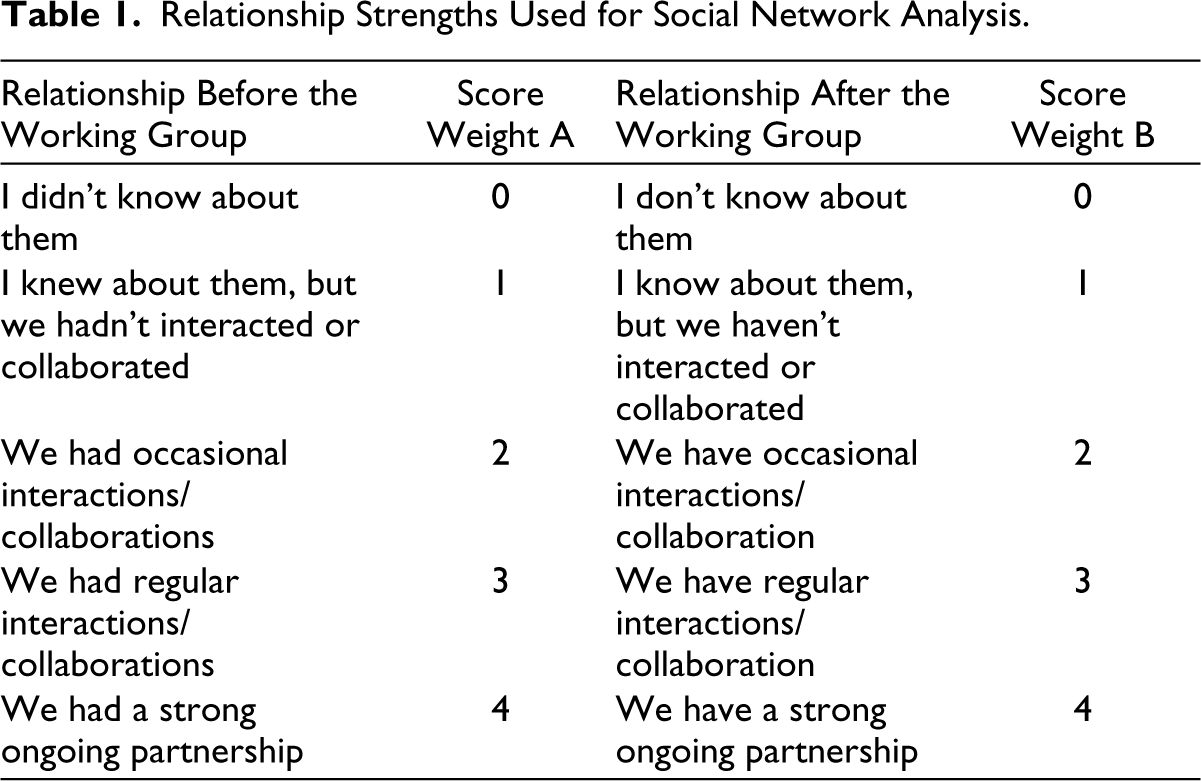
The survey contained a mix of close-ended and open-ended questions, as well as two questions to gather data on relationships using social network analysis methods. The close-ended questions were analysed using conventional quantitative survey analysis methods (counts and percentages, visualised as bar charts or pie charts) and the open-ended questions were analysed using thematic qualitative analysis. For the two network-related questions, respondents were asked to select the option that best described their relationship with each of the other participating organisations as of January 2020, before the workshop sessions began, and as of the year immediately prior to filling out the survey (18 months after the conclusion of the workshops). A score of one to four was assigned to each available option to be used as edge weights, which enabled analysis of possible changes in the workshop participants’ before/after networks.
The scores used for this social network analysis are given in Table 1. Designating the score of the relationship type before the workshop as Weight A and the score of the relationship type after the workshop as Weight B, the differences in edge weights (Weight B − Weight A) were calculated for all the available pairs of nodes and later summed to identify the overall strengthening or weakening of each relationship type from within each respondent’s network, and of the whole network created by all participants. Results from the survey were analysed in combination with data from the programmatic records to identify the findings presented in the following section.
Relationship Strengths Used for Social Network Analysis.
Results
The above analysis identified that the ecosystem-strengthening methodology accomplished its primary objective, which was to guide the group towards the identification and launch of an initiative that could be implemented as a multi-actor ecosystem-strengthening pilot. During the group’s fourth meeting, group members identified three related sectors in which they envisioned that Ghana’s SDG-oriented IE and EE could excel within the span of a decade. These sectors were: (i) health innovation, focused on natural and medicinal products sourced from smallholder farmers; (ii) agritech innovation to improve agricultural productivity of smallholder farmers and attract youth into farming; and (iii) educational innovation focused on human capital development among youth. In the group’s seventh and final meeting, members identified a crosscutting first ecosystem-strengthening initiative that could build out missing and weak elements of the ecosystem required for early-stage, innovation-oriented entrepreneurs to succeed in all three of these priority sectors (Hoffecker et al., 2021).
Group members termed this initiative the entrepreneurial value chain approach (EVCA) and launched the approach as a multi-stakeholder ecosystem-strengthening initiative at Accelerate 2030, a high-profile conference convened by the SDG Advisory Unit within the office of Ghana’s President (Hoffecker et al., 2021). Subsequently, working group members launched a website for the approach, wrote a concept note describing it, and incorporated the EVCA approach into the workplan of Ashesi University’s Entrepreneurship Center, as reported in the NEXT i2i project’s 2022 Close-out Report to USAID. The identification of this first initiative indicate that the ecosystem-strengthening methodology and process was adaptable outside of the context in which it was developed (the US) and piloted (Mexico, Central America and South America as well as Western Europe) and could be successfully applied to the Ghanian context. It also indicated that the methodology could be implemented remotely and over a longer period than initially designed, indicating its adaptability as an approach.
However, analysis of the monthly team debriefs and preparation meetings and the programme-level AAR, combined with an analysis of attendance records and WhatsApp messages sent to group members, identified several drawbacks of facilitating the meetings remotely. Specifically, achieving consistent attendance of group members at the online-only meetings proved challenging. While the initial in-person meeting had 11 participants and the first online meeting had 10 (65% and 59%, respectively, of total members who had been invited to the working group), subsequent online meetings had between seven and eight participants (41% and 47%, respectively), and—more consequentially to the results of the process—the same group members did not attend each time. This inconsistency in participation created challenges in implementing the ecosystem-strengthening methodology, as each activity in the methodology builds on the previous activities and assumes consistent participants throughout the process.
A second challenge was that facilitating the activities remotely proved more difficult than doing so in person. The participatory activities took significantly more time to complete online than they did in person. It was more challenging to keep group members focused during the activities and discussions as compared to when these activities were facilitated in person, and it was more difficult to build rapport between participants. Additionally, the tools the group had chosen for online facilitation (Google Slides and Google Docs) proved more difficult to use than the paper-based worksheets that had been used in the previous pilot. Finally, the facilitation team identified that ongoing effort was required to maintain momentum between meetings, in terms of ensuring that group members completed prep work and remained engaged, challenges that were compounded by the inconsistent scheduling and pacing of the meetings.
The process challenges identified by the facilitation team foreshadowed that beyond the immediate objective of developing a vision for the ecosystem’s future and a first multi-actor initiative that could be implemented as a pilot, the system-strengthening results of the process could be expected to be weaker than initially hoped. Over a year later, when workshop participants responded to the ex-post survey, this prediction was largely confirmed. Of the 15 working group members to whom the survey was sent, six submitted completed survey responses. While low, this number was expected, as it represents 73% of the average attendance at the online-only working group meetings, which had an average participation of eight working group members per meeting.
Combining an analysis of the survey results with an analysis of programmatic records from the project, we qualitatively assessed the extent to which results could be identified in each of the five structural system domains that Hoffecker and Douthwaite (2022, p. 31) synthesised from the innovation systems literature. These structural domains build on the work of Wieczorek and Hekkert (2012), who proposed that the strength of technological innovation systems (another closely related type of CAS to IE and EE) should be analysed in terms of both structural and functional attributes. The results of our structural analysis of changes in Ghana’s SDG-oriented IE and EE are presented in Table 2.
Assessment of Structural Dimensions of Ecosystem Strengthening.
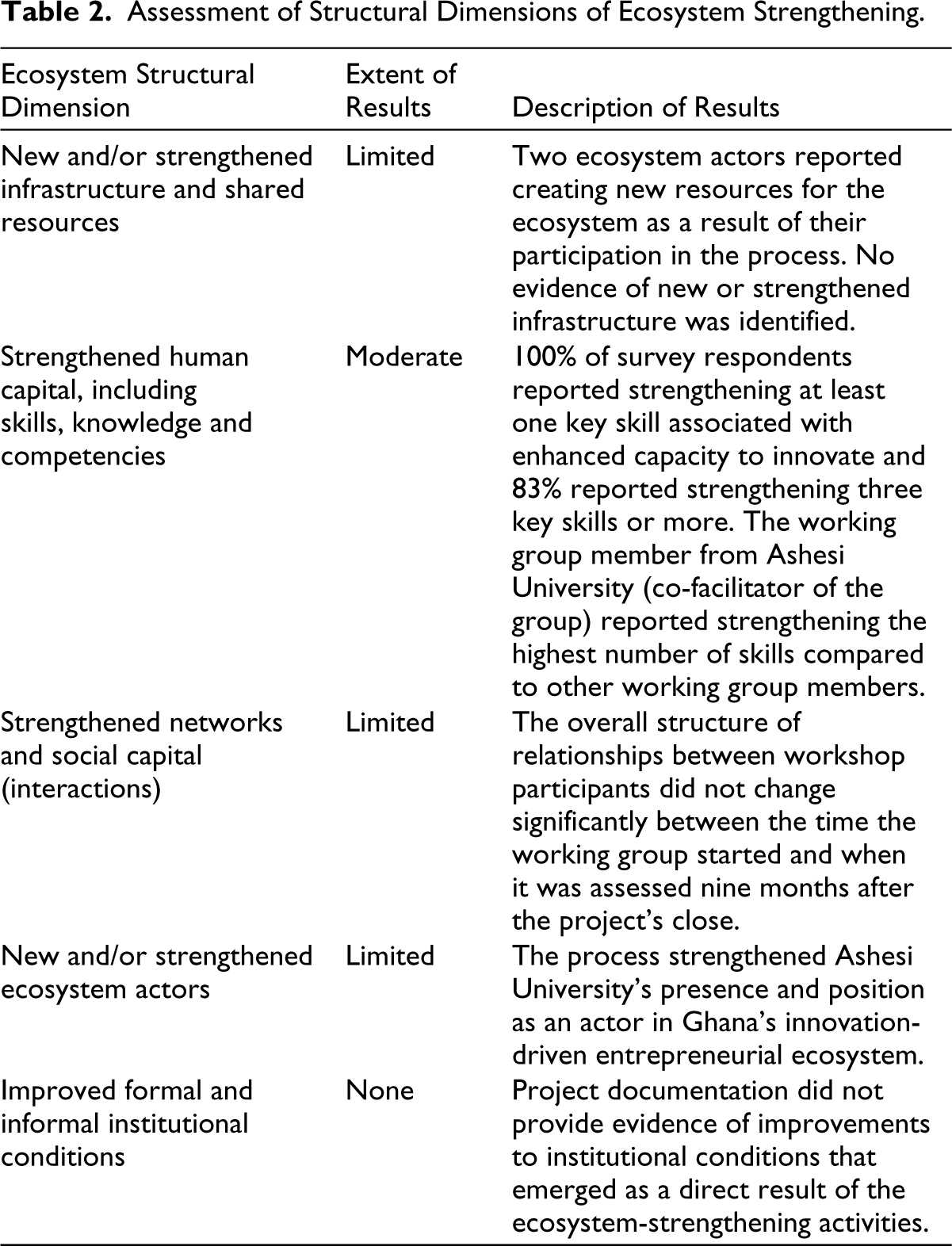
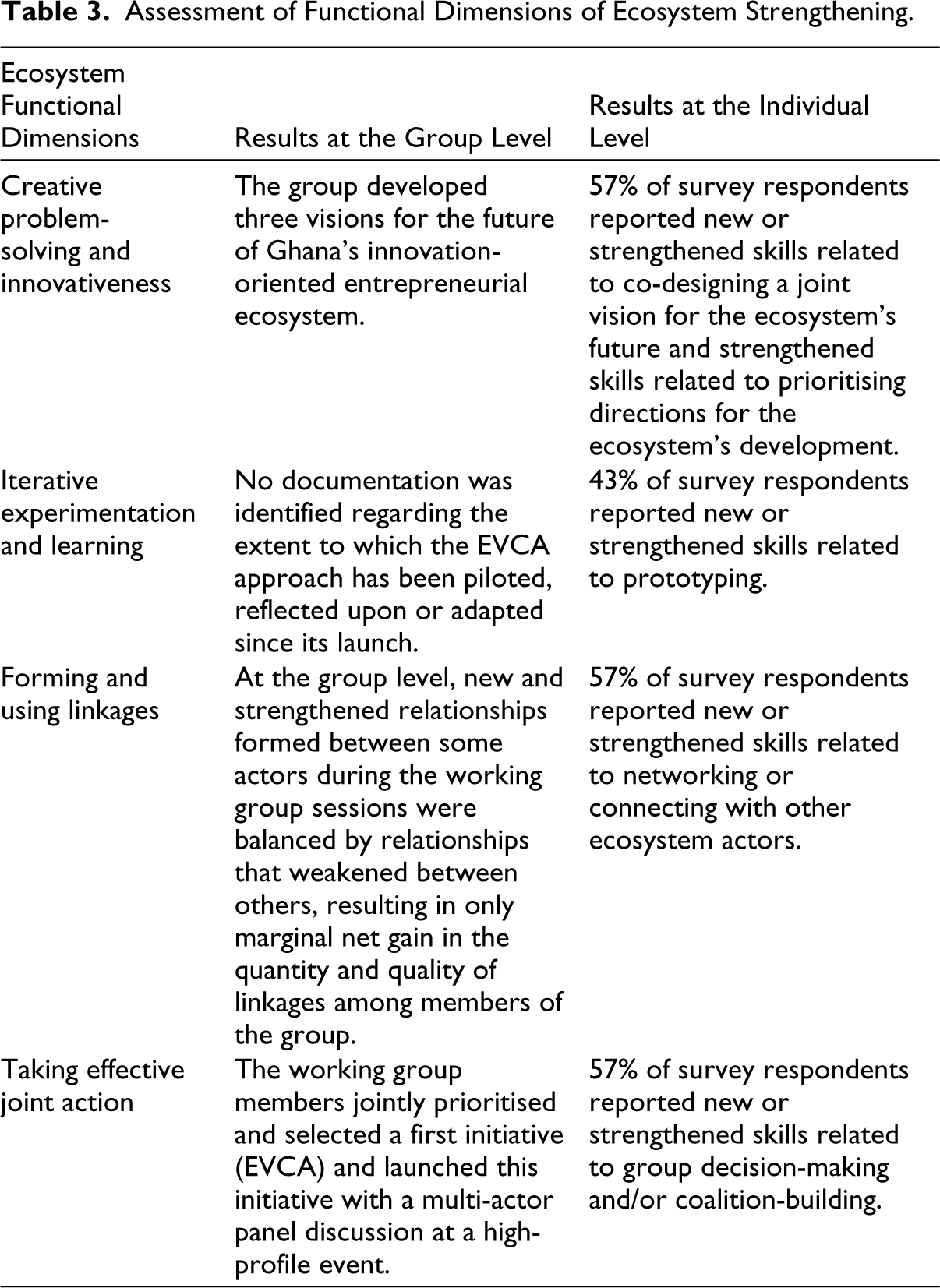
As noted by Hoffecker and Douthwaite, these structural dimensions of local IE (and innovation-driven EE) can be understood as the capabilities of the system, while the system’s functional dimensions can be understood as its competencies. System-strengthening efforts can strengthen both capabilities and competencies of local IE and EE (Hoffecker & Douthwaite, 2022), and system competencies can be strengthened at the level of individual system actors, groups/teams of system actors and the system overall, as a CAS can display emergent properties that transcend the operation of its component parts.
Table 3 provides a qualitative assessment of the extent to which the ecosystem-strengthening process contributed to strengthened competencies for individual members of the working group and for the working group as a whole, using the list of innovation-related system competencies identified by Douthwaite and Hoffecker (2022, p. 32, Table 3.2). This functional analysis was conducted only at the individual and group/team levels, as the project did not have sufficient data from the local system to enable an ex-post system-level functional analysis.
Assessment of Functional Dimensions of Ecosystem Strengthening.
Focusing on the network of interactions between group members, the social network analysis revealed mixed results, with some actors strengthening their relationships, others weakening them and still others with no net change in relationships before and after the process. As evident in Table 4, relationships considered weak or non-existent among working group members prior to the start of the working group sessions improved slightly, moving from not knowing about other actors (score of zero) or knowing about them but not interacting (score of one) to occasional or regular interactions (scores of two or three). However, of the relationships involving occasional interactions with others (score of two), 22% were strengthened, while 27% fell back to a knowing-each-other basis in the year following the end of the working group sessions. One category three relationship (5.3% of the total) was strengthened into a category four relationship (strong ongoing partnership), but 42% of category three relationships became weaker in the year following the conclusion of the working sessions. The only category that did not show change was category four, meaning that all strong, ongoing partnerships at the start of the working group sessions remained strong, ongoing partnerships at the time of the survey, over three years later.
Change in the Relationships Among Working Group Members Over Time (Prior to the Start of the Sessions vs. 18 Months Following the Sessions’ Conclusion).
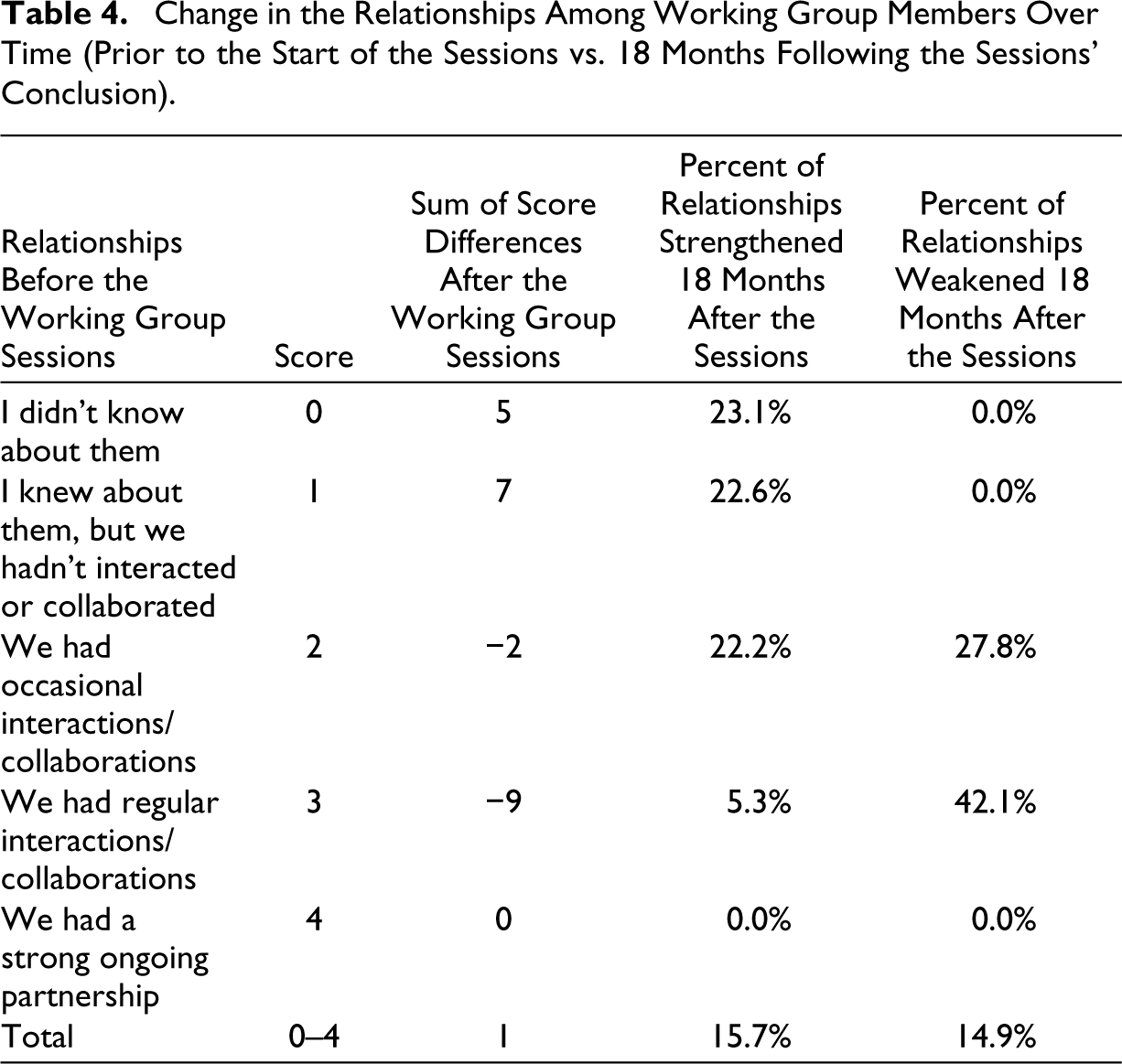
While the workshop series, therefore, allowed participants to strengthen some relationships and develop new collaborations, especially those that were previously weak or non-existent, it did not generate a significant improvement in participants’ individual networks or in the overall structure of relationships among these ecosystem actors. In the following section, we interpret these results and others described above, identify potential explanations for them and discuss limitations in the data sources that should be taken into consideration when identifying conclusions from these results.
Discussion of Results
The results above suggest that the six online working group sessions were useful for the most basic levels of networking, but that they did not lend themselves to more in-depth collaboration-building, likely because they were held online and facilitated with a highly structured agenda that did not leave open time for informal networking between members. This kind of informal networking had been a key feature of the in-person workshops where the approach was piloted and had provided participants in those workshops with opportunities for side conversations, learning about each other’s work and identifying potential opportunities to collaborate. The online meeting process, however, did not facilitate these types of interactions, which may have contributed to the results observed above.
Another factor that may have played a role in the weak network-building effects of the process was the inconsistent attendance of working group members over the course of the time that the group met. When we analysed the relationship strength of each working group member individually, we identified that among the nine members of the working group who attended three or more working group meetings, seven (78%) had experienced strengthened or no change in their incoming relationships (the relationships that other actors mentioned having with them), while only two had weaker incoming relationships. However, of the 13 ecosystem actors with representatives who attended two meetings or fewer, only seven (54%) had stronger or unchanged relationships, while almost as many (six, or 46%) had weaker incoming relationships at the time of the survey. This analysis supports the interpretation that the weak relationship-building results may be attributable in part to inconsistency in participation combined with the relative infrequency of meetings.
Limitations in the Data
When interpreting the findings presented above, several limitations in the data should be considered. The first is that the numbers assigned to each relationship level are standardised in increments of one, so if a participant strengthens a relationship with one actor from category three to four, and lessens interactions with another actor from category three to two, these neutralise each other in our analysis, resulting in a net relationship change of zero. However, this symmetry in the magnitude of these changes may not reflect how actors perceive the values of these respective relationships. Interacting less with a lower-priority partner in order to have the time to interact more with a higher-priority partner may, from a given actor’s perspective, be perceived as a net gain in the quality of their network, as the relationship with the new partner might hold more value for them than the relationship with the partner they are de-prioritising. From this perspective, the numerical analysis presented in the previous section might understate the actual relationship-strengthening and network-building effects of the working group sessions.
Another limitation is the absence of comparable longitudinal survey data, such as a pre-survey of members at the start of the workshop or an immediate post-survey at the conclusion of the workshop series. Surveying members more frequently, and closer to the end of the working group sessions, may have yielded information that would assist in our ability to interpret the results of the ex-post survey, which was administered nine months after the end of the project and a full 29 months after the last working group session. More frequent follow-up with working group members in the year following the conclusion of the sessions might have identified system-strengthening changes that our survey did not detect, such as evidence of piloting or iteration of the EVCA approach, evidence of additional shared resources or infrastructure having been created, or evidence of relationships that may have been temporarily strengthened, before lapsing later in time. It is, therefore, possible that the results included in our analysis understate ecosystem-strengthening results that could have been detected with more frequent and fine-grained follow-up.
Conclusions and Future Directions
This paper sought to address two central questions. The first was to what extent would an ecosystem-strengthening approach developed from success cases in the United States be relevant and adaptable beyond the context in which it was developed, and in particular, to the Ghanaian context? To this question, our analysis indicates that the approach, in terms of the methodology and specific sequence of activities, was relevant and adaptable, as it guided group members to identify visions for Ghana’s SDG-focused entrepreneurial ecosystem, identify gaps and challenges that needed to be addressed to achieve the visions, and launch a first multi-actor pilot initiative, the EVCA approach, which was designed to address these gaps.
The second question focused on whether this ecosystem-strengthening process, which was developed as an in-person process, could be moved fully online and facilitated remotely, as was necessitated during the COVID-19 pandemic. To this question, our analysis leads to a mixed conclusion. While it was technically feasible to facilitate the full process remotely, some of the ecosystem-strengthening benefits anticipated by the process, such as new or strengthened innovation system-related capabilities and competencies at the individual and group levels, were weaker than anticipated. Our analysis suggests that the fully online format of group meetings, combined with a sporadic meeting schedule and inconsistent participation of group members, likely contributed to these results.
Based on this analysis, several recommendations for future implementation of this ecosystem-strengthening approach can be identified. First, it is important to start the ecosystem-strengthening process with a clear focus in terms of the ecosystem of interest, whether this be a community-based innovation ecosystem, an innovation-driven entrepreneurial ecosystem, or a sustainable development-oriented entrepreneurial ecosystem, as was the case in this experience. The system of interest determines the most relevant actors to participate in the process, and the clearer this system focus is, the easier it is to identify actors who will be personally invested in and committed to the ecosystem-strengthening process over time. Second, the role of the backbone team driving the ecosystem-strengthening process is essential, particularly in terms of providing consistent scheduling of meetings, skilled and well-prepared meeting facilitation, and thorough and timely documentation of meeting results. Sessions should be scheduled at consistent intervals, with no more than several weeks between them, over a sufficient period of time for the ecosystem-strengthening process to gather and sustain momentum and for a cohesive backbone group to form.
In terms of the initial ecosystem-strengthening pilots developed by the group, we recommend that these be concrete activities or initiatives with clear, time-bound objectives and achievable goals, so that participants know when the pilot activity has been accomplished and can assess results. Examples of such initiatives, drawn from the case studies informing this ecosystem approach, would be the launch of an interactive directory of ecosystem members, or the implementation of a festival showcasing innovative, sustainability-oriented enterprises in the community. These types of activities are achievable within several months and it is clear when they have been achieved, which contributes to building momentum of the process and the commitment of backbone team members to stay engaged. A pilot initiative that is too long term in its implementation timeframe, too ambitious in its goals or broad in its scope, or does not have clear results indicators is unlikely to have the same motivational and engagement effects, compared with a discreet, time-bound ‘quick win’.
Finally, based on our results, we recommend that this type of ecosystem-strengthening work be conducted in person. While the NEXTi 2i project demonstrated that it is feasible to facilitate this process online, the results of our analysis indicate that this may not be the optimal way to engage in such a process, unless working group members already know each other well and have a strong, pre-existing, in-person working dynamic established. In that case, we recommend that the process be facilitated using a standard set of activity templates and facilitation instructions, including a pre-designed template for all activity worksheets, which has been developed and made publicly available as a final output of the NEXTi 2i project (Hoffecker et al., 2021).
There is a clear need for additional research on ecosystem-strengthening processes, as this study was in many respects preliminary. Additional empirical studies of successful examples of IE- and EE-strengthening processes in a wide variety of settings will add to our understanding of what these processes involve and how they can be successfully facilitated. In parallel, there is a need to continue to develop ecosystem-strengthening assessment frameworks, such as the one we introduced in this paper, to enable the evaluation of these processes and their system-strengthening effects over time.
Footnotes
Acknowledgements
The authors wish to acknowledge the members of the Accra Ecosystem Design Team for their willingness to engage in a novel and unfamiliar process online during the height of the global COVID-19 pandemic. We also wish to acknowledge the members of the NEXT i2i project team who provided support to the working sessions in the form of process documentation, follow-up between sessions and related support, including but not limited to Arkeisha Amissah Arthur and Asiedua Amoah.
Declaration of Conflicting Interests
The authors declared no potential conflicts of interest with respect to the research, authorship and/or publication of this article.
Funding
The research, authorship, and/or publication of this article were supported in part by the following funding sources: the United States Agency for International Development (USAID) under Agreement numbers 7200AA18CA0018 and 7200AA21CA00009. USAID staff were not involved in any aspect of planning or implementing the research described in this article, nor in its preparation.