




Abstract
COVID-19 has changed the world. The pandemic was a public health crisis with profound implications for society. Accordingly, the quantum of waste generated also went up especially fast. The global nature of the pandemic demanding global communication and coordination, also required locally adopted responses for specific reasons like lack of opportunity to network and create bonding and bridging ties as lockdown conditions prohibited human interactions. This situation that needs the substitution of human interactions and communication with technology however did not encourage strong ties and only allowed for the sustenance of weak ties along with pressures of financial sustainability on the social enterprise in solid waste management (SWM). This research paper attempts to explore whether the SWM social enterprises could remain true to their mission in these uncertain times or would need to replace their true beneficiaries with technology. This would then test their aspects of ‘mission agility’ versus ‘mission drift’ as discussed in the article. The findings also lead us to conclude that a fine balance between objectives of value capture and value creation in determining the switch over to technology by SWM enterprises underscored the importance of social mission to them.
The data for this research was collected through qualitative and semi-structured interviews of Project Managers / Program Coordinators of various organisations working in the field of SWM.
Keywords
Introduction
Solid waste (SW) is a by-product of human and animal activities. These can be classified in terms of their original use (such as packaging waste), the material (glass, paper or plastics), their physical properties (combustible or biodegradable), their origin (domestic, commercial, industrial or agricultural) and the safety parameters (hazardous or radioactive) (Banga, 2011). SW covers all waste materials except hazardous waste, liquid waste and released gases. Municipal solid waste (MSW) has numerous resources such as residential, commercial, institutional, construction and demolition, and urban services (Badran & El-Haggar, 2005). Although SW has increased manifold, for example, in 1960, the total waste generated in the United States was 88.1 million tons, up to about 250 million tons in 2008 (Eiselt & Marianov, 2014), most recent studies recommend the reuse and recycling of SW (Banga, 2008; Ekere et al., 2009). However, for any recycling activity to take place, the waste must be segregated. One of the problems in waste management is the absence of a culture of sorting waste by type at the generation points. Sustainable waste management requires different management methods for SW, which not only is a major challenge for society but also provides the basis for the growth of many potential jobs (Sharif et al., 2018). However, it is faced with various barriers to development, including technical, financial, organisational, economic and social factors (Manaf et al., 2009).
An additional dimension to segregation of SW is the health hazard due to the infectious nature of the waste; a special category of SW that includes sharps, human tissues or body parts and other infectious materials (Baveja et al., 2000). If the infectious component gets mixed with the general non-infectious waste, the entire mass becomes potentially infectious. In late December 2019, the world woke to a truth of a pandemic of Coronavirus Disease (COVID-19), with the possibility of causing dangerous respiratory difficulties and quick transmission putting COVID-19 in the rundown of the public health emergency of international concern (PHEIC). COVID-19 has changed the world. The pandemic is a public health crisis with profound implications for society (Bacq & Lumpkin, 2020). An unusual increase in COVID-19 waste generated with usage of nitrile gloves, surgical facemasks, shields, shoe covers and other protective equipment being used extensively in public and private activities in comparison to use only by healthcare professionals before the pandemic has created unforeseen challenges. As a result, discharge of new category of infectious biomedical waste becomes a global concern if handled improperly (Ilyas et al., 2020).
Background
As stated by Marshall and Farahbakhsh (2013), solid waste management (SWM) is influenced by environmental and health factors in industrialised nations. However, in developing nations, other, more pressing issues like urbanisation, inequality, economic expansion, socioeconomic and cultural factors, as well as institutional, governmental and policy issues delay SWM trajectories. As a result, a sizable portion of SWM in developing nations like India is informal. The following are the justifications provided by the waste collectors for carrying out this type of work: unemployment, a lack of education, physical handicaps and old age. This demographic profile is put in a system that has additional challenges, including instability and the lack of functioning relationships; income variability as a result of changes in the amounts of waste collected and pricing; and the low administrative ability of the collectors’ associations; weak negotiating position with recyclable materials traders; strain from hauling heavy loads over long distances; a lack of government aid, and, eventually, health issues brought on by the terrible working conditions, such as worm infestations and musculoskeletal issues (Castilho et al., 2013). To such informal SWM infrastructure was added COVID-19 pandemic conditions increasing manifolds biomedical waste management’s special case wherein the hazards and risks exist not just for the generators and operators but also for the general community (Sandhu & Singh, 2003).
Even before the pandemic, SWM experience in emerging economies like Brazil showed how information and communication technology (ICT) and quality concepts have been employed to innovate logistics organisational structures, highlighting the dedication to deliver products and services. The use of ICT can maintain economies of scale with flexible production processes. Thus, research effort needs to address issues of industrial diversity and society’s needs, which include processes in multiple scales so that environmental, economic and social dimensions are considered (Almeida et al., 2013). A sustainable development model must also be utilised to guide the changes brought about by innovation. Dees (1998) mentions a strategy for making socially motivated investments that has a hybrid structure, which may be profitable or not. This business model can be an inclusive business when the Base of the Pyramid (BoP) is one of the links in the production chain (Teodosio & Comini, 2012), or a social business when the BoP is identified as a potential customer market (Prahalad & Hart, 2002). However, the scale of impact and uncertainty inherent in times of pandemic needed coordination and partnership across organisations and institutions. In response to it, many commercial corporations like Ford & GM produced medical ventilators and distilleries produced sanitisers in an unprecedented effort to contain the pandemic, highlighted as prosocial behaviour (Bacq & Lumpkin, 2020; Sheth, 2020). With prosocial efforts of such commercial ventures, the scaling up was quite rapid. Accordingly, the quantum of waste generated also went up especially fast. The global nature of the pandemic demanding global communication and coordination also required locally adopted responses for specific reasons like lack of opportunity to network and create bonding and bridging ties (Putnam, 2000) due to lockdown conditions prohibiting human interactions (Bacq & Lumpkin, 2020). Often this situation needed substitution of human interactions and communication with technology, which however did not encourage strong familial or relational ties and only allowed for sustenance of weak transactional/commercial ties (Granovetter, 1985; Mitra & Deepak, 2021).
Social value co-creation resulted in many innovative developments in processes and protocols besides technology that however restricted human interaction except those related to healthcare (Ratten, 2022). As in the race to develop vaccines, there is exchange of large volumes of data, whose need Chesbrough (2020) identified as ‘we need parallel experimentation…’. Besides data analytics and mobile apps helped track the virus, its spread and behaviour involving governments, public and private entities coming together to collaborate (Ratten, 2022). In emerging economies like India too, robots and apps were developed to help disperse masks and sanitises and even use of drones was experimented with delivery where human contact was prohibited (Sahasranamam, 2020).
The discussion above will however throw light on the fact that while protocols and technologies were developed to manage COVID pandemic containment and treatment, not much is known about how the waste generated as a result, particularly the SW of the infectious kind, was being handled. Without active citizen participation, throwing and dumping of infectious waste can jeopardise lives of all those involved in the chain of waste management (Sharma et al., 2020), particularly given the vulnerable profile of waste collectors discussed earlier.
Solid Waste Management: Role of Technology in Managing Uncertainty
The ferocity of the scale with which coronavirus has struck, the world will never be the same again (Kissinger, 2020). With waste being handled physically, if pandemic related uncertainties precipitate, it could result in a complete stoppage of the waste collection and disposal mechanism. To this was added uncertainty of citizens strictly following COVID protocols in segregating waste and flagging them adequately for handling to avoid jeopardising the safety of waste workers. How was one to know what was in a waste bag unless the appropriately coloured bag or double wrapping of biomedical waste was followed even with guidelines making use of PPEs compulsory by waste workers (Central Pollution Control Board, 2020).
‘Uncertainty is confronting with the unknown and making difficult choices in the face of limited information. Uncertainty is particularly pernicious in situations in which catastrophic outcomes are possible, but conventional decision tools are not equipped to cope with these potentially disastrous results’ (Farber, 2010). Uncertainty is tied to the human resources of the organisation and facilitates new practices in times of crisis (Nowotny, 2016). Due to the magnitude of uncertainty faced by organisations, new management and operational models must enable continuous learning and flexible responses as organisations rely on structure and processes to deal with challenges (Finn et al., 2020).
In understanding the role of technology in SWM, material recovery and recycling should be the first consideration in the chain of waste management extending all the way to ashes from waste-to-energy plants used to make bricks to replace landfills. This ends up diverting 93.5% waste from landfills that otherwise increases its life span from 30 years to 200 years (Annepu, 2012). Technology can not only successfully track SW using GPS and electronic weighing for better planning besides reducing human contact, with accurate and timely availability of such data it helps recover greater value from the sale of segregated waste. Transfer stations, or material recovery facilities (TS/MRF), as they are known in India, can be used to transport waste from waste generation areas to treatment centres. In these facilities, the waste is collected by the vehicle, possibly compressed, and then loaded into efficient trailers that transport the waste to the treatment centres (Eiselt & Marianov, 2014). The reduction of waste volume, lower shipping costs and more flexibility in treatment centres are some of the significant advantages of TS/MRF (Xue et al., 2015). For this, bridging gap across stakeholders, it needs each one of them to migrate to a common technology platform base together with common protocols. This way technology can help expand the scale and scope of impact of disparate organisation types when it comes to facing the uncertainties of a pandemic. The COVID-19-related opportunity helps crystalise multi-partner efforts to develop innovative solutions as referred to by Lumpkin and Bacq (2019). By producing real-time information on diversion of SW from landfills, greater transfer of earnings to waste collectors, and more collection of SW using the same resources using WhatsApp and other conferencing facilities, technology can even bring more CSR investment from corporates by showing social impact data. Technology therefore plays a role in handling waste quantity, type and quality-related uncertainties that impact society.
The use of technology apps like the government of India mobile-based app Arogya Setu not only helped track COVID cases and so track exposure of waste workers to their waste but also use of infrared guns for contactless temperature monitoring, non-touch sanitiser dispensers together with soft copy records of waste workers health data could monitor vulnerable cases for closer institutions to rethink the regulations, policies and protocols related to a wide range of issues including intellectual property rights, data privacy and security, consumer rights, worker skills and training, entrepreneurial financing and securities, incubator/accelerator programs and regional/local economic development (Bruton et al., 2015). Much of this could be strongly identified with use of technology to handle protocol and policy-related responses to uncertainty.
But proper segregation of waste is largely dependent on waste generators’ attitude and requires a behavioural change and a mindset free from deep-rooted taboos around waste and mistrust. Beginning with video displays on disposal trucks advising and demonstrating segregation of waste, other media like TV, radio and even pamphlets were effective information disseminators (Mitra & Deepak, 2021). Behavioural change of waste generators can be bolstered by recognition and incentivising their efforts. Krishna of The Independent Media Centre India (2004) noted that in India, there was prevalence of reuse/recycling of biomedical waste due to (i) lucrative monetary returns and (ii) lack of awareness about the problems associated with biomedical wastes. Importantly in many situations, it indicated lackadaisical implementation of rules, a case of ignorance and lack of accountability under any strict protocol. These need monitoring of waste segregation using QR codes, mobile apps such that details of waste generation behaviour of each generator can accurately be stored and disseminated. Based on the same incentives like rebates or fines linked to segregation can be determined. Professionalising waste collectors by giving them training on the use of smartphones for QR scanning, recording waste disposal helps to sensitise them to uses of technology. Distributed training of waste collectors using smartphones, equipping them with data and videos as evidence of behaviour on ground have not only empowered them to execute their job fearlessly but have over time helped them come out of the age old social and caste stigma to gain a position of pride for their profession. The use of technology in monitoring segregation in this transparent and consistent manner, avoiding human interphase reduces possibilities of manipulation and increasing trust of both waste generators and collectors on the system. This has chiefly been possible due to the technological breakthroughs and innovations that make our lives easier (Galvanauskaite, 2014). Technology therefore plays a role in behaviour-related uncertainties when it comes to SWM.
Social Entrepreneurship
Social entrepreneurship is not a novel phenomenon and change makers have existed throughout history, but in the present times, the scale and reach of social impact has increased manifolds. The boundary between social enterprises (SE) and commercial enterprises has blurred in the heightened state of uncertainty of COVID-19. With both classes of organisations exhibiting pro-social behaviour in the face of the pandemic, challenges exist in organisations maintaining their focus on their social mission due to their different origins and hence structures, systems and processes.
The type and nature of technology benefits obtained by social enterprises operating in SWM during COVID-19 times of lockdown and restrictions in physical contact supports the argument that technology-based entrepreneurs benefit more from relational embeddedness—the freer and greater exchange of non-redundant information while non-technology-based entrepreneurs benefit more from structural embeddedness-linking activities closely to human participants often beneficiaries, hence extensiveness of social networks (Liao & Welsch, 2003). The authors argue that the substitution of social ties with rich, non-redundant knowledge and information helps in lowering cost of maintaining ties too. In this connection, digitisation is not merely a context for innovation and entrepreneurship—increasingly, digital technologies can assume the role of an operant resource, that is, serve as an active ingredient in fuelling innovative initiatives (Lusch & Nambisan, 2015; Nambisan, 2013). This is witnessed in startups coming up with multilingual software with options of symbol-based operation for the limitedly literate or even illiterate waste workers to use. Such software is expandable and scalable to include increasing and changing COVID-19 protocol and other instructions to be included for SWM. Openness of software with such characteristics can allow simultaneous and multilevel data extraction real-time so that from the same data inputs different stakeholders like government, social enterprise and private corporates can extract relevant information for decision-making. This brings coordination and unidirectional effort of different stakeholders. In uncertainty, availability of such reliable real time data removes complexity and interpretation vagueness of situations which are vital when uncertainty in the environment is high with possibilities of gossips and fake news; particularly helping in the development and dissemination of changing protocols across large geographical areas through smooth cooperation between diverse stakeholders from corporate CSR participants to local governments to private waste removers and incinerators.
‘Never let a good crisis go waste’.—Winston Churchill said. It is in times of crisis we are presented with a compelling opportunity to rethink and reflect on our past practices to come out with best originations. While people ponder over opportunity to face challenges of rapidly increasing volume of SW, change in their composition, will technology, help change attitude towards waste segregation arising out of socio-economic factors? Would social enterprises through use of technology help beneficiaries like waste collectors and managers of MRF, the weaker neglected segments of society to better their lives? OR Would technological efficiencies focus on better value recovery from SWM by replacing the human beneficiaries with technology? Would the use of technology in SWM therefore help reinterpret ideas of ‘mission drift’ of a social organisation to more commercial goals in stable environment to something like ‘mission agility’ in uncertain times like the pandemic as claimed by Bacq and Lumpkin (2020)?
Social enterprises are identified by their mission and operational characteristics (Sullivan Mort et al., 2003). Therefore, it needs to be seen if technology is used by SE as a ‘make do’ arrangement or social bricolage (Di Domenico et al., 2010; Zahra et al., 2009) to facilitate the process of SWM amidst uncertainties of the pandemic or as an operative resource encouraging innovation (Lusch & Nambisan, 2015) that replaces the beneficiaries of the social enterprise and/or reduces spillover benefits to such beneficiaries. This is rooted in the balance between ‘value creation’ and ‘value capture’ achieved by the social enterprise in adhering to its social mission while using technology. According to Santos (2010), value creation is a necessary precursor for value capture. However, while value creation, particularly for a social enterprise, is measured at the societal or system level, value capture is measured at organisational or unit level. Therefore, if value capture at the organisational level is prioritised over value creation at the societal level by leveraging technology, there is the likelihood of beneficiaries of the social enterprise being adversely affected, resulting in mission drift. Alternatively, if rapid introduction of technology in the pandemic uncertainty facilitates beneficiaries while solving firm operational problems, mission agility can be achieved. This paper looks at steps taken by social enterprises operating in the SWM space to introduce technology amidst the uncertainty of the COVID-19 pandemic to understand the objectives being achieved.
Research Methodology
The multiple case-site research design yields a better grounded, more robust, generalisable and testable framework than a single case study (Eisenhardt & Graebner, 2007). Replication of a phenomenon as available in multiple case settings is a key to establishing reality (Mir & Watson, 2001). The data for this research paper was collected through qualitative and semi-structured interviews of project managers/program coordinators of various organisations working in the field of SWM. The experts from Saahas.org, Saahas Zero Waste (SZW), Waste Warriors (WW), Recity and Skrap were interviewed for data collection. The organisations were chosen following purposive sampling based on the nature of SWM work done with use of technology as indicated in websites and reports featured on these organisations. To ‘tease out and disentangle a complex set of factors and relationships in one or a small number of instances’ (Easton, 2010, p. 119), a mix of purposive and snowballing technique for selection of sample was used based on prior information. The interviews were conducted online which also emphasises the role of technology in research. Interviews adopted the constructivist approach in which both the interviewer and the interviewee discuss the knowledge and understandings open to the researcher’s interpretation creating meaning of the interviews (Eriksson & Kovalainen, 2008; Galvanauskaite, 2014). The interviews were semi-structured with a possibility to explore a wide variety of facts and opinions on the topic discussed.
Case Background: Challenges in SWM During COVID-19
All the three divisions in SZW were impacted by COVID-19. A lot changed with the nature and composition of waste changing during the pandemic. With most cities under lockdown, people working from homes, the point of generation of waste shifted to households from Tech Parks. SZW diversified to SWM of large townships.
Skrap is an environment sustainability firm that helps businesses and brands adopt sustainable practices and zero-waste solutions. The on-ground operations were very much affected after the pandemic struck our country. The events did not happen almost a year and offices were also shut. The waste management services have not been resumed by many offices till now, as they are still not open. Skrap started managing waste for film shoots. They carved out new verticals and reinvented new opportunities by shifting to working towards behaviour change online. While managing waste at film shoots also, they aim at behaviour change, but with timings being erratic, job hours not being fixed, most of the staff working on contractual basis, it was challenging. For the film shoots, the processes remain the same as commercial projects. While effort was to reduce the usage of one-time plastic, fear of the spread of COVID-19, saw people prefer single use plastic cutlery due to fear of catching infection.
COVID has certainly affected the process of waste management in WW. The collection of the waste had to be done with proper gear post-COVID. The protective gear had to be provided for the waste workers and waste pickers as well. The waste bags had to be sanitised before they were touched by the waste sorters. This was done by spraying disinfectants on them. The waste was also kept aside for about 24 hours to rule out the chances of catching infection. WW have distributed fresh high-density polyethylene (HDPE) bags to every household of the wards under their SWM. The HDPE bags, once the waste is taken out of them for sorting, go back to the authorised recyclers.
Recity started working on four-way segregation rather than following a common practice of simply segregating waste into wet and dry. Post-COVID-19, waste was being divided into dry, wet, hazardous and domestic biomedical waste. Recity had started the practice of four-way segregation, through information education and communication (IEC), in few cities in the hills but expanded it to cities like Bangalore, Varanasi and Puri, post COVID-19 also.
Technology and SWM: Value Creation, Operations and Technology
Till 2017 the residents of Ambala city were not segregating waste. In 2009, the city of Ambala had commissioned a centralised composting plant, which was unsuccessful because segregation was not happening at the source. The Municipal Corporation with Recity, under Swachh Bharat Mission, adopted education of waste generators using different electronic media including a YouTube Anthem (inculcating pride in segregation and treating waste as wealth) to be circulated to the residents. As a consequence, 60% of Ambala residents started segregating waste at source with 24,000 tons of waste diverted from landfills and a visible behaviour change of people. All the waste management organisations had to switch to social media platforms after the pandemic struck.
When Skrap could not continue managing waste for events and office projects, they relied heavily on Zoom and Instagram workshops to create awareness among generators of waste through various online sustainability workshops. They conduct workshops on sustainable living like how to make bio-enzyme at home, compost at home, plastic free kitchen, zero waste lifestyle, how to grow microgreens, making bio-enzymes, natural cleansers at home, trash talk, conducting about 120 workshops for various clients, IT parks and offices. Technology has increased its impact on the audience through regular and frequent workshops. It helped them to reach a wider audience, helped generate income to keep the projects afloat, including conducting workshops for international clients using technology.
Post the pandemic, communications with the field supervisors were drastically changed to virtual mediums even in Saahas.org. Before the pandemic struck all the visits and checks were on site, the supervisors met in person directly with the field workers and the team. Post-pandemic such communication was on WhatsApp and various online platforms using Google Sheets for attendance to report generation. All the staff meetings were now conducted on online platforms as not every employee needs to report to the office every day. Customised apps developed frequently using open sources like the Zoho app both in Saahas.org and SZW were used for the purpose. Unlike as thought, many of the SWM social enterprises reported the app-based management to be economical too.
Within the organisations also there is a lot of focus on continuous capacity building of the present staff, team members and field workers as they need to be updated with all the latest COVID-19 protocols regarding operative management of waste. The virtual platforms were not only used to create awareness but also to communicate and update team members, clients and other stakeholders on progress with SWM. Skrap, Recity, Saahas, WW, all of them reported using Zoom, Whatsapp, Zoho, Glip Chat or other apps to communicate.
Technology as a Tool to Empower
The informal sectors helped to maintain the value chain by sorting out recyclables from garbage and selling them to scrap dealers, which are further sold to the industries as secondary raw material or to be put up for recycling (Kaza et al., 2018). To further empower and acknowledge their efforts, giving them a formal training in door-to-door collection, employment at MRFs to improve the percentage of recycling was important as India was home to 5 million waste workers who deal with garbage (Chature & Gupta, 2020). Recity had empowered their waste workers by distributing smartphones and giving them proper training to use the app, which makes them feel important in the chain of waste management. Sanitation workers scan the QR codes everyday while collecting waste. As SWM SEs highlighted, with data backing, sanitation workers could not be treated as socially inferior or outcasts by waste-generating households who refused to segregate as requested by the workers. This helped break the age-old mental and emotional barriers of the waste workers by instilling dignity in their kind of job. Introducing technology by helping empower the waste collectors, inculcated a sense of pride in their jobs, which also motivated them to perform better. As Recity pointed out, protocols on collection of waste could be regularly reinforced as part of virtual technology-driven training for the waste collectors, which not only kept their knowledge up to date but also acted as an institutional support in their interaction with generators. The waste workers were made aware of the do’s and the dont’s of collection, like, they were instructed to refuse collecting waste, if it was not segregated properly.
With automation technologies like conveyer belts, baling facilities being used in the MRF of social enterprises like Saahas, WW and NEPRA to manage larger quantities of waste generating more income by selling it to the recyclers/aggregators, rag pickers/informal waste workers were encouraged to sell waste directly to them rather than small time scrap dealers. As a result, many items like multilayered plastic not accepted by small scrap dealers were bought by these MRFs. Not only did this increase income for informal workers with higher rates offered than small-time scrap dealers, it also helped in certain type of low-value waste getting picked by rag pickers, otherwise not picked for recycling before.
Like a Program Officer from Saahas said, their MRFs facility employed 55% female waste segregators/workers whose families did not approve of their profession initially as it is looked down by the society. Since technology helps in scaling and expanding MRF output, it gave the female waste workers a permanent job. Today, most of the waste workers at their MRF in Saahas have concrete houses with electricity and water, and almost all these waste workers have children going to school (Source: Interview Data). Recity has similarly empowered their waste workers by distributing the smartphones and giving them proper training to use the apps, apps which are user friendly, with audio instructions available in several languages.
Value Capture: Technology for Earnings from SWM
Smartphones with apps on tracking the journey of waste were provided to the waste workers. The app has a QR code. Each waste worker scans it to show whether segregation by that particular household has been done or not. It also helps to weigh the plastic waste collected for the convenience of the recyclers and scrap dealers, who are registered on the app. The vehicles used for transporting waste have GPS installed to track the movement of waste being collected using commonly used technologies like digital weighing scales, Google Sheets, Google Cloud, Excel Sheets, GPS trackers, Zoho apps, Dunzo app and Google Maps.
These technologies make information available at the click of the button. It is easier to compare, record and analyse data, which helps in making logistical decisions and impact reports. Newer technologies ease out operations and bring good investments in return. Monitoring progress and evaluating impact is critical to any project, which is now made hassle-free with the use of technology.
For example, Saahas managed about 70–80 metric tonnes of waste every day. Once the waste is collected from the clients, it is weighed by using digital weighing scales by the waste contractors. The digital weighing scales are connected to Zoho App, which automatically uploads the data into Google Sheets using the supervisor’s mobile phone. It makes it easier to store data at one place and very convenient to analyse and do the necessary calculations even before the waste reaches the MRF. Information is collected regarding the quantities of waste and percentage of segregation in aggregated form in a central location. Besides making the process less tedious such real time information on the status of waste, including nature and quantity of waste, can forecast business opportunities with recyclers.
Once the dry waste is brought to MRF facility, it is put on the conveyer belts. It makes it easier to pick up waste from the belts than from plastic bag. Then, it is segregated into about 25–30 categories in separate bins mostly by women workers. At the MRF, about 150–200 kilograms of waste is sorted out manually with automation to support the female sorters and speed up quality sorting. From the conveyer belts to different platforms for segregation, the waste is compressed in the baling machine to be able to reduce transportation costs and hence carbon footprints. As far as recycling is concerned, SZW does not directly engage with small-scale recyclers. They prefer mid-level or large-scale recyclers like ITC, Reliance. However, such recyclers are particular about quality of waste delivered. At times when the quality of the waste to be sent for recycling goes down as in case of the plastic waste being mixed with all multi-layer plastic (MLP) waste, Saahas had to give money to the recyclers to dispose of waste for them and hence the waste for recycling does not fetch money or else they at times approach small-scale recyclers who are ready to buy the compromised quality of waste cheaply. Hence, the quality of the waste supplied to the recyclers determines the selling price, especially of plastics. Thus, as the project officer of Saahas pointed out:
When we use technology like conveyer belts, robots with artificial intelligence there are less chances of waste being mixed together. When the quality of the waste being sent to the recyclers is of good quality, it fetches a good price as well. It is the recyclers who decide the amount of be paid to the MRFs, based on the quality of waste sent to them.
While SWM social enterprises like WW use technology like Google Workspace since 2018 and had GENPAK develop dashboard for the management of waste collection, remote locations like Corbett Park Reserve Forest lacks internet connectivity for real-time update and depended on weekly updates available from site. As one financial analyst of Saahas said:
Saahas offers complete traceability of waste for clients by the use of technology. The entire journey of the waste is mapped out right from collection to its end destination on Zoho app.
At Skrap too, waste is weighed using digital weighing scales, which are connected to the mobile phones of the supervisors. The data are stored in the form of excel sheets. These data are entered under various heads, including number of plastic uses, also number of half-filled bottles, amount of water wasted, number of food packets, etc. These data help in auditing the waste. This report is solely for the clients and is confidential. When similar events are organised again, it also helps to compare data figures of waste generated across events to check for improvement.
Discussion
As indicated in the discussions above, technology especially IT and social media played an important role in better managing quantity and quality of SW affecting its recycling and not going to landfills. Tested under the impact of frequent and strict policy changes due to COVID-19-related uncertainty, use of technology not only helped disseminate the changes but also trained waste collectors on actions to be taken in the light of the changes. The use of technology to generate data to be shared for decision-making among different stakeholders being in its infancy, policy development in areas of intellectual property and security of data was yet to mature. However necessary security of the analysis results of the data at the individual social enterprise level, when sharing with diverse stakeholders was being put in place. More importantly, trust and transparency in the entire SWM operation were successfully brought in using technology to collect and report data of different types from the field.
Clearly use of technology, whether in waste collection and segregation or in transportation and sorting at MRF to be finally given for recycling, helps in not just continuing with but improving the process of value creation in SWM at the time of pandemic. This included improving operations in SWM as also bringing about change in behaviour leading to empowerment, improved self-esteem and ultimately better performance and outcome when it came to what waste collector did in their interactions with waste generators. By use of technology to create data-based evidence of segregation and effective collection of SW, knowledge sharing and updating on the latest COVID related regulation and action, multiple areas of value creation were impacted involving different stakeholders. Impact created was on CSR partners with transparent and real-time information of SW collection and recycling, on waste generators by creating trust based on evidence as also with municipalities and other government bodies by updating and following the latest policy and regulation put in place. This is evidence of the three areas of impact of technology in SWM highlighted before.
As an essential requirement of a successful social enterprise and as part of its hybridity (Battilana et al., 2012), technology does help capture value by segregating and recycling waste. Use of free source software like Google Docs and customised apps created out of open source like Zoho, besides electronic weighing, mobile-based scanning, GPS all help in enhancing value of SW resulting in higher payment for this waste by recyclers. This technology uses from frontline waste collectors to central data repositories at headquarters reduce the need of people for manual entry and management of information. This way uses of technology to replace manpower not only allows for faster handling of larger volumes of data but also reduces the possibility of error besides facilitating different stakeholders/partners to access uniform data from a central source. As highlighted by authors (Liao & Welsch, 2003), greater uncertainty pushes for relational embeddedness centred on data as compared to structural embeddedness of human relationships in COVID times of social distancing. But this use of technology to capture value can be a double-edged sword. While on one hand scope for greater volumes of waste to be handled for greater earnings can not only support higher returns to a greater number of informal waste collectors/rag picker, on the other hand, it can replace some categories of workers with technology including women waste workers who work in MRFs as principal earners in their family. Therefore, social SWM enterprises need to remember their mission statements when deciding on technology choices for SWM during COVID like emergencies.
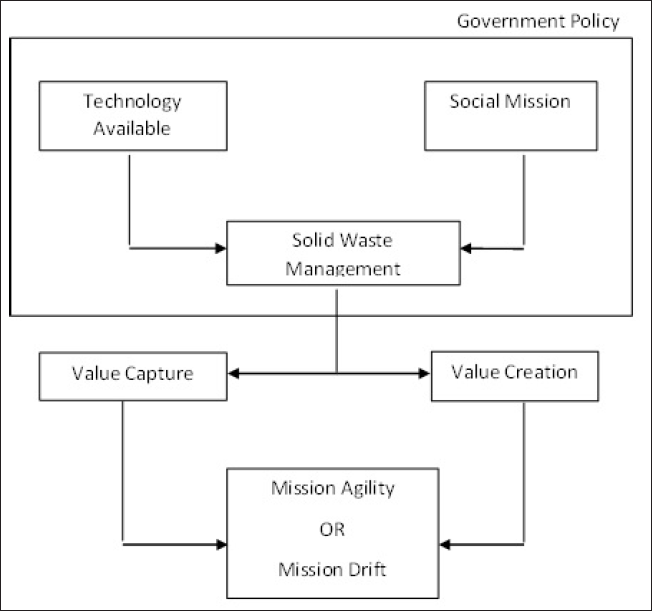
From the discussion, it is clear that a fine balance between ‘value capture’, through the use of technology to replace workers, for higher incomes to social enterprise and ‘value creation’ by choice of technologies that increase efficiency of its workers and hence enhanced earnings for these workers is the social enterprises priority given its social mission. Therefore ‘make do’ or bricoleur use of technology (Di Domenico et al., 2010) when replaced by technology as an operative resource for innovation (Lusch & Nambisan, 2015) can either result in a ‘mission drift’ or a ‘mission agility’ as discussed before. When contextualised to the uncertainties of a pandemic like COVID-19, the flexibility of responding to government policy and protocol with the help of technology may call for government and other institutional agency role to ensure this balance between technological innovations and social mission of social SWM enterprises through dynamic adoption of policies and protocols to the COVID situation keeping the welfare of waste workers in mind. As an outcome of this effort, the balance between value capture and value creation results in mission agility getting prioritised over mission drift, to create a sustainable business model.
In the absence of a sustainable business model, if the volumes of SW, its segregation and recycling reduce significantly when the pandemic retreats, competition between SWM enterprises may intensify. It needs to be seen then how under pressures of financial sustainability these hybrid enterprises remain true to their social mission or if they tend to be more commercial by replacing waste workers—the true beneficiaries with technology for the obvious financial benefits from technology discussed. This is captured in the framework in Exhibit 1.
Conclusion
What the situation of use of technology in the uncertainties of a pandemic in SWM helps us understand is that the role of technology depends on (a) the larger context of use of technology in SWM and (b) the individual social enterprise and founding social entrepreneurs’ faith in the social mission and service to the weaker sections of society. Like many other SE space, in SWM too, the trajectory of development of technology useful for SWM and the emerging structure of the industry, for example, increasing concentration with few large social businesses in SWM may also be other factors in the fine balance between value creation and value capture in SWM.
Footnotes
Case Study Samples
Declaration of Conflict of Interests
The authors declared no potential conflicts of interest with respect to the research, authorship and/or publication of this article.
Funding
The authors received no financial support for the research, authorship and/or publication of this article.