




Abstract
The objective of this study was to assess the literature, on the intersection of technology and social entrepreneurship. It involved conducting analyses by interviewing five entrepreneurs and analyzing the narratives of five governmental organizations that cater to educational needs in Delhi NCR.
Through these interviews the study delved into how technology and entrepreneurship impact the access to education for marginalized communities. To analyze both literature and real-life examples from entrepreneurs the ATLAS.ti coding program was employed. Codes and concepts were generated from the data in a manner for analyzing the literature. These codes and concepts were then used deductively to analyze the instances of entrepreneurs using an approach that helps us interpret data and gain new insights.
The study filled a gap in knowledge by examining how new technologies can be utilized to create business models that benefit populations. By highlighting the importance of technology among communities for social and economic progress it contributes to the understanding of social innovation and entrepreneurship. Additionally, it provided considerations for technology innovation within contexts.
The findings from this research highlighted challenges faced by both social entrepreneurs and organizations working with disadvantaged populations. One major obstacle identified was access to technology. Insufficient financial resources and ineffective resource utilization are also seen as hindrances. Lastly enhancing skills, among groups is emphasized as crucial for effectively promoting education.
Introduction: Understanding Social Entrepreneurship Education
Around the world, the idea of social entrepreneurship has become fundamental. This idea of generosity has intrigued many individuals, but it is more than just philanthropy and positively affects the social setting. It offers the best combination of social service and business, which makes this idea the most appealing and wholly original. Entrepreneurship is typically associated with profit-making economic operations that disregard societal benefits or human welfare. The current institutions and enterprises have overlooked and forgotten about important human needs and requirements, but social entrepreneurs have taken up these issues.
Social enterprises are businesses that prioritise addressing the needs of society and the environment with a focus on reinvesting the earnings into the business/community. It is the creation of viable (socio-)economic structures, relations, institutions, organisations and practices that yield and sustain social benefits (Fowler, 2000). In this sense, it incorporates programmes designed to identify weak social groups and present justifications for how entrepreneurship might build thriving societies.
That said, it is critical to distinguish social enterprises from businesses that use commercial innovation, or inventions that are widely accepted as having the goal of producing money (Westley & Antadze, 2010). It is also important to distinguish between social institutions from activities that are traditionally entrepreneurial. While commercial mission entrepreneurship seeks to make an economic profit, it may also produce social value as a by-product. Social entrepreneurship seeks to create lasting social value for the common good. Second, the dimensions of social initiatives have not yet been determined because they constantly cross the lines separating ‘for-profit’ and ‘non-profit’ businesses with social missions. Third, social entrepreneurship businesses address societal issues that are either disregarded or insufficiently addressed by traditional business owners or the public sector. The introduction of new goods or services, the creation of job opportunities, and most importantly, indirect transformative social impacts all benefit society, whereas traditional for-profit ventures are focused on making economic profit leading to individual or shareholder gain.
Innovation and entrepreneurship frequently have good social consequences, such as increased employment and economic growth. Social entrepreneurship is a type of entrepreneurship that focuses on creating both economic and social presence.
Social businesses aim to improve environmental, societal, educational and economic developments by using scalable and inventive solutions (Dey & Steyaert, 2010). According to Abu-Saifan (2012), the social businessman is a goal-driven person who applies a set of entrepreneurial behaviours to provide social value to those who are less fortunate through an entrepreneurially oriented organisation that is financially independent, self-sufficient, or sustainable.
In this way, the social enterprise sector has emerged as a key actor in addressing complex issues with a focus on addressing global issues like healthcare, education, poverty alleviation, education and so on. The field of entrepreneurship education has received increased interest from business as well as other academic school systems, practitioners and policymakers around the world (Satar & Alarifi, 2021). The major problem plaguing social entrepreneurs in the field of education is educational inequality (Bjørnskov & Foss, 2013).
COVID-19 and Innovation of Technology
The term ‘technology in education’ combines two concepts: education, which is the process of learning through education and technology, which is the practical application of scientific knowledge to support and develop human talents, senses, intellect, efforts and productivity. Thus, the use of various technical instruments and applications for instruction and learning is definitively referred to as ‘technology in education’. Examples include audio-visual aids, communication media, computers, the internet and so on.
The word ‘technology in education’ was first used in the development of the terminology ‘educational technology’ or ‘technology of education’, and the definition was constrained by educational writers to include tools (audio-visual) that can transfer lesson information. This is in line with NCERT’s (2006) definition. These concepts’ definitions are constantly changing. The configuration, organisation and usage of technology in educational practices, as well as other facets of human pursuits, are all subject to the constant change brought about by technology. In the course of evolution, the phrase ‘technology in education’ has been rebranded as ‘technology of education’ at one point and ‘educational technology’ at another.
With the spread of the pandemic that is COVID-19, technology and education became the most important topic of discussion. Education took a whole new meaning when COVID-19 brought in the closure of all academic spaces. According to a report released by the United Nations Educational, Scientific and Cultural Organization (UNESCO) when schools across the world were shut down as a result of COVID-19, it created an overwhelming impact on the education system. According to their numbers, the closure of schools had an influence on roughly 1.6 billion children in as many as 194 nations. In India too, it disrupted access to education with 247 million primary and secondary school students out of school.
Traditional system of teaching or face-to-face teaching took a backseat and learning came to be imparted from virtual classroom spaces. However, all this was very challenging both for the academic fraternity, students as well as social entrepreneurs engaged in the field of education. As research by Burke (2020) states when distance learning enters long-term development, there is a tremendous psychological, emotional, and academic impact of this transition. Due to the long-term impact, the pandemic raised questions as how technology can help children adapt to learning process in challenging times and how social entrepreneurs and organisations can ensure students continued access to education.
Literature Review: Technology and Social Entrepreneurship to Address Education Needs
With a long history, social entrepreneurship is a field that combines the creation of commercial and social value. Bill Drayton in 1980 founded Ashoka with a vision to provide financial support to entrepreneurs with a social objective. Broader and more specific definitions of social entrepreneurship have been offered. Dees and Anderson (2006) and Neck et al. (2009) argue for a ‘big tent’ approach to the term since they claim that social entrepreneurship encompasses a wide range of activities and organisations. Even more so, according to some academics (Austin et al., 2006), social entrepreneurship can take place within or across the public, private and non-profit sectors and is an innovative, social and value-creating activity. On the side of a more restrictive definition, Yujuico (2008) proposes that social enterprises should not be defined to include well-established institutions like government agencies, assistance organisations, charities, foundations and non-governmental organisations. This is because, in terms of objectives and methods, those businesses blur the distinction between for-profit and non-profit organisations. In other words, the justification for the exclusion of the enterprises is mainly because for-profit enterprises are not primarily funded by revenues from tax collection or charitable aid and are thus less isolated from market dynamics. Thus, social entrepreneurship involves entrepreneurship including development of viable organisations—and creation of practices that have a larger social impetus (Peredo & McLean, 2006).
Advances in Technology in COVID Time
The landscape of education today has been radically altered by technology advances over the past 20 years. A revival in education technology, sometimes known as ed-tech, has resulted from revolutionary developments in information and communication technology (ICT), particularly in the fields related to computers, mobile devices and the internet. Governments, educational institutions and families now place a higher importance on technology as a key component of the educational process.
The term ‘educational technology’ refers to the methodical and organised use of modern technologies to improve educational levels. It is an approach to conceptualising the implementation and assessment of educational processes, such as learning and teaching, and supports use of modernised teaching pedagogies. It entails the conduct of all individuals involved in the educational processes, including instructional materials, methodologies and organisational structures for work and relationships (Stosic, 2015). Both developed and poor countries are enthralled by how technology has the power to change education. The coronavirus pandemic affected the entire educational system, ushering in a new era of e-learning. E-learning refers to learning that is facilitated by online technology, such as web-based classes, multimedia and electronic portals or mobile applications for accessing courses outside of the classroom (Ngampornchai & Adams, 2016).
According to UNESCO, as of June 2020, 123 countrywide closures had affected 1.1 billion students, which was approximately 62% of total enrolment (UNESCO, 2020). Even though schools were closed, most governments around the world designed and implemented nationwide remote-learning initiatives during the COVID-19 pandemic.
The Center for Disease Control and Prevention published guidelines for different teaching practices to communicate class materials and assignments to students in March of 2020. The transition from chalk-board physical classroom interaction to online and e-learning depended heavily on the use of popular virtual classroom software like Zoom, Google Classroom, Moodle and Blackboard. Twitter, Facebook and WhatsApp are social networking platforms that have supported other virtual classroom applications, fostering collaborative learning and information sharing.
According to a World Bank report (Barron Rodriguez et al., 2021), countries with previous experience in distance learning programs rapidly implemented their already existing solutions in their education system when COVID-19 forced school closures across the world. Over the years, the government in these countries had been working on strengthening their technical and digital skills. For example, the report mentioned about Sierra Leone, a country in West Africa who took advantage of an existing radio instruction program and launched it on 6 April 2020. It was less than one week after schools were closed in the country. Similarly, Malawi adapted itself for a reciprocal radio programme where lessons were learner centric and explicit (Gondwe, 2020).
Research Methodology
The variety of definitions for social entrepreneurship may be a contributing factor to the paucity of research on education abilities. Confusion arises because there is currently no consensus on what social entrepreneurship is and how to describe it. Yet, how could we identify the abilities required to practice social entrepreneurship if we are unsure of what social entrepreneurship actually is? As a result, we made the decision to forego the definitional controversy and instead base our study on the narrative analysis of self-described social entrepreneurs. We developed a list of social entrepreneurs who work to solve a variety of social and educational issues. In order to find social entrepreneurial endeavours in the education domain, author’s personal contacts were used. The study employs the ‘Explanatory research approach’, in which it seeks to identify the factors that led to and affected the incident under inquiry. To explain and account for the descriptive data is the aim of an explanatory study. While descriptive studies may focus on ‘what’ queries, explanatory studies aim to provide ‘why’ and ‘how’ answers (Gray, 2014). For the current study, a judgemental sampling which is a kind of purposive sampling was used wherein the researcher ‘handpicked sample members to conform to some standard’. It is a nonprobability sampling technique where some units of the population in the study have no chance of being chosen or when it is impossible to determine with precision what probability they have of being chosen. Normally, non-random criteria like quota or convenience are used to select units. Non-probability sampling techniques include purposive sampling, quota sampling, expert sampling and snowball sampling (Kothari, 2004; Kumar, 2011). Choosing specific locations, people or events on purpose in order to provide crucial information that cannot be learned from other options is known as judging or purposeful sampling (Maxwell, 1996). When a researcher feels that certain cases or volunteers should be included in the sample, they will include them.
Figure 1 gives a summary of the sample and sampling process followed. In order to safeguard privacy, we have not revealed names of the social entrepreneurs and enterprises.
Research Methodology Process.
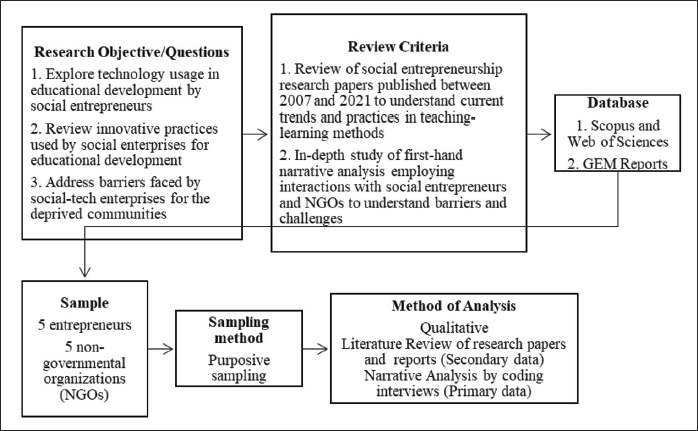
Our sample consisted of five Delhi-based social entrepreneurs and non-governmental organisations. In-depth interviews of five entrepreneurs and a narrative analysis of five non-governmental organisations were carried out. Despite the tiny sample size, the study’s primary goal is to investigate rather than provide evidence, therefore it is acceptable. Following a thorough qualitative investigation, we determined the following seven distinguishing traits among the social entrepreneurs we spoke with such as developing a financial model that supports the venture’s social mission, developing a financial model, developing solutions that address a social problem, co-creating product with multiple stakeholders, placing a priority on social and financial returns are just a few of the complex relationships that need to be established and managed with multiple stakeholders.
The study set out to explore the following research questions:
How are entrepreneurs using technology for social value creation in education practices?
What are the innovative practices used by social entrepreneurs for promoting educational development?
What are the barriers faced by social-tech enterprises when innovative solutions are implemented for deprived communities?
Through the in-depth interviews, we explore the impact/role of technology and entrepreneurship in accessing education by marginalised communities. The ATLAS.ti coding programme was used to analyse both the academic literature and the social entrepreneur examples thematically. The academic literature was analysed inductively, which means that codes and concepts were derived from the data (Braun & Clarke, 2006). The resulting codebook and concepts were then utilised to deductively analyse the social entrepreneur instances, that is, interpreting data using a set of codes and concepts while allowing for the discovery of new codes and concepts—a hybrid approach.
Data Description
The data utilised in the study captures both primary and secondary data types. It has included published and unpublished data for the secondary data such as World Bank reports, UNESCO statistics and primary data such as annual reports of social enterprises, first-hand in-depth interviews with the stakeholders for the purpose of the analysis. The respondents included in-depth interviews of five entrepreneurs and a narrative analysis of five non-governmental organisations. A tabular representation of the data is as follows:
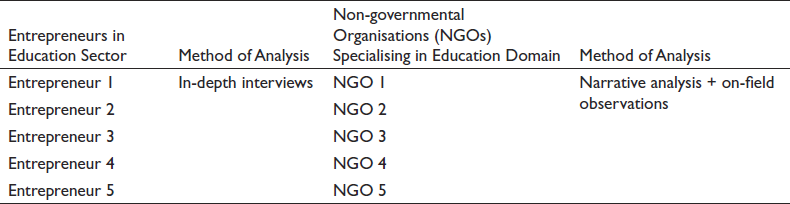
According to the respondents’ professional roles, the data were organised into two data files. The in-depth interviews for entrepreneurs and narrative analysis for non-governmental organisations, and these two data files—one for social entrepreneurs and one for non-governmental workers made up the entire dataset. In addition to making it easier to comprehend the data, providing the interview survey together with the narrative data files encourages potential harmonisation with other survey-based studies. The dataset has the potential to provide practical applications as well as provide answers to understanding how educational technology has been a boon or bane to promoting social entrepreneurship development, especially during COVID pandemic. The dataset’s information on evaluation criteria and data use might be used to inform data metrics, and educators and research support specialists could utilise it to create training programmes.
Results and Findings
Social entrepreneurship should be understood as an age-old idea that is a significant engine of human progress rather than as a recent fad. The idea of social entrepreneurship has aided in serving the society in a more meaningful way during this time of industrialisation and economic expansion, which has caused societal gains to take a back seat globally. In today’s world, social entrepreneurship offers an altruistic style of business that emphasises potential advantages for society. Simply put, when social capital is transformed in a way that benefits society, entrepreneurship turns into a social enterprise. In the domain of education social entrepreneurship becomes an added challenge because of various factors such as economic barriers, legal policies, social boundaries and technological hurdles. An in-depth interaction with social entrepreneurs and non-governmental organisations brought results which highlighted the challenges faced and opportunities recognised, especially in the education sector in the pandemic era to fulfil the needs of the society at large.
Technology Usage and Innovative Education Methods for Value Creation
COVID-19 pandemic posed numerous obstacles for educational systems, which raised crucial concerns regarding the direction of education. With highly varied results and the exposure of systemic flaws like social injustice, inequity, and digital divide educators were compelled to conduct ‘emergency remote education’, which significantly differed from planned practices such as blended learning, distance education or e-learning.
Slowdown in economy and school closures drastically affected the education system. While schools were closed, learning gains that students previously achieved were partially lost. Children from disadvantaged backgrounds suffered these shocks even more and were at a higher risk of dropping out of school (World Bank, 2020). Children who were previously disadvantaged felt less connected to their education due to the lack of interaction between teachers and pupils.
However, adhering to the sudden change and a transition from the traditional teaching to a virtual teaching was a two-edged knife. It first brought challenges both systemic and individual such as lack of resources, absence of training to completely rely on technological methods of teaching and opportunities such as developing innovative practices and methods to engage students at large.
It was deduced from the interactions with social entrepreneurs that educators required various changes to adapt to technology and incorporate innovative means and create value in learning. Some measures suggested were:
First, method entrepreneurs laid out included systematic changes in respect of revamping training of teachers beyond the acquisition of fundamental digital skills. According to them, training teachers must look for ways to use ICTs to interpret meanings and exploit the creative potential into their teaching practices.
Second, measure included the pre-class preparation that is motivating and training educators for effective personal communication, usage of word processing, slide presentations, or information search, which affected a majority of teaching methods making them ‘superficial’ or ‘basic’ with the use of digital technologies. For example, during the course of fieldwork, while interacting with one of the teachers in a selected NGO, it was found that the teacher faced problems in making the students read an English lesson while using mobile phone as she had to hold the textbook on one hand and use mobile phone with the other hand to read out the lesson.
Third, the attitude of teachers to the digital transition was recognised as a drawback. Teachers believed that the adoption of new methodologies was not being supported and they were not suitably equipped to use ICT. They did not try to make efforts, especially for addressing the needs of the disadvantaged students assuming that they would never be able to cope up or use smartphones for learning.
On the other hand, the non-governmental organisations brought out keynotes on how expositional teaching techniques (read, view and listen) were being promoted by teachers in their respective organisations using digital technology with the COVID-19 pandemic. Second, study-related tasks, such as doing research or exploratory tasks, were the ICT activities that teachers rigorously adopted for their own development. Third, instructional strategies were implemented which directed students’ assignments toward the application of information. The following teaching methodologies were thereby, enhanced with less common technologies such as (a) collaborative learning, (b) learning that involved students to produce digital resources (such as texts, images, audiovisual etc.) and (c) ICT-supported communication activities that encouraged discussion and reflection. Examples of some of the tools to enhance teaching methodology include—Mentimeter, Canva, Prezi, Powtoon, Kahoot and so on.
Barriers and Challenges Faced by Social Entrepreneurs
The findings from the study suggest two sets of barriers faced by social entrepreneurs before and after COVID-19 set in. The study shows that prior to the pandemic most of the social entrepreneurs were beset with some common challenges which included—first, lack of financial capital is the first major cause of concern for any social entrepreneur. Generally, these entrepreneurs invest their own savings or raise funds to start their venture without any form of capital support from any financial institutions such as banks and government. Lack of support usually makes the social entrepreneur fall prey to borrowing from petty money lenders at unjustified high rates of interest. Second, non-cooperation from the side of the government is also a major reason for social entrepreneurs failing at most times to fulfil their set objectives. This failure on the part of the government has forced social entrepreneurs and organisations to bear burdensome regulations, strict government policies and complex decisions which hamper their growth. Third, from the study it emerged that most times these entrepreneurs failed to relate to the philanthropists’ or organisations’ visions which could support them in their endeavour. Fourth, lack of competent manpower such as educators, community participants and volunteers proved as a challenge for the social entrepreneur as well as the organisation to sustain them in the long run.
When COVID-19 pandemic set in, it brought in a fresh set of the challenges for entrepreneurs and organisations as the findings of the study reflect. For example, when the pandemic stuck most of the teacher educators were hardly equipped with technical knowledge to suddenly switch to the online mode. They lacked the required technical and pedagogical skills to blend digital technology with education. Further, in-depth interviews conducted with social entrepreneurs revealed that the initial days of online teaching also brought in emotional and physical exhaustion for the knowledge commuters. This was due to the fact that since majority of the teachers did not find themselves trained to teach remotely, they were anxious and in the process found themselves drained out. Besides, in comparison to male teachers, female teachers found the process more tiresome as they did more household work than male teachers. The study also found that students, especially from the disadvantaged sections found themselves to be at the receiving end of the pandemic-induced lockdown. Majority of the students belonging to this section did not have a peaceful environment to study in their homes which makes learning quite difficult. There was a lack of technological tools such as smartphones or internet connections in their homes. For example, in a household comprising four members, just one smartphone was available which further weakened the learning process. It was found that one of the NGO received funding to distribute basic tablets to students. One of the student stopped attending the classes. It was later found that he had traded the tablet perceiving it be useless. In the same group, a girl student had to give her tablet to her brother who was younger to her in class as her brother’s education was prioritised over her own. COVID lockdown also saw large percentage of migrant workers returning back to their hometowns as their means of livelihood in Delhi-NCR were wiped out. Children migrated along with their parents to their native places, some of which were not served by mobile networks. These forced them to lose their connection with their studies which social entrepreneurs and organisations had managed to build over the years. The pandemic also resulted in many households facing economic hardships forcing parents to send their children to go for work instead of school in order to add to the household income.
Conclusion
Social entrepreneurship is an emerging field that has generated debate among scholars for yielding for-profit business and social value concepts. Social entrepreneurship education systems have created a huge impact in providing accessible education to children, especially from the weaker sections of the society and provided a platform for entrepreneurs and organisations to create a valuable impact on society. COVID pandemic proved highly challenging for the entrepreneurial section in providing quality and accessible education however with constant effort they have managed to assess their current technological resources and have managed to a great extent to implement learning solutions to students. With cooperation from government and financial institutions, there is a bright possibility for them to rapidly reach and effectively promote education to all students from disadvantageous groups.
Originality of the Paper
Through the use of a conceptual framework, the article shows how new technologies are used and implemented in the building of social business models that target disadvantaged people. The article could be used as by the researchers to understand and expand the possible usage and importance of technological innovations in the field of social educational entrepreneurship. Moreover, social entrepreneurs and organisations can gain benefit from the conceptual framework which might aid them in promoting social entrepreneurship as a separate field of discipline within the academia.
Footnotes
Declaration of Conflicting Interests
The authors declared no potential conflicts of interest with respect to the research, authorship and/or publication of this article.
Funding
The authors received no financial support for the research, authorship and/or publication of this article.