




Abstract
Mission drift poses a real threat to social enterprises because it leads them to diverge from their main social purposes. Although various accounts of mission drift already exist in organization studies, a unifying processual account that would clarify this notion while broadening the perspective to encompass drift in relation to social issues more generally is lacking. Taking a practice-based approach, I develop a conceptualization of ‘practice drift’ in social enterprises as a process that emerges from tensions and is unintended, unnoticed and unwanted by organizational actors. A practice perspective not only helps substantiate the dynamics of mission drift in its unintended form but can also sensitize scholars to mission-neutral drift. This paper contributes to social enterprise studies by shedding light on the processual dynamics of mission drift and by introducing fine-grained distinctions between different types of drift, including partial mission drift, economically driven practice drift and mission-driven practice drift. Furthermore, it contributes a theoretical account of drift in relation to social issues that is relevant not only for social enterprises but organizations more generally. Finally, this paper identifies drift-driving and drift-blurring elements and thereby provides theoretical scaffolding that can serve to theorize the drifting of practices in a wider sense.
Keywords
In memory of Hilmar Schäfer (1977–2023)
Introduction
Social enterprises are organizations that use entrepreneurial means to pursue specific social missions while following practices that they find ethically adequate (Bruder, 2021; Bull & Ridley-Duff, 2019; Dacin, Dacin & Tracey, 2011; Lechterman & Mair, 2024). The notion of ‘social mission’ is often central in organizational scholarship engaging with social enterprises because it is regarded as their raison d’être and constitutive feature (Ebrahim, Battilana, & Mair, 2014; Mair, Mayer & Lutz, 2015). Hence the phenomenon of inadvertent mission drift has caught researchers’ attention (Ebrahim et al., 2014; Grimes, Williams & Zhao, 2019, 2020; Ometto, Gegenhuber, Winter & Greenwood, 2019; Varendh-Mansson, Wry & Szafarz, 2020; Wolf & Mair, 2019). Mission drift is a process during which an ‘organization diverges from its main purpose or mission’ (Cornforth, 2014, p. 4). In the case of social enterprises, it leads them to increasingly and, usually, unintentionally ignore the needs of the stakeholders that they initially intended to help (Garrow & Hasenfeld, 2014).
Even though organization scholarship has produced a large body of literature containing a range of perspectives on mission drift (e.g. Battilana & Lee, 2014; Grimes et al., 2019; Wry & Zhao, 2018), conceptualizations are partly contradictory (e.g. Grimes et al., 2019; Varendh-Mansson et al., 2020) and a unifying processual account of what happens within a social enterprise during mission drift is lacking. More important, organization research on social enterprises seems to implicitly assume that the only relevant drift is mission drift. Of course, it is indeed a highly significant issue for these organizations, but I problematize this assumption (Alvesson & Sandberg, 2011), pointing to the possibility that drift might not alter a social enterprise’s social mission but, rather, the practices it follows to pursue this mission. It is important to develop a more nuanced processual account of drift in social enterprises because it can (1) provide organization scholars with theoretical tools and a vocabulary to better grasp drift observed during their empirical research and (2) sensitize scholars to types of drift that have not been on their radar so far, even beyond social enterprises. Thus, I seek to answer the following research question: How does the process unfold through which social enterprises inadvertently drift towards overlooking stakeholder claims that they initially intended to consider?
To answer the research question, I will develop a processual account of drift in relation to social issues while drawing on practice-based approaches (Nicolini, 2012). I view practices as recurring patterns of action that unfold through repetition, share an implicit normativity and are relatively stable across space and time (Giddens, 1984; Rouse, 2007; Schäfer, 2022). A practice perspective is, by default, sensitive to all types of practice and practice change, be they related to stakeholders addressed by a social mission or not, thus allowing drift to be theorized more broadly. Moreover, it is processual in nature (Schatzki, 2019) and thus provides a suitable means to integrate insights from processual scholarship on drift (e.g. Dekker, 2011; Ortmann, 2010; Snook, 1996; Vaughan, 1997) that are yearning for integration with mission drift research. Following this literature, I use a narrow definition of ‘drift’ as an unintended and partly unnoticed process leading to outcomes that are not desired by the actors involved. Understood in this way, drift is the dark side of emergence.
Theorizing practice drift makes it possible to elucidate processual dynamics within social enterprises during both mission drift and mission-neutral drift. Whereas mission drift implies that the implementation of a mission went awry, mission-neutral drift implies that the successful implementation of a social mission has brought about an unintended side effect: a drifting of practices that are not directly related to the stakeholders addressed by the social mission. Moreover, I contend that mission drift and other involuntary drift in social enterprises affecting social issues are driven by the same kind of process: practice drift, which is sparked by a tension, advanced by a set of drift-driving elements and propagates iteratively and decrementally through the repetitions implied by practice (Schäfer, 2022); all the while, it remains by and large undetected because of drift-blurring elements that make it difficult for practitioners to detect differences between repetitions.
By theorizing practice drift, this paper contributes to several strands of the literature. First, the model developed adds nuance and clarifies the organizational-level dynamics during mission drift and, thereby, provides a unifying processual account that can underpin various conceptions of mission drift (Battilana & Lee, 2014; Grimes et al., 2019; Varendh-Mansson et al., 2020; Wry & Zhao, 2018). Second, the paper contributes to social enterprise research by introducing mission-neutral practice drift to the hitherto mission-centric discourse on drift in social enterprises (e.g. Ebrahim et al., 2014; Ometto et al., 2019; Wolf & Mair, 2019). A typology identifies three new drift types beyond classic mission drift that are relevant for social enterprises and organizations more broadly: partial mission drift, economically driven practice drift and mission-driven practice drift. Third, this paper contributes to practice-based organizational scholarship by elaborating on the recently developed concept of practice drift, which has not yet been theorized in truly processual terms (Schatzki, 2019; Stjerne, Geraldi, & Wenzel, 2024). The process model, together with the identified drift-driving and drift-blurring elements, provides a scaffolding that can help researchers better understand the processual dynamics of other types of drift in terms of practice theory.
Mission Drift in Social Enterprises
Social enterprises are organizations that use entrepreneurial means, often in innovative ways, to pursue specific social missions. Usually, this implies that they address social problems while striving for justice and engaging in practices that they find ethically adequate (Bruder, 2021; Dacin et al., 2011; Defourny & Nyssens, 2010; Lechterman & Mair, 2024). Social enterprises are often regarded as hybrid organizations that combine commercial and social elements (e.g. Battilana & Dorado, 2010). There is much variation among them as regards the relative importance of commercial and social elements (Battilana & Lee, 2014), as well as the intensity of these elements (Shepherd, Williams & Zhao, 2019). The social element is often subsumed under a social mission, which is viewed as a constitutive feature of social enterprises (Wolf & Mair, 2019). A ‘mission’ can be conceived as the enduring purpose of an organization (Bart & Baetz, 1998) and the raison d’être for its existence (Ebrahim et al., 2014). More recently, mission has been conceptualized as a bridge between an organization’s identity and its actions (Grimes et al., 2019). In short, the mission clarifies the ‘what?’ and the ‘why?’ of an organization, while being unspecific and allowing some latitude as to the ‘how?’
It has been suggested that the social element in social enterprises is not limited to their social missions, but also includes the ‘how?’ dimension, namely, how they carry out their activities (Dacin et al., 2011). Accordingly, beyond their social missions social enterprises are often determined to engage in practices that they themselves find ethically legitimate (Bruder, 2021; Bull & Ridley-Duff, 2019). Such ethical aspirations can be implicit or explicit. They usually relate to aspects other than the social mission. For instance, the definition of social business used by the Yunus Centre (a support organization for social enterprises) refers to features such as gender equality or decent work conditions (Yunus, 2010). These ethical aspirations concern practices in a general sense, rather than the nuances of a specific social mission. Within social enterprises, aspirations for ethically adequate practices often tend to be implicit, yet do inform their actions (Bhatt, 2022).
When it comes to research about social enterprises that have failed to live up to their social ambitions, however, the ‘how?’ dimension of their practices is entirely absent from the literature: all the emphasis lies on the social mission. While the mission drift literature thus shares a firm focus on mission, it can be divided into three streams.
First, mission drift may be understood as a change during which a social enterprise generally loses sight of its social mission (Wry & Zhao, 2018). In a more specific interpretation, this implies deviating from the social mission and moving towards the generation of financial income instead (Bielefeld, 2009; Green & Dalton, 2016). This view of mission drift is often empirically rooted in studies on microfinance, which contributed to the spreading of the concept in the first place (e.g. Mersland & Strøm, 2010). The mission of microfinance social enterprises is to lift the poorest out of poverty by providing them with micro-loans under generous conditions which, for example, allow debtors to buy seeds or plants and sell their harvest at a profit and then pay back the micro-loan. However, some microfinance social enterprises shifted their focus towards better-off customers, with whom it was easier to make a profit (Mader, 2013). Such cases were interpreted as mission drift (e.g. Augsburg & Fouillet, 2010; Hishigsuren, 2007).
Research in this stream focuses on the potential causes of mission drift, for instance the volatility of subsidies (D’Espallier, Hudon & Szafarz, 2016) or pressure by donor organizations to become financially self-sustainable (Augsburg & Fouillet, 2010). There are hints that more experienced credit officers in microfinance institutions tend to contribute to mission drift by issuing fewer loans to more vulnerable clients (Beisland, D’Espallier & Mersland, 2019). This literature also discusses measures and mechanisms designed to combat mission drift after it has happened, for instance by introducing social accounting or ensuring a stronger stakeholder engagement in decision-making processes (Ramus & Vaccaro, 2017). While this perspective did put mission drift on the map of organization studies, it has a rather static bias and lacks processual theorizing.
Second, mission drift may be understood as any loss of balance between the typically dual objectives (or missions) of a social enterprise (Battilana & Lee, 2014; Stevens, Moray & Bruneel, 2015). This understanding of drift is rooted in the literature on hybrid organizations (e.g. Varendh-Mansson et al., 2020), which conceptualizes social enterprises as entities with two missions – a social and a commercial one – stemming from two distinct institutional logics (Battilana & Dorado, 2010). Thus, in this conception, drifting away from a balance between social and commercial objectives towards either the social or the commercial mission would be considered mission drift.
Nevertheless, the literature on hybrid organizations often focuses on drift from social to commercial objectives (Ebrahim et al., 2014). It considers that one of the causes of mission drift within hybrid organizations is external pressure to prioritize one of the two institutional logics over the other (Battilana & Dorado, 2010; Ebrahim et al., 2014; Garrow & Hasenfeld, 2014). As a remedy, this strand of research discusses organizational governance measures (Ebrahim et al., 2014; Wolf & Mair, 2019). In addition to monitoring the management of commercial and social activities and, in particular, the relationship between them, enabling downward accountability to the beneficiaries of social enterprises could be a solution (Ebrahim et al., 2014). Another prevention measure is to maintain ‘herding spaces’ where social enterprises are connected to their institutional contexts in order to learn and reinforce their normative purposes (Ometto et al., 2019). Although this perspective does contain longitudinal studies with a processual character, it still offers little theorizing of how the mission drift process actually unfolds.
Third, a recently developed stream conceptualizes mission drift as a perceptual and socio-cognitive construct defined as a perceived discontinuity between an organization’s actions, on the one hand, and its image and identity, on the other (Grimes et al., 2019). In this view, mission drift is something that happens mainly, though not exclusively, in the minds of external audiences. Leading up to socio-cognitive mission drift are value-based complexity and inconsistent organizational actions triggered by several independent yet simultaneously interacting values within society, organizational fields and organizations (Grimes et al., 2019). According to Grimes et al. (2019), organizational actions will appear inconsistent if current ones deviate from a past pattern. This can happen if resources are suddenly allocated too far away from the core domain of an organization’s business model or if activities catering to dissimilar values are not coordinated well enough internally (Grimes et al., 2019).
Social enterprises can prevent a socio-cognitive mission drift by adopting a broad stakeholder orientation (Klein, Schneider, & Spieth, 2021). According to this perspective, once mission drift has occurred, a social enterprise can engage in various ‘mission work’ practices (Grimes et al., 2019). To start with, this may entail impression management practices. If this is not sufficient, governance-related practices may be instituted to signal either consistency or responsiveness, the aim being to bring an organization’s image and actions into alignment again. Although this perspective is processual in nature, it does not theorize the processes taking place within an organization during mission drift but, rather, processes in the minds of audiences.
In these three rather differing views of mission drift, whether it is unintentional or deliberate remains elusive. While some conceptualize mission drift as a deliberate strategic process (e.g. Casselman & Sama, 2013), others, including the present author, view it as an unintended outcome (Hishigsuren, 2007; Ometto et al., 2019; Varendh-Mansson et al., 2020; White, 2007), or as encompassing both deliberate and unintended change (Grimes et al., 2019).
Although drift related to a social enterprise’s mission has been discussed widely in the literature and is well understood, drift processes that do not alter a social mission but, rather, the practices implementing that mission have not been addressed. Furthermore, the concept of mission drift may have been discussed in a wide-ranging way, but it lacks a unifying account that would theorize how the mission drift process actually unfolds within social enterprises. Extant scholarship on drift in relation to reliability and safety issues is highly promising in that regard, since it provides sophisticated accounts of drifting processes.
Processual Accounts of Other Types of Drift in Organizations
Organization scholars often discuss drift or drift-like processes in relation to reliability and safety issues when analysing the processes leading up to disasters (e.g. Dekker, 2011; Ortmann, 2010). In several disaster situations, such as the friendly-fire downing of US Army helicopters (Snook, 1996), the explosion of the Challenger space shuttle (Vaughan, 1997), or the crash of an aeroplane into the open sea (Dekker, 2011), researchers came to the conclusion that what had failed were not single individuals or parts. Rather, these disasters were the outcomes of unintended organizational drift processes that had gone largely unnoticed. Thus, this literature understands drift as an emergent process that unfolds imperceptibly as a result of continuous adaptations designed to increase efficiency and the seeming success of such adaptations – even though they reduce overall system safety (Dekker, 2011). This implies that while the organization is drifting towards safety failure, it does not realize this since (on the surface) its operations are repeatedly successful.
Drift displays common features across varied contexts. First, resource scarcity and competition might lead an organization that is constantly seeking to balance trade-offs between efficiency and safety to develop an emergent tendency that is reflected in many small decisions; together, these create a pull effect in one direction, but this is difficult to see at the point when single decisions were made, and remains unnoticed (Dekker, 2011; Vaughan, 1997). Second, many small steps, although achieved through locally rational decisions, will add up decrementally over time, amounting to an unfavourable trend when viewed holistically (Dekker, 2011; Snook, 1996). Third, feedback imbalance is constitutive of drift. As regards decisions and actions involving a trade-off between efficiency and safety, efficiency gains can easily be quantified and compared, whereas safety is a lot more difficult to assess. Thus, small adaptations that increase efficiency at the cost of safety are more likely than vice versa, since feedback on efficiency-related modifications is less ambiguous. Fourth, drift is often obscured by the repeated success of small alterations (Dekker, 2011). Earlier ones become culturally accepted and socially reproduced in spite of personnel turnover (Vaughan, 2004). This develops into a new, taken-for-granted status quo. Moreover, drift can be thought of as progressing in recursive loops, whereby a small change during one sequence of action leads to a new state that becomes taken for granted by the time the next sequence begins, and so on (Ortmann, 2010). Drift may go on like this until its extent is such that it becomes noticeable. Paradoxically, this usually happens when it has caused such severe damage that it is no longer entirely reversible (Ortmann, 2010).
Towards a Practice-Based Understanding of Drift in Social Enterprises
A practice-based perspective provides the means to combine insights gained by, on the one hand, mission drift research into social issues and, on the other hand, organization studies of drifting, thus adding up to a single, coherent theoretical framework. Common to all practice-based approaches is that they offer an explanation of social phenomena in processual terms while remaining connected to daily doings and sayings (Feldman & Orlikowski, 2011; Goldenstein & Walgenbach, 2024). They have a family resemblance that makes them ontologically compatible (Nicolini, 2012); for instance, in addition to assuming a processual ontology, they de-centre the individual (Nicolini & Monteiro, 2016), shifting the focus to the supra-individual level. This, I will argue, is essential to grasp drift processes.
In this paper, I build on Giddens’ (1984) structurationist account of practice and on Schäfer’s (2022) conceptualization of practice as repetition. In a nutshell, this implies an agentic model of goal-oriented action mainly relying on practical consciousness and leading to a number of unintended consequences that may become unacknowledged conditions for further actions (Giddens, 1984). Such actions reproduce socially shared practices by repeating them (Schäfer, 2022). Practices have a common implicit normativity (Rouse, 2007) and are relatively stable across space and time. Repetition does not mean that the exact same thing happens again and again. Rather, a repeated practice is something that is linked by its reappearance, but that reappearance can never be exactly the same as a prior repetition owing to the inevitably altered context (Schäfer, 2016).
From a practice-based perspective, a mission can be understood as an organizational structure – in the virtual sense in which Giddens (1984) uses the term – that spells out the purpose and raison d’être of an organization (Bart & Baetz, 1998; Ebrahim et al., 2014), and needs to be constantly reproduced through organizational practices. This implies that mission drift takes place because the practices reproducing the mission are themselves drifting. However, practices unrelated to the mission may also drift even if the mission stays unchanged.
Drift has been picked up in practice theory as a potential source of social change: the drift of practices is an ‘omnipresent but often insignificant feature of the world’ (Schatzki, 2019, p. 98). Thus, only some drift-related changes to practices would turn out to be socially relevant, which is reflected in people’s reactions to practice changes through drift (Schatzki, 2019). Building on that, Stjerne et al. (2024) introduce the notion of strategic practice drift, which occurs if the strategy process within an organization shifts towards a more open mode of strategizing and, to some extent, is overlooked by top management. Although these studies do make important contributions to the understanding of drift in terms of practice theory (e.g. as an unintended and often unnoticed instance of practice change), they do not theorize the emergence of practice drift but, rather, try to explain other outcomes through practice drift. Hence this paper’s ambition is to build on their findings to develop a theoretical account of the process of practice drift in social enterprises, which I turn to in the following sections.
The emergence of drift within social enterprises originating from a constitutive tension
Building on the literature reviewed so far, I develop an integrated processual account of practice drift in social enterprises in relation to social issues. I understand practice drift as an unintended and, to some extent, unnoticed decremental change process affecting (inter-)organizational practices that eventually leads to a state that is undesired by the organization concerned. More precisely, this state is viewed as a failure in a relational sense: an organization’s actions conflict with the claims of certain stakeholders even though the focal organization itself finds these claims legitimate and initially intended to respect them.
Practice drift is sparked by organizational tensions (Putnam, Fairhurst & Banghart, 2016), which also feature prominently in the processual drift research described above. In order to develop a versatile account of practice drift, I posit a rather broad constitutive tension at the centre of my theorizing, which will allow detailing of different types of drift later. Going beyond a social-economic dichotomy, I focus on the tension between organizational success metrics and legitimate (in the eyes of the organization) but unquantified stakeholder claims. The focus is specifically on success metrics because they are the reification of success in everyday organizational life, be it economic success for any business or mission success for social enterprises, which tends to be quantified as social impact (Molecke & Pinkse, 2017). In practice, such success metrics often clash with the stakeholder claims that they do not cover even though the organization finds these claims legitimate (Mitchell, Agle, & Wood, 1997) and, therefore, would like to respect them. Unquantified legitimate stakeholder claims may be divided into two types: those whose fulfilment, for whatever reason, is not measured and a sub-set of those that can be very difficult or almost impossible to quantify – for instance, the degree of fairness towards suppliers. In the following, I will illustrate my argumentation with claims of the first type and turn to the second type in the ‘Manifestations of practice drift’ section. The more an organization devotes its time and resources to increasing quantified organizational success, the less capacity it will have to consider legitimate stakeholder claims that are not measured by these metrics, and vice versa. I deliberately focus on tension in this sense, since this is most relevant for explaining both mission drift and mission-neutral practice drift.
The tension between legitimate stakeholder claims and success metrics will be greater if the economic survival of an organization is at stake. In this case, pursuing economic success will be so vital that less capacity will be available for other legitimate stakeholder claims – especially those that do not contribute to improving organizational success metrics. In capitalist market economies, profitability pressures are typically applied by providers of internal or external capital (Augsburg & Fouillet, 2010). By contrast, the claims of stakeholders who do not contribute to quantifiable organizational success are usually only considered once the interests of capital providers have been satisfied. Against the background of this constitutive tension, practitioners try to carry out their practices and satisfy the two poles of the tension. Yet the stronger this tension is, the greater the likelihood of practice drift.
As depicted in Figure 1, practice drift evolves through repetitions of a practice in infinitesimal steps. The drift itself is depicted as a fading of colour from black to grey in barely noticeable steps unfolding from repetition to repetition over time. Each circle above the time axis constitutes one repetition of the focal practice, and the changing colour indicates that the practice is drifting towards a stronger consideration of success metrics at the expense of legitimate stakeholder claims. There are two sets of elements that are at work simultaneously and contribute to practice drift: drift-driving elements are the ‘engine’ moving a practice towards stronger consideration of success metrics, while drift-blurring elements contribute to obscuring drift from individual actors. In the following sections I will unpack both sets of elements in detail.
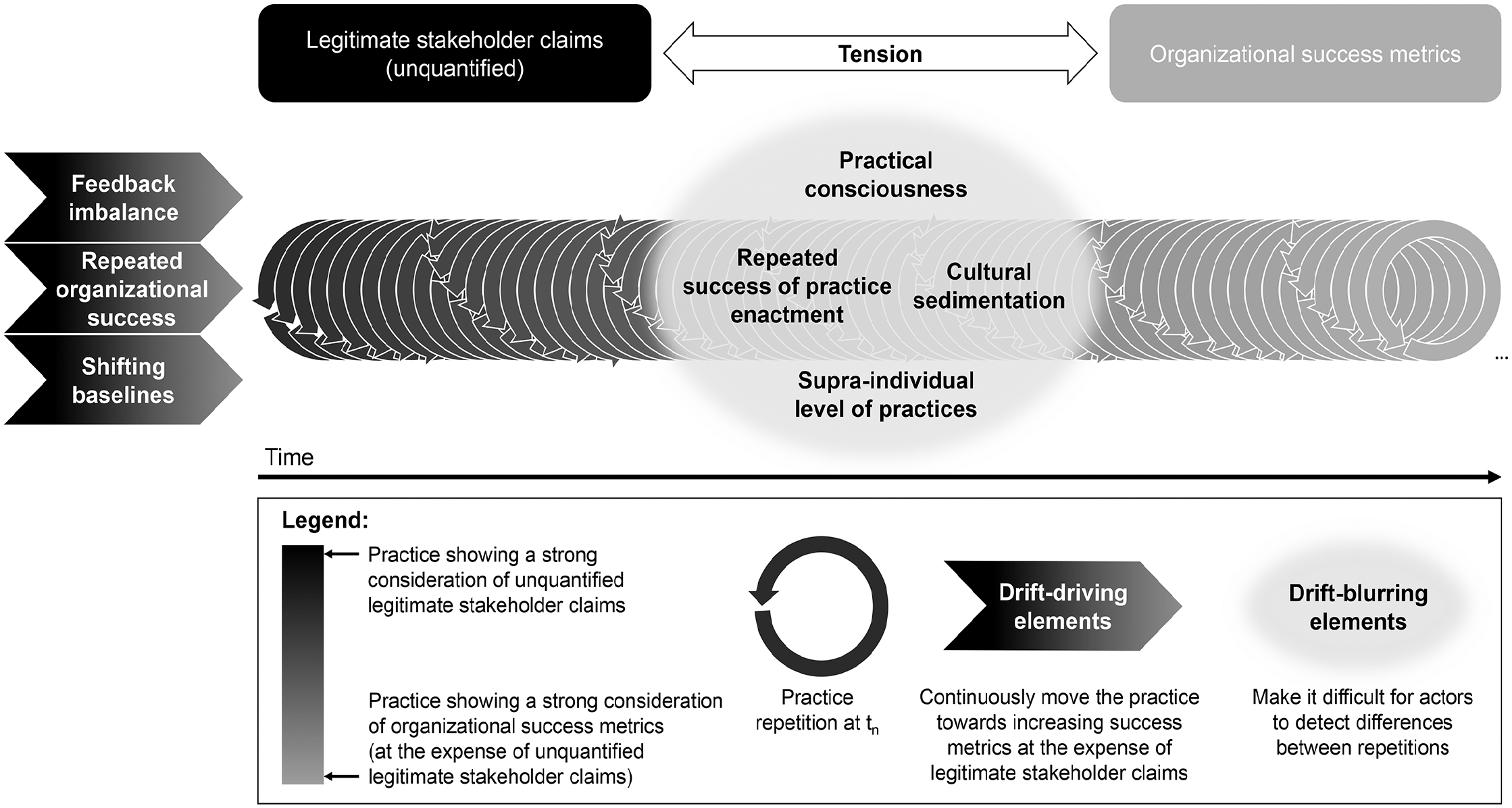
A model of practice drift in relation to social issues.
The decremental pull towards disregard for legitimate stakeholder claims: Drift-driving elements
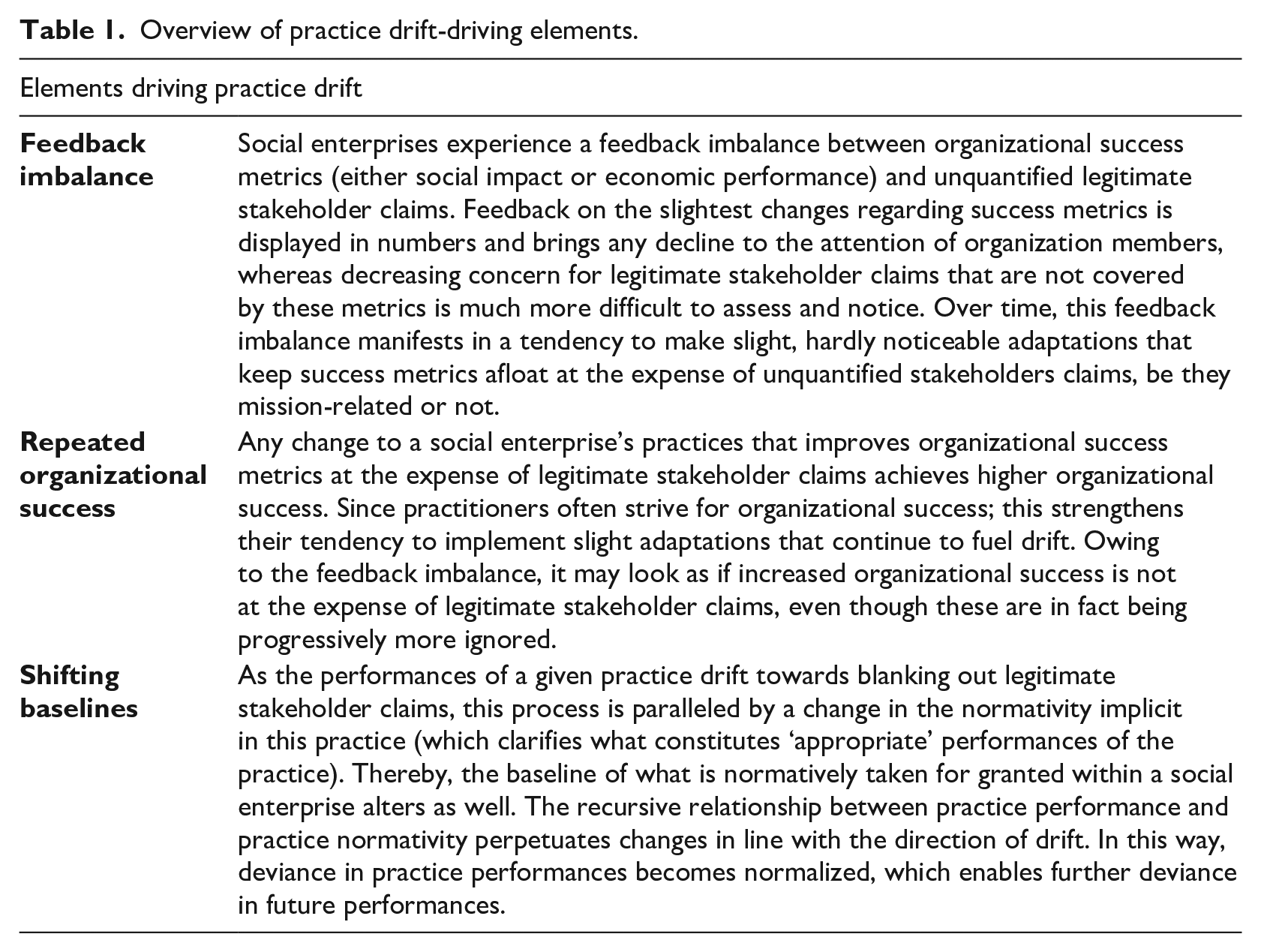
There are three elements that drive the decremental pull of practice drift towards an increasing disregard for stakeholder claims: feedback imbalance, repeated organizational success and shifting baselines. First, Dekker’s (2011) ‘feedback imbalance’ plays a central role in the emergence of practice drift. Just as with the tension between calculable and incalculable outcomes (e.g. efficiency and safety, respectively), all organizations, including social enterprises, are subject to a certain degree of feedback imbalance between success metrics and stakeholder claims. Fluctuations in financial results or social impact measurements are quickly noticed. On the other hand, assessing the extent to which unquantified, legitimate stakeholder claims are being taken into consideration is messy and ambivalent, not least because this is an ethical question – and ethics is controversial (Ulrich, 2008). For instance, the question ‘Are we making enough turnover?’ is more straightforward and easier to answer than the question ‘Are we (still) paying a fair price to our suppliers?’
This feedback imbalance fences off unintended practice changes, but only those that involve decreased regard for organizational success metrics: the slightest change that leads to less success will quickly stand out; this is due to the manifest presence of financial figures and social impact metrics. In the case of practice changes leading to a slight disregard for legitimate stakeholder claims, no such mechanism exists that would bring them to the attention of actors. For the ‘appropriate’ degree of consideration is more ambivalent and difficult to assess. This problem is amplified if the stakeholders concerned have no or very little direct interaction with the focal organization, or are from groups experiencing social marginalization and exclusion and, thereby, are less heard. The tension between organizational success metrics and unquantified, legitimate stakeholder claims, together with the feedback imbalance between the two poles of the tension, creates a pull towards improved success metrics.
Whereas practice drift always involves several practices, owing to their interconnected nature (Hui, Schatzki, & Shove, 2017; Schatzki, 2019), in the following I will highlight a single practice for analytical purposes. However, this is not intended as ceteris paribus theorizing but, rather, as a zooming in on one practice affected by drift. For example, a debtor assessment practice that a microfinance social enterprise whose mission is to help very poor people out of poverty will routinely engage in. Drift will arise out of the tension between loan repayments (a success metric) and the (legitimate) claims of very poor people wishing to be helped out of poverty (not measured). In fact, the more loans the social enterprise gives out to very poor people, the fewer loan repayments it will experience owing to the limited resources held by debtors. Against this background, the debtor assessment practice can become subject to drift (Beisland et al., 2019).
Second, repeated success is a drift-driving element and a crucial part of drift (Dekker, 2011; Ortmann, 2010). If there is a pull towards organizational success metrics at the expense of unquantified yet legitimate stakeholder claims, practices drifting towards improved success metrics will usually yield repeated success. Paradoxically, this is extremely dangerous with regard to practice drift, since it allows it to remain invisible despite attempts to reflexively monitor what is going on (Giddens, 1984). During practice drift, actors will feel encouraged to continue in the direction that the social enterprise is heading for. This makes it likely that a practice will again undergo slight adaptations – further contributing to drift.
Since things are taken for granted more easily if they are successful time after time, repeated organizational success, which recursively reproduces practice drift, also facilitates the sedimentation of past drift changes onto the practice – a feature also found in self-reinforcing dynamics (Kremser & Sydow, 2022). Despite this commonality, there is a clear difference between self-reinforcing processes, such as path dependence (Schreyögg & Sydow, 2011), and drift processes. Whereas, in the case of path dependence, self-reinforcing feedback loops (Tsoukas & Cunha, 2017) lead to a situation where a practice can no longer be changed even though practitioners might deliberately try to alter their course of action (Schreyögg & Sydow, 2011), the dynamics that perpetuate drift lead to continuous change in the same direction while practitioners strive for stability. Returning to the microfinance example, the practice drift of the social enterprise towards increasing neglect of the legitimate claims of very poor potential clients brings about ‘better’ results in terms of fewer loan defaults and, thus, higher profits. As a consequence, despite an ongoing mission drift triggered by its drifting debtor assessment practice, the organization believes that it is operating successfully.
Third, a shifting of baselines contributes to the continued reproduction of practice drift (Pauly, 1995). Changes in actual performances of the drifting practice unfold in recursive co-constitution with changes in the normativity implicit in that practice. Practices are governed by an implicit normativity that surfaces in distinctions between ‘appropriate’ and ‘inappropriate’, or ‘correct’ and ‘incorrect’ performance of a practice (Rouse, 2001, 2007). Over time, what is considered appropriate or inappropriate is subject to change (Palazzo & Hoffrage, forthcoming; Rouse, 2023). While a practice’s performances might drift – owing to feedback imbalance and repeated organizational success – this slight decremental change is accompanied by a change in the normativity of that practice, which enables a further parallel slide of practice performances and so on. In drift research, shifting baselines have been described in relation to generations of fishers’ perceptions of decreasing fish stock and biodiversity, where every generation took a lower ‘new normal’ for granted (Pauly, 1995).
In the same way, the recursive relationship between a practice’s performances and the normativity implicit in that practice enables drift to perpetuate itself: the new status quo, despite unnoticed changes to a practice, becomes taken for granted, yet what is taken for granted normatively is subject to drift as well – the baseline shifts over time. It is in this sense that, during practice drift, increasing deviance in practice performance becomes normalized (Vaughan, 1997) which, in turn, enables further infinitesimal deviance in future performances. Thus, in the example of the microfinance social enterprise, the current debtor assessment practice may seem standard and unchanged to the practitioners concerned, even though its performances may have slowly but steadily slid over time towards decreasing the number of loan defaults – at the expense of very poor potential clients. At the same time, the implicit normativity regarding the type of client request that a credit officer may turn down has also changed slowly in parallel to the performances of that practice, enabling further drifting in the same direction.
Table 1 summarizes the elements driving practice drift in social enterprises. Of course, drift cannot go on indefinitely and an ever-increasing disregard for the stakeholder claims that an organization actually wishes to respect will eventually catch the attention of practitioners. However, in most cases this will only happen if the extent of the drift has become so large that it is likely to have caused irreversible damage (Ortmann, 2010). This is because, without any signs of damage, there are too many elements obscuring the ongoing drift, as will be shown in the following section.
Overview of practice drift-driving elements.
The unnoticed progression of drift in social enterprises: Drift-blurring elements
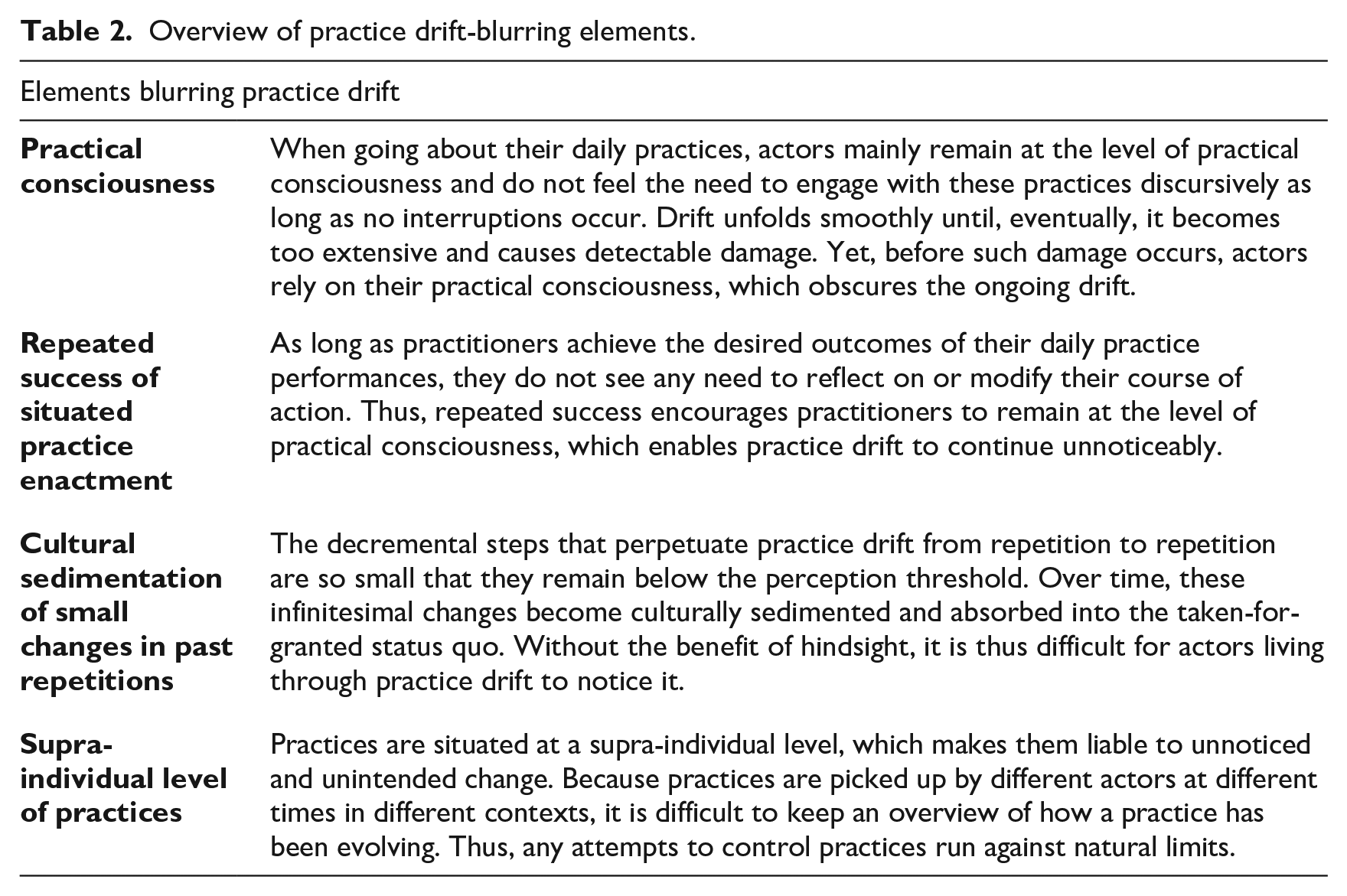
To better understand how practice drift can make headway unnoticed, we need to unpack the drift-blurring elements depicted at the centre of Figure 1. Practice theory underscores that the temporal dimension of a particular practice is constituted by repetitions of that very practice (Schäfer, 2022), thereby slicing it into iterations of practice performance. Each of the slices in Figure 1 represents one repetition of a practice, which occurs in a potentially slightly altered context and, therefore, in a slightly changed manner. Practice drift towards disregarding legitimate stakeholder claims progresses in decremental steps (Dekker, 2011) that do not even feel like changes to the organizational actors involved since they are only repeating a practice that they know well (Schäfer, 2022). Every repetition takes place under conditions that the practitioner is not fully aware of, and thus also has consequences other than those intended by the practitioner (Giddens, 1984). This makes it possible for the next repetition to follow the pull towards organizational success metrics a little further than the previous one, even though the practitioner does not intend this.
There are four elements that blur practice drift: practical consciousness, repeated success of situated practice enactment, cultural sedimentation of small changes in past repetitions and the supra-individual level of practices. First, practitioners carry out everyday practices mostly by relying on practical consciousness (Giddens, 1984), which means that they usually do not engage with what they are doing discursively: in most situations, there is simply neither need nor time for this. For example, if a credit officer in a microfinance social enterprise has already dealt with debtor assessment many times, they will feel no need to mobilize the discursive conscience when facing a potential client’s request.
Second, as already pointed out above, experienced success is crucial for practice drift to develop (Dekker, 2011; Snook, 1996). This also applies to practitioners repeating a practice. If the situated enactment of a practice does not lead to an actor’s desired outcomes, they will deliberately alter their course of action or turn to a practice that is more conducive to achieving these outcomes. This means that a precondition of practice drift is that the practice continues to achieve practitioners’ desired outcomes. If this is the case, there is no need to waste any energy on questioning the practice – for example, as long as debtor assessment runs smoothly and credit officers can complete their tasks.
Third, even if an interruption or a breakdown leads a practitioner to analyse a practice, for instance by discussing it with colleagues, drift proceeds in such decremental, infinitesimal steps that these remain below the perception threshold (Palazzo & Hoffrage, forthcoming). As shown in Figure 1, any specific repetition of a practice very much resembles any previous one. Drift only becomes visible from a bird’s eye view if we look back at a series of iterations spanning a considerable amount of time. Clearly, for an actor who has to act in time lived forwards (Kremser & Sydow, 2022), such a view is difficult to take. In most cases, practitioners simply will have the impression that everything is going on as usual and that the current repetition more or less mirrors the last.
Yet even a bird’s eye view can be insufficient to detect drift: after a while, changes to a practice become culturally sedimented (Vaughan, 1997). Moreover, during the temporal unfolding of a practice, there is no absolute reference point. Practitioners may well have relative reference points (for instance, the day when they were introduced to a new practice), but at no time in the past did all practitioners engage simultaneously in a single repetition of a practice (Schäfer, 2022). Hence, they are unlikely to detect a series of changes that remain below the perception threshold and have sedimented culturally. Though continuous drift, which takes place in spite of actors striving for stability, shows a resemblance to cultural inertia (Zárate, Shaw, Marquez & Biagas, 2012), it is different. In cultural inertia actors actively resist change, whereas during practice drift actors do not have any opportunity to resist, since they do not even notice decremental changes. For example, even though over the years debtor assessment may very slowly have developed towards ever more rejections of poor clients who, in the past, would have been granted a loan, for credit officers it continues to feel like business as usual.
Fourth, the supra-individual nature of practices makes it difficult to notice their drifting. Since practices are situated at a supra-individual level, their inherent repetitions make them liable to unintended and unnoticed change (Schäfer, 2016); for it is difficult to track where and when a practice has been repeated, by whom, and to what (more or less decremental) changes it has led. Thus, no authority has a complete overview of the development of a practice. In organizations, as well as in other contexts, practitioners may ‘reflexively monitor’ (Giddens, 1984) their own enactments, the conditions under which they act, and those of others, all with regard to their desired outcomes. However, since practices are carried out by a variety of people at different times in different places, even in control-oriented organizations such as NASA (Vaughan, 1997) or the military (Snook, 1996), which are equipped with an extensive monitoring capacity, management cannot control practices to such an extent that the risks of drifting will be eliminated entirely. It lies in the very nature of practices that drifting might occur. Table 2 provides an overview of the elements that make it difficult for practitioners to notice drift while it is ongoing.
Overview of practice drift-blurring elements.
Manifestations of practice drift
Having established how the process of practice drift unfolds, what drives it, and why it is so hard to detect, let us now turn to the various manifestations of practice drift. To illustrate these, I now introduce two distinctions concerning the tension between organizational success metrics and the unquantified stakeholder claims that are viewed as legitimate by the focal organization. As depicted in Figure 2, drift may well progress either towards improving economic success metrics such as profit or towards improving social success metrics such as social impact. Likewise, the drift unfolding may blank out the claims of stakeholders addressed by the mission on the one hand, or the claims of those stakeholders that remain unaddressed by the focal organization’s mission on the other hand. A differentiation along these two dimensions will help clarify mission drift and, importantly, take the conversation further to discuss manifestations of practice drift that do not alter a social mission, yet are detrimental for social enterprises – and organizations more generally.
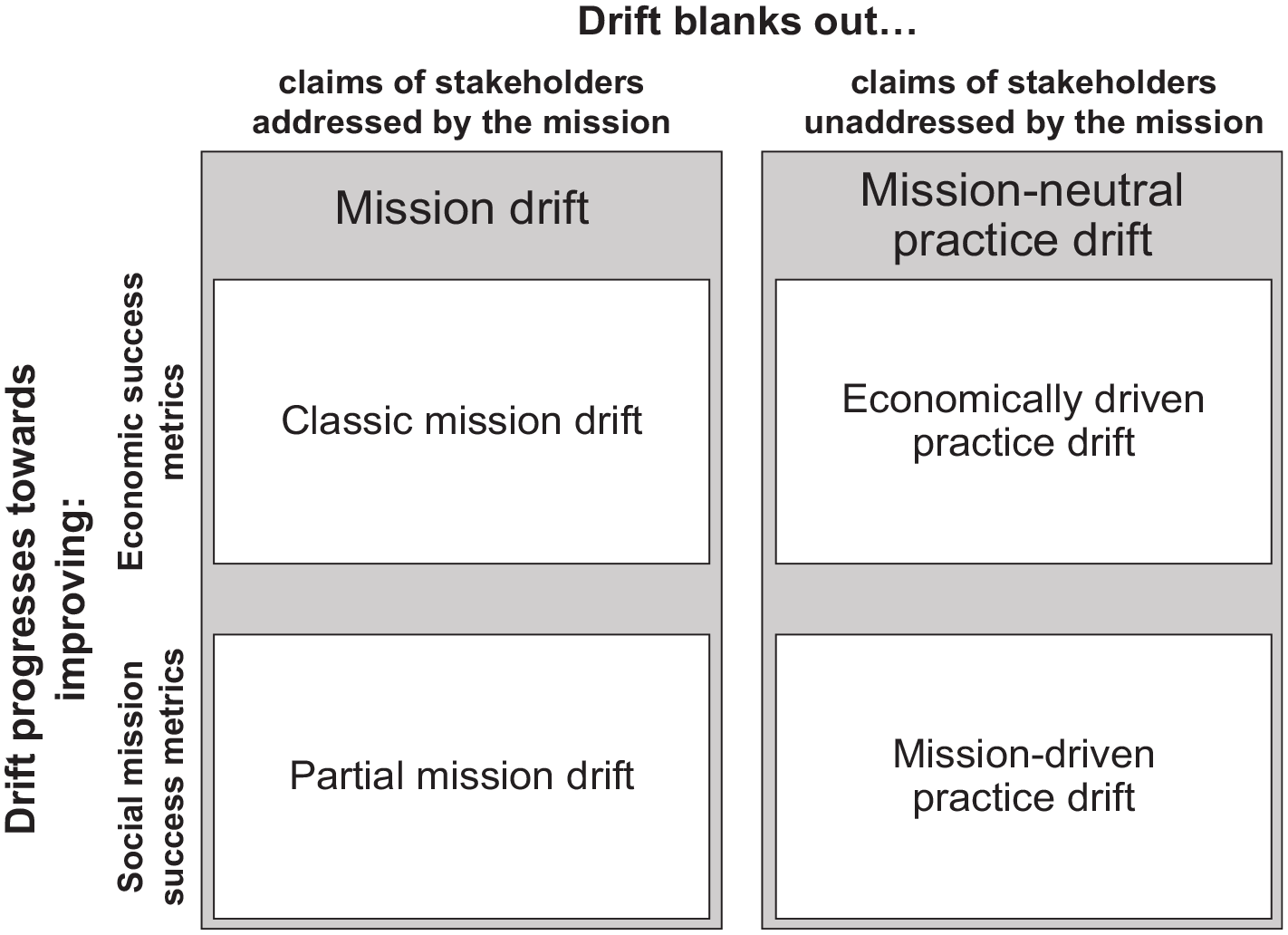
An overview of drift types related to social issues.
The first type, classic mission drift, manifests as a drifting of practices towards improving economic success metrics at the expense of the legitimate claims of stakeholders addressed by the social enterprise’s mission (i.e. mission-related stakeholders, who are individuals or organizations explicitly targeted by the enterprise). It starts when the striving for quantified economic success conflicts with the legitimate claims of these stakeholders not covered by the metrics. This kind of drift is most salient and has often been researched as ‘mission drift’ (Cornforth, 2014), thus the qualifier ‘classic’. The microfinance example used to illustrate the argument above describes a case of classic mission drift. Drift sparked by this tension, which is inherent in all social enterprises, affects practices in such a way that economic success metrics improve, albeit by increasingly ignoring the legitimate claims of stakeholders who are central to the mission (e.g. a social enterprise’s beneficiaries). Hence such drifting poses a serious threat to an organization’s raison d’être. According to this understanding, the mission drifts away from its social focus because the practices reproducing that mission drift. Thus, classic mission drift affects the relative importance of the social mission vis-a-vis economic success (Shepherd et al., 2019) and tilts it towards the latter.
Second, partial mission drift manifests as a drifting of organizational practices towards improving social mission success metrics at the expense of the legitimate claims of mission-related stakeholders who are not covered by these metrics. The tension sparking partial mission drift also involves a feedback imbalance and arises whenever mission success metrics are so narrow that they systematically exclude certain mission-related stakeholders (though not necessarily entire stakeholder groups). This issue has been addressed by the critique of exclusionary business models in social entrepreneurship, which points out that such models do not really tackle the full breadth of a social issue, but only focus on some of the mission-related stakeholders (Martí, 2018). Such drift can be difficult to detect, because it is not an entire stakeholder group that disappears off the radar of a social enterprise; in fact, a superficial impression that this group is well served may dominate. I propose to characterize this as ‘partial mission drift’, since the organization remains within the scope of its mission but, nonetheless, inadvertently overlooks the claims of some of the mission-related stakeholders that it initially intended to help. Partial mission drift may decrease the intensity with which the social mission is being pursued (Shepherd et al., 2019), although it can also occur in situations where intensity is high but the social mission too narrowly operationalized.
For instance, a social enterprise whose mission is to support farmers in the Global South by providing know-how, seeds, plants and equipment might follow a fee-for-service social enterprise model. Such enterprises are exposed to the tension between social impact (measured as the increased earnings of supported farmers) and the legitimate claims of farmers who would also benefit from help but cannot afford to pay the fee. In such a case, there is a feedback imbalance, since social impact is easier to measure and drives organizational success – understood as social mission success. Yet as the enterprise manages to constantly increase its quantified social impact, those farmers who are left out are not only on their own: they might even suffer from increased competitive pressure because farmers supported by the social enterprise perform better. While the enterprise has the impression that its social mission is being fulfilled, it is in fact suffering from partial mission drift by increasingly ignoring the legitimate claims of some of the stakeholders that its social mission was meant to address.
Third, mission-driven practice drift manifests as a drifting of practices towards blanking out the legitimate claims of mission-unrelated stakeholders while constantly improving mission success metrics. It arises from tension between the striving for narrowly defined social mission success metrics and the claims of stakeholders who are not addressed by the social mission, but are nevertheless viewed as legitimate by the focal organization. In the case of a social enterprise, such drifting is particularly unfortunate, since it implies that pursuing a social mission and constantly improving mission success metrics with the intention to do good actually inflicts harm on some stakeholders as an unintended side effect. This type of drift is especially relevant for the social enterprise discourse because it may cause serious damage. Mission-driven practice drift, similar to mission-neutral practice drift, is orthogonal to the axis between social mission and economic performance, because it does not imply any alterations along this axis but, instead, concerns social issues involving stakeholders outside the social mission’s scope. However, the drivers of mission-driven practice drift are analogous to those of mission drift.
For example, a social enterprise whose mission is to bring electric light to off-grid communities by offering solar-powered LED lamps at subsidized prices might experience a tension between quantified social impact (i.e. the number of households equipped with solar lamps) and the (unquantified) claims of its suppliers’ employees for fair payment – the social enterprise finds these legitimate and wishes to take them into account. The feedback imbalance between these two poles of the tension may trigger a drifting of procurement practices towards a higher, quantified social impact (more subsidized units offered thanks to ‘better’ deals with suppliers) at the expense of suppliers’ working conditions – unnoticed by practitioners. In cases of severe mission-driven practice drift, the ethical legitimacy of a social enterprise may even be threatened in spite of its enduring focus on its social mission (Bruder, 2021).
Fourth, economically driven practice drift manifests as a drifting of practices towards increasing economic success at the expense of the legitimate claims of mission-unrelated stakeholders whenever these elements are in tension. This tension has been discussed widely as a ‘social–business tension’ in relation to social enterprises (Smith, Gonin & Besharov, 2013) and also in relation to businesses more generally (van der Byl & Slawinski, 2015). Social enterprises rely on economic success and need it to ensure their survival. Some social enterprises are more economically oriented than others (Battilana & Lee, 2014) – for these, economically driven practice drift is particularly relevant; but most organizations, not only social enterprises, may be affected by this type of drift, because the basic tension between social concerns and economic demands is present throughout capitalist economic systems (Streeck, 2016).
Economically driven practice drift may even lead to corporate scandals (e.g. Rhodes, 2016) or other serious failure: in the light of the social–business tension, the feedback imbalance favouring economic success metrics, together with other elements contributing to practice drift, may create a pull towards less regard for social concerns. In some cases, this may be deliberate, yet the notion of economically driven practice drift may sensitize researchers to the fact that disregard for the stakeholder claims that an organization actually wishes to respect may come about unintentionally (Palmer, 2013). In many such cases of ethical failure, actors did not have any malicious intentions from the outset but, rather, unintentionally lost their way (Palazzo & Hoffrage, forthcoming).
For instance, a social enterprise applying a differentiated hybrid model (Battilana & Lee, 2014) and operating a farm to finance its non-profit homeless shelter might be exposed to the tension between financial success and the legitimate claims of the region’s inhabitants to clean and healthy drinking water, which the social enterprise intended to respect. The feedback imbalance between the poles of this tension can spark a drifting of farming practices towards slightly but constantly increasing the use of fertilizers and pesticides, which yields larger harvests and thus improves financial performance. However, these drifting farming practices lead to growing amounts of nitrate and pesticide contamination in ground water, negatively impacting drinking water quality. Even though the social enterprise remains intact and is thriving economically, economically driven practice drift leads towards a disregard for mission-unrelated stakeholder claims that it initially wished to respect, potentially harming its ethical legitimacy.
Practice drift’s relations to intentional action and emergence
The previous sections clarified the practice drift process as well as its manifestations. The understanding of practice drift as an emergent process that is unintended, unnoticed and unwanted requires us to delimit it conceptually from other types of emergent process as well as from intentional action. Not all emergent modifications to practices may be viewed as drift and the theoretical account presented here only explains processes that fit the narrow definition of ‘drift’ employed in this paper (Ortmann, 2010; Snook, 1996). In sharp contrast to practice drift, practices may be subject to unintended emergent changes that are welcomed by organizations because these changes bring about positive outcomes, e.g. valuable resource (Feldman, 2004). There is thus a grey zone between the dark side of emergence (leading to drift) and emergent change that, although equally unintended and unnoticed, is eventually welcomed by organizational actors. This grey zone is an arena of contestation within social enterprises and organizations more generally, because practices are surrounded by legitimation work (Rouse, 2001) regarding what counts as a legitimate practice adaptation and what needs to be regarded as inappropriate or as a violation. Thus, in some cases, the distinction between practice drift and welcome emergent practice change may be blurred. It might even happen that intra-organizational actors in a social enterprise view an emergent change process as beneficial, whereas outside stakeholders criticize it as drift.
As an emergent phenomenon, drift differs from any deliberate, noticed and desired changes to missions, such as pivots that are outcomes of conscious interventions. Yet these interventions also have implications for practices performed in an organization. Although deliberate mission changes are not covered by my practice-based theorizing of mission drift, they may relate to practice drift in several ways.
First, an intentional intervention within an organization might produce an unintentional side effect leading to practice drift (Giddens, 1984). For example, the introduction of incentive schemes meant to improve performance within a social enterprise may increase the tension between success metrics tied to these schemes and legitimate stakeholder claims not included into these success metrics. Accordingly, this increased tension can set drift in motion, as explained above.
Second, once practice drift has set in, an organization might make intentional attempts to modify its mission in order to match the mission to changed practices. For instance, a microfinance social enterprise might shift its mission accordingly and transform into a commercial bank (Oparada, 2022), where its ‘drifted’ practices will fit in with the new, commercial mission. Thereby, the tension that sparked practice drift is somewhat mitigated by redefining what the organization actually views as legitimate; it may now ignore the claims of the poorest potential customers since its mission is no longer focused on poverty alleviation.
Third, organizations affected by drift might deliberately attempt to shift organizational practices towards achieving the actual mission (Ramus & Vaccaro, 2017). This may imply trying to tweak the reproduction of the affected practices through educational intervention in a social enterprise. It may even imply either introducing additional practices that are designed to keep the affected practices from drifting, or abandoning the affected practices altogether and engaging in new ones that can serve a similar purpose. However, even such deliberate interventions can never prevent practice drift.
It would be beyond the scope of this paper to theorize drift-related differences between the myriad practices that organizations follow. However, one brief indication shall be given here. Since practices are unavoidably connected (Shove, Pantzar, & Watson, 2012), practice drift unfolds as the co-drifting of bundles, or complexes, of practices. Most drift-driving and drift-blurring elements do not simply refer to a single practice but affect entire bundles. Even though these elements are relevant for organizational practices in general, some of them might have particularly strong effects regarding practice bundles that are only loosely coupled with an organization’s other practices (Snook, 1996). Loosely coupled practice bundles are (repeatedly) performed by a smaller group of organization members, with fewer ‘outsiders’ being peripherally involved, so that taken-for-granted cultural sedimentation might happen faster and blur potential drifting. Furthermore, the double movement shifting a practice’s implicit normativity can unfold more quickly if there are fewer actors involved and, therefore, less potential contestation over the practice’s normativity (Schatzki, 2002). However, this does not imply that bundles of practices that are tightly coupled with other practices are safe from potential drifting, as the disintegration of a NASA space shuttle vividly illustrated (Vaughan, 1997). It lies in the very nature of practices that drifting might occur (Schatzki, 2019).
Discussion and Conclusion
This paper aimed to theorize the process during which social enterprises inadvertently drift towards disregarding stakeholder claims that, initially, they actually intended to respect. Building on a range of views of mission drift in social enterprises (e.g. Grimes et al., 2019; Ometto et al., 2019; Wry & Zhao, 2018), this paper applied theories of practice (Giddens, 1984; Rouse, 2007; Schäfer, 2022) to integrate processual accounts of drift developed in safety and reliability studies (Dekker, 2011; Snook, 1996; Vaughan, 1997) into a coherent theoretical framework for drift in social enterprises.
Contributions to social enterprise studies
This paper contributes to social enterprise studies, and the literature on mission drift specifically (Grimes et al., 2019, 2020; Varendh-Mansson et al., 2020), by shifting the analytical focus towards practices in social enterprises and clarifying processual dynamics during mission drift. Thereby, I take the drift in mission drift seriously and substantiate it as a process. This processual account is compatible with all three views of mission drift presented earlier and elaborates their underlying processes; hence it has the potential to unify hitherto dispersed strands of research. In research where mission drift is viewed as losing sight of the social mission (Beisland et al., 2019; Green & Dalton, 2016; Wolf & Mair, 2019; Wry & Zhao, 2018), the application of my model is straightforward: social mission beneficiaries are among the stakeholders whose claims a social enterprise initially plans to respect, and the model theorizes how these increasingly, yet unintentionally, can be disregarded. Beyond that, for research viewing mission drift as a loss of balance between two missions and, thus, seeking to explain the drifting from commercial to social goals (Battilana & Lee, 2014; Stevens et al., 2015), the model can be applied by starting from a constitutive tension containing a feedback imbalance favouring the social pole of the tension, which can explain how such drifting occurs.
Regarding socio-cognitive mission drift (Grimes et al., 2019, 2020; Klein et al., 2021), the model can provide an additional explanation about how actions perceived as inconsistent by audiences can come about. Although this perspective does take into account actions that deviate from prior patterns of action (Grimes et al., 2019), my model adds another pathway to such perceived inconsistencies, namely, cases where current actions do not break with a prior pattern but where the pattern itself, as a whole, turns out to be deviant. Here, rather than one strongly deviating action, it is the overall damage caused by the drift (Ortmann, 2010) that audiences notice and interpret as discrepant with the organization’s image. Thus, this study identifies practice drift as an additional element leading to socio-cognitive mission drift (Grimes et al., 2019, 2020). Furthermore, the perspective developed here adds nuance to the general understanding of mission drift by distinguishing between classic mission drift (Cornforth, 2014) and partial mission drift, while pointing out that they are both driven by the same kind of process: practice drift.
Furthermore, by adding a second dimension, namely, practices in more general, mission-unrelated terms, I cast light on an unacknowledged aspect of the hitherto mission-focused discourse on drift in social enterprises (e.g. Ebrahim et al., 2014; Ometto et al., 2019; Wolf & Mair, 2019). Thus, the notion of practice drift might sensitize social enterprise researchers to other types of drift that had not been on their radar: involuntary drift towards disregard for claims of stakeholders not explicitly addressed by the social mission that the social enterprise nonetheless initially intended to respect. I demonstrate that social enterprises trying to do good by pursuing their social mission may actually create harm through practices that have drifted (Bruder, 2021) while their social mission remains intact. The introduction of the two types of mission-neutral practice drift – economically driven practice drift and, above all, mission-driven practice drift – could inform critical research on social enterprises investigating the potentially dark side of social entrepreneurship by pinpointing one of the processes that bring it about (Dey, Schneider & Maier, 2016; Dey & Steyaert, 2018; Eikenberry & Kluver, 2004).
Contributions to organization and management theory
This paper contributes to practice-based approaches in organization and management theory by substantiating the process underlying practice drift, which has only recently become an established concept (Schatzki, 2019; Stjerne et al., 2024). By theorizing the emergence of practice drift in processual terms and identifying four types that pose a threat to various organizational forms, this paper delineated the various trajectories that practice drift can follow, going beyond the well-established problem domains of reliability and safety (Dekker, 2011; Snook, 1996; Vaughan, 1997). The process model, together with the drift-driving and drift-blurring elements, provides a scaffolding that can help theorize the drifting of practices more broadly, because contributing elements can feature in any situation of tension where practices unfold. Accordingly, my model encourages researchers conducting process organization studies (Cloutier & Langley, 2020) to pay closer attention to possible practice drift in their empirical work, which may help them better understand phenomena located between continuity and change (e.g. Feldman, Worline, Baker & Lowerson Bredow, 2022; Hernes & Feuls, 2024).
There are several strands within organization and management studies that might benefit from integrating practice drift. For instance, the processual account of practice drift presented here could underpin the conceptualization of institutional drift (Voronov, Glynn, & Weber, 2022), since it discusses unintentional social change and pays explicit attention to practice deviations, which can be further explained through elements of my model. Furthermore, practice drift might present itself as a particularly valuable complement to routine dynamics research (Feldman & Pentland, 2003). Even though research on routines does not always distinguish between intentional and unintentional processes in relation to drift (Friesl & Larty, 2013), the notion of practice drift improves our understanding of how some routine performances may not just evolve as intended but drift unintentionally over time whenever they are performed in a setting characterized by a tension involving a feedback imbalance. Moreover, practice drift could enhance research into how information infrastructure in organizations may drift from its planned purpose over time (Ciborra, 2001; Pentland, Liu, Kremser & Haerem, 2020) by emphasizing drift-driving elements affecting the mundane practices of users. Through the incorporation of insights from drift (Dekker, 2011; Ortmann, 2010) into practice-based theorizing (Giddens, 1984; Schäfer, 2022), it becomes possible to grasp continuous unidirectional change across several organizational contexts that underlies an apparent stability.
Practical implications, limitations and future research
Practice drift has clear practical implications for managers. Since the drifting of practices is, generally speaking, unavoidable, managers can take measures to ensure that most of the drifting in their organizations is confined to issues that turn out to be insignificant (Schatzki, 2019). The race against problematic or harmful practice drift is potentially never-ending, yet competing in this race is still worthwhile. A possible guard rail against drift is organizational reflexivity which, ideally, should be deeply institutionalized within an organization (Ortmann, Sydow, & Windeler, 2023). As already suggested in mission drift research, it is key to integrate the inter-organizational dimension, for example through the institutionalization of exchanges with external stakeholders (Ramus & Vaccaro, 2017). Importantly, organizational reflexivity cannot be reduced to creating metrics. Although creating social impact metrics for claims stemming from mission-related stakeholders might decrease the likelihood of mission drift, the risk of mission-neutral practice drift will not disappear. Thus, reflexivity measures beyond quantification are desperately needed in social enterprises.
The theoretical choices made in this paper imply certain limitations. For instance, the conceptual account of practice drift developed here specifically focused on stakeholder claims, which is particularly relevant for the analysis of social issues in relation to social enterprises. Furthermore, practice drift was theorized regarding existing stakeholder claims while bracketing out their dynamics and the organization’s perspectives on these claims – both of which might change over time. Another limitation lies in this paper’s emphasis on explaining practice drift while leaving open the question of how to counteract it once it has started, although this is an issue of great importance for managerial practice.
This paper opens up the space for future research in several areas. Research on social enterprises, in particular that of a critical kind (Dey & Steyaert, 2018), could investigate empirically how forms of practice drift might develop that do not alter a social mission yet are ethically problematic (Bruder, 2021). It could also investigate to what extent different types of practice drift might take place simultaneously within a social enterprise, for instance, partial mission drift and mission-driven practice drift, especially if circumstances require performing well both on economic success metrics and social impact metrics. Furthermore, social enterprise research could investigate to what extent the manifold measures discussed to prevent or counteract mission drift (e.g. Ebrahim et al., 2014; Ometto et al., 2019; Wolf & Mair, 2019) might also apply to mission-neutral practice drift.
Beyond the domain of social enterprises, further research could develop a more general framework for drifting practices. It would also be intriguing to research how processes of conscious value inquiry (Espedal & Carlsen, 2024) relate to practice drift, that is to say, whether value inquiry might be a countermeasure to practice drift or, conversely, how practice drift might alter value inquiry. Another pathway for future research could explore temporal aspects, such as the acceleration or deceleration of practice drift and what contributes to such changes in pace. Overall, I hope that this processual conceptualization of practice drift will inspire researchers to question apparent stability and pay closer attention to seemingly inconspicuous processes of infinitesimal change.
Footnotes
Acknowledgements
I thank Davide Nicolini for his masterful editorial guidance as well as three anonymous reviewers for their very constructive engagement with this paper. This paper profited from generous comments made by Jörg Sydow, Ulrich Thielemann, Günther Ortmann, Hilmar Schäfer, who many of us miss dearly, Elizabeth Shove, Olivier Berthod, Johanna Mair, Sébastien Mena, Natalia Martini, the participants of the sub-theme “Strategizing for Grand Challenges” at the 35th EGOS Colloquium in 2019, the participants of the SAP Community Day at the 36th EGOS Colloquium in 2020, the participants of the 1st Organization Theory Winter Workshop in 2020, the participants of the University of Edinburgh Business School Paper Development Workshop in 2021, as well as the participants of the ‘Jour Fixe’ paper discussion group at the Chair for Inter-firm Cooperation at Freie Universität Berlin. I am grateful for the support received from Joachim Herz Stiftung.
Funding
The author received no financial support for the research, authorship, and/or publication of this article.
