




Abstract
The present study examines the practices that multinational companies located in a small, open and peripheral European economy (Portugal) are acting to build talent pools for expatriate assignments. The role of employee willingness (to go) is explored as a dimension influencing the existing firm staffing practices’ success. By using a Portuguese sample, the study examines whether prior findings in mature economies and consolidated multinational companies can be generalised to peripheral and less-developed international business settings. Five business contexts and 24 expatriate cases were considered to ground empirical analysis. The prevalence of internal recruitment practices, informal and closed systems and staffing criteria, and less established international mobility and staffing experience, suggest the existence of critical differences with the current best-of-breed practices. Study findings indicate that divergent willingness profiles operate as moderating factors of firm propensity to use international work to support expansion goals. A typology of business expatriate willingness profiles (conformist expatriates, trajectory-focused expatriates and disrupted expatriates) is proposed to showcase expatriation assignments as a contemporary socioeconomic heterogenetic condition.
Keywords
Introduction
Managerial discourse tends to portray work-related mobility as a benign and positive occurrence (Doherty & Dickmann, 2009) that provides workers with opportunities for stimulation and differentiation. Leaving and living abroad are portrayed favourably, as types of opportunities, resources and desirable choices that allow workers to grow personally and professionally. In business settings, the need to fulfil business internationalisation goals anchored in global work practices (Caligiuri & Bonache, 2016; Kraimer et al., 2016) may contribute to discursively spread a mobility dream conception, in sharp contrast with empirical evidence where detrimental impact of work-related mobility both at organisational and individual levels is illustrated (Kraimer et al., 2016).
Despite the benefits that can be associated with international work assignments (Doherty et al., 2011; Makela et al., 2016), as previous studies employing data from the United States, Australia and Japan show, recruiting candidates remains challenging for multinational companies, because few employees willingly accept an opportunity entailing international mobility (Froese & Peltokorpi, 2011; Mol et al., 2009; Peltokorpi & Froese, 2009; Tharenou, 2008). Taking this in consideration and Portugal as a case example, the present study explores the topic of supply availability, employee willingness and staffing practices for international work assignments currently being enacted by multinational companies located in less mature and more peripherical economies.
In Portugal, peripheral positioning in relation to global value chains (Beugelsdijk & Mudambi 2013; Reis, 2020), and limited and heterogeneously distributed company capabilities and resources (Amador & Cabral, 2014; Cabral et al., 2020; Forte & Moreira, 2018; Silva et al., 2018), constitute preconditions of company liability, an outsidership marker (Johanson & Vahlne, 2009), for extending business operations in general. Evidence exists that signals Portugal as having one of the highest firm-level heterogeneity ratios in Europe (Cabral et al., 2020; del Rosal, 2013, 2018), with decisions to open up to international markets being concentrated in older and larger companies, specific business sectors, destination countries and host markets (Amador, 2017; Amador & Cabral, 2014; Banco de Portugal, 2015, 2016; Cabral et al., 2020; Fernandes, 2017; Silva et al., 2018). Given these attributes and being one of the hardest hit economies during the 2009 economic and financial crisis (Esteves et al., 2018), Portugal can currently be considered a relevant and natural context for assessing companies’ practices regarding foreign expansion during the last decade, and the ability and propensity to use international work (and workers) to anchor expansion intents.
As organisations aim to expand and strengthen their presence overseas, their need for international work and assignees typically grows (Brookfield, 2016). Recent studies show that more than 90% of multinational companies are currently using long-term assigned business expatriates (Finnacord, 2019; KPMG, 2020). In an increasingly diverse global mobility and international work scenario (Bonache et al., 2021; Jooss et al., 2020; McNulty & Brewster, 2019), scarce empirical evidence exists concerning the way and extent to which international work assignments are being used and deployed by Portuguese companies (Câmara, 2011; Marques et al., 2021; Martins & Diaconescu, 2014; Pinheiro et al., 2015), namely, through the use of business assigned expatriates, that can be defined as legally working individuals who reside temporarily in a country of which they are not a citizen in order to accomplish a career-related goal, being relocated abroad either by an organization or by self-initiation, or directly employed within the host country (McNulty & Selmer, 2017, p. 30).
Taking this into consideration, the study takes two questions as key focus: What systems and practices multinational companies located in peripherical economies such as Portugal, are put in place to build talent pools for expatriate assignments? To this regard, are individuals in these peripherical contexts willing to go? Having contextual embeddedness effects in mind, and if answers to these questions can’t derive, from reviewing for other peripherical economies, what the literature has said on the matter (Cheng & Lin, 2009; Horwitz & Budhwar, 2015; Zhu et al., 2017), this differentiated approach is currently pending. By using a Portuguese assigned business expatriates sample, the study examines whether prior findings in mature economies (e.g., the United States, the United Kingdom, Australia, Japan, Finland and Germany) and consolidated multinational companies (Froese & Peltokorpi, 2011; Mol et al., 2009; Peltokorpi & Froese, 2009; Tharenou, 2008; Tungli & Peiperl, 2009), related with supply availability, staffing practices and the moderating impact of employee’s willingness for staffing decisions, can be generalised to more peripheral, less developed economic and business contexts.
Theoretical Framework
The importance of supply availability, recruitment practices and employee willingness for enabling international companies to compete effectively has long been recognised (McNulty & De Cieri, 2011; McNulty & Inkson, 2013). By involving people in an international work assignment who aren’t able to do or don’t want to do the work, everything involved in their management becomes more difficult (Bonache et al., 2021). In the case of business assigned expatriation and in less developed contexts, one may say this issue is exacerbated, as the needed change and adjustment, essential for assignment and firm internationalisation success, complicates the picture even further (Anderson, 2005; Haslberger et al., 2013, 2014; Harris & Brewster, 1999; Kandogan, 2018; Makela et al., 2010; Shen & Lang, 2009; Tungli & Peiperl, 2009).
For business assigned expatriates, most companies tend to depend or rely almost exclusively on internal candidates for their expatriate positions (Shen & Lang, 2009). Recent reports (Brookfield, 2016; KPMG, 2020) mention that at least 80% of international business assignees are internal candidates. Diversification of talent sources is mentioned as an emergent trend, primarily aimed to leverage supply availability issues (Bonache et al., 2018). Justification for this is largely driven by strategic value being ascribed to international assignment, and importance given to expatriates understanding the company’s culture, processes and systems. This means that internal, already-employed candidates have relevant advantages over external applicants. But not all member of the existing staff may want to live and work in a different country. A significant body of research has examined antecedents of expatriation motivation and willingness for mature economies and consolidated multinational companies (de Eccher & Duarte, 2016; Dickmann & Baruch, 2011; Doherty & Dickmann, 2009; Froese & Peltokorpi, 2011; Haslberger & Brewster, 2009; McNulty & Brewster, 2019; Mol et al., 2009; Pate & Scullion, 2010; Peltokorpi & Froese, 2009; Suutari & Makela, 2007; Tharenou, 2008; Waxin et al., 2019). Employee’s motives and willingness to accept an international assignment are key elements to be considered when examining expatriate recruitment practices. Expatriation willingness, defined as the likelihood of an individual accepting an expatriation job offer (Mol et al., 2009), constitute a relevant predictor of expatriate success (Froese & Peltokorpi, 2011; Peltokorpi & Froese, 2009; Tharenou, 2008) and time to proficiency (Waxin et al., 2019). Unwilling candidates are less likely to accept expatriate assignments and remain in the host country till the end of their assignment (Tharenou, 2008). Generally, the main motivations to accept an expatriation include the opportunity to access a wider and more exciting kind of work, the attractiveness of host locations (de Eccher & Duarte, 2016), personal and professional advancement driven by an assignment and financial advantages (Doherty et al., 2011). If the job or assignment on offer is only remotely linked to these key drivers, then more persuasion tends to be required to convince candidates or chosen individuals to move (McNulty & Brewster, 2019).
As previous studies employing data from the United States, Australia and Japan show, recruiting candidates for expatriation assignments remains challenging for mature multinational companies, because few employees willingly accept an opportunity entailing international mobility (Froese & Peltokorpi, 2011; Mol et al., 2009; Peltokorpi & Froese, 2009; Tharenou, 2008; Tungli & Peiperl, 2009). To leverage this, staffing criteria, systems and practices play a decisive role, namely, in smaller and newer internationalised businesses (Harris & Brewster, 1999), where options and existing capabilities may look different, if compared with more mature settings.
Tungli and Peiperl (2009) examined staffing practices in four countries and found that references and self-nominations were globally among the most used sourcing methods. Harris and Brewster (1999) described international recruitment practices in four categories, organised in two axes: (a) open/closed processes and (b) formal/informal processes. As described by these authors, practices can be open or closed. In open systems, vacancies are public and advertised, interviews are made and selection occurs by consensus amongst decision-makers. In closed systems, top-down nominations of suitable candidates occur, supported by HR and line manager interactions. Processes can also be either formal or informal. In formal approaches, vacancies are advertised, selection criteria specified and decision-makers need to agree about the best candidates. In informal approaches, criteria are often not defined and past performance, loyalty, networking, reputation and individual preferences of senior management decision-makers can dominate. In many cases, as mentioned by Bonache et al. (2021, p. 41), ‘personal contacts seem to be the only thing that matters’. Three detrimental effects of this option can be conceived: limitations in the degree to which relational abilities are considered; restrictions in the talent pool that is considered; and full developmental potential of international assignments isn’t strategically explored. Considering this as being possibly hampered by limited and heterogeneously distributed company capabilities and resources (Amador & Cabral, 2014; Cabral et al., 2020; Forte & Moreira, 2018; Silva et al., 2018), supply availability, recruitment practices and employee motives (to go) are key topics deserving close attention in peripheral economic contexts such as Portugal.
Methods
The study sought to expand upon existing knowledge concerning recruitment practices and individual willingness to engage with a specific type of international work regime (assigned business expatriations; McNulty & Selmer, 2017) in developing peripheral economies, taking Portugal as use case example. To explore existing practices within a real-life context, a qualitative approach, with descriptive purposes (Ragin & Amoroso, 2011; Yin, 2003), was adopted. Global staffing practices for business expatriation assignments enacted by multinational companies located in a peripheral economy (Portugal) was considered as unit of analysis, with two themes being analytically explored: (a) recruitments systems and criteria, and (b) employee willingness (to go).
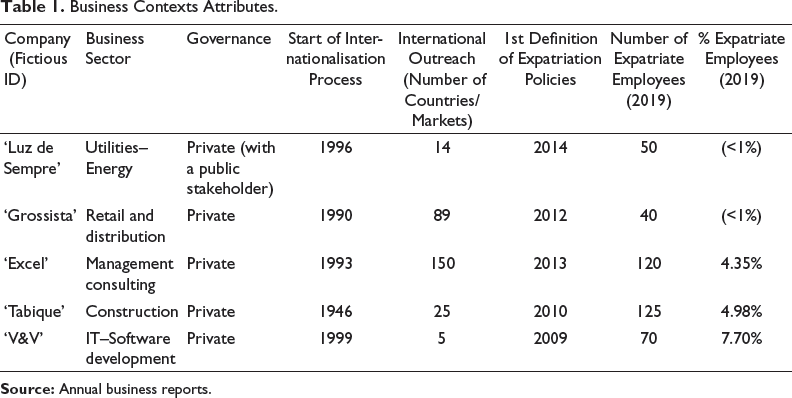
The empirical basis for the research is provided by cases of Portuguese multinational companies actively engaged in international expansion efforts since the 2009 economic and financial crisis (Esteves et al., 2018). A purposive sample of five cases was chosen, with cases and business contexts selected due to their relevance to the study, in terms of diversity and typicality. Cases were selected that fulfilled the following conditions: (a) the company should be registered in Portugal and owned by Portuguese-based interests; (b) the company should have operations in host countries and not just direct or indirect exports to that countries; and (c) the firms should belong to different business sectors, and be of different sizes, thus providing a glimpse of the Portuguese, particularly heterogenous multinational firm reality (Amador & Cabral, 2014; Cabral et al., 2020; Forte & Moreira, 2018; Silva et al., 2018).
Business Contexts Attributes.
Data collection was conducted between 2018 and 2020. The study employed two types of empirical data collection techniques. The first technique involved the use of statistical and documental sources, which were publicly available or provided by the companies under study, while the second technique encompassed semi-structured interviews with company managers and business expatriates. Regarding the use of statistical sources and documents, the main goal was to allow overall contextual descriptions of the business settings under study. About 200 different documents were collected for analytical work. Interviews had dual objectives depending upon the interviewee. The objective of interviews with the company managers was to depict business and international expansion operating conditions, international work regimes and business expatriation staffing practices. In the case of interviews with expatriate workers, the objective was to explore the core attributes of expatriation staffing as a lived experience and to identify key motivations (to go) (Mol et al., 2009).
The interviewed assigned business expatriates were chosen based upon a set of predefined criteria, seeking out diversity and typicality of experiences. Based on the existing literature evidence, five assignee selection criteria were proposed and shared with specific points of contact at each company, typically a human resources manager tasked to act as gatekeeper (Shenton & Hayter, 2004). The first criterion focused on the employment track of expatriate individuals (number of different employers and domestic service track in present employer) (Sullivan & Baruch, 2009; Suutari & Makela, 2007; Suutari et al., 2012). Previous international work experience (number of years working in international environments) formed a second selection criterion (Caligiuri et al., 2009; Kim et al., 2019; Suutari et al., 2017; Waxin et al., 2019). The length of the current or most recent international mobility experience constituted the third criterion (Sullivan & Baruch, 2009). The fourth factor considered by this study was the employee’s present career stage (Suutari et al., 2012)—four points were mapped, inspired by Super’s theory (1957): early/self-exploration career stage, expansion, plateau/stagnation and end of career stage. Finally, each expatriate individual family situation (e.g., the existence of young children, elderly dependents and accompanying partners or family) was considered (check Table 2, for details). A total of 37 individual interviews were conducted, both in-person and remotely, of which 13 were with company managers and 24 with expatriate workers. A detailed description of these is provided in Table 2.
Expatriate Individuals.
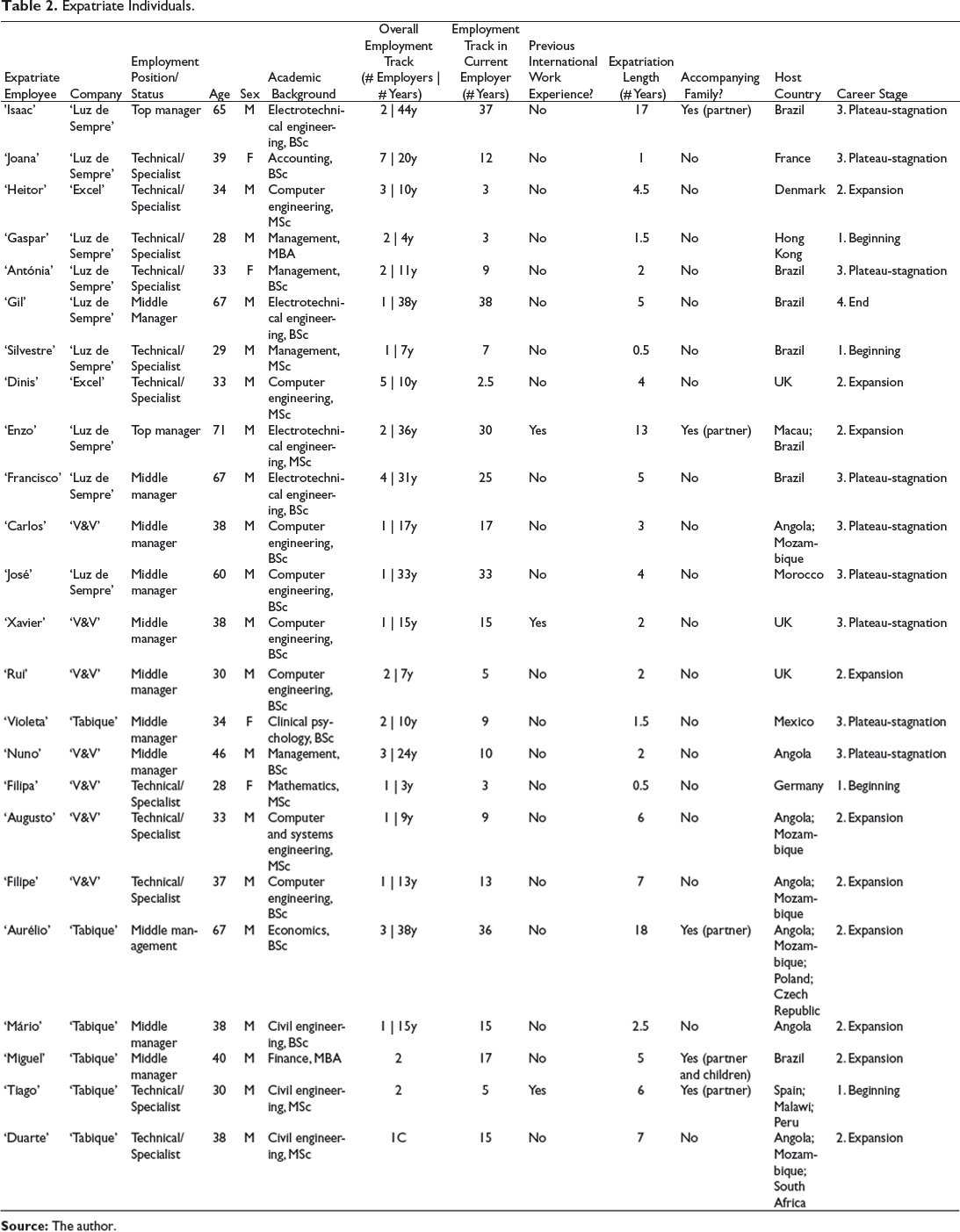
Interviews with company managers were conducted in-person and lasted an average of 80 minutes. Of the 24 interviews with expatriate workers, 13 took place remotely, via Skype or a similar platform, with four of the interviews utilising solely audio due to communications infrastructure issues. Interviews with expatriate workers lasted an average of 120 minutes. For the sake of feasibility, this study utilised data saturation criteria (Strauss & Corbin, 1998) to limit the number of individual cases considered at each company.
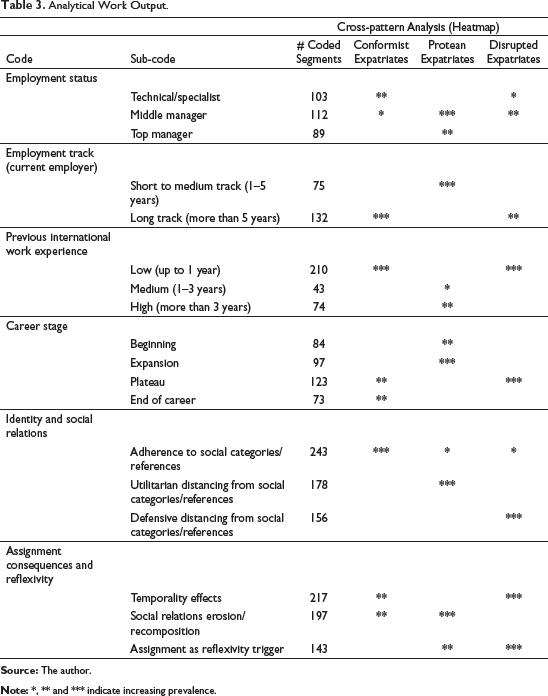
Analytical work was theoretically driven. Expatriate recruitment systems and practices were analysed considering two dimensions: (a) degree of formality and (b) openness/inclusiveness of existing systems (Anderson, 2005; Harris & Brewster, 1999; Kandogan, 2018; Makela et al., 2010; Shen & Lang, 2009; Tungli & Peiperl, 2009). Expatriate willingness screening was driven by the existing expatriate opt-in motivation literature (de Eccher & Duarte, 2016; Dickmann & Baruch, 2011; Doherty & Dickmann, 2009; Froese & Peltokorpi, 2011; Halberger & Brewster, 2009; ; McNulty & Brewster, 2019Mol et al., 2009; Pate & Scullion, 2010; Peltokorpi & Froese, 2009; Suutari & Makela, 2007; Tharenou, 2008; Waxin et al., 2019), and it focused on checking the existence of tensions between structural conditions and personal positionings (Bourdieu, 1972/1990; Costas, 2013; Deleuze & Guattari, 2004; Ehrenberg, 1998; Elliot, 2015; Lindgren & Wåhlin, 2001; Sainsaulieu, 1985), possibly moulding employee motives and opt-in/out decisions. The collected empirical data was analyzed and thematically categorised using MaxQDA v.12. The 2,961 data segments were coded and then condensed in 61 thematic categories.
Analytical Work Output.
Results
Three key empirical findings were observed, concerning how staffing to a business expatriation setting is taking place in the multinational companies considered by the study: (a) prevalence of internal recruitment practices, with an informal/closed nature; (b) three different profiles of employee willingness (to go); and (c) 30% assignees presenting a dysfunctional willingness profile.
Prevalence of Internal Recruitment and Informal, Closed Systems
All considered 24 expatriate individuals were internally recruited, regardless of the role, scope and status (low/medium/high) of the job being considered. Among 63% of the interviewed business expatriates (15 of the 24 interviewees), internal recruitment resulted from deliberate, direct invitations made by the employer company. As a result, in the cases examined, direct invitations to partake in expatriation assignments were dominant in multiple companies (e.g., ‘Luz de Sempre’, ‘Tabique’ and ‘V&V’), as well as references to the existence of ‘distinct compensation packages available for selected groups in the company that engage in expatriation regimes’ (HR Manager, Grupo ‘Tabique’), particularly noticeable in what concerns accompanying family support, where packages tend to be reserved to top managers by ad-hoc agreements.
These practices signal the existence of subsidised conditions for professional development, a closed system (Harris & Brewster, 1999) made available only for specific segments of existing staff, and the specific and differential valuation given to the role (to be) performed by business expatriates. Informality and closed staffing criteria were found to be particularly acute in decisions involving ‘highly sensitive, CEO-like positions’ (HR director, ‘Tabique’ and ‘Luz de Sempre’), or an exceptionally specialised skill needed to carry out specific projects. About 60% of the interviewees mentioned that their recruitment wasn’t driven by formal criteria and systems, being granted via direct invitations, based upon proximity and personal trust—‘relations that already existed in Portugal, someone who knew someone…’ (Miguel, ‘Tabique’)—and the existence of choices that arose from clients’ valuation of employee domestic performance and internal employment trajectories. The portfolio of host countries being considered (e.g., Morocco, Angola, Mozambique, hills of Peru, Malawi and rural regions of Brazil), seen as less attractive (de Eccher & Duarte, 2016) and infused, in specific cases, with post-colonial reverberations (‘we’re going there to teach them how to work’) (Filipe, ‘V&V’), contribute to lengthy bargaining processes. In this context, personal references cultivated ‘in off-work schedules’ (Miguel, ‘Tabique’), during ‘one-off critical conversations with a director’ (Carlos), or through direct appeals and ‘requests for help’ (Isaac, ‘Luz de Sempre’) made by the ‘company’s CEO’ (Nuno) were used, in specific cases, as a last refuge of ‘trust’ (Gil, ‘Luz de Sempre’) and had a pivotal coordination role at this level:
There are always invitations and there are always candidates. I do not know the numbers, but there are always these two ways to access international work opportunities. (Silvestre, ‘Luz de Sempre’) These international positions, as you know, are appointed and depend a bit on the administrators will. (Francisco, ‘Luz de Sempre’) December (2016) marked one year since the company CEO personally called on me and told me that he needed my help. I had already refused this project in Angola two times for personal and familial reasons. (Nuno; ‘V&V’) This was the challenge that I first accepted: to go for a month and come back, go for a month and come back, go for a month and come back. After that, the company bought one of the four companies that my team had evaluated, and I was invited to stay in Brazil at that company due to the experience I had gained during the evaluation process. (Isaac, ‘Luz de Sempre’) One day, I received a call asking me to come to Coimbra where they asked me if I wanted to go to Brazil. [An invitation?] Yes, an invitation was formally made by one of the previous company administrators who knew me. (Francisco, ‘Luz de Sempre’)
As mentioned by Duarte (‘Tabique’), ‘formal rules can be different, but most of these cases [business expatriations] involve an invitation’. The existence of ‘invitations’ contributes to expatriation assignment descriptions as global work contexts subject to top-down managerial control, made by multinational companies and by their clients. As frequently mentioned in interviews, in international expansion contexts, it can be understood as a key priority to maintain a sense of ‘control’ in a context perceived as being tarnished by risk and uncertainty: clients are ‘demanding’, projects are ‘complex, pioneering efforts’, host contexts are ‘distinct’ and conditions are ‘unprecedented’; it is necessary to demonstrate competence and leadership with local partners (HR director, ‘Luz de Sempre’). As a result, it is important to choose and send only ‘the best’ (among those available) (HR director, ‘Grossista’). ‘The best’ are typically those who evoke trust in the ones making decisions, and who can inspire trust themselves. To fulfil this goal, in most of the business contexts that were considered (namely, the ones using international projects or consortiums to anchor expansion intents), the end customer’s feedback matter, influencing staffing outcomes, making the roster of potential candidates become even more finite and signalling the existence of staffing practices characterised by a strong sense of contextual dependence.
Direct invitations rejection was observed in every business setting considered in the study, and cases of acceptance following previous multiple rejections were registered (Mário and Nuno), mirroring divergent levels of expatriate willingness and the need for managers to develop deep persuasion efforts to convince candidates or chosen individuals to go abroad. To this regard, ‘opportunities’ (HR director, ‘Tabique’) conducive to the acquisition of differential benefits and possible future advantages (e.g., personal development, career advancement and gaining global work experience) are stressed. At ‘Luz de Sempre’, company managers suggest that it is important (‘decisive’) for the company and its workers to ‘gain international work experience’ (HR director). This is a discourse that conveys a valuation of international mobility close to an institutional requirement. Additionally, management frames business expatriation as a desirable and distinct personal experience that is distinguishable from others, although not without difficulties. Conversely, expatriate individuals acknowledge (their) expatriation as an assignment that implies ‘concessions, but also benefits’ (Joana and Silvestre).
Given the need to mobilise a high volume of expatriate workers and the present incommensurate nature of international work to ensure business sustainability, at ‘Tabique’, a construction company, deliberate actions were observed to value international experience as an opportunity not only for ‘growth’ but also to preserve one’s job (Duarte, Aurélio and Mário), transforming going abroad into a condition needed to preserve one’s future career within the employer organisation. At ‘V&V’, there is a deliberate effort to present expatriate assignments in a neutral light, but the existence of away-from-home financial compensations calculated based upon hardship coefficients help signal a possible ambivalent nature. Overall, limitations were observed in what concerns staffing decisional options, which often manifested themselves in the need to carve ad-hoc exceptions to formal established rules and policies (regarding, for example, expatriate financial compensation), and to go to great lengths to manoeuvre rejected direct invitations:
Management called on me, invited me, and wooed me very well. I already knew there was a reputation … a tradition at this company: ‘If you want to grow, you have to go abroad’. If you want to gain visibility within the company in order to grow (in terms of pay, hierarchy, decision-making power, responsibility, respect) you must show that you can go abroad to a different market. (Duarte, ‘Tabique’) [Do you seek out workers to invite?] Yes, those who are invited are sought out. [Can those who are chosen say no?] Yes, they can say no … and some … many … do that. (HR director, ‘V&V’) [You’ve mentioned that a person can reject an expatriation invitation. What happens in this situation?] Nothing. We must leverage that. We are at a point where we simultaneously lack resources for certain positions and projects and possess misplaced excessive resources for others. (Production manager, ‘V&V’) [Can workers reject an invitation?] They can … and many times they do say no. We must accept their decision. In fact, the worst-case scenario would be to send someone to a client against their will. At most, what we try to do is to convince workers who are unsure of their decision. [Using what type of arguments?] We explain their importance to the company and the confidence that we have in them. We choose the most appropriate person to carry this conversation: the direct manager, HR … even, if needed, the CEO of the company. After, we appeal to their sense of mission, as the majority of those who work at the company value its brand and image, and this produces an effect that weighs upon their decision-making, but which is not always sufficient to convince workers to leave their families. (Production director, ‘V&V’)
Three Employee Willingness Profiles
Expatriate Willingness Profiles.
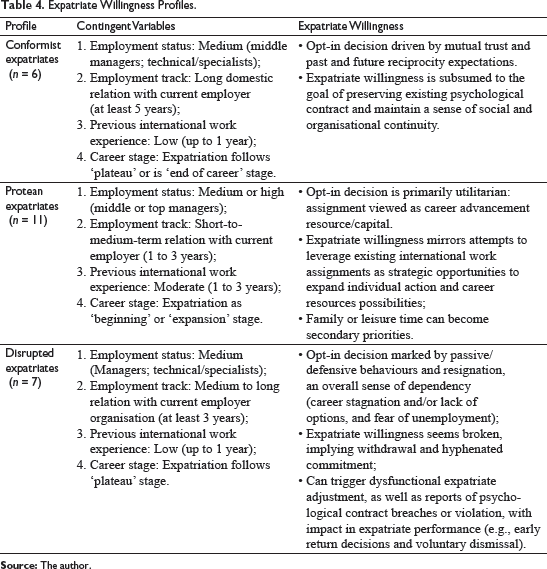
Conformist expatriates were noticeably characterised by opt-in decisions driven by passive accommodation to proposed assignments, a sense of conscious obligation (Bourdieu, 1972/1990) towards existing exchange commitments and expectations with the current employer, and a need to confirm and sustain organisational belongingness continuity (Haslberger & Brewster, 2009; Pate & Scullion, 2010; Rousseau, 2004; Sainsaulieu, 1985). For this group, the way to reason expatriation assignments is characterised by a need to conform to managerial and business decisions. A fusional sense of complicity emanates from past long-term domestic service with the current employer. In specific cases, a sense of (moral) debt towards the employer organisation was also registered. This willingness profile was primarily observed in individuals (6 of 24 interviewees) with long domestic service trajectories within companies where they work(ed) as expatriates:
Initially I came to be here till 2012, then it changed to 2014, to 2016, which, later, shifted again to 2017. And getting here … I am making a prediction—I will end my career where it started in 1981. In Angola. This is what I expect to happen. Now, I have an outlook for the future. I will be here working until I cannot. That day will come, someday in the future … I will be doing my best for the company. (Aurélio) I do not know if I was the first, third, or fifth choice, it does not make a difference to me. Happily, or unhappily, I am the one who is here now. (Nuno) In my case, something that helped was that I had already spent many years at the company. Let’s say that I knew the core of the company, including the administration board and long-term senior employees. There are always people joining and going, but I have kept in touch with these key people, which has allowed me to manage things in an agile manner, maintaining me in-sync with the company’s mindset. (Filipe)
In contrast, protean expatriates seek to actively carve their expatriate assignment as an opportunity to emancipate from external contingencies, expanding individual action possibilities (Breitenmoser et al., 2018). For this group, motives and opt-in decisions are primarily utilitarian (Costas, 2013; Ehrenberg, 1998; Tung, 1998): an expatriation assignment is viewed as a career advancement resource. Being or becoming a business expatriate is mainly seen, therefore, as a strategic resource to collect present and future advantages, to exercise oneself in a different role and to enlarge a social network:
I am not looking for a profound friendship with the company. I do not feel the need to belong to something. I represent the company, and I feel that I should do so to the best of my ability, to not leave the company worse off, but I do not feel as if I have any obligation to the company, nor does the company have any obligation to me. (Rui) When I decided to go to the company headquarters in Portugal, I assume I would leave the construction projects behind. It was a turning point in terms of self-recognition and recognizing that this was not for me. In Mozambique, the company made great efforts to convince me to take over production and projects again. I did not do it. I was not a good fit, and that was not what I wanted. Naturally, I faced all of the consequences associated with that decision. (Duarte)
For this group of expatriate employees (11 of the 24 interviewees), to be able to choose one’s working circumstances, as well as to own decisions guiding one’s life and employment trajectory, constitutes a key motivational driver—a primary influence in the way relations with work and managerial practices evolve with time:
My lifestyle is a choice. It is not easy—it is a difficult choice. I do not think I will be able to live like this for many more years, but it was what I chose for myself at that time. It is possible that my ambition is the biggest driver of this choice. (Dinis) To me, it is necessary [when managing one’s career] to take action to make things happen more quickly. (Rui)
For protean expatriates, there is, essentially, a ‘path’ (Rui), a ‘journey’ or a ‘going forward movement’ (Duarte)—a trajectory, not to be followed, but to be owned and mastered. In this regard, the focus on the ‘journey’ tends to render conformation to external contingencies as being secondary. Maintaining a sense of autonomy and contextual independency is key: as a result, an expatriate experience emerges as a useful act or event, anchored in the expectation of future gains and benefits:
[Did you feel like your life was somewhat on-hold, during your expatriation?] No. It was a part of my journey. Currently, I am continuing to move forward. Independent of where I am, I continue to move forward. (Duarte) For me, my career is my journey—a professional journey and personal experience that I can use to find a new job, for example. (Rui) I was always an ambitious person, professionally-speaking. In Portugal, I did not see much of a professional future. I had reached what was the end of my career path (…). My main motivations [for expatriation] were the notions that my career had stagnated in Portugal and the expectation of having new experiences abroad. (Isaac)
Throughout the analysis of the collected empirical evidence, the existence of a specific group of disrupted individuals progressively established itself has a core research finding. For these individuals, expatriation represented a moment of social and employment discontinuity, implying withdrawal and defensive behaviours, short-wired involvement and an overall sense of contextual dependency (Ehrenberg, 1998; Elliot, 2015). Two attributes were shared by these individuals: previous scarce personal, family and professional international experience or exposure; and expatriation opt-in decision, mainly driven by external contingencies (e.g., direct managerial nudging efforts, fear of unemployment, career stagnation or lack of career development options) (check Table 4 for details). For five of the seven expatriates fitting this group, their expatriation experiences represented their first international work experience—an experience considered to be not entirely desirable or sought out:
Actually, I never imagined that I would partake in an international mobility experience. (Violeta) To be honest, going abroad was always a possibility, but it was still unexpected. I have never looked for this. It just happened, by chance. (Francisco) I think that nothing in my previous trajectory influenced where I am. There are people who openly state that they do not mind traveling or going abroad. There are many companies that need help, because they cannot send the work to Portugal. My case was not exactly like that. (Filipa)
Disrupted expatriates were those individuals whose willingness was primarily characterised by conditional commitments, as well as by a preference to withdraw and protect themselves from what was perceived as a disrupted social exchange context, carrying effects whose possibility of personal control seemed remote and/or unfeasible. In most cases, for this group of individuals, following initial rejections, a decision to go abroad was made because they didn’t have another viable option—despite the reluctance, going abroad was the best option among the (perceived) available ones.
The core defining aspects of each observed expatriate willingness type are summarised in Table 4. Two factors seem to contribute to divergent motivation and willingness to go, in the considered business contexts and expatriate cases (check Table 3 for analytical output details). The first factor concerns the intersection of the expatriation experience with the existing domestic employment trajectory and current career stage, with relevant differences being observed between individuals to which access to an expatriation is linked with an expansion stage (protean expatriates), and others where it represented a possible solution for a plateau/stagnation (disrupted expatriates) or an end of career stage (conformist expatriates). A second factor emerged from the existence of past global work experiences or exposure to international work environments, a career resource protean expatriates actively put in practice to sustain their assignment opt-in decisions.
30% of Employees with a Dysfunctional Willingness Profile
The business and management literature tend to portray internationalisation processes as happening homogenously and as carrying benign consequences (Costas, 2013). This perspective encapsulates these processes as desirable and natural, unequivocally valuing globalism and interterritorial orientations (Tung, 1998). In contrast to this and to what was observed with conformist expatriates and protean expatriates, disrupted expatriates’ willingness wasn’t framed by a sense of obligation, trust and reciprocity, or a quest for personal challenge or networking opportunity carving. When closely examined, in contrast to what was observed for protean expatriates, disrupted expatriates didn’t value international mobility as a condition for possible expanded action, but rather as context for impaired performance and commitment, a motive for displacement and ‘uprooting’ (Mário):
It was an experience. In my opinion, it was a consistently uprooting experience. In general, I knew it would be, but still, I always felt like I was being uprooted. To me, expatriation is an uprooting moment. In my case, I was able to replant my roots here, in Portugal. But many must plant their roots elsewhere, which is something I cannot imagine doing. This is a very common situation that is extremely present today and at this company, as well. The reality is that there are either roots for the company or roots for the worker, and the reconciliation of these perspectives is impossible. (Mário)
For this expatriate group, a sense of lived caesura and constraint raised from the exposure to a life and work condition (being or becoming a business expatriate) understood as out-of-the-ordinary, which, in some cases, replaced a previously existing conformist sense of organisational belonging. This type of detrimental experience derived, in most cases, of breached psychological contracts and changing social exchange conditions (Haslberger & Brewster, 2009; Pate & Scullion, 2010; Rousseau, 2004), where opportunities to maintain previously existing social bases of reciprocity were temporarily or permanently put on-hold. If utilitarian perspectives contribute to make a business expatriation a strategic career resource for protean expatriates, a sense of constraint among disrupted expatriates is justified by a strong disjunctive sense experienced by these individuals, between self-definitions arising from their past trajectories and present motivations and expectations of potential future trajectories. Context is seen as being adverse: for disrupted expatriates, becoming an expatriate constitutes a situation not fully sought, where scarce of no chance to exercise personal control is or was observed. Truncated, distanced involvement informs social behaviour, as expatriation is defined as happening ‘by chance’ (Francisco) or as the product of ‘external circumstances’ (Mário). Most of these individuals counted ‘the days left’ (Mário) for the(ir) expatriation to end. Feelings of strain, ambiguous paradox and impairment were common, as well as multiple mentions of ‘life suspension’ (Violeta), ‘being uprooted’ and/or ‘caesura’ (Tiago). In the considered contexts and cases, 30% of the employees weren’t initially willing to go or passively accepted the(ir) assignment:
I feel like I have changed a lot. I feel different. I realized that, when I temporarily return to Portugal, for a couple of weeks, I always feel out of place. Although I’m in close contact with family and friends through social networks and skype, it isn’t the same. In Malawi, where I am, and in Peru, my work frames and framed my entire life. I met many different people. However, I feel that I am not at home there, and that I am always waiting to go back to Portugal. But, when I return, I feel excluded from conversations and from what is happening in the country. (Tiago) Despite keeping in touch, I am not in Portugal. I am always missing things—dinners, birthdays, events. Here, we do not have a lot of contact with the locals. I end up feeling uprooted—being neither here, nor there. It is as if we are on-hold. (Tiago) There are cases where expatriates do not invest themselves in life there [point of origin], because they don’t know how long they will be there, but they also do not invest themselves in life here, since they are not here. My case is like that, but it is not the same for everyone. There are some people who return from time to time, while others bring their families. I am still paying rent in Portugal. My things are still there, in my house, but I do not remember the last time that I slept there. (Filipa) In Brazil, I spent a lot of time with myself. (…) During the week, I only worked. There were those who liked to interact with locals … I do too, but if I had to be alone, it does not bother me much. (Francisco)
Discussion
Considering the study findings and the research key questions, two major streams of results exploration and discussion are suggested. First, in what concerns recruitment and staffing approaches to expatriation assignments observed in the multinational business contexts considered by the study, the findings are in part consistent with the existing literature on the topic (Anderson, 2005; Cheng & Lin, 2009; Harris & Brewster, 1999; Kandogan, 2018; Makela et al., 2010; Shen & Lang, 2009; Tungli & Peiperl, 2009; Zhu et al., 2017). The preferential use of internal recruitment options guided or bounded by closed and informal coordination systems and staffing criteria is documented for mature multinational companies and Anglo-Saxon developed economies (Brookfield, 2016; KPMG, 2020; Shen & Lang, 2009; Tungli & Peiperl, 2009). Fully relying, as observed, on internal staffing options is in contrast to benchmark references, which indicate that up to 20% of business expatriate workers are progressively being externally recruited (Brookfield, 2016; Bonache et al., 2018).
To this regard, regardless of the size and activity of the sector, the considered cases of Portuguese multinational companies seem to be doing what larger and more mature companies did (Cheng & Lin, 2009), in terms of business expatriation staffing, in their earlier firm international expansion stages. As noted by authors such as Collings et al. (2007), motives to use and deploy expatriation assignments are changing and widening when compared with an earlier global staffing stage where control intents (Harzing, 2001) of international operations ensured by people already known to the organisation framed most decisions. This was because these individuals were understood to have built a level of trust with their managers and thus were more likely to act in the best interests of the organisation (Sainsaulieu, 1985).
This being mentioned, it should be highlighted that implications of these options and practices can be distinctive for multinational companies as the ones considered in the study, where staffing options can be found as particularly limited and existing international work management systems as incipient and juvenile (accompanying family support made by ad-hoc agreement as practical example of this). This can be considered as symptoms of the liability of outsidership (Johanson & Vahlne, 2009). In the considered cases, to overcome this liability, by-design decisions, that take in consideration employee real-options reasoning, emerge as palliative to scarcity and managerial options constraints. The influence of discretion can comprise a source of further vulnerability for a company, rendering the comparison of decision-making processes nearly impossible. Targeted to ensure control and selectiveness, priority given to internal recruitment deepens, in consequence, liability conditions associated with distance and peripherical economic positioning (Beugelsdijk & Mudambi 2013; Reis, 2020) as individual opt-in isn’t guaranteed and tight talent pools can become even tighter. Having to nudge employees who are unwilling to go abroad (disrupted expatriates), can be considered an ultimate consequence of this.
For the considered cases, heterogeneously distributed company capabilities and resources (Amador & Cabral, 2014; Cabral et al., 2020; Forte & Moreira, 2018; Silva et al., 2018) aren’t mirrored in significantly different ways to build talent pools for business expatriation assignments, with primary and exclusive attention being given to pre-employed domestic staff. It can be argued that building a talent pool for international work, primarily (or exclusively, as observed in the study) relying in domestic employees and with past significant employment tracks, can have detrimental effects. To this regard, implications of this option present in the literature (Bonache et al., 2021) were observed in the considered research cases: limitations in the degree to which relational abilities are considered as recruitment criteria; restrictions in the talent pool that is considered; potential of international work assignments not being explored.
A second relevant discussion stream concerns the role of employee willingness in peripherical contexts and the ability to frame divergent motives and employee influence in consistent managerial policies and systems. In the considered contexts and cases, the existence of divergent motives is consistent with evidence presented in the literature (Dickmann & Baruch, 2011; Doherty & Dickmann, 2009; Suutari & Makela, 2007; Tharenou, 2008; Waxin et al., 2019), namely, in European contexts (Scullion & Brewster, 2001). In these contexts, expatriate management and supply availability has become a particularly acute topic, because firm internationalisation had often taken place at the same time as downsizing of the domestic business which reduced opportunities for expatriate employees on re-entry. In Portugal, this relation between domestic business retraction and company internationalisation is particularly documented, namely, for the time period considered in the study (Esteves et al., 2018).
As observed and illustrated, in the considered cases, divergent expatriate motives and willingness profiles influence supply availability not only in terms of volume/quantity but also in terms of its quality and readiness to perform (Waxin et al., 2019). Aligned with the existing literature, observed attrition and divergent employee willingness profiles were closely related with current career stage, previous domestic employment track (Sullivan & Baruch, 2009; Suutari & Makela, 2007; Suutari et al., 2012) and international work experience (Caligiuri et al., 2009; Kim et al., 2019; Suutari et al., 2017; Waxin et al., 2019), and cultural distance (Froese & Peltokorpi, 2011) understood as significant (and unappealing). As illustrated by the research, these processes have come to promote the differentiation of individual employment experiences at the heart of companies by providing heterogenetic frameworks for individual action (Deleuze & Guattari, 2004), where diffluent implications seem to resist managerial intentions to establish unifying and all-encompassing control policies. As illustrated, business expatriates’ lived experiences do not necessarily imply homogeneity, conformity or personal growth.
For conformist and disrupted expatriates, psychological contracts play a particularly relevant role, being developed along long domestic service tracks (Haslberger & Brewster, 2009; Pate & Scullion, 2010; Rousseau, 2004). For these groups, expatriation assignments tend to be conceived as a personal, non-standard work and life experience, distant from other work and previous life experiences. This representation can be linked with earlier international experience and employee exposure to international work settings, as well as less established international mobility and staffing experience (Cascio & Boudreau, 2016). To this regard, it should be highlighted that these employee willingness profiles emerge as a possible liability source, being in sharp contrast with a global competitive business landscape where, in an increasing sum of cases, international work assignments used to anchor international business expansion aren’t first ventures abroad or a possible ‘once-in-a-lifetime experience’ (Bonache et al., 2018, p. 2). The need to catch-up with the existing global landscape (PwC, 2020) can be proposed both as a managerial priority and as a possible peripherality operating trait, for the companies considered in the study.
Overall, a sense of hardship present in the literature (Froese & Peltokorpi, 2011; Mol et al., 2009; Peltokorpi & Froese, 2009; Tharenou, 2008), with regards to existing business expatriation staffing practices, seems to be particularly evident and acute in developing European contexts such as Portugal, as highlighted by the study results, with nuanced individual appropriations that can co-exist concerning the notion of mobility as an opportunity. Dysfunctional consequences of this were observed, unplanned and, to some extent, unpredictable. In the study, for 30% of employees, disrupted or broken willingness patterns fostered the risk of downward spirals, namely, in terms of turnover, assignment failure and career derailment. For this group, psychological contract breaches (Haslberger & Brewster, 2009; Pate & Scullion, 2010; Rousseau, 2004) seem to possibly associated with employment-related social exchange basis (Chernyak-Hai & Rabenu, 2018) impairment, and learning and career development prospects not being perceived as clear or obvious. Ultimately, to this group, the extent of persuasion and opt-in negotiation efforts may depend on who needs the assignment more—the employee or the company.
Given this evidence, a deeper and thorough understanding of expatriate willingness can help in developing international business contexts. To this regard, taking in consideration the career stage and domestic employment trajectory and its implications in employee’s real options reasoning seems particularly relevant. As noted by recent research about the evolving international work experiences, personalised approaches and awareness of the crucial nature of the context in which international work is or will be carried out are two key aspects needed to ensure its effective management (Bonache et al., 2021; Bonache et al., 2018; Caligiuri & Bonache, 2016; Jooss et al., 2020; Kraimer et al., 2016; McNulty & Brewster, 2019; PwC, 2020). Peripherality consequences, in a staffing perspective, further highlight the importance of taking context in consideration, as employee options and existing firm capabilities may look different if compared with more mature and consolidated settings.
In the considered cases, understanding expatriation willingness reveals itself as both critical and hard to accomplish. Supply shortages, selection criteria (preference being given to employees with domestic track records and previous performance or experience in the country of origin), juvenile international expansion management policies and systems, reactive or lack of ex ante planning and portfolio of less attractive host countries being considered (e.g., Morocco, Angola, Mozambique, hills of Peru, Malawi, rural regions of Brazil) make someone’s willingness to go abroad a multi-linear equation, increasing the chance of recruitment errors and assignment failure. This should be considered as focus for further empirical studies, namely, including low status and self-initiative expatriates, in order to generate a more grounded understanding of how business expatriates handle asks or opportunities to go or move abroad and how companies can respond to this by developing, for instance, portfolio-based staffing approaches to leverage divergent motives and willingness profiles. This is a particularly sensitive situation, in practical terms, which should be carefully considered by management due to the fact that incumbent business internationalisation processes often depend on successful expatriation processes, in addition to the fact that, for an increasing number of individuals, in contexts such as Portugal, maintaining contractual relations and career progression prospects within an employer organisation is seen as being conditioned by the acquisition (and display) of international work experience.
Conclusions
The research presented in this article aimed to examine how recruitment to an expatriation setting is currently taking place in multinational companies located in a European peripheral economy, Portugal. As illustrated, the prevalent use of already-employed staff, with past long-employment trajectories, carry relevant implications in what concerns existing psychological contracts and social exchange basis. Importance given to social capital and organisational knowledge shortens the pool of admissible options and, being coupled with less established international mobility and staffing experience, suggest the existence of liabilities and critical differences with the current best-of-breed practices, where using external talent pools constitutes a raising trend, one of the vectors currently changing business expatriation’s population and nature (Bonache et al., 2018). Additionally, the need for companies to deep drive, nudge and incentivise business expatriate opt-in decisions illustrates the existence of differences in the representations and value ascribed by employees and employers to international assignments, possibly influencing firm propensity to use international work to support expansion goals, in peripheral economic contexts. Considering the divergent willingness groupings that were found, there is strategic work to be done in these contexts to present an expatriation developmental value and to enlarge the pool (from internal to external) of candidates, densifying and aligning the value ascribed to international assignments by employees.
Footnotes
Declaration of Conflicting Interests
The author declared no potential conflicts of interest with respect to the research, authorship and/or publication of this article.
Funding
The author received no financial support for the research, authorship and/or publication of this article.
