




Abstract
Introduction
Career path decisions among medical students are crucial for strengthening health systems, particularly in Tanzania, where physician shortages persist despite increasing medical graduate numbers. While many studies have focused on specialty preferences, few have examined whether students nearing graduation intend to remain in clinical medicine. In Tanzania, this decision is shaped by intrinsic motivation, poor learning environments, limited job opportunities, and systemic challenges. This study assesses the proportion of students intending to remain in the profession and identifies key influencing factors.
Methods
An analytical cross-sectional study was conducted among 292 medical students from Tanzanian medical universities between September and December 2024. Stratified random sampling was employed. Data were collected through an online structured questionnaire. Variables included demographics, initial motivations, and theory of planned behavior (TPB) constructs. Data analysis involved descriptive statistics, chi-square tests, and binary logistic regression.
Results
Of the participants, most were male (64.0%) and those aged 21–25 years old (77.7%). Precisely, 64.7% intended to remain in the medical profession, while 35.3% considered alternative careers. Intrinsic motivations such as a desire to help others (odds ratio [OR] = 2.90, p < .001) and personal interest (OR = 1.99, p = .016), along with perceived behavioral control (OR = 2.26, p = .005), were significant predictors. No significant associations were observed with demographic variables.
Conclusion
A significant portion of final-year medical students in Tanzania (over one-third) consider leaving the clinical field. This underscores the critical role of intrinsic motivation and perceived behavioral control in shaping career intentions. To enhance the retention of medical professionals, stakeholders should prioritize strategies that strengthen intrinsic drivers, reinforce self-efficacy, and improve supportive training environments.
Introduction
Decisions regarding career paths are crucial for the advancement of healthcare systems, especially within the realm of medical education. A career can be broadly defined as a progression of jobs or professional roles undertaken by an individual throughout their life, typically reflecting their aspirations, skills, and roles in society. 1 Grasping these influencing factors is essential, particularly as the global demand for healthcare professionals rises due to aging populations and the growing incidence of chronic illnesses. 2 The medical profession, while highly esteemed, is characterized by rigorous education, high levels of stress, and demanding working conditions, which can influence a student's long-term career commitment. 3 Studies from around the world have identified various factors influencing medical students’ career choices, including personal interests, familial and peer influence, educational background, mentorship, and job security.4–6 A negative learning environment and inadequate mentorship can lead students to leave the medical field, while a positive environment and strong mentorship are associated with higher retention rates.7,8 Work–life balance issues and economic instability have also been identified as key factors contributing to medical students and professionals choosing alternative careers.9,10
In Africa, the healthcare sector faces numerous challenges, such as a high burden of disease, limited resources, and a severe shortage of healthcare professionals. These factors significantly affect medical students’ career decisions, often leading to “brain drain” as skilled healthcare workers migrate to high-income countries. Poor learning environments and academic difficulties can diminish interest in the medical field, as evidenced by a study in Sudan where more than half of the students opted out due to these challenges.11,12 In Tanzania, the career decision-making process is shaped by the country's healthcare needs and socio-economic environment. Tanzania faces a severe shortage of healthcare workers, yet difficulties in finding jobs for medical graduates can reflect systemic challenges. While Tanzanian students are driven by altruistic motives and societal respect, a poor learning environment, poor working conditions, limited career advancement, and low wages prompt many to consider alternative careers.13–16
Existing studies have largely focused on specialty preferences rather than the broader question of whether students intend to remain in the medical profession. Furthermore, there is a notable lack of studies that apply structured psychological models, such as the theory of planned behavior (TPB), to assess how intrinsic and extrinsic factors shape these intentions in the Tanzanian context. Given this gap, this study sought to assess the extent to which Tanzanian medical students intend to stay in medicine after graduation and to explore the personal, systemic, and behavioral factors influencing their decisions, with the goal of informing strategies for improving medical workforce planning and graduate retention.
Methods
Study Design and Setting
This was an analytical cross-sectional study conducted between September and December 2024 across 4 selected Tanzanian medical universities. The institutions were purposively chosen to represent both public and private medical education sectors and included Muhimbili University of Health and Allied Sciences (MUHAS), University of Dodoma (UDOM), Kilimanjaro Christian Medical University College (KCMUCo), and St. Francis University College of Health and Allied Sciences (SFUCHAS). These universities were selected through stratified random sampling from a pool of 8 accredited universities offering the Doctor of Medicine (MD) degree in Tanzania, and that currently have 5-year programs.
Study Population and Eligibility Criteria
The target population included 5th-year Tanzanian medical students enrolled at the selected institutions. These students were considered ideal for the study as they were approaching the end of their medical training and were at a critical decision-making point regarding their career paths.
Inclusion criteria
Tanzanian nationality Final-year (fifth-year) medical student Enrollment in one of the selected universities Provision of informed consent
Exclusion criteria
Non-Tanzanian students
Students on academic leave or who had withdrawn
Students with cognitive or physical impairments are prevented from completing the questionnaire
Students who declined consent
Sample Size Determination
Sample size was calculated using Cochran's formula for cross-sectional studies with a 95% confidence interval (CI), 5% margin of error, and an assumed proportion (p) of .5 for maximum variability. The initial calculated sample size was 384. Applying a finite population correction for an estimated total of 1200 eligible students as per the acquired data from class lists of the applicable universities, the adjusted sample size was approximately 291 students. A final sample of 292 students was achieved.
Sampling Procedure
A stratified random sampling technique was used to ensure representation from both public and private universities. Two universities were randomly selected from each stratum. Within each selected university, students were assigned unique identifiers, and 73 students per university were randomly selected using a random number generator in Microsoft Excel to reach the target sample size.
Data Collection Methods and Tools
Data were collected through a structured, self-administered questionnaire distributed online using Google Forms. The questionnaire included items on socio-demographic characteristics, initial motivations for studying medicine, and constructs from the TPB: attitude, subjective norms, perceived behavioral control, and external factors. An open-ended question was also included to collect suggestions for improving career retention. The TPB items were measured using Likert-scale responses and aggregated into scores. The questionnaire was pilot-tested among a small group of 5th-year medical students at CUHAS and UDSM-MCHAS who were excluded from the final sample to improve clarity and completeness.
Statistical Analysis
Data were exported from Google Forms to Excel for cleaning and coding, then imported into SPSS version 27 for analysis. Descriptive statistics (frequencies, percentages, and means) were used to summarize variables. Bivariate analysis using chi-square tests assessed associations between independent variables and career intentions. Binary logistic regression was applied to identify predictors of intent to remain in medicine. Odds ratios (ORs) and 95% CIs were reported. A p-value <.05 was considered statistically significant.
Results
Sociodemographic Characteristics
The study included 292 participants, with a mean age of 22.5 years. The majority were male (64.0%, n = 187) and between the ages of 21 and 25 years (77.7%, n = 227). The sample was evenly divided between public and private universities, with 146 students (50.0%) from each (see Table 1).
Distribution of Demographic Characteristics.

Career Path Decisions and Initial Motivations
Out of the 292 students surveyed, 189 (64.7%) intended to continue in the medical profession, while 103 (35.3%) were considering alternative careers (see Figure 1). Regarding their initial motivations for pursuing medicine, personal interest was the most common factor, cited by 54.1% (n = 158) of students. This was followed by a desire to help others, which motivated 47.9% (n = 140). Other factors included family/peer influence (22.6%, n = 66), job security (23.3%, n = 68), and societal expectations (8.2%, n = 24) (see Figure 2).

Career path decision distribution.
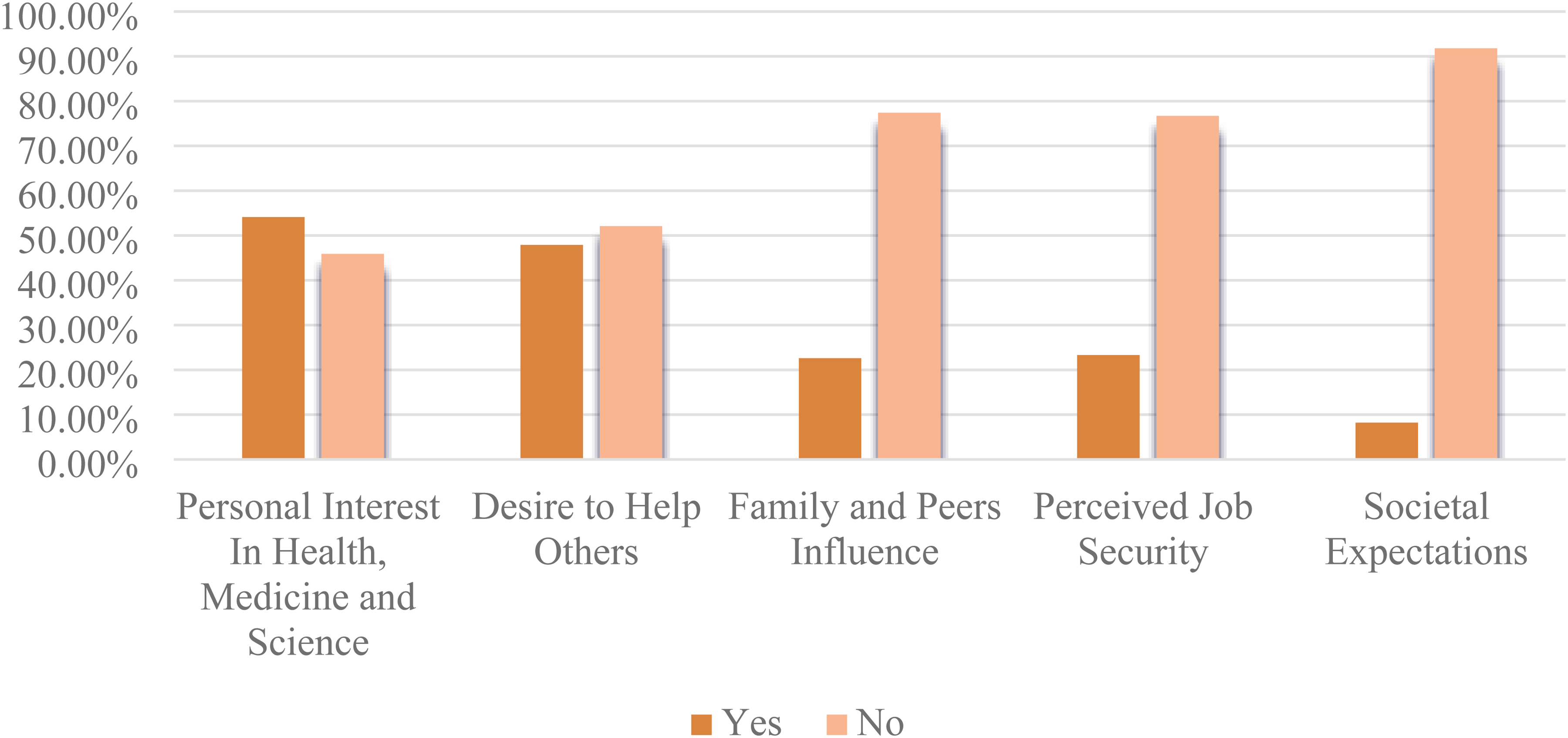
Distribution of initial motivations.
TPB Constructs
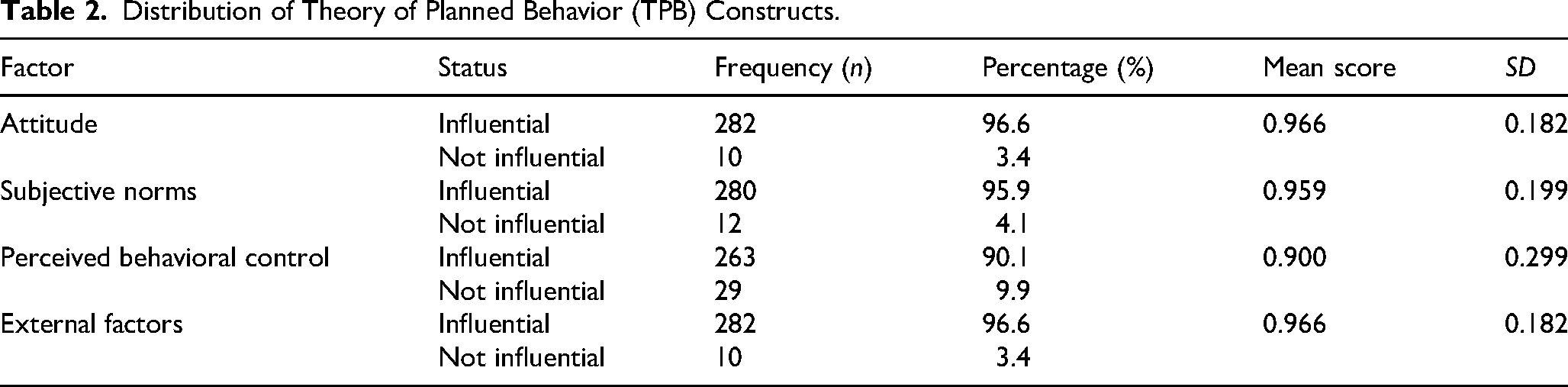
The majority of students rated the TPB constructs as highly influential. Attitude and external factors were seen as influential by 96.6% of students, while subjective norms were influential for 95.9%. Perceived behavioral control showed a slightly lower, but still high, influence at 90.1% (see Table 2).
Distribution of Theory of Planned Behavior (TPB) Constructs.
Associations and Predictors
Bivariate analysis showed no statistically significant association between career decision and demographic factors like age (p = .377), gender (p = .448), or university type (p = .403). However, significant associations were found with all initial motivations except societal expectations. The TPB constructs of attitude, perceived behavioral control, and external factors also showed significant associations with career decisions, while subjective norms did not (see Table 3).
Associations Between Demographics, Initial Motivations, and Theory of Planned Behavior (TPB) Constructs Versus Career Path Decision.

In the final binary logistic regression model, only 3 factors were identified as significant predictors of a student's intention to continue in medicine: desire to help others (OR = 2.901, p < .001), personal interest (OR = 1.987, p = .016), and perceived behavioral control (OR = 2.256, p = .005). Other variables, including demographic factors, subjective norms, and external factors, were not significant predictors in the adjusted model (see Table 4).
Regression Analysis Results of Predictors for Medical Career Continuation.

Suggestions for Career Retention
Based on open-ended responses from 185 students, the most frequently cited factors for career retention were financial stability and support (28.6%) and improved working conditions and environment (26.5%). These were followed by curriculum and training improvements (14.6%) and job security and opportunities (9.2%) (see Figure 3).

Students’ suggestions on factors to influence career retention.
Discussion
This study found that a significant proportion, 35.3%, of final-year medical students in Tanzania consider pursuing careers outside of clinical medicine. This is a concerning finding for a country already facing a severe shortage of physicians. Our results are consistent with prior studies in other low- and middle-income countries that have reported high levels of career uncertainty among medical students. For instance, a study in Sudan revealed that over half of medical students opted out due to poor learning environments and academic difficulties, while similar findings have been reported in Nigeria and Ethiopia due to concerns about poor working conditions and limited job opportunities.12–18
In contrast, our findings highlight a unique dynamic compared to high-income countries, where career attrition is generally lower. This is often attributed to stronger mentorship, financial incentives, and clearer postgraduate training frameworks.7,8 For example, a study by Russa et al 15 highlighted that medical student debt and economic instability are major deterrents to career progression. While financial factors are a global issue, our findings suggest that in the Tanzanian context, the lack of well-established supportive systems during training may be a more pronounced driver of career disillusionment. 15
Our analysis revealed that intrinsic motivations and perceived behavioral control are the strongest predictors of a medical student's intention to remain in the profession. In the bivariate analysis, personal interest and the desire to help others showed a strong association with career continuation. This suggests that students who are driven by a personal passion for medicine and a sense of altruism are more likely to commit to the profession. Interestingly, while other initial motivations, such as family influence and perceived job security, showed some association, their significance disappeared in the multivariable logistic regression model. This indicates that while external factors may play a role in the initial choice to enter medicine, they are not the primary determinants of long-term career intentions.12–18
This finding contrasts with some prior studies that place a stronger emphasis on extrinsic motivators such as income and social status. For example, a study among medical students in Addis Ababa found that job security and respect were primary motivators. 17 Our findings, however, suggest that for Tanzanian students, the internal drive and belief in one's own capabilities are more powerful in sustaining their commitment. This aligns with the TPB, which posits that an individual's behavioral intention is most strongly influenced by their attitude toward the behavior and their perceived control over it.19,20
The high proportion of medical students considering alternative careers presents a significant public health challenge for Tanzania. A sustained loss of qualified medical professionals exacerbates the existing healthcare workforce shortage, which can lead to increased workloads for remaining staff, reduced quality of care, and an inability to meet the country's growing health needs. 14 Our findings suggest that policymakers should focus on interventions that go beyond recruitment and instead prioritize retention. By nurturing intrinsic motivation and building students’ confidence in their ability to succeed, medical schools can cultivate a more dedicated and resilient workforce. This includes establishing robust mentorship programs and improving the clinical and learning environments to make them more supportive and less stressful. 16
The main strength of this study is its application of a psychological model, the TPB, to a context (Tanzania) where such models have not been widely used to explore career intentions. The use of stratified random sampling ensured a representative sample from both public and private universities. However, the study has several limitations. First, its cross-sectional design prevents the establishment of a causal relationship between the identified predictors and career decisions. A longitudinal study would be needed to track students’ intentions over time. Second, the study relied on self-reported data through an online questionnaire, which may be subject to social desirability bias. Finally, while the questionnaire was pilot-tested for clarity, it was not a previously validated instrument, which may affect the generalizability of the findings.
Conclusion
This study reveals that 35.3% of final-year medical students in Tanzania consider alternative careers, a significant finding for a country with a physician shortage. Our study, using the TPB, found that intrinsic motivations such as the desire to help others and personal interest are the strongest predictors for staying in the medical profession. Another key factor is perceived behavioral control, which is a student's confidence in their own abilities. These findings suggest that a student's commitment is more influenced by internal drive than by external pressures such as job security. To boost retention, we recommend that academic institutions and policymakers focus on interventions that strengthen these internal drivers. This includes updating the curriculum to emphasize the humanistic side of medicine and establishing mentorship programs that build confidence. Improving the overall learning environment will also help foster a more dedicated and resilient medical workforce, ultimately improving healthcare outcomes in Tanzania.
Supplemental Material
sj-docx-1-mde-10.1177_23821205251408669 - Supplemental material for Career Path Decisions and Influencing Factors Among Medical Students in Tanzania
Supplemental material, sj-docx-1-mde-10.1177_23821205251408669 for Career Path Decisions and Influencing Factors Among Medical Students in Tanzania by Phillip Joseph Mugeta, Majani Edward and Senga Kali Pemba in Journal of Medical Education and Curricular Development
Supplemental Material
sj-docx-2-mde-10.1177_23821205251408669 - Supplemental material for Career Path Decisions and Influencing Factors Among Medical Students in Tanzania
Supplemental material, sj-docx-2-mde-10.1177_23821205251408669 for Career Path Decisions and Influencing Factors Among Medical Students in Tanzania by Phillip Joseph Mugeta, Majani Edward and Senga Kali Pemba in Journal of Medical Education and Curricular Development
Footnotes

Ethical Approval and Consent to Participate
The study protocol was approved by the St. Francis University College of Health and Allied Sciences Ethical Clearance Committee with reference number SFU/Re.Pub/Eth.App/Vol.1/1. This study adhered to the Declaration of Helsinki, and written informed consent was obtained from all participants before their involvement in the study.
Consent for Publication
Not applicable.
Author Contributions
Phillip Joseph Mugeta conceived the study design, drafted the manuscript, carried out the analysis, and authored the original draft. Majani Edward, together with Senga Kali Pemba, authored the original draft and revised the manuscript. All authors read and approved the final manuscript.
Funding
The authors received no financial support for the research, authorship, and/or publication of this article.
Declaration of Conflicting Interests
The authors declared no potential conflicts of interest with respect to the research, authorship, and/or publication of this article.
Data Availability Statement
The data supporting the findings of this study are available upon reasonable request from the corresponding author.
Clinical Trial Number
Not applicable.
Transparent Statement
The corresponding author, Majani Edward, affirms that this manuscript is an honest, accurate, and transparent account of the study being reported; that no important aspects of the study have been omitted; and that any discrepancies from the study as planned have been explained.
Supplemental Material
Supplemental material for this article is available online.
References
Supplementary Material
Please find the following supplemental material available below.
For Open Access articles published under a Creative Commons License, all supplemental material carries the same license as the article it is associated with.
For non-Open Access articles published, all supplemental material carries a non-exclusive license, and permission requests for re-use of supplemental material or any part of supplemental material shall be sent directly to the copyright owner as specified in the copyright notice associated with the article.
