



Abstract
BACKGROUND
Ethics and professionalism are fundamental elements in the practice of medicine consisting of a set of values, behaviors, and relationships that reinforce the trust and respect for the physician in a society. It consists of several key elements that are learnt during their formative years of study. This study aims to compare knowledge and self-reported practice of ethics and professionalism between preclinical and clinical undergraduate medical students.
METHODS
We included 427 medical students including males and females of age 18 and above. They were further divided into preclinical and clinical groups. We assessed knowledge and practice of medical professionalism through a validated questionnaire containing 11 core elements (components) of medical professionalism and ethics. The assessment was carried out by comparing median scores assigned to the components of professionalism against each question. Data was analyzed through SPSS v.22 and GraphPad Prism v.8.
RESULTS
Clinical medical students had significantly higher knowledge of medical professionalism as compared to nonclinical students (P = .0016). Moreover, among the components of professionalism, there was a significantly higher score for confidentiality (P = .006), communication skills (P = .001), self-directed learning (P = .011), peer and self-assessment (P = .0011) along with ethics in research and patient care (P = .0042) in clinical students as compared to preclinical medical students. However, no significant difference was found between students of preclinical and clinical years for honesty, accountability, respect, responsibility, compassion, and maturity (P > .05). The findings were comparable across students of different ethnicities in our study cohort (P > .05).
CONCLUSION
Our findings suggest that knowledge and practice of certain elements of ethics and professionalism are enhanced through clinical exposure, however, few remain consistent across different stages of study. Moreover, lack of significant differences in practice of professionalism based on ethnic differences underscores the potential universal standards in medical education.
Background
Medical professionalism is a fundamental element in the practice of medicine, encapsulating a set of values, behaviors, and relationship that underpin the trust and respect for the physician in a society. 1 It encompasses several key attributes including responsibility, accountability, honesty, confidentiality, communication skills, leadership qualities, and establishment of trust. 2 These attributes not only guide the interactions between the doctor and the patients but also influence the healthcare system. 3 Developing professionalism in medical students is essential to ensure that future doctors are fit for clinical practice and thus engender public trust befitting the profession. During undergraduate medical training, it is the most important time when students are expected to acquire the knowledge, skills, attributes, and experiences to attain the professionalism which is a key requirement for being a physician. 4
Traditionally, medical professionalism was developed through unscripted curriculum in which students used to observe their clinical team members and professors as their role models for developing their professional skills. 5 In the current era, health profession education is working on development of advanced medical professionalism among medical students through formal activities incorporated in curriculum. 6 The concept of medial professionalism has evolved significantly over the past few years incorporating various values such as patient-centered care, ethical practice, teamwork, and continuous professional development taught to the medical students in their curriculum during their formative years. 7 There is extensive literature on the expectations and definitions of medical professionalism, there is a relative gap lying focusing on how medical students perceive and internalize these values during their formative study years. 8
Taking a timely snapshot of knowledge and practice of professionalism among future healthcare professionals is important for many reasons. Firstly, it helps in identifying the potential gaps between the formal curriculum and utilization of knowledge. This helps to know the effectiveness of current strategies. Secondly, it helps in exploring the challenges faced by the students in adhering to professional standards which will be helpful in developing the targeted strategies. Lastly, it helps to identify its impact on patient's care which can prepare them for complexities of modern practice of medicine. 9
The objective of this study was to evaluate the knowledge and self-reported practice of ethics and professionalism. We used a self-assessment approach to compare the knowledge and practice regarding ethics and professionalism between preclinical and clinical medical students. This study also highlights the impact of clinical exposure on students’ understanding and application of these professional attributes.
Methods
Description of study
This cross-sectional study was performed among undergraduate students of MBBS from years 1 to 5. The sample size was 427 students calculated from OpenEPI with student population size of 1100 and 1.5 design effect (DEFF). The study period was from March 2023 to January 2024.
Ethical consideration
This study was approved by the ethical board of our university. Approval number was IRB/2023/142. Participants were included after written informed consent. The study was conducted according to STROBE guideline (Supplemental File 1).
Inclusion and exclusion criteria
Both genders of age 18 and above were included in our study. The students included from years 1 to 5 as of Academic Year 2022/23. Students were further categorized into preclinical years (years 1 and 2) and clinical years (years 3–5). Those who consented to participate were included in the study. Students on internship and postgraduate trainees were excluded from the study. Those who did not consent to participate or did not complete the questionnaire were also excluded.
Data collection
Data was collected in a printed from of questionnaire having information regarding demographic characteristics along with knowledge and practice of core components of medical ethics and professionalism through a validated instrument (questionnaire attached as Supplemental File 2).
Data collection tool
Data collection tool was designed by our team. The questionnaire was piloted on 17 participants out of the study participants and modifications were made after suggestions. The final questionnaire was validated by the Department of Medical Education of our university and approved by the Institutional Review Board. We measured Cronbach's alpha for consistency of responses for elements of professionalism by student groups (Supplemental Table S1). Hence data saturation was reached for this study.
The questionnaire contained 2 sections, one for demographic characteristics and the other for knowledge and practice regarding eleven elements of medical professionalism. Eleven core elements of professionalism included honesty, accountability, confidentiality, respectfulness, responsibility, compassion, communication, maturity, self-directed learning, ethics of research and patient's care, and peer and self-assessment. There was a range of statements under each professionalism core element that were measured by 5-point Likert scale, giving a maximum score of 280.
The median score of each component was compared between preclinical and clinical students.
Data analysis
The data was entered into MS Excel and analyzed through SPSS 22.0 and GraphPad prism 8.0. Frequencies were calculated for categorical data. Median scores of elements of professionalism were compared between preclinical and clinical groups through the Mann-Whitney test.
Results
Reliability and validity studies of the questionnaire
The reliability (internal consistency) of the questionnaire was assured through Cronbach's alpha test. Cronbach's alpha coefficient of >0.7 was detected for multiple components of ethics and professionalism compared in our study which indicates a high level of internal consistency and reliability of the questionnaire. We compared the Cronbach's alpha coefficient of the ethics and professionalism with respect to year of study from years 1 to 5 separately (Supplemental Table S1).
Demographic characteristics
The mean age of students was 21.23 ± 4.17 years. There were 298 females and 129 males in our study. Based on ethnic distribution, there were 149 Sindhi, 76 Urdu, 34 Punjabi, 89 Baloch, 55 Pashtun, 11 Kashmiri, and 13 foreign national students in our study cohort. The distribution of demographic data among students based on their year of study is given in Figures 1 and 2.
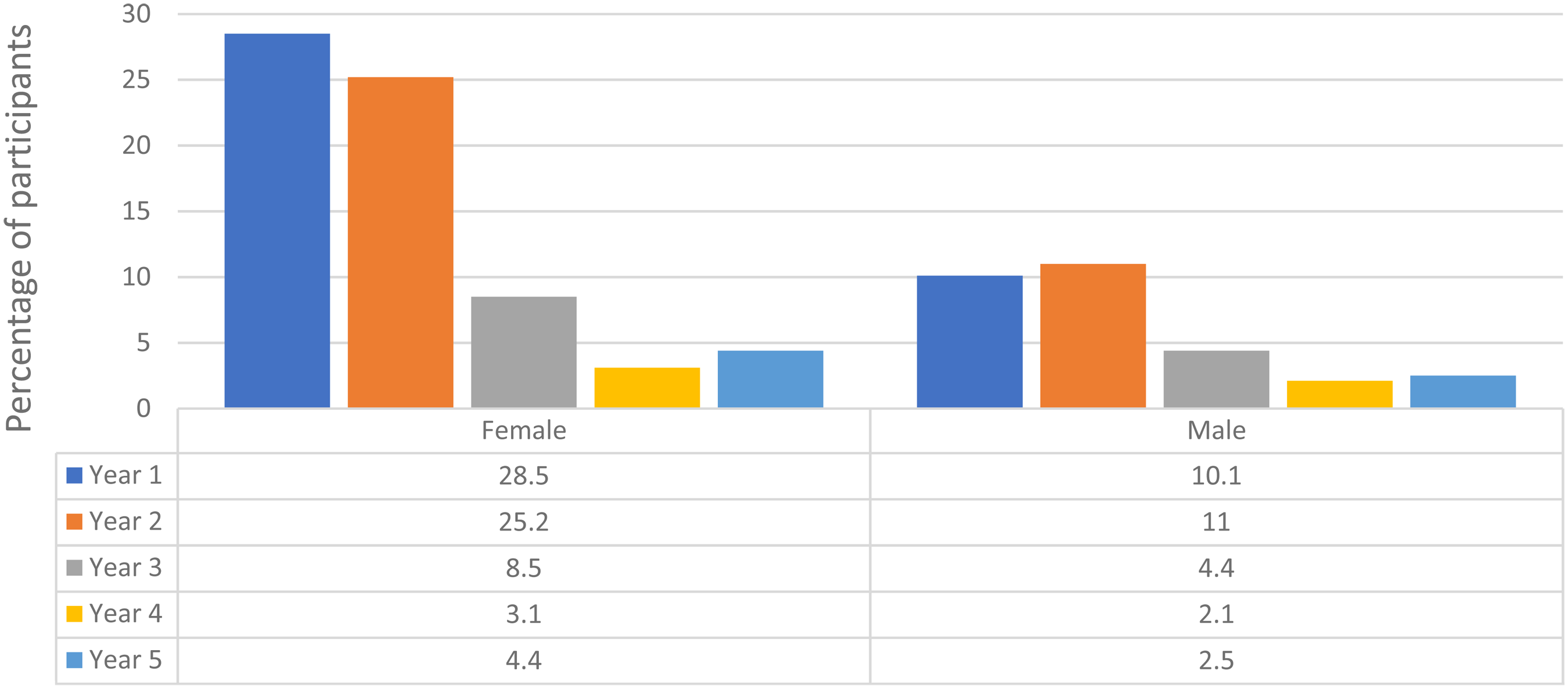
The percentage of gender distribution across the study years of medical students n = 427.

The ethnicity distribution across the study years of medical students n = 427.
Assessment of components of medical professionalism among students
Firstly, we compared the median score of overall components of professionalism between preclinical (years 1 and 2) and clinical years (years 3–5). We found a significant difference in overall score for practice and knowledge of medical ethics and professionalism among preclinical and clinical students (median 219.0 vs 227.8, respectively; Figure 3; P = .016).
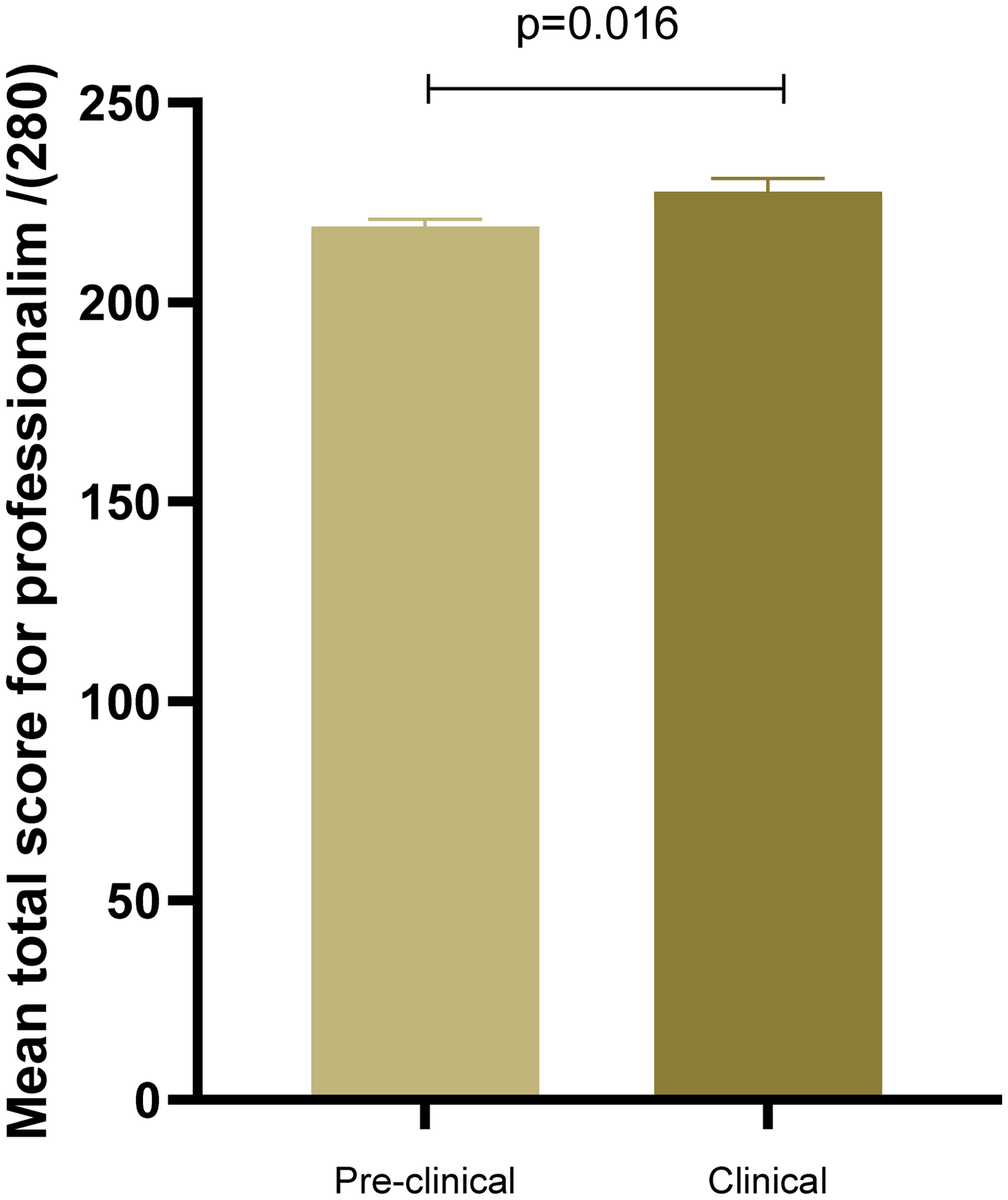
Comparison of total median score for professionalism between preclinical and clinical medical students (n = 427). The significant difference in the total median score of professionalism measured by Mann-Whitney test through a validated questionnaire.
We further compared median score for individual component of professionalism. There was significantly higher score of confidentiality (P = .006), communication skills (P = .001), self-directed learning (P = .011), peer and self-assessment (P = .0011) along with ethics in research and patient care (.0042) in students at clinical rotation as compared to preclinical medical students (Figure 4). However, no significant difference was found between students of preclinical and clinical years for honesty, accountability, respect, responsibility, compassion, and maturity (Figure 5; P > .05).

Comparison of professionalism between preclinical and clinical medical students (n = 427). The significant difference of median score of elements of professionalism measured by Mann-Whitney test through validated questionnaire.

Comparison of professionalism between preclinical and clinical medical students (n = 427). No significant difference of median score of elements of professionalism measured by Mann-Whitney test through validated questionnaire.
Furthermore, we compared the median score of each element of professionalism with respect to year of study of medical students (years 1–5) through one-way analysis of variance (ANOVA). We found significant differential median scores for honesty, accountability, respect, compassion, communication, maturity, ethics, and peer and self-assessment among the groups (Supplemental Table S2).
Impact of ethnicity on knowledge and practice of medical professionalism
We also compared the knowledge and practice of medical students regarding professionalism based on their ethnicity. We did not find any significant difference in knowledge and practice of medical professionalism with respect to their ethnicity (P > .05; data not shown).
Discussion
Our study has shown differential knowledge and self-practice of a few elements of medical ethics and professionalism in clinical medical students as compared to preclinical medical students. Our study cohort included a higher number of female students (298 females vs 129 males). This aligns with the trend observed in medical schools globally where female enrollment usually surpasses the male enrollment. 10 The ethnic diversity in our cohort included multiple ethnicities uniformly distributed across study groups reflects multicultural composition of medical student population in various regions. 11
Our findings indicate significant differences in the self-practice and knowledge of medical professionalism between preclinical and clinical medial students. Clinical students scored higher in confidentiality, communication skills, self-directed learning, peer and self-assessment, and ethics in research patient care. The same trend was observed in previous studies that highlighted the positive impact of clinical exposure on the development of medical professionalism. 12 Additionally, a Malaysian study found that clinical students have better attitudes toward patients and peers as compared to preclinical students which further supports the notion that clinical exposure enhances certain processional attributes. 13 However, we did not find significant differences for honesty, accountability, respect, responsibility, compassion, and maturity among preclinical and clinical students suggesting these attributes may be less influenced by clinical experience. 14 Ryan et al 15 also reported difference in knowledge and practice of different elements of professionalism but did not differ with ascending year of study.
We observed that all the respondents scored more than 65% of the score for each element of medical professionalism which shows a satisfactory component of professional development in our curriculum. Moreover, one-way ANOVA revealed significant differences in mean score of various professionalism elements across different years of study. These scores were having an increased trend across the higher year of study. This finding underscores the progressive development of professionalism attributes as students advance through their medical education. 16 However, Sattar et al examined the effectiveness of a professionalism course during the transition from nonclinical to clinical settings. The study found that students maintained a good understanding of professionalism even after the transition, indicating that early exposure to professionalism concepts has a lasting impact and was not associated with ascending years of study. 17
Furthermore, we did not find any significant difference in knowledge and practice of any of the components of medical professionalism based on ethnic diversity. There was a diverse ethnic population in our study cohort which did not have any influence on differential knowledge and practice. This result contrast with some literature where Klein et al 18 reported that cultural and ethnic backgrounds can influence the practice of medical professionalism. However, it aligns with the other studies which emphasize the universal nature of core professionalism attributes across the diverse ethnic groups. 19
Conclusion
Our study has contributed to the understanding of how the elements of medical professionalism develop across the study years. Our findings suggest that certain elements of medical ethics and professionalism are enhanced through clinical exposure, however, few remain consistent across different stages of study. Moreover, lack of significant ethnic differences in professionalism underscores the potential universal standards in medical education.
Limitations
This study was based on self-assessment scores which might have introduced answering bias as the answers to included items were susceptible to social desirability bias.
Supplemental Material
sj-docx-1-mde-10.1177_23821205241311476 - Supplemental material for Self-Assessment of Medical Ethics and Professionalism: Comparison Between Preclinical and Clinical Medical Students
Supplemental material, sj-docx-1-mde-10.1177_23821205241311476 for Self-Assessment of Medical Ethics and Professionalism: Comparison Between Preclinical and Clinical Medical Students by Saima Naz Shaikh, Uzair Abbas, Tazeen Shah, Arsalan Ahmad Uqaili, Hudebia Allah Buksh and Mehreen Fatima in Journal of Medical Education and Curricular Development
Supplemental Material
sj-pdf-2-mde-10.1177_23821205241311476 - Supplemental material for Self-Assessment of Medical Ethics and Professionalism: Comparison Between Preclinical and Clinical Medical Students
Supplemental material, sj-pdf-2-mde-10.1177_23821205241311476 for Self-Assessment of Medical Ethics and Professionalism: Comparison Between Preclinical and Clinical Medical Students by Saima Naz Shaikh, Uzair Abbas, Tazeen Shah, Arsalan Ahmad Uqaili, Hudebia Allah Buksh and Mehreen Fatima in Journal of Medical Education and Curricular Development
Supplemental Material
sj-docx-3-mde-10.1177_23821205241311476 - Supplemental material for Self-Assessment of Medical Ethics and Professionalism: Comparison Between Preclinical and Clinical Medical Students
Supplemental material, sj-docx-3-mde-10.1177_23821205241311476 for Self-Assessment of Medical Ethics and Professionalism: Comparison Between Preclinical and Clinical Medical Students by Saima Naz Shaikh, Uzair Abbas, Tazeen Shah, Arsalan Ahmad Uqaili, Hudebia Allah Buksh and Mehreen Fatima in Journal of Medical Education and Curricular Development
Footnotes
Authors Contributions
SNS, UA, and AAU were involved in conception/design of the work; TS and HAB in data collection, data analysis, and interpretation; UA and MF in drafting the article; and UA, AAU, TS, HAB, MF, and SNS in critical revision of the article and final approval. All authors have read and approved the final manuscript.
Availability of Data and Materials
All data has been included in the study however it is available with the corresponding author and may be provided on request.
DECLARATION OF CONFLICTING INTERESTS
The authors declared no potential conflicts of interest with respect to the research, authorship, and/or publication of this article.
FUNDING
The authors received no financial support for the research, authorship, and/or publication of this article.
Ethics Approval and Consent to Participate
This study was approved by the ethical board of LUMHS. Approval number was IRB/2023/142. Participants were included after informed consent.

Supplemental Material
Supplemental material for this article is available online.
Notes
References
Supplementary Material
Please find the following supplemental material available below.
For Open Access articles published under a Creative Commons License, all supplemental material carries the same license as the article it is associated with.
For non-Open Access articles published, all supplemental material carries a non-exclusive license, and permission requests for re-use of supplemental material or any part of supplemental material shall be sent directly to the copyright owner as specified in the copyright notice associated with the article.
