



Abstract
Objectives
Since their debut, medical dramas have been popular, particularly among medical students. This study examined how much time medical students spend watching medical TV shows and their impressions of the shows’ professionalism, ethics, and realism.
Methods
A survey on medical students’ medical drama viewing behavior and perceptions with regard to bioethics was given to 341 first- to fifth-year undergraduate medical students at a university in Al Majmaah, Saudi Arabia. The poll gathered demographic information, TV medical drama watching habits, bioethical and professional concerns in medical dramas, and the sources of bioethical knowledge.
Results
The most popular medical dramas were The Good Doctor, Grey's Anatomy, and House M.D. Compared with English-language television medical dramas, Arabic ones were less popular. Ninety-one percent of students watched television alone. There was no statistically significant difference in respondents’ perceptions of ethics accuracy based on year of study, gender, or whether they discussed it with friends. In comparison to students who had not seen any medical dramas, those who had were more inclined to view them as a credible source of ethical advice (P-value .04).
Conclusions
There is a high interest in medical programs among medical students, and these programs can be used to teach them about the ethical aspects of practicing medicine.
Introduction
Medical drama has been one of television's (TV's) most popular genres since its inception in the 1960s. 1 Even though the fact that the vast majority of TV medical dramas are produced in the United States and are centered on the American healthcare system, they are viewed globally. 2 In addition, the growing popularity of online platforms, also known as subscription video-on-demand services, has, over the past decade, radically changed the way TV shows are produced and viewed. 3 Thus, medical students are influenced by a variety of global English and non-English TV medical dramas. Moreover, in recent years, there has also been an increase in the number of Arab medical TV series. Two examples are the Saudi TV show 37 Degrees, which has been on air for two seasons, and the Egyptian show Critical Moments, which has been on air for three seasons.4,5
In their portrayal of physicians, contemporary TV shows focus more on moral ambiguity and realism, compared with TV shows of the past, which presented extremely idealized fictional doctors. 6 In a content analysis of two TV shows, House M.D. and Grey's Anatomy, there were 179 and 396 depictions of bioethics and professionalism, respectively. 7 These dilemmas are presented in an entertaining manner and also address the interests and concerns of medical students. 8 As a result, medical students like watching TV medical dramas. Findings on the percentage of medical students who watched medical dramas in the past year range from 49% to 93%.2,9,10
Some educators have recognized that the appeal and engaging format of TV shows and their presentation of ethical issues may have educational worth. 1 Although some characters are presented as rude or unethical (eg, Gregory House, the lead character of House M.D.), certain scenes may help in teaching ethics to medical students. 11 Twenty distinct learning outcomes were proposed by Berk (2009) while using clips, including but not limited to: Attracting and retaining student attention; facilitating focused attention; encouraging creative thinking; and promoting the free flow of ideas. 12 In a review of more than a hundred articles about using TV drama and movies in teaching, it concluded that teaching medical students and residents to identify and process their own emotions through exposure to media like TV and film helps them better empathize with their patients. 13 Arawi 14 argued teaching ethics using medical drama narratives provides students with a setting that allows them to take in as much context as possible, to participate in the case as active participants rather than passive observers, and to immerse themselves in it just enough to feel invested but not so deeply that they lose the ability to think critically about it. In a Canadian study where snippets from the TV show ER were shown, students claimed that the clips sparked a debate. Moreover, these video segments promote critical thinking and reflection. 15 A meta-analysis of 13 studies that assessed the use of medical TV dramas in health science teaching showed that medical students are generally in favor of using program clips as a teaching tool. 16 Moreover, modern TV depicts current ethical dilemmas. New TV series like New Amsterdam, The Good Doctor, and Chicago Med, for instance, feature many episodes pertaining to the COVID-19 epidemic. In a number of incidents, the impact of shortage on the delivery of optimal medical care and the treatment of dying patients was illustrated. 17 Conversely, some studies have found little evidence of the efficacy of the use of TV programs in ethics education. Ward (2014) suggests that the poor portrayal of nurses in medical TV leads to the belief that physicians are the only ones involved in ethical dilemmas and nurses are subservient. 18 Trachtman has pointed out that TV medical dramas depict extreme ethical cases to be finished within 1 h with a clear outcome, which contradicts real-life situations. 19 He also suggests other media that might stimulate bioethical thinking, such as literature, paintings, and plays. 19 Also, most of the studies did not compare medical TV drama with a standard method of teaching (lectures, classroom) and did not evaluate the long-term behavioral changes in students. 13
In a study of US medical and nursing students, Czarny et al 10 found that post-clinical students were more critical of projected professionalism and ethical difficulties in TV dramas than pre-clinical students. The same findings were also showed in an English study. 20 However, two other studies, one conducted in England and the other in Australia, did not find a significant association between years of enrollment and perception accuracy.2,9 To date, no studies on this topic have been conducted in Saudi Arabia. Therefore, the purpose of our study was to investigate the perceptions of medical TV programs among Saudi undergraduate medical students. This article presents the findings of a survey of medical students’ viewing habits and perceptions of medical TV programs.
Methods
This cross sectional study was conducted at a medical school in a small university in Al Majmaah, Saudi Arabia, during the 2021–2022 academic year. From February fifth to February 12th, an online population-based survey was distributed. All first through fifth undergraduate students who were enrolled were included in the study. Faculty and other collaborators were excluded. Our study utilized a modified version of the medical drama TV survey developed by Czarny et al 10 The original survey was designed to collect information on basic demographic factors, TV medical drama viewing patterns, perceptions of bioethical and professionalism issues in medical dramas, and sources of bioethical knowledge. The survey adaptation was limited to the addition of Arabic TV programs (37 Degrees and Critical Moments) and omitting questions about role models, watching formats, and types of TV programs. The redesigned survey was pilot tested on five medicine staff volunteers. The survey was redesigned based on this feedback to increase its clarity. The survey was distributed using SurveyMonkey (San Mateo), a platform that allows academics to conduct online surveys. The access link to the questionnaire was then shared via WhatsApp to all student's groups. The respondents were invited to participate in the survey by completing the questionnaire at their leisure.
In the first part of the survey, participants were informed of the purpose of the study and that their participation in the research was completely voluntary. Students’ consent was presumed if they continued to complete the survey after reading consent instructions. The Institutional Review Board at the College of Medicine Majmaah University approved the study (approval MUREC-Mar.23/CONI-2022/29-z).
Since all medical dramas were mentioned in the questionnaire, respondents may answer certain portions yes while leaving others blank. In these circumstances, we regarded any blank answer in the context of one or more “Yes” replies to be a “No.” Respondents who left the whole question (and survey) blank were removed from this study.
Statistical analysis
Continuous variables were presented as means (interquartile range) or medians (standard deviation), and categorical variables were summarized as counts and percentages. and were examined using the χ² test. SPSS software (version 23, IBM Corp.) was used to perform the statistical analyses. Associations between variables were tested with χ² or analysis of variance scores where appropriate, with a statistical significance cutoff of 0.05.
Results
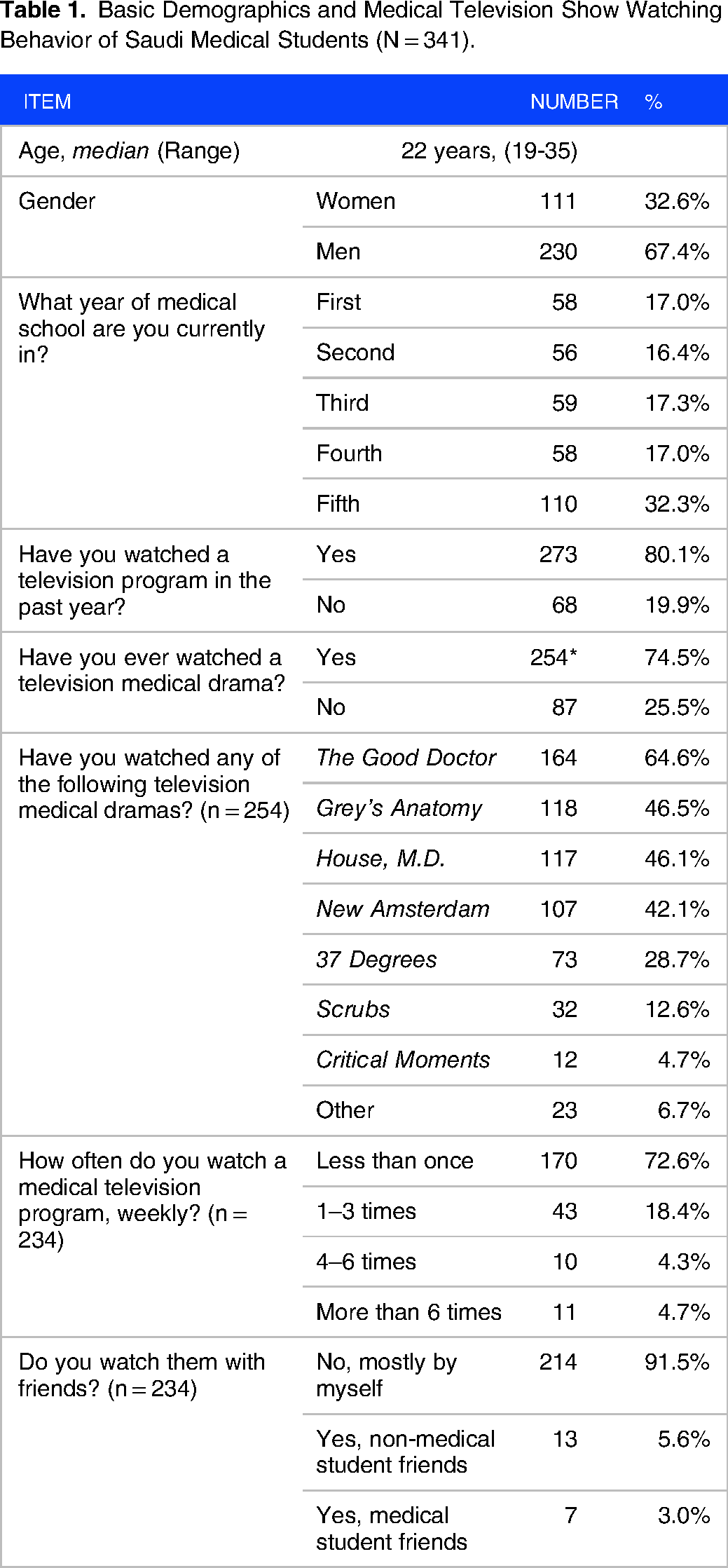
Three-hundred forty-one medical students answered the questionnaire. The response rate is 90%. The median age of the participants was 22 years (IQR, 3 years) and almost two-thirds were men (n = 230, 67.4%). One-third of the medical students were fifth-year students (n = 110, 32.2%), and the remaining two-thirds were equally represented from the first-to-fourth year of medical school. Watching TV, in general, was reported at least over the past year by the vast majority of participants (n = 273, 80.1%), with a similar rate among those who have watched medical TV shows specifically (n = 254, 74.5%). Among those who watched medical drama (n = 254), 20 respondents did not complete the questionnaire. The majority of medical students watched these TV shows less than once weekly (72.6%) or 1–3 times per week (18.4%). Students watched these TV shows by themselves in 91.5% of the responses. The most commonly watched TV shows were The Good Doctor (64.6%), Grey's Anatomy (46.5%), House M.D. (46.1%), and New Amsterdam (42.1%). A quarter of participants showed interest in one of the two Arabic local medical TV shows, with more showing interest in 37 Degrees (28.7%) than in Critical Moments (4.7%) (Table 1). Participants are allowed to mention other series. It was noticed that they mentioned non-English and non-Arabic shows like Doctor stranger and Romantic Doctor (Korean) and Mucize Doktor and Kalp Atışı (Turkish).
Basic Demographics and Medical Television Show Watching Behavior of Saudi Medical Students (N = 341).
Almost 42% of the students reported that they had never been exposed to bioethics, whereas only 1 in 3 had been in undergraduate courses. Generally, half of the medical students usually discuss ethical issues with their friends, but most have never been asked about bioethical issues raised in medical TV shows. The depiction of ethical issues in medical TV shows was deemed accurate (9.8%) or mostly accurate (2.1%) by only 11.1% of medical students (Table 2). This accuracy assessment was not statistically different between years of study, genders, or those who did and did not discuss these shows with friends.
Saudi Student Exposure to and Interests in Bioethics (N = 234).

In the participants’ view, rationing of care, medical mistakes, and professional misconduct was the least well-handled topics in medical dramas, while the topics of death, confidentiality, quality of life, and infectious diseases were assessed as good or excellent by 44%–47% of the participants (Figure 1). Depiction of leadership in medical TV shows had the highest positive rating in 70% of participants, and respect had the highest negative rating (28%) (Figure 2). The importance of bioethics sources in informing bioethical issues was largely variable, with medical dramas being among those considered the least important, and those considered the most important being medical school (85%), religious values (82%), and family (76%). The perceived importance of the sources of bioethics was not influenced by whether the students reported watching TV medical dramas, except on the degree of importance of TV medical dramas (p-value .04) (Table 3).

Perceived overall handling of ethical and medical issues in medical television dramas among Saudi medical students (N = 234).

Perceived handling of the ideals of professionalism by medical television shows among Saudi medical students (N = 234).
Association Between Having Watched Television Medical Dramas and Perceived Importance of Sources of Guidance on Bioethics Among Saudi Medical Students (N = 312).

Discussion
This study confirms what Czarny et al 10 and Weaver et al 9 have found about medical students as avid TV viewers. In line with Cambra-Badii et al 2 , the most popular shows were The Good Doctor, Grey's Anatomy, and House M.D. With its unique use of an autistic character as the protagonist, The Good Doctor has an advantage over other popular medical dramas in terms of creativity. The appeal of House M.D. is most likely due to its emphasis on clinical decision-making. Scrubs lost its appeal to our cohort probably because it cannot be found on any streaming services. Despite the fact that it aired more than a decade ago, the Saudi medical drama 37 Degrees was watched by a quarter of our students. Chicago Med, Dr Romantic, and Code Black were also referenced by students in their comments.
New Amsterdam is a new series that debuted 4 years ago. It focuses mainly on the underlying social structural concerns that are the key drivers of the United States medical problems. Issues like poverty, immigration, medicine cost, are represented in this show. 21 Compared to other medical dramas, 16% of narrative time in New Amsterdam is dedicated to professional plot, while in other series it is only 8%–9%. 22
No statistical correlation was found between the year of enrollment and the perceived accuracy of medical TV dramas. Unlike the study by Czarny et al, 10 this one is in line with the findings of Weaver et al 9 and Cambra-Badii et al 2 Based on this, we can assume that these students approach their studies with a more critical attitude about the reality of medical TV shows. Perhaps students may not realize how much medical programs impact them, even in subtle ways.
The sources of information on bioethical issues deemed most important in this study are consistent with those cited in previous research,9,10 highlighting the significance of universities and scientific journals. However, religious values ranked among the top 3 sources, while in the other studies, it is usually in the lower three. Most likely because religion is seen as a key part of how people think and act in the country.
Our study showed that most Saudi medical students watch TV alone, but they discuss what they have seen with their friends. This finding contradicts those of previous studies.9,10,20 Streaming services and smartphones make it possible to view TV shows at any time. Furthermore, social networking applications facilitate communication about the most recent TV episodes.
Most of our participants watch medical dramas fewer than once a week. This is comparable to other cohorts.2,10 Although we did not inquire about the formats in which students watch medical drama, we suspect that they are using video-on-demand platforms that allow viewers to see numerous episodes at once like in a previous similar study. 2
Although we did not ask about non-English and non-Arabic shows, the frequent mention of a Korean medical drama by survey participants merits further consideration. Korean medical dramas place more emphasis on the negative characteristics of doctors, particularly the “corrupt” ones. 23 Currently, no studies have evaluated the educational value of Korean medical dramas. Students may benefit from learning about other cultures and ethical challenges by expanding their horizons.
This study suggests that adding medical dramas as class material may strengthen bioethics instruction. TV medical dramas may help students reflect on bioethics since they are widely seen, have a fascinating and appealing style and format, and illustrate bioethical challenges students remember. It is important to assess the content and determine the appropriateness of the material for each educational purpose before using a TV show to teach ethics. There have been several attempts to produce instructions for educators to utilize medical dramas for educational purposes. 24 The large number of students who could recall ethical dilemmas from medical programs suggests that there may be advantages to using the programs in medical school as case studies or examples in tutorials or lectures.
In a study evaluating the methods of teaching ethics in our country, 92% of education was delivered through lectures. In addition, students are evaluated primarily through written exams. The majority of curricula were created by universities themselves and unqualified faculty. Curriculum is primarily based on religious standards and the characteristics a Muslim doctor must possess. 25 Our cohort demonstrated that religious morals are valued in our culture. The incorporation of medical dramas would increase the interactivity of ethics education and broaden the horizon for approaching different cultures.
Incorporating TV medical dramas in curriculum can come in many shapes and forms. For instance, a noncredit seminar in which House M.D. was screened attracted a large number of students and was favored over traditional seminars. 26 Also, an online course in which students can discuss in a form under supervision of the instructor is a feasible method. 27 In a controlled environment supervised and moderated by a qualified moderator, medical dramas on TV will serve as a supplement to illustrate moral theories and principles rather than as pure entertainment.
Our findings should be interpreted with caution. The study was restricted to a subset of health science students from one university. Consequently, generalizing this to different stated and cultures may not provide the same outcomes. Furthermore, the majority of respondents were male which might affect the type of most-watched medical drama.
Future studies should evaluate the influence of local TV programs on bioethical concerns outside the United States. Moreover, it may be worth comparing the influence of English and non-English medical dramas on students’ views and behaviors and how it would conflict with religion as a source of ethics.
Conclusion
This research indicates that medical students are avid viewers of TV depictions of their chosen profession. Medical dramas can serve as useful tools in the training on bioethical and professional practices in the health sciences. Finding out what students want to do in their free time, what shows they watch, and what bioethical conflicts they remember might help teachers design better lessons.
Footnotes
Acknowledgments
The author would like to thank the Deanship of Scientific Research, Majmaah University, for providing guidance and support throughout the study.
Declaration of conflicting interests
The author(s) declared no potential conflicts of interest with respect to the research, authorship, and/or publication of this article.
Funding
The author(s) received no financial support for the research, authorship, and/or publication of this article.