



Abstract
OBJECTIVE
The COVID-19 pandemic affected in-person educational activities and required medical schools to adapt and enrich their curriculum to ensure ongoing professional development. During the height of the COVID-19 pandemic, students expressed a significant desire to contribute and continue their medical education. Service learning promotes experiential learning and Professional Identity Formation (PIF). This study examines the impact that a service-learning elective had on medical students’ education and PIF.
METHODS
Offering a service-learning elective allowed students to remain engaged in educational activities and pandemic-relief efforts. We conducted a qualitative analysis of 132 written reflections by medical students who completed a 2- or a 4-week service-learning elective to assess for major themes and impact on PIF.
RESULTS
Participation in service learning had a favorable impact on PIF as expressed by the personal qualities student identified as having developed or improved upon because of their participation. Enhancement of communication skills, teamwork skills, compassion, and empathy were major themes conveyed in student reflections. Qualities of resilience were also portrayed through the write-up as students noted how the elective allowed for active engagement in community pandemic-relief efforts and created opportunities for overcoming obstacles related to service learning projects they participated in.
CONCLUSIONS
Service learning in medical school has a dual purpose of providing community support while imparting significant learning opportunities for PIF in medical students.
Introduction
It is known that key components of professionalism which promote Professional Identity Formation (PIF) include communication skills, compassion and empathy, resilience, and teamwork collaboration and leadership.1,2 The COVID-19 pandemic disrupted medical education and necessitated the design of novel and revised curricula.3,4 During the height of the pandemic there was tremendous community need and although students were able to learn remotely, many expressed a desire to contribute 5 to pandemic efforts as well to continue to learn.6–8 Kalet et al 9 further asserted that the pandemic-related change in medical school curriculum from in-person to a virtual platform would likely endanger student's PIF due to the loss of opportunities to meaningfully engage with faculty, peers, and patients. One French study found that working in the clinical setting during the COVID-19 educational pause was not a risk factor for anxiety in students, but that it was instead a coping mechanism, suggesting that students appreciate active participation in reducing the disease's burden. 10
One approach to maintain student engagement and education is service learning. Active, self-directed service learning is a well-recognized pedagogy in medical education11–13 and has recently gained momentum in medical schools.14,15 Mandated by the Liaison Committee for Medical Education (LCME) as a required component of medical school curricula, service learning is defined as educational experiences that involve all of the following components: (1) medical students’ service to the community in activities that respond to community-identified concerns; (2) student preparation; and (3) student reflection on the relationships among their participation in the activity, their medical school curriculum, and their roles as citizens and medical professionals. 16
Though the process of developing service learning throughout COVID-19 has been published,17,18 the impact it has on PIF as promoted through reflection on service learning has not been fully studied. Personal development which occurs from service learning directly contributes to development of PIF in students.19–21 Oftentimes, the intangible lessons of professionalism are difficult to teach throughout medical school and it has been shown that service learning and self-reflection are valuable methods to promote these teachings.12,13 A qualitative study of first-year medical students volunteering at a pediatric medical specialty camp showed that their service-learning experience fostered their professional identities and helped them “move beyond the textbook.” 19 Other studies have shown that volunteer service acts as a transformative experience that increases development of both empathy and professional identity.20,21 There are various PIF models and definitions in the literature, for instance, Cruess et al 22 relates PIF to a process that is influenced by mentors, experiences and reflections, whereas Wald et al 23 maintain that the “three R's”—Reflection, Relationships, and Resilience—are important elements of PIF.
Research on reflection in medical education has indicated that it helps learners understand humanism, supports personal growth, and PIF. 24 According to Kolb, the cycle of experiential learning focuses on the central role of experience in the continuous process of learning. 25 Kolb describes an iterative process with 4 major elements: concrete experience, reflective observation, abstract conceptualization, and active experimentation. Learners mentally process the information from a learning experience and then create their own abstract concepts and theories with which they actively experiment to solve future problems. In this model, reflection is a supportive activity necessary to process observations, which results in behavior or practice change. 25 General medical student reflections during COVID-19 showed themes of adaptive coping strategies, 26 but no analysis of reflections in the context of service-learning experiences has been conducted. Therefore, this study seeks to answer the question “What is the impact of participation in a COVID-19 Service-Learning elective on medical student PIF development in particular with regards to promoting resilience and building relationships with patients, faculty and peers, as demonstrated through the analysis of postexperience reflections?”
Methods
Course design and development
In a large, public medical school located in the Northeastern region of the USA, a COVID-19 Service-Learning elective course was designed to promote learning for our student body, while concurrently provide meaningful assistance to patients, families, faculty, and the broader community affected by the pandemic. Faculty, hospital staff, and community leaders posted service needs on a centralized database and interested students who selected a project and supervisor then enrolled in the elective (eg, telehealth support, patient outreach, hospital support, see Tables 1 and 2 for full list of student projects). The course began during the period in which students were removed from in-person learning at the height of the pandemic and continues presently. Students who signed up for 2- or 4-weeks were required to commit 35 or 70 h of service learning, respectively. Preparatory work such as completing pre-assigned readings, participating in didactic lecture, or attending an orientation session was required prior to participation. The purpose of the preparatory work was to review content specific materials to better understand context of service and develop needed knowledge and skills required for service learning project execution, not the development of PIF. To ensure a quality experience, project supervisors held scheduled meetings designed to debrief and review best practices and address difficulties encountered with the execution of the project. The elective course directors were also available to assist with any questions or issues.
Number of students by class, elective length, and service learning type (N = 132).

Type of service learning project, number of students that participated, and student roles and responsibilities.

Regarding student assessment, in addition to formative feedback from supervisors, students must submit an online self-reflection via Qualtrics (Provo, UT) at the conclusion of their 2- or 4-week project. The form prompts students for details of their project(s), supervisor(s), and amount of service time contributed. Students have to reflect and respond to the following: “What personal qualities have you developed through this service-learning experience?” and “In what ways do you anticipate these qualities will help you in the future? To help others in the future?”. Students were instructed to reflect on each project if they participated in more than one. To confirm student participation, supervisors verified hours completed through a separate online form. The elective course is graded as pass/fail. Students received a passing grade upon successful completion of committed service hours and a self-reflection submission. The Stony Brook University Committee on Research Involving Human Subjects institutional review board (IRB) considered this study exempt from ethical review (IRB2020-00472). General Waiver of informed consent for participation was granted, as the study involved analyzing reflections that were submitted by students upon completion of their COVID-19 Service Learning elective. It posed minimal risk to the student subjects and all the reflections were de-identified prior to analysis. The reflections were a course requirement and were part of the student's usual medical education curriculum.
Participants, data collection, and nature of study
All students enrolled in the COVID-19 Service-Learning elective course were eligible to participate in this study. Students not enrolled in this course were not eligible. We conducted a retrospective analysis on the reflections written by 132 medical students at our institution who enrolled in the COVID-19 Service-Learning elective. The reflections were submitted between April and October 2020. As all enrolled students were eligible, collection of student demographic information would not have contributed to the analysis of data.
Data analysis
All reflections were collated and de-identified for analyses. An inductive thematic analysis of the students’ reflections was conducted by the research team to identify the most salient themes. The members of the research team have extensive research experience and skills including an expert in qualitative data analysis (W-HL) to ensure credibility of the data analysis process. The researchers independently reviewed and analyzed the reflections. Words and phrases were highlighted and coded for frequency and meaning. Similar codes were grouped together. The coded groups were analyzed for patterns and commonality, and themes emerged. Trustworthiness was enhanced by the use of an iterative process of review and comparison of themes during research team meetings. In these meetings, the researchers compared the coding results, agreed on the themes by consensus, and identified relevant quotes that reflected the themes. Saturation was achieved after the first round of review by the independent researchers and discussed at the initial research team meeting. Microsoft Word was used to store, organize, and facilitate the data analysis. 27 While some coded words or phrases could be assigned to unique themes, many individual student reflections were linked to and represented in more than one theme.
Results
Service learning projects and student roles
The number of students by graduating class year, elective length enrolled, and the type of service-learning project they participated in are provided in Table 1. Students were allowed to participate in multiple projects concurrently and in the self-reflection write-ups they were asked to list all the projects. The number of service-learning projects students reported ranged from 1 to 3, with 93 students participating in one project, 32 students participating in 2, and 7 students participating in 3. The project that had the most student participation was patient telehealth support (57 students). Table 2 depicts the types of service-learning projects, the number of students that participated, as well as student roles and responsibilities.
Personal and professional qualities fostered that enhanced relationships and resilience
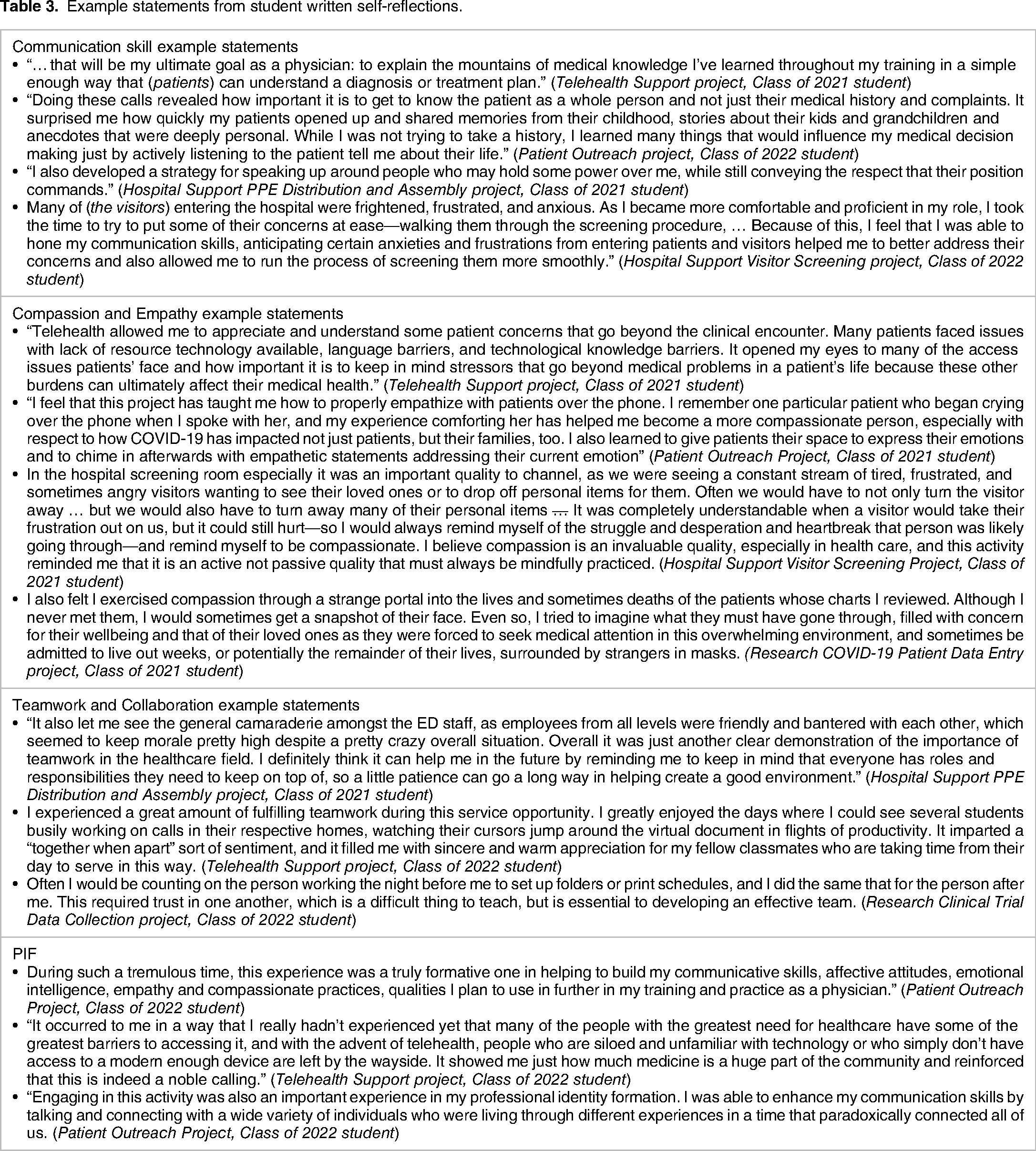
Analysis of the reflective responses to the question “What personal qualities have you developed through this service-learning experience?” yielded several identified qualities. A total of 445 sentences were coded and 4 major themes emerged as personal qualities that students identified as having developed from the service-learning experience; thereby supporting our postulation that it promotes student PIF. In the sections that follow, we describe each of these themes, highlight key findings, and present representative reflective statements from student self-reflections using quotation marks. Additional example statements are listed in Table 3.
Example statements from student written self-reflections.
Theme 1: Communication skills
The most common personal quality students reported as developing and gaining confidence in was communication skills (108 of 132 students). Students described effective communication with patients as “attentive listening,” “creating a comfortable environment where patients could ask questions,” “asking questions to ensure patients understood (teach back method) what was discussed,” “using understandable terms,” “talking slower and clearer,” and “having patience.” Being able to effectively communicate with patients was key to building rapport, allowing students to assess how patients were faring during the pandemic.
Several (19) underscored the need for patience when communicating with patients using technology “because at times it would take more than 30 min to troubleshoot a patient's device so that they could have a successful telehealth visit.” It was not uncommon for patients to become upset and frustrated but our students learned that “patience goes a long way and that most troubleshooting issues were resolved by waiting, trying again, or walking patients through the instructions more than once.”
Working with peers and other healthcare professionals also relied on effective communication to successfully carry out their work. Effective communication was needed for collecting patient data, reviewing charts, assembling and distributing personal protective equipment (PPE), or mentoring. Due to the rapidly evolving issues, protocols, and policies related to COVID-19, students were able to experience firsthand how important regular and clear communication among team members is in the coordination and completion of tasks. There were a few instances in which effective communication required students to have the self-confidence to “speak-up.” Demonstrating the confidence to correct or remind senior healthcare staff about policies or procedures, ask questions when situations were unclear, as well as request others for help when necessary, were skills in communication that students had the opportunity to hone as part of this experience.
Theme 2: Compassion and empathy
Compassion and empathy were the second most noted qualities that students (51 of 132) developed through this elective. Many reflected how this experience allowed them to “see the perspective of a patient suffering from a virus that we know very little about,” which “prepared them for the sensitivity of the situation” and “made the pandemic more tangible.”
Students acknowledged that the experience of witnessing distraught family members of patients with COVID-19, hearing the stressful and frustrated voices of patients, and reading patient charts that recorded in detail the pain that they had suffered, had prompted feelings of sympathy and compassion. They realized demonstration of compassion and empathy could be as simple as listening to others discuss the “stresses and disruptions that the pandemic had brought onto them” or by greeting staff members as they walk into the PPE room because even small interactions such as these “lifted spirits on both sides.”
Several also commended the compassion that they observed others role model. One student stated how “humbling it was to see all involved in patient care (nursing assistants, housekeeping, hospital attendants, RN's, residents, attendings, PAs, NPs) maintain their compassion for their patients.” Another commented that although the circumstances were challenging, it made the student “appreciate how wonderful, kind, and compassionate people can be.” This student continues to affirm that the experience “highlighted the importance a sense of community can be, and how in reality we all need each other.” Students were surprised that people were more willing to offer support to others, and thus, they found themselves doing the same thing reflexively for others too. Lastly, another student shared their belief that “compassion is an invaluable quality, especially in health care,” and this experience reminded students that “it is an active not passive quality that must always be mindfully practiced.”
Theme 3: Resilience
Qualities of resilience were described by 48 students (of 132). While 8 directly used the word “resilience,” resilience was mostly portrayed through student's descriptions of their ability to overcome adversity posed by the pandemic and through adjustments required during their service-learning project execution. Overcoming personal concerns and fear of COVID-19 and wanting to make their own “small contribution to the larger fight against the pandemic” was a common description of resilience. Even though they did not have direct patient contact, students knew that the support they offered would allow “someone else the ability to do their job and be available on the frontline” which was still significant and very much worth it.
The service-learning projects they engaged in also afforded an opportunity for them to exhibit resilience. In order to get the work done, they had to overcome every obstacle (eg, inexperience, lack of time/resources, etc) and deal with constantly changing challenges regarding the project, task at hand, or workplace setting. For some, they had to step out of their comfort zone and work on honing certain skills in order to resolve problems. This experience allowed students to “become more adaptable” and feel “more confident and readier to take responsibility and action when a difficult situation arises” in the future. Two students indicated that they observed resilience in their healthcare colleagues as well as patients themselves which was truly impressive.
Theme 4: Teamwork, collaboration, and leadership
Teamwork and collaboration skills development were reported (30 of 132 students) through participation in the service-learning projects. Of the 30, 7 students commented that they were also able to exercise leadership skills. Students noted that in the beginning they started out working in silos, but it soon became apparent that group effort and constant communication was necessary in order for the project to be achieved quickly and effectively. There were no assigned roles to the workflow, nor a designated leader, so it was up to them to “step up to the plate when there was an issue or something that required troubleshooting.” Students were faced with what seemed like impossible, daunting tasks to accomplish in such a short amount of time (eg, going through thousands of patient charts in a week, assembling hundreds of gowns in a shift, calling a large number of patients every day) but they were able to discuss and divide up the tasks so that the work was not redundant and efforts were maximized.
Students reflected on how they felt like part of a team and had developed a sense of trust among their team members. They would regularly check up on one another making sure to “step in to help” when necessary while ensuring that the work continued but that “no one person became too overwhelmed.” Smooth transitions of the work and handover of updated information between teams and shifts were also important aspects of effective teamwork that students believed were “vital in contributing to our success in patient outreach and education.” Leadership skills also came up as a personal quality when they cited examples of taking the initiative, being proactive and assuming the role of liaison between student volunteers and the project supervisors.
Through this experience our students “gained an appreciation for the teams of individuals and many moving parts that make our healthcare system run smoothly.” As one student summed it up, this experience reminded us that “no one works in isolation,” medicine is a “team sport” and so the qualities that they fostered would prepare them for the career they chose.
Professional identity as future physicians
Responding to the prompt question “In what ways do you anticipate these qualities will help you in the future?”, students acknowledged that the service-learning project(s) and personal qualities developed from the experience has had a positive impact on them. They noted that “as future physicians” these acquired skills and qualities will help them become “better communicators” and “more rounded physicians.” As such, they are confident in their capability to “take better care” as well as “advocate for” and “meet the different needs” of their patients. Students believed that they have fostered the ability to deeply connect with patients which will contribute to enhanced patient-physician relationships in future clinical practice. In addition to becoming more confident and competent physicians, due to the variety of service-learning projects, students also attributed the experience as valuable in their journey toward becoming “physician-scientists,” “researchers,” “educators,” “mentors,” and “life-long learners.” Of note, although students did not directly report on role-modeling relationships as a lesson they learned, it emerged frequently as an underlying theme. In all, participation in service learning allowed students to envision how these qualities will be useful in their next phase of training as they develop their professional identity as physicians.
Discussion
Service learning and associated reflection on their activity provided opportunities professional identity formation in our students. This aligns with previous reports that community service learning experiences played a role in the development of PIF in medical students.20,21 Student reflections on the experience reinforced the critical elements of PIF which include relationships and resilience. By participating in the elective, during a period when their medical education was suspended, students had the opportunity to strengthen relationships with patients, peers, and colleagues through enhancement of qualities and skills related to communication, compassion, empathy, teamwork, collaboration, and leadership. The elective also promoted resilience as it allowed for active engagement in community pandemic-relief efforts and created opportunities for overcoming obstacles related to project completion.
Reflection
Self-reflection on values and experiences deepens experiential learning and is integral to PIF. 23 Analysis of self-reflections revealed that students were self-aware about their role in COVID-19 management and that they grew from their experience. Aligned with Kolb's cycle of experiential learning, the reflections included thoughts about future practice. Through the active experience of the service-learning elective followed by the written self-reflection exercise, students were able to conceptualize their identity as future healthcare professionals with clearly defined future-oriented goals. Student reflections indicated that these experiences would promote practice changes through experimentation in their next phase of training.
Relationship
Relationships with patients, mentors, and colleagues are of the utmost importance in healthcare. Students generally look toward their mentors and peers for inspiration and for examples of how one should act. Through observing those around them, students piece together values, beliefs, and learn how manage responsibilities effectively as healthcare team members. The theme of “relationship” in PIF is directly related to communication, empathy, compassion, teamwork, and leadership. Communication was frequently written about in terms of general qualities developed and future implementation of lessons. The service-learning elective allowed students to witness and practice effective communication skills, which resulted in enhanced confidence and improved abilities. By remaining engaged in pandemic-relief efforts through this elective, students gained empathy and improved their ability to be compassionate. Their participation also resulted in the creation and strengthening of relationships with peers, patients, and mentors, and provided an opportunity to practice and hone their teamwork and leadership skills in a high-stakes setting. Students were also able to witness many positive interactions between healthcare teams which served as important examples of professionalism. Positive role modeling directly relates to the development of professional identity and the shaping of career aspirations. 28
Resilience
Resilience is defined as the ability to adjust or recover from adversity or major life changes. It is recognized as a vital component of PIF and is an important tool for preventing burnout. 29 Participation and reflection on their service-learning project gave students the opportunity to witness firsthand adversity on a massive scale as they worked on pandemic-relief efforts. They were no longer passive bystanders during these unprecedented times, and could now contribute meaningfully through their chosen project. Despite setbacks and challenges, they showed perseverance and a determination to work at completing their projects. Additionally, students utilized the lessons they learned from their projects to visualize a future version of themselves who would actively implement the new lessons. Through the participation in service-learning projects, an interruption in a critical moment of education turned into an enriching learning opportunity. This experience resulted in a forward-thinking, goal-oriented, and created a positive view of their future role and impact as physicians. It also showed that service learning is a method to promote PIF even amidst a pandemic, which Kalet et al believed had the potential to endanger personal growth and student engagement with peers and patients. 9
Overall, numerous projects were created at our institution based on areas of need as communicated by patients, faculty, staff, and the general community. In addition to providing “service” to the pandemic-relief efforts, the second half of service learning is the “learning” portion. Highlighting the reciprocal nature of this education modality, students’ professional identity and skills also grew significantly from the elective. The advantages of implementing service learning are not limited to the COVID-19 pandemic setting. We advocate for service learning to be made an integral part of the larger medical school curriculum. Service learning has been implemented in both preclinical 30 and clinical years 31 with significant enhancement of student development and preparedness for future endeavors.
There are a few limitations to our study. The self-reflections were a required component of the COVID-19 Service-Learning elective, which could yield response bias in that the students may have written responses that are considered socially acceptable or what they think the course directors wanted to hear. This study was done in a single institution based on a group of students who self-selected to take the Service-Learning elective. This was course only offered to students at our institution and we did not collect demographic information or ask why they were motivated to participate in this particular course. These factors could limit the generalizability of the data.
Conclusion
Overall, this qualitative study on student reflections postcompletion of their COVID-19 Service-Learning elective showcases the significance of promoting active, self-directed learning in academic medicine, especially during a pandemic. It is clear that service learning opportunities offer a dual-purpose: it provides a way for medical students to engage and help their communities while providing learning experiences that personally and professionally grow their identity as physicians.
Footnotes
Author contribution
All the authors participated in the conceptualization of the project, in the collection and analysis of the data and the write-up of the article.
Data availability
De-identified student reflections can be made available upon request.
IRB: The Stony Brook University Committee on Research Involving Human Subjects institutional review board (IRB) considered this study exempt from ethical review (IRB2020-00472). General Waiver of Informed consent for participation was granted, as the study involved analyzing reflections that were submitted by students upon completion of their COVID-19 Service Learning elective. It posed minimal risk to the student subjects and all the reflections were de-identified prior to analysis. The reflections were a course requirement and were part of the student's usual medical education curriculum.
Declaration of conflicting interests
The authors declared no potential conflicts of interest with respect to the research, authorship, and/or publication of this article.
Ethical approval
The Stony Brook University Committee on Research Involving Human Subjects institutional review board (IRB) considered this study exempt from ethical review (IRB2020-00472).
Funding
The authors received no financial support for the research, authorship, and/or publication of this article.