




Abstract
OBJECTIVES
Anatomy education plays a critical role in medical practice, and the level of anatomical knowledge among students and physicians significantly impacts patient care. This article presents a pilot project aimed at exploring the effectiveness of the Area9's Rhapsode platform, an intelligent tutoring system that uses artificial intelligence (AI) to personalize learning and collect data on mastery acquisition.
METHODS
The study focused on liver anatomy (microscopic and macroscopic anatomy, embryology, clinical anatomy) and employed a flipped classroom approach, incorporating adaptive learning modules and an interactive in-class session. A total of 123 first-year medicine students (55 M/68F) participated to the study. Content and resources of the module were adaptable to various digital devices. Statistics were compiled based, on the one hand, on the measurement of mastery for every single learning objective provided automatically by the platform via the student interactions with the system probes (questions); on the other hand, metacognition data were worked out by crossing mastery data with the self-awareness declared in every question and learning resource by each learner.
RESULTS AND CONCLUSIONS
At the outset of the study, students displayed a 18.11% level of conscious incompetence and a 19.43% level of unconscious incompetence. Additionally, 50.86% of students demonstrated conscious competence. By the conclusion of the learning module, the level of conscious incompetence had decreased to 1.87%, and 98.73% of students exhibited conscious mastery of the materials. The results demonstrated improved learning quality, positive repurposing of study time, enhanced metacognitive awareness among students, with most students demonstrating conscious mastery of the materials and a clear understanding of their level of competence. This approach, by providing valuable insights into the potential of AI-based adaptive learning systems in anatomy education, could address the challenges posed by limited teaching hours, shortage of anatomist, and the need for individualized instruction.
Introduction
Anatomy education is crucial for medical students and physicians as it lays the foundation for understanding the human body and is vital for clinical practice.1–4
However, in recent years, the decrease in anatomy teaching time, the reduced allocation of resources, a shortage of trained anatomists and of skilled teaching staff and conversely the increasing number of students are critically impacting both undergraduate anatomy curricula and medical formation, with significant implications in medico-legal claims.5–7
This is also particularly true for anatomical dissection programs, long considered a cornerstone in developing anatomy knowledge. 8 High costs, ethical issues, low donation rate, the reduction of time in teaching anatomy, the difficult to enroll qualified staff, the recent technological advancements and the negative emotional experiences of students are limiting the use cadaveric dissection, despite its significant role in allowing a 3D visualization of the organization of human body including anatomical variations and in the preparatory work for the transfer of concepts from normal anatomy to pathological aspects.9,10
Another critical factor in developing a profound understanding of anatomy is the substantial cognitive load associated with studying it during the preclinical years at the beginning of one's university education. This also applies to other fundamental sciences. Additionally, there is a noticeable decrease in the retention of information related to the basic sciences, especially anatomy, acquired during the first 1-2 years of medical school when students enter the clinical years. In this context, emphasizing the clinical significance, both in theory and practice, of fundamental scientific knowledge (such as promoting ongoing and focused anatomical education during medical training) could prove immensely advantageous in preserving not only anatomy knowledge but also information related to other foundational sciences.11,12
Various methods have been explored in anatomy education, including radiologic imaging technologies, living anatomy, problem-based learning, digital dissection, and emerging technologies like virtual reality (VR), augmented reality (AR) and 3D printing.13–18 Specifically, the integration of AR and VR into medical school curricula remains a topic of debate, and further research is necessary to evaluate their impact on enhancing educational outcomes in the learning and understanding of anatomy.19,20
These challenges underscore the need for innovative approaches to enhance anatomy learning in medical education. 21
This article explores the potential of technological advancements, particularly artificial intelligence (AI) and adaptive learning.
We present a pilot project centered on liver anatomy as a case study conducted during the Course of Anatomy at Vialba Medical School, University of Milan.
The project design integrated a flipped classroom methodology, combining asynchronous adaptive learning modules, based on the Area9's Rhapsode platform, with interactive, in-person sessions. It focused on evaluating the use of the typical mechanisms of intelligent tutoring systems, which combine the domain (subject) and pedagogy models provided to the system by its subject matter experts and programmers, with the AI-generated student model based on the collection of more than a dozen data points per minute for every single learner. Within this framework, the adaptive learning module could deliver personalized educational experiences tailored to students’ unique requirements and advancements, assessing and remediating to address student knowledge gaps, and reassessing student. Furthermore, due to its asynchronous interactive nature, it is not constrained by time or location, making it accessible for remote learning beyond the confines of the classroom. This could enable students to fully process information and reduce the cognitive load placed on them during lectures.
Adaptive AI, coupled with effective classroom teaching, has the potential to revolutionize anatomy education throughout the continuum of medical courses by providing valuable support to anatomy teachers and by collecting and analyzing user data in ways and at times that other resources would not permit.
Methods
The pilot project involved first-year medical students taking the Course of Anatomy at Vialba Medical School, University of Milan, and was carried out during the second semester of the 2022-2023 academic year, in the months of April-May.
The total study population size of the pilot project was 132 students.
The recommended sample size was 101 students (confidence level 95%, margin of error 5%); the subjects who participated were 123 students (91,8%). Fifty-five students were males (45%), 68 were female (55%).
The module was presented to students of the Anatomy Course, and student participation in the module was open without any exclusion or inclusion criteria, thereby maintaining continuity with the normal progression of the Course. Participants gave their oral consent to participate to the pilot project. This study aligns with the University of Milan's initiative to enhance the skills and professionalism of teaching staff. This is achieved through the introduction of innovative teaching methodologies, with a focus on student-centered approaches to improve the quality of courses offered to the student community. The project did not require approval from the ethics committee, as it falls within the discretion of the course instructor to determine teaching methods. Nevertheless, the study was conducted with the knowledge and under the auspices of the Office of the Vice Rector for Education and the Presidency of the Faculty of Medicine. The test was conducted anonymously. The test results as well as the data relating to the completion of the final questionnaire were provided to the teacher in order to maintain the student's anonymity and prevent the student from being traced back.
The topics of the pilot project developed by the course teacher focused on different aspects of liver anatomy (microscopic and macroscopic anatomy, embryology, clinical anatomy). There wasn’t any need for the students to have any formal educational opportunities about AI. The students were given a brief introduction on the general characteristics and structure of the module.
Content and resources of the module were accessible on various devices (ie, smartphone, tablet, computer) and worked on both Windows and macOS operating systems.
Each student received by email a personal code to access to the platform.
The project used the Rhapsode platform developed by Area9 Lyceum (https://area9lyceum.com).
The module was developed in close collaboration between the Coordinator of the Course of Anatomy and Area9 Medical Learning Architects and Engineers.
Figures 1 and 2 show two examples of the learning module.
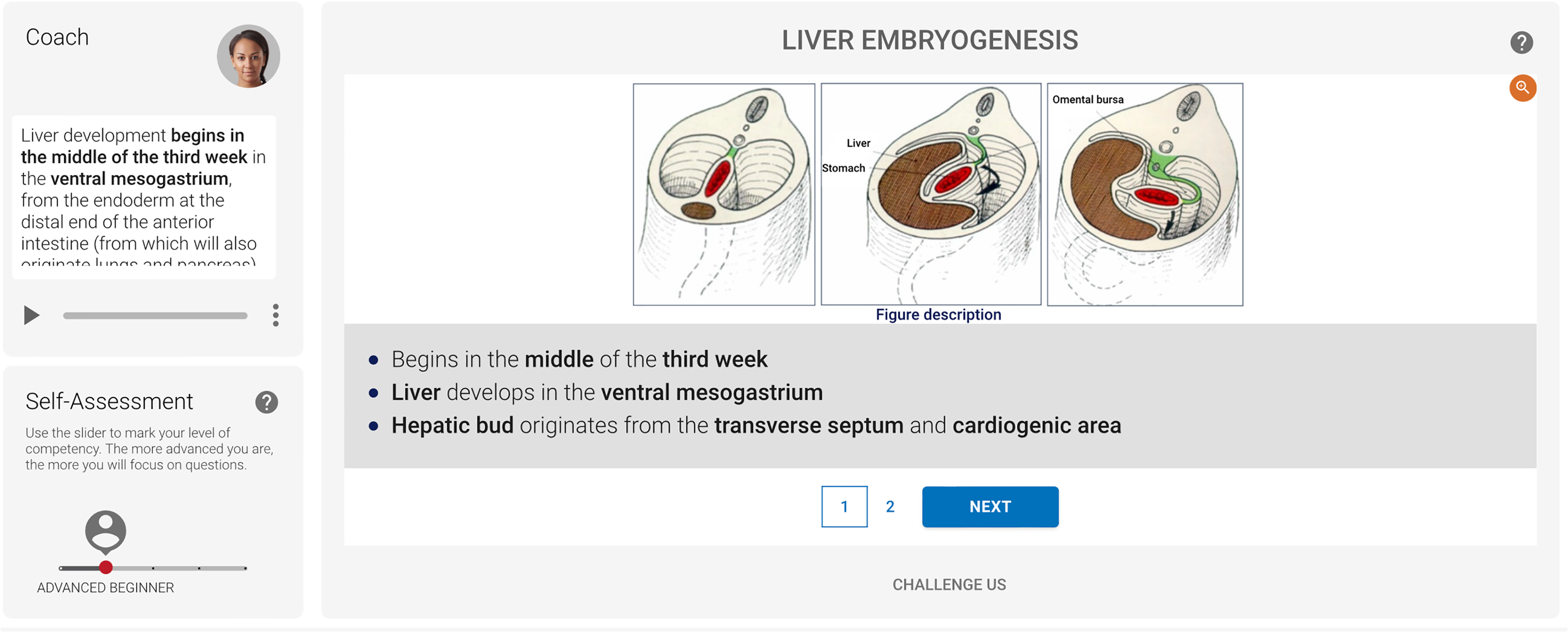
The figure illustrates an example regarding the learning module. The box on the left presents the delivered concept (also in audio form) and the user's chosen proficiency level.

The figure displays an example of a test concerning the learning module. In the central part of the figure, the user must input the choices deemed correct on the figure and define their own level of knowledge.
For every question posed to students, as well as whenever a learning resource is presented to them, before they can proceed, the system asks them to also indicate their level of confidence regarding their knowledge and answers (ie, for question: I know - I think so - I'm not sure - I have no idea; for resources: I knew it - Now I understand - I think I understand - I don't understand).
The AI-driven system collected comprehensive data on student performance, including advancement rates and time taken to achieve mastery. Additionally, metacognitive data was collected, assessing students’ confidence levels and awareness of their knowledge gaps.
At the end of the test, the students were given a non-mandatory anonymous pilot-tested questionnaire, automatically sent to the students who had taken part in the experiment.
Fifty-one (51,8%) participants responded to the questionnaire.
In the days following the test, the AI system generated additional micro-review sessions to ensure retention of knowledge acquired through participation in the asynchronous module.
This research has been submitted as preprint (doi:10.20944/preprints202401.0218.v1).
Statistical Analysis
Data related to the questionnaire administered at the end of the module were analyzed using the SPSS software (IBM Corp., Armonk, NY, USA). To provide a measure of the internal consistency of the test, the Cronbach alpha index was calculated.
Results
The outcomes of the pilot project indicated significant improvements in learning outcomes and student engagement. The students demonstrated high levels of mastery acquisition, with an average progress rate of 98%. Among the participating students, 115 out of 123 (93.5%) achieved a 100% progress, indicating full mastery of the defined learning objectives within the adaptive learning module. The average time taken to achieve full mastery of the 34 learning objectives was 38 min and 25 s. The minimum time recorded for achieving 100% advancement was 19 min, while the maximum time was 58 min.
Analysis of the metacognitive data revealed that, initially, students exhibited a 19.43% level of unconscious incompetence, ie, they answered almost every fifth question stating they believed to know the subject, but they actually didn’t (Figure 3a, b).

The graphs show the cross-over levels of initial (a) and final (b) proficiency and awareness of the participants. The initial unconscious incompetence detected by the system was 19.43%. In the current literature, the average amount of topics that, when questioned, “you think you know but do not actually master” (definition of unconscious incompetence) fluctuates between 22% and 28% in groups of students interested in a subject but not yet experts in it. This is a crucial indicator, especially in areas where presumption can have fatal consequences.
Additionally, students displayed a 18.11% level of conscious incompetence, recognizing thereby their lack of knowledge in some learning objectives. However, in 50.86% of the cases, students exhibited conscious competence, indicating a strong awareness of their knowledge.
After participating in the adaptive learning module, only 1.87% of students remained in the category of unconscious incompetence.
Moreover, the majority of students (98.73%) demonstrated conscious mastery of the materials, with a clear understanding of their level of competence.
The interactive in-class session facilitated discussions and clarifications for topics that were identified as more challenging based on the AI system's data analysis. Students expressed increased clarity and understanding compared to traditional in-person lectures.
The Rhapsode platform's analytical tools enabled also to collect valuable data regarding to the progress of each individual student, as well as of the course as a whole, in detail, helping to develop the best path to reach learning goals.
A heat map (Figure 4 provides a purely indicative snapshot) displays in a concise manner the performance of each individual student (on the x-axis) with respect to the individual learning objectives (on the y-axis).
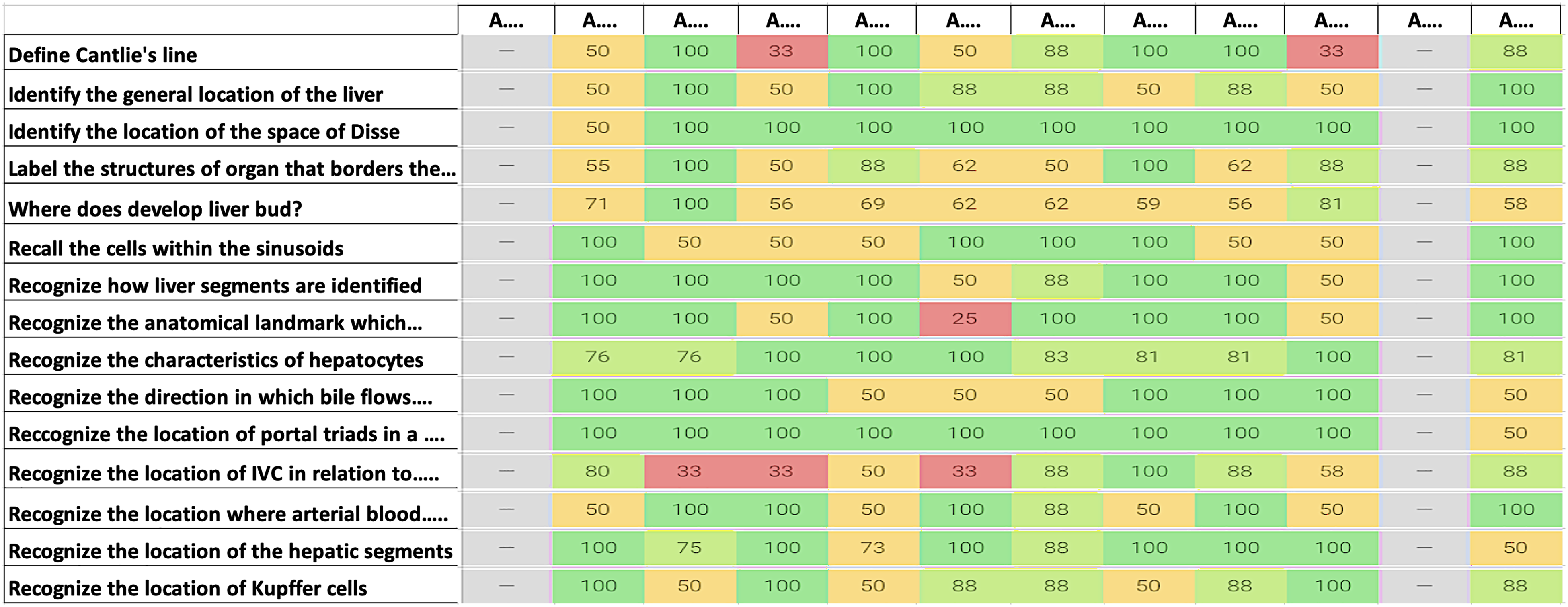
The analytical tools of the Rhapsode platform also make it possible to collect extremely important data regarding the progress of each individual student as well as the course as a whole and in detail. A heat map (of which the figure provides a purely indicative snapshot) summarizes the performance of each individual student (on the x-axis) with respect to the individual learning objectives (on the y-axis).
The detailed analysis of the thermal map of the course made it possible to identify two learning objectives that required improvement in the resources provided to the students for learning.
On the other hand, the presence of too many yellow or red rectangles in the vertical columns, allowed us to identify 11 students out of 123 who could benefit from a supplement of personal help, especially from the point of view of study method.
The questionnaire administered at the end of the module included three questions, two with a pre-given scale of possible answers, and one open-ended.
At the first question (“How useful was this system for learning the materials proposed in the module?”), 39.2% of students responded extremely helpful, 51% very helpful, and 9.8% quite helpful. No student reported finding the system to be of little or no use.
Regarding the second question (“In your opinion, compared to what you would consider reasonable, how much time did you dedicate to this module?”) 90.2% of students reported dedicating a reasonable amount of time, 7.8% reported too little time, and 2% reported too much time.
The Cronbach alpha index for the first two questions—the only ones for which it was suitable to apply this type of calculation, based on answers placeable on a scale of values—was 0.79, confirming the internal consistency of the questionnaire.
The third question was open-ended and optional. Based on the responses (cumulative responses are reported in the Appendix), it is evident that students were highly satisfied with the quality of learning facilitated by adaptive learning. They also expressed a desire to extend this method to other topics and subjects, as well as a preference for additional in-depth materials on the studied topic, prepared using the same system.
Discussion
The findings of the pilot project underscore the potential of flipped classroom learning and AI-based adaptive learning platforms in anatomy education, allowing monitoring of student activity based on models that could accurately predict student outcomes. The personalized learning experiences offered by the Rhapsode platform empowered students to take an active role in their learning process. The integration of AI technologies facilitated the identification of individual learning needs, promoted critical thinking skills, and optimized learning outcomes.
The preliminary pedagogical considerations highlighted the importance of high-quality learning materials, continuous assessment, and professional development of teachers to effectively implement adaptive learning systems.22,23
Lazarus et al have examined the risk of tensions between the promises and perils of integrating AI into anatomy education. These tensions involve areas such as human variations, healthcare practice, diversity and social justice, student support, and student learning. In this regard, adaptive AI in educational settings for the study of anatomy could serve as a supplemental resource to be developed and integrated within a context where the student-teacher relationship remains central to the learning process. It would function as a tool allowing students to learn to self-assess (unconscious incompetence), understanding their limitations concerning the topics presented, and simultaneously enabling them to utilize this tool at their own pace. Moreover, adaptive AI is suitable for a personalized approach that could be utilized by students according to their personal characteristics, including those with learning disabilities. 24
The integration of adaptive learning modules into anatomy education offers several benefits. Firstly, it enables students to learn at their own pace, ensuring a comprehensive understanding of the subject matter. The platform's adaptive nature ensures that students receive targeted instruction, addressing their specific areas of weakness while reinforcing their strengths. This personalized approach enhances student engagement, motivation, and knowledge retention.
Furthermore, the AI-driven system provides valuable insights into student performance, allowing educators to identify common areas of difficulty. These data inform instructional design and curriculum development, ensuring that teaching materials and resources are tailored to meet the specific needs of learners. The platform's metacognitive assessment tools also contribute to students’ self-awareness of their learning progress and areas for improvement, fostering lifelong learning skills.
The interactive in-class sessions could complement the adaptive learning modules by providing opportunities for real-time discussions, questions, and deeper exploration of complex topics. The teacher's role shifts from that of a traditional lecturer to a facilitator, guiding students through active learning experiences. This could have a positive impact not only in preclinical settings but also when medical students engage with patients during clinical years. Salam et al have underlined that bedside teaching is a vital component of medical education and bedside teacher must learn how to involve patients and learners in the educational processes. 25
In this context, adaptive learning modules, by promoting critical thinking, focused teaching, problem-solving, and collaborative skills, could have a positive impact on the development of essential competencies for future healthcare professionals.
The project's results also underscored the importance of continuous assessment and immediate, meaningful feedback. The AI-driven system collected detailed data on student performance, enabling educators to identify knowledge gaps, misconceptions, and areas requiring additional support. This data-driven feedback on performance allows for timely interventions, personalized remediation, and targeted teaching strategies, significantly impacting the results and quality of the educational offering.26,27
Furthermore, the feedback loop encourages students to reflect on their learning progress and actively engage in self-directed strategies that could enhance their learning experience. Lastly, the system also enables quick and efficient evaluation of resources provided to students. The analysis of issues revealed by AI showed that a significant percentage of students tended to choose a specific incorrect answer in four questions. This issue can be addressed by adding a micro-correction to these incorrect answers, which will be immediately presented to students when the system notifies them of their mistake. Additionally, the system allows curators and teachers to modify and adjust learning materials, enabling a more dynamic and responsive learning experience that evolves with students and the continual challenges of scientific knowledge. The success and positive outcomes indicate the potential for applying adaptive learning modules to other anatomical areas.
However, the potential effects of AI on the teaching of anatomy are still a matter of concern. Cornwall et al underlined the need to assess the effects of the introduction of AI into healthcare education on the essential human-to-human connections that form the foundation of healthcare practice. 28
Experiential human connections remain the “core” of medical formation and exposure to donors and dissection room time provides students with an educational approach to anatomy learning. In this context, AI human body simulation could complement rather than replace cadaver dissection sessions. Additionally, the integration of AI into a medical education curriculum represents an important aspect, also concerning teacher training, that requires further investigation.
This study has potential limitations.
One limitation is that it only focuses on a single anatomy topic, namely the liver model. Our findings, supported by metacognition results and students’ comments, encourage us to continue the experimentation by extending it to the development of further adaptive modules on other anatomical organs.
A second limitation is that the study involved students attending the Anatomy Course taught by the teacher who developed the scientific part of the module. In the future, it would be interesting to propose this approach in other Anatomy course contexts, involving different teachers and universities.
Lastly, another limitation is related to the reduced sample of participants, specifically 51 (51.8%) out of 123, who answered to the pilot-tested questionnaire. Our findings are in line, if not superior, with what is reported in the literature, where an average response rate of 44.1% has been documented across a sample of online surveys. 29 There is no straightforward explanation for the low participation rate in the survey compared to the application. However, it should be noted that completing our questionnaire was not mandatory. In the future, to attain a higher response rate, it will be essential to pre-contact potential participants, strengthen connections between participants and the teacher, integrate various survey methods, utilize phone or online reminders, and prevent misunderstanding of the study's purpose.
Conclusions
This study explores the potential of AI and adaptive learning, which combine advanced machine learning algorithms with a more responsive and flexible approach to autonomous learning, aiming to enhance the teaching and learning of anatomy. The study offers valuable insights into improving teaching methods, personalizing learning experiences, and promoting metacognitive awareness among medical students. This enables students to assess their level of proficiency and intervene where necessary, such as when they believe they are competent but lack confidence or when they lack competence despite demonstrating proficiency. By harnessing AI and adaptive learning technologies, anatomy education can evolve to meet the demands of the digital era, ensuring that future healthcare professionals possess comprehensive anatomical knowledge.
Footnotes
Acknowledgments
The authors would like to express their gratitude to the participating students for their active involvement and valuable feedback in this pilot project.
Author contributions
Conceptualization: M.P. and M.V.; methodology, M.V.; software, M.V.; validation, M.P, G.V., and M.V.; investigation, M.V. and M.P.; writing—original draft preparation, M.V.; writing—review and editing, M.V. and M.P..; supervision, G.V., M.P., and M.V.; project administration, M.P. and M.V.; funding acquisition, M.V.
All authors have read and agreed to the published version of the manuscript.
DECLARATION OF CONFLICTING INTERESTS
The authors declared no potential conflicts of interest with respect to the research, authorship, and/or publication of this article.
FUNDING
The author(s) disclosed receipt of the following financial support for the research, authorship, and/or publication of this article: Fondazione Romeo ed Enrica Invernizzi, Regione Lombardia under the Program “Call Hub Ricerca e Innovazione” POR-FESR 2014–2020 Project —PRINTMED 3D, (grant number Project ID 1170989).

Appendix
Herein are resumed the comments of the students.
Excellent project that helps you learn content quickly and intelligently. It would be very interesting to see the difference in learning before and after the lesson and/or individual study do it more calmly independently from home. The final results are very useful and allow you to have a conscious understanding of your preparation. I would have only added more videos/3D models to better understand the relationships of the liver with the various organs. If this method could be used for all topics, the lessons would be more interactive and the oral lesson would also be easier to follow. I really appreciated the possibility of choosing, for each answer we gave, the level of security of our choice. Very clear explanations of the theoretical part. The system was very effective in understanding the lesson given in the classroom. I found the form very clear. I would like it to be possible in the future to access greater levels of depth on the topic. I believe that the module is very effective for focusing on unclear concepts and for immediately testing myself. If it is possible, I would suggest doing it again for other topics. I found this module to be very effective from a learning point of view. I hope we can replicate the experience with other modules I really liked the learning method, maybe I would have asked more questions on the different topics to make sure I understood it 100% In view of the exam, I would like to have more in-depth material related to other organs. It was very helpful, the material clear and easy to understand. It would be nice to do this again for other topics. It was very useful to follow this preparatory module for the lesson on the liver as it allowed me to Better establish the concepts and become aware of my level. I was happy with the topics proposed and with the system itself, the only very small comment I would like to make concerns the automatic text reading mode: although it was set to “automatic playback,” it did not start automatically but needed to be still. Clicked with the play button most of the time. Maybe it's a small problem that only I've encountered, but it's truly minimal and negligible!