




Abstract
Background:
The shift in the medical education system from a time-based to a competency-based model has encouraged its adoption and application in competency-based education in anatomy classrooms, such as team-based learning models and flipped classroom models. This pilot study aimed to build on previous work of the linkages between anatomy-based learning (a flipped classroom model inspired by a modified team-based learning) and student learning and engagement, and further to assess the linkage between anatomy-based learning and academic performance.
Methods:
A sequential mixed-methods design was employed to first gather and analyse quantitative data, including confidential student first semester scores in anatomy: gender, stream, anatomy-based learning, and final anatomy overall mark. The quantitative phase was followed by a qualitative phase in which a series of 8 anatomy laboratories were observed (4 anatomy-based learning and 4 traditional). Thematic analysis was performed on the observation data.
Results:
Aggregate anatomy-based learning and traditional stream tests, and final unit scores were compared. The anatomy-based learning and final unit scores showed little difference between students in the anatomy-based learning and students in the traditional stream. Students using anatomy-based learning had an aggregate score of 1.15 and final aggregate mark of 72, whereas students in the traditional section had an aggregate score of 1.19 and final mark of 79. Qualitative phase was undertaken to try to assess the linkages between anatomy-based learning and student learning. Observations showed that students in the anatomy-based learning section spent more time on task as compared with their peers in the traditional stream. The anatomy-based learning students also seemed to practice more self-directed learning and employed more multimodal learning strategies than the traditional section stream.
Discussion/conclusions:
Although the quantitative results of this study showed no significant difference in mean scores between anatomy-based learning and traditional designs, it was possible to observe the potential of flipped classroom model in engaging students in individual preparation, in team-based learning, and in consensus-based learning approaches.
Keywords
Background
In transitioning from a time-based to a competency-based medical education system, the focus of curriculum (and curriculum delivery) is now one of a learner-centred approach that emphasizes achieving specific outcomes called milestones. Entrustable professional activities (EPAs) are processes that link learned competencies to clinical practices, defined as tasks or responsibilities entrusted to a trainee once the specific competency or milestone is deemed as ‘reached’. 1 Among the basic sciences, anatomy is often a logical starting point for implementing competency-based education because the traditional courses already include experiential laboratory sessions as well as didactic classroom time. 2 This is particularly relevant and timely at our institution in that a modified team-based model was already in place for most of anatomy sessions.
Competency-based medical education provides new challenges to teaching faculty to become ‘trained observers’. Evaluation of learner success within a framework of EPAs and associated milestones is far more challenging when compared with traditional assessment methods. 3 A review of the competency-based implementation literature reveals that an important step has been left poorly designed – the curricular design.
The objectives of the current work were threefold. First, we sought to build on our previous work of the linkages between team-based learning (TBL) and student learning and engagement. 4 Second, we wanted to obtain more evidence of the TBL and academic performance linkage. Finally, our data revealed that we were prepared to map out some key anatomy competencies, particularly medical expert, collaborator, and communicator.
Our institution began using a flipped classroom (FC) model inspired from a modified TBL approach (see Figure 1), herein called anatomy-based learning (ABL).4,5
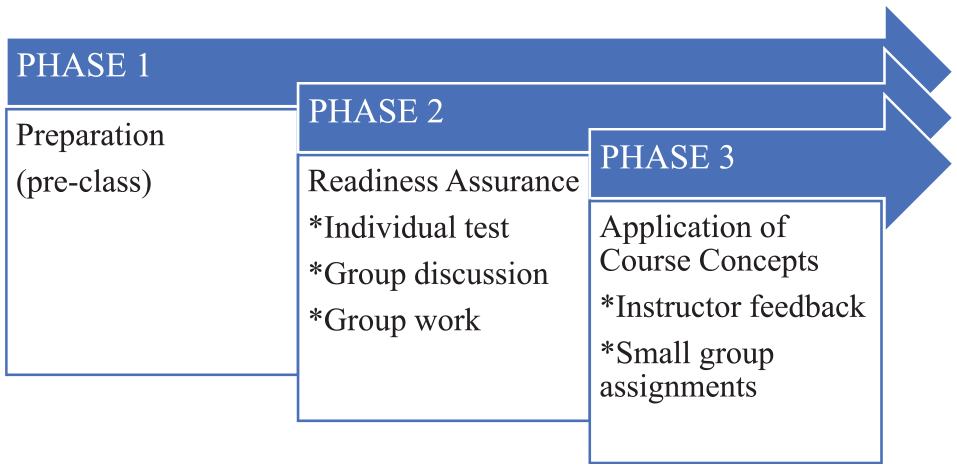
The sequence of activities in modified team-based learning: anatomy-based learning (ABL).
Methods
The modified ABL processes adopted in this pilot project were described extensively elsewhere. 4 Much like the traditional TBL model, the modified ABL model included 7 core elements of TBL: team formation, readiness assurance, immediate feedback, sequencing of in-class problem-solving, the 4 Ss (content [significant problem], structure [same problem and specific choice], and processes [simultaneous reporting]), incentive structure, and peer review. In short, in the ABL stream, each team followed a curriculum including group discussions, oral appeals, immediate feedback from facilitators, and work in groups at cadaver stations. The teams were formed by the faculty director, taking in consideration of students’ backgrounds in human anatomical knowledge. The students remained in same teams for the semester. The students in the traditional stream (TS) received traditional didactic teaching where the instructor alone gave demonstrations in the anatomy laboratory and the students were not actively engaged. This pilot study employed a sequential mixed-methods approach. 6 Quantitative data included confidential student final first semester anatomy scores. Scores were broken down by gender, stream, ABL, and final laboratory exam overall mark. Aggregate ABL and TS individual tests, and final unit scores were compared.
Qualitative data were collected via participant observation. A series of 8 anatomy laboratories were observed (4 ABL and 4 TS) using a pre-designed observational protocol. Six groups of mixed gender teams of 5 to 7 students were observed during each anatomy laboratory sessions, and students were in their first year of medical school. The observer (expert in qualitative observational methods) took ongoing field notes as students moved through all the cadaveric stations. All field notes were transcribed and entered into NVivo qualitative analysis software for inductive coding. 7 Thematic analysis was employed to analyse emerging themes.
This pilot project was reviewed and approved by the Institutional Review Board from the University of Ottawa, Faculty of Medicine.
Results
Comparisons of students in the ABL and the TS showed small difference in ABL individual tests and final exam mark mean scores (Table 1). Students using ABL had an aggregate laboratory score of 1.15 and final exam mark of 72, whereas students in the TS section obtained a slightly higher mean scores, with an aggregate laboratory score of 1.19 and final exam mark of 79.
Mean aggregate laboratory score and final mark of students in the TS and ABL sections.

Abbreviations: TS, traditional stream; ABL, anatomy-based learning.
We were curious to further test the assumption that the academically weaker students could ‘academically’ benefit from the ABL method 8 and compared results of students in the lowest quartile from each of the 2 groups (Table 2). When we compared the results obtained by students in the lowest quartile, the students in the ABL section obtained a relatively higher final mark (70 compared with 63 in the TS section).
Mean aggregate ABL score and final exam of students in the TS and ABL sections, limited to the lowest quartile.

Abbreviations: TS, traditional stream; ABL, anatomy-based learning.
Furthermore, mixed gender teams of 5 to 7 students were observed during their anatomy laboratory sessions. Observations revealed that students in the ABL section spent more time on task (eg, time spent at each cadaver station) as compared with their peers using a TS approach. Similarly, the ABL students were less reliant on the facilitator to ‘tell them the answers’. Finally, the ABL groups employed more multimodal learning strategies (eg, computerized assistance, seek out text book, and/or plastic models) than the traditional section stream. A student in the ABL group mentioned,
If one person thinks that this [pointing to the artery] is the aorta and another person doesn’t . . . well . . . you’re going to kind of have to determine why this is so. So, the TBL approach can establish good team building, and initiative . . . especially self-initiative. People think this way [TBL] is a lot more motivating and engaging.
Through our observations, we have attempted to construct a competency matrix mapping out the competencies and associated milestones for the CanMEDs roles of communicator, collaborator, and medical expert (Table 3). Table 4 presents the CanMEDs roles and competences that were present in the ABL and in the TS approaches in this pilot study.
Assessment rubric for entrustable professional activity (EPA): anatomy.

CanMeds roles and enabling competences present in ABL and traditional approaches to anatomy teaching and learning.

Abbreviation: ABL, anatomy-based learning.
Discussion and Conclusions
This short report adds to the growing literature that TBL encourages student engagement in their learning.9-11 In addition, anatomy teaching is rapidly evolving, including teaching models that use virtual and augmented reality technologies.12,13 Therefore, assessments of new teaching models such as the ABL evaluated in this pilot study add to the growing knowledge base of innovative teaching models in anatomy and medical education. Comparative observations of students using a TBL versus more traditional learning approach show that the TBL students spend more time on task and were less reliant on the facilitator to readily provide them with answers. TBL’s strategic sequence, when repeated multiple times during a course or academic term, encourages conscientious individual preparation while developing teams into cohesive learning groups. TBL also provides frequent opportunities for peers to enhance learning, as teammates talk and listen to each other to arrive at consensus decisions. Faculty often observe considerable energy and engagement of students during team discussions.4,14
Few studies, however, have attempted to correlate the use of TBL with students’ academic performance. Our pilot study showed virtually no change in scores for students using the TBL method versus students in a more traditional approach. Similarly, Nieder et al 15 showed no change in mean scores with performance in the use of TBL (using a pre-post TBL implementation design). Perhaps, the most significant finding is that the failure rate for the TBL approach had decreased, which suggests that the academically weaker students may benefit from TBL. 8 In their study, Koles et al 14 found that TBL provided a larger learning benefit for lower achieving students compared with higher achieving students.
There are several limitations to this short study that should be noted. First, this was a pilot study with a small sample of students and 2 lecturers. Second, there may exist other factors affecting students’ marks between the ABL and TS, aside from the learning approaches. Finally, having 1 person conduct observations may have introduced observer bias into the results.
However, some valuable lessons were learned from this pilot project. We have successfully restructured a traditional basic science course as integrated student-centred sessions using specific competencies as templates. In addition, based on our preliminary findings, we are in the process of developing a matrix outlining appropriate and collaboratively agreed upon EPAs for the CanMEDs roles of communicator, collaborator, and medical expert. It is anticipated that such milestones will enable students to better understand the progression and significance of their anatomy learning and produce increased levels of students’ engagement within the anatomy laboratory component of their training.
Footnotes
Author Contributions
All authors contributed to the design of this project, analysis of results, writing, and final approval of this manuscript.
Funding:
The author(s) received no financial support for the research, authorship, and/or publication of this article.
Declaration of conflicting interests:
The author(s) declared no potential conflicts of interest with respect to the research, authorship, and/or publication of this article.
