



Abstract
Objectives
Due to the limitations of the Coronavirus disease pandemic, medical applicants have relied on remote means of information, such as a program's website, to decide where to apply. However, studies have shown that many residency and fellowship websites lack information. Vascular neurology fellowship websites have not yet been studied. This study evaluates the availability and accessibility of information on vascular neurology fellowship websites.
Methods
From 2021 to 2022, a total of 109 U.S. vascular neurology fellowship programs from the Fellowship and Residency Electronic Interactive Database were investigated to determine whether they had websites. Each website was evaluated on the immediate availability of 34 different criteria, which were deemed important by past studies. These criteria were reviewed under four categories: program overview, application information, fellow life, and curriculum. The comprehensiveness of the information among these different categories were analyzed. Programs were grouped by geographic region and electronic residency application service (ERAS)-participation status and comparisons were made within these groups.
Results
There were 107 programs with websites (98%). ERAS-participating programs fulfilled more criteria on average than non-participating programs (P = 0.004). All websites provided information on general descriptions of their programs, but information on board exam pass rates, fellow testimonials, history of the fellowship program, responsibility progression, family and social events, parking availability, and application deadline were provided by less than 25% of websites.
Conclusion
This study found that there was a large lack of information on vascular neurology fellowship websites, which could be improved to attract more applicants.
Introduction
The Internet serves as an important resource for prospective candidates to learn about medical training programs. Social media and official program websites guide application decisions for residency and fellowship programs.1–3 Studies have demonstrated that visits to emergency medicine program websites peak during key dates in the application and match cycle, such as the opening day of the electronic residency application service (ERAS) 4 submission. 5
Due to the disappearance of in-person, on-site interviews during the Coronavirus disease (COVID) pandemic, an increasing number of applicants have turned to program websites for information.6,7 In the 2020–2021 virtual Match cycle, 99% of family medicine applicants accessed program websites to inform their decisions. 8 Now, in a post-COVID era, where some, but not all, medical programs continue to prefer solely virtual interviews per recommendation by the Association of American Medical Colleges, candidates are likely to continue to rely heavily on virtual sources of information. 9 Although the importance of high-quality websites has been well-reported, there is a widespread lack of information on program websites across a myriad of specialties including emergency medicine, surgery, and neurology.10–15 This represents an important gap to bridge, as missing information on a program website was enough to deter 41% of potential residency candidates from applying to that program, demonstrating the significance of website comprehensiveness to applicants. 16
Yet, there has been no attempt to evaluate the comprehensiveness of vascular neurology fellowship websites. With a growing shortage of neurologists and vascular neurologists, identifying general deficiencies across vascular neurology program websites can help guide adjustments to better attract current candidates of an Internet-adapted generation.14,17,18
This study reviewed the information available on 107 vascular neurology fellowship websites in the United States and judged their comprehensiveness based on the presence of information such as salary, clinical rotations, and fellowship testimonials. The purpose of this study was to identify the areas in which vascular neurology websites excel as well as areas in which they can improve. We hypothesized that the comprehensiveness of vascular neurology fellowship program websites will differ for various types of information.
Methods
A cross-sectional analysis was performed on vascular neurology fellowship program websites using quantitative and descriptive statistics. A list of 109 vascular neurology fellowship programs was found on the Fellowship and Residency Electronic Interactive Database (FREIDA) 19 in December 2021. These programs were pre-stratified in the FRIEDA by their geographic location in the west, midwest, northeast, and south. ERAS-participating status was determined by information provided in the FREIDA or the presence of a direct link to the ERAS website on the program's website.
Out of 109 total vascular neurology programs, only 107 programs had websites that could be evaluated in the period between December 2021 and May 2022. Each website was searched on the Google search engine with the name of the institution, followed by the words “vascular neurology fellowship.” The website was then carefully analyzed for 34 different criteria (Table 1, Supplemental Table 1). The list of criteria was chosen based on the criteria that residency applicants found important or the criteria used in previous fellowship and residency studies.13–16,20–23 These 34 criteria were classified under one of four different categories, which have been used for classification in past studies: program overview, application information, fellow life, and curriculum. 24
Criteria, number of websites containing this information, and the percentage of these numbers relative to all 107 vascular neurology fellowship websites.

ERAS = Electronic Residency Application Service.
Percentages calculated out of n = 107 websites.
Websites were only given credit for criteria that were directly addressed on the home page of the fellowship website, often via a labeled tab, header, or direct link. If information required more than one click away from the home page to be seen, such criteria were deemed inaccessible, unless the second click directly opened a corresponding web page, PDF file, played a video, etc, with information. This condition ensured that a website met a criterion only if the applicant would not have to search extensively for its information.
If a website displayed unclear or vague information about any criterion, the criterion was marked as missing. For example, if it was not clear whether a website's information applied specifically to the vascular neurology fellowship program or generally to all its residency programs, or if the information was outdated, then the website failed to meet that criterion. This study was granted exempt status by the Institutional Review Board at the primary author's institution, and in lieu of a formal ethics committee, the principles of the Helsinki Declaration were followed.
Statistical analysis
All statistical analyses were performed using R. The number of programs among different regions of the U.S. was compared using the Exact Binomial Test, and the relationship between region and ERAS-participation status was determined by the Fisher's Exact Test. The availability of information on each website was analyzed via descriptive statistics and results from Kruskal-Wallis, Wilcoxon Rank-Sum, and one-way ANOVA tests, which were followed by Post-Hoc Tukey HSD tests with adjusted P-values (p-adj.). These results do not reflect any potential changes made to the websites or any new vascular neurology fellowship programs established after the conclusion of this study. P-values < 0.05 were considered significant.
Results
There was a total of 109 accredited vascular neurology fellowship programs in the U.S. These programs were grouped by geographic location: 17 in the west (15.6%), 26 in the midwest (23.9%), 30 in the northeast (27.5%), and 36 in the south (33.0%). The number of programs was statistically significantly lower in the west and higher in the south compared to the other regions (P = 0.033 and P = 0.044, respectively; Exact Binomial Test). According to the FRIEDA, 101 of 109 (93%) programs participated in ERAS. A program's ERAS-participation status was not associated with its region (P = 0.282, Fisher's Exact Test, Supplemental Table 2).
Out of 109 total programs, 107 had websites (98%). The average number of criteria described on each website was 17.6 ± 4.5, which corresponded to 52% ± 13% of 34 criteria. Programs in the west described the greatest percentage of criteria (54% ± 17%) compared to the midwest (52% ± 13%), northeast (53% ± 12%), and south (50% ± 13%) (Table 2, Supplemental Figure 1). However, no statistically significant difference was found between the number of criteria described on each website for different geographic locations (P = 0.766, Kruskal-Wallis Test). Programs that participated in ERAS reported a higher number of criteria on their websites than programs that did not participate in ERAS (P = 0.004; Wilcoxon Rank-Sum Test; Table 2; Figure 1). ERAS-participating programs satisfied 53% ± 13% of 34 criteria, whereas non-ERAS-participating programs only met 37% ± 13% of criteria.

Percentage of criteria satisfied in each category by programs stratified by electronic residency application service (ERAS)-participation status.
Summary statistics for criteria satisfied per geographic region and ERAS-participation status.

ERAS = Electronic Residency Application Service; SD = standard deviation.
Kruskal-Wallis Test.
Wilcoxon Rank-Sum Test.
Percentages calculated out of n = 34 criteria.
Information regarding a general description about the program (100%), contact information (98.1%), and research opportunities (96.3%) were the most frequently described. Less than 25% of vascular neurology program websites included information on board exam pass rates (4.7%), fellow testimonials (8.4%), history of the fellowship program (14.0%), responsibility progression (15.9%), family and social events (15.9%), parking availability (22.4%), and application deadline (22.4%) (Table 1).
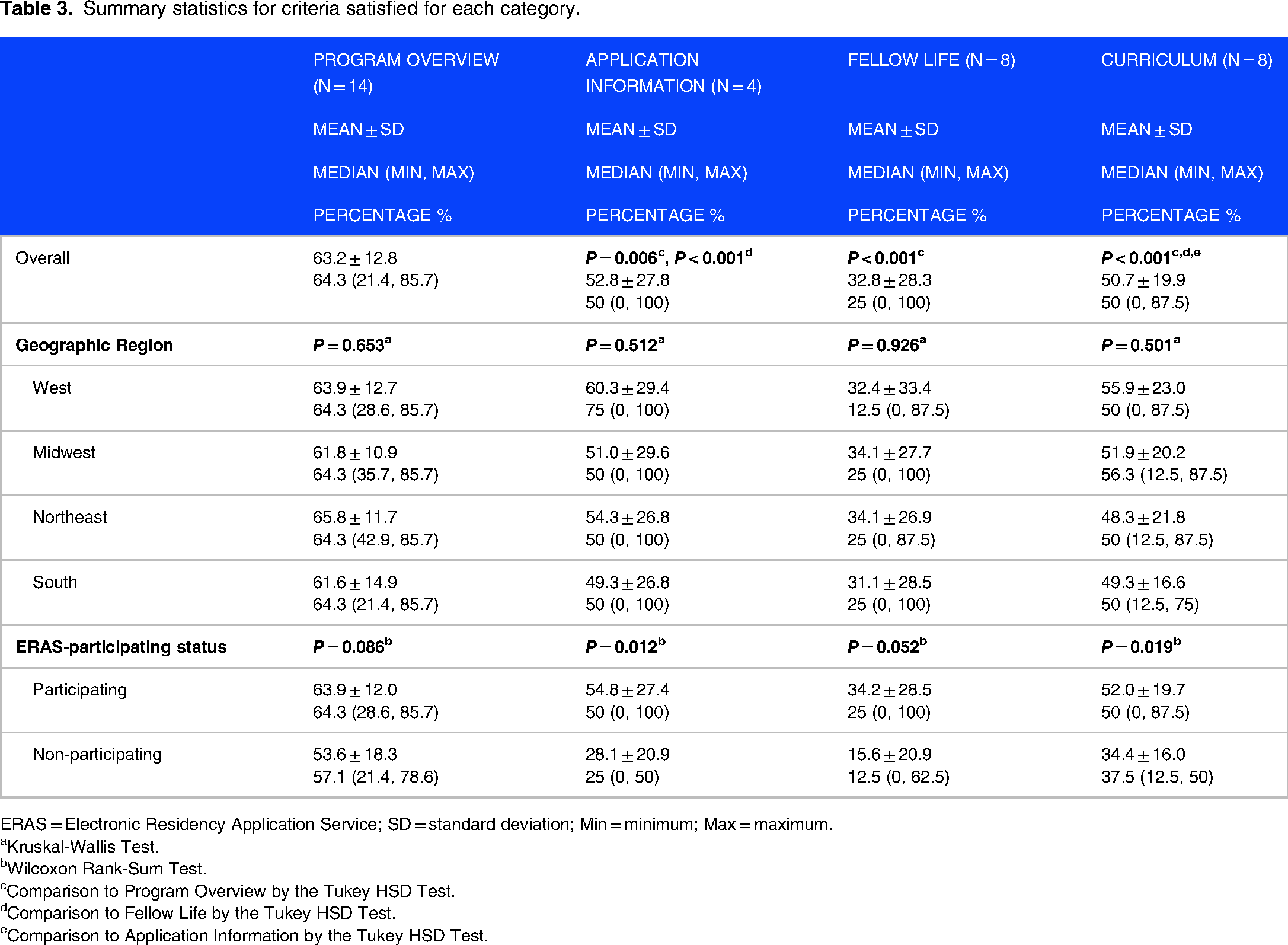
The 34 criteria were also analyzed under one of four categories, and the mean percentage of criteria satisfied in each category was calculated: program overview (63.2% ± 12.8%), application information (52.8% ± 27.8%), fellow life (32.8% ± 28.3%), and curriculum (50.7% ± 19.9%, Table 3). There were significant differences in the percentage of information satisfied among these four categories (P < 0.001, ANOVA, Figure 2). Fellowships reported a significantly higher percentage of information about the program overview than application information, fellow life, and curriculum (respectively, p-adj. = 0.006, p-adj. < 0.001, p-adj. < 0.001; Tukey HSD Test; Table 3). In addition, these websites lacked more information on fellow life than on application information and curriculum (both p-adj. < 0.001, Tukey HSD Test). However, there was no significant evidence showing a difference between the percentage of criteria reported on curriculum and application information (p-adj. = 0.910, Tukey HSD Test).

Percentage of criteria satisfied for application information, curriculum, fellow life, and program overview.
Summary statistics for criteria satisfied for each category.
ERAS = Electronic Residency Application Service; SD = standard deviation; Min = minimum; Max = maximum.
Kruskal-Wallis Test.
Wilcoxon Rank-Sum Test.
Comparison to Program Overview by the Tukey HSD Test.
Comparison to Fellow Life by the Tukey HSD Test.
Comparison to Application Information by the Tukey HSD Test.
There were no statistically significant differences between a website's comprehensiveness of information on program overview, application information, fellow life, or curriculum based on region (P = 0.653, P = 0.512, P = 0.926, P = 0.501, respectively; Kruskal-Wallis; Table 3; Supplementary Figure 2). When comparing ERAS-participating and non-participating programs, the former satisfied a higher percentage of criteria for application information and curriculum (P = 0.012 and P = 0.019, respectively; Wilcoxon Rank-Sum Test; Table 3; Figure 1). There was no significant difference between the percentage of information reported on program overview between the two ERAS-participation statuses (P = 0.086; Wilcoxon Rank-Sum Test; Table 3). In addition, though ERAS-participating programs provided a higher percentage of information on fellow life than non-ERAS-participating programs, this difference was not statistically significant on the level of 0.05 (P = 0.052, Wilcoxon Rank-Sum Test; Table 3).
Discussion
More than 90% of vascular neurology fellowship websites appeared as the first Google search result and satisfied criteria on general program information, contact information, and research opportunities, but lacked information on fellow testimonials and board exam pass rate. We found that program overview criteria were most satisfied, whereas websites failed to include even half of the criteria for fellow life. Our study also reported a novel result that ERAS-participating program websites described a higher number of criteria than non-ERAS-participating programs.
These fellowship websites met the same criteria as interventional neuroradiology websites, such as general information about the program, a contact email address or number, eligibility requirements, research opportunities, and the program director's name and/or email. 13 The most frequently missed criteria, such as information on meal allowance, parking, responsibility progression, retirement and benefits, and call schedule, were consistent with neuroradiology and interventional neuroradiology fellowship websites.13,15 Although information on meal allowance and parking availability may not be as important to applicants as information on a program's curriculum, these factors are still relevant, as they have been shown to be positive determinants of satisfaction in the workplace.16,25 Although fellowship training may differ in some respects from the general workplace, vascular neurology fellowship programs can benefit from promoting these incentives, especially as well-being and lifestyle become increasingly more important to applicants. 26 Furthermore, criteria regarding the availability of board pass rates, program history, patient demographics, work hours, post-fellowship placement, and current fellows were all important to emergency medicine and anesthesia applicants, yet were missing by more than half of vascular neurology websites.16,21 When comparing vascular neurology websites to radiology residency websites, both were found to provide the most information in the program overview category. 24 However, some of the individual criteria in the program overview category were satisfied by less than half of these programs, such as fellow testimonials, history of the fellowship program, patient demographics, alumni and post-fellowship placement, and number of positions per year and thus need to be improved.
Our finding that there were no significant differences in website comprehensiveness among the four regions was consistent with many other studies on neurology fellowship websites.13,15,22,23 Although our study showed that ERAS-participation status influenced website comprehensiveness, a study on pain medicine fellowship websites did not find this result significant. 22 We predict that programs that do not participate in ERAS may not rely on websites to provide information to applicants, as they may prefer different methods of communication. Future studies can examine the usage and effectiveness of other virtual platforms such as social media by non-ERAS-participating programs and ERAS-participating programs.
Our study has limitations. These results reflect only the data available during the time of this study. It is possible that these websites have updated their information since data was last collected. In addition, though this study focused only on comprehensiveness of individual program websites, there are other online sources where missing information could be listed. However, when compared to these other Internet resources such as discussion boards, forums, social media postings, or ERAS or FREIDA websites, program websites were deemed more important and accessed more frequently for information by applicants.8,21,27,28 Since applicants have reported that a lack of information on a program website alone has deterred them from applying, it is important to address this problem, regardless of the information present on other sources. 16 Furthermore, we recognize that there are many components other than the presence of information that can contribute to the effectiveness of a website, such as its design, esthetic appeal, and user experience. However, as emergency medicine applicants have ranked the presence of information higher in importance than the ease of navigation or esthetic quality of a website, our study prioritizes how vascular neurology programs can improve the lack of information on their websites. 16 Still, vascular neurology fellowship programs may benefit from a future study that investigates how these qualitative aspects of websites impact applicants’ decisions. In addition, these programs may have intentionally excluded information from their websites if they feel that such information could deter applicants. For example, a website may not provide information on parking availability and meal allowance if the program recognizes that its amenities are not as attractive as another program's. Thus, including more information about that specific criterion may not help the program entice more applicants. Nevertheless, a future survey can be conducted to determine the most and least important criteria for vascular neurology applicants to better inform these fellowship programs on which information to include. This study would be important, as the metrics deemed most meaningful to applicants may vary by residency or fellowship. However, present data on the effectiveness of program websites are largely based on the surveyed preferences of applicants, and, to date, there are no studies that demonstrate a correlation between vascular neurology website quality and program filling/match rate. As this objective data can greatly incentivize programs to enhance their websites, it may be important for a future study to investigate this correlation.
To attract more prospective vascular neurologists, vascular neurology programs can use the results of this study to determine the specific criteria and category of criteria they can improve on their websites. Many candidates may be deterred from pursuing a fellowship in vascular neurology due to financial or lifestyle concerns, leading to unfilled positions at programs that thereby contribute to the shortage of vascular neurologists. 18 To address these matters, programs can promote their financial and lifestyle-related benefits on their websites by providing comprehensive information about salary, call schedule, and vacation, among others. Website enhancement thus provides important benefits to both vascular neurology programs and their applicants: these programs can attract more candidates, and applicants can formulate more well-informed decisions for their career goals. These benefits may ameliorate the supply-demand imbalance in vascular neurology as the incidence of stroke continues to climb higher than the supply of vascular neurologists who can treat patients. 18 In a COVID-pandemic-adjusted era where person-to-person communication may be limited and information dissemination relies heavily on the Internet, it is even more important that training programs provide extensive amounts of information on their websites. Although website enhancement can be costly due to additional staffing and funding, a number of programs, such as urology, family medicine, and otolaryngology, have been able to reduce their costs in the virtual interview cycles by hundreds and thousands of dollars, and these savings can now be directed towards improving Internet content.29–31
Conclusion
This study aimed to examine the comprehensiveness of vascular neurology fellowship websites in the U.S. on numerous different criteria. The information found on these websites were limited, and the fewest criteria were met by non-ERAS-participating programs. Information providing a general overview of the program was frequently mentioned, while less than half of the criteria regarding fellow life were addressed.
Supplemental Material
sj-docx-1-mde-10.1177_23821205231225921 - Supplemental material for Evaluation of Vascular Neurology Fellowship Websites in the U.S.
Supplemental material, sj-docx-1-mde-10.1177_23821205231225921 for Evaluation of Vascular Neurology Fellowship Websites in the U.S. by Michelle T Tram, Colum Amory and Kursad Tosun in Journal of Medical Education and Curricular Development
Supplemental Material
sj-docx-2-mde-10.1177_23821205231225921 - Supplemental material for Evaluation of Vascular Neurology Fellowship Websites in the U.S.
Supplemental material, sj-docx-2-mde-10.1177_23821205231225921 for Evaluation of Vascular Neurology Fellowship Websites in the U.S. by Michelle T Tram, Colum Amory and Kursad Tosun in Journal of Medical Education and Curricular Development
Supplemental Material
sj-docx-3-mde-10.1177_23821205231225921 - Supplemental material for Evaluation of Vascular Neurology Fellowship Websites in the U.S.
Supplemental material, sj-docx-3-mde-10.1177_23821205231225921 for Evaluation of Vascular Neurology Fellowship Websites in the U.S. by Michelle T Tram, Colum Amory and Kursad Tosun in Journal of Medical Education and Curricular Development
Supplemental Material
sj-doc-4-mde-10.1177_23821205231225921 - Supplemental material for Evaluation of Vascular Neurology Fellowship Websites in the U.S.
Supplemental material, sj-doc-4-mde-10.1177_23821205231225921 for Evaluation of Vascular Neurology Fellowship Websites in the U.S. by Michelle T Tram, Colum Amory and Kursad Tosun in Journal of Medical Education and Curricular Development
Footnotes
Author Contributions
Michelle Tram: Conceptualization (lead); formal analysis (equal); investigation (lead); methodology (equal); project administration; software (equal); validation (equal); visualization (equal); writing—original draft (lead); writing—review and editing (equal).
Colum Amory: Formal analysis (equal); methodology (equal); validation (equal); visualization (equal); writing—review and editing (equal).
Kursad Tosun: Conceptualization (supporting); formal analysis (equal); software (equal); supervision; visualization (equal); writing—original draft (supporting); writing—review and editing (equal).
Declaration of conflicting interests
Dr. Colum Amory is the director of the vascular neurology fellowship program at Albany Medical Center.
Funding
The author(s) disclosed receipt of the following financial support for the research, authorship, and/or publication of this article: This work was supported by Siena College.

Supplemental Material
Supplemental material for this article is available online.
References
Supplementary Material
Please find the following supplemental material available below.
For Open Access articles published under a Creative Commons License, all supplemental material carries the same license as the article it is associated with.
For non-Open Access articles published, all supplemental material carries a non-exclusive license, and permission requests for re-use of supplemental material or any part of supplemental material shall be sent directly to the copyright owner as specified in the copyright notice associated with the article.
