




Abstract
OBJECTIVES
The objective of this study was to explore current trends in undergraduate fixed prosthodontics teaching at undergraduate dental level education.
METHODS
This cross-sectional descriptive study included close-ended questions to inquire about the teaching practices of fixed prosthodontics at Bachelor of Dental Surgery level education. Electronic copies of the survey forms were sent to the heads or directors of department of prosthodontics responsible for undergraduate dental students teaching and learning in various institutes of Sindh by the help of Google forms in December 2020. The form included questions on sociodemographic details and questions inquiring the theoretical and clinical teaching practices in undergraduate fixed prosthodontics course. Data was entered and analyzed using SPSS 25. Frequency distribution and percentages of categorical variables were recorded.
RESULTS
Out of total 18 dental institutes of Sindh, 15 returned the completely filled form, giving a response rate of 83.3%. Seven (46.7%) schools teach various fixed prosthesis in the preclinical years to their students. All 15 colleges carry out didactic teaching and provide exposure by live clinical demonstrations for various fixed prosthesis. Faculty of 12 (80%) dental colleges where fixed prostheses are being constructed in the dental outpatient department mentioned that their students observe or assist the clinical procedures during their clinical rotation; but none of the students fabricate any type of fixed prosthesis in the clinical setting during their undergraduate years.
CONCLUSION
Didactic teaching and live clinical demonstrations of fixed prosthodontics is being carried out in all dental colleges of Sindh. Almost half of the dental schools teach crown preparation on phantom teeth during their preclinical course. Contrary to this, none of the students fabricate any type of fixed prosthesis in the clinical setting during their undergraduate years. As these procedures are not included in the current undergraduate curriculum, recommendations should be forwarded to governing educational body of the country to include cases of fixed prosthesis in their skill set prior to their graduation.
What Do We Already Know About this Topic?
- Construction of fixed partial dentures is a skill that dental graduates must have competency to manage patients in their dental practices.
- Construction of fixed partial dentures is a skill that should be demonstrated by the faculty and then performed clinically by the student for complete understanding.
- Lack of clarity and any disparities in teaching fixed prosthodontics may result in dental graduates who do not have the necessary competency to treat patients in independent clinical practice, resulting in patient care that may not be up to the mark.
- Studies have been carried out over the years to explore the methods employed to teach the theoretical and practical aspects of fixed prosthodontics to dental students in developed countries.
How Does Your Research Contribute to the Field?
- This is the first study conducted in Pakistan to assess practices in fixed prosthodontics teaching in undergraduate dental institutes.
- The results of the current survey reported that didactic teaching of fixed prosthodontics is conducted in all colleges. Similarly, in all schools where fixed partial dentures are constructed by faculty in the outpatient department.
- This direct clinical experience at the undergraduate level will serve to improve and enhance students’ expertise in rehabilitating patients requiring fixed prosthesis once they graduate.
- This will help to divide the prosthodontics curriculum over the span of 3 years and hence students will have enough time to gain adequate clinical experience for both fixed and removable prosthesis fabrication.
What Are Your Research's Implications Toward Theory, Practice, or Policy?
- This direct clinical experience at the undergraduate level will serve to improve and enhance students’ expertise in rehabilitating patients requiring fixed prosthesis once they graduate.
- This will help to divide the prosthodontics curriculum over the span of 3 years and hence students will have enough time to gain adequate clinical experience for both fixed and removable prosthesis fabrication.
- Recommendations should be forwarded to governing educational bodies of the country to include cases of fixed prosthesis prior to graduation to include this in their skill set prior to their graduation.
Introduction
Recent developments in dental materials and increased patient awareness have brought about considerable improvement in preventive dental care over the past years. 1 On the contrary, studies have shown that there will remain a need of removable and fixed prosthetic treatment in the future because of extended life expectancy and population growth globally. 2 Studies document that about 4% of our elderly population over 65 years of age are edentulous, with a predicted rise to 9.3% by 2030. 3 Conventional dentures have replaced missing teeth as predictable, acceptable, minimally invasive treatment modality for many years.4,5 Shortcomings of removable prosthesis has shifted the focus to fixed prosthetic options for replacement of missing teeth.6,7 Fixed prosthetic options include conventional, resin bonded, or implant retained fixed partial dentures; each having its own merits and demerits. 8 Moreover, the introduction of digital technologies such as digital dental impressions, cone beam computed tomography (CBCT) and computer aided design, computer aided milling (CAD-CAM) systems has made way for novel management strategies and restorative options by contemporary diagnostic tools, improved communication, and treatment planning. 9 Conventional fixed partial dentures (FPDs) are popular treatment modalities to replace missing teeth. Their foremost advantage is the comparatively low cost compared to implant-supported restoration and its ease of maintaining hygiene from the patients’ perspective. 7 Studies show high survival rates of cantilever and fixed-fixed conventional FPDs of 91.4% and 93.8%, after 5 years, respectively. 10
Provision of a successful fixed prosthesis, that is, crowns and bridges need impeccable treatment planning and attention to detail when designing prosthesis. Faulty designing and its execution can lead to undue stresses on the abutment teeth and deleterious effects on periodontium because of food packing and plaque accumulation. This can cause caries, gingivitis, and periodontal problems resulting in loss of abutment teeth and therefore failure of the prosthesis.7,10
Pakistan Medical and Dental Council (PMDC) is the body that frameworks the undergraduate curriculum and develops key competencies of the undergraduate dental program of our country. Construction of FPDs is a skill that dental graduates must be competent to manage patients in their dental practices. Even though didactic teaching is necessary to attain the basic cognitive part of the subject, it cannot equip the students with the competency to execute a skill, especially in independent clinical practice. Construction of FPDs is a skill that should be demonstrated by the faculty and then performed clinically by the student for complete understanding. 11 The test for dental educators of today is to train dentists who are proficient oral healthcare providers. 12 Dentists gain knowledge, acquire technical skills, and get vocational experience in management of missing teeth during the undergraduate years.13,14 Thus, it is the responsibility of faculty at dental institutes to prepare/educate graduates with the necessary competence and professional attributes needed to fulfill challenges of oral healthcare in our community. Lack of clarity and any disparities in teaching fixed prosthodontics may result in dental graduates who do not have the necessary competency to treat patients in independent clinical practice, resulting in patient care that may not be up to the mark. Dental undergraduate programs must thus continually evaluate their curricula to ensure that current treatments and techniques are being taught to the students, so dental health needs of the society will be met once they graduate.12,14
A number of studies have been carried out over the years to explore the methods employed to teach the theoretical and practical aspects of fixed prosthodontics to dental students in developed countries.8,15,16 To the best of our knowledge no similar survey to assess current teaching trends for fixed prosthodontics has been done in our country.
The objective of this study was to explore current trends in undergraduate fixed prosthodontics teaching at undergraduate level education in Sindh, and to determine current trends in techniques and materials being used in dental colleges of Sindh when fabricating fixed prosthesis.
Materials and Methods
This cross-sectional descriptive study was conducted after approval from ethical review committee of Altamash Institute of Dental Medicine, Pakistan (number: AIDM/EC/11/2020/03). The Helsinki Declaration's ethical aspects were followed. The questionnaire used in this study was adapted from previous studies and altered in accordance with our local practice.8,15 The altered questionnaire was mailed to 2 senior content experts; the final survey form was changed as per their comments. The questionnaire was then emailed to 2 heads of prosthodontic department for pilot testing. After they had filled the questionnaire, they were inquired regarding any ambiguities that they encountered in the questions. Any necessary changes identified were made in the questions at this time. These measures helped improve the validity of the questionnaire before it's administration. The close-ended questions to inquire about the teaching practices of fixed prosthodontics at Bachelor of Dental Surgery (BDS) level comprised the survey form.
The heads or director of department of prosthodontics responsible for undergraduate dental students teaching in the dental institutes of Sindh that are recognized by the national governing body (PMDC) and that fulfilled the inclusion criteria were included in our study. The institutes that were recently established were excluded from our study. The well-structured questionnaire was uploaded to Google forms and sent to the head of prosthodontics departments affiliated with 18 dental colleges in December 2020. The self-administered questionnaire recorded the email address and consent of participants. Two reminders, at a week’s interval, were sent by email for return of completed forms. The first section of the questionnaire included items on the sociodemographic details. The second section consisted of questions inquiring the theoretical and clinical teaching practices in the undergraduate fixed prosthodontics course. A contact number was provided for any queries that respondents may have. To maintain anonymity, participants had the option of mentioning if their institute was a public or private sector institute.
Statistical Analysis
The data were entered and analyzed with Statistical Package for the Social Sciences Software (SPSS Statistics, version 25, Chicago, USA). The frequency distribution and percentages of categorical variables was recorded.
Results
Out of total 18 dental institutes of Sindh, 15 returned the completely filled form, giving a response rate of 83.3%. Six (40%) of the dental schools were public, and 9 (60%) were private. Thirteen out of 15 (86.7%) dental schools carried out didactic and practical teaching regarding fixed prosthodontics in fourth year, while 2 (13.3%) of the colleges taught fixed prosthodontics over a span of 2 academic years.
Eight (53.3%) dental schools do not teach fixed prosthodontics in the preclinical years. In all the 7 (46.8%) dental schools where preclinical is taught, students exercise crown preparation on phantom teeth during their preclinical course. Two (13.4%) schools teach bridge preparation and fabrication of provisional restoration to their students in their preclinical course alongside crown preparations. One (6.7%) dental school also teaches wax-up procedure to their students (Table 1).
Exercises carried out by students in preclinical prosthodontics at various dental colleges.

All 15 (100%) dental schools reported that the students do not fabricate any fixed prosthesis in the clinical setting during their prosthodontic rotation. Twelve (80%) colleges mentioned that noninclusion in the PMDC curriculum and time constraints precluded the students to fabricate any prosthesis in their clinical rotation, 1 (6.7%) mentioned the lack of availability of suitable patients. Different methods that were employed to teach fixed prosthodontics to undergraduate students are shown in Table 2.
Methods used for teaching fixed partial denture to undergraduate students.

Indicates that multiple methods are employed by dental colleges, total percentage is >100.
Abbreviations: n, frequency; %, percentage.
Various fixed partial dentures are being fabricated in 12 out of 15 dental outpatient departments (OPDs)/colleges. In all these 12 (100%) dental OPDs, porcelain fused to metal (PFM) and all-metal crowns are being fabricated. Along with these, all-ceramic crowns are fabricated in 3 (25%), zirconium crowns in 2 (16.7%) and veneers in 1 (7.7%).
Faculty of all 12 (100%) dental schools where fixed prostheses are being constructed in the dental OPDs mentioned that their students observe or assist the clinical procedures during their clinical rotation. Out of 15, students of 4 (26.6%), dental schools observe or assist clinical procedures of implant-supported crowns or FPDs during their rotation.
Regarding the impression techniques taught in the dental schools
Out of 15, 9 (60.0%) schools do not have an in-house laboratory for fabrication of fixed prosthesis. Students of only 1 (6.7%) dental school sometimes perform laboratory steps for the fabrication of fixed prosthesis themselves.
All dental schools recommend contemporary fixed prosthodontics by Rosenstiel for teaching fixed partial dentures. Smith and Shillingberg are also recommended as textbooks by 8 of the dental colleges. Out of 15, only 2 (13.3%) dental colleges suggested extra reading of journals to their students along with textbooks. Faculties of 9 (60%) dental colleges were of the opinion that undergraduate students should perform clinical cases of crown/FPD during their prosthodontic rotation as shown in Table 3.
Textbooks recommended for fixed prosthodontics to undergraduate students by various dental colleges.
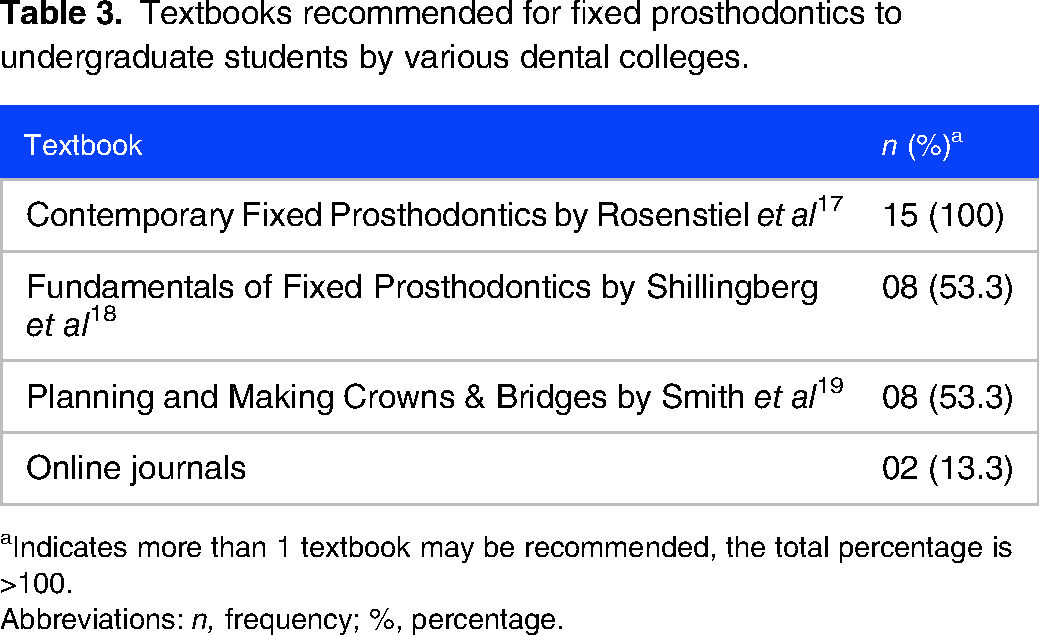
Indicates more than 1 textbook may be recommended, the total percentage is >100.
Abbreviations: n, frequency; %, percentage.
Discussion
This is the first study conducted in Pakistan to assess practices in fixed prosthodontics teaching in undergraduate dental institutes. Although similar studies have been carried out globally, none has been conducted to date in our part of the world.8,15,16
Preclinical courses are the preparatory courses that help students enhance their clinical skills before they enter clinical years.20,21 The results of this survey showed that out of 15, only 7 colleges taught preclinical fixed prosthodontics course to their students. Seven colleges taught PFM crown preparation while only 1 college taught tooth preparation for conventional FPD in addition to porcelain fused to metal crown on phantom heads. Two colleges taught fabrication of provisional restorations, while students in only 1 school carried out wax-up exercises and other laboratory procedures during their preclinical course. None of the college taught tooth preparation for resin-retained FPD. These results are in disparity to studies in United Kingdom and Ireland as their students exercise different types and designs of FPDs in their preclinical course.8,15 The common reported reason was lack of appropriate time within program as well as no inclusion of quota of fixed prosthesis in PMC curriculum. In recent studies by Lone et al, 22 all dental colleges in Pakistan teach removable and complete denture fabrication during preclinical prosthodontics rotation to their students. Rehabilitating patients with fixed prosthesis are as important a treatment modality as removable prosthesis; hence, students must be confident prior to treating such patients in their clinical years. 23 A recent international Delphi survey also reported that 96% of experts agreed to the importance of a dedicated preclinical course for fixed prosthodontics. 11 It is thus imperative that guidelines be formulated to enhance standards of preclinical prosthodontics so similar practices are carried out in all dental institutes across the country.
Provision of fixed prosthesis is an important treatment modality for rehabilitation of a partially dentate patient. A recent dental graduate should possess basic knowledge, skills, and competency to deliver quality dental treatment before they practice independently in dental clinics. The results of the current survey reported that didactic teaching of fixed prosthodontics is conducted in all colleges. Similarly, in all schools, where FPDs are constructed by faculty in the OPD (12 out of 15); students observe the clinical procedures. In stark contrast, none of the students gain hands-on clinical experience during their rotations. In United Kingdom and Ireland, students are required to fabricate fixed prosthesis in prosthodontics department prior to graduation.8,15 Clinical learning achieved by clinical exposure and practice is more important to attain a skill and fulfill the learning outcomes of fixed prosthodontics. In dentistry, clinical training involves students performing irreversible procedures on patients with supervising faculty assuming all legal risks associated with the procedure. 24 Lack of clinical experience during undergraduate years poses challenges to young graduates during treatment planning and management of complex FPD cases. Faculty of 9 (60%) dental colleges agreed that students should treat patients requiring crown or FPD during their prosthodontic rotation. Thus, in the authors’ view, recommendations should be forwarded to governing educational body of the country to include cases of fixed prosthesis for students prior to graduation. This direct clinical experience at the undergraduate level will serve to improve and enhance students’ expertise in rehabilitating patients requiring fixed prosthesis once they graduate.
Another recommendation that has been put forward over the years is to increase the duration of BDS program in Pakistan from 4 to 5 years. 25 This will help to divide the prosthodontics curriculum over the span of 3 years and hence students will have enough time to gain adequate clinical experience for both fixed and removable prosthesis fabrication. Since didactic teaching for both fixed and removable prosthodontics is conducted in final year, the limited year calendar makes it difficult for students to achieve adequate clinical expertise for both fixed and removable prosthesis fabrication during their OPD rotations. In comparison, dental schools of Romania have a 6-year undergraduate dental program, and thus teaching of fixed prosthodontics has been spread out over a span of 3 years. 26
This survey showed that out of 15 dental schools, faculty of 12 (80.1%) schools fabricate PFM and all-metal crowns in their dental OPD, 2 fabricated ceramic and only 1 reported fabrication of veneers and zirconia crowns. None of the colleges are fabricating resin-bonded FPD, CAD-CAM, or implant-supported fixed restoration. It is alarming that we are lacking as compared to the modern world, where advancement in CAD-CAM and ceramics has taken place. 9 Lack of resources and lack of patient affordability have been the most common limiting factor in our setups. In recent years, introduction of adhesive techniques and materials has vastly influenced treatment concepts in fixed prosthodontics. 27 A paradigm shift toward minimally invasive dentistry relies on prosthesis provision removing minimal tooth structure. Contemporary advancements in digital technology and latest restorative materials have given the clinicians a wide array of treatment modalities in fixed prosthodontics. 9 Becoming familiar with the latest advancements and strategies in the field of fixed prosthodontics should be the aim nowadays. However, majority of dental institutes in our setting are still fabricating age-old conventional crowns and FPDs. In the authors’ view, serious efforts should be made by dental institutes to deliver the required resources at subsidized costs that will help the dental educators as well as students to cope with the latest restorative concepts and treatment strategies in fixed prosthodontics.
Out of 15, 6 (40%) dental schools have the facility of in-house laboratory for the fabrication of prosthesis. All the 15 schools in total responded that their students do not perform laboratory steps for the fabrication of fixed restorations. An in-house laboratory can help students see first-hand the laboratory steps and procedures of fabrication of various fixed prosthesis. This will help them attain a basic understanding of the laboratory steps and thus improve the communication necessary between the technicians and clinicians. Studies conducted globally have reported that dentists are ill prepared to communicate with the dental laboratory, do not have adequate understanding of the laboratory techniques and fill only the bare minimum information in work authorization forms.28,29,30
Teaching methods including lectures, live group demonstrations, and hands-on were used as a mode of didactic teaching in majority of the schools. Due to the pandemic situation, all the teaching institutes have been teaching on the web through E-learning. The dental schools face new challenges in the “distance learning” to continue education. Recent studies have reported that students and teachers overall had a positive perception on implementation of online learning and have continued with it beyond COVID-19 as a teaching strategy.26,31,32 However, faculty of dental schools lack teaching skills related to E-learning and there should be proper training facilities provided to the faculty of our dental schools to be trained in E-learning program.
According to the results of our study, only 2 dental colleges advised journals for additional knowledge in conjunction with textbooks. Even though textbooks are the mainstay of learning, journals deliver evidence-based, latest knowledge. All teaching faculties should recommend these to students so they can stay abreast to latest updates in fixed prosthodontics.
It is important to acknowledge that in our study the sample size was not scientifically calculated due to the unique circumstances of our research setting. In Sindh, Pakistan, there are a total of 18 dental colleges recognized by the PMDC, all of which were included in our study. While this approach provided a comprehensive view of fixed prosthodontics education in undergraduate dental colleges, it should be noted that the sample was nonrandomized. As a result, the generalizability of our findings to a larger population may be limited. To enhance the validity of our results, future studies should consider larger, scientifically calculated sample sizes.
Despite the nonrandomized sample, our study provided valuable insights into the current trends in fixed prosthodontics education. By including all available dental colleges in Sindh, Pakistan, we captured a wide range of educational practices and policies, leading to a comprehensive understanding of the subject.
In future, multicenter collaboration with other provinces or regions within Pakistan, or even internationally, would offer a broader perspective on fixed prosthodontics education, facilitating the identification of similarities, differences, and areas for improvement in educational practices. Longitudinal studies following students throughout their undergraduate education would provide a deeper understanding of the evolving nature of fixed prosthodontics education, capturing changes in curriculum, teaching methods, and clinical practices. Supplementing quantitative data with qualitative research methods, such as interviews or focus groups, can yield a more comprehensive understanding of the factors influencing fixed prosthodontics education, including students’ experiences, faculty perspectives, and educational challenges. Lastly, conducting implementation research evaluating specific educational interventions or policies would offer targeted assessments of their impact, enabling evidence-based recommendations for improving fixed prosthodontics education.
Conclusions
Didactic teaching of fixed prosthodontics is being carried out in all dental colleges of Sindh by various teaching methods including lectures and small group discussions. Live clinical demonstrations are given by the faculty for various fixed prosthetic procedures. Almost half of the dental schools teach crown preparation on phantom teeth during their preclinical course. Contrary to this, none of the students fabricates any type of fixed prosthesis in the clinical setting during their undergraduate years. As these procedures are not included in the current undergraduate curriculum, recommendations should be forwarded to governing educational body of the country to include cases of fixed prosthesis in their skill set prior to their graduation
Supplemental Material
sj-docx-1-mde-10.1177_23821205231193282 - Supplemental material for Current Trends in Fixed Prosthodontics Education in Undergraduate Dental Colleges
Supplemental material, sj-docx-1-mde-10.1177_23821205231193282 for Current Trends in Fixed Prosthodontics Education in Undergraduate Dental Colleges by Muneeb Ahmed Lone, Uzma Anam Iqbal, Maham Muneeb Lone, Samira Adnan, Artak Heboyan, Naseer Ahmed and Mohmed Isaqali Karobari, Anand Marya in Journal of Medical Education and Curricular Development
Supplemental Material
sj-docx-2-mde-10.1177_23821205231193282 - Supplemental material for Current Trends in Fixed Prosthodontics Education in Undergraduate Dental Colleges
Supplemental material, sj-docx-2-mde-10.1177_23821205231193282 for Current Trends in Fixed Prosthodontics Education in Undergraduate Dental Colleges by Muneeb Ahmed Lone, Uzma Anam Iqbal, Maham Muneeb Lone, Samira Adnan, Artak Heboyan, Naseer Ahmed and Mohmed Isaqali Karobari, Anand Marya in Journal of Medical Education and Curricular Development
Footnotes
Author's Note
Acknowledgments
The authors would like to thank all the participants for their participation. The present research work was supported by Taif University Researchers support project number (TURSP-2020/102), Taif University, Taif, Saudi Arabia.
Authors’ Contributions
MAL, NA, MML, UAI, SA, and AH were involved in conceptualization; NA, MAM, and MML in methodology; UAI, MAL, and NA in software; NA and AH in validation; NA, MAL, MML, SA, and UAI in formal analysis; NA in investigation and visualization; AH, SA, and MAL in resources; NA, UAI, and MML in data curation; MAL, NA, MML, UAI, MIK, and SA in writing—original draft preparation; NA, UAI, AM, AH, AH, and SA in writing—review and editing; MAL and NA in supervision; NA, and MAL in project administration; and AH in funding acquisition. All authors have read and agreed to the published version of the manuscript.
Consent
Written informed consent was obtained from all the participants regarding their participation in the study.
Data Availability Statement
The data included in the present study are available upon request from the corresponding author.
Declaration of conflicting interests
The author(s) declared no potential conflicts of interest with respect to the research, authorship, and/or publication of this article.
Funding
The author(s) received no financial support for the research, authorship, and/or publication of this article.
Institutional Review Board Statement
The present study was approved by the ethical review committee of the ethical review committee of Altamash Institute of Dental Medicine, Pakistan (number: AIDM/EC/11/2020/03).

Supplemental Material
Supplemental material for this article is available online.
References
Supplementary Material
Please find the following supplemental material available below.
For Open Access articles published under a Creative Commons License, all supplemental material carries the same license as the article it is associated with.
For non-Open Access articles published, all supplemental material carries a non-exclusive license, and permission requests for re-use of supplemental material or any part of supplemental material shall be sent directly to the copyright owner as specified in the copyright notice associated with the article.
