



Abstract
Objectives
The WHO has recognized the importance of multidisciplinary education and recommended its promotion worldwide. In our medical school, students experience practical nursing training in their first year to promote multidisciplinary education. Herein, we clarified the learning experiences of medical students during a practical nursing training for enhancing multidisciplinary collaborative education.
Methods
A questionnaire about nursing practice was conducted after training completion. Regarding attitudes during the training, the nurses in charge of shadowing evaluated the students, and the students also evaluated themselves. The survey results were analyzed qualitatively, and the attitude evaluation results quantitatively.
Results
There were 76 students who provided informed consent, of whom 55 completed the survey. Three main learning areas were extracted from survey: Nursing treatment, support, and communication activities (7 categories), Nursing care for hospitalized patients (3 categories), Multidisciplinary collaboration through effective communication and coordination (2 categories). On the first training day, the scores of evaluation by others were higher than those of self-evaluation in 6 items. On the second day, the scores of self-evaluation were higher than those of evaluation by others in “Actively learning” and “Communicating appropriately with medical staff and patients.”
Conclusion
Through the training, students learned about Nursing treatment, support, and communication activities; Nursing care for hospitalized patients; and Multidisciplinary collaboration through effective communication and coordination. The training enabled the students to understand the doctors’ roles in the clinical setting, and to reflect on what doctors should be. Leaning from nursing training is highly beneficial for medical students.
Keywords
Introduction
The World Health Organization has emphasized the importance of multidisciplinary and interprofessional education in developing healthcare professionals who can work in collaborative teams and has therefore recommended the promotion of interprofessional education worldwide. 1 In medical universities, it is important to develop medical personnel who have collaborative skills so that they can understand the specialties of various professions and demonstrate their respective specialties while respecting each other. Thus, multidisciplinary interprofessional education was introduced into the education system of medical universities.
The School of Medicine at Tokyo Medical University in Tokyo, Japan conducts practical nursing training for medical students in the latter half of their first year as an early form of clinical training to promote interprofessional education. The goals of this training are as follows: 1) learn about actual nursing activities, 2) understand how nurses relate to patients in the medical field and what nursing assistance is, 3) understand what roles nurses play in the healthcare team, 4) experience actual medical treatment situations of patients, and 5) learn about interprofessional collaboration between doctors and nurses in team medical care. In the training, medical students provide nursing assistance to patients by shadowing a nurse to achieve these 5 goals.
To our knowledge, there have been few studies on the educational effects of a practical nursing training on medical students. To better understand the effects of interprofessional education, we describe herein an actual practical nursing training for enhancing interprofessional education, and its effects on the learning experiences and attitudes of first-year medical students.
Methods
Study design and dates
We conducted a questionnaire using our university Learning Management System (LMS) to understand the levels of learning and experiences of first-year medical students after completing their practical nursing training. The training period was from October 21, 2019 to October 26, 2019. The study design is a mixed research method (integration of descriptive qualitative data and quantitative data).
Subjects and evaluation
The study subjects were 128 first-year medical students enrolled in the Early Clinical Training Course at the Department of Medicine, School of Medicine, Tokyo Medical University in Tokyo, Japan. The study was performed at Tokyo Medical University, and the study subjects were 19 to 20 years old. The exclusion criterion was refusing to participate in the Informed Consent.
The questionnaire is based on the practical nursing training goals, and the students can freely describe what they learned in the training and the nursing assistance that they experienced. Each day the training was completed, the nurse who was being shadowed evaluated the students using a training evaluation table to assess the students’ attitudes during the training. The students also performed self-evaluation.
Analysis method
From the students’ responses in the free description section of the questionnaire, the response contents were classified for each data with similar content and meaning. Then, qualitative analysis of the data was performed, and categories were extracted. The evaluations from the shadowed nurse and the self-evaluations of the training were analyzed quantitatively. The “Evaluation/Self-Evaluation sheet” consists of 6 items. Each item was evaluated on 6 levels: very good (5 points); good (4 points); acceptable (3 points); more effort required (2 points); bad (1 point); very bad (0 points). The total score was calculated.
Ethical considerations
The study was approved by the Medical Ethics Review Board of our institution (study approval no.: T2019-0083. Date of ethics approval: October 3, 2019). At the orientation of the practical nursing training, a research manual describing the purpose of the study and ethical considerations was distributed to the medical students. Moreover, an oral explanation of the study was provided and cooperation of the students was sought. As the questionnaire survey was conducted anonymously using our LMS, the identity of each student is not specified. The statistical analysis also does not identify the students. The researcher (RI) verbally explained based on a research manual that student participation is purely voluntary and that the student will not be disadvantaged when withdrawing even after providing consent to participate. It was also emphasized that participation or non-participation will not affect their performance, and that the data obtained will only be used for the study's purposes. Those who agreed to participate were selected as research collaborators and requested to sign a consent form. This study involving human participants adheres to the principles set forth in the Helsinki Declaration.
Results
The study was explained to a total of 128 first-year medical students at Tokyo Medical University, and 76 students provided written informed consent. The questionnaire was completed by 55 students (implementation rate: 72.3%). Self-evaluation was performed by 76 students (implementation rate: 100%). Evaluation by the shadowed nurse was also performed for 76 students (implementation rate: 100%) (Figure 1).
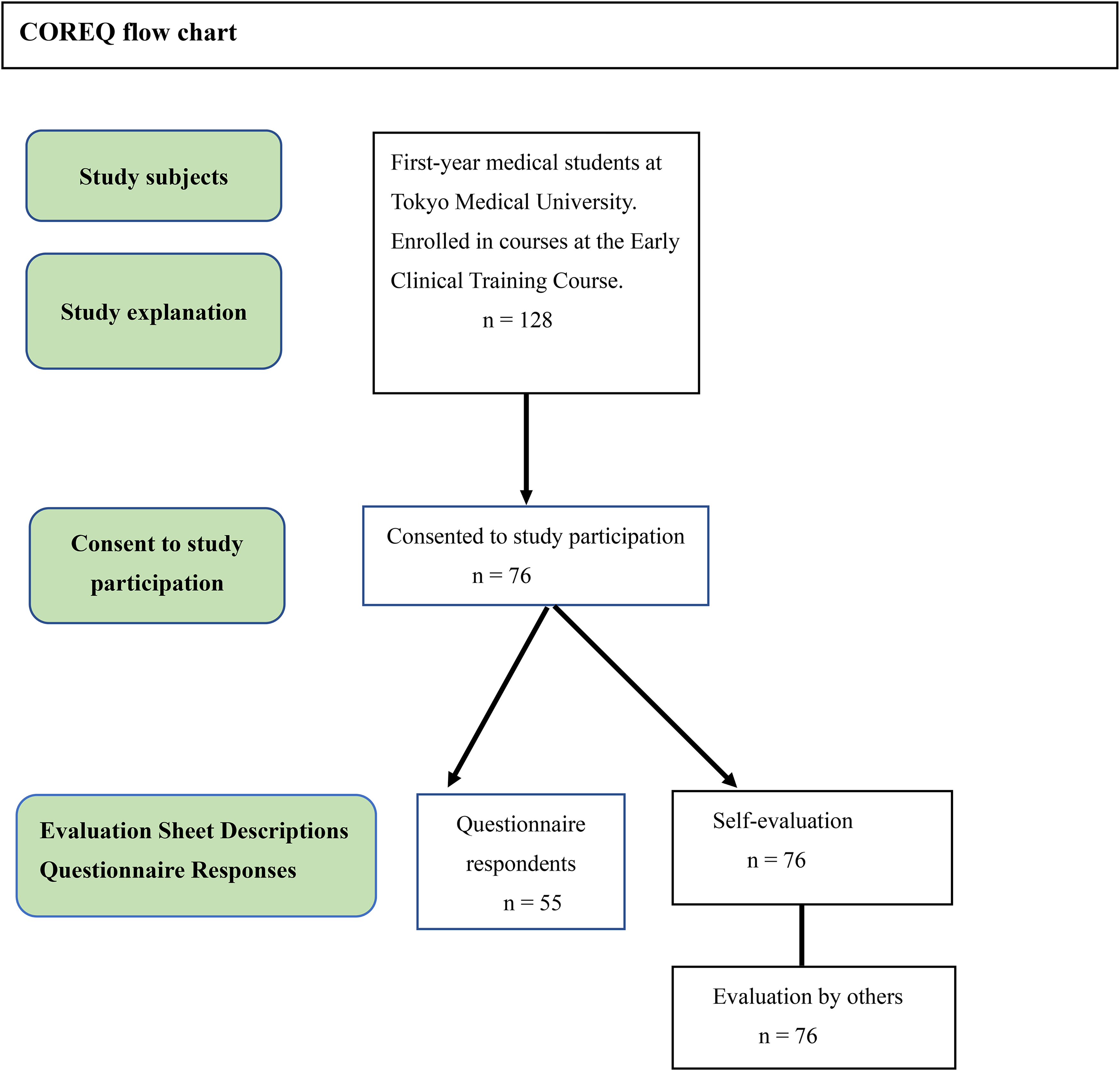
COREQ diagram this is a flowchart of the consolidated criteria for reporting qualitative research (COREQ) for screening, registration, and completion of the questionnaire and evaluation.
Important aspects learned by the students during the practical nursing training
There were 3 nursing areas examined: Nursing treatment, support, and communication activities; Nursing care for hospitalized patients; and Multidisciplinary collaboration through effective communication and coordination. Each of these areas consisted of categories and subcategories as described below (Table 1).
Learning areas of the medical students in practical nursing training.

Nursing treatment, support, and communication activities
A total of 7 categories and 33 subcategories were extracted from 109 codes. The 7 categories were (1) Daily living assistance, (2) Mental support for the patient, (3) Observation and understanding of the patient's physical condition, (4) Administering treatment and assisting with procedures, (5) Management to ensure patient safety, (6) Building bridges between doctors and patients, and (7) Helping the patient's family.
Daily living assistance
This category consisted of 9 subcategories. These subcategories were considered to represent the students’ understanding of life support and personal care support of patients who are hospitalized for treatment.
Mental support for the patient
This category consisted of 2 subcategories. This category was considered to represent the students’ understanding that a nurse is close to and is an important support for the patient during recuperation.
Observation and understanding of the patient's physical condition
This category consisted of 8 subcategories. This category was considered to represent the students’ understanding of the observations and knowledge nurses need to assist patients.
Administering treatment and assisting with procedures
This category consisted of 6 subcategories. This category was considered to represent the students’ understanding of the management of specific treatments and the assistance of treatments performed by nurses.
Management to ensure patient safety
This category consisted of 3 subcategories. This category was considered to represent the students’ understanding of what nurses do to ensure patient safety.
Building bridges between doctors and patients
This category consisted of 2 subcategories. This category was considered to represent the student's understanding of the role of nurses in connecting doctors and patients.
Helping the patient's family
This category consisted of 3 subcategories. This category was considered to represent the students’ understanding of the assistance provided by nurses to the patient's family.
Nursing care for hospitalized patients
A total of 3 categories and 16 subcategories were extracted from 56 codes. The 3 categories were (1) in need of assistance in daily life, (2) have physical or mental anxiety or distress due to illness or treatment, and (3) living in an unusual environment in the hospital.
In need of assistance in daily life
This category consisted of 7 subcategories. This category was considered to represent the students’ understanding of the nursing assistance required by patients.
Have physical or mental anxiety or distress due to illness or treatment
This category consisted of 5 subcategories. This category was considered to represent the students’ understanding of the anxiety and distress experienced by hospitalized patients.
Living in an unusual environment in the hospital
This category consisted of 4 subcategories. This category was considered to represent an understanding that many patients live in a hospital with minimal privacy.
Multidisciplinary collaboration through effective communication and coordination
A total of 2 categories and 13 subcategories were extracted from 54 codes. The categories were (1) cooperation and collaboration with doctors and nurses and (2) team medical care.
Cooperation and collaboration with doctors and nurses
This category consisted of 7 subcategories. This category was considered to represent the students’ understanding of the cooperation between doctors and nurses.
Team medical care
This category consisted of 6 subcategories. This category was shown to represent the students’ understanding of treatment of a patient by a medical team in interprofessional collaboration.
Experiences of students in the practical nursing training
The medical students were being able to become more familiar with the “Roles and work of nurses,” “Hospitalized patients,” and “What a doctor should be.” They learned about nursing assistance, actual patients, inpatient situations, and cooperation between doctors and nurses by shadowing nurses. They learned that a doctor must closely support a patient while providing treatment by understanding the patient's background, feelings, and distress. The students also learned that doctors should build a relationship of trust by observing and knowing the patient's life in the hospital. From their training experience, the medical students realized that doctors need to provide specific instructions, convey clear information, and communicate well with people of various occupations to effectively treat patients.
Evaluation of students by others and self-evaluation of students regarding the practical nursing training
The attitudes of the students were evaluated by the shadowed nurses (evaluation by others), and the students also evaluated themselves (self-evaluation). The practical training evaluation sheet consisted of 6 items: Greeting staff properly; Appropriately dressed in white clothes, appropriate hairstyle, and wearing a name plate; Following the rules and appointed times of the outpatient department and ward; Being polite to patients; Actively learning; and Communicating appropriately with medical staff and patients. Each item was given a score between 0 to 5 points, as follows: very good (5 points); good (4 points); acceptable (3 points); more effort required (2 points); bad (1 point); very bad (0 points). The total score was calculated.
(1) Evaluation by others
Results of the evaluation of the practical nursing training by the shadowed nurses are shown in Figure 2. The scores were higher on the second day of the training than on the first day of training for all items, except for “Following the rules and appointed times of the outpatient department and ward.” On both days of the practical nursing training, the scores were 4.50 or higher for “Appropriately dressed in white clothes, appropriate hairstyle, and wearing a name plate,” “Following the rules and appointed times of the outpatient department and ward,” and “Being polite to patients.”

Evaluation by others.
(2) Self-evaluation
Results of the self-evaluation by the students are shown in Figure 3. For all items, the scores were higher on the second day of the practical nursing training than on the first day. In particular, the scores for “Greeting staff properly” and “Communicating appropriately with medical staff and patients” were higher on the second day of the practical nursing training than on the first day.

Self-evaluation.
(3) Comparison of the results of evaluation by others and self-evaluation
A comparison of the results of evaluation by others (ie, by shadowed nurses) and the results of self-evaluation by the students is shown in Figure 4. On the first day of the practical nursing training, the scores of the evaluation by the shadowed nurses were higher than those of the self-evaluation in all 6 items. The difference in the scores between the self-evaluation and evaluation by the shadowed nurses was 0.29 to 0.4 points for “Greeting staff properly,” “Appropriately dressed in white clothes, appropriate hairstyle, and wearing a name plate,” and “Following the rules and appointed times of the outpatient department and ward,” with the score of the assessment by the shadowed nurses being higher.

a. Comparison of the results of evaluation by others and self-evaluation. Figure 4b. Comparison of the results of evaluation by others and self-evaluation.
On the second day of practical nursing training, the scores of self-evaluation were higher than those of the evaluation by the shadowed nurses for “Actively learning” and “Communicating appropriately with medical staff and patients.” The difference in the scores between the self-evaluations and the evaluation by the shadowed nurses was 0.15 to 0.22 for “Appropriately dressed in white clothes, appropriate hairstyle, and wearing a name plate,” “Following the rules and appointed times of the outpatient department and ward,” and “Being polite to patients,” and the scores of the evaluation by the shadowed nurses were higher.
In addition, when comparing the scores of the evaluation by the shadowed nurses and those of self-evaluation by day of the practical nursing training, the second day of training showed higher scores in all items than the first day of training.
Experience of nursing assistance
The nursing assistance experienced by the students in the practical nursing training is shown in Table 2. The nursing assistance experienced was mainly assistance in daily life and physical observations.
Content of nursing assistance experienced by the medical students.

Good points regarding practical nursing training experience
The students were free to write down what they felt was good about their experiencing the practical nursing training. The main good points were that the students were able to know and learn about “Roles and jobs of nurses,” “Hospitalized patients,” and “What a doctor should be” (Table 3).
Valuable experiences of the medical students in the practical nursing training.

Discussion
Important aspects learned by the students during the practical nursing training
Based on the results of this study, the important aspects learned by the medical students in the practical nursing training were categorized into 3 main areas: Nursing treatment, support, and communication activities; Nursing care for hospitalized patients; and Multidisciplinary collaboration through effective communication and coordination.
Nursing treatment, support, and communication activities
Seven categories were extracted: Daily living assistance, Mental support for the patient, Observation and understanding of the patient's physical condition, Administering treatment and assisting with procedures, Management to ensure patient safety, Building bridges between doctors and patients, and Helping the patient's family. Through shadowing, the students realized that the work of nurses was complicated, diverse, and hard. The nurse frequently visited a patient in his/her room, observed the patient's physical and overall condition, talked to the patient and consciously tried to communicate with the patient, and assisted the patient in carrying out his/her daily activities. By observing such nursing assistance, the students understood that nurses spent more time being involved in a patient's care than doctors, and that patients were more familiar with the nurses. The students learned that the nurse supported and maintained the patient's daily life in the hospital, listened to the patient's anxiety and distress regarding treatment, medical conditions, and life in the hospital, provided psychological support to the patient, and was able to immediately notice changes in a patient's mental and physical conditions. Therefore, the students understood that nurses play very important roles for supporting the patient's life during medical treatment. They realized that nurses assist not only the patient but also the patient's family. Furthermore, nurses act as a bridge between doctors and patients, and between people of multiple occupations and patients, so that patients receive the best treatment and assistance to make a smooth recovery, indicating the crucial roles nurses play in team medical care. Sugimori and Funashima 2 stated that “Practical training is very important as a learning experience.” Therefore, through this practical nursing training, the students understood and learned the important roles of nurses in medical care.
Physicians and nurses are central figures in a medical team. In the clinical setting, physicians and nurses play important roles in the treatment and care of patients through collaboration and cooperation. Previous studies have shown that the relationship between physicians and nurses has a significant impact on the quality of patient care.3,4 The characteristics of the physician-nurse relationship that negatively affect patient care include inadequate communication and coordination within and between physicians and nurse organizations, and inadequate exchange of information about patient care and conditions.4,5 These have been linked to medication errors, patient safety problems, and patient deaths. 6 A good relationship between doctors and nurses, and adequate communication, collaboration, and cooperation will lead to a better quality of patient care and promote patient recovery. Thus, it is important for medical students to know and understand the important roles of nurses and nursing as early as their first year.
Nursing care for hospitalized patients
Three categories were extracted: In need of assistance in daily life, Have physical or mental anxiety or distress due to illness or treatment, and Living in an unusual environment in the hospital. With the various restrictions in hospitals and wards, patients are staying in the hospital by making various compromises from their usual lifestyle. The medical students understood that a patient's admittance in the hospital was accompanied by pain and anxiety from medical tests, treatments, and their own symptoms. In addition, patients are only separated from each other by a single curtain, and they are required to stay in the hospital under conditions of minimal privacy. This is consistent with the statement of Fujino et al (pg .149,420) 7 regarding the students’ image of patients wherein students felt that “Patients are forced to live an inconvenient life and have no privacy. Living in the hospital in a state of depression, such as anxiety and fear, or in a state of nervousness and impatience.” The medical students found that their communication with patients often led to anxiety and distress about their illness and treatments, and that they spent a stressful hospital life with hesitation towards other patients and healthcare providers. The medical students recognized that family members and nurses are important sources of emotional support for patients. They learned that the existence of nurses is very important for patients because they can tell nurses what they cannot say to doctors.
Multidisciplinary collaboration through effective communication and coordination
Two categories were extracted: Cooperation and collaboration with doctors and nurses, and Team medical care. In the clinic, doctors decide how to treat patients and provide instructions to nurses. Nurses perform nursing activities while receiving instructions from doctors regarding patient treatment. Nurses also report the patients’ condition to doctors. Doctors and nurses constantly exchange information to achieve a smooth recovery of patients. The medical students understood that cooperation and collaboration between doctors and nurses are important in medical care.
The students also learned about the detailed roles of nurses in the medical team and the importance of cooperation between doctors and nurses. The practical nursing training deepened their understanding of the cooperation between doctors and nurses. This deeper understanding was brought about by their experience of how doctors, nurses, pharmacists, physical therapists, social workers, and people from other occupations collaborated and cooperated in the treatment of patients, as well as by their participation in conferences between nurses and between nurses and doctors. Anuja et al 8 previously conducted a nurse-shadowing program with first-year medical students at the University of Michigan, USA. The goals of the practicum were 1) to understand what nurses contribute to the healthcare team, and 2) to communicate effectively with nurses. Surveys conducted before and after the program indicate that the attitudes of the medical students toward nurses have improved, and that their knowledge of the important roles of nurses in healthcare delivery has increased. From these results, a nurse-shadowing program can serve as an important foundation for medical students to develop interprofessional skills and attitudes. The responsible and professional attitudes learned in a nurse-shadowing program as interns and future physicians can positively contribute to a more effective working relationship between nurses and physicians. Solomon et al 9 also described the importance of practical training as a way of learning multidisciplinary collaboration. These works indicate that practical nursing training is crucial for the interprofessional education of medical students.
Experiences of students in the practical nursing training
The medical students were encouraged to freely describe what they thought was good about the practical nursing training. The main good points mentioned by the students were their being able to know and learn about the “Roles and work of nurses,” “Hospitalized patients,” and “What a doctor should be.” Specifically, the medical students were able to learn about the work and roles of nurses, nursing assistance, actual patients, inpatient situations, and cooperation between doctors and nurses by experiencing how to provide nursing assistance through the shadowing of nurses. Regarding the item “What a doctor should be,” the medical students learned that a doctor should provide treatment while closely supporting a patient by understanding the patient's background, feelings, and distress, and by building a relationship of trust by observing and knowing the patient's life in the hospital. Additionally, the medical students understood that as a member of the medical team, doctors need to provide clear instructions and smoothly exchange information and communicate with people of various occupations to effectively treat patients. Emori et al 10 stated that “Medical students who experience nursing view nursing and nurses positively by deepening their understanding of nurses.” This finding agrees with the finding of our practical nursing training. This implies that a clear understanding of the important work and roles of nurses can deepen medical students’ understanding of both clinical practice and inpatients, as well as understand what is required from doctors in a medical team. Moreover, through the practical nursing training, the medical students were able to feel how they should act as doctors by objectively viewing their position and by imagining their future as doctors. This underlies an important dimension of education that the medical students gained from the practical nursing training.
Evaluation of students by others and self-evaluation of students regarding the practical nursing training
On the first day of the practical nursing training, the average score of the evaluation of students by the shadowed nurses was higher than that of the self-evaluation in all items. This was likely because the shadowed nurses evaluating the students were slightly lenient in their evaluation of the students who were new to hospital practice and did not have much knowledge about medical specialties, the clinical setting, nursing, and patients.
Regarding the difference between the self-evaluation and the objective evaluation of the medical students during the practical nursing training, the medical students’ self-evaluation tended to fluctuate, was unstable, and had a tendency of underestimation, which are unique to adolescents.11,12 This nursing practice was the first hospital practice for first-year medical students. We consider that they underestimated themselves because they were unsure of and insecure about how to tackle the practical nursing training.
On the second day of practical nursing training, the average score of the self-evaluation was higher than that of the evaluation by others in the categories of “Actively learning” and “Communicating appropriately with medical staff and patients.” This is because the students learned the necessity of communicating with the medical staff and patients on the first day of the training, and they tried to apply what they have learned on the second day by actively participating in the practical nursing training. On both days of the training, the scores of the evaluation by others were higher than the scores of the self-evaluation in the categories of “Appropriately dressed in white clothes, appropriate hairstyle, and wearing a name plate,” and “Following the rules and appointed times of the outpatient department and ward.” This study describes the medical students learning and understanding of the importance of these points from their practical training, and putting them into action. This understanding reflects the positive effects of educational interventions as early as in the first year. Having an appropriate appearance, following rules, and being punctual are some of the most important basic attitudes that medical students must learn and understand from their practical nursing training. Medical students should show courtesy, manners, and common sense, and follow rules, which are crucial skills not only as trainees but also as future doctors.
Ohbu suggested that the evaluators should be a mix of nurses and other professionals as an element of professionalism in the evaluation of students. 13 Anuja et al 8 reported that shadowing with nurses was effective in improving the knowledge and attitude of medical students. Therefore, it is equally important for nurses to supervise the practice of medical students and evaluate their attitudes. Elder et al 14 found that the attitudes of medical students toward nurses influence their attitudes on becoming medical doctors in the future. Elder et al also reported that ethical attitudes remain the same or worsen as medical students advance through the grades and acquire more education. Students who have academic and behavioral problems while in medical school are three times more at risk of violating professionalism and being disciplined for noncompliance after becoming a physician than those who do not.15,16 Taking all these factors into consideration, we believe that continuous curricular interventions are necessary to enable students to learn and acquire basic manners and attitudes as members of society and as medical professionals from as early as their first year of medical school.
The importance of education on the appropriate attitudes of medical students is increasing, with the aim of nurturing them to become highly proficient medical doctors not only in knowledge and skills but also in human qualities. We believe that by having educators other than physicians play a role in the education of attitude, medical students will be able to more fully understand the suffering and views of patients and develop an awareness of themselves as those involved in medical care.
The Japanese Ministry of Education, Culture, Sports, Science and Technology's Model Core Curriculum for Medical Education cites the importance of attitude education. 17 Before the introduction of practical nursing training at our university, medical students had no opportunity to learn about appropriate attitude as a medical professional. However, after the introduction of practical nursing training and shadowing of nurses, students understood the importance of common sense skills, such as grooming, following rules, punctuality, and communication, and deepened their learning and began to take action.
From this point of view, nursing practice is considered useful for teaching the appropriate attitudes for medical students in medical education.
Limitations of the present study and suggestions for future studies
In the present study, we analyzed the learning experience and actual situation of the practical nursing training for first-year medical students only at our university. Therefore, the present results cannot be generalized to other universities. In the future, it will be necessary to accumulate more data through further research to allow for generalization. A total of 128 first-year medical students were the study population of this study. The required sample size was 97 students. Those who expressed willingness to cooperate in the study and gave their consent were included in the analysis. The limitation of this study was that only 76 students (78.3% of the required sample size) expressed willingness to cooperate in the study, which is 78.3% of the required sample size. As this course is held once a year and the content of next year's course will be improved based on the results of this study, the analysis was conducted although the required sample size was not reached. Responding to the questionnaire or evaluation sheet was not mandatory. Therefore, only 55 respondents (56.7% of the sample size) responded to the questionnaire. In the future, it will be essential to increase the number of study subjects and improve the response rate to the questionnaire. The questionnaire used in this study was an original questionnaire created by the researcher, and completed after much review and revision by faculty members in the Department of Medical Education. The questionnaire used in this study was considered as a questionnaire for the pilot study.
There are few reports of universities providing nursing training in medical schools in Japan. There are 82 medical schools in Japan, and interprofessional education is increasing. About half of the medical schools have interprofessional education initiatives. However, there are few reports of medical schools in Japan providing nursing practice as part of interprofessional education. Therefore, the challenge is to develop a standardized questionnaire similar to the one used in this study.
Conclusions
We describe in this study an actual practical nursing training and its effects on the knowledge and attitudes of our medical students. The practical nursing training was conducted by medical students through shadowing with a nurse. The nursing practice enabled them to learn more about nursing treatment, support, and communication activities; nursing care for hospitalized patients; and multidisciplinary collaboration through effective communication and coordination, and what a doctor should be. The medical students were able to feel how they should act as doctors and imagine their future profession. Furthermore, the medical students were able to understand the importance of acquiring common sense attitude skills. The practical nursing training is useful for attitudinal education, and is important and meaningful for medical students who will become doctors in the future.
Supplemental Material
sj-docx-1-mde-10.1177_23821205231175035 - Supplemental material for Status and Educational Effects of Practical Nursing Training for Medical Students as Part of Interprofessional Education
Supplemental material, sj-docx-1-mde-10.1177_23821205231175035 for Status and Educational Effects of Practical Nursing Training for Medical Students as Part of Interprofessional Education by Ryoko Igarashi in Journal of Medical Education and Curricular Development
Supplemental Material
sj-xlsx-2-mde-10.1177_23821205231175035 - Supplemental material for Status and Educational Effects of Practical Nursing Training for Medical Students as Part of Interprofessional Education
Supplemental material, sj-xlsx-2-mde-10.1177_23821205231175035 for Status and Educational Effects of Practical Nursing Training for Medical Students as Part of Interprofessional Education by Ryoko Igarashi in Journal of Medical Education and Curricular Development
Supplemental Material
sj-pdf-3-mde-10.1177_23821205231175035 - Supplemental material for Status and Educational Effects of Practical Nursing Training for Medical Students as Part of Interprofessional Education
Supplemental material, sj-pdf-3-mde-10.1177_23821205231175035 for Status and Educational Effects of Practical Nursing Training for Medical Students as Part of Interprofessional Education by Ryoko Igarashi in Journal of Medical Education and Curricular Development
Footnotes
Acknowledgements
Sincere appreciation and gratitude are expressed to all the medical students and nurses who participated in this study.
Declaration of conflicting interests
The author declared no potential conflicts of interest with respect to the research, authorship, and/or publication of this article.
Funding
The author has not received any funding to conduct this study.
Ethical Approval
The study was approved by the Medical Ethics Review Board of our institution (study approval No.: T2019-0083. Date of ethics approval: October 3, 2019).
Informed Consent
All participants provided written informed consent.

Supplemental Material
Supplemental material for this article is available online.
References
Supplementary Material
Please find the following supplemental material available below.
For Open Access articles published under a Creative Commons License, all supplemental material carries the same license as the article it is associated with.
For non-Open Access articles published, all supplemental material carries a non-exclusive license, and permission requests for re-use of supplemental material or any part of supplemental material shall be sent directly to the copyright owner as specified in the copyright notice associated with the article.
