




Abstract
OBJECTIVES
Strategies to increase confidence in rheumatology knowledge are valuable for medical trainees and residents. A web-based teaching innovation was implemented in an attempt to increase rheumatology exposure for internal medicine residents.
METHODS
An Image of the Month webpage was established, where a practicing rheumatologist would post a new image that could be answered online by internal medicine residents. Cumulative data was analyzed to determine the extent and change in rheumatology exposure.
RESULTS
The Image of the Month webpage posted images for a total of 76 months between July 2010 to May 2017, with a total of 1326 submitted responses. The proportion of residents who only participated in Image of the Month and only did a rheumatology rotation averaged 36.1% and 16.5%, respectively. The proportion of residents who only participated in Image of the Month was higher than the proportion who only did a rheumatology rotation for all of the 7 time periods assessed. A total of 491 residents participated in Image of the Month, with an average of 54.9% of residents participating each year. Overall, on average, 52 residents had 1 or more submissions, 3.6 entries were submitted per resident, and 17.4 entries were submitted per month. Junior residents (PGY1) participated more often than senior residents (PGY3).
CONCLUSIONS
The Image of the Month webpage successfully improves internal medicine resident exposure to rheumatology with minimal resources and manpower required. Further study is necessary to determine the impact this exposure may have on the abilities and confidence levels of internal medicine residents.
Introduction
The subspecialty of rheumatology involves the diagnosis, investigation, and management of over 100 different diseases including broad conditions such as arthritis, connective tissue disease, and soft tissue ailments. In North America, research suggests there is a growing shortage of rheumatologists, despite an increasing burden of rheumatic disease in the population.1–3 With fewer rheumatologists than sufficient, other medical professionals will likely encounter many rheumatic conditions. Yet, data has shown a lack of education in rheumatology topics in both undergraduate and postgraduate medical education, thereby escalating the care gap.4,5
Many studies have demonstrated that early exposure to rheumatology by medical trainees is an important factor that influences their confidence and career choice.1,6–8 In Canada, a rheumatology rotation is not mandatory for medical students and internal medicine residents. Previous studies have demonstrated limited confidence in the musculoskeletal abilities of internal medicine residents when compared to other medical subspecialties. 9 A lack of rheumatology exposure is associated with this poor ability and increased exposure is linked with improved ability. However, rheumatology manpower and resources remain limited to facilitate this. The internet may provide a solution to improve rheumatology exposure while using available resources efficiently.
In 2008, our center completed a Canadian national survey of all internal medicine residency programs which demonstrated the real impact formal didactic teaching in rheumatology could have on internal medicine resident confidence in their rheumatology knowledge, higher than other medicine subspecialties. 9 This study aligned with similar data demonstrating only 3.5% of all internal medicine trainees in Canada entered rheumatology subspecialty training. 10 As a result of this data, an online web-based teaching innovation was implemented locally in an attempt to increase rheumatology exposure for internal medicine residents. This paper describes the teaching innovation and results.
Methods
An Image of the Month webpage was established in July 2010 on the www.AlbertaRheumatology.com website, a site representing rheumatologists in the province of Alberta, Canada. 11 Each month, a rheumatologist with a background in medical education was responsible for posting a new image with a question which could be answered and submitted online by the University of Alberta Internal Medicine residents. Residents in any year of training (Postgraduate Year [PGY] 1, 2, or 3) could participate, and participation was entirely voluntary. Residents were emailed at the start of each month to inform them that a new image was posted and to provide the link where they could submit their responses. Responses were short-answer style with a variety of questions including, but not limited to, identification of a finding in the posted image, providing a differential diagnosis, or describing an associated rheumatologic condition and its treatment or investigations. Rheumatologists typically obtained images from a local image bank or online image searches. All were free to use and not patient-identifying. A curriculum of 30 images across a broad range of rheumatology topics was developed (Table 1). The images and associated questions were not validated or pretested in advance of their use. Images were repeated on a 3-year cycle. At the end of each month, a token book prize was awarded randomly to a correctly submitted respondent. The program was run year-long, although occasionally a few months were missed due to technical difficulties or transitions between outgoing and incoming resident cohorts.
Rheumatology topics of posted images.
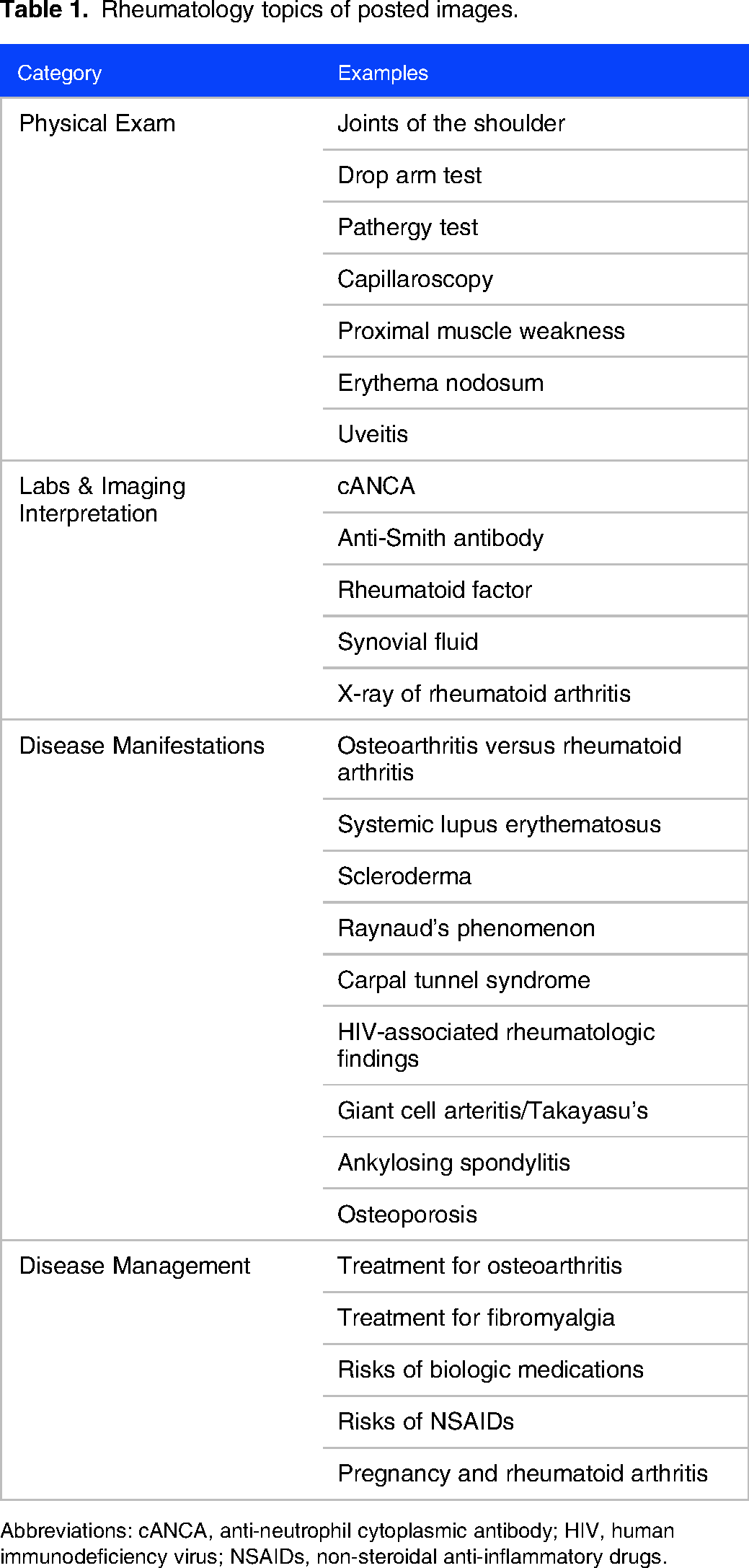
Abbreviations: cANCA, anti-neutrophil cytoplasmic antibody; HIV, human immunodeficiency virus; NSAIDs, non-steroidal anti-inflammatory drugs.
For this analysis, the responses were collated and normalized according to months of participation and the number of residents for the corresponding year. Cumulative data was analyzed to determine the extent and change in rheumatology exposure for internal medicine residents and the time and resources required to implement the program. Comparisons between those who did or did not rotate with rheumatology were drawn. The effectiveness of the program was assessed on the proportion of residents who participated. This study was approved by the University of Alberta Health Ethics Board (Pro00111340).
Results
The Image of the Month webpage posted images for a total of 76 months between July 2010 and May 2017. The program ran for an average of 10.9 months per year (range 9-12 months). A total of 1326 responses were submitted by 491 unique internal medicine residents over the total time period, with an average of 54.9% of residents participating each year. The proportion of residents who participated in both a rheumatology rotation and Image of the Month stayed relatively constant over the years, averaging 18.2% (range 13.6%-23.0%) (Figure 1). The proportion of residents who only participated in Image of the Month averaged 36.1% (range 21.4%-43.8%), which was higher than the proportion of residents who only did a rheumatology rotation for all of the 7 time periods assessed (average 16.5%, range 11.0%-18.5%). Residents who participated in both a rheumatology rotation and Image of the Month submitted fewer entries over all 7 time periods than residents who only participated in Image of the Month. Of the residents who submitted 7 or more entries at some point during their training, 58.9% had done a rheumatology rotation in their first year, as a PGY1. On average, 29.1% of residents did not participate in either a rheumatology rotation or Image of the Month.

Proportion of residents who participated in Image of the Month, rheumatology rotation, both, or neither (proportions of participation).
Over all 7 time periods, on average, 52 residents had 1 or more submissions, 3.6 entries were submitted per resident, and 17.4 entries were submitted per month (Figure 2). Out of all the internal medicine residents, 54.3% participated in Image of the Month. The number of entries submitted per resident per year ranged from 1 to a maximum of 12 (in years where the program was able to run for 12 months). Participation according to PGY generally went down as residents transitioned from year 1 to year 3; consequently, junior residents (PGY1) participated more often than senior residents (PGY3), comprising 43% and 25%, respectively (Figure 3). Uniquely because of the program (and excluding residents who did a rheumatology rotation), an additional 34 residents, on average per year, received rheumatology exposure, that may not have had exposure otherwise.

Resident participation in the Image of the Month over time (change in participation over time).

Resident participation in Image of the Month by training year (total participation by residency year).
There was no cost to implement the program as the website already existed and there was preexisting funding for the book prize. The rheumatologist required no more than 15 min monthly to administer the contest.
Discussion
This study of a low-resource innovation, Image of the Month, demonstrated an increase in rheumatology exposure for internal medicine residents. With over 50% of internal medicine residents participating, including 36.7% that may not have had rheumatology exposure otherwise, the program was deemed to be a worthwhile intervention by the Rheumatology department, requiring very few resources and manpower. Considering the proportion of residents who only participated in Image of the Month was higher than the proportion of residents who only did a rheumatology rotation, and those who did both a rheumatology rotation and Image of the Month, this suggests there is interest and motivation in such a program from internal medicine residents. Having a rotation in rheumatology may have decreased motivation to participate, given that residents would be having rheumatology exposure on their rotation. Nonetheless, over 50% of residents who did a rotation still participated and the program allowed an additional average of 18.9% of residents to gain rheumatology exposure. Based on previous data, we know that increased exposure can have a worthwhile impact on resident confidence in rheumatology knowledge. 9
For decades, images have been a rich source of information in clinical medicine. 12 The power of images lies in “creating mental models of physical models, a process somewhat removed from classical hands-on auscultation, percussion, palpation … [and such models] are invaluable aids to perception and interpretation, functions critical to the performance of doctors.” 12 Furthermore, “images evoke even more than hypotheses; they evoke predictions, decision making, and planning … what at first glance appears to be simple perception of images, then, is a complex stimulus to reasoning that leads to appropriate patient care.” Visual learners are believed to make up 65% of the population and around 40% of learners respond better to visual information than text alone. 13 Thus, images can help develop visual literacy and observation skills, contribute to critical thinking and lifelong learning, and promote understanding and memory retention, especially in our increasingly media-rich world.14,15
Computer-assisted programs have been previously explored in rheumatology, citing advantages such as the ability of the learner to participate at their own convenience and pace, and the same material being available to a large number of people, which standardizes the learning experience. 16 Batthish et al 17 found that 89% of pediatric residents felt pictures (eg, clinical and pathological slides, radiologic images) were “very important” to include on a pediatric rheumatology teaching website to make it more effective, the highest ranked web-based technology option. Furthermore, the COVID-19 pandemic has underscored the role of virtual platforms for learning rheumatology, and in a time when isolation is happening more frequently than desired, online rheumatology education has “the potential to reach the furthest doctor or healthcare provider in every nook and corner of the world.” 18 In other specialties, an “images based dermatology teaching module” showed a significant improvement in student knowledge and skills, as well as performance of students in an Objective Structured Clinical Examination (OSCE). 19 The authors described multiple advantages of clinical images based teaching including the facilitation of active learning, a time-saving method of teaching, an effective supplement where clinical teaching may be limited, an unlimited number of images that can be used, and the creation of an image bank to ensure uniformity in an exposure. Although we do not know for certain, we can extrapolate from this dermatology study and presume that our Image of the Month innovation impacted rheumatology knowledge and confidence.
There are a number of weaknesses to this report and areas for future study. Unfortunately, we did not survey our participants to assess their satisfaction with the program and obtain feedback on its utility and value, or evaluate for any change in their rheumatology confidence level and performance on exams. As the study was done retrospectively, we could not assess participant knowledge gained and whether or not this improved over time. Outcomes apart from participation are challenging to measure. It may be a matter of perspective if an average of 17.4 responses per month over 7 years of implementation is low. This would only represent about 20% of the residents. Although we note there was a decline in participation over time from the junior to senior year of residency, there are a multitude of changes that can occur in a residency program and therefore account for this. Evidently, residents may have growing predilections or priorities for certain subspecialties as they advance through their Internal Medicine residency, thus curtailing their exposure to other areas. We also did not assess the time commitment to submit responses each month, which would be useful to know in recognition of the busy internal medicine resident schedule, although presumably, it was a minor commitment. Finally, we acknowledge that not all learners are visual and the program may only appeal to a certain population. The sample size was also not calculated or justified, as it depended on the number of residents that were in the Internal Medicine program that year and the number that were voluntary participants in the Image of the Month program.
Seeing how medicine is very visually oriented, our Image of the Month program represents a current, innovative strategy for teaching. It draws on methods of active recall, which can increase the strength of memory and solidify prior learning. 20 It can be applied to all years of postgraduate medical training, and trends in participation from year-to-year can therefore be observed. Although we cannot state causation, the University of Alberta Internal Medicine program went from a low producer of future rheumatology fellows in 2005 to 2007 to one of the highest in Canada from 2014 to 2016, as evidenced by a relative and absolute increase in residents entering rheumatology training when comparing the 2 time periods. 21 Of note, in our current study, the proportion of submissions by residents who went into rheumatology as their subspecialty was 9.8%.
Conclusion
This Image of the Month program was easy to implement, had high levels of participation, and increased valuable exposure to rheumatology for internal medicine residents. Using limited resources and manpower, hope similar endeavors could be used to influence the care gap that exists and improve the confidence levels of our residents in their musculoskeletal abilities. Directions for future study could include examining the confidence levels of residents in more detail, assessing knowledge gained and satisfaction with the use of image-based learning, and how to sustain participation as residents transition from PGY1 to PGY3. With the anticipated decline in practicing rheumatologists, a continuation of the program or similar initiatives hopefully would enhance interest in rheumatology as a subspecialty, or prove to be beneficial for nonrheumatology residents and professionals. Broader application to other specialties could also be instrumental in enhancing the learning journey of medical residents.
Footnotes
Ethics Approval and Consent to Participate
This study was approved by the University of Alberta Health Ethics Board (Pro00111340). All methods were carried out in accordance with relevant guidelines and regulations. The informed consent of participants was waived by the Health Ethics Board due to the nature of the study.
FUNDING
The authors received no financial support for the research, authorship, and/or publication of this article.
DECLARATION OF CONFLICTING INTERESTS
The authors declared no potential conflicts of interest with respect to the research, authorship, and/or publication of this article.
Author Contributions
Both authors contributed to the study’s conception and design. Material preparation, data collection, and analysis were performed by AS and SK. The first draft of the manuscript was written by AS. SK provided comments and edited subsequent versions of the manuscript. Both authors read and approved the final manuscript.
Availability of Data and Materials
The datasets used and analyzed during the current study are available from the corresponding author upon reasonable request.
