




Abstract
E-learning has gained popularity in Uganda. Midwifery institutions have invested in it to manage the increasing demand for education. However, its adoption is low, which is likely to hinder the enhancement of numbers, competencies, and skill mix of midwives. The study intended to ascertain if technology leadership practices were significant to e-learning adoption and sketch core practices. Ten midwifery institutions and 167 end users participated in the study. Two phases of data collection and analysis were executed. Technology leadership practices had substantial effect on adoption of e-learning (n = 167, r = 0.691, & p = 0.000), and was responsible for 47.5% of the change. Core technology leadership practices were; commitment to provide e-learning facilities; encouragement of learners to use e-learning facilities; appreciating those who excel at using e-learning facilities; grooming of e-learning champions; supportive environment for technological use; and institutionalising technological use in school activities. Midwifery institutions can focus on technology leadership core practices to improve e-learning adoption.
Keywords
Introduction
E-learning approach has gained immense popularity in the past one decade in East Africa and Uganda in particular, 1 and has been positioned as a modern approach aimed at managing the increased demand of higher education. Health training institutions in Uganda have also not been left behind and subsequently have embraced the e-learning approach as their main avenue for delivering modest training and education, to individuals and groups of learners including midwives, 2 mainly by increasing easiness to access and use the web, obtain downloads, including easiness to access and use Compact Disc, Read-Only-Memory (CD-ROM) or computer-based resources for learning within classrooms, workplaces or homes (Santally, Rajabalee, & Cooshna-Naik, 2012). The government of Uganda, and particularly through the Business, Technical, and Vocational Education &Training (BTVET) directorate of the Ministry of Education and Sports (MoES) and together with development partners have also invested heavily in the use of e-learning to train midwives across a number of midwifery institutions in the country.
In spite of the immense resources input in programmes of e-learning starting from 2010, low adoption rates have persistently occurred with the seemingly new approach among end users in the participating midwifery institutions,3,4 and those who do begin to use the system subsequently dropout.5,6 The slow adoption is exhibited in terms of the number of people or institutions beginning to use e-learning as a medium for teaching and learning, and it is measured in terms of new students enrolling on the programme; the sum of learners and teachers using the Learning Management System (LMS) or CD-ROM, and the sum of teachers providing web support to end users.
7
The tendency of sluggish adoption to e-learning will likely constrain the state's ambition to enhance numbers, competencies, and skill mix of midwives. Previous studies on e-learning adoption8,11 have tended to focus on individual, technical, and infrastructural factors with few of them if any, highlighting institutional forces such as technology leadership practices of end-users that need to be brought into play to aid in enhancing the adoption rates of e-learning programmes. The research therefore aimed at evaluating whether technology leadership practices of end users had an influence on e-learning adoption, and ascertain the main practices of technology leadership to be prioritised by midwifery institutions in order to improve e-learning adoption. Two research questions guided the study and these included:
What is the relationship between technology leadership practices of end users and e-learning adoption? What are the noticeable technology leadership practices that should be embraced by midwifery institutions so as to enhance the adoption of e-learning?
The study advanced the hypothesis that technology leadership practices of end users promotes e-learning adoption.
Technology leadership practices of end users in this study, were conceptualised from a wider understanding of leadership, characterised by relationship building, and influence peddling towards achieving a common goal rather than enlisting orders and asserting control. 12 In such a realm, the participants of the study who included e-learning students, tutors and their administrators, were construed as leaders with a common vision of using technology to aid the teaching and learning experiences. The emphasis the paper seeks to make, is that technology leadership should be looked at as distributed leadership because it is the responsibility of all those involved in e-learning programmes, students, tutors and administrators alike, as each party plays a critical part to promote the adoption of e-learning. 13 To ascertain the above assertion, the research evaluated six of the several tenets of technology leadership practices on how they related to e-learning adoption. These include: commitment to provide and use e-learning facilities, a supportive environment for using e-learning facilities, a culture of rewarding the use of e-learning facilities, a culture of recognising and promoting champions in e-learning programmes, and institutionalising e-learning in all teaching and learning endeavours of the school. 14
Technology Leadership and E-Learning Adoption
Technology leadership has been defined as a process of committing to provide technology infrastructure, and ensuring that there is a suitable environment that allows the total usage of these facilities, so as to ease classroom teaching and subsequently enhance learning achievement among learners. 15 This process, among others ensures that teachers are well prepared in terms of training, and that they are provided with the necessary technological facilities, and they are adequately supported to ensure they utilise the facilities to achieve their teaching objectives. The definition has two important aspects, the act of commitment to provide an ‘enabling environment’ and the ‘technological infrastructure’. School administrators have to perform a critical role to ensure that these two vital ingredients are made available at all times. This is also affirmed by Mwawasi, 16 who indicated that school administrators should be prepared to finance technological infrastructure costs, in addition to providing moral and psychosocial support to all stakeholders within and outside the school environment, so as to actualise the full usage of ICTs in education. 16
It is important to realise that in this definition, the focus of technology leadership is so much on the school administrators and the respective teachers therein. However, in the main stream leadership literature, it is indicated that leadership, is not about the position one holds in the organisation, but rather, it is more about motivating and inspiring people to challenge and defeat their current difficult situations. 12 The belief is that in most times, leadership develops from difficult situations. Although managers and administrators are expected to exhibit leadership practices and practices, nevertheless, leadership and management have different purposes. Because of the enormous challenges encountered by several institutions on the African continent, and Uganda in particular, related to low adoption rates of e-learning, technology leadership becomes very central at this stage in the education systems of developing countries. However, technology leadership should not be narrowly confined to school administrators, it should also be understood to include the wider stakeholders like students, and their teachers. Because, they too have a central role in exhibiting technology leadership practices. This perspective can also be a likened to Davis et al 17 study, where they ascertained that building strong relationships with teachers, students and the wider community facilitated innovative changes and better outcomes for e-learning. Although, in their study they referred to such practices as transformational leadership. 17
Anderson and Dexter's 18 study, examined the different technology leadership practices in American institutions, and related them to the National Educational Technology Standards for Administrators (NETS-A). 18 In their findings, they asserted that at that time, NETS-A were the only comprehensive educational technology standards available to guide technology practitioners including principals. These guidelines include specific sections on what school managers must know and put in practice in relation to educational technology. Currently, it is not clear how widespread NETS-A guidelines are, globally, but the fact remains that most e-learning programmes especially in the developing world have been initiated without any prolific standard guidance on technology leadership like what is prescribed in the NETS-A. However, what is widely acknowledged in most literature is that technology leadership plays a critical role in e-learning programming.16,20 The absence of widespread guidelines on technology leadership, and the varying definitions assigned to the concept clearly indicates that it is conceptualised differently by different researchers. And subsequently, the defining dimensions of technology leadership are also varied and only determined based on context and the scope of e-learning programmes.
Despite of the differences exhibited in the definition and dimensions of the concept technology leadership, its importance in e-learning programmes has been widely documented and recognised. For instance, Chang et al's 19 study, suggested that principals who embraced the idea of technology leadership were able to provide appropriate technological resources to boost the engagement of students in learning. The study further opined that that principals needed to grasp five aspects so as to become effective technology leaders and these include; commitment to provide infrastructure support, vision for technology, staff development, and monitoring and evaluation. 19 Additionally, skills to communicate effectively, strong and genuine relationships with stakeholders, were also found to be critical in enhancing principal's technology leadership effectiveness. 20
Technology Leadership Practices and e-Learning Adoption
Rupp 21 opines that leadership practices in institutions are becoming more collaborative, and inclined to distributed leadership. Likewise, technology leadership is also likely not to be spared, as voices that agitate for all-inclusive leadership practices are increasing. A case in point is where some researchers are insisting that leadership contributed by different groups of people such as teachers, students, administrators and school principals have more influence on end user's achievement, compared to an individual leader endorsement.22,23 Based on the seven strong claims of successful school leaders, Leithwood et al 24 indicated that some practices of leadership seemed to be more effective as compared to others. 24 Under this claim, they argued that student achievement is highly linked to echelons of inspiration from different fonts of leadership. Given the challenging situations inherent in most e-learning programmes in low-income countries, such kind of leadership practices become meaningful as all sources of leadership become ignited to confront the challenges at hand. Futrell 22 also illustrated that in thought-provoking situations the greatest effective school managers have been found to be unbiassed, always willing to learn from others, flexible but focused in their thought processes, confined in a set of values, persistent in pursuit of high expectations, resilient, and optimistic. 22 In Rupp's 21 study, effective leadership qualities included being firm and purposeful, having shared vision and goals, promoting teamwork and collegiality, and frequent monitoring and feedback. The link of leadership to the culture of the school is explained as preserving effort on pedagogy and creating a constructive school environment. 21 It is also emphasised that school leadership is as important as teacher quality.
The question to ask here is, are all these leadership practices desired in technology leadership? If your answer is yes as ours, it might be that technology leadership is transitioned towards a distributed perspective which frames leadership as a creation of exchanges of school administrators, students, teachers and the circumstances at hand. 13 Based on these revelations, there can be several technology leadership practices aligned, depending on the context and educational goals you espouse. In this study, technology leadership practices for e-learning included: commitment to provision and use of e-learning facilities, enabling a supportive environment for using e-learning facilities, a culture of appreciating those who excel at using e-learning facilities, and a culture of grooming e-learning champions. More discussions on these practices is continued below.
Commitment to provide and use e-learning facilities, has two important technology leadership practices that are rarely talked about in most literature of technology leadership. First, commitment to provide e-learning facilities within a school is more related to school administrators like principles and all those involved in decision making. Whereas, commitment to use e-learning facilities encompasses more stakeholders including administrators, the students as well as their tutors. Commitment is one of the leadership practices highly desired in aspects which require team-work, like in most e-learning programmes.
Literature has shown, that effective leadership within a team cannot happen without the commitment of a team leader and the team members. 25 All successful leaders we have witnessed in several parts of the world have been committed to their cause of action. Therefore, commitment is conceptualised as a leadership value that motivates and inspires people. 11 It demonstrates the conviction held by the leader towards a particular phenomenon, in this case the provision and utilisation e-learning facilities. It is also demonstrated elsewhere that more often team members get to buy into the conviction of executing an activity together with their leader before they buy into the vision of the activity itself. Commitment to provide and use e-learning facilities is an important element of improving e-learning adoption. E-learning programmes in low income countries like Uganda exhibit several challenges, with committed leaders some of these challenges can easily be mitigated as we already know that commitment unbolts the gates to excellence.
E-learning proponents will often be confronted with difficulties and resistance in their quest for acquiring and using e-learning facilities due to sometimes the enormous financial inputs required. There will be times where their commitment is the only thing that carries them through. Commitment will enable e-learning team leaders to continue with their aspirations despite of the many times they get flawed, as it has been argued elsewhere that nothing meaningful can be accomplished devoid of commitment. Likewise, provision of e-learning facilities requires committed leaders. 26
Provision of supportive environment for using e-learning facilities, is another technology leadership practice that is scarcely discussed in the current technology leadership literature. This kind of environment is characterised by developing a vision for technology, collaboratively with key stakeholders including administrators, teachers, students and selected members of the community where the school is located. The idea of developing a vison for technology for the school is also a quality standard recommended by NETS-A.27 Under section one “Leadership and Vision”, NETS-A, indicates in what way technology leaders should cultivate a schoolwide collective vision for technology and make sure to avail the coordination mechanisms, suitable environment and financial resources required to implement it. 27 When the technology vision is collaboratively developed, it stands high chances of succeeding than the one developed with a few handfuls of people. The dream for technology use must be well communicated with all those involved, communicating the vison of e-learning with all stakeholders creates an environment where everyone becomes aware of what role they play towards its achievement 28 .
Furthermore, to enhance supportive environment for using e-learning facilities, key administrators including teachers have to act as role models in using e-learning facilities. Role modelling is not a new concept in teaching and learning spheres, particularly for e-learning, it is important to emphasise that administrators and teachers alike need to be cognisant of the visible and invisible facets of learning from role modelling, so as to make the overall effect of the practice more constructive. 29 The role modelling process is an influential teaching tool for transferring values and competencies of any profession towards the young generation. However, suffice to mention that some researchers especially in the medical field have revealed that its net effect on the behaviour of students can sometimes be negative, rather than positive. 29 It is against this background that in the e-learning sphere, administrators and teachers have to be cautious as they aspire to become role models to others. They need to carefully analyse their own performance as role models, and adapt strategies that can allow them to improve their modelling experiences. There are several strategies that can help them become better role models including; an aspect of becoming cognisant of the impact of what they are modelling, setting aside time to engage in dialogue, reflection, and debriefing with their students, and creating feasible efforts of communicating what they are modelling, and to make clarifications on their intended vison for modelling. Notwithstanding, teachers and administrator's role modelling practices can create a supportive environment for using e-learning facilities hence improving the adoption of e-learning in any school environment.
Administrators also have to initiate, and support changes within the school environment, including practices, and policies geared towards supporting the use of e-learning facilities. Changing school policies and practices has been identified as one way of making the school environment more supportive in using e-learning facilities. Anderson and Dexter 18 study, also indicated that technology leaders had a duty of establishing and refining school policies which embraces aspects of fairness in access. The protection of end users, and acquiescence of administrators, tutors and learners with lawful and ethical procedures for use of technology, was also emphasised. The issue of enabling a supportive environments to promote the utilisation of e-learning facilities in institutions was also recognised in other countries were deliberate efforts to established e-learning policies at international and national levels has evolved over time and have yielded positive results related to e-learning adoption. 30
Literature indicates that there are several incentive schemes that technology leaders can use to motivate stakeholders to adopt and continue to use the e-learning approach. 31 One of such schemes is the culture of rewarding those who excel at using e-learning facilities. 32 This becomes important especially where teachers, students and administrators who are innovative with technology, receive material incentives such as stipends, waivers, special opportunities including sponsorship arrangements. In some instances non material incentives like special appreciation and public recognition have also been given. All these are in tandem with the notion that a good leader motivates followers. All these aspects play a big role in motivating stakeholders and help in creating a supportive environment and hence improving the adoption of e-learning. 33
Grooming and promoting champions in e-learning programmes is another vital technology leadership practice.34,35 This can be achieved when school administrators are seeking to hire teachers and recruit new students on the e-learning programme. They can consider technology literacy and leadership for technology in their assessment. This would help to segment teachers and students as either novices or as exhibiting some basic capabilities for using e-learning facilities. The segmentation, can help them to deliver tailored support to respective groups, while observing the early adopters or ICT enthusiasts. 36 Subsequently, the early adopters or ICT enthusiasts can easily be groomed to become e-learning champions.
Institutionalising e-learning in all teaching and learning endeavours of the school is yet another technology leadership practice for e-learning, 37 especially this is well achieved when the school administrators make deliberate efforts of developing a technology plan for the school collaboratively with the key stakeholders such teachers, students and some selected community members. 17 Additionally, they can consider using technology in all their communication endeavours. For instance, communicating and collaborating with the wider stakeholders in relation to school activities and learner teaching and learning including communication related to school co-curricular activities. In this realm stakeholders stop viewing technology as a distant phenomenon but rather begin considering it as part and partial of their daily lives and routines. 35
Materials and Methods
This study used an explanatory sequential mixed methods design to ascertain whether technology leadership practices of end users stood germane to the adoption of e-learning and the crucial technology leadership practices to be executed by midwifery institutions. The choice of an explanatory sequential mixed methods research design was because of its fundamental idea that combining quantitative and quantitative methods offers an improved conceptualisation of a research phenomenon than using a single method. 38
Study Population &Sample Size
Three population groups were considered, the first being midwifery institutions and this marked the entry point for the study. Students on the e-learning programme and the tutors in these midwifery institutions formed the second and third population groups. There were twelve midwifery institutions offering e-learning programme in Uganda. The first sampling process begun with the institutions.
Sampling Techniques
The sample size of midwifery institutions was determined by the use of Krejcie and Morgan technique. 39 Subsequently, simple random sampling was used to identify the individual institutions to participate in the study. Secondly, the total population of end users from the sampled institutions was ascertained, and this was subjected to the Krejcie and Morgan technique to ascertain a representative sample size of end users to participate in the study. Thirdly, Probability Proportional to Size (PPS) sampling, 40 was used to determine the proportionate sample size of end users from each of the midwifery institutions selected, proportionate to their population. Fourthly, simple random sampling was used to select end users to participate in the study from the determined sample size.
Methods of Data Collection
Data collection process utilised three data collection methods, one for quantitative data and two for qualitative data, these included: Questionnaire, In-depth interview schedule and Focus group discussion guide.
Quantitative Phase
A structured self-administered questionnaire was used to collect data from end users. A structured questionnaire was preferred because of two reasons: it poses similar questions to end users thus a good way for eliciting random responses and minimising bias, it also captures systematic and similar information from all respondents. The questions were developed in a way that they would be answered by all the end users on the e-learning programme and the distinguishing feature was the role that each end user played on the programme as either student, tutor or administrator.
Quantitative data analysis was done by performing both descriptive and inferential analysis. Statistical Package for Social Sciences (SPSS), Version 23 was used to complete inferential and descriptive analyses. inferential analysis focused on regression and correlation analysis of technology leadership practices of end users and e-learning adoption. Pearson's correlation coefficient was preferred because the data was assumed to be normally distributed and thus aided in measuring the strength of the relationship of technology leadership practices and e-learning adoption. The findings of the quantitative phase helped to re-design the qualitative phase which was conducted one month after presentation of findings of phase one.
Qualitative Phase
Qualitative phase employed two data collection methods which included: focus group discussions (FGDs) and key informant interviews (KIIs). Data analysis for qualitative phase begun with data collection process, and data was recorded by audio recorder and in field notes. Verbatim transcription was done and some samples referred back for cross reference. Data was also coded, categorised, and themed. Open, selective, and axial coding processes were done guided by the seminal work of Strauss and Corbin. 41 These methods were used for purposes of data triangulation and providing a deep and thick description about technology leadership practices and the adoption of e-learning. Comparative sampling procedure was also used in the process of coding because of its ability of being iterative hence allowing thick collection of data. To aid the management of data and facilitate data reduction process, NVivo software was used.
Results
A total of two hundred twenty-four (224) survey tools were distributed in form of questionnaires, of which one hundred sixty-seven (167) were completed and returned, hence returning a response rate of 74.6%. This response rate is deemed as being good enough to be used as a reasonable ground for making any recommendations or observations. 42 Additionally, having a high response rate in education research is commendable for reasons of ascertaining stakeholder's enthusiasm in the subject matter being studied, and it also provides an opportunity for unbiased estimates.43,44 Additionally, based on Mugenda and Mugenda 45 seminal work, a fifty percent response rate is considered adequate for analysis and reporting, a sixty percent response rate is considered good, and a seventy percent response rate and above is excellent. The results also indicated that female respondents were almost eight times the male respondents.
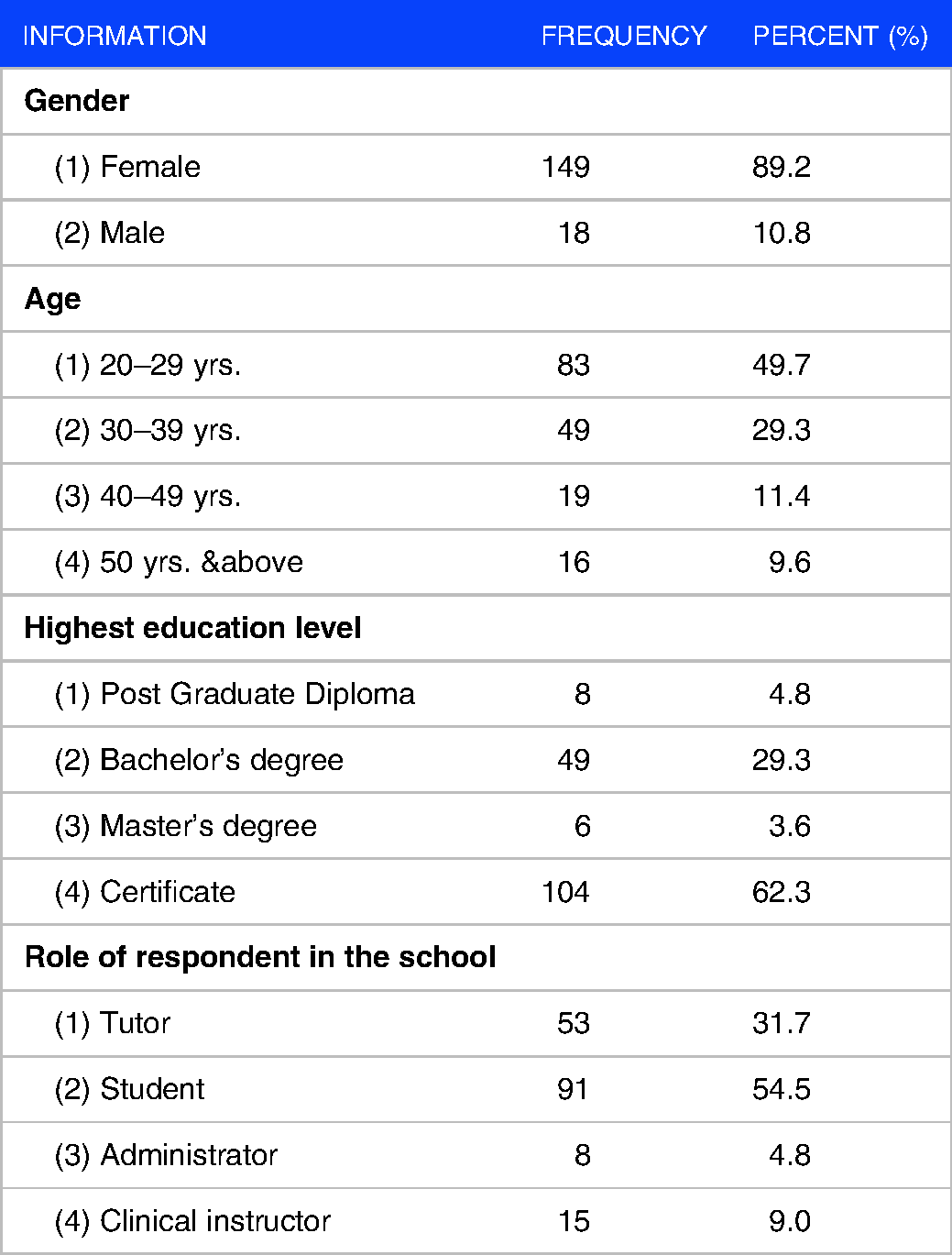
In Table 1, though both female and male participants got involved in the study, a great number 149 (89.2%) were females as compared to 18 (10.8%) males. The females dominated in number because the midwifery occupation in Uganda is largely dominated by women both as learners and faculty. Many, 79.0% were below 40 years, describing a somewhat younger populace undertaking the e-learning programme as either learners, faculty or managers at the sampled midwifery institutions. Majority of the participants 104 (62.3%), possessed a certificate as their highest level of education. Participants who possessed certificates, were mainly midwives who had enrolled on the e-learning programme to upgrade to the diploma level in midwifery studies, and these constituted the biggest number of participants as students 54.5% (91). Whereas participants with Postgraduate diplomas, Bachelors’ and Masters’ degrees were either tutors or administrators. These results demonstrate that all end users on the e-learning programme within the midwifery institutions responded to the study.
Participants demographics (n = 167).
E-Learning Adoption in Midwifery Institutions in Uganda
Eight statements on the questionnaire were used to assess e-learning adoption. Respondents were requested to indicate their level of disagreement or agreement with each statement. Majority of the respondents strongly and somewhat agreed to all the eight statements used to evaluate e-learning adoption, and the level of e-learning adoption was stained to be at 61%. If only 61% of end users agree that they are contented with the overall e-learning programme, and that they are happy with the number of end users taking on and using e-learning as their main system for their quest for knowledge and skills, quantitatively expressed in terms of new students enrolled on the programme; number of end users utilising LMS/CD-ROM; and the number of faculty offering online support to their learners, the 40% who explicitly voice dissatisfaction represents a slightly larger constituency of likely defaulters over time, and something needs to be done to mitigate the situation. In this study, technology leadership practices of end-users were hypothesised to be the solution of improving the low adoption of e-learning. In the proceeding sections we present results related to technology leadership practices of end-users.
Views of Participants on Technology Leadership Practices of End Users
The views of participants on technology leadership practices of end-users were ascertained using six (6) statements on the questionnaire. And participants were requested to show their level of agreement or disagreement or with each of the statements, and the results are shown in table 2. Qualitative results collected from interview guides and FGDs were used to expound on the quantitative results.
Technology leadership practices.

End users were in agreement with five (5) out of the six (6) statements used to evaluate technology leadership practices in midwifery institutions in Uganda as indicated in Table 2. On whether the school administration is committed at providing most of the technological facilities students and staff require on the e-learning programme, 40.1% somewhat agreed and 16.2% strongly agreed. This means that as many as 56.3% had a view that the school administration is committed at providing most of the technological facilities students and staff require on the e-learning program. Findings from FGDs and KIIs established that all the institutions had a budget towards support of technological facilities used on the e-learning programme. A key informant from midwifery school “C” revealed as thus; The school shares the internet facilities with the hospital and it is the hospital that pays all bills related to Internet that students and tutors use.
In response to whether students and tutors are always encouraged to use technological facilities inside and outside classroom to supplement their learning, 38.9% somewhat agreed and 31.1% strongly agreed. This suggests that as many as 70.0% had a view that students and tutors are always encouraged to use technological facilities inside and outside classroom to supplement their learning. A number of institutions have set up WIFI to encourage tutors and students to use technological facilities both inside and outside classrooms as a way of supplementing their learning.
On whether there are people that students and staff can visibly refer to as ‘champions’ that advocate for the use of technology in teaching and learning endeavours. 43.7% somewhat agreed and 16.8% strongly agreed. This suggests that as many as 60.5% exhibited the view that there are people that students and staff can visibly refer to as ‘champions’ that advocate for technological use in instructional processes. In relation to this finding, results from the KIIs and focus FGDs indicated that most midwifery institutions lacked a culture that recognises and appreciates those that excel at using technology, a case in point was where it was indicated that in some institutions there are young a and bright students who are able to use computers better than some tutors, but institutions where such students exists have never recognised them not even giving them an incentive to continue with their computer skills and even coach and mentor others to be able to access various teaching and learning materials online. One of the key informants had the following to say: I have recently realised that if we had paired our students and tutors by ensuring that every set of students or tutors had a champion in them who is technologically savvy, and able to hold others by hand and by supporting them to use the e-learning facilities we have here, we would have recorded more achievements than what we are observing today! As the saying goes it is never too late… we shall start this arrangement with our new group coming in soon!
Furthermore, on whether the e-learning programme is seen as an opportunity for embedding technology in all their learning programmes in the school, 25.7% strongly agreed and 38.9% somewhat agreed. This infers that as many as 64.6% had a view that the e-learning programme is seen as an opportunity for embedding technology in all their learning programmes in the school. Furthermore, KIIs and FGDs findings concurred with these findings from the questionnaire where it was established that at least each school had indicated of having a school technology plan, and a school technology plan is one of the ways of embedding technology in all the programmes of the school. However, in some institutions again through KIIs and FGDs it was discovered that these technology plans were not developed collaboratively, hence, signifying that very few e-learning stakeholders knew what was contained in those plans.
Table 4 further shows that there were mixed reactions on one (1) out of the six (6) statements used to measure technology leadership practices in midwifery institutions in Uganda as detailed; on whether there is a culture of appreciating those who take an extra mile in using technology to enhance their teaching and learning process, 17.4% somewhat disagreed whereas 24.0% strongly disagreed, 16.8% strongly agreed, and 31.7% somewhat agreed while 0.2% neither agreed nor disagreed. This signifies that respondents had mixed reactions on whether there is a culture of appreciating those who take an extra mile in using technology to improve their teaching and learning process, with 41.4% in disagreement, 10.2% neither in agreement nor in disagreement and 48.5% in agreement. It was revealed that most of the institutions do not have a culture or even policy on appreciating those who take an extra mile in using technology to enhance their instruction and learning process. However, among both tutors and students there is unofficial recognition of those that are good at using technology to enhance their instruction and learning practices. These findings are also in line with some revelations from the key informant interviews and focus group discussions, which indicated that most institutions did lack a technology policy, it would be through such a policy that such issues would be well embedded. Indeed, a key informant stated as below: For sure we lack a system that recognises our very own who are good at using these technological facilities, I can tell you I have several students on this e-learning program who have demonstrated a mastery of using these gadgets, and more often they even help us as tutors
Correlation matrix for technology leadership practices and the adoption of e-learning.

*Correlation is significant at the 0.05 level (2-tailed).
Model summary of regression analysis for technology leadership practices and the adoption of e-learning.

Predictors: (Constant), Technology leadership practices.
Average of Technology Leadership Practices
Overall, 55.7% of the participants were in tandem with all the statements used to assess technology leadership practices in midwifery institutions in Uganda. Respondents who strongly disagreed to all the statements were 3.0% on average, while 13.6% somewhat disagreed, and 27.5% neither agreed nor disagreed. This result is partly in agreement with results from KIIs and FGDs where most participants indicated that they had practiced some of the leadership practices espoused by the study but they thought they were not completely conversant with how to execute some of them. This is indeed reflected in some of their wishes as one of the senior team members who participated in the FDGs had the following to say: I am eagerly waiting to read the full report of your study, we need to sit as a team go through these issues, prepare to learn more on these leadership practices so that we can be able to practice them in full mode.
Correlation Analysis for Technology Leadership and E-Learning Adoption
To ascertain the degree and direction of the relationship between technology leadership practices and the adoption of e-learning, Pearson's product moment correlation coefficient was calculated with confidence level at 95%. The findings are summarised in Table 3.
A moderate positive association between technology leadership practices and the adoption of e-learning in midwifery institutions in Uganda was depicted, (r = 0.691, p = 0.000, n = 167), as indicated in table 5 above. Since the p-value (Sig.) was equal to 0.000 whereas the recommended is (<0.050), with the confidence level of 95%, we can say the relationship was statistically significant. Therefore, this can be interpreted as, improvements in technology leadership practices are associated with improvements in the adoption of e-learning in midwifery institutions in Uganda. Likewise, a decrease in technology leadership practices are associated with decrease in the adoption of e-learning in midwifery institutions in Uganda.
ANOVA and regression coefficients for technology leadership practices and the adoption of e-learning.

Dependent Variable: E-learning adoption.
Predictors: (Constant), Technology leadership practices.
Regression Analysis for Technology Leadership Practices and the Adoption of E-Learning
To determine the magnitude of the influence of technology leadership practices on the adoption of e-learning in midwifery institutions in Uganda, a regression analysis was performed. The coefficient of determination (R Square) is shown in Table 4.
In Table 4, the Pearson's correlation coefficient R is (R = 0.691), Coefficient of determination or R Square is 0.478 and Adjusted R Square is 0.475. An adjusted R Square of 0.475 shows that technology leadership practices account for 47.5% of the variance in the adoption of e-learning in midwifery institutions in Uganda. The result shows that besides technology leadership practices other factors exist that influence the adoption of e-learning in midwifery institutions in Uganda.
Analysis of Variance (ANOVA) and regression coefficients were used to determine the overall significance of the regression model for technology leadership practices and the adoption of e-learning. Table 5 presents the findings.
The decision rule of ascertaining if a regression model is significant is always ascertained when the calculated p-value (level of significance) for ANOVA is less than or equal to 0.05. In table 5, the calculated p-value was 0.000 which was found to be less than 0.05. Based on this, we can say the regression model was statistically significant with F = 151.083, df = 1, and p = 0.000; p < 0.05. This signifies that technology leadership practices have a statistically significant contribution to the adoption of e-learning in midwifery institutions in Uganda
Additionally, to ascertain if technology leadership practices are predictors of e-learning adoption in midwifery institutions in Uganda and ascertain the magnitude to which technology leadership practices influence e-learning adoption in midwifery institutions in Uganda, t and Standardised Beta coefficients were calculated. To ascertain if the magnitude is significant or not, the decision rule is that the p-value must be less than or equal to 0.05 and the t value must not be close to 0. In table 5, the t-value is 12.292 and is not close to 0 and the p-value is 0.000, and is less than 0.05. Based on this finding, the study confirmed that technology leadership practices are predictors of e-learning adoption in midwifery institutions in Uganda. A standardised Beta coefficient of 0.691 signifies that; every 1-unit increase in technology leadership practices will result into an increase of 0.691 units of e-learning adoption in midwifery institutions in Uganda.
Results from correlation analysis established that technology leadership practices have a moderate positive statistically significant relationship with e-learning adoption in midwifery institutions in Uganda. Results from regression analysis confirmed that technology leadership practices contribute to 47.5% of the influence observed in e-learning adoption in midwifery institutions in Uganda and that this influence is positive and statistically significant. The findings consequently accepted the research hypothesis that stated as: “Technology leadership practices of end users promote e-learning adoption”.
Salient Practices of Technology Leadership
Based on this study, technology leadership practices has six salient practices for the management apparatus of a midwifery institutions to critically look out for, and these include: commitment of school administration to provide technological facilities; encouragement of students and faculty to use technological facilities; a culture of appreciating those who excel at using technological facilities; grooming of technological champions; ambient and supportive environment for technological use and; institutionalising technological use in all instruction and learning accomplishments of the school.
The results generally indicate a below average performance on almost all of these practices with 55.7% of respondents on average agreeing that all these six practices are satisfied in their respective institutions. Although all the six practices require concerted efforts of improvement, however, more efforts can be put on the lowest performing practices which include: a culture of appreciating those who excel at using technological facilities (48.5%), commitment of school administration to provide technological facilities (56.3%), and grooming of technological champions (60.5%). The desire is to have a more than 75% performance on each of these six practices of technology leadership of end users, this would be in tandem with an acceptable dropout rate of about 25% on most e-learning programmes.
Results from KII and FGDs further elicited on the ways of improving on the poorly performing salient practices, and the most common recommendations emanating from these discussions included: Collaborative learning, constant communication, peer to peer support and budget. In one of the discussions members asserted that to groom technology champions within the school would entail a deliberate effort of the school administration to identify students who master the usage of technology much faster and assign them to support other students in form of tutorial groups. This would encourage peer to peer learning especially for those students who are slow at grasping and using technology in their learning endeavours. One of the group discussants had the following to say: When I had just joined this e-learning program I was about to give up because I used to find difficulties in starting a computer and open the reading materials, even I used to face difficulties in submitting my assignments on-line, until one of my friends offered to support me especially in the evenings by going through all the steps of starting a computer, opening pages for assignments and contributing to on-line discussions
Results from KIIs and FGDs asserted that another way of improving on the salient technological practices is to involve students in forming a school technological committee. Students can be requested to join and become members of the school's technological team by choice. Examples of the roles to be executed by students on the committee may include; to create e-learning materials such as a video clips to be integrated in some main educational programmes. Their video clips and e-learning materials developed can be used in the instruction of other classes. However, in such instances, teachers have to come on board and teach students on how to develop good quality e-learning materials, including skills of filming, dealing with uploads, the type of software to use, and video editing skills. Students also need to be supported in terms availing to them the necessary resources and information required to develop the e-learning materials.
Teachers are very critical in these arrangements because they know the curriculum to be taught and possibly, they have also developed lesson plans as blue prints for guiding the kinds of e-learning materials required in each lesson. Therefore, they need to work collaboratively with the student led technological committee so as to achieve the vision of the committee. Depending on the technological needs of the school, the committee's mandate can also be broadened so as to act as an overall ICT think-tank of the school charged with providing technical guidance on ICT related equipment and trouble-shoot ICT related issues to ensure they are operational for any event or classroom. Lastly, monitoring and evaluation and learning avenues need to be included in their roles, including benchmarking, continuous assessment to ascertain whether the technology is meeting the learning outcomes.
Discussion and Conclusion
The key findings for this paper were that technology leadership practices of end users promotes e-learning adoption. The kind of relationship ascertained between technology leadership practices and the adoption of e-learning in midwifery institutions in Uganda was moderate and positive with r = 0.691, p = 0.000, against a sample size n of 167 respondents. The relationship was also found to be statistically significant at 95% confidence level and p-value of 0.000 which was less than 0.050 as recommended. These findings were able to show that improvements in technology leadership practices are highly linked to improvements in the adoption of e-learning in midwifery institutions in Uganda. Likewise, a decrease in technology leadership practices is highly linked to a decrease in the adoption of e-learning in midwifery institutions in Uganda. An adjusted R Square of 0.475 signifies that technology leadership practices is responsible for 47.5% of the variance in the adoption of e-learning in midwifery institutions in Uganda. These findings can be related to other major studies such as the study of Anderson and Dexter's 18 which revealed that technology leadership was a significant school characteristic responsible for major technological outcomes such as student tool use, TI access, Net use, and increased ratios of student per computer. 18 Relatedly, the study of Rupp, 21 also demonstrated that effective leadership skills translated to a successful online programme with critical success factors being achievable goals and clear vision, adequate resources and building relationships. 21
Additionally, the six technology leadership practices paraded by this study are highly skewed towards a distributed model of leadership which is well articulated by the seminal work of Spillane. 13 In the distributed standpoint of leadership, leadership is framed as a sum of exchanges of school administrators, students, teachers and the circumstances at hand. 13 The management apparatus of midwifery institutions can critically look at this perspective and ascertain how all those involved on e-learning programmes can be enabled to exercise their technological leadership practices more candidly than before, as this has potential for improving the adoption of e-learning. 12 These assertions are augmented by Chang et al's 19 study, which suggested that, principals who embraced the idea of technology leadership were able to provide appropriate technological resources to boost the engagement of students in learning. The study further opined that that principals needed to grasp five aspects to as to become effective technology leaders and these include; commitment to provide infrastructure support, vision for technology, staff development, monitoring and evaluation. Additionally, skills to communicate effectively, strong and genuine relationships with stakeholders, were also found to be critical in enhancing principal's technology leadership effectiveness. 19
Altunisik's 12 study also hinted on the role of leadership as having greater leverage on desired outcomes of e-learning and distance education in general, than technology infrastructure and expenditures. It was also found relevant for technology leaders to actively involve themselves in technological innovations, by creating suitable policies, using technological innovations like e-mail, and largely spending more time trying to ascertain how technology can be fully embraced in their institutions. Subsequently, it is suggested that efforts of an institution to use technology is seriously endangered if key administrators do not become active technology leaders in an institution. 16 These are in tandem with the revelations from the KIIs which indicated that teachers and learners in midwifery institutions are always encouraged to use technological facilities inside and outside classroom to supplement their learning and institutions provide an ambient and supportive environment for the use of technology in their pedagogical processes.
The results further revealed that, the e-learning programme is seen as an opportunity for embedding technology in all their learning programmes in the school and that there are people that students can visibly refer to as ‘champions’ that advocate for the use of technology in their teaching and learning processes. These findings suggest that technology leadership in the midwifery institutions have been supportive and influencing e-learning adoption. However, what is at stake now is that the results also indicate a below average performance on almost all of the practices of technology leadership, with only 55.7% of respondents on average, agreeing that all the six practices are being performed well at their respective institutions. More efforts can be built by the school management team on all the six salient practices of technology leadership practices of end users to improve the adoption of e-learning.
Recommendations
Owing to the results of this study, it can be concluded that improvements in technology leadership practices of end users can result into improved e-learning adoption in midwifery institutions in Uganda. Nevertheless, specific suggestions that are in tandem with the results have to be embraced to ensure that technology leadership practices exert a significant contribution to e-learning adoption in midwifery institutions in Uganda.
School administration ought to be committed to providing relevant technological facilities required by learners and staff on the e-learning programme. Commitment of administrators has been identified as a very critical element in technology leadership as effective leadership within a team cannot happen without the commitment of a team leader and the entire team members, and the current e-learning challenges faced by most institutions can easily be mitigated by committed leaders as we have known that nothing meaningful can be accomplished devoid of commitment, likewise improving e-learning adoption requires committed leaders.
School administrators must endeavour to create an enabling supportive environment for educational technology use, this can be achieved by ensuring a vision for technology is collaboratively developed together with key stakeholders such as students, tutors, administrators and other relevant individuals. The institution's vision for technology has to be effectively communicated with all stakeholders, administrators and other key staff have also to model effective use of technology, and subsequently, school administrators have to initiate and implement appropriate changes at the institution level which resonate with the institution's vision of technology, including developing policies and practices related to technology.
Midwifery institutions have to endeavour to create a culture of appreciating those who excel at using educational technological facilities. They can achieve this by ensuring that stakeholders such as tutors, students, and administrators who are innovative with technology receive material support like stipends, waivers, scholarship, and other special opportunities including non-monetary incentives like public recognition, and special appreciation.
School administrators also have to develop a culture of grooming technological champions. The starting point of achieving this is when school administrators, are seeking to hire teachers and recruit new students on the e-learning programme they can consider technology literacy and technology leadership skills in their assessment. This would help to segment teachers and students as either novices or as exhibiting some basic capabilities in technological use and in so doing they plan to tailor their support depending on the category the new staff or student belongs.
School administrators especially the principal and other key stakeholders have to craft innovative approaches of institutionalising technology in all teaching and learning experiences of the school. This can be achieved especially when the school administrators make deliberate efforts of developing a technology plan for the school, collaboratively with all key stakeholders such as teachers, students and some selected community members. Additionally, they consider using technology in all their communication endeavours for instance communicating and collaborating with the wider stakeholders on issues of school activities and student learning including communicating on extra-curricular activities designed to enhance student learning. In this realm stakeholders will stop viewing technology as a distant phenomenon but rather begin considering it as part and partial of their daily lives and routines.
Footnotes
Acknowledgements
We acknowledge and appreciate the support of students, tutors and administrators of all the midwifery institutions who participated in this study. They eagerly and willingly shared the information with us.
Declaration of Conflicting Interests
The author(s) declared no potential conflicts of interest with respect to the research, authorship, and/or publication of this article.
Funding
The author(s) received no financial support for the research, authorship, and/or publication of this article.
Ethical Approval
Not applicable, because this article does not contain any studies with human or animal subjects.
Informed Consent
Not applicable, because this article does not contain any studies with human or animal subjects.
Trial Registration
Not applicable, because this article does not contain any clinical trials.
