




Abstract
E-learning has become an integral part of mainstream society and hence revolutionizing distance education endeavours. A number of change agents and bureaucrats in Uganda have embraced this pedagogy constructing it as an alternative to the traditional brick and mortar educational systems, which have become difficult to develop and maintain. However, despite the high level of investment on e-learning programs, there is a slow adoption of this new pedagogy amongst students and faculty, and those who do start to use the system opt out later. This trend of slow adoption is likely to constrain government’s efforts of improving the skill mix, competencies and numbers of midwives in the country. This research intended to ascertain whether instructional design was an influencer of e-learning adoption and profile the salient instructional design traits relevant to e-learning adoption in midwifery schools in Uganda. Ten schools were sampled with 224 participants. Data collection was conducted in two phases, the first entailed quantitative data collection and analysis to ascertain whether instructional design played a significant role in e-learning adoption and the second embraced a qualitative data collection and analysis to ascertain the salient traits of instructional design to be relied on by midwifery schools. Simple linear regression analysis established that instructional design had a significant influence on e-learning adoption with p value of (p = 0.016), and it accounted for 38.7% of the variance in e-learning adoption, with a moderate positive relationship and its key salient traits includes: choosing an appropriate instructional design model to guide the entire e-learning process, interactivity of e-learning materials, collaborative working in developing and updating e-learning materials, eliciting feedback on instructional materials, and engaging in more than one e-learning activity. Midwifery schools therefore have to focus on these six traits if they are to improve e-learning adoption.
Introduction
It has been argued that the genesis of e-learning was based on human collaboration in knowledge work and innovation (Harasim, 2000, 2006). This can be traced to the development of network communication in the late 1960s, with the invention of e-mail and computer conferencing over packet-switched networks in 1971. Historically, these technological innovations introduced an unprecedented opportunity whereby people could communicate and collaborate despite differences in time and space, thus, they became key to a social, economic, and especially educational paradigmatic shift (Harasim, 2006). These networked communication systems created broad opportunities for “meetings of minds”, participatory government, and interconnected social and cognitive communities (Hafner and Lyon, 1998). Consequently, e-learning was born and is no longer peripheral or supplementary; it has become an integral part of mainstream society (Darkwa and Mazibuko, 2000), and hence revolutionizing distance education endeavours (Holmes and Gardner, 2006; Keegan, 2013).
Subsequently, a number of change agents and bureaucrats in health training institutions in developing countries including Uganda rushed to embrace this pedagogy arguing that it would help them mitigate the challenges posed by the traditional brick and mortar educational systems, which were becoming more difficult to develop and maintain given the growing demand for higher education (Mbatia, 2008). However, despite the high level of investment on e-learning program since 2010, there is a low adoption of this new pedagogy amongst students and faculty in the participating midwifery schools, and those who do start to use the system opt out late (Liao and Lu, 2008). This trend of slow e-learning adoption is likely to constrain government’s efforts of improving the skill mix, competencies and numbers of midwives in the country.
Thus, this research is essential because it sought to ascertain the influence of instructional design on e-learning adoption and the salient instructional design traits to be implemented by midwifery schools to effectively increase the adoption and continued use of e-learning particularly, in midwifery schools in Uganda. Specifically, the study aimed at answering the following questions:
What is the influence of instructional design on adoption of e-learning? What are the salient instructional design traits that should be focused on by schools so as to improve the adoption of e-learning?
The hypothesis posed was that Instruction design enhances e-learning adoption.
Theoretical framework
The study was guided by two sets of theories or conceptual frameworks for the two variables of instructional design and e-learning adoption. The two theories include the Model of e-learning uptake and continued use in higher education institutions (Pinpathomrat et al., 2013), and the institutional theory (Puffer and McCarthy, 2015; Selznick, 1996).
Institutional theory, was believed to be important in creating a befitting cultural change for e-learning adoption and it posits that institutions often have processes and structures that are similar to each other within a field (Eyre, 2015; Goodin et al., 2013). Organizations tend to look like each other due to the pressures of coercive, mimetic, and normative isomorphism (DiMaggio and Powell, 1991). DiMaggio and Powell (1983), opines that coercive isomorphism stems from political pressures, forces of state, and regulatory oversight and control. Normative isomorphism stems from potential influence of professionals and role of education. Mimetic isomorphism is as a response to circumstances of uncertainty. Relatedly, Scott (2003) improved these dimensions into three broad categories: Regulative, Normative, and Cultural/Cognitive. In the realm of e-learning, normative forces are conceptualised to encompass instructional design aspects.
On the other hand, the model of e-learning uptake and continued use in higher education institutions (Pinpathomrat et al., 2013), is relatively a new model that tries to combine traits of the unified theory of acceptance and use of technology (UTAUT), together with the Keller’s ARCS model to come up with the five expectations of trainees and faculty toward e-learning. This model is used in this study because all the five expectations experienced by the trainees and faculty before using the e-learning system should be well understood, fully integrated into the instruction design model employed by any e-learning program. The argument advanced here is that the summation of the five expectations together with the satisfaction experienced by the e-learner are all heavily influenced by the instructional design processes. Subsequently, the model of e-learning uptake and continued use in higher education institutions provides an explanation for the adoptive process that individuals and systems ought to go through in ensuring that e-learning gets entrenched within an institution and its subsequent continued use in the long run. The John Keller’s ARCS Model of Motivation (Keller, 2010), is a good ingredient in this combination in a sense that it is based upon the idea that there are four key elements in the learning process which can encourage and sustain learners’ motivation. These four elements form the acronym ARCS of the model and stand for Attention, Relevance, Confidence and Satisfaction (ARCS). Instruction design approaches ought to take into consideration most of these concepts so as to advance truly engaging e-learning courses (Pappas, 2015b).
Finally, there are nine permeating concepts from these theories that have to be considered in all the instruction design process and these include performance expectancy, effort expectancy, and social influence, facilitating conditions, attention, relevance, confidence, satisfaction and learning preference. These theoretical concepts provide a benchmark for ensuring that the instruction design process becomes more appropriate to facilitate the adoption of e-learning at both individual and system level within a midwifery school arrangement. The instruction design process should be able to captivate the beliefs and motivations of both the learners and faculty within the school to ensure a high adoption and continued use of e-learning within the school.
Empirical setting
This study was conceptualised as an interrelation between instruction design and the adoption of e-learning. Much as e-learning has been defined differently by different people, here, it is defined as the use of “Learning Management System” (LMS) or “Compact Disc Read- Only Memory” (CD-ROM) in combination with remedial face to face sessions to deliver flexible education and training to specific groups of people (Govindasamy, 2001). Relatedly, e-learning adoption is understood as the number of people or schools using e-learning as their main approach for their quest for knowledge &skills (Santally et al., 2012). Instruction design model referred to in this study, borrows best practices from both higher education and private-sector industry to help institutional leaders step up benchmarks for improving institutional performance (Milkovich, 2016). Therefore, the instruction design process is conceptualised as a set of rules, organisational practices, regulations, standard operating procedures and structures that the institutional management team of a midwifery school should focus on to create effective and efficient e-learning adoption (Frimpon, 2012).
In Uganda, several training approaches have been adopted to increase the supply of midwives, but notable among them is the “award winning” e-learning approach (Amref, 2015). As a result, the e-learning training approach is being used in many health training institutions in Uganda, and particularly by Ministry of Education and Sports (MoES) through the Business, Technical, Vocational Education &Training (BTVET) directorate, to train midwives across twelve midwifery schools. However, despite the high level of investment on e-learning program since 2010, there is a low adoption of this new pedagogy amongst students and faculty in the participating midwifery schools, and those who do start to use the system opt out later (Liao and Lu, 2008). This trend of slow e-learning adoption is likely to constrain government’s efforts to improve the skill mix, competencies and numbers of midwives in the country. Thus, this research became essential because it sought to ascertain the relevance of instruction design to e-learning adoption and the instruction design traits relevant for effective adoption and continued use of e-learning in midwifery schools in Uganda.
The vision for embracing e-learning in midwifery schools in Uganda was premised on the understanding that institutions, students, tutors, and administrators would rapidly adopt it as an aspect of change in teaching and learning. However, despite the immense investment in e-learning pedagogy in Uganda (over $2.5 m), routine data denotes low student enrolment rates (22%), few faculty offering online support to their students (18.8%) and low usage of the LMS/CD-ROM of up to 20% (Amref, 2014; Koczorowski and Bigirwa, 2013). Worse still, even those who start to use the system dropout out later, with dropout rates of 20% (Anobe and Ojok, 2014).
Several strategies have been put in place to improve the low e-learning adoption such as reduction of fees for e-learning students, training of teachers and students on ICT and distance education approach, support supervision and experience sharing by participating schools, and provision of technological equipment, among others. All these have not fully empowered the adoption of e-learning as a strategy of change in effective teaching and learning process.
Instructional design and e-learning adoption
Instructional design is defined as a process of analysing learning needs and goals and the development of a delivery system to meet those needs. It includes development of instructional materials and activities and evaluation of all instruction and learner activities (Berger and Kam, 1996). In the simplest way, instructional design is similar to lesson planning, but more elaborate and more detailed. In e-learning, instruction design is the process where learning, not technology, is kept at the centre of e-learning development (Siemens, 2002). Petty (2005) argues that instructional design for e-learning requires that faculty possess a conceptual model of instructional design for both traditional and virtual classrooms.
The traditional model conceptualizes content to learning objectives to delivery and to evaluation as a more or less static process. The e-learning instructional design model assumes content to learning objectives from the traditional model; however, it prioritises reconceptualising delivery to evaluation rather than dynamic process for virtual learners. Consequently, the knowledge of sound instructional design and understanding of research-based e-learning pedagogy is critical in instruction design for e-learning (Brown, 2007). Therefore, instructional design is like a roadmap for learning. From a designer’s perspective, various models can be followed in the instructional design process. However, it is important to emphasise that, at best, an instructional model is a representation of actual occurrences; therefore, it should be utilized only to the extent that it is manageable for the particular situation or task. This implies that health training institutions have to select a model that is not only easy to comprehend and implement but also fits their learning desires and aspirations. In other words, pedagogy must drive the choice of instructional technology, not the other way around (Chizmar and Walbert, 1999).
Instructional design is very important in e-learning because whereas many traditional classroom activities do not leave a “trail” that can be viewed by others (at least not directly–successes of graduates of a program can be evaluated and the relevance of courses assessed). On-line learning is far more transparent. Classroom discussion is generally not achieved (though certain lectures can be taped and shown to students), hence, every aspect of e-learning is transparent and can be used as resources for subsequent courses. Content, discussions, interactions, and other elements of learning can all be evaluated and reviewed by persons other than the instructor. Consequently, quality can be assessed more objectively in e-learning. Instructional design is a quality process, it seeks to ensure that critical concepts are explored through content presentation and learning activities. Beyond quality and transparency issues, the greatest value that instructional design offers to students of online programs is the essence of integrating their learning needs and successes through effective presentation of content and fostering of interaction (Gustafson and Branch, 2002).
The growth and success of e-learning is closely linked to the design of quality learning, enabled through the use of technology. Instructional designing plays the pivotal role of bringing together these different fields, for the benefit of students, instructors, and the training institutions. Many of the concerns of e-learning dropout rates, learner resistance, and poor learner performance can be addressed through a structured design process. The resulting benefits would include reduced design costs, consistent look and feel, transparency, quality control and standardization. There are a number of instructional design models that have been used in developing e-learning programs and the commonly used instructional design models include the ADDIE model, Dick and Cary Model, Robert Gagne’s ID model, including the e-book approach, among others (Siemens, 2002). However, for distance education approach and more specifically the technology driven distance education paradigm, these models have been found to have shortfalls (Santally et al., 2012).
Instruction design components and e-learning adoption
The components of instruction design linked to e-learning adoption are several, and in this study, we considered: choosing an appropriate instructional design model to guide the entire e-learning process (Pappas, 2016), interactivity of e-learning materials (Gutierrez, 2016), collaborative working in developing and updating e-learning materials (Franceschi et al., 2008; Vandenhouten et al., 2014), eliciting feedback on instructional materials (Brown and Voltz, 2005), providing feedback on e-learning program (Reeves et al., 2002), and engaging in more than one e-learning activity (Yengin et al., 2010).
Materials and methods
This study used an explanatory sequential mixed methods design to ascertain whether instruction design was relevant to e-learning adoption and the essential instruction design traits to be implemented by midwifery schools. An Explanatory Sequential Mixed Methods research design was preferred because of its central premise that a combination of quantitative and qualitative approaches provides a better understanding of a research problem than using a single approach (Creswell, 2013). Quantitative and qualitative approaches of data collection and analysis were employed to generate the findings of the study. In the first phase a structured questionnaire was used to generate stakeholder’s views on instruction design and e-learning adoption. Data from the questionnaires was analysed and interpreted and the findings were used to refocus the second phase of data collection and analysis which embraced a qualitative approach by use of key informant interviews and focus group discussions.
Quantitative phase
Ten out of twelve midwifery schools were sampled by the use of Morgan and Kreicie technique (Krejcie and Morgan, 1970). After determining the sample size of the schools, simple random sampling was used to select the individual schools to participate in the study. Secondly, the total population of tutors was ascertained to be 130 and those of students 190 from the sampled schools, and this was subjected to the Morgan and Kreicie technique to determine a representative sample size of 127 students and 98 tutors to participate in the study. Thirdly, Probability Proportional to Size (PPS) sampling (Skinner, 2016), was used to select the proportionate sample size of students and tutors from each of the midwifery schools selected, proportionate to their population. Fourthly, simple random sampling was used to select individual tutors and students to participate in the study from the determined sample size. In total 10 midwifery schools, 98 tutors and 126 students on the e-learning program were sampled to participate in the study.
Quantitative data was collected using one method, and that is the structured self-administered questionnaire, for tutors and students. A structured questionnaire was preferred, because of its advantage of capturing systematic similar information from all respondents, it was also preferred because of its advantage of posing similar questions to students and tutors, and thus a good way for eliciting random responses and minimising bias. The questions were designed in such a way that they would be answered by all the stakeholders on the e-learning program and the distinguishing feature was the role that each stakeholder played on the program as either student, tutor or administrator.
Quantitative data was analysed by performing both descriptive and inferential analysis. The study used Statistical Package for Social Sciences (SPSS), Version 23 to perform various inferential and descriptive analyses. The inferential analysis was largely focused on correlation and regression analysis of instruction design and e-learning adoption. The Pearson’s correlation coefficient was preferred because the data was assumed to be normally distributed and thus aided in measuring the strength of the relationship of variables.
Qualitative phase
The qualitative research method undertaken in this study was the narrative approach (Sauro, 2015), which aimed at weaving together a sequence of events of instruction design aspects used in e-learning program under investigation. The narrative approach was meant also to build an explanation to a number of instruction design traits desired in the midwifery eLearning program. Two data collection methods for qualitative data were used in this study, these included: key informant interviews, and focus group discussions. A key informant interview guide was used as a tool to elicit responses from the key informants. KII guide was conceptualised as a tool typically containing an outlined script and a list of open-ended questions (Carter and Beaulieu, 1992), relevant to instruction design and e-learning adoption. This tool targeted school administrators including some officials from the school management board and MOES specifically the BVET directorate. KII guide was chosen because of its advantage of providing an opportunity for respondents to elicit issues of instruction design and e-learning adoption, unrestricted and hence it generated more data to enrich data from structured questionnaire.
The Focus Group Discussion Guide was developed and used as a tool for guiding the entire discussion exercise. FGD guide was conceptualised as a write-up which includes all the information that facilitators need in order to conduct FGD. FGD guide was preferred in this study because of its advantage of enabling respondents and interviewer to have a flowing discussion without unnecessarily limiting ideas from respondents (Omar, 2018). In total 4 FGDs were held at four selected schools two targeting students and two for tutors respectively.
Qualitative data analysis commenced with commencement of data collection, data was recorded in field notes and supported by audio recorders, transcription was done verbatim and some samples referred back for cross reference. Data was also coded, categorized, and themed (Corbin and Strauss, 2014). Coding procedures also used the comparative sampling method, a technique that allows thick collection of data due to its iterative potential. NVivo software was used in the coding process to aid in the management of the large amount of data and to facilitate the data reduction process.
Data quality control
Data quality control procedures for both quantitative and qualitative data were employed with an aim of ensuring that reliability and validity aspects of the research were being adhered to. The validity of the questionnaire was established using the content validity index (CV1) (Yusoff, 2019). Three experts were requested to rate each of the items of the questionnaire based on relevance, clarity, simplicity and ambiguity on the four-point scale. The results of the content validity of the scale were analysed. Items that scored a CVI of over 0.75 were retained and those scoring below 0.75 were discarded. The retained items were further modified based on the experts' opinion. Two processes were undertaken to determine reliability of measurements &instruments, namely pilot testing in the field, and testing reliability of the items of the questionnaire based on the Cronbach Alpha method provided by Statistical Package for Social Sciences (SPSS). The researcher chose the Cronbach Alpha method because it was expected that some items or questions would have several possible answers, and hence the Cronbach Alpha method was assumed to be the best method for determining consistency of the items or questions (Taber, 2018).
In this study, credibility, trustworthiness, applicability, consistency and conformability of the qualitative data was ensured by being clear on the nature of the research; building a trust-relationship with the research participants; keeping accurate and detailed field notes; transcribing verbatim accounts of information from respondents; engaging participants in reviewing of transcriptions and peer examination; and rigorous training for interviewers (Brink, 1993; Glaser and Strauss, 2017; Leininger, 2007; Lincoln and Guba, 1985). Informed consent was obtained by reading out a consent statement to the participate explaining what the research is all about, the benefits she stands to gain from it and how the findings will be used. Thereafter, the participant was asked if she is willing to participate or not and if she is not willing, she was freely allowed to opt out and if she decided to participate, she was given a consent form to sign.
Ethical considerations
Ethical consideration in this research were ensured by adhering to the following: Seeking for ethical approval from Gulu University Research Ethics Committee (GUREC) and Uganda National Council for Science and Technology (UNCST); Seeking permission from relevant authorities including school administration of the midwifery schools; this was done by visiting the selected schools and discussing with the top management of the school on the aims of the study and how they stand to benefit. The management of the school was presented with an opportunity of making a decision on whether to participate or opt out of the study; Seeking consent from all respondents before filling in the questionnaire and participating in key informant interviews and focus group discussions. The participants were also availed an option to participate or reject to participate in the study; and Confidentiality was ensured by concealing the names of the participants in the research documents. The names of participating schools were also made anonymous in all the writings of the research.
Results
A total of two hundred twenty-four (224) questionnaires were distributed and one hundred sixty-seven (167) were completed and returned. The response rate for questionnaires was therefore 74.6 percent. The above response rate was good and offers a reasonable ground to make a case for any recommendations or observations. In addition, a high response rate is desirable in educational research because it shows the enthusiasm of the stakeholders in a particular phenomenon and offers an unbiased estimate (Dillman, 2000; Heberlein and Baumgartner, 1978). Similarly, according to Mugenda and Mugenda (2003) a response rate of 50 per cent is adequate for analysis and reporting; a rate of 60 per cent is good and a response rate of 70 per cent and above is excellent. The female sample was almost eight time the male sample.
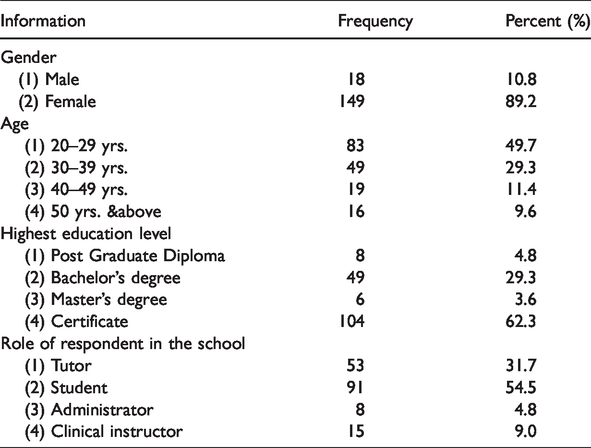
Based on Table 1, although both male and female respondents participated in the study, the majority 149 (89.2%) were females as compared to only 18 (10.8%) males. The females dominated in number because the midwifery profession in Uganda is generally dominated by females both as students and staff. Majority, 79.0% were below 40 years, depicting a slightly younger population undertaking the e-learning program as either students, tutors or administrators at the sampled midwifery schools. the highest number of respondents, 104 (62.3%) were of certificate level of education, Respondents who possessed certificates were majorly certificate midwives who had enrolled on the e-learning program to upgrade to the diploma level in midwifery studies, and these constituted the biggest number of respondents as students 54.5% (91). While respondents with Postgraduate diplomas, Bachelors’ and Masters’ degrees were either tutors or administrators. The above findings are an indication that all stakeholders on the e-learning program within the midwifery school environment participated in the study.
Demographics of respondents (n = 167).
E-learning adoption in midwifery schools in Uganda
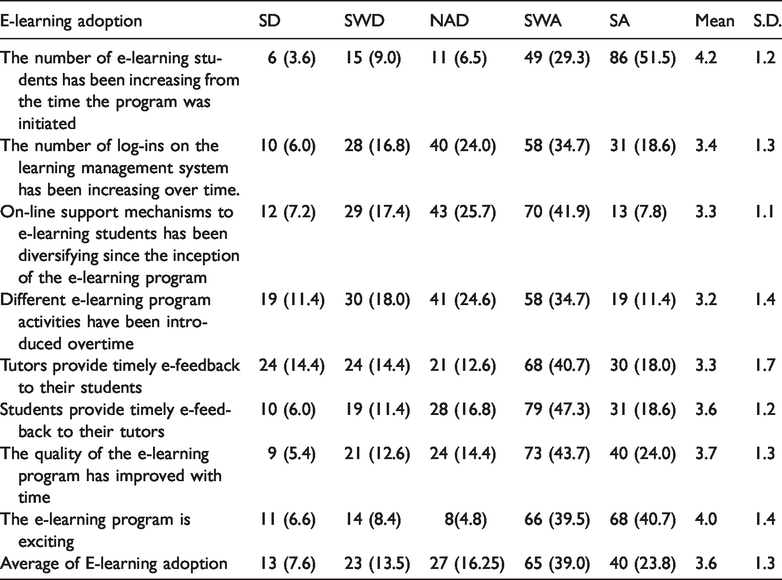
E-learning adoption was measured on the questionnaire using eight statements to which the respondents were required to indicate their level of agreement or disagreement. The level of e-learning adoption was ascertained to be at 61% as majority of the respondents somewhat and strongly agreed to all the eight statements used to assess e-learning adoption. However, if only 61% of students and faculty agree that they are satisfied with the overall e-learning program, and that they are happy with the number of students taking on and using e-learning as their main approach for their quest for knowledge and skills, quantitatively expressed in terms of number of students enrolled on the program; number of students and tutors using LMS/CD-ROM; and the number of faculty offering online support to their learners, the 40% who superficially pronounce disaffection represents a slightly bigger constituency of likely defaulters over time, and something needs to be done to arrest the situation.
In Table 2, a mean between 1.0 and 2.4 indicate disagreement and a mean between 3.5 and 5.0 indicate agreement, whereas a mean between 2.5 and 3.4 means neither agree or disagree to the statement. The Standard Deviation (S.D.) measures the magnitude of deviation from the mean of responses. Standard deviations of magnitude 1 and above indicate that the responses were wide spread from the mean, while standard deviations of magnitude less than 1 indicate that the responses were close to the mean. The findings from Table 2 show that the average mean was 3.6 and the average standard deviation was 1.3. These findings suggest that the respondents were generally in agreement with the statement on E-learning adoption, and the average standard deviation of 1.3, is an indication that the responses were wide spread from the mean.
Views of participants on e-learning adoption.
Participants views on instructional design traits
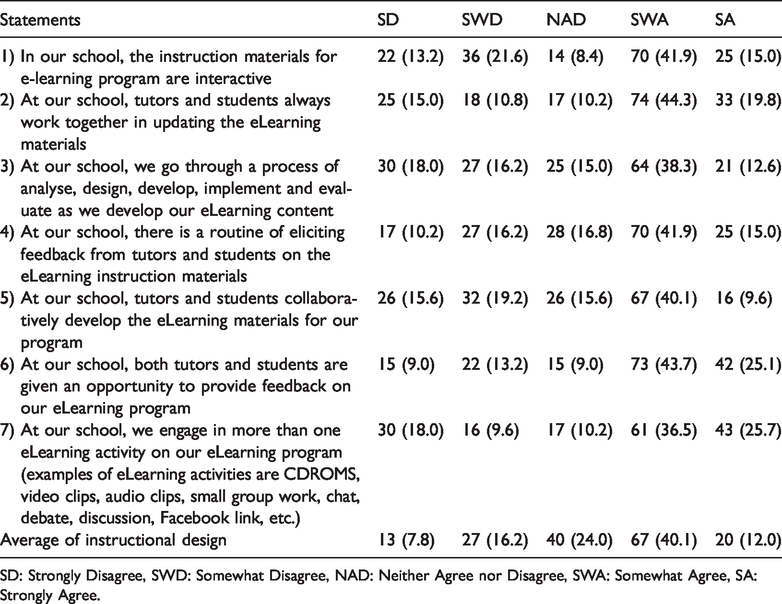
In order to detail the views of the respondents on instructional design, so as to evaluate whether it has influence on e-learning adoption in midwifery schools in Uganda, the study used seven (7) statements on the questionnaire to which the respondents were required to show their level of agreement or disagreement and the findings are presented in Table 3. Qualitative findings collected from interview guides, and FGDs were used to supplement the quantitative findings.
Views of participants on instructional design.
SD: Strongly Disagree, SWD: Somewhat Disagree, NAD: Neither Agree nor Disagree, SWA: Somewhat Agree, SA: Strongly Agree.
Table 3 shows that respondents were in agreement on six (6) out of the seven (7) statements used to measure instructional design in midwifery schools in Uganda as detailed; on whether the instruction materials for eLearning program are interactive, 41.9% somewhat agreed and 15.0% strongly agreed. This means that the majority, 56.9% were of the view that the instruction materials for e-learning program are interactive. A participant in FGD observed that: The instruction materials for e-learning program are interactive since they use a lot of audio and video clips (FGD Member).
On whether students go through a process of analyse, design, develop, implement and evaluate as they develop the e-learning content, 38.3% somewhat agreed and 12.6% strongly agreed. This suggests that the majority, 50.9% were of the view that students go through a process of analyse, design, develop, implement and evaluate as they develop the e-learning content.
On whether there is a routine of eliciting feedback from tutors and students on the e-learning instruction materials, 41.9% somewhat agreed and 15.0% strongly agreed. This means that the majority, 56.9% were of the view that there is a routine of eliciting feedback from tutors and students on the e-learning instruction materials. During one of the FGDS it was revealed that students get a lot of follow-up e-mails from tutors regarding course works.
Furthermore, on whether both tutors and students are given an opportunity to provide feedback on the e-learning program, 43.7% somewhat agreed and 25.1% strongly agreed. This implies that the majority, 68.8% were of the view that both tutors and students are given an opportunity to provide feedback on our e-learning program. A key informant explained that students are encouraged to give feedback whenever they turn up for the face-face sessions and tutors usually hold meetings at the end of each semester to discuss the challenges the e-learning students are facing.
Asked further whether they engage in more than one e-learning activity on their e-learning program, 36.5% somewhat agreed and 25.7% strongly agreed. This suggests that the majority, 61.2% were of the view that they engage in more than one e-learning activity on their e-learning program. Amongst the e-learning activities are CDROMS, video clips, audio clips, small group work, chat, debate, discussion, Facebook link, etc.
Table 3 further shows that there were mixed reactions on one (1) out of the seven (7) statements used to measure school instructional design in midwifery schools in Uganda as detailed; on whether tutors and students collaboratively develop the e-learning materials for their programs, 15.6% strongly disagreed, whereas 19.2% somewhat disagreed, 15.6% neither agreed nor disagreed, while 40.1% somewhat agreed and 9.6% strongly agreed. This means that there were mixed reactions on whether tutors and students collaboratively develop the e-learning materials for their programs, with 34.8% in disagreement, 15.6% neither in agreement nor in disagreement and 49.7% in agreement.
Findings from KIIs and FGDs generated themes that were quite similar to the quantitative findings above, which included: choosing an appropriate instructional design model to guide the entire e-learning process, interactivity of e-learning materials, collaborative working in developing and updating e-learning materials, eliciting feedback on instructional materials, providing feedback on e-learning program, and engaging in more than one e-learning activity, as discussed in the section of salient traits of instructional design and ways of improving them.
Average of instructional design
On average 7.8% of the respondents strongly disagreed to all the statements used to measure instructional design, whereas 16.2% somewhat disagreed, 24.0% neither agreed nor disagreed, 40.1% somewhat agreed and 12.0% strongly agreed. This is an indication that generally the respondents were in agreement to all the statements used to measure instructional design in midwifery schools in Uganda, with on average 24.0% in disagreement, a similar number neither in agreement nor in disagreement and 52.1% in agreement.
Correlation analysis for instructional design and e-learning adoption
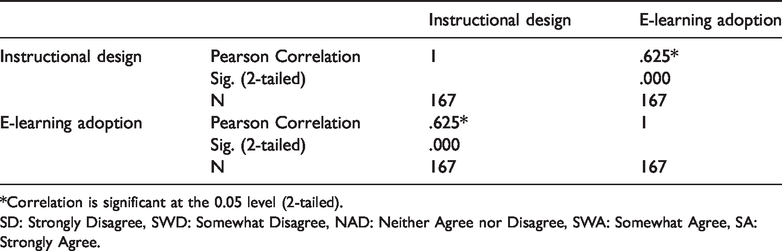
In order to assess whether there is a relationship between instructional design and e-learning adoption in midwifery schools in Uganda, Pearson’s product-moment correlation coefficient was generated at 95% confidence level to compute the degree and direction of the relationship between the two variables and the results are presented in Table 4.
Correlation matrix for instructional design and e-learning adoption.
*Correlation is significant at the 0.05 level (2-tailed).
SD: Strongly Disagree, SWD: Somewhat Disagree, NAD: Neither Agree nor Disagree, SWA: Somewhat Agree, SA: Strongly Agree.
Table 4 shows that there is a moderate positive relationship between instructional design and e-learning adoption in midwifery schools in Uganda, (r = 0.625, p = 0.000, n = 167). The relationship is statistically significant at 95% confidence level since p-value (Sig.) equal 0.000 (<0.050). This means that improvements in instructional design shall be related to improvements in e-learning adoption in midwifery schools in Uganda. Similarly decline in instructional design shall be related to decline in e-learning adoption in midwifery schools in Uganda.
Regression analysis for instructional design and e-learning adoption
Regression analysis was used to analyse whether instructional design has a significant influence on e-learning adoption in midwifery schools in Uganda. The coefficient of determination (R Square) under regression analysis is presented in Table 5.
Model summary for regression analysis for instructional design and e-learning adoption.

aPredictors: (Constant), Instructional design.
Table 5 shows Pearson’s correlation coefficient (R = 0.625), Coefficient of determination or R Square of 0.390 and Adjusted R Square of 0.387. An adjusted R Square of 0.387 means that instructional design account for 38.7% of the variance in e-learning adoption in midwifery schools in Uganda. This means that apart from instructional design there are other factors that contribute to e-learning adoption in midwifery schools in Uganda.
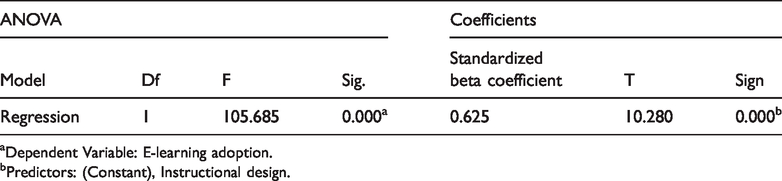
To assess the overall significance of the regression model for instructional design and e-learning adoption in midwifery schools in Uganda, Analysis of Variance (ANOVA) and regression coefficients were generated and the results are presented in Table 6.
ANOVA and regression coefficients for instructional design and e-learning adoption.
aDependent Variable: E-learning adoption.
bPredictors: (Constant), Instructional design.
In determining whether a regression model is significant, the decision rule is that the calculated p-value (level of significance) for ANOVA must be less than or equal to 0.05. Since the calculated p-value of 0.000a is less than 0.05, the regression model was found to be statistically significant (F = 105.685, df = 1, p < 0.05 (=0.000)). This means that instructional design has a statistically significant influence on e-learning adoption in midwifery schools in Uganda.
Furthermore, to establish whether instructional design is a predictor of e-learning adoption in midwifery schools in Uganda and determine the magnitude to which instructional design influences e-learning adoption in midwifery schools in Uganda, Standardized Beta and t Coefficients were generated. For the magnitude to be significant the decision rule is that the t value must not be close to 0 and the p–value must be less than or equal to 0.05. Since the t–value of 10.280 is not close to 0 and p–value <0.05 (=0.000), the study confirmed that instructional design is a predictor of e-learning adoption in midwifery schools in Uganda. A standardized Beta coefficient of 0.625 means; one-unit variation in
Research findings from correlation analysis established that instructional design has a moderate positive statistically significant relationship with e-learning adoption in midwifery schools in Uganda. Findings from regression analysis confirmed that instructional design has a statistically significant positive influence on e-learning adoption in midwifery schools in Uganda. The study therefore accepted the research hypothesis that was stated as thus: Instruction design enhances e-learning adoption”.
Salient traits of instructional design and ways of improving them
As discussed in the section of literature review, instructional design, is very loosely defined as a system or process of organizing learning resources to ensure learners achieve established learning outcomes. As such, it is essentially a framework for learning. This process is vital in e-learning programs because it serves the learning needs and success of students through effective presentation of content and fostering of interaction. Subsequently, there are certain traits that ought to be adhered to in order to make the process a success.
Based on the findings generated from KIIs and FGDs, there are seven salient traits of instructional design: choosing an appropriate instructional design model to guide the entire e-learning process, interactivity of e-learning materials, collaborative working in developing and updating e-learning materials, eliciting feedback on instructional materials, providing feedback on e-learning program, and engaging in more than one e-learning activity. However, on average all the seven traits of instructional design were inadequately being executed across all the midwifery schools as only 52.1% of the respondents agreed with all the statements put forward to assess the implementation of instructional design traits. The study therefore went ahead to ascertain ways of improving these traits so as to enhance e-learning adoption.
Choosing an appropriate instructional design model to guide the entire e-learning program is one of the salient traits that should be implemented by the midwifery schools, however, only 50.9% of the participants agreed that this was being done at their respective schools. Information from key informants and focus group discussions revealed that some of the reasons why certain schools were not using ID models in their e-learning program was that some models were quite difficult to comprehend and implement. One of the recommendations of improving this trait was that midwifery schools should choose instructional design models that are easy to understand and implement, these very sentiments are also in line with the recommendations of Chizmar and Walbert (1999) who emphasized that institutions ought to select an instructional model that is not only easy to comprehend and implement but also fits their learning desires and aspirations. In other words, pedagogy must drive the choice of instructional technology, not the other way around (Chizmar and Walbert, 1999).
Collaborative working in developing e-learning materials was another trait which was being inadequately implemented as only 49.7% of the respondents had agreed that this trait was being implemented at their respective schools. Findings from KIIs and FGDs revealed that the major reason why there was limited collaborative working in developing e-learning materials between students, tutors and other stakeholders on the e-learning program was that most stakeholders still exhibit the traditional form of teaching and learning where, a tutor is seen as the main custodian of knowledge and the other stakeholders only wait to receive knowledge from the tutor by following his or her instructions to detail. Worse still, the tutors have not made an effort to change this paradigm. In connection to this scenario, one of the key informants had the following to say: Most of our learners wait to receive handouts from their tutors, they still posses the mentality that the teacher has to prepare notes and other learning aids and give them to the students … changing this mind set to start developing the learning materials together as a team will take some time …, but we are trying our best (KII)
Discussion
Instructional design has a moderate positive statistically significant relationship with e-learning adoption and it accounts for 38.7% of the variance in e-learning adoption in midwifery schools in Uganda. This finding also concurs with similar studies that asserted that many of the concerns of e-learning dropout rates, learner resistance, and poor learner performance can be addressed through a structured design process. The resulting benefits would include reduced design costs, consistent look and feel, transparency, quality control and standardization (Gustafson and Branch, 2002). The most noticeable gap in some of the literature reviewed was the implicit mention of how much instructional design would contribute to the observable changes in e-learning adoption, this study however, has been able to explicitly discover that instructional design can contribute up to 38.7% of the observable changes in e-learning adoption.
According to Berger and Kam (1996), instructional design is a process of analysing learning needs and goals and the development of a delivery system to meet those needs. It includes development of instructional materials and activities and evaluation of all instruction and learner activities. Instructional design is therefore similar to lesson planning, but more elaborate and more detailed. This means that instructional design should include both the learners and the tutors. The research findings revealed that both tutors and students are given an opportunity to provide feedback on the eLearning program and that tutors and students always work together in updating the e-Learning materials are in agreement with (Berger and Kam, 1996). Although, the traditional paradigm of teaching and learning that constructs the teacher as the provider of knowledge, inform of lecture notes and other materials needs to change so as to embrace the learner centred teaching approach. The traditional paradigm has been found to inhibit collaborative development of e-learning materials as depicted in the FGDs and KIIs conducted. According to Vandenhouten et al. (2014), e-learning necessitates the talents of several team members from a variety of departments as well as the use of different teaching and learning strategies as compared to the traditional form of learning. Instruction as well as team configurations must change when moving to the online environment. As a result, collaboration is a key component in creating quality e-learning (Ellis and Phelps, 2000).
Furthermore, Siemens (2002) asserts that instructional design is the process where learning, not technology, is kept at the centre of e-learning development, which is also in agreement with the research findings that revealed that tutors and students collaboratively develop the eLearning materials for our program. This shows that while technology is being used in the process of e-learning, tutors and students are at the centre of the entire process. Therefore, instructional design is like a roadmap for learning.
Instructional design is very important in e-learning because whereas many traditional classroom activities do not leave a “trail” that can be viewed by others, e-learning does leave a “trail”. Online learning is also far more transparent; classroom transparency discussion is generally not achieved (though certain lectures can be taped and shown to students), however, every aspect of e-learning is transparent and can be used as resources for subsequent courses. Beyond quality and transparency issues, the greatest value that instructional design offers to students of online programs is the essence of integrating their learning needs and successes through effective presentation of content and fostering of interaction (Gustafson and Branch, 2002). This implies that instructional design is indeed key to e-learning adoption.
Much as instructional design had a potential of contributing up to 38.7% of the observable changes in e-learning adoption, what was found disheartening however, was that it was inadequately used in e-learning programming in most midwifery schools in Uganda as only 52.1% of respondents on average agreed to ever using instructional design in implementing their e-learning programmes. The inadequate use of instruction design partly explains the low rate (61%) of e-learning adoption in these midwifery schools.
The major reason behind the inadequate use of instruction design is that midwifery schools find it difficult to comprehend and put it in practice, as a result all the seven salient traits of instructional design were found to be in dare need and midwifery schools need to focus on each of these traits so as to be able to improve the adoption of e-learning.
Three out of the seven instruction design traits were sub optimally rated; interactivity of e-learning materials, use of instructional design model, and collaborating working in developing e-learning materials, yet these are very critical in improving the adoption of e-learning. For instance, interactivity of e-learning materials is very important in increasing the adoption of e-learning, especially when defining interactivity of e-learning as the dialogue between learners and e-learning tools through which learners become engaged and involved in the e-learning process (Pappas, 2015a). It is also argued that e-learning interactivity is a key element of the actual e-learning instruction design process, and it has proven to be a practice that adds outstanding value to any e-learning program (Rodríguez-Ardura and Meseguer-Artola, 2016). It involves forms of action or reaction on learners’ behalf, in order for them to achieve results or reach a conclusion. E-learning interactions may include multiple choice quizzes, tests, e-learning scenarios, simulations, and animation videos among others, that help learners to excavate their understanding of the subject matter through testing, dealing with unexpected circumstances, or even learning from their mistakes (Bucholska, 2019). All these were found to be lacking in all midwifery schools sampled. Additionally, there are various e-learning interactivity levels, however, the most desired level on any e-learning program is the full immersion e-learning interactivity level where learners have great control over their e-learning experience, as they are required to fully interact with the e-learning content and give feedback (Pappas, 2015a). To achieve this level, requires the use of: interactive games, simulated job performance exercises, customized audio or videos, avatars, stories and scenarios, as well as multimedia, all these were inadequately being used hence curtailing the adoption of e-learning.
Collaborating working in developing e-learning material is very critical as it provides an opportunity for all stakeholders involved to express their satisfaction and dissatisfaction on the materials hence providing room for improvement. As Donohue and Howe-Steiger (2005) assert that e-learning materials should be conceptualised as restaurant, offering a menu of options sufficient to meet individual preferences: various lettuces, tomatoes, carrots, radishes, cottage cheese, strawberries, peanuts, and peaches (Donohue and Howe-Steiger, 2005). The challenge for those involved, lies in selecting from among the variety of e-learning options the most appropriate methods to feed the hunger for learning and the passion for teaching of many different types of students and instructors (Biasutti, 2011; Ravenscroft and Matheson, 2002). The challenge for the administrator is to institutionalize the shift to a new e-learning paradigm by finding ways to balance proven traditional classroom modes with successful, cost-effective electronic models. It is not enough just to install an infrastructure of equipment and networks or to buy different software. It is also crucial to provide staff that have the necessary technical skills and an attitude of respect, cooperation, and support for the tutor and student personal preferences. This team approach is vital to energize both faculty and students as they teach and learn (Donohue and Howe-Steiger, 2005; Monahan et al., 2008).
Conclusion
Based on the research findings, it is concluded that improvements in instructional design shall lead to improvements in adoption of e-learning in midwifery schools in Uganda. However, under the current status, the following recommendations are here under made to ensure that instructional design contributes to adoption of e-learning midwifery schools in Uganda; midwifery Schools should continue to design interactive instruction materials for e-learning program as this energizes both faculty and students to achieve their learning outcomes.
Tutors and students should be encouraged and facilitated to continue working together in updating the e-learning materials, because this provides room for meeting expectations of both tutors and students on the e-learning program. Schools need to be able to identify and contextualise an effective and efficient instructional design model, and stop using the one size fits all approaches. The approach of going through a process of analyse, design, develop, implement and evaluate as they develop the e-learning content, and materials, is very critical as this provides an opportunity for both tutors and students to appraisal their e-learning process, and be able to adopt to the fit for purposes model that can motivate the majority of stakeholders on the e-learning program. Additionally, this process should ensure that the schools embrace an instructional design model which is easy to comprehend and implement at all levels of e-learning implementation.
The system for eliciting feedback from tutors and students on the e-learning instruction materials should be improved upon to ensure that all stakeholders can elicit feedback, and use the feedback to improve on areas that require joint efforts of all stakeholders. Providing effective feedback has been proven to be very useful in e-learning endeavours, Wu (2014) in his extensive research provided an account of the importance of feedback in distance education arena, and relatedly, Simonson and Schlosser (2007) have described feedback as a mechanism that allows the sender and receiver, teacher, and learner, to determine if the message was understood correctly (Simonson and Schlosser, 2007). In this regard the message embedded in the different e-learning materials need to be clearly understood by all those involved, and availing an opportunity to provide feedback, will improve the quality of the materials and hence increase e-learning adoption. When planning an e-learning program, feedback must be an integral part. Feedback should be given by students and tutors on the e-learning materials in order to help those involved to make sure whether they have grasped the knowledge or not, and students too should be availed with an opportunity of providing feedback on the different e-learning materials they interact with.
Tutors and students should also be encouraged and facilitated to collaboratively develop the e-learning materials for their e-learning program, as evidence has shown that collaborative working in developing e-learning material is very critical as it provides an opportunity for all stakeholders involved to express their satisfaction and dissatisfaction on the materials hence providing room for improvement.
Footnotes
Declaration of Conflicting Interests
The author(s) declared no potential conflicts of interest with respect to the research, authorship, and/or publication of this manuscript.
Funding
The author(s) received no financial support for the research, authorship, and/or publication of this manuscript.
