



Abstract
BACKGROUND
Twitter offers opportunities to share resources, engage in online discussions, and network with other professionals. In medical education, Twitter is also being used for professional development. Little is known about the level of engagement in topical chats related to medical education. This study explores how medical educators participated and engaged in Twitter-facilitated discussion activity using #MedEdChat.
METHODS
All twitter chat transcripts using the hashtag #MedEdChat from Thursday night synchronous discussions were collected between January and December 2019. A total of 37 discussion topics were included. To answer the first research question about the overall participation, descriptive statistics were used to analyze the number of participants, posts, retweets, and interactions for each week's discussion. To answer the second question about types of discussion participants engaged in during weekly chats, a combination of top-down and bottom-up coding strategy was adopted with three categories: functional, social, and content.
RESULTS
This study identified five themes from #MedEdChat discussions: curriculum, faculty development, scholarship, assessment, and general medical education topics. All discussions had an average of 26 participants, with an average of 145 total posts, including 37 original posts, 52 retweets, and 56 interactions (mentions or replies using @). In terms of types of discussion, content-related tweets were most frequently posted, followed by functional and social tweets.
CONCLUSION
By identifying the patterns of participation and content of discussions, preliminary findings suggest implications for future study to further explore the social interactions and knowledge building processes among online participants in the Twitter-facilitated medical education online community.
Background
Social media, such as Twitter, has offered educators new ways and platforms to share resources, engage in discussions, and connect with like-minded professionals from all over the world. 1 From a social learning perspective, 2 Twitter has the capability to create a community of practice (CoP) where learning happens through social interaction and negotiation of meaning. 3 This CoP could thus be used to facilitate professional development among online participants who have a shared knowledge domain. One benefit of Twitter-facilitated discussions is to enhance networking opportunities and reduce the geographic limitations to interprofessional interaction, which is a significant barrier faced by many professionals. 4 It also enables educators to network and communicate with a broader community outside of their regular work environment, and this early sense of professional belonging could be especially beneficial for novice educators. 5 Increasing attention has also focused on the use of Twitter for professional development among health professionals. An integrative review of social media use among healthcare professionals suggested that while healthcare professionals held positive attitudes towards the use of Twitter and other social media to disseminate medical knowledge, skepticism about the veracity of information exists among participants. To maximize the potential of social media for knowledge exchange and community building, a culture of trust and collectivism and participants’ knowledge self-efficacy need to be developed and supported. 3
However, the attention to Twitter as a platform for medical educators’ professional development is still scant. This study explores how medical educators participated and engaged in discussions in a Twitter-facilitated professional learning activity. Two questions were explored in this study:
What was the overall participation on the #MedEdChat discussions in 2019? What were the types of discussion participants engaged in #MedEdChat?
Methods
This study was approved by the Institutional Review Board in the designated university. We collected Twitter chat transcripts using the Twitter hashtag #MedEdChat between Jan 3, 2019 and December 19, 2019 from the Alliance for Clinical Education website (link: http://allianceforclinicaleducation.org/mededchat). The reason we chose #MedEdChat is because this hashtag is particularly focused on a variety of topics in medical education, holds a synchronous online discussion weekly, and has been in existence since 2011. As a medical-education-focused hashtag, #MedEdChat runs weekly conversations around certain medical education topics every Thursday night at 9pm EST (Eastern Standard Time) for a total of one hour, moderated by the Alliance for Clinical Education. A moderator facilitates the weekly discussion usually with three guiding topic questions posed at specified times during the hour. For example, in the discussion topic titled “train faculty to teach in learner-centered environment”, the moderator provided three topics throughout the session to guide the discussion: (1) What do we mean by learner-centered teaching? (2) Are there new and emerging uses of educational technology that could be harnessed for learner-centered teaching? and (3) How important is reflection in learner-centered education?
For this particular study, a total of 37 discussion transcripts generated during the study period were included. To answer the first question, descriptive statistics were used to analyze the number of participants, posts, retweets, and interactions (using Twitter handles designated by @) for each week's discussion. After several rounds of discussion and agreement among all authors, thirty-seven included discussion topics were categorized into five themes: Curriculum (topics related to either undergraduate or graduate medical education curriculum), Faculty development (topics related to teacher training), Scholarship (topics related to publishing articles or applying grants in medical education), Assessment (topics related to assessment in medical education such as the USMLE (United States Medical Licensing Examination)), and Medical Education in General (other general topics). One transcript from each theme was randomly selected for further content analysis with a total of five transcripts.
To answer the second research question, a combination of top-down and bottom-up coding strategy was adopted. The coding framework was adapted from the existing framework for online discussion posts, 6 which included three categories: Functional, Social, and Content. Functional posts included instructions from the moderator, questions about technical issues, or retweets. Under each of the three categories, specific codes emerged from our own study. Social posts referred to those focusing on social interactions among participants, and usually content-unrelated ones. Content posts are all those around the topic of discussion.
After one researcher reviewed all the transcripts and came up with a preliminary coding framework, all four researchers used the framework to code one of the five transcripts in order to discuss and revise specific codes, ultimately agreeing upon a final coding framework (see Table 1). Afterwards, four researchers were split to two groups—with each group including two researchers coding two out of the four remaining transcripts. They further discussed and resolved any disagreement, and the inter-rater reliability among the five transcripts were 69%, 81%, 91%, 78%, and 77%, respectively.
Coding framework adapted from Uijl et al. (2017).

Results
Overall Participation on #MedEdChat
The overall participation analysis showed that the 37 Twitter chat transcripts around #MedEdChat topics had an average of 26 participants, with the smallest number of participants being 12 and the largest number being 77 (Table 2). The topic that involved 77 participants was “The Rise of Medical Education Podcasts”. In addition, these 37 transcripts also generated an average number of 145 posts, including an average of 38 original posts, 52 retweets, and 56 interactions (mentions or reply using @). Each participant generated an average of 6 posts in each discussion. The Medical Education Podcasts topic had the largest number of total posts (N = 449) as well as original posts (N = 170).
Descriptive statistics of participation on #MedEdChat.
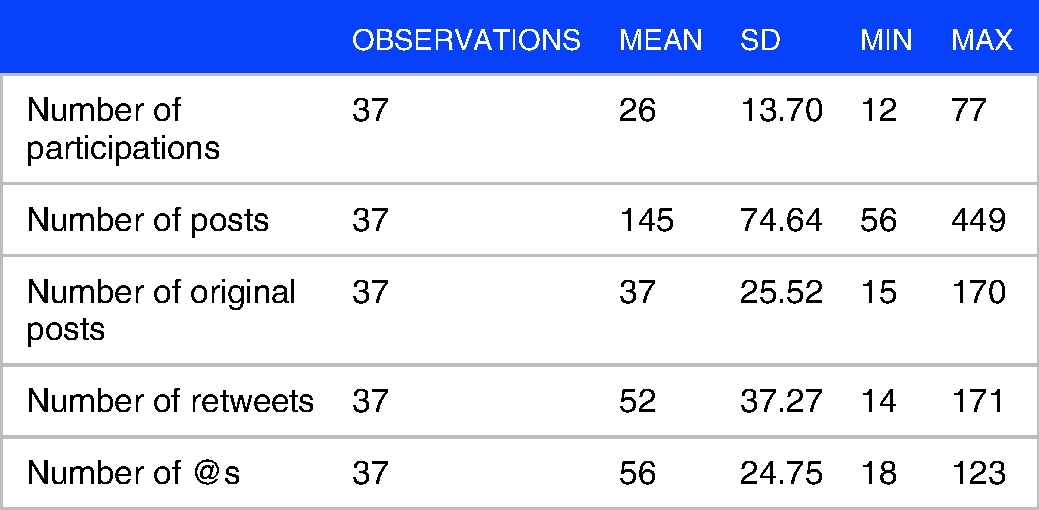
The topic on undergraduate medical education (UME) to graduate medical education (GME) transition generated the greatest number of interactions (with 123 @s) while the topic on peer mentoring program generated the greatest number of retweets (N = 171). Furthermore, an average of 6 outside resources were shared for each discussion, with the largest number of 28 resources shared for one discussion, which was again on the topic of Medical Education Podcasts. The resources shared included journal articles, websites, podcasts, books, and videos.
Types of Discussion
Five categories of themes emerged from the 37 Twitter chat transcripts, which included: Faculty development (N = 12), Curriculum (N = 10), Medical Education in general (N = 7), Assessment (N = 5), and Scholarship (N = 3). For the types of discussion occurring on #MedEdChat, the average numbers of each type of posts were presented in Figure 1. Content-related posts were the most frequent type of tweets (55%), followed by functional tweets (38%), and social tweets (7%). Among content-related posts, the most frequent posts were either original claims (19%) or build-ons (16%), in the way that the content of the post is built upon a previous idea expressed by other participants. Although not frequently used, other types of content-related posts included posting a question (6%), expressing agreement or disagreement (5%), citing outside information (5%), answering a question posted by participants other than the moderator (3%), and showing affection (3%).

Average percentages of different types of posts across Twitter chats.
Conclusion
Research on the educational use of Twitter has shown that participating in Twitter-facilitated online communities can be beneficial for collective knowledge building, collaborative problem-solving, and curating ideas and information.1,7 However, most studies were focused on perceptions and attitudes towards social media. 8 Research focusing on exploring online behaviors and types of interactions in medical education is still limited to our knowledge. This study thus provided a preliminary descriptive investigation of the online participation and nature of discussions in a medical education professional community supported by #MedEdChat.
Variation in the number of participants for each chat appears to be somewhat random. The topics are announced each week via Twitter and other medical education listservs. It is not clear why one topic would garner so many more participants than others. This is an area that could also be further investigated to elicit more engagement each week.
This study also suggested that medical educators are interested in discussion topics especially related to professional development and medical education curriculum. To ensure the active participation and engagement from medical educators, fostering interactions during the chat enhance meaning of the chat experience. 9 Therefore, it is important for an actively engaged moderator to facilitate the discussion. This study could provide suggestions for innovative curriculum focusing on using social media to engage medical educators in online discussions for professional development purposes.
In conclusion, participants engaged in Twitter discussions mainly through providing original claims and building upon others’ thoughts, while also generating questions, expressing agreement/disagreement, citing outside information, providing answers, and expressing affections. By identifying the patterns of participation and content of discussion, this preliminary study could provide implications for future study to further explore the social interactions and knowledge building processes among online participants in the Twitter-facilitated medical education online community.
Footnotes
Disclosure Statement
Dr Beck Dallaghan is the director of the Alliance for Clinical Education and manages logistics for the #MedEdChat.