



Abstract
Attrition rates among school leaders have risen in recent years, and scholars cite a lack of meaningful connections and responsive professional learning as leading reasons why they are leaving the field. School leaders are called to navigate unfamiliar and complex challenges, often working in isolation with limited opportunities for collaboration and professional growth. Social media forums, like Twitter, have potential to support a Community of Practice to facilitate learning around school leadership; however, there is a lack of scholarship exploring how school leaders use social media to support their needs. This mixed-methods study used sentiment and content analysis along with a phronetic iterative approach to explore how school leaders use Twitter to connect with others in the field. The umbrella categories of efficacy, agency, and resiliency emerged from the analysis, offering a glimpse into potential connections made through social media. The findings of this exploratory study suggest that principals are seeking connection, encouragement, and professional learning, yet further development in this area could help inform more formal practices to fill the gap in access to informal professional learning.
Keywords
The educator crisis has gained national attention, with teachers and school leaders leaving the field at historic rates (Goldring & Taie, 2018; Levin et al., 2020). Scholars have found that principal turnover is disruptive to school progress and negatively impacts student achievement, teacher retention, and school climate (Bartanen et al., 2019; Grissom et al., 2021; Levin & Bradley, 2019). However, research indicates the national average tenure of a principal is four years (Levin & Bradley, 2019). Leading factors cited in principal attrition are inadequate preparation and professional development (Levin & Bradley, 2019; Levin et al., 2020), as scholars have found that novice and veteran principals experience intense work situations (Liljenberg & Andersson, 2019), work in isolation, and have limited opportunities for collaboration (Schimel, 2014; Maxwell, 2015; Mitchell et al., 2017). Relatedly, a recent survey conducted by NASSP (2021) among a nationally representative sample of 502 preK-12 school leaders indicated 77% of principals surveyed would like to have more opportunities to connect with principals facing the same issues and challenges.
With a significant number of school leaders identifying a lack of meaningful professional learning as a contributing factor toward attrition (Levin et al., 2020), Darling-Hammond et al. (2022) conducted a comprehensive literature review and national survey analysis, "Developing Effective Principals: What Kind of Learning Matters?", to examine formal preservice and in-service professional learning. The findings from the combined national survey analyses, representing 836 principals, suggest that participants want more professional development in every topic covered; however, the top three include: (1) supporting students’ social-emotional development; (2) supporting children's physical and mental health; and (3) improving student achievement (Darling-Hammond et al., 2022, p. 52). Here, the NASSP (2021) survey and the Darling-Hammond team (2022) findings intersect to establish an overarching problem: A significant number of principals want to learn more about the same topic, yet data suggests they do not have the opportunity to connect and learn.
While there is extensive literature on formalized leadership learning and preparation, there is a lack of scholarship regarding informal professional learning (Veelen et al., 2017). However, there is an emergent area of inquiry in how educators utilize Web 2.0 tools, like social media, to address evolving professional learning needs (Bauer, 2010; Haas et al., 2020). Here, a growing number of studies have examined teachers’ use of Web 2.0 resources to connect and learn (Bauer, 2010; Oddone et al., 2019; Sharimova & Wilson, 2022), but there is a gap of inquiry in how school leaders utilize social media platforms as a space for informal learning.
Twitter, Facebook, TikTok, and YouTube are among a number of platforms that have transformed how people connect and communicate around the world, influencing professional interactions, relationships, and identities (Joosten, 2012). Educators have accelerated its use in both personal and work contexts as a means to share, support, and grow (Greenhow & Askari, 2017; Greenhow et al., 2019). As a result, educators may use social media to move beyond their current state of knowing (Siemens, 2004) and interact within the online environment to construct knowledge or make meaning of experiences (Vygotsky, 1978). This dynamic has shifted accessibility for Communities of Practice (Lave & Wenger, 1991), creating a broadened space for school leaders “who share a concern or a passion for something they do and learn how to do it better” (Wenger-Traynor & Wenger-Traynor, 2015).
Considering that school leaders of today are navigating new and complex challenges, networking opportunities available through Web 2.0 resources, like social media, may address the gaps they have identified related to a lack of meaningful professional learning and connectivity around similar issues (Darling-Hammond et al., 2022; NASSP, 2021). However, while social media has arguably provided new spaces to engage Communities of Practice, there is a lack of scholarship exploring how school leaders actually use these resources. As a foundational inquiry, this study investigates how school leaders are using one popular Web 2.0 platform, Twitter, as a potential Community of Practice. The research questions guiding this study are:
How do school leaders use Twitter to connect with others? What are school leaders talking about on Twitter?
The Context of Professional Learning Within the Principalship
In Preparing Leaders for a Changing World: Lessons from Effective School Leadership Programs, Darling-Hammond et al. (2007) identified five commonalities within exemplary principal learning programs: (1) meaningful, authentic, and applied learning opportunities; (2) curriculum focused on developing people, instruction, and the organization; (3) expert mentoring or coaching; (4) program structures that support collegial learning; and (5) proactive recruitment. In the 15 years since Darling-Hammond et al.’s (2007) findings, the multifaceted skills required of students, the pedagogical expertise and responsiveness of teachers, the landscape of accountability, and the subsequent demands of educational leaders has grown more diverse and complex (Darling-Hammond et al., 2022; Darling-Hammond & Oakes, 2019). As a result, scholars have continued to investigate formal pre-service and in-service school leadership professional learning (Bailey et al., 2022; Chernikova et al., 2020; Davis, 2016; Drake, 2020; Oliver et al., 2018). However, Veelen et al. (2017) noted that there is a lack of empirical research regarding informal professional development and argued there is a need to understand the interplay between the school environment and the person on school leadership learning.
Due to the organizational structure of the school and characteristics of the job duties, principals work in isolation and have limited opportunities for collaboration (Schimel, 2014; Maxwell, 2015, Mitchell et al., 2017). The demanding responsibilities, role overload, and job ambiguity can lead to feelings of distress and isolation (Bauer et al. 2019; Spillane & Lee, 2014) that could impact self-efficacy (Veelen et al., 2017). Beyond the organizational challenges, the evolving responsibilities of the principal have transformed from the role of manager to instructional leader (Hitt & Tucker, 2016). This changing role has fostered new concerns and challenges among campus leaders that include heavy workloads, accountability measures, and compliance requirements (NASSP, 2021).
To address their professional learning and collaboration needs, school leaders may utilize online networks to seek support, mitigate isolation (Silard & Wright, 2020; Smith-Risser, 2013), and expand their community (Rehm & Notten, 2016). Here, examining the social media engagement of school leaders in a particular forum, like Twitter, through the lens of Communities of Practice may provide insight into how principals are engaging and utilizing informal professional learning.
Redefining Communities of Practice
The work of Vygotsky (1978) and Bandura (1977) established that learning is rooted in social interaction; however, technological connectivity has broadened spaces for learners to seek information, connect, and collaborate (Siemens, 2004). Specifically, Twitter's platform promotes social interaction through hashtags, creating virtual communities that center around political topics, sports teams, current events, and trending memes. Through the use of shared hashtags, educators can engage in a virtual community around professional topics or experiences, potentially promoting accessibility to support learning needs by removing boundaries related to geography, time, access, and relatability. While former educational leadership literature has utilized Communities of Practice (CoP) to explore professional development, there is a need to explore CoPs within informal learning forums, like Twitter. Sauers and Richardson (2015), found school administrators use of Twitter resembled the principles of CoP. However, there remains a lack of exploration in how school leaders use Twitter, which may advance previous findings (Sauers & Richardson, 2015) and inform practices within informal leadership learning.
Wenger et al. (2002) refer to a CoP as groups of people who genuinely care about similar problems or topics and subsequently interact regularly to learn together and from each other. The CoP differs from a Personal Learning Network (PLN), as a PLN is frequently identified as a more informal and unintentional connection around a similar topic; whereas members of a CoP seek connections that are more deliberate and focused on improving professional practice (Haas et al., 2020; Wheeler, 2013). Here, within a CoP, members find value in the collective knowledge to learn from each other. The CoP framework (Wenger et al., 2002) includes: (1) the domain—the identity defined by shared interest and commitment; (2) the community—defined space where members engage in activities or discussion, provide advice, and share resources; and (3) the practice—the sharing of resources: tools, stories, practices, and ways to address recurring issues. Through this lens, the two questions driving this study bring forth considerations in exploring how school leaders may create or access a learning community through Twitter.
Methods
The use of social media in research has shown potential as a tool to explore individual thoughts, opinions, and emotions on a variety of real-world topics (Ghani et al., 2019; Weichelt et al., 2020; Zimba et al., 2020). Twitter is one such social networking service that allows free-access users to post brief messages containing no more than 280 characters and paid-access users to post up to 4,000 characters. These messages, known as tweets, are publicly available and do not require membership to view or to share. Within Twitter, hashtags help users reach broad audiences with similar interests. By using the hashtag symbol (#), a user can create topics of interest or establish a group of followers around a particular cause or identity. Consequently, the power of hashtags allows researchers to home in on specific phenomena and explore associated themes within mountains of data.
As a mixed-method study, the data collection for this study was organized into two phases: (1) an initial phase of data collection using the Twitter API centered on key relevant hashtags and (2) the second phase of data extraction from the initial dataset using a collaborative, iterative sentiment and content analysis. Prior to collecting data, hashtags and keywords were identified through a purposive sampling technique and tested for participation levels, audience, and relevance to the research questions. As such, the hashtags identified for this study are not inclusive within the vast expanse of available hashtags connected to school leadership but instead offer a sample of potential discussions on the platform which the researchers consider a delimitation of the study.
Participants
Target participants for this study were school leaders currently serving as a principal, assistant principal, or aspiring principal. As a public platform, Twitter does not delineate users by position, so additional preprocessing involved filtering out posts by students, parents, community members, or businesses through a contextual pre-review of each tweet. This procedure was conducted through a series of tiered reviews by each individual researcher, then a collaborative review for agreement as the research team.
Data Collection
To construct the initial dataset, the researchers used the R-Studio development environment in conjunction with the academictwitterR V 0.3.0 package to build query parameters for data extraction from Twitter's academic API. Through this process, publicly available historical data was obtained from August 1, 2021 to April 1, 2022. These dates were selected to be a representative portion of an academic school year—encompassing traditional and year-round calendars. The search query for this study focused on the purposive sampling of identified hashtags on publicly shared Twitter accounts: #assistantprincipal, #principallife, #principal, #principals, #schoolleader, #schoolleaders. The identification of these hashtags is noted as a delimitation in the study.
Following the purposive sampling protocol with potential hashtags and finalizing time-bound query parameters, the Twitter API produced an initial dataset of 28,000 tweets and retweets. Prior to analysis, preprocessing of the dataset was implemented to narrow results to the target participant population, reduce noise, and assist in classification (Krouska et al., 2016; Symeonidis et al., 2018). Initial preprocessing eliminated non-English tweets to allow a comparable analysis of the language used by participants. It is important to note that the target of the English language cannot be generalized as a dataset of United States school leaders; however, the research team did remove British-English tweets through the tiered filtering process. Next, the data was filtered to remove social media management apps, aggregators, retweet bot applications, and commercial outlets. Final preprocessing of the data involved removing retweets of identical messages lacking additional commentary to maintain original thoughts. This established a working dataset of 8,337 tweets. To assist with the qualitative language analysis, UNICODE characters were removed (excluding # and @) along with video and images. Prior to the collaborative sentiment analysis, additional preprocessing included removing stop words, punctuation and extra spaces within the text (Krouska et al., 2016).
Data Analysis
The researchers used a tiered process for quantitative and qualitative analyses. First, the researchers integrated a machine learning sentiment analysis approach with a collaborative, iterative approach. Sentiment analysis was conducted using the MPQA Subjectivity Lexicon (Khoo & Johnkhan, 2018; Weibe et al., 2005). Lamba and Madhusudhan (2022) defined sentiment analysis as a natural language processing approach that recognizes significant patterns of information and features from a large collection of text. The sentiment analysis “analyzes thought, attitude, views, opinions, beliefs, comments, requests, questions, and preferences expressed by an author based on emotion rather than a reason in the form of text towards entities like services, issues, individuals, products, events, topics, organizations, and their attributes” (Lamba & Madhusudhan, 2022, p. 191). Each tweet was categorized by positive, neutral, and negative sentiment and provided a gradient score between 0 (most negative) to 100 (most positive). This process provided an initial context of the data prior to engaging in coding. Next, the research team engaged in individualized first level coding to categorize tweets. Here, the dataset was divided in half and two researchers individually coded the first half while the other two researchers individually coded the second half. This process was then repeated through second level coding as a research team to collaboratively identify commonalities in the categories, explore implications of cross-categorization, and answer the first research question of how Twitter was used.
The research team then engaged in a secondary qualitative analysis utilizing the phronetic iterative approach. According to Tracy (2018), the phronetic iterative approach allows researchers to explore participant views and opinions while connecting back to external theory and literature. Here, the research team determined that engagement in phronetic iterative analysis would (1) triangulate the data; (2) advance the purpose of the study; (3) explore what school leaders seek to talk about when using Twitter; and (4) provide insight into how school leaders may utilize Twitter to extend informal learning through connection and community.
Using the quantitatively driven findings from the finalized Twitter sample, the researchers bracketed the categorized data around research question two. Here, the lead qualitative researcher engaged in data immersion through a primary cycle coding process followed by collaboration with the research team around emergent interpretations. Primary cycle coding included descriptive methods followed by constant-comparative methods for the developing codebook. Secondary cycle coding encompassed hierarchal coding to develop the final conceptual umbrella categories. The research team engaged in methods drafting, analytic memos, and a loose analysis outline through the coding and analysis process.
Findings and Discussion
First-level and second-level coding revealed significance within tweets among school leaders, answering the first research question: How do school leaders use Twitter to connect with others? From the coding process, four categories (Table 1) emerged as the most significant with all remaining categories falling below 3% of the sample. Representing the largest focus area of the dataset, 34.8% of the tweets were initially categorized into communication related to connections, stories, and encouragement with a sentiment score of 67.2—the most positive category within the sample. The next area of influence within the dataset was communication related to professional development, advice, and improving practices, representing 15.2% of the sample and targeting a more positive focus with a 61.9 sentiment score. The third most significant area of connection for school leaders was communication focused on social-emotional learning, mental health, well-being, and self-care. This category represented 12.8% of the dataset, but unlike the other categories, tweets scored more highly as negative sentiments with an overall sentiment average of 52.8. A final category was discussion of issues connecting to diversity, equity, and inclusion. This category represented 3.6% of the sample and had a sentiment score of 46.6, representing the most negative sentiment of the dataset.
How School Leaders Use Twitter to Connect With Others in a Sample.
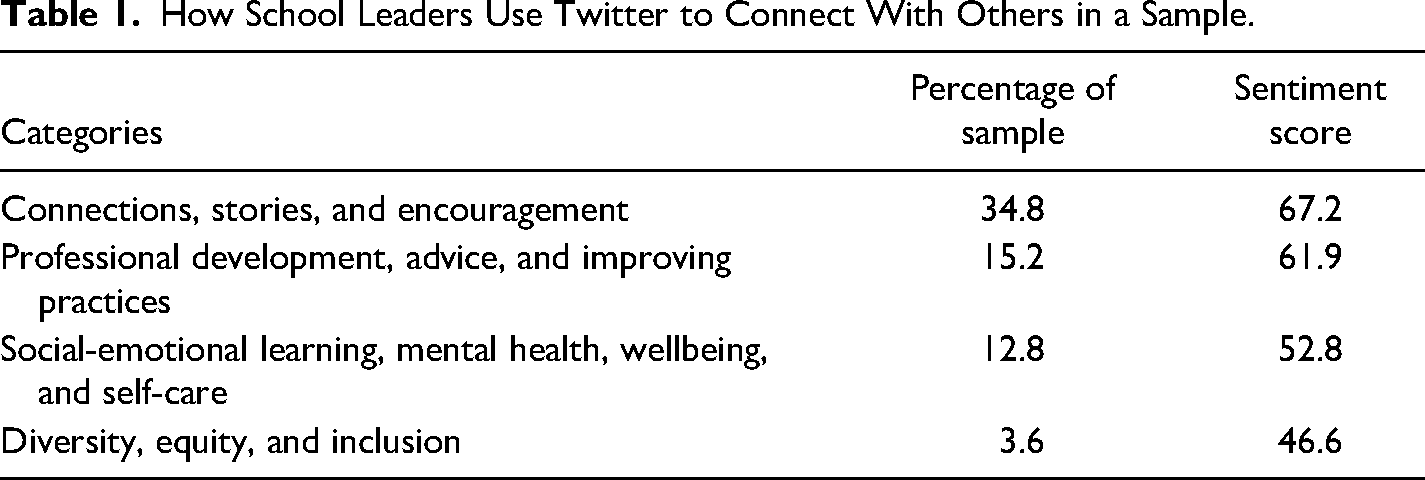
In examining the categorical representation and percentage of each respective area for how school leaders are using Twitter, several considerations emerge. First, in relation to the cited need for meaningful professional learning grounded within the attrition findings (Levin & Bradley, 2019), school leaders in this sample sought more interaction through connections, stories and encouragement with a secondary interaction to professional development, advice, and improving practices. However, the findings representative within this sample point toward and potentially reinforce the literature related to the demands of the role, isolation, and lack of collaboration (Liljenberg & Anderson, 2019; Maxwell, 2015, Mitchell et al., 2017; Schimel, 2014). Here, the difference in prioritization of interaction may suggest what school leaders are seeking from a CoP is not necessarily learning within “how to do it better” (Wenger-Traynor & Wenger-Traynor, 2015) but instead leaning into more opportunities to create community for advice and resources or for relationships (Wenger et al., 2002). In relation, the combination of the third highest category of social-emotional learning, mental health, wellbeing and self-care with the first category of connections, stories, and encouragement, collectively represent 47.6% of the sample. An examination of these combined categories may also suggest a shift for how school leadership learning is defined in response to the educational landscape. Situating the sentiment score around these ideas also contributes toward the potential for what school leaders are seeking, responding to, and how they may be redefining learning, as the respective scores reflect the emotional implication of the language surrounding each category. Here, the next phase of analysis was imperative to move deeper into the context of the categories in pursuit of moving from how school leaders connect to what they are talking about.
Research Question Two
To further examine the sample and how school leaders use Twitter, the researchers engaged in phronetic iterative analysis to explore what school leaders are talking about. Situated within the triangulated framework of the CoP—Domain, Community, and Practice (Wenger et al., 2002)—school leaders may directly connect through a shared interest in their hashtags, then engage through tweets and comments to seek knowledge and learn from one another. Through this lens in analyzing the data for shared interests and development within the positionality of school leadership, three overarching umbrella categories emerged: (1) Efficacy, (2) Agency, and (3) Resiliency.
In unpacking each of the three respective umbrella categories within the primary cycle of coding, the category of Efficacy encompassed tweets related to school leaders’ connection and encouragement with others by sharing stories, positive moments, congratulations, affirming the “why” of leadership, celebrating others, and acknowledging the challenge inherent in the work. The second category of Agency encompassed tweets related to school leaders seeking and sharing professional development by examining and improving practices in leadership, implementing diversity, equity, and inclusion (DEI) practices, expanding equitable access for students, staff, and community, shifting stakeholder perspectives, and initiating change. The third category of Resiliency encompassed tweets related to school leaders seeking supports for mental health of self, students, and teachers through discussions of social-emotional learning, support through COVID, personal well-being, and identifying the needs of students and staff. By situating these three respective categories within the CoP framework, the researchers seek further insight into how Twitter is used to facilitate conversations and potential learning around school leadership.
Efficacy
The first umbrella category of Efficacy suggests that school leaders are seeking connection to encourage, affirm, and celebrate self and others. Findings from a recent study conducted by NASSP (2021) indicated school leaders have a desire to have more opportunities to connect with other principals facing similar issues germane to the job, such as heavy workload, accountability pressures, and compliance requirements. Here, Twitter may provide an untethered space where school leaders can seek connection to combat the isolation and loneliness revealed through the literature (Bauer et al., 2019; Dor-Haim, 2021; Silard and Wright 2020). An example of Efficacy within seeking support was illustrated through one school leader's tweet: heres hoping this week is better than last for all our schools struggling to stay afloat #edadmin #principal #sick #school. Another school leader suggested determination while also providing encouragement, tweeting: my mama always told me to leave it better than you found it sometimes i have to remind myself that even on the toughest days we are making a better way the discomfort is part of the journey i am determined to leave it better than i found it #phled #principal #leadership. A third school leader shared the facets and demands of the role with humor: i walk through halls smiling waving observing and praying i attend meetings daily wave wands constantly i coach masters at their trade and at the end of the day i direct traffic while wearing a sign that says there is no school next week #weleadtx #principals #happyspringbreak. A final example demonstrated encouragement through a call to action within the challenges, with a school leader tweeting: lets continue to work together school leaders this season will not defeat us #teachers #principals #schoolcounselors.
Agency
The second umbrella category of Agency suggests that school leaders are seeking to learn from one another for professional growth. This relates to a recent study that was conducted by Grissom et al. (2021), suggesting four principal behaviors that influence positive school outcomes:
Engaging in instructionally focused interactions with teachers Building a productive school climate Facilitating collaboration and professional learning communities Managing personnel and resources strategically
Here, Rehm and Notten (2016) suggest educators utilize Twitter for advocacy, staying up to date with current issues, sharing professional information and news. Likewise, in a review of the literature, Malik et al. (2021) found Twitter to have a positive effect on both professional development and peer-networking. An example of Agency is shown with a school leader sharing resources, tweeting: have two #book ideas one about being a #leader in all aspects of your life forging your own path other one for #schoolleaders #leaders of anything about putting #peoplebeforepaper and how to lead authentically thoughts #writerslift #edutwitter #leadershipdevelopment. Another school leader sought ways to support the campus, prompting: as the pandemic takes a turn and schools reopen all school staff need support just as the children #principals what are ways you pour into your staff #edutwitter #principallife #teachertwitter. A third school leader encouraged suggested practices to support staff, sharing: everyones worried about educator burn out but what can #principals actually do about it thats within their power these moves are a start, while another took a different approach with a resource: yes this is why adult sel work is so critical for leaders #adultsel #mindfulness @brenebrown #principal #leaderschat. Another school leader challenged perspective, tweeting: principals get out of your office teachers go on the swings once or shoot baskets with them and theyll remember it forever if youre brave climb a rope or do the zip line w them priceless #teacherlife #education #teacher #principal #empathy. A final example demonstrated an examination for reflective practice and encouragement for transformation through praxis, tweeting: time to ask yourself a tough question are you doing everything you can to grow yourself so that you can grow those you are serving #craftedcoaching #edleaders #growyourself #leadershipdevelopment #principals #counselors #instructionalcoaches #nooneleadsalone #mastermind.
Resiliency
The third umbrella category of Resiliency suggests that school leaders are seeking shared identity through collective understanding. Scholarship related to resiliency examines responsive efforts, behavioral traits, grit, and wellbeing within the face of adversity (Duckworth & Quinn, 2009; Masten, 2015; Ungar et al., 2013). Maulding et al. (2012) conducted a study to examine the relationships between emotional intelligence and resilience and school leadership success, suggesting both as significant predictors. Specifically, the researchers found that as emotional intelligence and resilience increased, the leader's capacity increased (Maulding et al., 2012, p. 26). Here, school leaders may access social media platforms, like Twitter, to seek support and avoid isolation (Silard & Wright, 2020; Smith-Risser, 2013). This use may potentially meet the needs revealed in the NASSP (2021) survey in which 77% of principals indicated a desire for more opportunities to connect with principals facing the same issues and challenges. An example of this connection and offer for support surrounding social-emotional needs within Resiliency is shown by a school leader, tweeting: principal wellbeing should not be an afterthought but rather where the conversation begins stay tuned for my principal sel blog principals are struggling 4 ways to help coming soon #blog #edutwitter #adultsel #principal #sel #mindfulness. Another school leader reached out to the community, sharing: whats it like to be a #principal right now a carrying the collective anxiety sinking dumpster fire new challenge every day hard to find joy cant tend to my needs more lonely than ever before just holding things together. In relation to the challenges but seeking connection in navigating the adversity within pandemic protocols, a school leader tweets: calling in all district leaders policymakers and public health officials why in gods name are we having #principals do covid testing and contact tracing this is inhumane and unsustainable principals i support are working 60 hours week and barely surviving #allhandsondeck. Here, shared identity and collective understanding found within the CoP framework resonates with a school leader facing similar challenges, tweeting: this thread is incredibly accurate carrying the collective anxiety being a pandemic principal is beyond surreal and unsustainable school leadership is all consuming right now with no finish line leaders i see you #principal. Another example revealed further social-emotional connection with: i am an elementary #principal as well lockdown and shelter in place drills are now commonplace as are school shootings so so sad #edmundsout. However, a final example of Resiliency from a school leader is a call for encouragement, reminding the community of the principles around grit: struggles are unavoidable but we often see them as negative what if we were for the struggles because they act as a time of growth and learning needed to move forward #givethanksalways #shareyourgratitude #changeyourperspective #craftedcoaching #principals.
Implications
While these three umbrella categories of Efficacy, Agency, and Resiliency cannot be generalized nor considered exhaustive possibilities from the study sample, they do provide an exploratory lens from which to examine what school leaders may seek in a CoP when accessing social media platforms, like Twitter. Further, while these respective categories and the example tweets are not inclusive of shared concerns or identity, as this study provided a sample of engagement within a bounded timeframe, several implications emerge from the findings. Here, as scholar-practitioners and former school leaders, we ground our discussion around the questions that we, as the researchers, wrestled with in response to the growing research surrounding leadership attrition, lack of leadership professional learning, and desire for connection with leaders facing similar needs and concerns within their schools (Levin & Bradley, 2019; NASSP, 2021): How may school leaders address their professional learning needs?; and, if formalized learning is failing to meet their needs, how might informal learning be harnessed?
In taking both strands of analyses within the Twitter sample in this study, school leaders demonstrate they are seeking connection, encouragement, and professional learning that supports their leadership capacity and impact. Accordingly, a continued examination and inquiry into these individual categories and strands, both individually and collectively, is recommended to advance scholarship surrounding school leaders’ use of Web 2.0 tools, like Twitter, to engage in informal learning and potentially serve as a CoP. Moreover, while the findings in this study suggest that Twitter may bridge the gap of connectivity and provide targeted informal learning opportunities, there are considerations for school leaders who seek to advance their practice and engage in community within an open forum. Here, the proverbial principal's door is now open for public access and influence, leading to noise beyond the confines of the campus. School leaders seek meaningful and efficient professional learning but navigating unaligned-domain members who have accessed the CoP, such as teachers, parents, and consultants who want access to the conversation through distractions, advertisements, and solicitations may inhibit the learning they seek. A subsequent study examining the noise school leaders sift through on Twitter to access potential professional learning would bring additional perspective to the conditions and limitations of Twitter as a CoP.
Limitations and Future Research
Even with a large dataset and rigorous analysis, this study has several limitations to consider. First, although Twitter has a large user base and is relatively simple to access, primary users of social media trend younger which may mean that established school leaders could be hesitant to embrace the tool as a means for professional connection. Similarly, there may be privacy concerns that may limit what school leaders are willing to share to a public audience online.
A second limitation is related to the selected hashtags for search. While this study tested a variety of potential hashtags for relevance and engagement, the list of selected hashtags may have missed additional terms that may have further improved the dataset. Further research could refine the hashtag search query by examining results in light of specific themes or keywords.
A third limitation involves the choice to analyze American-English language tweets and not all potential languages represented by school leaders. Some users may feel more comfortable or proficient writing in different languages. Nuances in language use by non-native speakers and the exclusion of other languages may have impacted the results of the sentiment analysis and limited the dataset. Future research could look to include all languages used.
Finally, preprocessing of the data prior to analysis requires certain decisions to be made that can influence coding outcomes. For example, preprocessing for this study included the removal of special characters and emojis that may add supplementary context to the tweets. Machine-assisted sentiment analysis is unable to detect sarcasm, and the use of negation words can affect overall sentiment scores for a string of text. Although not a limitation, it is important to note that of the original data pull of 28,000 tweets, only 8,337 tweets were included in the final dataset after commercial posts and retweets were removed. This represents a significant amount of noise for users to sift through while seeking professional connections or advice. Again, there may be some benefit for future research to examine who is seeking the attention of school leaders and how this noise impacts the accessibility of social media as a tool to develop a CoP or pursue meaningful informal learning.
Conclusions
This study explored how school leaders are using social media platforms, like Twitter, to connect around professional needs and learning as a potential CoP. Answering the first research question in how do school leaders use Twitter to connect with others, a quantitative, tiered analysis led to the identification of four leading categories centering around connections, professional development, social-emotional needs, and diversity, equity, and inclusion (DEI). A phronetic iterative approach was utilized to answer the second research question examining what school leaders were talking about with three emergent umbrella categories identified as: Efficacy, Agency, and Resiliency. Grounded within the recent literature and national surveys that suggest a lack of meaningful opportunities for school leaders to engage with others or connect around similar concerns, the findings from this exploratory study suggest that school leaders are utilizing Twitter as a learning community. As such, the convenience of an online platform, like Twitter, may be where communities of higher education, local education agencies, educator preparation programs and professional organizations come together to support our school leaders in their shifting needs. However, as we have seen Twitter's accessibility shift in recent months, we must also reflect on the influence and impact it potentially has on those leaders who have found a CoP within the social media platform as well as others that may present inherent barriers. While inquiry is developing in this area, we must continue to investigate and find potential solutions to fill the gap that our school leaders have expressed in the need for access to professional learning. As Grissom et al. (2021) remind us, “it is difficult to envision an investment with a higher ceiling on its potential return than a successful effort to improve principal leadership” (p. 43). We must explore, encourage, and extend new forums for school leader communities to thrive and no longer be tethered by the boundaries of time, space, or geography.
Footnotes
Declaration of Conflicting Interests
The authors declared no potential conflicts of interest with respect to the research, authorship, and/or publication of this article.
Funding
The authors received no financial support for the research, authorship, and/or publication of this article.
