




Abstract
The Johns Hopkins School of Medicine’s Learning Community–White Coat Ceremony (LC-WCC) is held each spring as a learning community (LC) event. Learning communities (LCs) connect people to learn and work across boundaries to achieve a shared goal. The LC-WCC invites first-year students to collaborate with school leaders, define the class professional values, and innovate with community members. Class-elected student leaders recruit peers to join committees to plan and lead several aspects of the ceremony, including a class-nominated speaker, a personal statements presentation, a patient inclusion presentation, a class-authored statement of values, and artistic performances. Student cloaking is performed by LC advisors in their LC small groups. A 2015 post-LC-WCC survey asking students to compare experiences of a traditional Stethoscope Ceremony (SC) with the LC-WCC found that the latter significantly increased students’ sense of accomplishment (38% vs 68%, P < .001), sense of connection to the school (59% vs 82%, P < .001), to classmates (71% vs 93%, P < .001), and to the event (42% vs 76%, P < .001). Cloaking as a community is an effective way for a medical school LC to instill a greater sense of community and student leadership in this milestone celebration of humanistic values in medicine.
Background
Learning communities (LCs) have increasingly populated the landscape of undergraduate medical education over the past 10 to 15 years. 1 Inspired by Ernest Boyer’s vision of creating a collegiate community that is purposeful, open, caring, disciplined, just, and celebrative, medical school LCs have an opportunity to achieve this vision through community-based expressions of humanism. 2 The Johns Hopkins School of Medicine (JHSOM) LC—The Colleges Advisory Program—was created in July 2005 to foster camaraderie, networking, advising, mentoring, professionalism, clinical skills, and scholarship for students. 3
Over the past 25 years, the White Coat Ceremony (WCC) has become an established tradition in 99% of Association of American Medical Colleges (AAMC)–accredited medical schools, representing a major milestone along the path of professional development. 4 While at JHSOM, first-year medical students are assigned to LCs at the beginning of the academic year; the WCC, held each year in the spring, represents the first true opportunity for first-year students to lead in their community.
At JHSOM, similar to the timing of traditional WCCs at other medical schools, first-year medical students participate in a Stethoscope Ceremony (SC) in their first 2 months of school to inaugurate them to the medical profession. Planned and led by the medical school deans, the event includes speeches by faculty leaders that emphasize professional values. These speeches are followed by a formal recognition of each student and gifting of a stethoscope. While students actively listen to and learn from the faculty’s wisdom during speeches, they do not recite an oath at this ceremony.
Providing students with opportunities for leadership roles within an LC helps to engage students and foster a sense of community.5,6 Moreover, allowing students to be recognized and valued on a personal level as well as opportunities to get to know other students creates more impactful LC experiences. 5 The Learning Community-White Coat Ceremony (LC-WCC) merges the relationship-centered LC approach with the WCC tradition, utilizing community participation to enhance the goal of fostering humanistic values. The LC-WCC provides a space where students can share their personal backgrounds with their class and community, both throughout the planning process and during the ceremony event. In this article, we describe the innovative features of the LC-WCC, how it can effectively reinforce participation and leadership in the context of LCs, and compare student perspectives of the LC-WCC with the more traditional SC.
Description of Program
Planning process
Encouraging student participation is a main goal of planning the LC-WCC. Six months before the spring event, the LC faculty director meets with the 4 newly elected first-year class student government representatives to invite them to assume WCC leadership roles and initiate planning efforts, as depicted in the timeline of Figure 1. This faculty-student relationship represents the role of mentorship emphasized in LCs. 8 Five months before the event, these student leaders (SLs) host an information session for classmates to learn about the LC-WCC with its various traditions and volunteer opportunities, often with the assistance of prior-year SLs. Typically, 30 to 40 students in a class of 120 volunteer for this planning effort, and they are then invited to join 1 of 8 WCC subcommittees (Table 1). These subcommittees, requiring diverse skills and varying time-commitments, create multiple ways for the class to get involved in planning the WCC. Each subcommittee designates a subcommittee leader and is assigned a SL to provide support. The subcommittee leaders and SLs together form a Steering Committee, which develops a vision statement, coordinates tasks, and meets monthly, then weekly as the date of the LC-WCC nears. Throughout the preparation phase, a relationship-centered approach is used, emphasizing collaboration and community involvement. 7
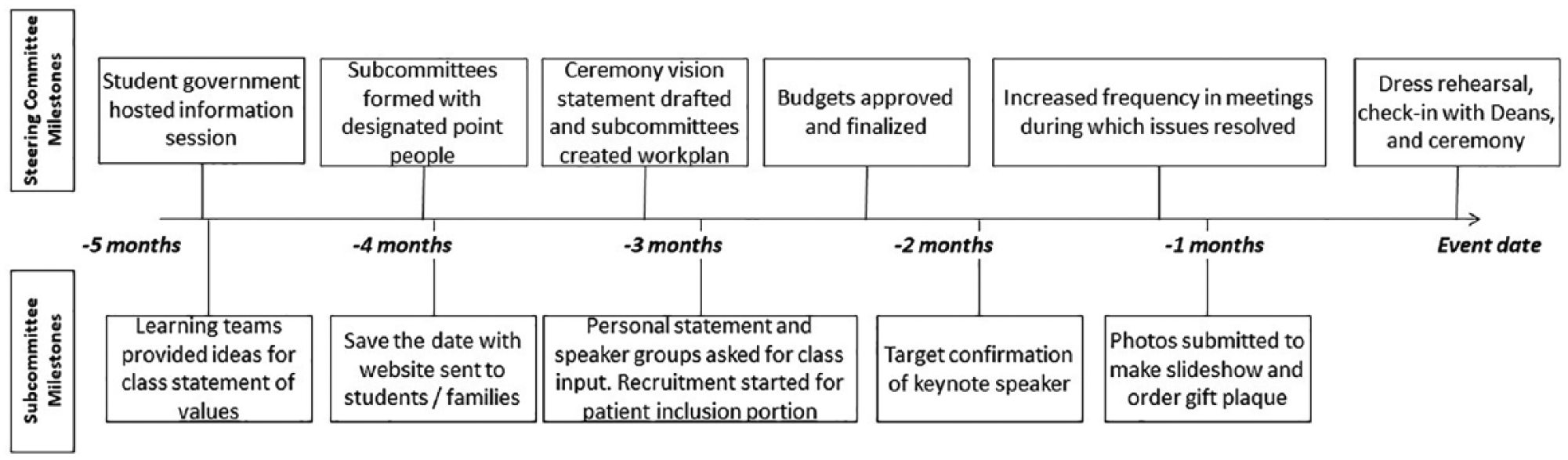
Learning Communities–White Coat Ceremony planning process.
Description of subcommittees and activities.
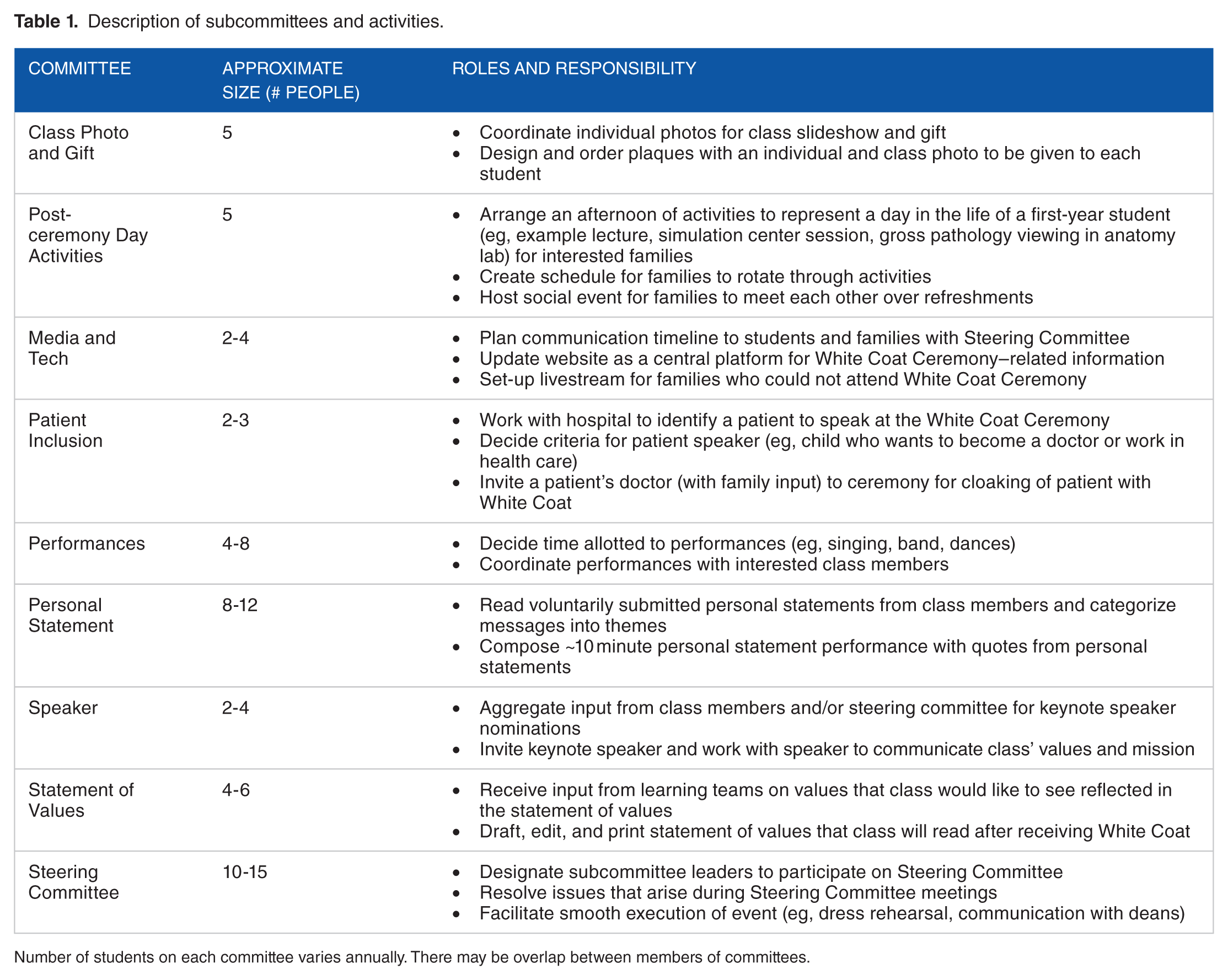
Number of students on each committee varies annually. There may be overlap between members of committees.
Event description
The annual audience attendance of the LC-WCC is approximately 500 to 600 people, consisting of families, friends, and faculty of the students. The ceremony program includes student-led and administration-led portions (Table 2). Most of the ceremony involves student-led preparation, with input and approval from administration.
Agenda for 90-minute Learning Community–White Coat Ceremony (LC-WCC).

Events were led by administration (yellow), students (blue), and student-administration collaboration through learning communities (green).
Faculty speaker
The speaker subcommittee sends a survey to the first-year class for faculty speaker nominations. The subcommittee provides a class-authored statement of values to the nominated speaker so that the speaker understands the core values of the class.
Personal statement excerpts presentation
The personal statement excerpts presentation is a dramatic 10-minute performance that highlights the unity of values and diversity of experiences using excerpts from voluntarily submitted personal statements from medical school applications (Table 3). The personal statement subcommittee invites students to submit their personal statements and selects excerpts based on theme for use at the LC-WCC.
Excerpts from the 2018 White Coat Ceremony personal statement dramatic reading by theme.

Student photo slides
The media and technology subcommittee asks students to upload a unique fact with a current professional photo, childhood photo, and optional photo which represents something important about their lives. This subcommittee assembles the presentation, which is then projected during the cloaking of students.
Cloaking of students
To introduce the LCs, SLs read brief biographies of the legendary faculty for whom the Colleges Advisory Program LCs are named. Then, students are called on stage by their LC small group and cloaked by their LC small group advisor after a greeting from the deans.
Patient inclusion presentation
Students added this component in 2018 to honor the key role of patients in medical education by cloaking a patient during the ceremony. Students collaborate with the Child Life Department to identify a young patient with an interest in health care careers, who could share how their struggles with illness would affect their hopeful future as a health care professional. In addition to the patient’s speech, the students invite the patient’s current physician to give a short speech and officially cloak the patient with a personalized white coat.
Class-authored statement of values
Within LC small groups, 5 months before the ceremony, students reflect on the professional values they aim to embody through medical school and their future careers. The statement of values subcommittee uses these reflections to craft a class-authored statement of values, which is sent to the class for comments and iteratively revised before being read in unison at the LC-WCC.
Artistic performances
To enhance the celebrative nature of the ceremony and build community through artistic interests, students organize musical and dance performances. Cultural dances are used to appreciate the diversity of the class and their families.
Outcome of Program
Methods
In August of 2015, an anonymous, institutional review board (IRB)-approved, online survey was sent to 120 medical students of the class of 2018. Participants were asked to compare on a 5-point Likert-type scale their LC-WCC experiences versus the SC, an introductory celebratory event held at the beginning of the first year, similar to the traditional WCC. Paired t-tests were used for statistical analysis of responses with statistical significant results set to P < .05.
Results
After a 3-month participation period, 76 out of 120 (63%) students responded to the questions presented in Table 4. Respondents felt that the LC-WCC “a lot” or “completely” exemplified characteristics of an LC. When asked to compare their LC-WCC experience with that of the SC, participants felt a statistically significant sense of accomplishment (P < .001) and importance as well as connection to the event (P < .001), class (P < .001), and school (P < .001) (Table 4).
Percent of 76 students of the class of 2018 who responded “a lot” or “completely” to the following elements of the Stethoscope Ceremony a and White Coat Ceremony.

Abbreviations: LC-WCC, Learning Community–White Coat Ceremony; SOM, School of Medicine.
Administration-led induction ceremony as a comparison with the LC-WCC.
Paired t-test performed with significant < .05.
Discussion
Medical student participation and leadership in the organization of their WCC fostered important LC goals at the JHSOM. Compared with the SC, a similar administration-led event marking the induction of students into the medical profession, the WCC strongly increased a sense of accomplishment and connection to the school of medicine, fellow classmates, and the event. The planning process allowed many students to innovate, define the class professional values, and collaborate with each other and faculty.
This study is the first to describe how a LC can empower medical student leadership through the process of organizing a WCC. The description of the planning process can be used as a guide for other medical schools that would like to implement student-led WCCs as part of their LCs. Our findings and description of the planning process complement other literature that highlights the role of community events and leadership in engaging students who are part of LCs.5,6 In addition, 1 major benefit of an LC-WCC is that students develop and publicly express shared values through their personal statement readings, statement of values, speaker nomination, and multi-cultural artistic expressions. Both having students plan their WCC and allowing students time to participate in clinical activities during their first year of medical school helps students better appreciate and understand the significance of receiving their white coats. This approach mitigates concerns of entitlement from medical students receiving white coats without adequate experience, knowledge, and intention. 9
Limitations
It is important to note that the description and results only represent the experience of 1 school. The survey results only included 76 out of the 120 students in 1 class. Contextual and cultural factors of JHSOM LC program may allow for more seamless adoption of an LC-WCC.
Summary
Cloaking as a community resonates with the goals of LCs and facilitates medical student leadership and community engagement. Learning Community–White Coat Ceremonies can be an effective way for medical schools to strengthen LCs and allow medical students to pave their professional paths by defining their WCC, a major milestone in their medical education.
Footnotes
Acknowledgements
The Learning Community–White Coat Ceremony would not be possible without the collaboration among students, faculty, and administration at Johns Hopkins School of Medicine.
Funding:
The author(s) received no financial support for the research, authorship, and/or publication of this article.
Declaration of conflicting interests:
The author(s) declared no potential conflicts of interest with respect to the research, authorship, and/or publication of this article.
Author Contributions
RT led the study team from inception, contributing in each phase of the project.
NK and BD participated on the study team and added core content to the manuscript.
DP participated on the study team from inception, contributing in each phase of the project.
RS mentored the study team from inception, providing guidance in each phase of the project.