



Abstract
Although building preservice teachers’ racial literacy is a key goal to reducing racial inequity in K-12 settings, little attention has been paid to how literacy teacher educators are prepared to conduct this work. This is unsurprising given the neoliberal logic underpinning universities today. In this multiduo autoethnographic study, six literacy teacher educators utilized reflection on critical incidents to examine their own racial literacy development. By forming cross-racial pairs and utilizing a combination of writing and dialogue, these six participant/researchers interrogated their own views and experiences of race and racism. Findings suggest that the examination of critical incidents can support teacher educators’ racial literacy growth. Specifically, participants reflected on the vulnerability necessary to support preservice teachers’ racial literacy development and utilized ethnographic methods to build the practice of sharing about their own racial literacy learning. They also used critical incidents to come to a deeper understanding of the construct of racial literacy itself. These results imply that for professional organizations such as the Literacy Research Association to deliver on their espoused commitments to addressing ongoing institutional racism, they must intentionally create professional spaces for coreflection and dialog about racial literacy. Further, we consider the implications of this work for literacy doctoral programs and teacher educator preparation within contexts of college and university-based teacher education programs.
Introduction
Race is of central importance in literacy teacher education (Haddix, 2019; Souto-Manning, 2021), but persistent obstacles hinder teacher educators’ attempts to build preservice teachers’ racial literacy. This occurs in part because university-based teacher preparation programs operate within the constraints of academic structures (Andrews et al., 2019; Pels, 2000; Shore, 2008), and “positivist hegemony is alive and thriving in the contemporary neoliberal academy” (Rinehart & Earl, 2016, p. 211). Given universities’ intentional resistance to change, it is unsurprising that university-based teacher education programs often reify the status quo of institutionalized racism (Chun & Feagin, 2022). Despite these challenges, many dedicated teacher educators’ work to build the sociocultural knowledge, including racial literacy knowledge, of future teachers (Mosley Wetzel et al., 2019).
The current study focuses on the ongoing learning about race and racism provided to literacy teacher educators. Through multi duoautoethnographic methods (Adams et al., 2021), we explored how literacy teacher educators could use reflective spaces to develop their own racial literacy (Menna et al., 2022; Milner, 2017). Sealey-Ruiz (2021) defines racial literacy as “a skill and practice by which individuals can probe the existence of racism and examine the effects of race and institutionalized systems on their experiences and representation in US society” (p. 2). Racially literate teachers—like racially literate teacher educators—understand how individuals’ and groups’ educational experiences are shaped by race (Rogers & Mosley, 2006; Skerrett, 2011). They also understand the role race plays in shaping individuals’ economic and political opportunities (Croom, 2020) and their own role in creating equitable classrooms (Baker-Bell, 2020; Ladson-Billings, 2006).
Many professional organizations in education have suggested that understanding race and racism is central to improving education systems (National Education Association, 2020). In relation to this work, the Literacy Research Association has codified its position that “issues of racism are not peripheral to literacy research, and literacy research need not remain peripheral to issues of racism” (Haddix, 2019, p. 1). Despite the attention racial literacy has received within scholarly organizations, recent reviews indicate that the inclusion of coursework, readings, and experiences to support teachers’ racial literacy varies across universities (Lammert, 2022; Mosley Wetzel et al., 2019). Relatedly, international research suggests that teacher educator credentialling is more systematic and entails higher requirements for ongoing learning in countries with more equitable education systems (Boei et al., 2015; European Commission, 2013). The current study emerged from these prior studies as we realized a need to focus on the learning experiences of literacy teacher educators themselves in relation to racial literacy (Menna et al., 2022). By using multi duo-autoethnography to conduct this study, we intentionally resisted the neoliberal institutional pressure placed on faculty to separate personal experiences from professional knowledge (Kershen & Hill, 2023). The research questions driving this study are:
What can we learn about literacy teacher education and racial literacy by investigating the phenomena of our embodied experiences as preservice teacher educators through multi duo-autoethnography? Within this context, how does cointerrogation of self-identified critical incidents inform the way we understand the nature of racial literacy itself?
Foregrounding the Study
First, we define racial literacies and define the role racial literacy plays in literacy teaching. Then, we outline how literacy teacher educators are prepared to have racial literacy and teach in ways that build their students’ (i.e., preservice teachers) racial literacy.
Racial Literacy
Racial literacy can be defined as having conceptual knowledge of race as well as the capability of noticing how racism shapes systems and individuals and acting on those systems (Guinier, 2004; Sealey-Ruiz, 2021). Racial literacy knowledge is something all individuals, including teachers, must develop through reflection on experience (Baker-Bell, 2020; Grayson, 2018; Matschiner, 2023; Sealey-Ruiz, 2021). Developing teachers’ racial literacy in initial teacher education is necessary because unless teachers are oriented toward noticing, naming, and acting on questions of racial justice, race-based educational inequities will persist (Milner, 2006; Oto et al., 2023; Sealey-Ruiz, 2021). There are well-documented challenges to building teachers’ racial literacies, such as resistance to the content, difficulty connecting theory and practice, and discomfort experienced by preservice teachers when engaging in this work (Chen et al., 2024; Lammert, 2022; Rogers & Mosley, 2006). There is also reason for hope; the literature shows that when teacher educators push through this resistance by using discourse practices for preservice teacher learning, teachers’ racial literacy is associated with improved teaching practices (Rogers & Mosley, 2006; Rolón-Dow et al., 2021).
It is crucial to understand that racially literate teachers are also effective literacy teachers (Rogers & Mosley, 2006; Skerrett, 2011). This is because they can adapt and design literacy curricula to be responsive to students’ racial and cultural backgrounds, authentically represent racial diversity in their text choices, and affirm language variation within their literacy assessment practices (Baker-Bell, 2020; Ladson-Billings & Dixson, 2021; Milner, 2017; Sotirovska & Vaughn, 2023). By preparing teachers to engage in these practices, teacher educators engage in “racial literacy as resistance” (Price-Dennis & Sealey-Ruiz, 2021, p. 23). Decades of research and reforms have existed based on models such as culturally relevant pedagogies (Ladson-Billings, 1995), yet as measured by standardized assessments that are prone to prioritizing white cultural knowledge, the reading and writing achievement of students of color continues to lag (Donnor & Shockley, 2010). We strongly caution against taking this as evidence that teaching through culturally relevant practices is ineffective. What is missing from these initiatives has been explicit attention to race (Milner, 2017; Sleeter, 2012; Teale et al., 2007) and support building teachers’ racial literacy from the preservice phase onward.
Literacy Teacher Educators’ Racial Literacy
Despite the centrality and importance of literacy teacher educators being racially literate and being prepared to build preservice teachers’ racial literacy (Croom, 2020; Haddix, 2019), little is known about how they are prepared to do so. Teacher educator qualifications in relation to racial literacy and understandings of equity and justice (i.e., knowing how racism manifests in reading instruction) are studied far less than teacher educators’ content expertise (i.e., knowing what a phoneme is; see Boei et al., 2015; Goodwin & Darity, 2019). In their review, Goodwin and Darity (2019) found that in studies of teacher educators’ preparedness, teacher educators’ conceptual knowledge of the sociological factors influencing schooling has received virtually no attention. In contrast, the greatest attention is given to teacher educators’ personal knowledge of learner characteristics and their pedagogical (i.e., applied) knowledge. We do not contest that it is vital for literacy teacher educators to hold content knowledge and pedagogical knowledge. However, despite agreement that “the quality and effectiveness of teacher education depends largely on the competence and expertise of teacher educators” (Buchberger et al., 2000, p. 58) the literature suggests that there is little targeted preparation for those who prepare teachers to develop their understandings of race and racism (Berry, 2007).
The Lack of Standards for Teacher Educator Qualifications
Those of us in the field of literacy education are likely familiar with the idea of content standards for teaching (i.e., Common Core State Standards, 2010; National Governors Association for Best Practices), standards for teacher preparation outlined by states (i.e., Texas Education Agency, 2021) and standards for literacy educators outlined by professional organizations (International Literacy Association [ILA], 2017). However, as authors we know of no agreed upon standards for literacy teacher educator preparation in the United States. Instead, with oversight from university accrediting bodies, higher education faculty typically define the content and course sequence of doctoral programs. Without mechanisms to ensure that doctoral programs include attention to racial literacy, faculty who value racial literacy knowledge are left to find individual-level solutions to the institutional-level problem of racial injustice. Regardless of whether such standards might eventually be created, currently, Too much of teacher preparation is informed by too little knowledge, with teacher educators relying on their own preparation (which is in the past and always dated) on instinct, on tacit knowledge, and on trial by error. This preparation must center on social justice teaching, not as an add-on or a contemporary trend, but as fundamental and inherent to the very act of teaching, and teaching about teaching. (Goodwin & Darity, 2019, p. 75)
Method
We structured this study as a multiduo autoethnography (Adams et al., 2021) because autoethnography is a methodology that can be used to explore the connections between personal experiences and race and provide evidence for the manifestation of institutionalized racism in daily life. Further, Adams (2017) has argued that autoethnographies “offer strategies to curtail abuses of power and privilege, challenge social injustices and inequities, [and] change dangerous beliefs and practices” (p. 79). Since autoethnography emerges from an interpretivist paradigm (Tafoya, 1995; Wilson, 2008), our goal was not to corroborate the details of our lived experiences but to examine those experiences through new lenses with the possibility of uncovering connections to racial literacy not previously seen.
Participants
Participant/researchers were drawn from a larger investigation that began at the Literacy Research Association conference. The line of research we developed, which focuses on the ways teacher educators build and measure preservice teachers’ racial literacy, begun in a 2020 meeting of the Teacher Education Research Study Group. Ten scholars from different universities connected around the pressing question of how we might grow preservice teachers’ racial literacy. As a team we developed a racial literacy survey instrument (Chen et al., 2024), conducted interviews with novice teachers, and analyzed the existing racial literacy levels of various preservice and in-service teachers. As such, all participants knew one another prior to beginning this study in which six researchers from the larger study elected to participate.
Participant positionality plays a central role in ethnographic research. To begin this research, each participant wrote a description of their positionality as a 200-word statement. While we will explore our positionalities throughout the manuscript, we share them in abbreviated form here to provide initial descriptions of ourselves.
Pair One: Xiufang is a literacy faculty member of color with 20+ years educational experience who immigrated to the United States for a PhD degree in her 30s. She works at a public institution in New Jersey. Amy is a white, cisgender, middle-class woman. Her personal experiences with anxiety, depression, and chronic pain have uniquely impacted her approach to antiracist, antiableist, and antibias teaching and learning. Amy works in Maryland.
Pair Two: Catherine is a white cisgender woman, and Shuling is a woman and immigrant from China. They both work at public institutions in conservative-leaning states in the U.S. south, in Texas, and Tennessee, respectively. They are both moms with daughters.
Pair Two: Rhonda is a Black woman, a teacher, a scholar, and most importantly, a learner whose positionality as a young Black professional is central to her efforts as a teacher educator. She works at a large public university in Ohio. Lisa is a white teacher, researcher, and parent of a child with profound special needs who values educational equity. Lisa works at a medium-sized Catholic institution in Massachusetts.
We intentionally constructed cross-race pairs to ensure contact points of similarity and difference between ourselves. Knowing the pervasiveness of “niceness” which we have described in our other work as “a shared disposition, particularly amongst white women, that centers silence, passivity, denial and avoidance” (Gardiner et al., 2023, p. 91), we had multiple explicit conversations about the importance of directness. When choosing pairs, we also considered how the geographic locations where we work, and have worked, impact our views.
The Critical Incident Narrative as a Method
Narratives of critical incidents are valuable tools in ethnographic research. This approach involves the detailed examination of specific events or experiences that hold significance for individuals, offering researchers a deeper understanding of the complexities inherent in educational settings (Kennedy-Lewis, 2012; Tripp, 2011). Importantly, within multiduo autoethnographic research, each participant identifies, recalls, and narrates the incidents that they found meaningful or relevant to the focus of inquiry. While the process originates with an individual memory, by sharing these critical incidents, other participants may find new insights into their own experiences that lead to personal growth. As Breault (2016) puts it, “unlike more traditional forms of research, at the heart of dialogic methods is the potential they hold for meaning-making and transformation during the data collection process itself – the conversations, the collaboration, and writing,” (p. 783). In this way, critical incidents provide a lens through which researchers can explore the lived experiences of educators, students, and other stakeholders, shedding light on the nuanced aspects of teaching and learning.
This method has proven particularly effective in unveiling sociocultural dynamics within educational contexts and allowing for a more comprehensive analysis of the factors influencing pedagogical practices (Viergever, 2019). For example, critical incident narratives have proven useful in research on exercise psychology, a topic that requires a nuanced understanding of how individuals live, move, and eat in diverse ways that are not necessarily captured by studies conducted in laboratory settings (Smith & Sparkes, 2009). The use of critical incidents contributes to nuanced understandings of the multifaceted nature of educational experiences.
The Multiduo Autoethnography Process
In constructing a multiduo autoethnography, the six of us primarily worked in three sets of pairs to write and coreflect. Our multiduo autoethnographic reflections were structured as follows. First, we met as a group of six to agree upon a process for this study and to determine our research questions. At this meeting, we agreed to meet in pairs for four 1-hr long meetings. Before each meeting, each participant wrote an analytic memo and posted it to a shared folder. These memos served as “data centerpieces to generate additional interrogation” (Kershen & Hill, 2023, p. 64). Pairs were encouraged to read their partner's reflection prior to the meeting to ensure the meeting time could be used for discussion.
The content of our analytic memos was driven by four different reflective prompts that we codeveloped in our initial meeting. These are described in Table 1.
Reflective Prompts.
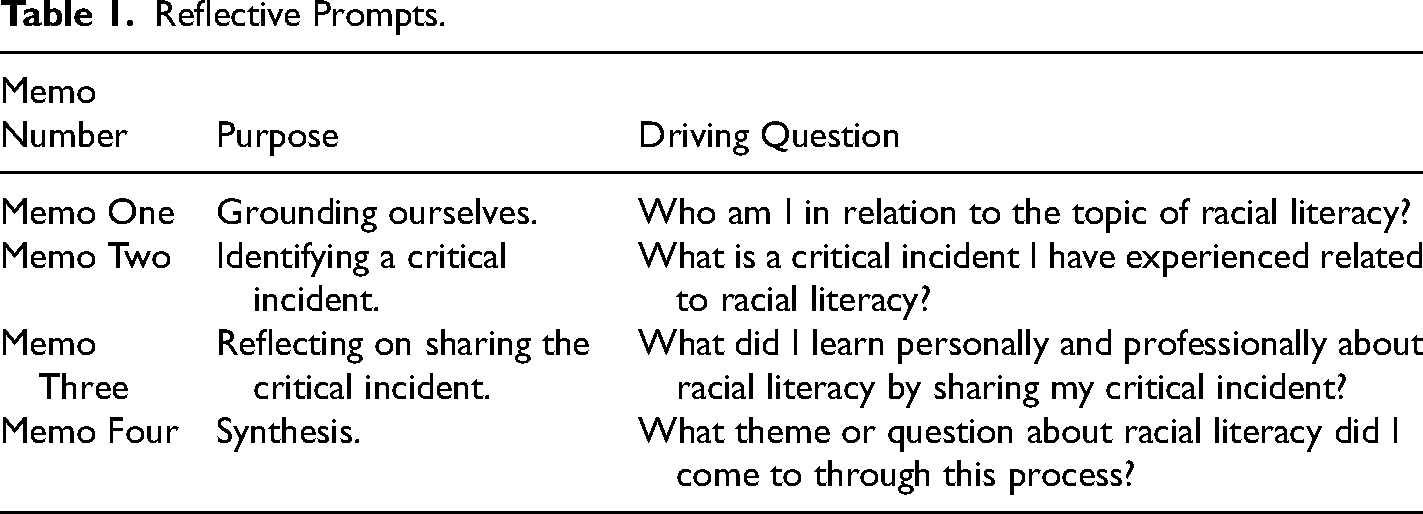
Reflective Prompts
Together, we sought to uncover the stories that inform our own racial literacy awareness, interpretations, and narratives through praxis. As such, these conversations were distinctly not “friendly chats” (Kinnear & Ruggunan, 2019, p. 3), although they often began and ended with discussions of upcoming holidays, university deadlines, and other casual topics. In these conversations, we intentionally guided one another to reflect more deeply on the critical incidents we identified with the goal of uncovering what role(s) we had in shaping them, how they impacted us at the time, and how they continue to impact us now (Kennedy- Lewis, 2012). Following the fourth meeting in pairs, the whole group came together for a fifth meeting in which we looked across memos from other pairs and prior weeks and discussed what new ideas we had generated through this process. Each meeting was audio-video recorded and available for participants to review between meetings. We also encouraged others to write comments on one another's memos before and after meetings. At each stage, we reminded each other that the process was flexible and open to redesign based on participants’ needs.
The autoethnographic process described above resulted in the following data: analytic memos (4 per participant; n = 24) and videos of reflective dialog (4 per pair plus 2 whole-group videos; n = 14). The videos were selectively transcribed when participants felt that certain sections were important for their reflections, however, we predominantly reviewed the auto-video recordings in their existing format. This was necessary to help us capture facial expressions, inflections, and physical referents (i.e., pointing to books in the room) that were relevant to understanding these interactions. Racial literacy is a complex construct tied to both personal and professional experiences (Sealey-Ruiz, 2021) that is not neatly segmented through traditional qualitative coding methods (i.e., Saldaña, 2016) that fundamentally reduce data into smaller sections and therefore themes. Instead, in keeping with ethnographic approaches and to maintain the situated nature of our racial literacy knowledge, our analytic focus was on reading and rereading our own views and others’ views for understanding.
Research Ethics
Since multiduo autoethnography is not intended to produce generalizable results, it does not fit the post-2018 Common Rule definition of research used by Institutional Review Boards (IRBs). Our institutions confirmed that formal IRB approvals were not necessary for us to conduct this research. However, as scholars we agreed that it was important to set ethical guidelines amongst ourselves. To this end, we agreed that anything said or written by a particular speaker/writer stayed within the group unless the speaker/writer consented to share it broadly. We wanted the space to be one where we could openly reflect without concern that details would potentially be taken out of the context in which they were intended.
Results
For purposes of this article, we use the opening and closing whole-group discussions as touchpoints to express the universality of the topics raised by one focal pair. Within this structure, we address our research questions by focusing on their critical incidents to show how examination of critical incidents built our collective knowledge of racial literacy. Although our findings differ from a thematically organized qualitative report, the presentation of our findings is consistent with other similarly structured autoethnographic studies (i.e., Kershen & Hill, 2023; Stevens et al., 2023).
The focal pair, Xiufang and Amy, made many connections between their own preparation as literacy teacher educators and their knowledge of racial literacy. In the first memo, Xiufang explained, “Racial literacy is close to my heart as it reflects not only my own identity and growth but also people's opinions of and attitudes toward me, an Asian immigrant literacy education faculty of color.” While she did not elaborate further on the role her doctoral program played in her knowledge of racial literacy, she did open the door to connect to this topic. Reflecting immediately on her doctoral preparation without being prompted to, Amy copied and referenced a section from her dissertation where she addressed the relationship between race and gender. She had identified, “A preoccupation with affirmation of this type may be particular to what Kamler (2001) referred to as ‘my middle-class good-girl desire-to-please’” (p. 9). She went on to note, “these identity markers seem entwined with my reading and writing identities,” connecting her work as a literacy expert to her embodied experiences of race and whiteness. Then, each expressed their critical incident narratives (Prompt #2; see Table 1), which are presented in detail below.
Amy's Critical Incident
Amy wrote, “The incident that sticks out to me is one from Fall semester 2021, when I was in Tennessee. In one of the early group meetings, one of my white students asserted that she did not believe in white privilege. I gave her this feedback, and she was not pleased: ‘I also want to follow up on the group conversation of White privilege’—yes, it can be uncomfortable to talk about, and I appreciate that you pushed through that discomfort. I think it's important to understand that acknowledging white Privilege isn't about feeling guilty or that you’ve asked for that privilege, and it doesn’t negate or undermine the challenges you’ve faced or the hard work you or your families have done to earn things. What it does mean is that you have not had to face discrimination because of your race. You have likely faced other kinds of discrimination—whether that's because of gender, or social class, or ability. But you have likely been able to walk into any convenience store and find band aids or tights that match your skin, or hair products for your hair type. That's not true for everyone. Acknowledging White privilege isn’t endorsing it, but it is being aware of the facts that there are microaggressions and biases and assumptions that go along with racial identities—you all cited some clear examples of those. Even the fact that you all mentioned that it was hard to think of stereotypes that might have been applied to you, or that you don’t often think of your race and aspects of your identities like your nationality is a part of that—those who are in the minority are often reminded of and aware of the aspects of their identities that make them different. What you discussed there is very similar to what the Hammond reading discussed—many teachers are middle class White women who don’t feel like they have a ‘culture’—which means that, if we don’t think about it and acknowledge it, those teachers might not acknowledge and celebrate the cultures of their students or think to teach students about cultures that are different from what they perceive as ‘normal.’ So, while it can feel uncomfortable to acknowledge or discuss—because we’re often explicitly taught not to discuss it—it is important to be aware that not everyone experiences the world the way that you do, and that your students might be experiencing. I hope that you’ll keep an open mind about those topics as we continue through the semester—thanks for engaging with these ideas in a thoughtful way.”
Xiufang responded, “I love how you responded to your student, Amy! This part is so good for acknowledging the student and her effort, and to build the trust.”
Amy continued, “After the identity activities (writing a name story, identity webs, etc.—all designed to support their development of racial literacies), I asked them to write a kind of mission statement for teaching, and they could choose to write it as a letter to their future selves, to their future students. This same student included an ‘all lives matter’ statement in her writing, which was framed as a letter to her future students. This student had a LOT of resistance to my approach to teaching, building up across a semester and half, and she was not pleased with her grade/my feedback to this assignment.”
Xiufang replied, “Same in my class. I like this confrontation and hope this experience can help build mutual understanding. A collective voice leads to collective power. This is one approach to dismantling racial inequity.”
Amy continued, “She complained about it openly in between some of the other classes the cohort of students took together, and the five students of color in the class (all Black women) decided to confront her about it. They explained why her comments were offensive to them, and how they felt represented and appreciative about the content of the course. They came to talk to me about it afterwards, finding me after my in-person writing methods class. I apologized for them having to do that emotional labor, but also shared my gratitude for them doing that, as they expressed they knew it meant something/changed the thinking of some of their classmates (though not the one they confronted). They were so upset about it, but also so determined, and I just wanted to support them however I could. I asked them what they wanted or needed, and one thing that surfaced was the need for a space for BIPOC students in the College of Education, which was predominately white. A place for students of color to connect, because so often there were only one or two students of color in a class. These women were thrilled to have the five of them together and felt like it was that collective power that enabled them to address this issue. And they wanted to share that support with other students of color, so they felt the same way. From this incident, we got several of these students enrolled in a Tennessee Educators of Color Alliance (TECA) mentorship program that pays them a stipend for student teaching and connects them with mentor teachers of color (outside of their placement, where they had white mentors), and we worked together to found a BIPOC student group in the COE. These students are teaching now. I’m so proud of them.
Xiufang responded, “That's beautiful! I wonder how they practice in their own classrooms now.”
Amy concluded, “While I gave lots of feedback to the student who started the problem across the semester and tried to engage her, there was not really a consequence beyond her grade—she continued in the program and graduated, and she's in a classroom … which is so concerning. Though I raised concerns about her professionalism and approach to teaching, our dispositions weren’t written in a way of acknowledging racism and antiracism, so there wasn’t really a mechanism to act beyond documenting my concerns. I think within this, there's lots individual choices, but this incident is a part of institutional and societal issues, too. Institutionally, it's indicative of the kind of curriculum being implemented in the college that let the white student think that what she did was just fine (and the structures that ultimately meant that she was right about that). On the other hand, there are resources in the institution that made forming the BIPOC student group possible (the support of my dean, money for pizza and fliers, etc.), and TECA as an organizational partnership. At the societal level, there is socialization that the white student has had that fostered both an “all lives matter” mentality, and the confidence that she could include it in a class assignment and face no repercussions. And one that hasn’t asked her to reflect on or engage with discussion of her privilege prior to getting to me in her senior year in college” (Critical Incident #2 Writing).
Interrogation One: What We Learned From Amy's Critical Incident Narrative
Amy's critical incident highlighted the relationship between personal and professional learning about race and racism (Sealey-Ruiz, 2021). In her narrative, she explored her role as a white woman working to shift the mindset of another white woman who refused to acknowledge her racial privilege. In doing so, she pushed against the component of her “middle-class good-girl desire-to-please” (Kamler, 2001, p. 9) and instead actively challenged the student's thinking despite the likelihood that the student would resist her feedback, as often happens (Rolón-Dow et al., 2021). She also took a stance of allyship (Grayson, 2018) toward her Black students by following their leadership and efforts to organize a group so they could better support one another. Finally, Amy utilized one of the advantages of multiduo autoethnographic methods by holding space to write and reflect on a series of connected moments that prompted a wide variety of emotions for her (Adams, 2017). In doing so, she used reflective writing of a critical incident and reflection on that incident to bring about new insights. She would return to this idea in the final conversation where she explained, “There's not just one critical incident. Your racial literacy is consistently impacted by these experiences that you're having, especially in our teaching and learning, and there's not a sort of hierarchical order” (Whole Group Discussion). In this way, Amy's reflection on her critical incident and revelation that her racial literacy was built by a string of connected incidents.
Xiufang's Critical Incident
Xiufang began, “Many times, I’m perplexed by how we address racial literacies in teacher education. One incident that perplexed me happened last Spring. We have Diversity in Action committee in the college of education. Last year, every month we focused on one topic that connected to the heritage month. In May, the AAPI month, I invited an Asian American scholar to deliver a presentation. Like the other months, I sent the invitation to the university and college of education and ensured it was on the university event calendar ahead of time. On the presentation day, only seven people showed up in the beginning, with one from our medical school; only three of us remained until the end. Honestly, the presentation content and interaction design were good. The presenter shared that whenever her college had an Asian American event, there were always fewer attendees and it seemed people were not interested in the topic, or the topic was not important to them. Is the Asian American group not important? Why are we so invisible to people? Because we have a smaller voice or, because we are the model minority”?
Amy inserted the idea that, “We can't solve this at an individual level. We can develop our racial literacies individually to try to navigate the institutional and societal issues and manifestations of racism.”
Xiufang continued, “My daughter once told me, “Mom, you came to the States as an adult. You will never understand what I have gone through.” She shared with me when she was in kindergarten, her White friends told her they couldn’t play with her because she has black hair and eyes. Her food and her appearance were often mocked. In high school, her friend groups were based on race. She never shared with me when those incidents happened, but way later. It hurts me even more as a mom because I wish I could be there for her, but what could I have done? So, how do we make efforts to include everyone and every race in the discussion on racial literacies in all classrooms as teacher and as teacher educator? On the other hand, I myself as a teacher educator don’t always feel confident to talk about race in class. One time we were reading a book on one incident in Black history. I received pushbacks from both White and Black students. One White student felt she was offended because she felt people were blaming her or attacking her. I had to explain to her why we were talking about race in class. One Black student didn’t speak at all. When I invited her to join, she responded, “I feel people won’t understand and connect to Black people, so why should I talk?” I responded that having an honest open discussion on race itself was the first step to help understand each other. “But I knew it's not always easy to take that step.”
Amy noted, “This is such a powerful comment that illustrates that student's school experiences. In predominately white space of teacher ed, it's important for us to center the experiences of students of color, not just White students who need to recognize and dismantle White privilege.”
Xiufang concluded, “I need to confess that I’m still learning about other races and many times I hesitate to conduct a deep conversation or often feel incapable to guide students in their discussions because I am not sure if I will offend people or if my thoughts are appropriate or accurate or not. I grew up in a society where there is just one race and people have no awareness of race or racial issues. Racial talks are still not a confident topic to me. If I myself as a teacher educator am not comfortable or confident, how can we guide our students in class to talk about race? And I wonder how many teacher educators and teachers like me are in higher education and in classrooms … How do students look at us? Do we walk the talk? I’ve made efforts to include multicultural books, authors, and conversations in my class. But when it comes to deep conversations, I need to learn more about many aspects of the topic.”
Amy added, “I appreciate your honesty and vulnerability in this, and your openness to continuing to learn. I think modeling that is as important—maybe more so—than having the ‘right’ answers for our students. Because it's a life-long process of fighting our socialization around race, and none of us will ever have all the answers. But we can develop our toolkits to do our best and repair harm when we make mistakes” (Critical Incident #2 Writing).
Interrogation Two: What We Learned From Xiufang's Critical Incident Narrative
In her critical incident narrative, Xiufang showed the connection between the personal and professional by discussing her role as a mother in her conversations about race and nationality with her daughter. As has been suggested by other scholars (i.e., Andrews et al., 2019) teacher educators can take a more humanizing stance toward their students when they take a more humanizing stance toward themselves by recognizing the interconnectedness of their positionalities and their professional perspectives. Xiufang's recounting of the poorly attended workshop on Asian American experiences also highlights the complex ways institutional priorities shape faculty members’ actions as they prioritize certain activity over others (Rinehart & Earl, 2016). In the final discussion, Xiufang expanded on how sharing this critical incident had influenced her thinking. She explained, “As teacher educators ourselves, we are also learning. So, when we teach our students, we have to be open minded to understand and allow them to grow. It's about vulnerability, and we kind of have to break the walls” (Whole Group Discussion). She went on to discuss the importance of letting preservice teachers see our own growth and see the questions we are still grappling with to invite their growth.
Interrogation Three: Representations of Racial Literacy
In our final discussion, new ideas surfaced about the value of sharing our critical incidents. First, the researcher/participants had developed new answers to the question as to whether racial literacy is knowledge, a disposition, a belief, or some other type of construct. Each of us shared a description or metaphor of how we now represent racial literacies. Table 2 lists these representations and includes representative quotations.
Representations of Racial Literacies.
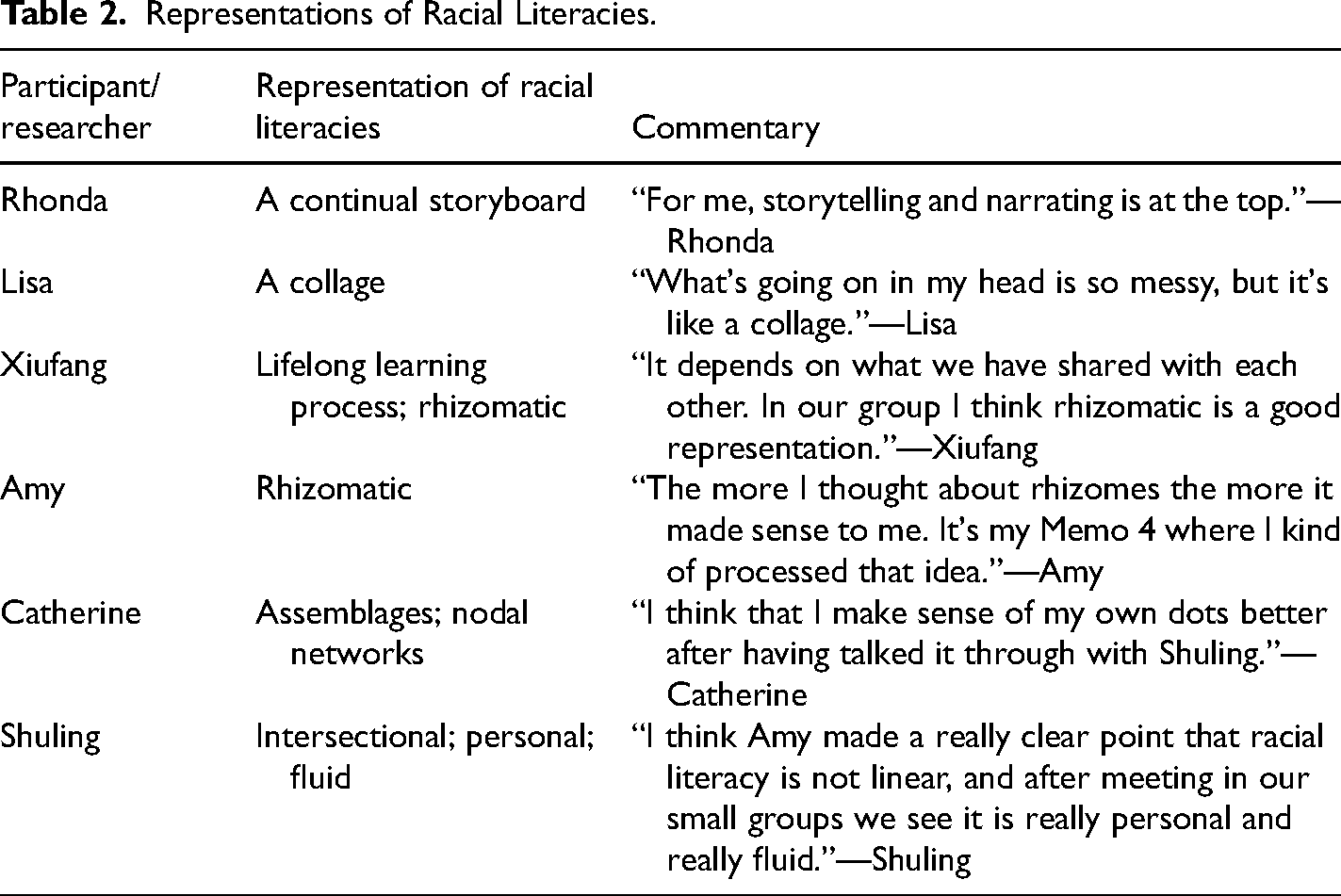
Representations of Racial Literacy
When discussing these different representations, Amy's description of them as rhizomatic was returned to repeatedly. She explained, “Racial literacy might be rhizomatic … like to Rhonda's point about how there's not just one critical incident. There's not some hierarchical order. It's an assemblage.” In sharing this perspective, she built the work of Deleuze and Guattari (1987) to conceptualize racial literacy knowledge in the form of interconnected networks in a constant state of evolution. Furthermore, the group agreed that the process of writing, reflecting, and engaging in dialog brought our various metaphors into clarity. On this topic, Catherine shared, “The dots don't connect themselves. The assemblage of dots and the collection of these critical incidents is who we are, but we're the ones making sense of it. I make sense of my own dots better after talking with Shuling” (Whole Group Discussion). Comments such as these show how the multiduo autoethnographic process directly contributed toward new thinking and growth for the participant/ researchers as we interrogated our critical incidents together.
Second, and relatedly, we discussed the need for more reflective spaces of this nature to exist in academic settings. Lisa explained that, “(Conferences) don’t always tackle juicy issues in the field. Normally I go, I take in information, some of it I use and some of it I don’t. … we need spaces for whatever problem of practice we want to address.” The group agreed, noting how rare it was in their academic lives to have such an opportunity. Rhonda recalled the summer of 2020, which was ripe with racial tension, and the exhaustion she felt trying to answer questions about race without a professional community with whom to reflect. She explained, “everything was inundating us. Everything was overwhelming. And I was so tired. I was so tired of like trying to figure out how to participate, and what does this mean?” Collectively, we agreed that we found new energy from the duo autoethnographic process.
Discussion
Consistent with our research questions, this study addresses both a methodological gap and a knowledge gap and (Miles, 2017). First, we were interested in understanding how multiduo autoethnographic methods can contribute fresh insights into the layered complexity of literacy teacher educators’ racial literacy. Specifically, we focused on how writing, considering, and discussing critical incident narratives with one another could further our understandings. Second, we also wondered what new questions might arise about the preparation of literacy teacher educators, and the lack of systematic attention to their own racial literacy, from this process. Our goal was to “interrupt the trauma and harm inflicted in and by literacy education” (Souto-Manning, 202, p. 597). Through this research, we came to view the process of teacher educators working in cross-racial pairs to interrogate their own critical incidents of race and racism as a key pathway to advance this goal.
Methodological Insights
Speaking to the first research question, our work suggests that the construction of and coreflection on narratives of critical incidents (Kennedy- Lewis, 2012; Tripp, 2011) can enable teacher educators to identify the experiences that have contributed to our racial literacy. Although each of our experiences was bound to our positionalities, we found that naming and deconstructing critical incidents as multiduo autoethnographers was a universally valuable process. We argue that three methodological decisions contributed to the success of this research.
First, we began this multiduo autoethnographic work after having already known one another for several years. Were our process replicated between people who were initially meeting, the same depth of sharing may not have been present. Thus, we do not see this as something that can be easily added to a single doctoral-level course, for example, but the process may be able to be adapted to upper-level coursework or doctoral programming. Second, we believe that the decision to work primarily in cross-racial pairs created space for each participant to share, reflect, and listen to others’ perspectives. Had we met as a group of six, each person would have had one third the time to think aloud as compared to in a partnership. Simply put, understanding race takes time. The extended space to write, talk, and engage in dialog was key to moving beyond superficial conclusions.
We also constructed cross-racial pairs to intentionally invite discussions of difference and sameness. The understandings we gained may not have come to fruition in the predominantly white spaces that are typical in teacher education, or in “diverse” spaces where BIPOC are present but have their voices marginalized (Gardiner et al., 2023). Again, we see this structure as potentially useful in graduate courses where the goal is to build doctoral students’ self-reflection, active listening, and knowledge of racial literacy. Third, we found it helpful to structure our work around the notion of critical incidents as a tool that might center our reflections. Although several of us resisted the idea of one single moment influencing us in an ongoing way, identifying one of the many influential moments served us. As Rinehart and Earl (2016) have put it, “co-produced ethnography admits to an open-ended non-conclusion, and an uncertainty at where the lines between public disclosure and private confidentiality blur and merge” (p. 219). Thus, we agreed to accept the tentative nature of this outcome.
Conceptual Insights
Second, this study contributed new insights into the broad range of experiences and personal factors that support the racial literacy development of teacher educators. Notably, pairs discussed their formal training (i.e., graduate studies) at different junctures, and as they did so, they named elements of their positionalities that shaped how these learning experiences humanized or dehumanized them (Andrews et al., 2019). Despite the pull of audit culture and impact of efficiency models of teacher education (Pels, 2000; Shore, 2008) our findings were consistent with other studies that suggest that there was no easy separation of the professional from the personal when it comes to teacher educators’ racial literacy (Menna et al., 2022).
As a result of having personally experienced the complexity of racial literacy learning, we argue that doctoral-level education should transcend knowledge transmission on the topic of race. A more ambitious goal of any program serving future literacy teacher educators would be to build the reflective tools needed to continue to grow, reflect on, and reshape their own racial literacy knowledge for their lifetimes (Baker-Bell, 2020; Grayson, 2018). We are not alone in utilizing the spaces created by the Literacy Research Association, such as the Teacher Education Research Study Group, to engage in this ongoing learning (see Nash et al., 2023).
Second, we wonder whether content standards for literacy teacher education, which might parallel standards for educator preparation (i.e., ILA, 2017) would elevate the issue of race and racism to an institutionally required topic with which doctoral programs must engage. Since racism is a system-level problem, addressing it requires system-level solutions (Grayson, 2018; Price-Dennis & Sealey-Ruiz, 2021); however, the very individuals who espouse this belief sometimes act as though professional standards are unhelpful. Ideally, these standards would include the necessary content and pedagogical knowledge of teaching reading and writing that are essential to working as a literacy teacher educator as well as attention to race, racism, and sociocultural factors of schooling. As authors, we leave the question of literacy teacher education preparation standards the field. What is clear is that “teacher beliefs about preparedness cannot ignore the diverse students currently occupying classrooms” (Goodwin & Darity, 2019, p. 74). It is essential for those defining the learning trajectories of soon-to-be literacy teacher educators to center race within their curricula (Haddix, 2019).
Limitations
While our findings are not generalizable, we understand this to be a function/feature rather than a bug/flaw of the mutliduo autoethnographic research methodologies we employed (Adams et al., 2021). If the same multiduo autoethnographic process were replicated by researchers who hold positionalities other than our own, or if our pairs had been composed of different combinations of participants within our study, other themes may have emerged (Kershen & Hill, 2023). We graciously welcome this possibility to the table (Croom, 2020). A legitimate limitation of this research is the possibility that as participants in our writing and dialogic processes, social desirability bias (Fowler, 2014) may have shaped the experiences and ideas we raised, especially for white literacy teacher educators who wanted to be perceived as understanding these issues. Although we had developed relationships with one another that spanned several years prior to the study, it is likely that what was shared was shaped, at least in part, by how we expected one another to react.
Conclusion
Literacy teacher educators must be prepared to strategically build the racial literacy knowledge of the preservice teachers with whom they work (Chen et al., 2024; Souto-Manning, 2021). The multiduo autoethnographic methodological process utilized in this research might be explored further to develop racial literacy among teacher educators and preservice teachers to improve the ways they bring their own racial literacy into their work. However, to create space for doing so requires more systemic attention, and possibly professional standards, particularly given the current audit culture and neoliberal logic that permeates college and university settings (Chun & Feagin, 2022; Shore, 2008). It also requires fostering a common vision, disposition, and culture within and across teacher education programs (Lammert, 2022; Sotirovska & Vaughn, 2023) that could be led by professional organizations such as the Literacy Research Association if only we act. Doing so is essential to addressing the underlying racial inequities that have persistently gripped literacy education.
This work reported in this manuscript does not fit the post-2018 Common Rule definition of research used by IRBs. Therefore, no IRB approval was obtained. Please see the Research Ethics section the manuscript for an extended description of the research ethics underpinning autoethnographic research.
Footnotes
Declaration of Conflicting Interests
The authors declared no potential conflicts of interest with respect to the research, authorship, and/or publication of this article.
Funding
The authors received no financial support for the research, authorship, and/or publication of this article.
