



Abstract
This ethnographic case study explores how parents participating in reading experiences influenced children's responses to culturally relevant texts. I focus on six Chinese American families who participated in an online family book club. The children were between the ages of four and six and spoke both English and Chinese Mandarin. In each session, the families listened to an interactive read-aloud, participated in a family book discussion after reading, and shared a question/connection with the group. The data included transcribed video-recordings, transcripts of the family's book discussions, and transcripts of interviews conducted with the families. These data were analyzed using Nexus Analysis and grounded coding methods. Findings showed that parents fostered connections between the child, the book, and their own relationship to the book. These connections reflected heritage culture, family history, and family experiences. The parents shaped the children's reading experience and cultural knowledge by building on and extending existing cultural knowledge, redirecting children to attend to new cultural knowledge, choosing not to address certain types of cultural knowledge, utilizing home resources, and cultivating intercultural awareness and language learning. This study has implications for teachers and educators who want to engage parents in supporting children's cultural knowledge.
Keywords
Asian American families experienced anti-Asian discrimination, prejudice, and stress during the COVID-19 pandemic (Huang & Tsai, 2023; Zhang & Halpern, 2021). Some Asian American families found it was challenging to maintain their children’s heritage language learning during the pandemic (Cun & Cheng, 2023). Starting from 2019, many Chinese heritage language schools shifted to offering only online classes. Some parents discontinued online classes because they thought it was hard for their children to stay engaged with virtual contexts. However, other parents still wanted their children to learn Chinese characters and Chinese culture.
To help Chinese American children continue to make cultural connections, I established a weekly online Sunday book club in Fall 2020 and read culturally relevant picture books with some Chinese American children. As a teacher researcher, I am interested in understanding children's meaning-making process and their cultural awareness. As we continued the book club into Spring 2021, I recognized opportunities for family involvement during virtual book club meetings. Parents often supported their children during online book clubs. Based on my observations, these interactions helped the children to better understand the stories. For example, some parents extended their children's understanding of stories and helped them make cultural connections to the texts. This involvement created spaces for complex parent-child interactions and the co-construction of knowledge, thus creating unique opportunities for learning. Beginning in Spring 2021 and extending into Summer, I invited the children's parents to join the book club; thus, creating a bilingual family book club that entailed children responding to books alongside their parents.
Parents play a crucial role in their children's reading progress (Breiling, 1976; Vasylenko, 2017). Families, schools, and communities must work together to raise bilingual children and help them learn their heritage culture (Dao, 2021; Li, 2006). It is important to understand what parents do during the children's reading experience in order to better collaborate with parents. The purpose of this study is to explore how parents participated in online reading experiences that involved culturally relevant texts. I focus on six Chinese American families who participated in the online family book club. My central research question is: How does parent participation in an online book club shape their children's reading experience and cultural knowledge? I focus on two subquestions: (1) How do the parents sustain and negotiate cultural knowledge with their children? (2) What resources do the parents draw on to teach new cultural knowledge to their children?
Reader Response and Culturally Relevant Texts
Rosenblatt used the term transaction to describe reader-text processes that stress the roles of both readers and the text in meaning-making processes. As Rosenblatt (1982) explained, “Reading is a transaction, a two-way process, involving a reader and a text at a particular time under particular circumstances” (p. 268). Reader response theory emphasizes relationships between readers and texts as readers actively draw on their prior knowledge, transact with texts, and make meaning (Rosenblatt, 1978, 1986). As Hennings (2000) explained, “What readers are ‘living through’—what they see, hear, and feel—as they interact with the text is important” (p. 131). Reader response theory informed how I encouraged the children to respond to the texts and make connections in the book club.
Freeman et al. (2003) claimed that “students read better and read more when they make personal connections with the books they are reading” (p. 6). Bishop (1990) defined culturally relevant texts as “texts that afford children whose ethnicities and experiences have traditionally been devalued or ignored in children's literature opportunities to see themselves and their lived experiences as part of the formal literacy curriculum” (p. i). Culturally relevant literature is “authentic, realistic, and uphold a culturally conscious ideology and message” (Ouimet, 2011, p. 3). In a culturally relevant text, “the primary characters remind children of themselves and their families and neighborhoods” (Clark & Fleming, 2019, p. 24). Freeman and Freeman (2004) claimed that “Culturally relevant books connect to students’ lives, not just to their cultural heritage” (p. 9). These definitions guided the selection of culturally relevant texts in this study. I selected culturally relevant texts that connect to the family's backgrounds, histories, and lived experiences.
Research has shown that using culturally relevant texts can facilitate students’ engagement (Feger, 2006), validate family's cultural and life experiences (Hao & Brown, 2022; Keis, 2006), increase students’ learning motivation (Herrero, 2006), and help students negotiate their identities (Boston & Baxley, 2007; Freeman & Freeman, 2004). Bilingual children bring knowledge about cultures, languages, and experiences as they transact with the text. Thus, it is important that teachers select culturally relevant texts for students.
Taylor (1983) argued that parents play essential roles in children's literacy development. Family members act as educators and assist children with reading and writing at home (Taylor, 1983, 1988). Compton-Lilly et al. (2012) argued for celebrating the diverse family literacy practices brought by family members as family members reference their own literacy experiences, cultural values, and beliefs when they support children's literacy learning (also see Compton-Lilly, 2003; Li, 2003, 2012; Taylor, 1988). Thus, family members’ lives, educational backgrounds, and educational preferences must be valued (Taylor, 1993). Guided by these family scholars, in the book club, I invited the parents to read together and valued the parents’ backgrounds. I also designed prompts for the parents to share their experiences with the children.
Reading With the Families of Bilinguals
Scholars have documented the role parents play in children's reading development. For example, Hao and Wang (2022) read digital texts with a bilingual student and her parent in a virtual context. This parent was involved in the reading process by observing the reading, identifying miscues, teaching the child, reflecting on her parenting role, encouraging the reader, and facilitating the sessions. Hao and Wang concluded that parents played the roles of “observers, learners, teachers, cheerleaders, and facilitators” (p. 33). Noguerón-Liu and colleagues (2020) explored emergent bilingual first-graders reading with Spanish-dominant parents and found that the “children negotiated translating and retelling for their parents in different ways” (p. 412). In Korab's (2010) work with African American and Hispanic families with young children, she demonstrated that children's learning was related to parents’ investment and that the parents acted as teachers, taught Spanish words, and helped the children write their family stories. Patel and colleagues (2021) explored parent-child interactions as they read storybooks and concluded that parents played critical roles in promoting the children's engagement with the books.
Translanguaging practices (i.e., using language resources flexibly without conforming to linguistic boundaries) provide connections across generations and enable the parents to share family histories and cultural heritages. For example, Criss (2013) conducted a bilingual family book club with families and examined their translanguaging practices while reading and responding to books. Results showed that the families utilized their full linguistic repertoires and cultural practices to reflect critically on the texts. Criss suggested that teachers should work collaboratively with families to create a curriculum that centered on translanguaging practices. In another study, Kwon (2019) explored the parent-child interactions among Korean American family members as they visited Korean cultural museums. Results showed that the parents utilized multilingual repertories as they helped their children understand and learn about Korean traditions and family histories. As Kwon concluded, translanguaging practices allowed the children and the parents to “share history, stories, knowledge, and emotions that are meaningful to them across borders” (p. 12).
Reading with families is important for supporting children's literacy development. McNair (2013) conducted several workshops featuring African American children's books with African American families to examine the social practices of the families and support the children's early literacy development. This study stressed the importance of collaborating with families to improve children's academic achievement. Other scholars also highlighted the importance of family engagement in children's literacy practices. Parent-child interaction during shared book reading supports bilingual children's heritage language development (Li & Fleer, 2015). Hao (2023) found that parents used their cultural knowledge to help their children build connections and disconnections with culturally relevant texts. Lynch and colleagues (2008) examined how parents and young children interacted with storybooks and found that the parents extended the children's literacy knowledge.
Inviting family and community members to develop family picture books with children is one way to promote children's literacy development. Louie and Davis-Welton (2016) developed a family bilingual picture books project to support students’ academic performance. Through integrating and honoring students’ cultural heritages, the students and their families became more engaged in the school activities. In another study, Taylor and colleagues (2008) invited families to develop books based on family experiences. A class of bilingual and multilingual children created dual-language books with their parents to share their family histories and experiences. The study showed that families drew on their multilingual resources for book composition and highlighted collaborative efforts made by teachers and parents to support children's literacy development.
While some studies have focused on children's cultural knowledge and home literacy practices, few studies that have explored the potential effects of online parent-child family book clubs in shaping the children's reading experiences, cultural knowledge, and literacy development. In this study, I explore how parent participation in online reading experiences impacted children's responses to culturally relevant texts.
Methodology
In this qualitative interpretivist study, I implemented an ethnographic case study (Compton-Lilly, 2020) to explore parent-child interactions in six Chinese or Chinese American immigrant families. According to Compton-Lilly (2020), ethnographic case studies can be located on a continuum between case studies and ethnographies. Ethnographic case studies draw on multiple data sources to explore people's social and cultural experiences, and the meanings they bring to those experiences. I focused on the children, their parents, and the interactions with parents around books that drew on children's lived experiences to understand how their cultural knowledge was sustained and negotiated through parent-child dialogue. Specifically, this study highlights what happened within the virtual contexts, “including the roles, activities, and meaning making that occur” (Compton-Lilly, 2020, p. 9) when parents and children share culturally relevant books online and collaboratively craft responses to those books. This ethnographic case study allowed me to attend to the virtual context alongside the meanings constructed by participants as they engaged with texts.
Setting and Participants
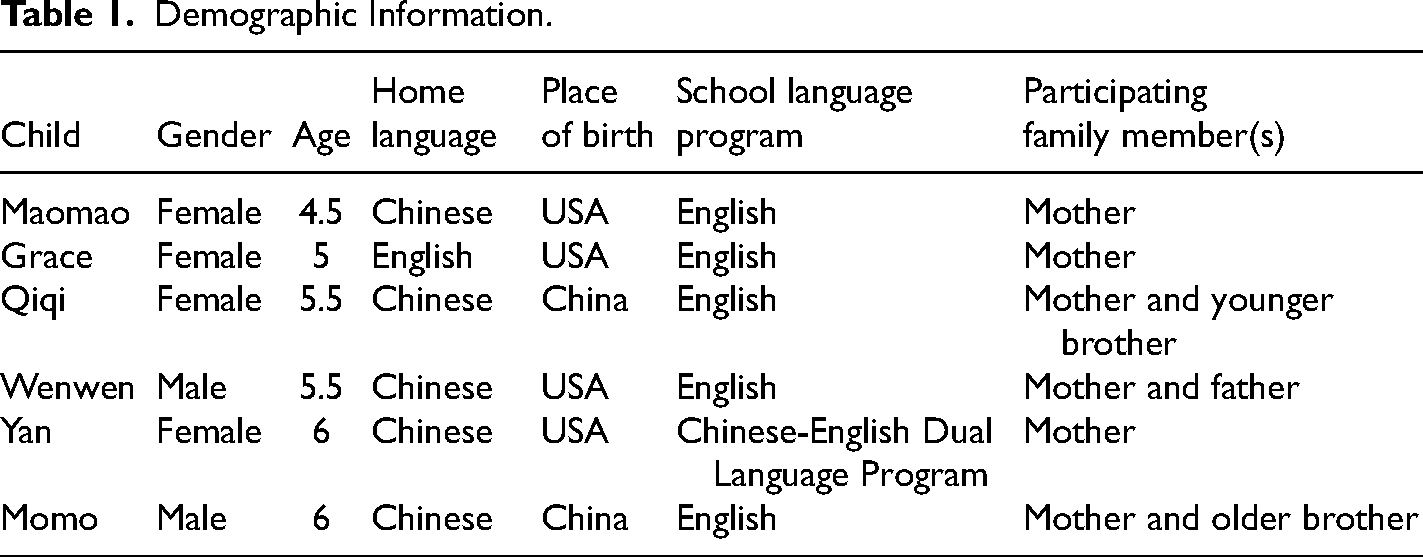
The research was conducted virtually through the video conferencing platform—Zoom—during the COVID-19 pandemic. I used a homogeneous sampling method to recruit participants. Homogeneous sampling entails selecting participants with similar backgrounds, which allows for in-depth understanding of a particular group of people. Participants were six Chinese or Chinese American families with children between the ages of four and six who were living in the United States. These families had participated in this online family book club in the past for one year, expressing a general need for heritage language maintenance. All the families spoke English and Chinese Mandarin. Five families spoke mainly Chinese at home. Grace's family spoke mainly English at home. Grace had recently started learning Chinese as a bilingual language learner. All other children were learning Chinese as a heritage language in their families. At least one parent from each family agreed to participate in the study. Table 1 presents the children's demographic information, including the child's gender, age, home language, place of birth, school language program, and participating family member(s). All names are pseudonyms.
Demographic Information.
Book Club Sessions
On Sundays during the Summer and Fall of 2021, I held ten virtual bilingual family book club sessions weekly. My purpose was to collaborate with parents to promote children's understanding of Chinese culture. I also taught the children to write Chinese characters. The book club was designed to create spaces for parents to engage their children with cultural knowledge. I selected fictional books that depicted Chinese cultural practices and heritage and/or Asian people. These books address Chinese culture, tradition, customs, or Chinese written language. Topics addressed in the books include holidays, foods, language, family traditions, and cultural heritage. When selecting the books, I referred to the definitions of culturally relevant texts and considered whether the books would address Chinese culture and heritage and invite families to engage with the texts in diverse ways to make cultural.
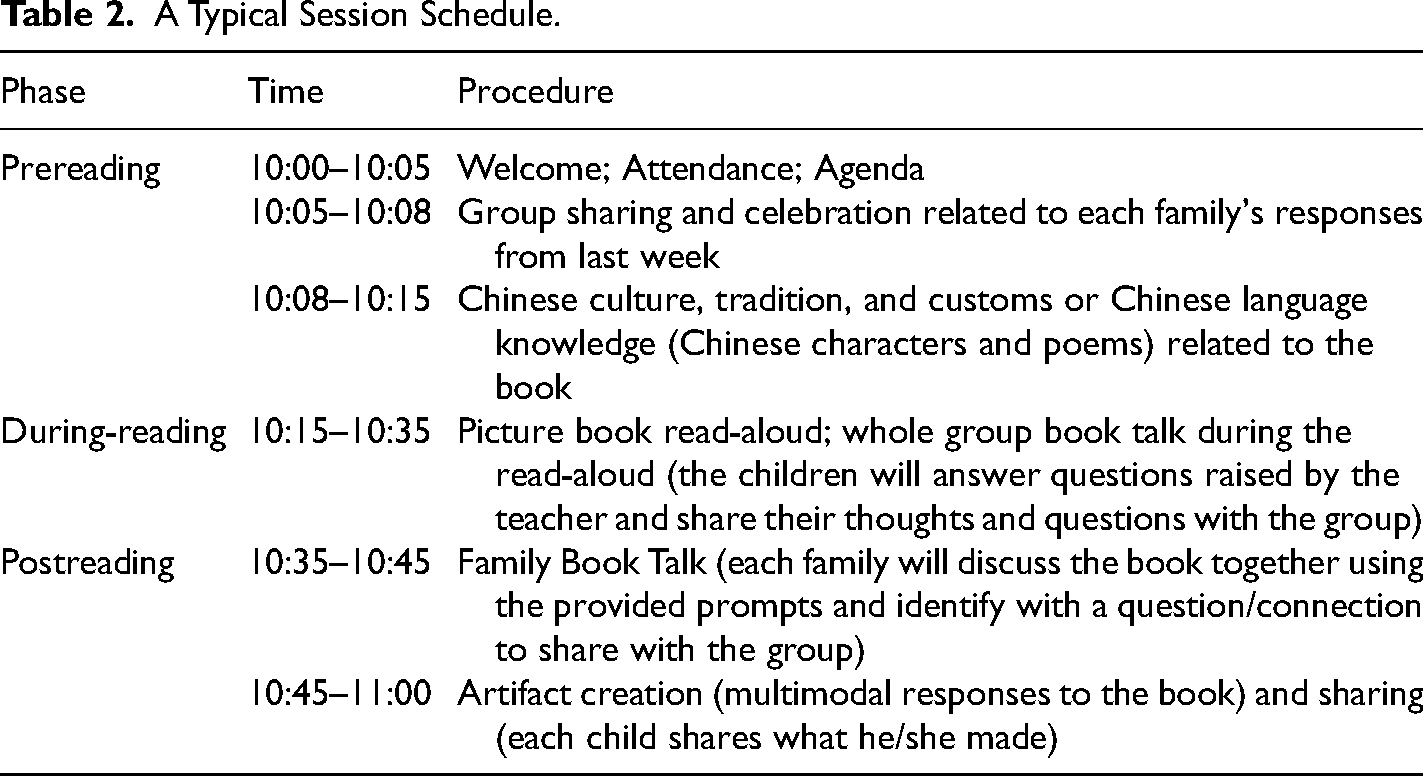
There were 10 sessions in total. Each session was about one hour and included three phases: the prereading phase (15 min), the during-reading phase (20 min), and the after-reading phase (25 min). Table 2 presents a typical session timeline. In each session, the parents assisted their children and interacted with them as I read a picture book aloud. We used both Chinese and English to communicate and I encouraged the children's translanguaging practices as they made sense of the texts. After hearing the story, the parents discussed the book with their children using prompts I provided (Figure 1) to help the child make cultural connections with the text. The parents could choose among the suggested prompts or ask their own questions. Each child worked with his/her parent to pose a question/connection to share with the group.
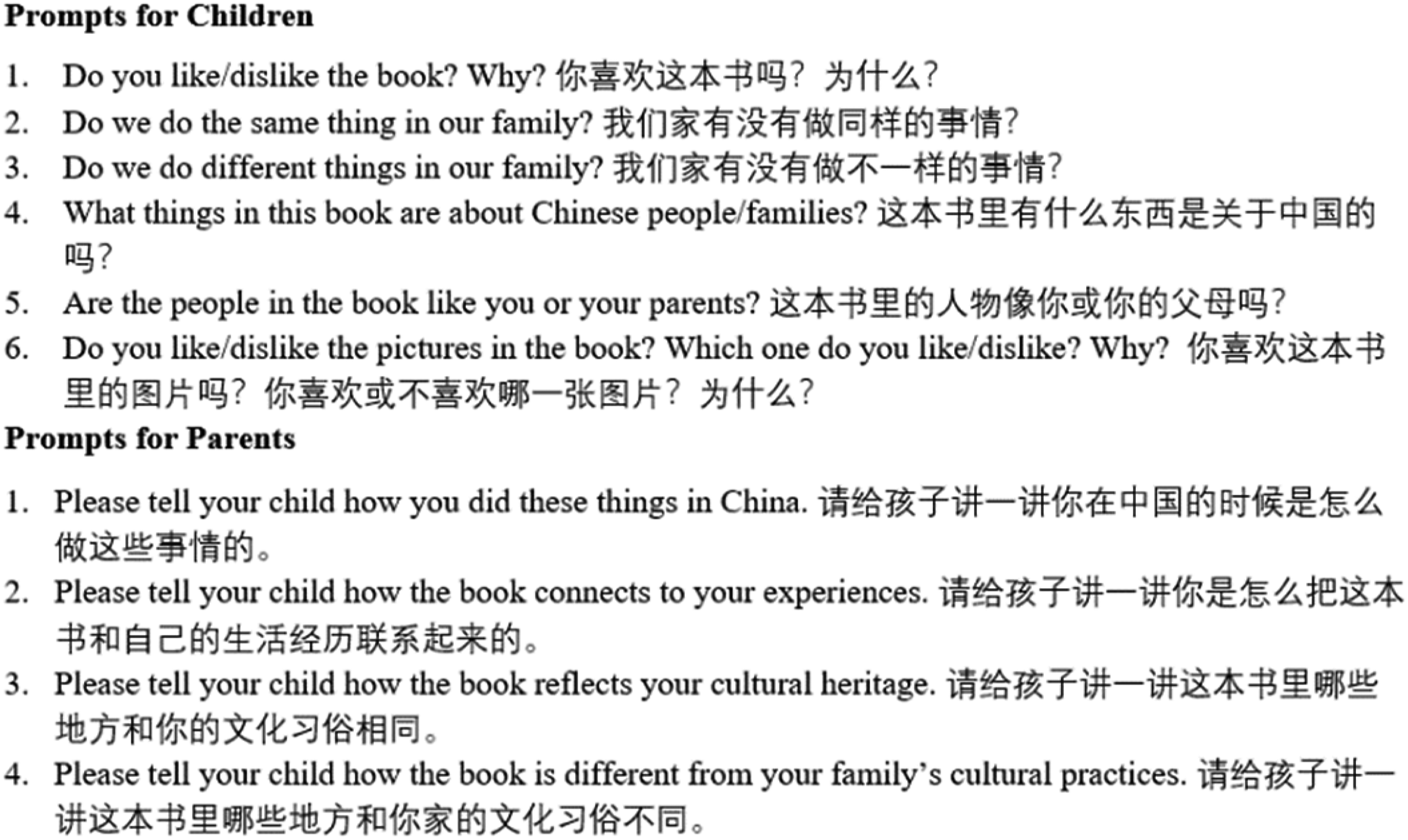
Family book talk prompts.
A Typical Session Schedule.
Data Collection and Analysis
I viewed my role in this study to be both a teacher and a researcher. I worked with these families for one year prior to this study. I provide thick description (Glesne, 2016) to present the children's meaning-making processes and contextualize their references to cultural knowledge and practices. I explored the children's meaning-making process through multiple sources of evidence, including session videos, family discussion recordings, interviews, and observations to provide in-depth descriptions of what happened in the virtual classroom. The research process, coding themes, and findings have been reviewed by my colleagues.
I video-recorded all group activities during family book club sessions. In total, there were ten video-recorded sessions. Each video-recording was around 1 hr. The parents either audio- or video-recorded their postreading discussions with the children using a voice recorder or camera on their cellphones. In total, there were 35 videos/audios collected from the families, each was about 3–5 min. Following the final session, I conducted a 30-min semi-structured interview with each child and one parent via Zoom to document their experiences with the family book club. The data included transcribed video-recordings for each session, full transcripts of the family's book discussions, and transcripts of interviews conducted with the children and parents.
I indexed the videos to identify activities occurring during prereading, during-reading, and postreading sequences. To address my research questions, I transcribed selected segments of during-reading and postreading activity to capture parent-child interactions that reflected culturally relevant responses to texts. For example, I transcribed times when children and parents referenced and negotiated cultural information. These selected segments of the indexed videos were analyzed using Nexus Analysis (Scollon, 2004; Wohlwend, 2021). During the Nexus Analysis process and when video data was available, I attended to children's speech, gestures, gaze, facial expressions, and body movements that reflected culturally relevant responses or involved their interactions with the teacher or the parent. I analyzed how these factors were connected and contributed to the children's understanding of the culturally relevant texts in the virtual context. For example, to better understand the parent-child interactions during the read-aloud phase, I took notes on moments when the children looked at their parents or sought help from them, and analyzed the purpose of these interactions in terms of meaning making or cultural knowledge.
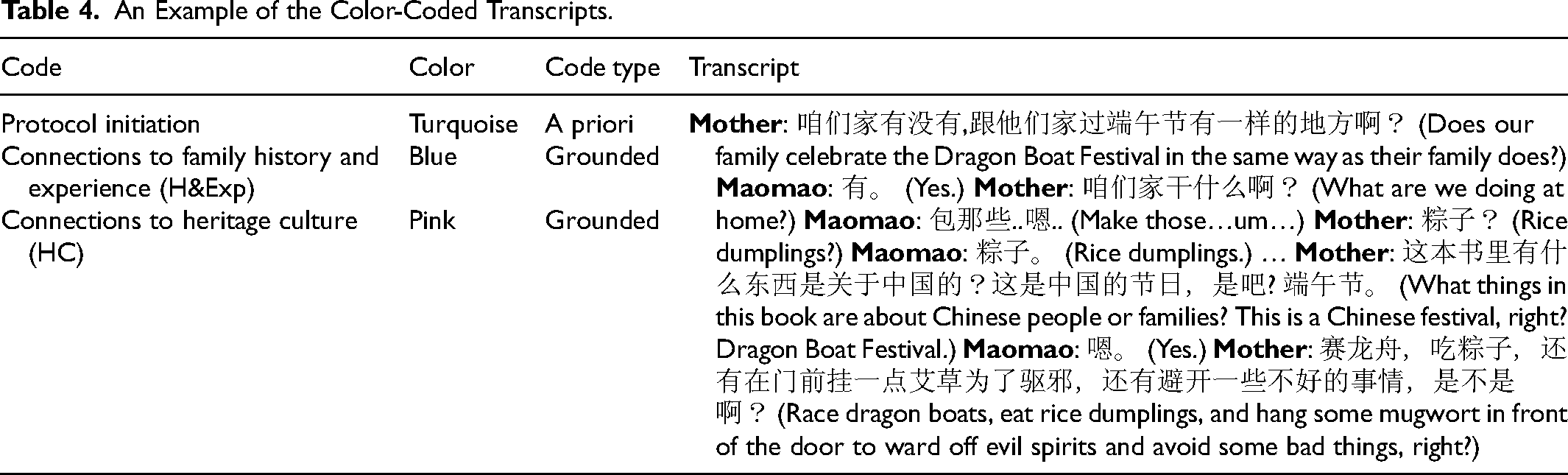
Digital transcripts of all the families’ book discussions were color-coded using both a priori codes and grounded codes (Stake, 1995) to identify codes and themes. A priori codes referenced parent initiation, child initiation, and protocol initiation to indicate how topics were initiated during each conversation. Grounded codes supplemented the a priori codes and were used to attend to culturally relevant and related constructs. When I reviewed my codes for larger themes, the grounded codes in particular spoke to my research questions, so I mainly drew on grounded codes to identify themes and present the findings presented in this article.
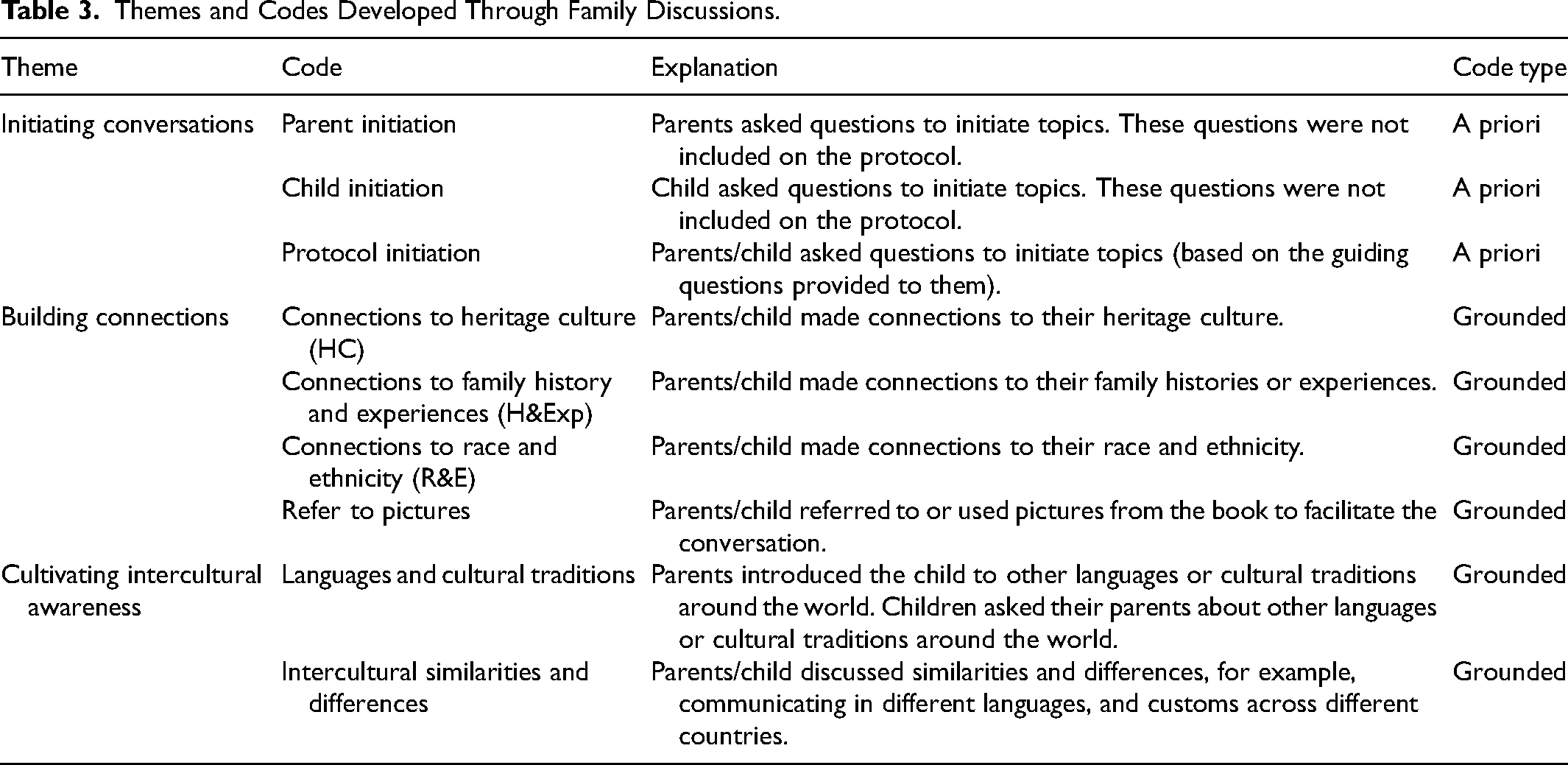
The families’ interviews were analyzed through grounded coding (Stake, 1995) to identify the topics and themes raised by the parents and the children. Based on the research questions, I further analyzed the ways that the parents participated in the conversations and identified the cultural topics they addressed in their discussions. For example, one way the parents participated in the reading experience was that they shared their own connections with the children and tried to build connections for the children. These connections came from their own family histories, experiences, or heritage cultural traditions. Some examples of the identified themes and codes are presented in Table 3.
Themes and Codes Developed Through Family Discussions.
In the second round of analysis, themes reflected on the specific ways of how the parents shape the children's cultural knowledge, such as building on and extending the child's existing cultural knowledge and redirecting the child attend to new cultural knowledge. Table 4 shows an abbreviated example of the color-coded transcripts.
An Example of the Color-Coded Transcripts.
Positionality
I played dual roles in this study as both the teacher and the researcher. My identity as a researcher urged me to participate in the process both as a teacher and as an observer. Coming from China and as the children's Chinese teacher, I encouraged the children to speak and write Chinese. At the same time, as a bilingual speaker, I also valued and supported the families translanguaging practices. I told the children and their parents that both Chinese and English are welcomed in the online book club. My experience of traveling between China and the United States helped me understand the families’ transnational experiences.
I must also acknowledge how my own experience might influence the study. I am from a different part of China than some families in this study. I spoke Chinese Mandarin in the book club when interacting with the families. Coming from different parts of China, some families spoke different dialects and had different cultural traditions. I valued the families’ cultural and linguistic backgrounds.
Findings
Parents participated and shaped the children's reading experiences and cultural knowledge in five major ways, including (1) building on and extending the child's existing cultural knowledge, (2) redirecting the child attend to new cultural knowledge, (3) choosing not to address certain types of cultural knowledge, (4) utilizing home resources to support the child to make connections, and (5) cultivating the child's intercultural awareness along with language learning.
Building on and Extending Existing Cultural Knowledge
Parent participation shaped children's reading experiences and cultural knowledge by building on and extending the child's existing cultural knowledge to help the child make connections. These connections are sometimes related to heritage culture, family history, and family experiences. For example, the book 端午粽米香 [The Dragon Boat Festival and Rice Dumplings] (Bao, 2021) describes how people in China celebrate The Dragon Boat Festival. After reading the book, Qiqi's mother spoke about the origin of this festival. (Explains what origin means.) (This conversation happened in Chinese and it was translated into English).
The parents helped their children connect with their heritage culture and family experiences by extending other topics introduced in the books. For example, after reading a book that featured the Chinese Zodiac, Wenwen's mother connected a conversation about the Chinese Zodiac to Wenwen's lived experience. In China, it is common to give children a zodiac doll during Chinese New Year. Wenwen's mother helped Wenwen make connections to his prior experience with the Chinese Zodiac by asking “What's your Zodiac sign?” Wenwen reported that he was a goat. Wenwen's mother then extended their conversation, asking “Have you ever received any gifts about [the] goat?” This question helped Wenwen to relate the Zodiac to his family experience and important people in his life who had given him gifts. They then discussed various Zodiac gifts (e.g., golden goat, sheep, and monkey) that Wenwen had received from his grandmother. Through this conversation, Wenwen's mother connected the book's focus on the zodiac with Wenwen's experiences.
Redirecting Children to Attend to New Cultural Knowledge
During family book discussions, parents often directed their child's attention to aspects of Chinese culture. For example, after reading 跟着姥姥去遛弯儿 [Feast of Treats for the High Summer Days] (Bao, 2010), which introduced the food, customs, and culture of Beijing, Qiqi's mother used one of the book's illustrations to redirect Qiqi to attend to new cultural knowledge: Beijing's temple fair. (Qiqi asks about the illustration in the book.) (This conversation happened in Chinese and it was translated into English.)
Making the Decision Not to Address Certain Types of Cultural Knowledge
Parents made decisions about what cultural knowledge to address or not to address. For example, after we read 跟着姥姥去遛弯儿 [Feast of Treats for the High Summer Days] (Bao, 2010), Grace's mother took advantage of the family discussion time to expand Grace cultural knowledge. She referred to the illustration and helped Grace learn about historical sites in Beijing.
Grace's mother started the discussion by discussing “new buildings” and “Asian [historical] sites.” She then provided examples of other sites in Beijing: the “Great Wall” and “Forbidden City.” Grace asked her mother to explain the name of the “Forbidden City.” When her mother described it as “really big,” Grace negotiated the meaning by providing a more precise understanding, saying: “No one's allowed in the city.” Rather than addressing the question directly, Grace's mother chose to discuss the history of Forbidden City by simply saying that nowadays “people are allowed there to visit.” Later during our interview, Grace's mother explained that she did not want to talk about the history of the Forbidden City because it was too complicated for Grace—as a young girl—to understand.
Grace's mother curated Grace's reading experience by redirecting Grace's question to introduce cultural knowledge about the Qing and Ming Dynasties, thus avoiding a complicated historical explanation of the Forbidden City. Grace's mother then introduced Beijing's long history with Beijing's temple fair which was illustrated in the picture book. During this discussion, Grace's mother used her agency to decide what types of cultural knowledge to share with Grace.
Utilizing Home Resources to Build Connections
With the help of their parent, the children shared family resources in connection with ideas presented in the books. For example, after we read The Ugly Vegetables (Lin, 2001) which discussed a Chinese-American girl's garden, I asked the children what they grew in their gardens (see Figure 2).
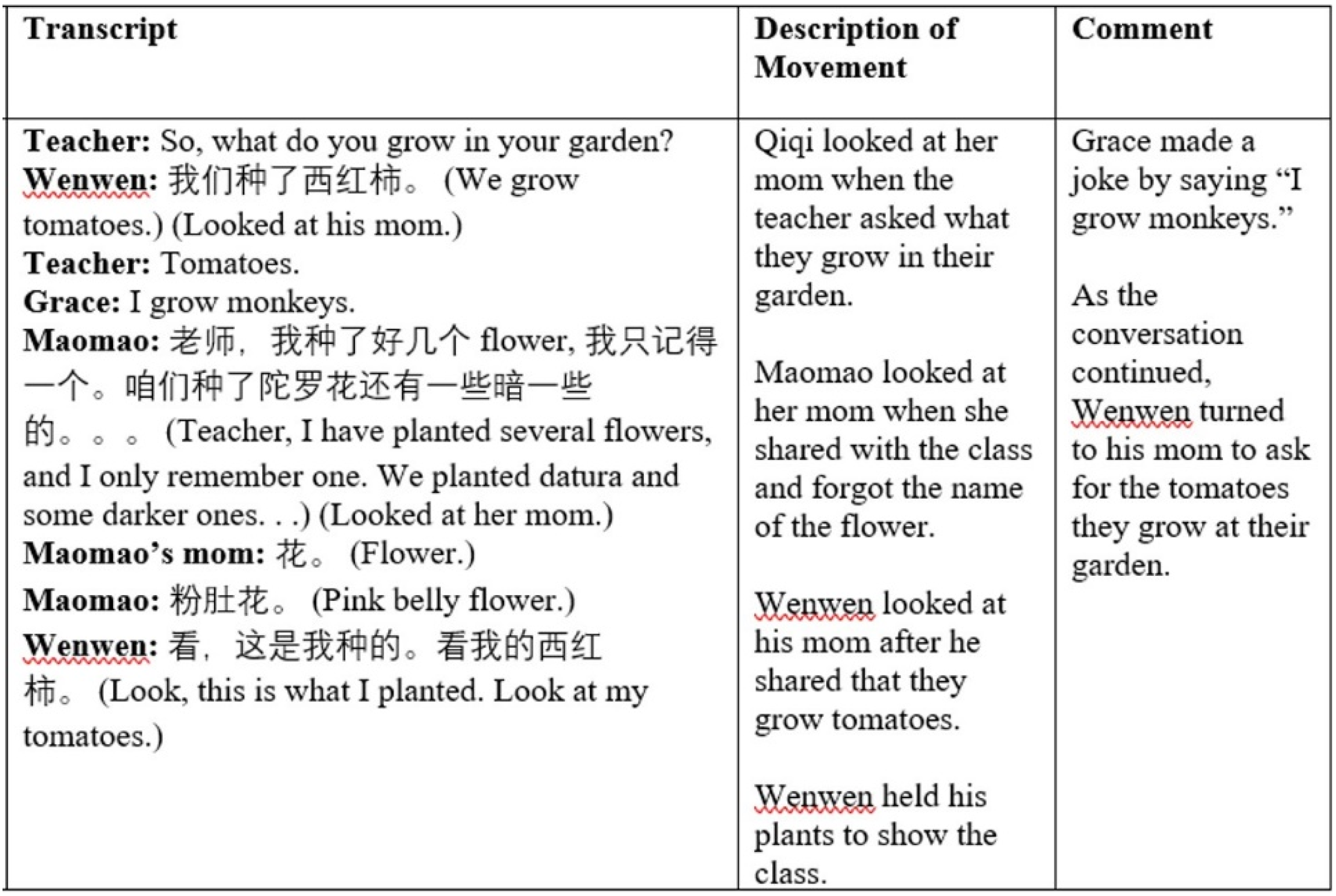
A segment of a whole group discussion after reading The Ugly Vegetables (Lin, 2001).
Wenwen shared that they “grew tomatoes.” He then turned to his mother, suggesting that she get one of the tomatoes that they grew in their garden. Wenwen's mother brought him the tomato plant and Wenwen proudly shared it with the group. He stood and held the planter with both hands, saying: “看,这是我种的。看我的西红柿 。 (Look, this is what I planted. Look at my tomatoes).” Wenwen's mother provided him with the plant so that Wenwen could share his family experience with the class. Later, Wenwen told the class: “I can show you, my garden.” He then asked his father to carry the laptop outside and led his father to the garden. With the help of his mother and father, Wenwen spoke about growing plants while actively seeking help from his parent in order to access and share experiences connected to the text.
Cultivating Intercultural Awareness Along with Language Learning
Parent participation promoted the children's intercultural awareness in two ways: by introducing languages and cultural traditions from around the world and by identifying cultural similarities and differences.
The parents cultivated the children's intercultural awareness by discussing language differences. For example, in each session, Grace's mother used the family discussion time to teach Grace Chinese words related to the book. She emphasized to Grace that she would be able to communicate with her grandparents if she learned to speak Chinese. Grace understood that she needed to speak Chinese in order to communicate with family members in southeast China. As Grace reported: “I just try to learn Chinese. Seeing if my mom could help or my dad could help [me communicate with grandma].”
Issues of language negotiation were also raised by some of the books I read. After reading a book about how a girl and her grandmother communicated across China and the USA, I extended the topic of the book and asked the children if they had suggestions for communicating with people who speak another language. Figure 3 shows a conversation involving Maomao, her mother, and me (teacher).
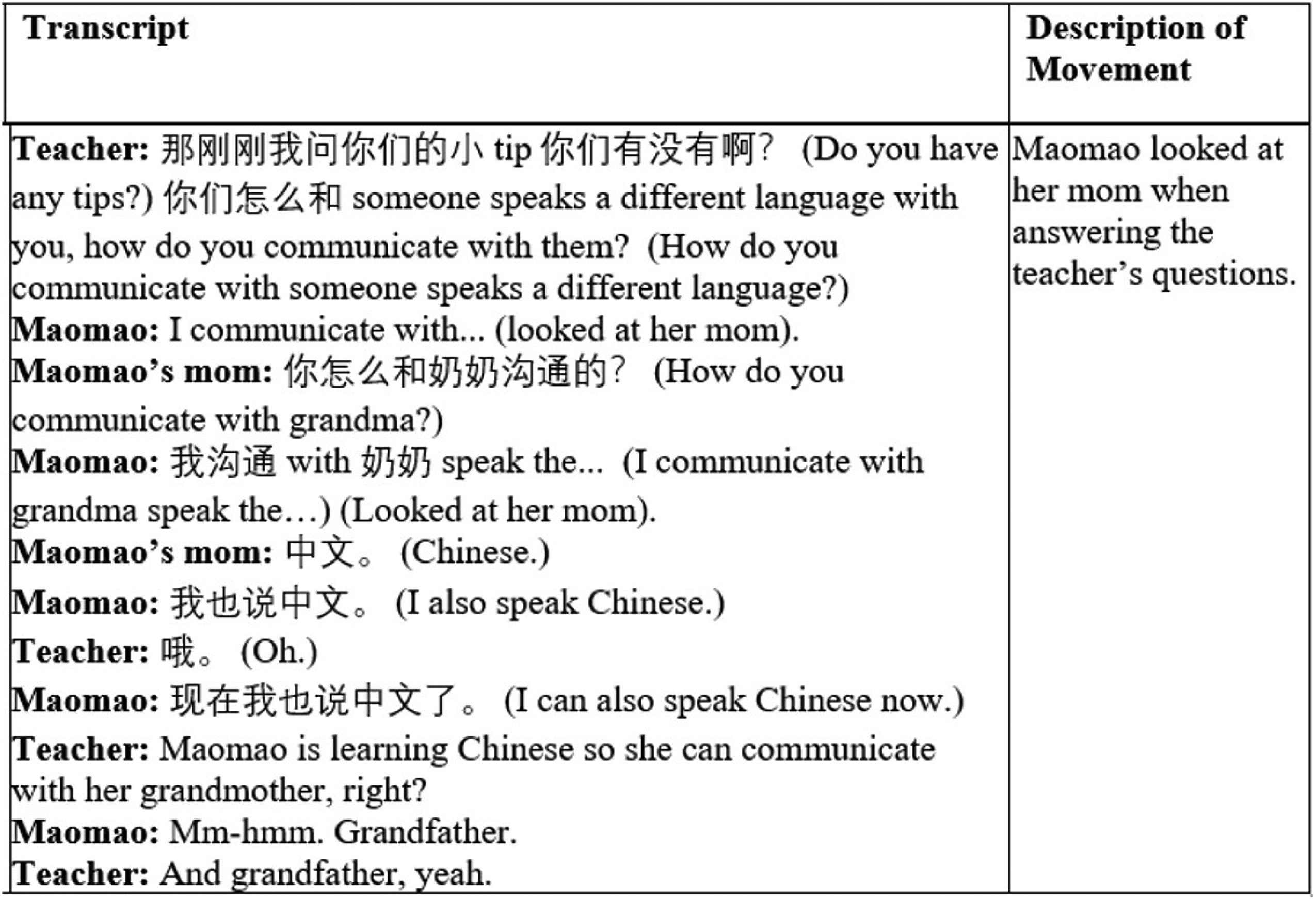
A segment of a whole group discussion after reading I Dream of Popo (Blackburne, 2021).
Maomao seemed confused by my question and was not sure how to answer; she looked to her mother for help. Maomao's mother used translanguaging to help Maomao understand; she restated the question in Chinese and drew on Maomao's first-hand experiences with her grandmother who lives in China and only spoke Chinese. Maomao responded to her mother's question by saying “我沟通 with 奶奶 speak the … (I communicate with grandma [I] speak [Chinese]).” Maomao also used translanguaging—moving between English and Chinese to expressing her ideas to her mother. As the conversation continued, Maomao realized that since she was now learning Chinese, she would be able to communicate with her grandmother and grandfather who did not speak English. In this case, Maomao's mother highlighted Maomao's intercultural awareness by helping her to recognize her emerging language skills.
The parents also developed the children's intercultural awareness by discussing and comparing customs across different countries. Sometimes the parents introduced the child to global languages or cultural traditions. At other times the children asked their parents about these languages or cultural traditions. After introducing the children to name stamps used in China, Yan's mother initiated a conversation about name stamps in other countries.
The parents helped their children to identify cultural similarities and differences. For example, Yan's mother often asked Yan to compare book illustrations with practices in the United States and China. She would point out buildings in the illustration and ask Yan about different architectural styles in the United States and China. Yan's mother also helped Yan compare the Chinese mail delivery method which was illustrated in a book to mail delivery in the United States. Yan realized that each house has a mailbox in the United States, while in China they do not have separate boxes. Yan's mother explained other cultural customs, including the addition of sugar to coffee in Europe, but rarely in the United States. Yan's mother also highlighted similarities across countries, noting that both American and British people eat fries and drink coffee.
Discussion
This study found that the parents shaped the children's reading experience and cultural knowledge by building on and extending existing cultural knowledge, redirecting children to attend to new cultural knowledge, choosing not to address certain types of cultural knowledge, utilizing home resources, and cultivating intercultural awareness related to language learning. Cultural knowledge is sustained and negotiated through parent-child dialogues. During and after book reading, parents engaged their children in conversations in several ways to elicit and silence certain cultural knowledge. In general, parents made connections between the child, the book, and their own lives. The topics addressed—through parent-child conversations—included heritage culture, family history, and personal experience; in some instances, parents drew on books to enhance the intercultural awareness of their children.
The significance of this study involves how culturally and linguistically diverse parents might be recruited to enhance children's reading experiences and support their child's language and cultural learning. These parents, whose heritage knowledge is rarely valued in the United States, used their transnational and multilingual expertise. This project honors the family's emotional and cultural connections to China and collaborative abilities to make sense of culturally relevant children's books. The research has the potential to create learning opportunities during which Chinese heritage parents and children connect across generations, cultures, and countries, with implications for teachers and educators who want to engage parents in supporting children's cultural knowledge.
Preserving the heritage cultures of bilingual children requires the collaborative efforts of families, schools, and communities (Dao, 2021; Li, 2006). My findings reveal the importance of parental involvement in the children's heritage culture learning and the possibility that parents can act as “key learning partners” (Hao & Brown, 2022, p. 107) in their children's reading and language learning. Family members are valuable resources for sharing their cultural values and beliefs with their children (Compton-Lilly, 2003; Li, 2003, 2012). Through the concerted efforts of the teacher/researcher, parents, and children, the children were able to engage in multiple learning opportunities that bridged generations and extended cultural knowledge. Families’ transcultural and translanguaging practices supported children's literacy development (Kwon, 2019). Through book discussions, parents provided the children with translanguaging opportunities that were not available at school as some parents translated and reframed my questions to help their child build cultural connections.
The parents elicited cultural knowledge in a strategic, powerful, and agential way. During reading, the parents recognized new cultural knowledge for their child and judged if they needed to teach the knowledge. They built on the child's existing cultural knowledge and expanded their child's cultural knowledge by raising new questions and redirecting the child's attention. The parents acted as supplementary resources to facilitate their child's understanding, share their own connections, and help their child develop intercultural connections. In some cases, they established connections between the child and the book by drawing on their own connections. The parents also explained things to facilitate their child's understanding about the heritage culture by referencing illustrations and helping the child make personal, familial, and cultural connections with the books. For example, during the family discussion, Maomao's mother drew on Maomao's personal experiences to raise her intercultural awareness of what she thought was important. These conversations provide opportunities for teachers to value and honor the heritage knowledge and cultural connections of Asian American parents.
The parents also silenced certain kinds of cultural knowledge consciously. While the parents actively shaped their child's cultural knowledge by making connections to heritage culture, their family history, and lived experience, it is important to note that parents made conscious decisions about the types of cultural knowledge they shared with their child. In other words, the parents were agential in what they took up and how they treated those topics. Some cultural knowledge was avoided by parents. For instance, Grace's mother chose not to elaborate on the history of the Forbidden City because it was complicated. In many cases, parents know children better than their teachers. Although the parents wanted their child to learn heritage culture, they did not want it to be overwhelming.
The parents drew on multiple resources to help the child build a connection with the text and teach new cultural knowledge to the child. They connected with their personal experience, utilized their home resources, connected with the family's transnational experience, and leveraged multilingual expertise to supported the child's translanguaging practices (Criss, 2013; Kwon, 2019). At the same time, the children recognized their parents as cultural resources and reading partners. The children eagerly sought help from their parents to support them to make personal and cultural connections. Wenwen asked his parents to locate resources in their home to support his sharing of ideas. This co-construction of knowledge created unique learning opportunities for children to draw on their heritage language and culture (Li & Fleer, 2015).
Conclusion and Implications
In this virtual context, parents and children sat side-by-side and engaged in face-to-face interactions. The parents built on and extended existing cultural knowledge, and introduced new cultural information, while sometimes deciding not to address cultural topics. This virtual context provided parents with opportunities to be involved with children's learning that were not available during face-to-face classroom instructions. Via the online format, parents were able to fully participate in educational spaces as they enjoyed digital texts and interacted with the teacher. The unique virtual context created book club experiences that could be implemented across long distances. This study has expanded our understanding of how educators can interact with bicultural and bilingual families. During an online reading session, teachers could flexibly engage parents in different aspects of the reader response to help the children make meaning and connect with texts.
While conducted in online spaces and outside of classrooms, this study has implications for classroom learning. Teachers could create an inclusive and welcoming classroom environment by inviting parents to participate in the reading activities. When working with Asian American communities, teachers can invite parents to use home resources to expand their children's linguistic and cultural learning. Furthermore, teachers need to provide guidance for parents to participate in the reading process. At the beginning of the online family book club, many parents were nervous when they were asked to discuss the book with their children. They followed strictly with the family book talk prompts I provided. The parents started to be flexible, agential, and strategic in leading the family discussion after they became familiar with the process. Thus, providing some handouts and guidance for parents can help them navigate the discussion. Teachers could also select culturally relevant texts that leverage parents’ cultural and linguistic knowledge and reflect their lives (Taylor, 1993). For monolingual teachers, they can collaborate with family members to build family-school partnerships to support children's linguistic and cultural learning. In this study, only one father, one young brother, and one older brother participated in the online club. Further study can focus on exploring the different roles played by different family members (e.g., mothers, fathers, and siblings) and how teachers can collaborate with different family members before, during, and after reading.
Footnotes
Declaration of Conflicting Interests
The author(s) declared no potential conflicts of interest with respect to the research, authorship, and/or publication of this article.
Editors' Note
Peer review adjudication overseen by James Chisholm, University of Louisville.
Funding
The author(s) received no financial support for the research, authorship, and/or publication of this article.
