




Abstract
Refutation texts are resurfacing as a suggested antidote to misconceptions and “fake news.” In a previous critical review of the refutation text literature, we, the author team, suggested further interrogation of the assumptions these texts imply: that learners share the same common misunderstanding about a topic, and that there is one “truth” that should replace the misconception. Building from Hynd’s feminist critique of refutation texts, we present in this essay a consideration of how these authoritative and prescriptive texts fit into an educational landscape being transformed by foci on students’ autonomy and funds of knowledge. In this position paper, we present the argument that refutation texts and their associated research may conflict with critical literacy perspectives and culturally responsive pedagogies. We examine these three perspectives for how they may view learning and literacy, and conclude the essay by proffering suggestions for future research on refutation text manipulations and for considering how refutational texts might be incorporated in classroom settings that enact culturally responsive pedagogy and critical literacy perspectives.
Keywords
Many literacy researchers and progressive educators currently endorse a view of teaching that is student-centered rather than content-centric, culturally sensitive rather than whitewashed, and autonomy-supportive rather than restrictive of students’ agency (e.g., International Literacy Association, 2020). Such a view is so widely espoused that it may be in danger of going unexamined, leading to unexpected problems when it comes to actual practice in the classroom. For example, what is a progressive teacher to do when talking with students about views and perspectives in which the teacher firmly believes but suspects the students resist, at least in part and most often quietly? What happens when the lesson is about climate change and its strong scientific foundation, and yet, the students come from families working in the oil industry? What can or should culturally responsive teachers do in situations where there is tension between attending to and respecting what students believe and what the teacher believes to be ultimately the “right” knowledge or perspective? These questions bear on issues that were at the heart of a classic line of research on refutation texts, texts designed to change the reader's knowledge or beliefs about something. In this position essay, we revisit the literature on refutation text effects, juxtaposing it with the assumptions about learning and literacy represented by critical literacy and culturally responsive pedagogy perspectives.
As a point of clarification, a canonical instance of a refutation text comprises three components: the presentation of a misconception (e.g., “you may believe that with two objects of the same shape and size, the heavier one will fall faster”); a refutation cue (“but this is incorrect”); and the currently accepted scientific explanation or explicit counterclaim (“in fact, the objects will hit the ground at roughly the same time”; Kendeou et al., 2016; Tippett, 2010). Since the 1980s, researchers have investigated the potential of refutation texts to ameliorate shortcomings of science textbooks in changing students’ conceptions of important scientific content (Sinatra & Broughton, 2011). Recent refutation text research has increasingly addressed political or controversial topics such as genetically modified foods (Thacker et al., 2020; Trevors et al., 2016), climate change (Nussbaum et al., 2017; Swire-Thompson et al., 2021), and vaccines (Vaughn & Johnson, 2018). The call for refutation texts to be used in nonscience domains (e.g., Sinatra & Broughton, 2011) has seemed more pressing in a “post-truth” era dominated by “fake news” and “misinformation” (Williams, 2018).
In a recent review we undertook of the refutation text literature (Zengilowski et al., 2021), we recognized the burgeoning research on sociopolitical topics and concluded the review with several concerns we left generally unexplored, but that we now take up in this essay. Given the tension between student-centered, dialogic, and culturally responsive pedagogies on the one hand, and, on the other hand, the autonomy-threatening potential that refutational texts represent, we wondered what educators should consider were they to adopt this often-touted textual innovation in their teaching. We saw value in re-examining concerns such as this, focusing on the underlying assumptions inherent in three topics: (a) the presumed effectiveness of refutation in both scientific and nonscientific domains; (b) the connection to a critical literacy perspective; and (c) the belief that educators should take a culturally responsive approach to curriculum and instruction, respecting and building upon the culturally situated funds of knowledge students bring to the classroom. The three perspectives (i.e., refutation text studies, critical literacy, and culturally responsive pedagogy) lent themselves to a comparison in terms of their implied views of literacy and learning. We drew on this comparison to inform our conclusion before offering implications for researchers and educators.
As a team of researchers, we hail from varied traditions, spanning theoretical and empirical work on adolescent literacy, text comprehension, socioconstructivist and cultural views of learning, and cognitive science approaches. Our backgrounds include training in educational and cognitive psychology, practice of and research on teaching (secondary English) and teacher education, and longstanding interests in learning from text, language, and sociocultural perspectives on teaching and learning. We drew upon our knowledges and experiences to put differing epistemological perspectives in conversation with one another. Without appropriate backgrounds in theoretical orientations that can at times clash in their assumptions about how meaning is constructed and learning happens, the dialogic exploration represented in this essay would not have been possible.
Questioning the Effectiveness of Refutation Texts on Their Own Terms
The literature on refutation text effects is robust enough to deserve attention from current-day literacy researchers (e.g., Guzzetti et al., 1993; Schroeder & Kucera, 2022; Sinatra & Broughton, 2011; Tippett, 2010). In our critical review, we located 79 papers, nearly all celebrating the value of such text design in situations where students might hold misconceptions (for a full description of the methods we used, please see Zengilowski et al., 2021). We offer the following as a typical example of these studies: Mason et al. (2008) had fifth graders read either a refutation text or a traditional text about how light works to allow humans to see objects. Using a pretest, and immediate and delayed posttests, the authors reported that students who read the refutation text experienced greater conceptual change, especially if they were interested in the topic and if they held more relativistic views of knowledge.
In our review, we acknowledged that the current literature built on previous work originating in the conceptual change literature of the early 1980s. As a reminder of the strong connection to literacy that this research tradition holds, we point to its favored position as a fruitful topic of investigation among reading researchers in the 1980s, especially those interested in content-area reading and information text comprehension (e.g., Alvermann & Hynd, 1989; Hynd & Alvermann, 1986; Maria & MacGinitie, 1987). Although not all results in the more modern papers we reviewed were strongly supportive of the use of refutation, the preponderance of our focal authors’ views was that adding refutational text to a learning experience would be effective in addressing learners’ misconceptions.
In our critical review, the first set of concerns we discussed were methodological issues with the experimental studies that might restrict the generalizability of refutation text effects. The vast majority of the reviewed studies used one text and one topic, potentially increasing the probability of finding statistically significant differences between refutation and traditional text effects, when in reality, there are none (Yarkoni, 2020). Additionally, findings from a one-topic approach may not generalize beyond the given topic or set of beliefs being refuted. From a testing perspective, studies frequently employed a pre-/posttest design administered within the same experiment session or not more than 2 weeks after encountering the manipulation. The claim that immediate effects on conceptual change are impressive enough to recommend the broad use of refutation texts is counter to findings that memory is not stable (Ebbinghaus, 1885/1964; Murre & Dros, 2015) and learning not always easy (Alexander et al., 2009). Interestingly, for many studies that used delayed testing, findings were mixed, not showing a clear effect of refutation texts on long-term conceptual change (but see Schroeder & Kucera, 2022).
As for theoretical considerations, we noted in our previously published review a clear emphasis on refutation research targeting scientific domains, even though several authors (e.g., Aguilar et al., 2019; Hynd, 2001; Sinatra & Broughton, 2011) explicitly proposed that the power of refutation could be marshaled in domains with sociopolitical dimensions. However, given some mixed findings on such topics (e.g., Swire-Thompson et al., 2021), we asserted that more research would be needed before refutation interventions are introduced with such complex beliefs and major misconceptions. Another theoretical issue we tackled is that certain refutation text studies appear implicitly to endorse views of knowledge that assume learning something contradictory to one's knowledge could happen with a single exposure to one text. Specifically, when considering beliefs that may be deeply ingrained or part of a person's larger knowledge network, ones tied to emotions or identity, more substantial interventions than a single refutation text may be required (Boler & Davis, 2018). We also introduced, but did not fully explore in that previous publication, two additional concerns to which we turn next.
A Critical Literacy Perspective on Refutation Texts
Although we critiqued the refutation text literature on methodological and theoretical grounds in Zengilowski et al. (2021), our purpose here is to critique this literature more thoroughly on a philosophical and epistemological footing. One possibly troublesome aspect of a refutation text is that it relies on two assumptions: first, that learners share the same dominating misunderstanding about a topic; second, that there is one “truth” that should replace the misconception. In scientific domains, this approach may seem, at first glance, unproblematic, as science is thought to be self-correcting (Ioannidis, 2012), with well-established checks on what is considered the current consensual “truth” for a particular topic. Nevertheless, it is important to consider the ways refutation texts privilege certain knowledge and delegitimize other experiences and perspectives.
Along these lines, Hynd (2001) brought a feminist critique to the refutation text literature, arguing that the structure of a refutation text (“you may think X, but actually this is wrong, Y is true”) imposes a hierarchy that inherently places more value on some knowledge over other knowledge, and assumes a single legitimate reality. In this view, the place afforded to a learner's starting conception of a topic is quite restricted. Once acknowledged by the refutational sentences of the text, the case is deemed closed, with the scientific consensus presented as the only legitimate position. The learner's views are often discussed in a cursory manner that relies on a straw person argument. In particular, the text's authors presume to know the readers’ views without input from actual learners. The refutation text allows little room for understanding why a misconception exists, or why the learner may prefer to endorse such a view. What may be worrisome about a refutation text, then, is the stance implied by its premature closure on only one “correct” idea. Such closure infringes on a learner's autonomy, and likely privileges discourses of power that oppress minoritized perspectives (Anders & Commeyras, 1998; Gutiérrez, 2012).
This brings us to critical literacy, with its emphasis on the importance of reading against the grain, questioning the positionality of authors, and examining the power relationships in which each text participates. As Luke (2012) defined it, “the term critical literacy refers to use of the technologies of print and other media of communication to analyze, critique, and transform the norms, rule systems, and practices governing the social fields of everyday life” (p. 5). Although there are important distinctions among different perspectives on critical literacy (Aukerman, 2012; Muspratt et al., 1997), scholars in this tradition share the assumption that all texts, authors, and representations of reality exist within sociocultural and historical contexts that inherently involve power relationships (Lankshear et al., 1996; Luke, 2013). The process of making meaning from a critical perspective is one of first examining the source from which a text is derived and the motives that its author might have for taking the position espoused. Second, in this view, reading is a continuously evaluative process, a search for whether there may be contrasting positions, other texts, or knowledges that contradict or question the claims of a text. A critical reading is a metacognitively imbued process of considering the meaning one is making from multiple perspectives, holding one's current understanding as provisional.
Critical literacy educators emphasize the importance of questioning every text in relation to power, including one's own perspective (Freire, 1968/2000; Nash, 2021). This practice poses problems for the kinds of learning presumed by the refutation text literature, which frames knowledge construction as more a process of prescribed consumption than the kinds of questioning and antagonistic text readings common within critically oriented literacy classrooms (Freire & Macedo, 1987). Whereas a critical literacy perspective paints the reader as an agentic evaluator of text, the reader of a refutational text is seen as constructing meaning based on a faulty starting point that, once rectified, will fall in line with the consensual meaning being presented. In refutation text studies, there is little room for the reader/learner to question the text. By contrast, it is the essence of a critical literacy perspective that the reader should actively interrogate texts on the basis that they are inherently biased in their presentation of truth in one way or another, especially in relation to histories of power, race, and class.
Given these critiques of the refutation text literature from a critical literacy perspective, it is nevertheless possible to construct and use refutation texts in more dialogic ways. For example, Aukerman (2012) offered a perspective on critical literacy that she called critical literacy as dialogic engagement. We interpret Aukerman's views of critical literacy as displacing both the text's author and the teacher as the ultimate authority of the text's meaning. Instead, it encourages students to grapple with multiple perspectives on texts. When applied to a classroom use of refutation texts, Aukerman's dialogic approach would counter the authoritative and dismissive view of the reader indexed in a refutation text by encouraging students to delve deeply into the diverse meanings they are making of the text's ideas.
Refutation Texts and Culturally Responsive Pedagogy
A final tension is one enjoined by taking a text that is closed, directive, and monologic in structure into a classroom design that is student-centered, dialogic, and responsive to learners’ sociocultural backgrounds. Indeed, the last three decades have witnessed a growing consensus within theoretical and pedagogical literatures that classroom learning experiences should be responsive to learners’ funds of knowledge (International Literacy Association, 2020; Ladson-Billings, 1995, 2009; Moll et al., 1992; Paris & Alim, 2014). Given refutation texts’ autonomy-threatening structures, what role should they play in culturally responsive classrooms, or in classrooms built around social constructivist foundations more broadly?
Refutation texts presume authority on the part of the presenter (the text/author or teacher). This kind of ontological and epistemological authority is incongruent with a pedagogical philosophy that presumes the culturally situated relativity of knowledge and that takes an explicitly asset-based approach to students’ existing experiences, knowledges, and ways of being. Culturally responsive and sustaining pedagogies (Alim & Paris, 2017; Gay, 2010; Gutiérrez, 2012) take up students’ diverse backgrounds and prior experiences, as teachers build curriculum around experiences and truths situated in particular cultural contexts. From this perspective, the truths presented by refutation texts are already tied to historical, hegemonic power relationships (Gramsci, 1989) that may differ radically from the students’ starting perspectives. Moreover, refutation texts presume the learner is wrong and in need of correction by a knowing authority. This knowledge structure mirrors the deficit ideologies that culturally responsive and sustaining educators seek to displace (Valencia, 1997).
At the same time, refutation texts could align with some pedagogical ideals related to correcting learners’ misconceptions about topics that culturally responsive educators see as true: truths related to race and racism, the reality of evolution and climate change, and the equal value of human beings and cultures across the world, to name several examples. It would not be surprising to see a refutational structure employed within a culturally responsive pedagogical design that is meant to correct misconceptions about topics in which students may hold misconceptions that stem from previous education tied to White, upper-class power structures. To provide one example, James Loewen's Lies My Teacher Told Me (2007), a historian's re-examination of American history focused on critiquing the mythologies embedded in textbooks and history curricula, is framed as refutation. Yet, this text would not fail to find purchase in a culturally responsive classroom. Similarly, researchers have noted that many hip-hop songs, which have recently been taken up in classroom spaces and literacy research, use rhetorics similar to those found in refutation texts to re-examine and critique hegemonic knowledge (Rodríguez, 2009). In this sense, refutational thinking that questions presumed assumptions, broadly speaking, has a place in such classrooms, and aligns with both critical and culturally responsive perspectives of teaching and literacy.
Ultimately, however, the traditional use of refutational text does not present an ideal match within a pedagogical framework devoted to posing questions about the world and elevating the cultural knowledge students bring with them to the classroom. Perspectives on learning as involving sociocultural/constructivist processes and on teaching as necessarily responsive to diverse cultural bodies of knowledge suggest that the ways of knowing presented in refutation texts are not effective for long-term concept-building and knowledge construction. These claims are particularly apt when sociocultural or sociopolitical topics are involved, and highlight the idea that refutation texts may not translate well into pedagogical practice (Hynd, 2003). Here, a more constructivist approach to knowledge seems appropriate, in which learners slowly shift ideas and paradigms as they experience ideas collaboratively and engage with new material that challenges old assumptions and perspectives.
This is not to say that refutation texts could not hold a place in such a classroom; refutation texts could, of course, support truths that align with the values common in culturally responsive classrooms. Moreover, as the previous section described, students can treat any text critically, including refutation texts, and a skilled teacher could certainly incorporate refutation texts in fruitful and exploratory ways. However, this kind of critical reading is not what refutation researchers have in mind, and the kind of authoritative stating of values and truths typically represented in refutation texts is more aligned with the didactic, Eurocentric traditions against which asset-based pedagogies established themselves (Ladson-Billings, 1995). At heart, refutation texts are not ideal for a pedagogical project whose goals are tied to personal and communal problem-posing and liberation, rather than the consumption of particular truths, however much those truths may align with liberatory philosophy (Freire, 1968/2000).
When considering the challenge of asserting shared values or truths, while at the same time accounting for diverse perspectives and the tenuous, ideological nature of perceptions of reality, a question arises: how can teachers assert any shared truth or place limitations on students’ thinking or expressions, a topic of particular concern when some students may hold views that, if shared, would harm others as, for example, essentialist views about race, class, or gender? Rather than relying on refutation texts to correct such misconceptions, teachers may be better served by discussing or specifying community-based norms related to epistemology, foundational values, and behavior during discussions (Chavez, 2021). Such a process may better ensure that students are not actively harmed by, for example, hateful dialogue in a literature classroom, while also allowing students the opportunity to continue building and changing their own conceptions (Moje & Lewis, 2007). This kind of democratic consensus-building around established norms is both more epistemologically sound from a sociocultural perspective, as well as more aligned with a democratic, asset-based approach to curriculum (Chavez, 2021; Sætra, 2021).
A Synthesis: What Should Literacy Researchers Take Away From our Analysis
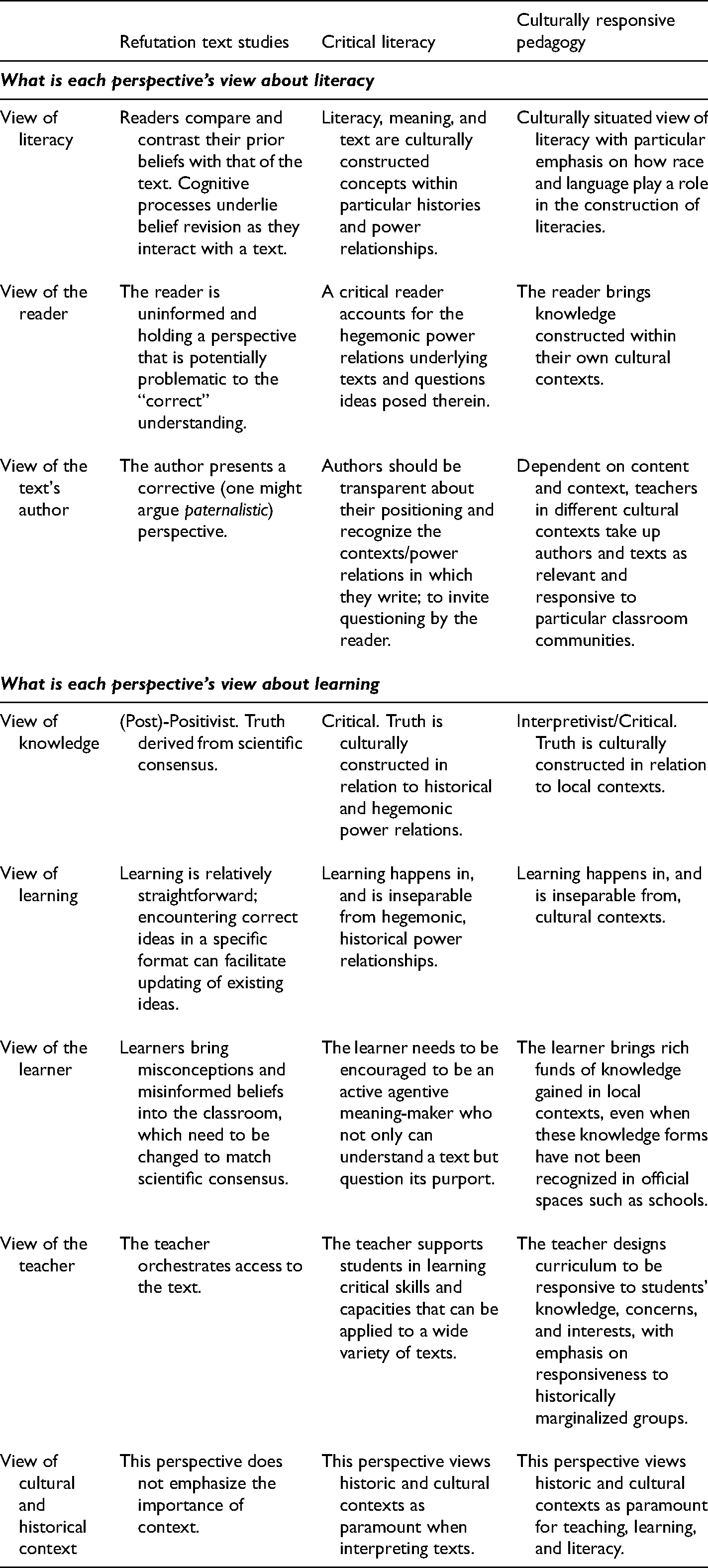
In Table 1, we present a summary of how the perspectives (refutation text, critical literacy, and culturally responsive pedagogy) address critical questions relevant to literacy scholars, that is, what view each perspective holds of literacy and of learning. We focused on these two areas because they are central to the concerns of all three perspectives including (a) how students make sense of texts they encounter as part of schooling and then (b) how they come to change their minds, acquire new knowledge, and take up new practices as a result of becoming educated.
A Comparison of Three Perspectives.
How Literacy is Conceptualized in These Perspectives
When it comes to literacy, we are claiming that the perspective of refutation text researchers is that readers respond to the refutation text by activating their misinformed prior beliefs and then changing their minds to align with the consensual understanding presented in the text. By contrast, critical literacy proponents start from a view that any text (or nearly any text) can be interpreted in more than one way. A reader reading critically starts first from an evaluative stance, examining the credibility of a text's author, and proceeds with an eye on how well the text's claims fit with other sources, bringing in skepticism based on an understanding of historical power relationships tied to class, gender, race, and other sociocultural factors. As for the view of literacy implied in a culturally responsive pedagogy, here the claim is that literacy is always culturally situated; the meanings of texts are constructed by learners/readers in relation to specific social contexts tied to language, class, race, and gender in a particular time and place.
To continue our comparison of these three perspectives on views of the reader and of a text's author, refutation text studies view readers as initially mis/uninformed and seem to assume that the role of a text author is to correct the reader. Critical literacy researchers see a central task of reading as that of evaluating the credibility of a text by examining potential bias introduced through unexplicated assumptions based on historical power differences and relations. In this view, the role of an author should include being more transparent about any bias the author holds and being more inviting of a reader's critical reading. Scholars and educators holding a culturally responsive pedagogy stance view the reader as always necessarily bringing in their own culturally situated perspectives, and they see texts and text authors as needing to be introduced to the reader with an eye to how well they serve, reflect, and expand what students ultimately need, both for their immediate classroom community and for their whole lives.
How Learning is Conceptualized in These Perspectives
As for what these three perspectives assume about learning, Table 1 sets out comparisons on five grounds: views of knowledge, learning, the learner, the teacher, and context. For a critical literacy theorist, knowledge is assumed to be culturally constructed and therefore to reflect inherent historical and dominant perspectives, and learning is inseparably tied to the cultural ways in which learners live. Learners may need to be encouraged to recognize the power relations at play and to take an active role as they make sense of texts, with teachers acting to support learners’ critical capacities by helping them recognize the sometimes subtle influences that historical and cultural contexts can have. Here, a teacher can guide learners to realize the power that texts have in their own knowledge growth, helping students consider different perspectives implied by texts written at different historical points and by different authorities. Such questions as who gets to write classroom texts, whose voices are celebrated, and whose silenced by the texts represented in the classroom, would reflect the perspectives of critical literacy proponents.
Culturally responsive scholars/educators view both knowledge and learning as culturally situated and reflective of local context. From this perspective, learners bring their funds of cultural, social, linguistic, and conceptual knowledge to any learning situation. It is the task of good teachers to keep central the concerns, interests, and communities of their students in their decisions about what to teach and how to teach it, with a constant eye on the contextual relevance of these decisions and how they function within inequitable histories of schooling.
Against the backdrop of these two perspectives’ views of the learning process, refutation text studies seem to make assumptions about learning that can appear unduly simplistic and that do not make much concession to the learner's context. The view of knowledge or of truth implied by refutation texts is that truth is the result of a scientific process open to revision at some future point but that at present represents the accepted knowledge of experts. The potential validity of learners’ existing perspectives and the possibility for murky or context-dependent truths is not considered in a refutation text, with accepted, status quo conceptions of reality holding a dominant hierarchical place.
Another largely unexamined assumption represented by refutation text studies is that learning is a relatively easy process: once the learner is made aware that existing beliefs and knowledge are considered erroneous and is presented with information that represents consensual knowledge, it will be a straightforward process to restructure one's knowledge, dropping the misconceptions and adopting the clearly more apt explanations being presented by the text. In this view, the role of the teacher is to bring together clear and persuasive presentations of explanations, making explicit how these explanations are better than the learner's preexisting knowledge or beliefs. From perspectives representing critical literacy or culturally responsive pedagogy, which build on epistemological traditions that reject positivist and rationalist assumptions about human interpretation (Gutiérrez, 2012; Ladson-Billings, 1995; Luke, 2012), this positivist attitude is both ineffective and ignores the vast wealth of cultural knowledge that readers bring to reading transactions or literacy events.
We want to end this synthesis by acknowledging that we have, in this essay, perhaps painted the refutation text tradition in too negative a light. In fact, our previous review of the refutation text literature (Zengilowski et al., 2021) was presented as a critique, but a “loving critique,” a term borrowed from Paris and Alim (2014), meant to reflect an open stance about the effectiveness or use of refutation texts. Refutation texts could be used in a classroom that was introducing critical literacy principles and strategies or one characterized as reflecting culturally responsive and sustaining instructional approaches, as we explicate in the next section.
Implications for Research and Practice
Here, we want to consider if it is possible to resolve the tensions introduced by these three perspectives. Refutation texts, as currently structured and researched, may not align with the goals of critical literacy and culturally responsive pedagogy. Although these texts may prove effective in changing students’ scientific misconceptions or more broadly, those less closely tied to deeply held beliefs, we argue it is more important to ensure learners play an active role in their knowledge revision process rather than remain passive recipients of accepted truths, especially when students are exploring topics with sociopolitical implications.
However, we do not mean to say that refutation should be entirely removed from the educator's toolkit. We can imagine researchers and teachers investigating and using a “refutation process,” by which an elicitation and revision of misconceptions are enacted through carefully facilitated dialogue and experienced within an intentionally constructed classroom community of practice. In such a classroom, it would be important to make room for teachers to be wrong and to allow students to refute their knowledge, something in which teacher educators may play an important role through their conversations with future teachers. Indeed, given the role of prior misconceptions that students may bring into teacher education classrooms via their long “apprenticeship of observation” (Lortie, 1975), teacher education has in some ways already been framed as both a conceptual change process and a form of refutation. By incorporating a wide-angle view of students’ background knowledge and lived experiences into knowledge revision, a more inclusive learning process would seem encouraged.
Alternatively, refutation and refutational texts could be used as an explicit pedagogical tool in the classroom. When students have the opportunity to break down refutation texts, they can engage in the metacognitive processes implied in a critical literacy perspective. In noting concerning perspectives or viewpoints presented by text authors, students could engage in their own critiques to push back against the presented knowledge as they consider what aspects to accept from the text. Rather than a tool meant for uptake without criticism, refutation texts could be a site for development, the foundation for an iterative process of constructing the skills and frames of mind that will support critical readers, or divergent thinkers across disciplines (see Gutiérrez, 2012). Ultimately, we hope to encourage conversations amongst literacy researchers and teachers to imagine innovative and responsible means of incorporating refutation texts in classrooms and research.
Conclusions
Although we are hopeful about the possibility of a more dialogic understanding of refutation that moves beyond conceptual change aimed to fit within a one- or two-sentence container, we do not propose an easy answer for teachers working in classrooms with students holding diverse perspectives. There is no simple line to be drawn. Rather, we suggest that teachers need to be prepared to consider the complexity of ideological and conceptual formation. We encourage them to see learning as a process instead of as the quick adoption of a right answer. When students are in the midst of coming to new understanding, which may take months, as Clark (2006) found in a qualitative study of undergraduates’ conceptual change processes, there is no room for punishing learners on their way to meaning-making simply because their (interim) meanings do not seem to align with those of the teacher. A pedagogy that values multicultural, pluralistic dialogue requires patience, with a view on the long game, in contexts where students hold views that teachers see as problematic.
And, though we place a great deal of emphasis on the thoughts and actions of practitioners, we also believe it important to consider the ways in which current teacher educators and programs rely on similar tactics as refutation texts, rather than employing a truly culturally responsive pedagogy perspective. Just as we have posited ways for students to build toolsets in support of becoming critical readers, we should think about how teachers, themselves, are building their own toolsets. Recent critiques from teacher educators have pointed to the more didactic elements of pedagogical practice intended to support culturally responsive teaching (Hoffman, 2020), calling for classroom structures in teacher preparation programs that more effectively model and embody the tenets of culturally responsive teaching. One relevant means by which this shift can occur is through pedagogical structures in which teachers’ perspectives and work with students are invited to function in conversation with established understandings of best practices (Nash et al., 2021).
Ultimately, we believe it is timely to re-examine the refutation text literature, work that, at one time, was more central to the Literacy Research Association's mission. How anyone learns from text, and in particular, how texts can be engineered to help readers change their minds about something should be important to current-day literacy researchers. Given concerns regarding an ongoing epistemological crisis related to post-truth political discourse (Berkowitz, 2021), it is important to re-examine foundational concepts that remain embedded in the structures of schooling and textbooks, even as researchers and progressive educators increasingly focus on the benefits of incorporating students’ culturally situated funds of knowledge into learning experiences. In these contexts, refutation texts may seem out of place, with a “one story” structure that may silence learners’ perspectives and stifle their active participation and construction. As refutation researchers continue their support of integrating these texts into public and educational spaces, literacy experts can redirect attention away from autonomous truths to be consumed by a relatively passive audience and back to students as active learners, ensuring that students’ knowledge is leveraged as meaningful and important.
Footnotes
Acknowledgments
The authors would like to thank Dr. Renata Love Jones, who acted as discussant of the Literacy Research Association conference session in which we presented this paper, for giving us insights and meaningful directions for improving our essay. We also are grateful for the time and helpful suggestions of the three reviewers of the manuscript.
Declaration of Conflicting Interests
The author(s) declared no potential conflicts of interest with respect to the research, authorship, and/or publication of this article.
Funding
The author(s) received no financial support for the research, authorship, and/or publication of this article.
