



Abstract
This phenomenological study reports findings related to preservice teachers’ experiences mentoring early elementary readers. Preservice teachers in this study were enrolled in a literacy methods course designed to develop their understanding of early literacy, including knowledge of the written code and culturally sustaining and historically responsive pedagogy, and prepare them for the Texas’ Science of Teaching Reading exam. Within this context, we explored how preservice teachers worked to bridge multiple approaches to literacy instruction. Thematic results illustrate how preservice teachers sustained the lifeways of children through literacy as a social practice, created space for code-based and meaning-making skills, and learned to teach responsively. These results provide implications for a comprehensive approach to preparing teachers of elementary literacy: one that fosters knowledge of the written code while contextualizing knowledge in children's cultures, communities, and experiences.
Keywords
Learning to teach early literacy exists at the intersection of multiple policy contexts and debates. Frequently, state policies have adopted assessment measures, curricula, and standards based on the Science of Reading (SOR). SOR is a body of cognitive research that seeks to identify how the mind learns to read, often through code-based approaches (Moats, 2020). SOR-based approaches to early reading instruction heavily emphasize phonemic and phonics skills (Hoffman & Duffy, 2016) because these skills have been associated with later reading comprehension (Castles et al., 2018). SOR research has been translated into instructional methods that can emphasize the practice of skills over comprehensive learning experiences (Hoffman et al., 2021). These interpretations have impacted the curricula adopted by schools nationwide and, subsequently, expectations for teaching and teacher preparation (Hoffman et al., 2020). In Texas, where this study took place, SOR has been codified as the Science of Teaching Reading (STR) educator standards and an accompanying certification exam for teacher candidates.
Undoubtedly, preservice teachers (PSTs) should be knowledgeable of reading processes and skill-based teaching practices (Drake & Walsh, 2020). At the same time, PSTs must learn to flexibly apply knowledge to teach reading in culturally sustaining ways to serve an increasingly diverse student population (Ladson-Billings, 1995; Muhammad, 2020; Paris & Alim, 2017; Patton-Terry & Albritton, 2023). Research on reading supports blended (cognitive and sociocultural) approaches to reading instruction (e.g., Handsfield & Jiménez, 2009). However, implementation and translational gaps often keep these perspectives from informing policy, curriculum, or mainstream practice (Skerrett, 2020).
Seeking to bridge these gaps, literacy teacher educators draw on sociocultural perspectives that extend PSTs’ knowledge of how to teach reading (e.g., Dunham et al., 2022). Sociocultural perspectives do not negate the need for explicit, systematic instruction. The English language is orthographically opaque and requires systematic means to break the written code of English (Ehri et al., 2001); however, reading scientists stress the role of phonics instruction as a means to an end—making meaning from text (Castles et al., 2018). Overly skill-focused literacy teaching can restrict how children put their literacies to use (Dyson, 2020). While “balanced literacy” has previously been associated with programs that include phonics in non-systematic ways, Castles et al. (2018) propose that the term be recast to represent literacy instruction that considers the varied factors (e.g., cognitive, social, cultural, contextual) that produce skilled readers. Striking a balance is not a simple task. In literacy research that blends sociocultural and cognitive dimensions, there has been a tendency to foreground one dimension (Skerrett, 2020). As this study demonstrates, keeping both perspectives centerstage while learning to teach literacy is a site of generative tension and productive struggle.
This study explores one such site: PSTs learned to teach early literacy using multiple methods, including explicit instruction and language experience (Hoffman & Roser, 2012). This study involves literacy mentoring, a practicum experience where PSTs facilitate literacy learning with students individually or in small groups (Hoffman et al., 2019). We use mentoring to avoid negative remedial connotations associated with tutoring and to center relationships. PSTs who mentor young readers (e.g., Nash et al., 2021) have been shown to build on learner's strengths, linguistic repertoires, experiences, and interests. However, previous research has yet to address how mentoring might serve as a site to navigate multiple instructional approaches.
As co-instructors of a course designed to prepare PSTs in the principles of SOR, we investigated how PSTs developed culturally sustaining and historically responsive pedagogy while mentoring early and emergent readers in code-based aspects of literacy. The research questions guiding this study were:
How do PSTs develop culturally sustaining and historically responsive pedagogy while working with early and emergent readers? How do PSTs foster student knowledge of the written code while using comprehensive approaches to literacy?
Theoretical Framework
An increasingly diverse student population and consistently inequitable educational outcomes have led to pedagogical approaches that sustain learners’ cultural and linguistic resources (Paris & Alim, 2017). Here, we use two complementary theories: Culturally Sustaining Pedagogy (CSP; Paris & Alim, 2017) and Historically Responsive Literacy (HRL; Muhammad, 2020).
Culturally Sustaining Pedagogy and Historically Responsive Literacy
First, CSP emerged as a “loving critique” (Paris & Alim, 2017, p. 4) of culturally relevant pedagogy (Ladson-Billings, 1995). CSP centers youth and communities of Color's ways of knowing, or lifeways, and disrupts a schooling system that privileges White, middle-class ideologies. From this perspective, the literacies of students of Color are not framed as bridges to attaining dominant ways of languaging but are sustained in their own right. This additional emphasis on cultivating non-dominant ways of knowing is reflected in Paris and Alim's use of the term sustaining. This change in terminology is not a replacement for, but a continuation of, the original goals of culturally relevant pedagogy.
Under the umbrella of CSP is HRL (Muhammad, 2020). Muhammad stated that HRL extends CSP by “taking a more historic look back and putting a practical model to the theory” (Gonzalez, 2020, n.p.). HRL is historically rooted in the practices of 19th century Black Literary Societies that collectively engaged in the pursuit of knowledge and liberation through literacy. Muhammad (2020) argues for a more humanizing and complete approach to literacy learning: one that begins with the identities of children who have been historically underserved by the schooling system to “get literacy education right for all” (p. 22). The HRL framework includes five pursuits: identities, skills, intellect, criticality, and joy. Central to HRL is the elevation of these areas to the same plane as skill—a move that breaks from long traditions of schooling that prioritize skills alone. At the same time, educators must dismantle the notion that elevating identities and criticality means abandoning skills (Gonzalez, 2020). High expectations and academic achievement—and thus skills—have always been a goal of CSP (Ladson-Billings, 1995; Paris & Alim, 2017).
Embedded within a CSP/HRL frame is literacy as a social practice (Street, 1984). From this perspective, literacy is embedded in social relationships and not simply a set of cognitive skills (Barton & Hamilton, 1998). A social practice approach centers learners’ assets and accounts for the complexity of learning to read across the multiple contexts of children's lives. In other words, children develop sophisticated and varied ways with words (Heath, 1983) through social interactions in their communities and bring these social literacy practices to bear on the school-based reading tasks. A social practice frame highlights the cultural and relational literacy practices that we seek to sustain in addition to code-based skills.
Together, these theories inform our analysis by directing our attention to the ways in which PSTs sustain the lifeworlds of young learners while teaching the code-based aspects of literacy. HRL offers a more specific lens to explore how literacy skills can be cultivated alongside and through learning experiences that sustain individual and cultural identities. We use these lenses to identify moments where PSTs work to take up CSP/HRL alongside skill-based goals.
Comprehensive Literacy Instruction
Current debates in literacy forefront the question of how best to teach code-based knowledge. Structured literacy approaches focus on the discrete acquisition of skills through direct, explicit instruction of word-level understandings (e.g., letter–sound relationships, structural analysis, decodable text, and corrective feedback) and comprehension of increasingly complex text (Spear-Swerling, 2019). Comprehensive approaches (Duke & Cartwright, 2021; Rohde, 2015) emphasize the complexity of these skills while also contextualizing knowledge in children's cultures, communities, and experiences. State adoptions of code-based approaches, i.e., STR, create tensions for teachers and teacher educators who must balance state-mandated instruction with culture-based approaches.
In this context, we approach literacy comprehensively as learning the code-based aspects of language within the context of student interest, identity, and meaning-making (Duke & Cartwright, 2021; Muhammad, 2020). Early literacy includes teaching phonological and phonemic awareness, the alphabet, letter names and sounds, and beginning consonant–vowel–consonant words. Writing supports the acquisition of early reading skills and makes space for student expression (Graham, 2020). Additionally, reading books provides an opportunity to model reading strategies and develop listening comprehension. Both CSP and HRL describe the mastery of skills as part of becoming a literate being. Thus, we frame our study through comprehensive perspectives of literacy that highlight the strengths of students (Aukerman & Chambers Schuldt, 2021; Muhammad, 2020).
Literature Review
We found no studies that explicitly situate CSP/HRL within SOR, a gap we intend to fill. Rather, studies of early literacy teaching grounded in CSP and HRL address code-based aspects of literacy using varied language. One study (Wissman, 2021) highlights tensions between enacting CSP and supporting foundational literacy skill development. Wissman (2021) attributes pressures to improve students’ foundational skills to the growing SOR movement (p. 584). Other CSP studies use the terms procedural (Schrodt et al., 2023), code-based (Byrnes-Cloet & Hill, 2022), and standards-based (Harris et al., 2020) to refer to foundational skills. These studies support teaching approaches that leverage family, community, and student knowledge to enhance the study of code-based language features. Some of these approaches include reinforcing phonics concepts within storytelling (Schrodt et al., 2023) and book-making (Byrnes-Cloet & Hill, 2022; Harris et al., 2020). Literature supports HRL as a tool for designing culturally responsive lessons that attend to literacy skill development (e.g., Vlach et al., 2023). In one study (Wise & Ward, 2023), HRL informed the design of centers that meet multiple HRL-aligned instructional goals, including but not limited to foundational skills (e.g., encoding, decoding). Together, the literature suggests that teachers must navigate tensions as they reach toward a vision of CSP/HRL (Wissman, 2021) that “include[s] and go[es] beyond skills” (Wise & Ward, 2023, p. 646).
We also situate our work within the literature and public discourse surrounding SOR. Scholars have called attention to the need to account for children's identities (e.g., racial, cultural, linguistic) when teaching foundational literacy skills (e.g., Aukerman & Chambers Schuldt, 2021). For example, teaching phonemic awareness to children who speak African American English requires an approach that both aligns with SOR and responds to these linguistic differences (Washington et al., 2023). Further, ensuring reading success for children of Color is one way to promote justice and equity (Patton-Terry & Albritton, 2023; Weaver, 2023). Despite some overlap of goals, research relating to CSP/HRL remains isolated from SOR discourse. We seek to bridge this divide.
Methods
We used phenomenology to explore how PSTs developed culturally sustaining and historically responsive pedagogy while mentoring emergent and beginning readers in the code-based aspects of literacy. Phenomenological methods center individual experience as essential to understanding how phenomena take shape in the world (Husserl, 1970; Vagle, 2018). Here, studying lived experience provided insight into how PSTs’ perspectives, actions, and thoughts supported their adoption of CSP/HRL in early literacy instruction.
Reduction and Bracketing
In phenomenological methods, epoché or reduction and bracketing allow researchers to identify and set aside potential differences in perspectives, making room for participant experience to remain at the forefront (Vagle, 2018). Epoché identifies potential tensions surrounding the central phenomena through identifying beliefs and biases. Reduction refers to the suspension of previous beliefs in order to hold space for participant understanding. Bracketing describes the process of setting aside researcher perspectives in order to forefront participant experience. Here, we briefly note that we are teacher educators who support the development of both code-based knowledge and CSP/HRL while also supporting PSTs as they master state expectations of literacy knowledge and instructional practices. As White female teacher educators, we are committed to humanizing pedagogies and disrupting Whiteness in education but limited in our ability to see past our socialization as oppressors. We look to children and teachers as sources of knowledge that can expand our perspectives. We engaged in reduction by unpacking our beliefs in relation to tensions including debates on reading instruction and Critical Race Theory as well as book banning in schools. We bracketed our own perspectives by continuously reading and discussing multiple perspectives on SOR and CSP/HRL. Still, to some degree our social positions as White women influence how we interpret PSTs’ written products. There is always a possibility of misinterpreting PSTs’ lived experiences. This is more likely for PSTs of Color or male PSTs as their lived experiences are further from our own, thus we spent more time in conversation together when making sense of data collected from these PSTs.
Context
This study occurred at a state university during an early literacy course co-taught by Vickie and Molly. This class focused on early literacy development, instruction, and assessment in concert with CSP/HRL and preparing teachers for their STR teacher certification exam. A recent state mandate, Texas’ STR exam exists to ensure teacher candidates’ knowledge of early literacy instruction based on SOR and the code-based aspects of literacy, including oral language, print awareness, alphabet knowledge, phonological and phonemic awareness, phonics (decoding and encoding), fluency, vocabulary, syllabication and morphemic analysis, and comprehension skills (Pilgrim, 2022; TEA, 2022).
This field-based course met at a Title 1 elementary school in a large urban district. The school serves a linguistically and culturally diverse community, including newcomers to the U.S. Demographics for the 2022–2023 school year were: 5.8% African American, 78.7% Hispanic, 6.1% White, 9% Asian, and 0.3% two or more races. Of the 343 students enrolled, 96.2% were described as Economically Disadvantaged, 77.6% received English Language services, and 11.4% received Special Education services.
As part of the coursework, participants mentored young readers in prekindergarten and kindergarten classrooms weekly for 8 weeks. Emergent multilingual learners spoke Pashto (n = 3), Spanish (n = 2), and Farsi (n = 1). For the first 2 weeks of mentoring, PSTs gave informal literacy assessments (i.e., phonological and phonemic awareness and phonics screeners), made observations about reading and writing abilities, and learned about children's background and individual interests. For 6 weeks, PSTs planned and taught lessons based on student strengths and needs.
The comprehensive approach to literacy teaching forwarded in the course included elements of code-based instruction and a language experience approach (Hoffman & Roser, 2012) that treats code-based skills as components that “[grow] from home language and home experience” (Hoffman & Roser, 2012, p. 302). This approach recognizes children's ways with words as starting points for exploring the “code” and meaning of written language. PSTs recorded children's talk in writing, invited children to draw and write, and often wrote collaboratively. PSTs planned mentoring sessions using a framework provided by the co-instructors. This framework included (1) an interactive read-aloud of a picture book and/or student reading, (2) writing together using a language experience approach, and (3) word study, or engagement with letters, sounds, and phonics elements. In an effort to “help teachers know their minds, rather than our minds” (Duffy, 1998, p. 3), we gave PSTs latitude in implementing their lessons. As a result, PSTs’ uptake of the three components varied. Over the semester, some PSTs demonstrated shifts in how they allocated time across the components or how they implemented a particular component. The shifts are discussed in the Findings section.
Participants
Participants were pursuing an initial certification to teach early childhood through 6th grade with an additional English as a Second Language endorsement. Out of 20 PSTs, 17 consented to participate. PSTs self-identified as: “Asian/Filipino” (n = 1), “Asian/South Indian” (n = 1), “Chinese” (n = 1), “Hispanic/White” (n = 1), “Hispanic” (n = 2), “White” (n = 4), and seven participants elected not to identify. Languages spoken by PSTs included Chinese (n = 1), French (n = 1), Korean (n = 1), Malayalam (n = 1), Tagalog (n = 1), Spanish (n = 4), and English (n = 17).
We secured Institutional Review Board approval for this study. To protect our student participants, an outside researcher obtained consent. We, the course instructors, did not learn which PSTs consented to participate until after the semester ended. Pseudonyms are used to protect PSTs’ identities.
Out of respect for the children, we did not collect demographic documents. Some children readily shared identifiers (e.g., age, language, home country) with us while other children chose not to share. Because our knowledge was incomplete, we did not separate our analysis based on the age or language of the children PSTs worked with.
Data Analysis
The primary data sources used for this study were coursework materials submitted by PSTs: lesson plans, reflections, a case report, and a final exam. As participant-observers during mentoring sessions, we collected field notes. We compared primary data sources to our field notes to resolve uncertainty or confirm details but ultimately we relied on the writing of PSTs as first-hand accounts of their experiences. Still, we recognize the limitations of PSTs’ self-reporting. For example, we note that PSTs rarely addressed CSP/HRL directly in their written products despite frequent conversations in class about these frames.
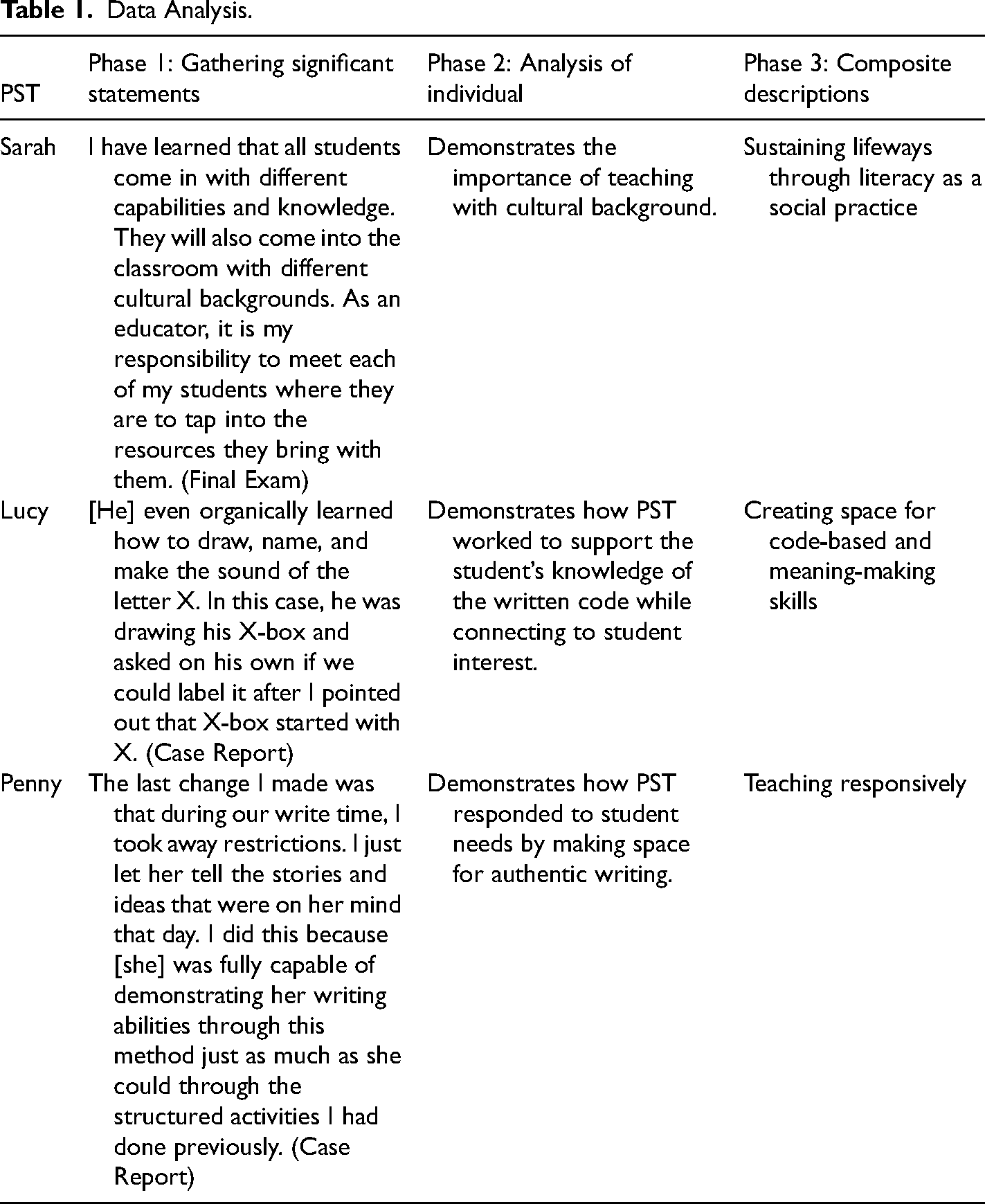
The unit of analysis was the central phenomena (PSTs’ understandings of CSP/HRL while mentoring emergent and beginning readers in the code-based aspects of literacy). Data analysis followed phenomenological methods of (1) gathering significant statements regarding participant experiences, (2) analysis of these experiences within the individual, and 3) composite descriptions of the central phenomena across all participants, see Table 1 (Vagle, 2018).
Data Analysis.
Phase 1
We holistically read the data, looking for significant statements representing PSTs’ reflections related to the central phenomenon. These reflections demonstrated individual experiences with mentoring students in reading and writing through the lens of CSP.
Phase 2
Next, we examined the data across participants using horizontalization or iteratively gathering significant statements across individuals (Moustakas, 1994). This process allowed us to identify similar significant statements across participants and cluster codes into broader themes representative of a shared experience across this group of PSTs. Initial coding resulted in multiple codes and subcodes, which were collapsed into three themes during the second round of analysis, yielding the final findings of (1) sustaining lifeways through literacy as a social practice, (2) creating space for code-based and meaning-making skills, and (3) teaching responsively.
Phase 3
Last, we wrote the findings into composite descriptions of participant experiences surrounding the central phenomena. Methodologically, phenomenological research requires attention to writing and reporting the findings of the work. Here, writing relies on the use of participants' words and language to highlight their lived experiences. The goal is to create a state of resonance with the reader, even if they have never before lived the experience being described (van Manen, 2014). For instance, utilizing narrative elements such as style, tone, and appeal builds a connection between the text, the reader, and the experience frequently drawing an emotional rather than purely analytic response.
Methodological Rigor
Validity and credibility are assessed by attending to the acceptability and convincibility of phenomenological methods (Vagle, 2018; van Manen, 2014). Thus, rigor and trust are established through suspending presuppositions (reduction and bracketing), closely following phenomenological methods, and attending to the origin of participants’ narratives. To establish methodological rigor, we attended to reduction, bracketing, and description of methods in this section. Attending to participant narratives included reading across multiple data sources to understand their experiences.
Findings
We explored the central phenomena of how PSTs developed CSP/HRL while mentoring emergent and beginning readers in the code-based aspects of literacy. We found that PSTs drew on literacy as a social practice to sustain the lifeways of children and their communities. They did this by centering children's identities and interests, family life, and culture. The centering of lifeways seemed to support, not detract from, skill development as PSTs embedded the study of code-based language features within meaningful literacy practices. Additionally, PSTs expanded skill development to encompass multimodal meaning-making skills. Finally, PSTs shifted their practices as they came to understand what teaching responsively looks and feels like. Being in the presence of children was key in these shifts.
Sustaining Lifeways Through Literacy as a Social Practice
PSTs’ instructional practices began with sustaining the lifeways of children and communities (Paris & Alim, 2017). In this work, PSTs drew upon literacy as a social practice (Barton & Hamilton, 1998) to connect with readers. Literacy as a social practice highlights literacy events in the everyday lives of people (Barton & Hamilton, 1998). For young learners, these important events are often related to day-to-day experiences, relationships with family, and individual interests (Nash et al., 2022). PSTs attended to the lifeways of their students by learning about their mentees as individuals and building instructional routines (e.g., reading, writing, talking) based on this knowledge. While PSTs discussed culture as significant in designing instruction, their practices attended to culture infrequently.
Identities and Interests
PSTs recognized learners’ identities and interests as key for designing instruction. Many PSTs selected books related to children's interests, including Spiderman (Reese), racecars (Melissa), and unicorns (Carla). Identities also informed how PSTs facilitated writing activities, inviting children to write about beloved topics like Rainbow Friends (Riley) and sloths (Ella). They also ensured that materials reflected their mentees, for example, supplying paper and markers in a child's favorite color (Savannah) or writing letters in glitter glue (Madison).
In one example, Reagan recognized her learner's experiences as contributing to her identity and, in turn, informing responsive instruction. [Child] lives with her grandmother, and her mom lives very far away. Her and her mom had big plans to play over Thanksgiving. All of these things big and small make [Child] who she is and impacts how she will learn. By making these connections and learning about her, I was able to create a meaningful learning experience. (Case Report)
Reagan's reflections also connect sustaining children's identities and resisting one-size-fits-all approaches to curriculum. Reagan states: “We cannot get a child to fit into curriculum; we must make the curriculum fit the child and their diverse needs and presence” (Final Exam). This statement reflects Reagan's recognition of teaching as adaptive work.
Ongoing experience working with the same child appeared to support PSTs in sustaining children's interests. For example, Candice initially took a skill-focused approach, but after spending time with her mentee, she began choosing books to engage her reader's interest (Reflections 1 and 2). She noted: We all have different experiences, identities, beliefs, abilities, etc. that build how we exist. Knowing this, it is important that learning and instruction is created to be meaningful to each and every student that enters the classroom. (Final Exam)
Together, these examples suggest that focused observations and extended opportunities to learn about children may support PSTs’ development of practices that sustain children's identities and interests.
Family Life
Participants also sustained the lifeways of students by learning about their families and lives. This knowledge shaped instruction as PSTs and their mentees made text connections and wrote about their lives (Hoffman & Roser, 2012). Many PSTs noticed learners’ eagerness to write about their families and encouraged this practice (e.g., Penny, Case Report). Others selected books that reflected learners’ families. Katelyn chose the book Big Sister, Little Sister (Pham, 2005) after learning about her mentee's family. Their conversations about the book allowed for sense-making around the experience of having a little sister and being a big sister (Katelyn, Reflection 5).
Savannah incorporated her learner's family throughout the reading and writing experiences. During their first session, the child shared about her daily school bus rides with her siblings and her father's job as a bus driver. Savannah invited the child to write about her experience, and over the next few weeks, the child continued to illustrate herself and her family on a school bus. Savannah reported, “She added windows to the bus, and you can see that there are people. Then we labeled each with ‘dad’ and ‘brother’” (Case Report). Savannah sustained her learner's family connection to buses by selecting family-oriented stories involving bus rides (e.g., Saturday; Mora, 2019). Additionally, Savannah constructed opportunities for her learner to compare and contrast her family's experiences with those of other families. While reading Last Stop on Market Street (de la Peña, 2015), “we talked about what a metro bus is and why its color is different from the yellow bus that they see in school” (Savannah, Case Report).
Like Savannah, Ella envisioned her future classroom as a space where children would see diverse families represented in text and discuss families that are different from their own. Ella noted how her future classroom would value all families, including “mom/mom, just one dad, a mom/dad, or a grandma, and different ones. Every family is different” (Final Exam). These examples illustrate how a comprehensive approach creates a space for children to share stories about their family life and for PSTs to use children's experiences as curriculum.
Culture
PSTs discussed culture as relevant to their future teaching; however, their understanding of culture in their mentoring was less clear. On their final exam, PSTs discussed the importance of culture and expressed commitments to centering “diversity” and “uniqueness” in their classrooms. PSTs recognized that children “come into the classroom with different cultural backgrounds” (Sarah) and “bring in different funds of knowledge” (Anjeli). They discussed the importance of “valuing multiple cultures and knowledge” (Anjeli) and “meet[ing] each of my students where they are to tap into the resources they bring with them” (Sarah). Anastasia understood culture as central in understanding how children read: “I think that each student has their own unique ways of understanding the literacy of the texts because the cultures and perspectives behind them made them unique on how they think and process the information” (Anastasia).
Despite their expressed commitments, there was less evidence that culture played a part in PSTs’ planning for instruction. Anjeli, Sarah, and Anastasia discussed the importance of selecting books that reflect children's cultures, but, in practice, Anastasia selected mostly alphabet books. Anjeli and Sarah's book choices reflected children's individual interests (animals, rainbows, and dragons). These choices are best illustrated in Anjeli's case report: As teachers, it is important to understand that we must plan activities that are culturally relevant to students and include aspects in lessons that relate to their own lives. When I found out [child] was interested in animals, I began to choose books that related to animals. I found that he was super excited when we shifted from simply learning about letters to reading a book that relates to his interest.
Anjeli's interpretation of responsiveness focused on individual aspects of culture and resulted in lessons tailored to student interest—a widespread pattern across the group (see previous finding). PSTs did not address collective elements of culture (e.g., race, nationality, affinity groups). Together, these examples point to some misalignment between PSTs’ commitments and practices and suggest that PSTs may find some elements of culture easier to draw upon than others.
Creating Space for Code-Based and Meaning-Making Skills
While learning to decode print is essential (Ehri et al., 2001), literacy is a social practice that cannot be reduced to the act of decoding print (Barton & Hamilton, 1998). Print text, images, and talk carry meaning and, thus, are resources for young children's sense-making (Taylor & Leung, 2020). Children regularly encounter multimodal texts in their lives and compose multimodally (Dyson, 2020); therefore, a CSP/HRL approach to early literacy must cultivate a multitude of skills, code-based and beyond. While maintaining a focus on developing foundational reading skills, PSTs created opportunities to decode as part of meaning-making. PSTs supported phonemic and phonics skills by engaging meaningfully with sounds and letters and creating space for meaning-making with print and non-print texts. PSTs did not abandon skills in the pursuit of CSP/HRL (Gonzalez, 2020); instead, they supported the full range of children's code-based and meaning-making skills.
Embedding
During their mentoring sessions, PSTs planned a variety of literacy learning experiences. They read books, discussed books with children, and worked with children to draw, write, and make books. They used a variety of materials (e.g., letter tiles) to study words. In all these activities, PSTs directed children's attention to code-based aspects of language, embedding phonics skill development within meaning-making practices. Some PSTs elicited children's letter knowledge while reading books, hunting for specific letters (Sarah), or comparing the letters in children's names to words from books (Reese). Others invited children to use their print knowledge to create books, connecting meaningful illustrations to print (e.g., Lucy). Madison used labels to connect her mentee's illustrations to meaningful words while supporting concepts of print. My student does not have a large concept of letters or words, so most of her writing is through drawing. I will help foster a deeper sense of writing by helping my student label her drawings she makes, or helping her sound out and spell smaller words she wants to write. I will also begin our time writing with a model of what I want her to do. For example, if my student draws a happy face, I could label it ‘happy’ with her, so that she begins to associate that image or symbol with the word ‘happy’. (Lesson 1)
Others, like Carla, encouraged learners’ use of invented spelling and used this as an opportunity to assess phonics skills. I was most excited to see the first “normal” E [child] has ever made! Usually she draws it with many extra horizontal lines, but today when she spelled my name she used her first ever “E” that I’ve seen. I was so excited! She also was very excited to label things on her cover, like party (“pt”), grass (“gras”), and star (“ctr”). (Reflection 6)
Carla also embedded sound and letter exploration in conversations about family: “I asked her if she could spell her brother's name with the tiles, and she did, then I asked her if she could describe her brother in one word what it would be. She said ‘stinky’. I asked her to spell that with the tiles, she spelled CTENKE, which is a great phonemic spelling!” (Carla, Reflection 3).
Together, these examples illustrate that fostering student knowledge of the written “code” need not be isolated from authentic texts and meaningful activity. Rather, a comprehensive approach offers space to cultivate foundational skills within a responsive curriculum.
Decentering Print
While print knowledge is essential, robust sense-making involves multiple modalities (New London Group, 1996). Recent research has addressed multimodality and CSP (e.g., Taylor & Leung, 2020) and play in literacy development (Rand & Morrow, 2021). PSTs de-centered print text in ways that opened up space for multimodal and playful meaning-making. Teachers recognized children's drawing (Katelyn), painting (Penny), and performance (Anjeli) as ways to make sense of text and the world. While we encouraged PSTs to invite both writing and drawing, painting and performance emerged organically.
Some PSTs came to better understand children's artistic representations as part of their meaning-making repertoire. For example, Katelyn reflected, “I also learned that drawing is a way of writing. My student can write a story. She is able to draw many different things and tell me a story or tell me what is happening” (Case Report). For PSTs who worked with emergent bilingual readers, de-centering print provided a more accurate picture of children's meaning-making resources. For example, Anjeli noticed her learner reacting to texts using exaggerated facial expressions and acting out stories with his entire body. Anjeli reflected, “I realized that [child] was making a lot of meaning from the text through his body language and his drawings. Though he was not physically speaking, he was still communicating and telling me something in other ways” (Case Report).
Other teachers, like Penny, found that expanding multimodal possibilities created new opportunities to interact with text and tell stories. During our painting session, she started by just being excited by all of the colors and just explored them for a while. Then, she started painting her name and some other letters. Lastly, she took inspiration from the book and started to paint a fish being chased and caught by a giant, ugly shark. She really started telling a story by the end, which was cool to listen to and capture. (Penny, Reflection 6)
In response, Penny planned activities to engage her learner's visual and textual modalities and support her as a reader. For our activity that day, we recreated the cover of the book. I wanted to go over the important parts of a book and add more concepts of print to her emergent reader tool belt (i.e., the title, author's name, cover picture). As we worked on this activity, she was able to transcribe the title and name each letter as she did. (Penny, Case Report)
For Penny, these artistic engagements sustained her child's multimodal repertoire while also building her text-based reading skills. Additionally, Penny experienced a shift in her thinking about her child's literacy skills.
Through this course, I began to take on a new view of reading, writing, and literacy instruction. Reading is more than accurately decoding a text. Reading is an interaction with a text to make meaning by using a variety of resources (pictures, context, words). Writing is also more than transcribing, and [she] had shown me that she had many literacy skills already. (Case Report)
Together, these examples suggest that decentering print might allow for a fuller picture of children's meaning-making resources, particularly for emergent readers and emergent bilinguals. When the full range of children's strengths was made visible, PSTs were able to design instruction in responsive and sustaining ways.
Teaching Responsively
Some PSTs initially focused on adhering to the lesson they had written but eventually shifted their teaching to meet student needs. As participants established relationships with students and learned about them (Muhammad, 2020), they adopted adaptive teaching practices (Parsons et al., 2018). Ultimately, this knowledge shifted the way PSTs approached the teaching of reading and writing.
Riley, Penny, and Connor initially expressed concern when their mentoring students did not follow the activities they planned. Riley described her mentee as distracted by other students in the room which disrupted the work of the lesson (Reflection 2). Penny noted that her student “really struggles with focusing on me and what we are trying to do” (Reflection 3). She continued, “Every time, I would get her attention for a couple of moments, and I would feel like it was working, but then she would be distracted again by something else” (Reflection 3). Likewise, Connor noted his mentee's lack of attention during their first lesson. He attributed this discomfort to the new relationship and assumed student engagement would improve as they spent more time together (Reflection 1). During these early sessions, Connor expressed uncertainty in connecting with his mentee due to language differences. Connor's student was a newcomer to the United States, spoke Farsi, and was just starting to learn English (Field Note 2).
Over time, Connor, Riley, and Penny began to respond to learners’ and revise their expectations for their mentoring sessions. Riley recalled changing her lesson “on the spot.” Instead of a teacher-led focus, she made space for her student to pick the letters they explored. Riley noted this as “not the lesson that I wanted to do, but I was able to gain more knowledge about his alphabetical skills” (Case Report). As she learned to adapt and responsively follow her student, she developed flexibility and noted this as important to her practice (Final Exam).
Initially, Penny described learning to read and write “as the ability to decode and transcribe” (Case Report). However, due to instructor feedback, course readings, collaboration with peers, and work with students, Penny began to understand reading as a complex interaction of skills, meaning-making, and authentic experience. Word study, once the whole focus of her mentoring time, was reduced to a portion of the session to make more room for reading and writing (Case Report; Field Note 4). Penny's instructional focus shifted from transcribing sentences to writing stories.
Connor shifted away from his initial concerns with “focusing on the work” (Reflection 1) and recognized the value in following his learner's lead: “Everything he wanted to work on was good for meaning-making” (Case Report). Connor began incorporating his learner's love of art (Case Report) alongside code-based literacies. Connor recounted, “The main plan fell through, but he was interested in the books and drawing, so I relied on a mixture of my backup plans and some improvisation, writing down what he was drawing and what colors he was using” (Reflection 2). In addition to scribing words alongside illustrations, Connor selected words of interest to the learner such as “giraffe” to study (Lesson 6). Ultimately, these PSTs shifted from adhering to a planned lesson to adjusting the instructional routine to support student learning.
Other participants made shifts in their instruction to support student learning. For example, Carla often leaned into child-initiated language exploration. In one unplanned moment, Carla supported her kindergartener in using letter-sound relationships to create name tags for friends (Reflection 2). Carla later reflected, “I learned that while we should plan intentionally, we should be aware of the importance of the joy and student-led discovery that can come from setting the lesson plan aside” (Case Report). Initially, Melissa relied on alphabet books to strengthen letter recognition, but her mentee seemed disinterested in these texts. She began to focus more on interest-based texts involving race cars, numbers, and fun stories (Case Report). These seemingly small shifts created tremendous changes to PSTs’ practice by developing instruction responsive to student interest, motivation, and learning (Muhammad, 2020).
Discussion
Learning From Children
PSTs made shifts in their practice as a result of working with children. This finding reflects the importance of adaptiveness for beginning teachers developing more culturally responsive practices (Hramiak, 2015). While we, as teacher educators, emphasized a flexible and child-centered approach, it was ultimately the children who taught PSTs about becoming responsive teachers. Similarly, being with children made tangible the tensions inherent in bridging CSP/HRL and SOR. While PSTs committed in writing to teaching literacy in culturally sustaining ways, the complexity of this task became evident as they translated their commitments into practice. Overall, focused observation and extended time to learn about children supported PSTs’ ability to sustain children's identities, interests, and family life. Our findings were consistent with previous research linking field-based mentoring experiences to CSP (e.g., Nash et al., 2021). Uniquely, we demonstrate how mentoring can be a generative site for PSTs to navigate multiple perspectives on teaching reading toward a comprehensive approach.
Reaching Toward CSP/HRL
Counter to the expectations of many policy-makers, we recognize that teacher preparation programs do not produce fully-formed teachers. Our PSTs are and will continue to be engaged in the work of becoming teachers (Britzman, 2003). We honor PSTs’ beginning experiences of who they are becoming and acknowledge their striving as initial steps in an ongoing journey. For these PSTs, initial steps included centering children's identities, interests, and family life; cultivating code-based skills while embracing meaning-making beyond print text; and learning to respond to children in the moment and across time. We do not present this study as a complete model; rather, we frame the work of our PSTs as reaching toward CSP/HRL. PSTs did not explicitly disrupt oppressive systems such as racism and English hegemony; rather, PSTs engaged in disruption implicitly. For example, decentering print text, which tends to be privileged in schools, affirmed and sustained children's multimodal meaning-making practices. This disruption was particularly impactful for multilingual children.
PSTs increasingly drew on individual elements of culture, such as family, experience, identity, and interest but collective aspects of culture did not show prominently in their teaching. While frameworks for CSP/HRL do emphasize relating content to children's individual lives and practices, an individual focus may overlook the potential of collective social positions (e.g., national, racial, ethnic, linguistic) for children's learning. Further, discontinuity between PSTs’ expressed commitments and their engagement with culture in practice reflect the difficulty of translating commitments into practice, particularly in a space as complex as early literacy (Yaden, 2023).
Bridging CSP/HRL and SOR
This study demonstrates that CSP/HSL and SOR are not only concurrent but interconnected. Ultimately, our findings highlight the need for comprehensive approaches to teaching literacy informed both by reading science and sociocultural perspectives (Patton-Terry & Albritton, 2023). Access to effective reading instruction is a matter of educational equity. Low-quality literacy curriculum and instruction amplifies educational inequities for children who come from marginalized communities (Seidenberg et al., 2020; Washington et al., 2023). Reading science has expanded our understanding of the reading process and should continue to inform reading instruction in ways that expand opportunities for all children to learn the code-based aspects of literacy. However, an equitable SOR must inform practice in ways that honor children's literacy practices and reading identities. As we have illustrated, bringing code-based instruction and CSP/HRL into the same learning space is possible, even for beginning teachers.
We recognize that the responsive, child-centered teaching highlighted in this paper is not new. Following Ladson-Billings (1995), we affirm that these teaching strategies are “just good teaching” (p. 159) and have been in use by excellent teachers (often teachers of Color) prior to the introduction of CSP/HRL. However, we also share Ladson-Billings’ concern about access to responsive teaching for children of Color. Given the rise of direct explicit instruction in whole group settings, tailoring learning to students’ interests and identities is becoming less common. For under-resourced schools, this is exacerbated by increased pressures to perform on standardized tests. Responsive teaching practices are not new, but today's teachers must make room for them while demonstrating historically unprecedented levels of student achievement. This study suggests that a CSP/HRL frame may support PSTs in doing just that.
Implications and Future Research
This study expands conversations (in Texas and across the U.S.) regarding how reading science and sociocultural theories inform teacher education. We contribute to this conversation in several ways. First, we illustrate the affordances of direct, sustained experiences with children while learning to teach reading and the importance of grappling with multiple perspectives on reading instruction. Second, we offer evidence of what initial steps toward CSP/HRL may look like for PSTs learning to teach code-based aspects of literacy and insights into the difficulties PSTs may experience during this initial phase. This study addresses the dearth of literature situating CSP/HRL within SOR contexts and has the potential to initiate conversation across the divide between sociocultural and cognitive literacy research.
Public discourse surrounding SOR paints a picture of ongoing “Reading Wars” and competing ideologies (MacPhee et al., 2021). In actuality, cognitive and sociocultural perspectives are not mutually exclusive. Culturally relevant (Ladson-Billings, 1995; Muhammad, 2020) and sustaining (Paris & Alim, 2017) frameworks have always emphasized high expectations and academic achievement. Further, the Texas STR preparation manual (TEA, 2022) includes references to “an assets-based approach” (p. 4) and “culturally responsive instructional practices” (p. 5). Though these statements are minimal, these points of overlap are valuable places to explore. Future research might examine how teacher educators and PSTs in certification programs impacted by state legislation learn to teach into spaces of overlap.
This course was the first in a three-course literacy sequence with CSP/HRL emphasized across the sequence. Molly followed these PSTs into their next methods course to explore how PSTs build on their practices and expand their understanding of CSP/HRL and SOR. The follow-up study will address how these PSTs move beyond individual interests to design responsive learning in relation to broader cultural identities.
Footnotes
Declaration of Conflicting Interests
The authors declared no potential conflicts of interest with respect to the research, authorship, and/or publication of this article.
Funding
The authors received no financial support for the research, authorship, and/or publication of this article.
