




Abstract
Universities in the United States face a challenging historic moment, as enrollment declines and trust in higher education decreases. One way universities can demonstrate their value is to enhance the generation, recognition, and visibility of societally impactful research, which addresses pressing large-scale challenges and often involves collaboration with stakeholders outside of academia. The path forward requires strong faculty incentives for conducting such research (which will require reforms in tenure and promotion criteria) and administrative structures that support these forms of scholarship. Fortunately, a range of universities, academic associations, and funding organizations are working to encourage such changes, providing models for advancing societally impactful research. Drawing on a recent report describing these efforts, the authors of this article highlight a range of emerging approaches for fostering societally impactful research and suggest strategies for making further progress in this area. By increasing their capacity to produce societally impactful research, universities can enhance how faculty bring their knowledge and expertise to bear on local, national, and global issues and can thereby more effectively fulfill their institutional missions.
Keywords
As American confidence in higher education wanes, 1 universities need to do more to prove their value to society. One way that universities can provide societal value is by producing rigorous research with an explicit priority of addressing questions related to policy or practice at the local, national, or global level. Recent national and international initiatives have proposed broad terms, including societally impactful research and public impact research, to refer to varied forms of impact-focused, multidisciplinary, and collaborative research.2,3 These forms include research–practice partnerships in education, community-based participatory research in public health, and highly integrative basic and responsive (HIBAR) research in the fields of medicine, technology, and innovation, among others. 4 These partnerships between academia and public and private sector entities may, for example, promote health, slow climate change, reduce school violence, increase voter turnout, and resolve or mitigate global conflicts.
Although public and private universities often emphasize societal impact in their mission statements, traditional academic cultures are not designed to provide sufficient support for scholars who, with their work, seek to make an impact outside of the peer-reviewed literature. One challenge is that it can take years to develop and nurture the collaborations that are often central to this form of research. Yet to advance in their careers, faculty often must produce results on relatively short timescales, given that they are typically evaluated every two or three years. Another issue is that researchers conducting partnered research projects often focus on producing reports, typically in the form of briefs and white papers aimed at policy and practice audiences, in addition to peer-reviewed academic articles. The impact of these reports is not adequately measured by the usual academic metrics such as citation counts, nor are they likely to be a fit for the most prestigious single-discipline journals. Thus, such scholarly reports are often not counted as scholarship or are otherwise underweighted in faculty evaluations. Third, fewer traditional grant mechanisms and dedicated avenues for financial support are available for societally impactful research than for traditional scholarship, in part because of its interdisciplinary nature. 5 In these and other ways, societally impactful research is undervalued in academia.6 –9 Strengthening university policies and practices (including tenure and promotion guidelines) to recognize diverse forms of scholarly excellence across disciplinary boundaries and providing new resources such as funding and administrative support can create academic environments more hospitable to societally impactful research. Such efforts assist in not only reinforcing the utility and importance of higher education but also supporting the goals of students and faculty, who report placing a high value on societally impactful research.10,11
Here we highlight some of the promising practices within higher education designed to support societally impactful research. We also discuss some of the obstacles to change. This article draws in part on a 2023 report we published that described and drew lessons from promising programs and practices supporting societally impactful research. The full report is available online. 3 In this article, we focus on the report’s key takeaways.
The Case for Societally Impactful Research
Before we delve into our findings and recommendations for change, let us elaborate further on the rationale for prioritizing societally impactful research at universities. Regardless of political or other external pressures to promote such research, we believe that doing so directly serves the goals of universities. Universities have a multifaceted mission as crucial institutions in society: They provide education to students and professional development opportunities to workers, produce research to generate new knowledge, offer collaborative partnerships and services such as health care to communities, and host cultural events, to name a few. Societally impactful research—which engages constituencies outside the university and thus promotes the research’s relevance to large-scale challenges—serves that mission in ways that are complementary to and synergistic with basic discovery research, which is primarily driven by intellectual curiosity.
For example, basic biological researchers might investigate the structure of a virus in the lab, whereas those engaging in synergistic societally impactful research might work with governments, community groups, and health systems to develop and disseminate vaccines, conduct epidemiological studies, and implement clinical trials.12,13 And whereas basic research has advanced the understanding of cognitive development in adolescents, 14 societally impactful research conducted in partnership with school districts has identified ways to improve middle school mathematics and high school science instruction.15,16 Such synergies and complementarities in multiple realms help serve universities’ educational mission: Opportunities for undergraduate and graduate students to engage in community-based projects, policy research, and the like are natural accompaniments to lab work and other jobs in basic research. Broad initiatives, such as HIBAR research projects, also provide invaluable support for scholarship that integrates curiosity and practical problem-solving. 4
Supporting societally impactful research gives universities an edge in the competition for human capital. Some individuals choose to earn a doctorate in part because they want to contribute to society. When those people are told that to achieve tenure they have to focus on basic research because that attracts the most citations, they may instead opt for opportunities in the private sector, a nonprofit or nongovernmental organization, or a think tank. Further, women and scholars of color are more likely to participate in societally impactful research than are their White male peers,17 –20 making institutional support for such research a powerful way to recruit and retain diverse faculty. 21 Although it is hard to isolate any one factor in faculty hiring and retention, insights shared during the interviews we conducted for our report’s case studies suggest that universities with a faculty personnel system and scholarly culture that are conducive to societally impactful research are in a better position to hire and retain the kind of faculty on which institutional excellence is built. 3
The Survey
Method
Our report 3 was commissioned by the Transforming Evidence Funders Network, which consists of more than 80 major public and private funders, as part of its mission to change the way evidence is generated and used for social impact. 22 Here we focus on several key policy and practice takeaways from the report and provide recommendations on how to boost support for societally impactful research.
Our report was not intended to be an exhaustive or systematic review. Instead, we sought to uncover promising practices that could serve as models for change and identify next steps toward increasing support for societally impactful research. As such, our data collection approach consisted of (a) interviewing individuals at 13 universities of diverse types that are engaged in a range of reform efforts; (b) reviewing reports, websites, and other materials at these universities and at 10 professional organizations (including academic associations devoted to particular disciplines) with programs aimed at encouraging societally impactful research; and (c) interviewing high-level staff of professional organizations working to strengthen promotion and tenure processes by recognizing and rewarding societally impactful research. We created protocols for semistructured interviews with both university and organizational leaders. These protocols included a predetermined set of questions about an institution’s efforts to advance societally impactful research but allowed for follow-up questions as needed on the basis of the interviewees’ responses. With these questions, we also sought to capture interviewees’ recommendations for funders, such as the Transforming Evidence Funders Network, that might want to support these efforts. We reviewed and analyzed interview transcripts to identify promising practices as well as persistent challenges, and we triangulated with relevant written materials.
Results
Next, we offer a high-level summary of a selection of findings from the full report 3 with a focus on policy and practice implications, as well as proposed directions for future work. Since the report’s publication in 2023, efforts in this area by organizations, universities, and funders have expanded, some of them informed by our results. We highlight these emerging initiatives in the Discussion section.
We found that promising approaches for supporting societally impactful research broadly fall into three domains: (a) supporting faculty in generating and disseminating societally impactful research through university structures and systems that provide technical assistance, financial resources, and the like; (b) reforming universities’ processes for evaluating faculty to give more recognition to diverse forms of societally impactful research; and (c) directing prestigious funding and awards toward societally impactful research and initiatives that encourage it, which supports the research while broadening the scope of what is valued in scholarly portfolios.
One approach adopted by several universities we studied involved revising university-wide faculty evaluation guidelines to more explicitly recognize the societal impact of research by broadening the definition of scholarly work beyond traditional peer-reviewed articles and books. At the University of California (UC) Berkeley, the senate faculty leadership drafted guidelines for evaluating a form of societally impactful research called community-engaged research, in which its faculty members partner with nonacademic entities that work in the public interest. The guidelines, which the vice provost approved and disseminated in 2021, specified that diverse non-peer-reviewed products such as policy reports, briefs, and computer apps should be categorized as scholarship rather than service and that such products would be considered published when they go beyond private conversations to be shared with a broad community, whether that community be a practice organization, a body of policymakers, or the public. The new guidelines help to align faculty evaluations with the university’s public mission and clarify that these forms of scholarship do matter for faculty advancement. Since adopting the guidelines, UC Berkeley has been working to integrate them into the training of deans and chairs and all facets of faculty evaluation—including the solicitation of letters of support from experts outside the university—across diverse departments. Encouragingly, several other UC campuses, including UC Santa Cruz, UC Davis, and UCLA have since established similar guidelines and their own implementation processes.23,24
As another example, Duke University revised its promotion and tenure standards to give greater weight to societally impactful research beginning in 2018. The changes followed the May 2017 Together Duke Strategic Plan led by then-Provost Sally Kornbluth, who stated, while announcing the formation of a committee to review tenure and promotion criteria, that “increasingly diverse forms of scholarship have not been taken into account in our appointment, promotion, and tenure processes. . . . [These forms include] online education, public scholarship, and policy outreach.” 25 The provost and the deans asked each department to review their appointment, tenure, and promotion standards and propose revisions. These initial revisions were reviewed for consistency with university-wide principles and criteria for faculty excellence. The revised standards were then integrated into the university’s faculty handbook, the official faculty evaluation criteria, and the procedures for each school and department. Because of the confidential nature of the hiring process, no systematic assessment has been done on the effect of this policy change on who gets hired and promoted. However, evidence suggests that the policy has increased support for societally impactful research. Some of this evidence comes from new hires and promotions in the Sanford School of Public Policy, which spans disciplines ranging from economics and political science to public health and social psychology.
In addition, in 2022, the university launched the Duke Climate Commitment as an interdisciplinary initiative emphasizing research in such key policy areas as transforming energy, building climate-resilient communities and ecosystems, and promoting environmental and climate justice. The initiative entails partnerships with the public and private sectors as well as nongovernmental organizations and other civil society groups. 26
We have also observed enthusiasm for programs that both support societally impactful research and connect institutions. For example, in 2023 the Pew Charitable Trusts, through the Transforming Evidence Funders Network, launched the Presidents and Chancellors Council on Public Impact Research, which will “develop and disseminate a roadmap” to advance societally impactful research. 27 Duke President Vincent Price, UC Berkeley Chancellor Richard Lyons, and UC President Michael Drake have joined this Council with other university leaders, led by Penn State President Neeli Bendapudi, to further affirm these universities’ commitment to creating university cultures and incentive structures that value research for the public good.
A well-established social science example is the Bridging the Gap project (supported by the Carnegie Corporation)—a highly successful multi-university initiative designed to integrate academia with the policy world, with a focus on international relations and foreign policy. Bridging the Gap originated in 2006 at UC Berkeley, where a cohort of political science graduate students interested in foreign policy worked with a senior Berkeley faculty member to bring together colleagues in political science and international relations from Duke University and American University (and others over time) to create a set of programs bridging the academic and policy worlds. 28 Since its founding, Bridging the Gap has grown to include an array of programs, including the New Era Workshop for U.S. and international doctoral students who share an interest in policy; the International Policy Summer Institute, which provides professional development, policy research writing, and policy engagement opportunities for postdocs and faculty; and New Voices, which brings scholars in relevant fields together with policy professionals in Washington, DC, to study and strategize on policy relating to issues such as hostage diplomacy, atrocity prevention, economic sanctions, and war-gaming.
Bridging the Gap has also partnered with Oxford University Press to create a series of books aimed at contributing to debates in both the academic and the policy communities. One book on how the military adapts to change, for example, was praised by former Defense Secretary William J. Perry as “critically important to the U.S. military.” 29 A former Canadian ambassador to NATO praised another book in the series for providing “important lessons on how militaries and international peace missions can do a better job on gender.” 30
Although the data are not systematic, a recent article by the Bridging the Gap leadership team provides examples of the ways in which the project has benefited its participants’ careers and contributed to a culture and processes at participating universities that incentivize public and policy engagement. 31 Moreover, the training programs, book series, policy workshops, and other components of Bridging the Gap could be adapted and tailored to a range of other disciplines. 31
Another successful cross-campus initiative, called Promotion & Tenure—Innovation & Entrepreneurship, is designed to foster the recognition of innovation and entrepreneurship in university guidelines for promotion, tenure, and faculty advancement. In this initiative, Professor and Principal Investigator Rich Carter of Oregon State University and other members of the leadership team built a nationwide network of more than 60 universities along with professional associations and other organizations to produce publications and hold conferences and workshops that further the initiative’s goal. Among the organization’s most influential publications are its 2021 survey identifying best practices for this type of promotion and tenure reform 32 and a 2021 Science magazine article advocating for this form of change. 6 Both publications helped spur the recently launched Accelerating Research Translation major grants program, which is designed to support institutional capacity for societally impactful research. 33
Our examination of promising practices also revealed that efforts to support societally impactful research are increasingly being made outside of universities, such as by academic organizations and associations geared toward particular academic disciplines. For instance, the Association of Public and Land-Grant Universities has sponsored an initiative called Modernizing Scholarship for the Public Good, which has surfaced a number of strategies for advancing this kind of scholarship. One of them is the publication of their Public Impact Research Activation Guide, which includes best practices and recommendations for university leaders, such as presidents and provosts, to support societally impactful research. 34 In a similar vein, the Modern Language Association published in 2022 Guidelines for Evaluating Publicly Engaged Humanities Scholarship in Language and Literature Programs. 35 Funders have also made important strides in this area. For example, the Institutional Challenge Grant, established in 2017 and led by the William T. Grant Foundation, provides funding for university-based research institutes, schools, and centers to build research–practice partnerships with public agencies or nonprofit organizations.
Discussion
These examples illustrate how strategies for change are shaped to fit different organizational settings. They also underscore three important general principles guiding such strategies. First, any adjustments in promotion and tenure criteria need to grant appropriate credit for tenure-line faculty interested in societally impactful research without mandating it for all faculty or would-be faculty. The goal is not a one-size-fits-all alternative model but greater intellectual pluralism. Second, a core set of university standards needs to be established as a baseline that frees schools and departments to adapt and implement those standards in ways appropriate for their discipline. Third, new measurement approaches are needed for assessing the quality of societally impactful research; ideally, these methods would be comparable to the citation counts and impact factors (measures of a journal’s influence) used to evaluate traditional academic scholarship. These traditional measures are far from perfect, 36 however, so innovations in metrics geared to societally impactful scholarship may end up improving the evaluation of all research. 3
Since our 2023 report was published, 3 additional and expanded efforts have been made to advance recognition of societally impactful research. The National Academies also recently convened a workshop titled Building Institutional Capacity for Engaged Research that brought together diverse area experts to advance this work. 37 Additionally, the National Science Foundation’s Accelerating Research Translation award was launched in 2023 and recognizes people who are building infrastructure for translational research at U.S. higher education institutions. 38
Next Steps
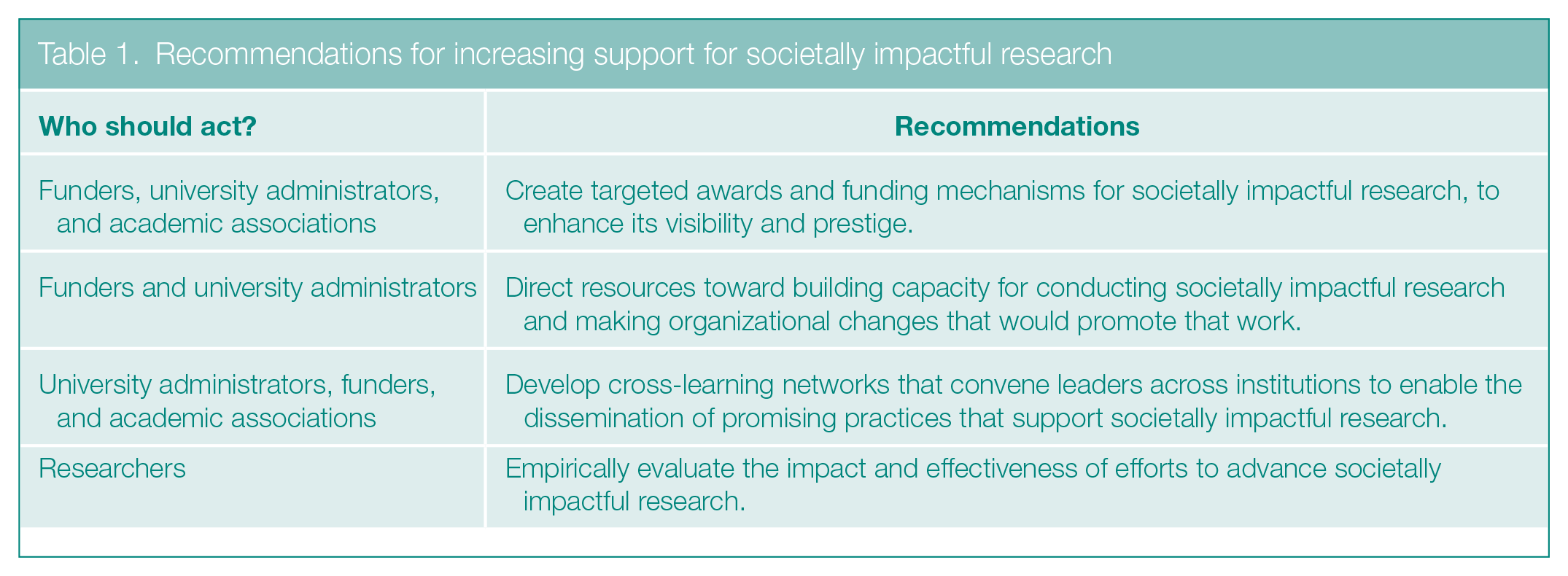
Informed by the momentum in this area, we offer several recommendations directed to various academic stakeholders for increasing support for societally impactful research (see Table 1). First, university administrators, funding agencies, and academic associations, among others, can help increase the visibility and prestige of this form of scholarship by offering more targeted awards and funding. These kinds of support also enhance recognition of some of the difficulties of this form of research, such as the time-intensive nature of collaborative research. Second, to address institutional challenges, funders and university administrators should direct resources toward building capacity for conducting societally impactful research and making organizational changes that would promote that work. Third, to reduce the burden on any individual academic institution, we recommend that university administrators along with funders or academic organizations convene cross-learning networks, wherein different institutions with common goals come together to share promising strategies for supporting societally impactful research. Last, we recommend that scholars work to find more systematic evidence about the best ways to implement policies and programs directed toward societally impactful research.
Recommendations for increasing support for societally impactful research
Conclusion
Societally impactful research is an important avenue through which universities can better address the needs of the public. Creating academic environments conducive to such scholarship, however, necessitates policy and practice changes. Although institutional change is challenging, especially in organizations as complex as universities, 39 the cases we have described show that such change is possible. 40 The examples we shared in this article also point to the ways in which a range of diverse stakeholders, from funders to academic associations devoted to specific disciplines, can contribute to these change efforts, both individually and collaboratively. Although many current trends in higher education are discouraging, such as declining trust and decreasing enrollment, societally impactful research and the individuals working diligently to support its advancement represent positive developments and a promising future.
Footnotes
Declaration of Conflicting Interests
The author(s) declared no potential conflicts of interest with respect to the research, authorship, and/or publication of this article.
Funding
The authors did recieve financial support from the Transforming Evidence Funders Network for the authorship of the scan referenced in the article.
