




Abstract
Objective
Many tertiary students access social networking sites on a daily basis. With the increased usage of smartphones, accessing social networking sites while commuting, in schools, waiting for friends, television commercial breaks has become prevalent among tertiary students. What started as a lifestyle choice has now become a daily necessity. Such behavior among tertiary students raises an important question for educators: how does social media usage affect tertiary students’ sleep patterns and daytime sleepiness, their attention difficulties, especially in school? Thus, the aim of this study was to examine the relationships between tertiary students' self-reports of social media usage and daytime sleepiness.
Design
The design was a cross-sectional, quantitative research study.
Methods
We used a survey that contained questions concerning demographic data, daytime sleepiness, total sleep time and social media usage and a version of the Cleveland Adolescent Sleepiness Questionnaire, modified for use in tertiary students, were used for data collection (n = 969).
Results
The most preferred tool for accessing social networking sites was smartphones and WhatsApp was the most accessed site. Results indicated that nocturnal technology use has a weak, negative impact on tertiary students’ quantity of sleep that may lead to daytime sleepiness. Local Singapore students spent significantly more time on social networking sites at night compared to foreign students. As a result, local students experienced more daytime sleepiness compared to foreign students.
Conclusions
Prolonged social media usage, especially in bed, has a negative impact on tertiary students’ daytime sleepiness. Since the technology is such an integral part of most tertiary students’ lives, it is important to understand the impact it has on their sleep and daytime sleepiness.
Introduction
Three main factors regulate sleep – a homeostatic factor, an endogenous circadian factor, and a behavioral factor.1–3 Behavioral factors can override both the homeostatic and circadian factors. As such it is important to understand behaviors that affect sleep. 1 Behaviors carried out close to sleep can potentially disturb sleep. 4
Daytime sleepiness may be defined as the reduced ability to stay awake and alert during normal daytime hours, resulting in lapses of sleepiness or sleep. 5 Cain and Gradisar 6 concluded that evening use of electronic media such as television, computers, etc. by adolescents is associated with a delayed bedtime and a reduction in total sleep time. In another study, Brunborg et al. 7 reported that the use of mobile phones and computers while in bed was associated with delayed time of sleep. Choi et al. 8 reported that Internet use is strongly associated with excessive daytime sleepiness in adolescents. However, Choi et al. 8 did not investigate why adolescents used the Internet excessively.
Previous studies have reported associations between electronic media use and sleep9–12 and social media usage and academic performance.13–17 Studies have also shown the associations between mobile phone use and daytime sleepiness. A survey study by Nathan and Zeitzer 18 showed an association between mobile phone use and daytime sleepiness in high school students in California. A study by Afandi et al. 19 reported that non-users of social networking sites (SNS) had better sleep quality than users. Although SNS were not mentioned in a study of Swedish adolescents by Soderquist et al., 20 it was reported that regular users of mobile phones had health symptoms such as tiredness, stress, headache, anxiety, concentration difficulties and sleep disturbances more often than less frequent mobile phone users.
The past decade has shown an immense increase in the usage of smartphones, handheld devices, and computers to access SNS. However, relatively few studies have investigated the association between social media usage, especially at night, and daytime sleepiness in tertiary students. One such study by Wolniczak et al. 21 showed the association between Facebook and poor sleep quality in undergraduate students in Peru. However, this study focused only on Facebook use and no other social networks, and did not include socioeconomic factors such as household income, and briefly investigated daytime dysfunction among adolescents.
Paralleling the rise in smartphone use is an equally rapid increase in the amount of time that tertiary students are spending on SNS such as Facebook, Twitter, Blogs, etc. SNS provide a way for adolescents to experience connectedness and opportunities to learn from each other. 22 A ComScore report 23 showed that out of the nearly three million Internet users in Singapore, more than 90% visited SNS in 2011. Mobile Internet usage – the use of a browser on a mobile device – in Singapore is at 79% according to “The digital media habits and attitudes of Southeast Asian consumers” report released by Nielsen in October 2011. 24 A recent report showed that sleep deprivation affected cognitive performance, sleepiness and mood of adolescents in Singapore. 25 The increasing use of electronic devices such as tablets and smartphones was cited as one of the reasons. 26 However, no research has been done to investigate any association between social media usage and sleep among tertiary students in Singapore.
Aims and significance of this study
Despite the increase in tertiary students accessing SNS through mobile devices, there has been limited investigation on tertiary students and their sleep and subsequent daytime sleepiness. The use of mobile phones or handheld devices to access the Internet, especially SNS, may extend the waking hours further into the night and thereby contribute to daytime sleepiness among tertiary students. It is also important to identify the SNS most preferred by tertiary students and the reasons for heavy usage so that proper intervention can be carried out to help tertiary students better manage their sleep quality and quantity. It is well known that poor sleep quality has negative neurobehavioral and psychological consequences that might lead to poor health and academic functioning. 19
Based on the literature reviewed on social media use among tertiary students, we expected that a significant number of tertiary students would use electronic media devices at bedtime to access SNS. Furthermore, social media usage was expected to be inversely proportional to sleep duration and positively related to daytime sleepiness. The following research questions were used to design this study and analyze the data collected: (a) How many hours do tertiary students spend on SNS daily? (b) Do tertiary students’ use of SNS vary according to their gender, nationality and household income? (c) What relationships exist between social media usage and daytime sleepiness in tertiary students?
Methods
Measures
This study employed a cross-sectional, quantitative research design. A questionnaire that contained questions concerning demographic data, daytime sleepiness, total sleep time, and social media usage was used as an instrument in this study. A modified version of the Cleveland Adolescent Sleepiness Questionnaire (CASQ) 27 to assess daytime sleepiness in tertiary students was included in the survey. The CASQ is a 16-item scale that has been validated as a measure of sleepiness in tertiary students. 27 Items such as “I feel wide awake the whole day” and “I fall asleep when I ride in a bus, car, or train” are measured on a five-point Likert scale. To measure students’ access to SNS, they were asked to state the amount of time spent on each social media networking site on a daily basis. They were also asked to state their reasons for using social media sites. Possible reasons for using SNS were stated in the questionnaire and students were required to select among the reasons based on their preference. These reasons for SNS usage were adapted from a study that investigated the college students’ use of social media. 28
Sample
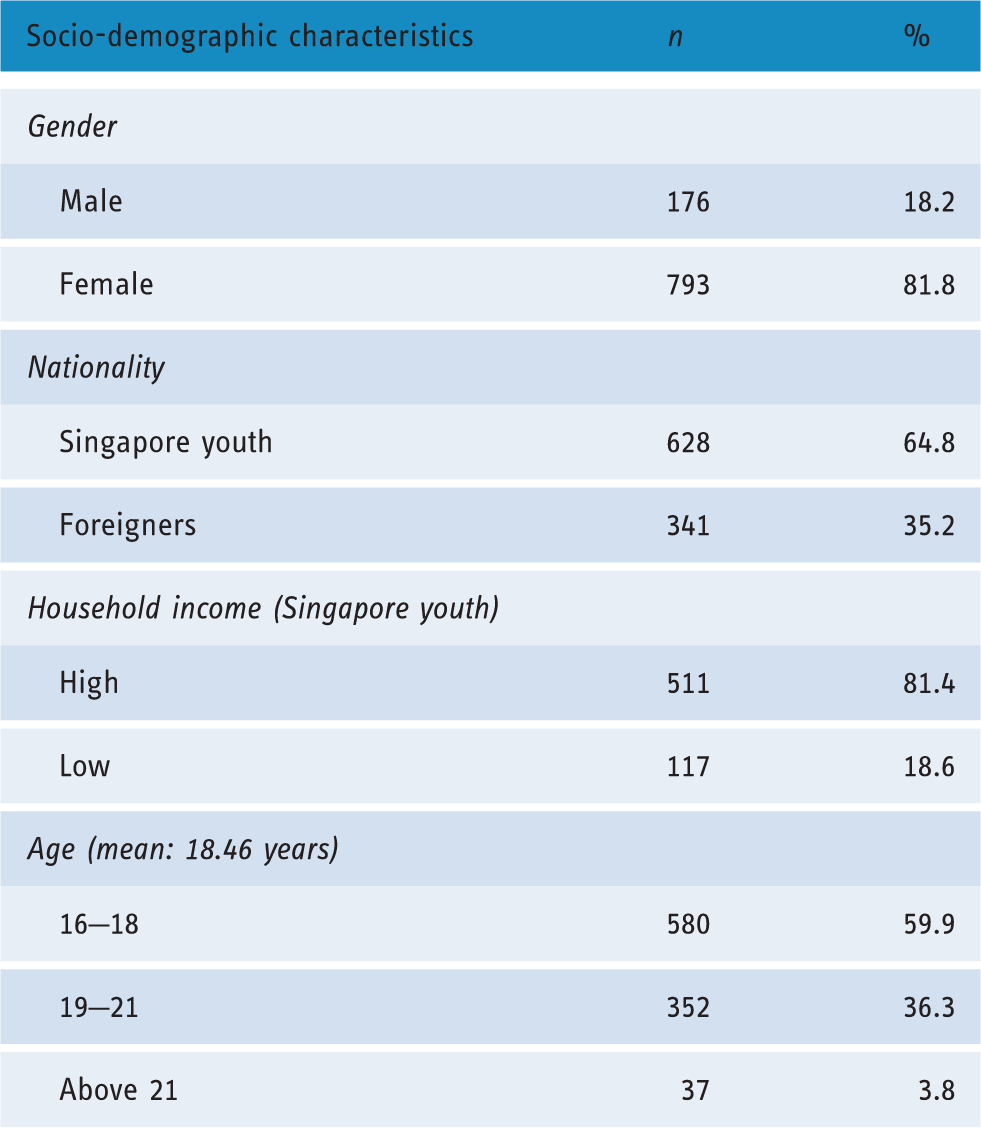
Characteristics of the sample, n = 969.
Procedure
The research methodology was approved by the tertiary institution’s Institutional Review Board and all participants provided written informed consent. Data was collected without personal identifiers to guarantee appropriate confidentiality. After consent was sought from participants, they were invited to complete the questionnaire. The questionnaire was accompanied by a letter explaining the objectives of the research and instructions for completing the questionnaire.
Data collected were transferred to Microsoft Excel 2010 (Microsoft, Redmond, Washington, USA). Standard data entry and quality control procedures were used, including double entry, range and consistency checks, and manual review of outliers. Statistical tests such as independent t-tests and Pearson correlational analysis were used to examine different variables and their relationship to social media usage and daytime sleepiness. All statistical analyses were performed using the Statistical Program for Social Sciences (SPSS) version 21.0 (IBM, Armonk, New York, USA). In the presentation of results, the statistical significance was set at p < 0.05 (two-tailed). Internal consistency reliability, assessed by Cronbach’s alpha, was 0.83 for the CASQ in this study.
Results
The purpose of this study was to examine the usage of social media and the relationship between self-reports of social media usage, especially at night, and daytime sleepiness among tertiary students in Singapore. In this study, tertiary students who are citizens or permanent residents of Singapore were termed as Singapore or local tertiary students and families with annual household income of S$30,000 or less were categorized as low-income.
Hours spent on each SNS and most preferred SNS by tertiary students
Daily social media usage by social networking site (n = 969).


Graphical representation of daily social media usage by social networking site.
Reasons identified by tertiary students for the use of SNS
Reasons for social media usage, n = 969.

Time spent on accessing SNS per day versus gender, nationality, and household income
Independent sample t-test analysis on social media usage versus gender, nationality and household income.

SD: standard deviation; SNS: social networking site.
Staying up late to access SNS versus gender, nationality, and household income
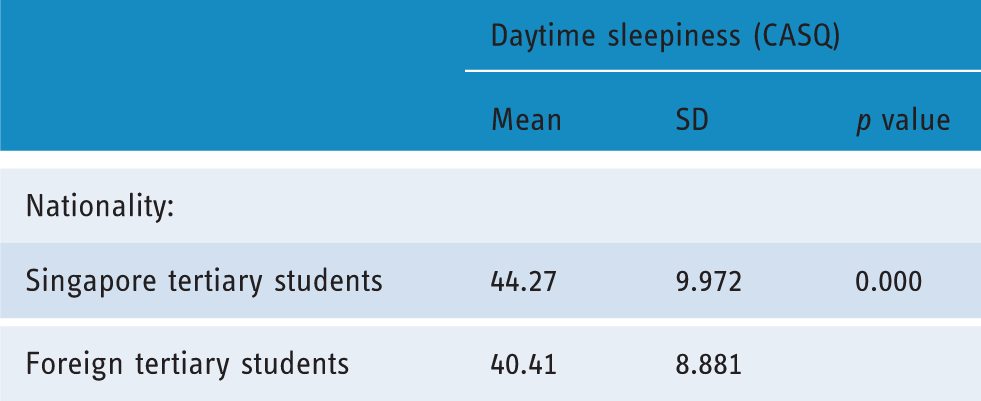
Independent sample t-test analysis on nationality versus Cleveland Adolescent Sleepiness Questionnaire (CASQ) (daytime sleepiness).
Total sleep hours at night
Survey participants were asked to report their hours of sleep at night on a typical day. About 50.4% (n = 488) of participants reported sleeping six hours or less, 47.2% (n = 457) slept seven to eight hours, 1.86% (n = 18) slept nine to 10 hours and less than 1% (n = 6) slept 10 hours or more at night on a typical day. Of those who slept six hours or less, 81% were female (n = 396), and 77% (n = 375) were local tertiary students (not foreigners). About 63% (n = 307) of local students from high income families also slept six hours or less on a typical day.
Weak correlation between social media usage, hours of sleep at night, and daytime sleepiness
Pearson correlational analysis of social media usage, hours of sleep and daytime sleepiness (Cleveland Adolescent Sleepiness Questionnaire (CASQ)).

SNS: social networking site.
Correlation is significant at the 0.01 level (two-tailed).
Correlation is significant at the 0.05 level (two-tailed).
Discussion
The current study describes social media usage and its impact on daytime sleepiness among tertiary students in a tertiary institution in Singapore. This study showed that Facebook was no longer the predominantly used SNS by tertiary students in Singapore. Facebook was reported to be the most accessed SNS by previous studies.15,23,28 The most preferred SNS, in terms of time spent and daily usage, was WhatsApp. LinkedIn ranked the lowest in terms of time spent and daily usage. The low rank given to LinkedIn was expected since it is a social site built for working professionals and not for such tertiary students as in this survey. Most participants reported “Keeping in touch with friends” as the reason for use of social media. This result synchronized with results from other studies.28,29
Our study did not find any statistically significant association between time spent on SNS and gender, nationality, or household income. A study by Hargittai 30 found that females are 1.6 times more likely to use SNS compared to males. A study by Tufekci, 31 showed that women were four to five times more likely than men to use SNS. A study conducted by Lenhart et al. 32 reported that teens from lower income families are more likely to use online social networks than teens from wealthier households.
However, our study indicated a statistically significant but weak association between “Staying up late to access SNS” and nationality. Singapore tertiary students who most likely have a larger pool of friends or relatives locally may stay up late at night to access SNS compared to foreign tertiary students who may not be so socially well-connected.
Pearson correlational analysis showed that time spent on SNS, the hours of sleep at night and staying up late to access SNS did have a significant, albeit weak, correlation to daytime sleepiness. The results of this study also indicated that staying up late to use social media tended to be linked with later bedtimes, a shorter duration of sleep, and increased daytime sleepiness. This may be a risk factor for sleep disorders and poor academic performances. Chang et al. 33, p1232 demonstrated that the use of portable light-emitting devices such as tablets, smartphones immediately before bedtime has biological effects that may lead to “sleep deficiency and disrupt circadian rhythms, both of which can have adverse impacts on performance, health, and safety.” Decrease in nighttime sleep due to reduced or altered sleep schedules has been associated with excessive sleepiness and impaired school performance.34,35
The main strength of this study is that it investigates how usage of social media, especially at night, affects sleep patterns or daytime functioning among tertiary students. Previous studies have mainly focused on only adolescents. However, there are several limitations that should be considered in interpreting the results of our study. The first limitation lies in the reliance on self-reported data on hours of sleep and social media use without objective confirmation. Hence, the data collected may have been influenced by recall bias,12,36,37 as well as by common method bias. 38 Secondly, since this study was focused on social media usage, no attempt was made to control for other potential confounding factors that could affect tertiary students’ sleep behaviors. Other factors, such as health status, peers’ sleep habits, and family stress may be significantly associated with school-going tertiary students’ sleep behaviors, so these factors may be potential confounders in interpreting the relationship between social media usage and sleep behaviors. Finally, the present study was cross-sectional and the sample population was selected from a single tertiary institution and hence there is limited generalizability of our results. The results of our study should be further confirmed through a prospective study.
Conclusion
Social media usage was investigated as one of the possible causes of increased daytime sleepiness among students from a tertiary institution in Singapore. Our results showed that accessing SNS late at night led to increased daytime sleepiness. The results of this study raise a health concern regarding social media usage and daytime sleepiness among the tertiary students surveyed. To further investigate sleep deprivation among tertiary students, we recommend the following in future research: firstly, further studies should include more tertiary students from many different local education institutes, in order to have a sample that is more representative of tertiary students in Singapore. Secondly, the questions included in the questionnaire should include more factors that might cause sleep disturbance. Thirdly, it is desirable to test the relationship between electronic media use and sleep to establish causal links between these two variables. Based on the results of this study, we recommend that the use of devices to access SNS, especially just before bedtime, should be limited. This may be beneficial to the tertiary students’ quantity and quality of sleep, and lead to improved attentiveness during the day. Schools may conduct workshops to increase awareness of sleep deprivation and responsible use of mobile devices. At home, parents or guardians should monitor the use of mobile devices beyond bedtime. Since most parents obtain mobile phones for their children to keep in touch, they could get their children to use mobile devices that do not have access to Internet. This way, the children will be able to keep in contact with their parents but will not have access to social media via the Internet. A mobile application that allows time-restricted access to the Internet could also be installed in the mobile devices used by the students. With such an application, access to the Internet could be restricted from bedtime till wake-up time. This will ensure that the students are not distracted by social media during bedtime. The ministry in charge of education may also conduct observational studies to understand the extent of sleep deprivation and its effect on cognitive performance among students to implement policies or guidelines for the telecommunication operators to restrict access to the Internet during schooldays. For example, the telecommunication operators may offer student subscription plans that restrict access to Internet from 22:00 till 06:00 This will also help students who are addicted to social media to sleep better.
Footnotes
Acknowledgements
The authors sincerely thank the final year students for participating in data collection for this research.
Contributorship
All authors have made substantive contributions to this study. All authors endorsed the conclusions and approved the final version of the manuscript.
Declaration of Conflicting Interests
The author(s) declared no potential conflicts of interest with respect to the research, authorship, and/or publication of this article.
Ethical approval
Approved by Ngee Ann Polytechnic Institutional Review Board.
Funding
The author(s) received no financial support for the research, authorship, and/or publication of this article.
Guarantor
AMAN
Peer review
The author has chosen for the three individuals who reviewed this manuscript to remain anonymous.