




Abstract
The game was developed for undergraduate business and management programs to teach the fundamental concepts of work organization and job design. Although it was inspired by historical problems in production and the division of labor, the real focus is on organization and managerial action. It can find application in a broad range of management education programs because the game draws from the questions that formed the roots of management education, still relevant today: How do we organize for production? How do we manage the human consequences of this? The debrief process guides students to possible managerial actions to ameliorate the negative consequences of the division of labor. It is frugal, easily scalable, extendable, and customizable to incorporate a broad range of class sizes and management theories. For readers, its implementation could improve their undergraduates’ appreciation of management theory and its relation to managerial action, as they are often without experience of managing or management.
This game was developed for teaching undergraduate programs in management or organizational behavior in engineering and business schools. Students experience the impact of the division of labor in the Industrial Revolution-era England, when merchants and industrialists took individual craft workers from their homes and workshops and put them into “manufactories.” They were then organized to perform only one function in production, whereas previously they had ownership of the entire process. The managerial problems caused by this quickly increased in the game. The game draws from questions that formed the roots of management thinking and education, namely, how do we organize for production? Then, how do we manage the human consequences of this? As the game is designed for learning about the consequences of organizing and managerial action, rather than production alone, it can act as an effective framework for work in teamwork, change management, innovation, identity, quality, lean, agile, and even health and safety.
A “widget” is an A4- or letter-size piece of paper with nine numbers and three symbols arranged as in Figure 1. Players produce widgets by writing these on the paper to conform to the model (Figure 1) in proportion and content, competing in teams/lines to produce widgets in the fastest time with the highest customer satisfaction, under two very different conditions, System A and System B. System A is equivalent to craft production. Each player produces entire widgets to meet an order. System B is equivalent to organization by division of labor. Each player specializes in one or several elements of the widget, and work in progress passes sequentially down a production line.
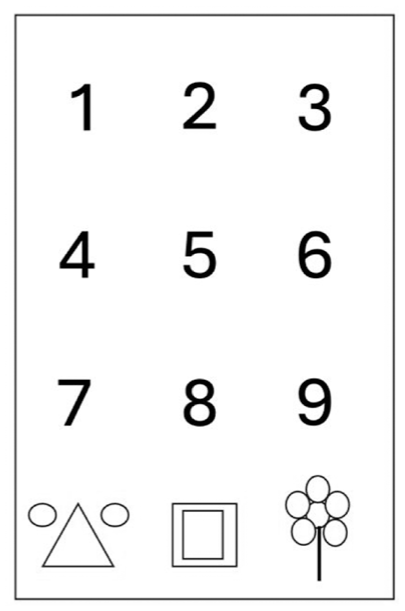
A Widget.
The nine numerals and the three symbols were designed to trigger learning by creating overconfidence in workers due to their apparent simplicity. Creating one in craft production that is consistent with the standard model proves surprisingly difficult at first attempt. The symbols have a complexity that takes longer to create, requires a slightly higher skill level and are harder to maintain consistency over a production run. The design allows for ease of movement between the two types of production. When the game moves to mass production through division of labor, the design determines what each person will do and where.
Undergraduates often have no exposure to or experience of work or managing (Burke & Moore, 2003); therefore, they have “little or no context for appreciating the value of the material” (Schmidt-Wilk, 2018). Hence, our discussions as teachers are often abstract in their minds. They may not grasp the need for the managerial action that we promote in lectures. This game gives them a work–like experience that is physically and mentally stressing, designed to provide “commitment . . . a sense of personal accomplishment or failure for results obtained . . . conflict, time-pressure in order to place the participant in as close to a real-life situation as possible” (Denholm et al., 2012). Perhaps the work featured in the game is silly, but the emotions generated are real, and the energy and insights aroused readily transform into ideas for the improvement of work organization in the debrief.
Theoretical Foundation
The theoretical foundations of the game draw on industrial history, specifically the discovery of the division of labor, identified by Smith (1776) and popularized by Taylor (1911) as a feature of scientific management for establishing “maximum prosperity” for worker and employer. However, economists almost from the outset expressed concerns over the excessive specialization of the division of labor leading to “mental mutilation” (Mill, 1848) and alienation.
Games have a strong tradition in teaching work organization (e.g., Donovan & Fluegge-Woolf, 2015). There is also a tradition of using the concept of a paper-based “widget” in production games. For example, Kiesel et al. (2020) whose widgets were based on various paper folding patterns in a game to demonstrate diminishing marginal product of labor. Delise and Mello (2017) used widgets to engage teams in developing skills in negotiation. McBride and Peterson’s (1985) widgets used paper and line drawing and a quantity of different operations to represent a multifunctional production. Neral (1993) and Neral and Ray (1995) use widgets to demonstrate production cost and scarcity. Carson and Tsigaris (2009) promoted sustainability with clean and dirty widgets. My game is different from these, as it focuses specifically on the division of labor and management rather than production and has a debrief that helps students with little management experience develop prescriptions for management action.
The design of the game was according to the classics (e.g., Keys & Wolfe, 1990) and contemporary literature in experiential and game-based learning (e.g., Jaaska & Aaltonen, 2022; Lameras et al., 2017), including my own practice (Stewart, 2025; Stewart et al., 2016). The design was intentionally frugal. A frugal design “. . . deliver[s] high-quality educational experiences with minimal resource costs” (Masters, 2024) through intentionally using “trailing-edge” technologies, ideal for resource-constrained environments (Arnab et al., 2025). Hence, the use of pen and paper. The development and application of the game draws on the critique of experiential education techniques and games/simulations in education, for example, Wright et al. (2018) and Bradford (2018).
Learning Objectives
After playing, students will be able to:
Identify the impact of the division of labor on productive activity
Discuss the human and economic costs of organizing productive activity
Relate the challenges experienced in the game to theory around management, motivation, and job characteristics
Propose innovations to improve the working conditions of workers performing productive activity in any working context
Logistics and Game Operation
The game is to be performed in a flat classroom, in an in-person environment. It requires the following resources:
Ideally, enough students in attendance for the creation of production lines of 12 people
Enough desks and chairs to create two production lines, though the game can work with one line and fewer people
Pens or pencils for players to write with
A ream of A4 or letter-size paper as raw material for the widgets
A whiteboard and markers to record time to completion and customer satisfaction
A timer to record time to completion of orders
Notepaper on which to write order quantities, which will form customer “orders”
Divide players equally into teams sitting side-by-side at two lines of desks. Name these teams/production lines to enhance team identity. If available, the instructor can appoint one or two additional students as the managers of each line. Their jobs are to receive orders from the customer (typically the instructor, though students could also play this role), feed raw material into the line, collect production, check it for quality, and hand it to the customer. Managers will also do whatever they think will be encouraging to obtain the “win.” The win condition may be the fastest completion times or customer satisfaction. In System A (Figure 2), a manager allocates raw material to each worker, and each worker creates a complete widget and hands it in to their manager to complete an order. In System B (Figure 3), each player is responsible for producing one part of the widget only and performs their work when a widget is handed to them in the line.
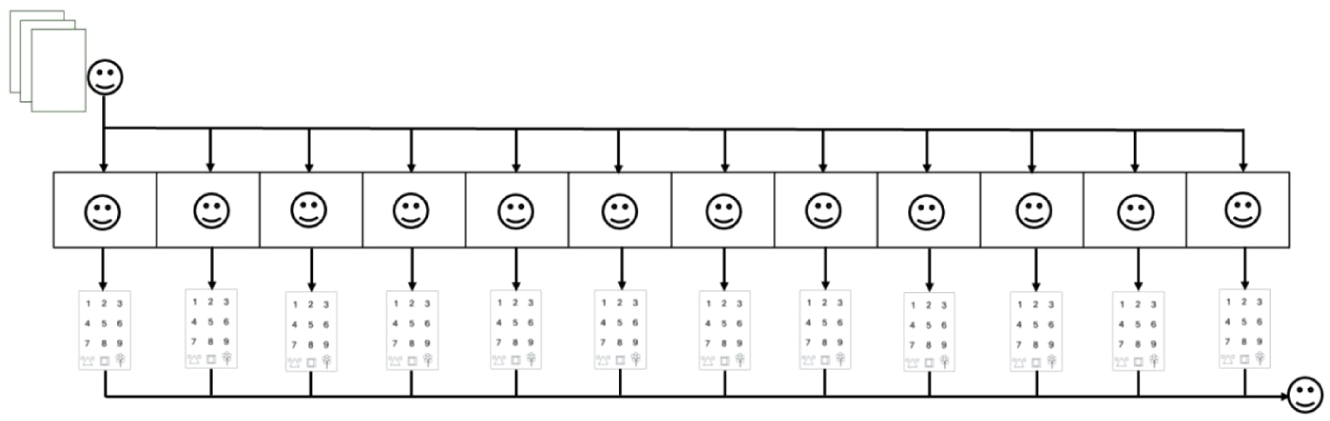
Production Under System A.
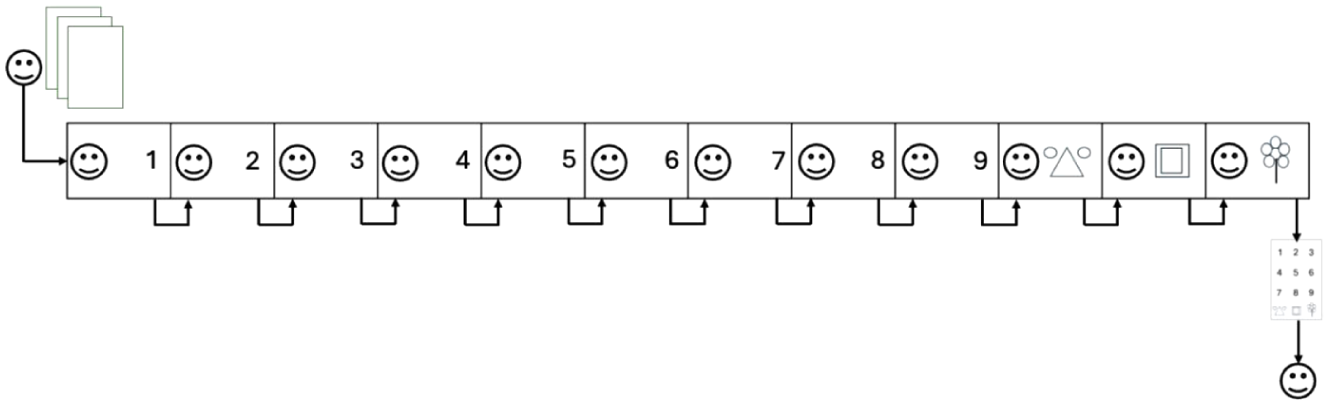
Production Under System B.
The instructor chooses order quantities, keeping them consistent across teams and sufficient to test operations. The customer checks completed work before acceptance. If the customer accepts, the instructor records the “time to complete” on the whiteboard, in a table set up as in Figure 4. This enables easy comparison between lines/teams and across orders. A smiley (or not) face is put next to each order on the whiteboard to signify the satisfaction level of the customer. If taking the role of the customer, the instructor can choose the level of conformity that they desire in comparison to the model widget. Rejection will require rework. The clock will start again when workers replace the defective widgets in the order, or alternatively, the instructor may add a time penalty for each defective widget.

The Performance Tracking Table.
A test order in System A can check for any early misinterpretations of the instructions. After several orders are completed in System A, production switches to System B. It is good for the first order of System B to be the same as the first real order of System A. This enables easy comparison of the performance of the two systems taking an identical order. The game can run for as long as wished, until the instructor declares a winning line. The students then enter the debrief (see Appendix B), which leads them to reflect on what they have experienced and what innovations might be required to overcome some of the managerial problems that quickly surface in the context of repetitive work and specialization. A more detailed set of game instructions is in Appendix A.
It is usually the case that System A is more enjoyable, but System B is faster. Quality and speed initially improve, per the observation of Adam Smith (1776). However, a sense of alienation and consequential quality control problems quickly surface. Students commenting on their experience showed features consistent with the theory on division of labor, for example, As one of the managers, I realised how easier my job was in System B . . . However, the workers were not as motivated as we were. They started striking in the middle of the game. As a manager, we fully understand the impact of when workers were less motivated: they did the assignment poorly and without interest.
The conformity of the numerals and shapes on the widgets declines. Bottlenecks emerge around the more complex shapes, which dissipate energy in the other workers as they realize that no matter how quickly they complete, the line cannot complete faster. The emotions released by the division of labor under time and competition pressure are something for reflection upon in the debrief, especially when students realize the implications for successful (on time, error-free, first time) production. This leads easily to the discussion of what managers can do about it.
The main advantage of experiential learning over traditional lectures is that the student is an active agent in the learning (Dubinsky & Hamid, 2024). Through acting in response to challenge, emotions are generated and encountered. Emotion affects every aspect of learning and memory formation and is proven to enhance retrieval and retention through integration of cognitive and emotional neural networks (Tyng et al., 2017). Ethical concerns exist around the temporarily uncomfortable nature of the physical and emotional engagement (Wright et al., 2018). A worker experiencing negative emotions may have a qualitatively different time than one selected to be a manager or one doing a part of the work that they enjoy.
Negative emotion can obstruct learning (O’Flanagan & Jester, 2025). Finch et al. (2015) negatively “activate” and “deactivate” learning emotions; boredom, hopelessness, and frustration are sometimes observed. However, such concerns are balanced against the proven benefits of embodied experience for learning retention, which creates memorable learning that lectures cannot replicate, through the ability to integrate social, intellectual, and physical aspects of the learner (Morris, 2020), especially when combined with systematic reflection (Levin-Banchik, 2018). In a lecture, I could talk about the alienation and boredom created by the division of labor show them quotes by Mill or the art of L.S. Lowry (which I do), but in the game, they can directly feel and observe the consequences for workers and production and, consequentially, appreciate the imperative for ameliorative managerial action. How I manage negative emotion is covered in Appendix A.
Conclusions
While there have been some surprises in terms of student behaviors (detailed in Appendix D), there have been few surprises in meeting learning objectives. The activity and debrief objectives are quite predictable due to the game design. (some suggestions for variations on game design are made in Appendix C). A repetitive production environment is generally not the intended employment destination of undergraduate management students. Therefore, they can discuss the work in the game without preconception. I have been surprised by how quickly students have bridged from the game, with little effort from me, into areas of management theory around job characteristics, management, and leadership and the enthusiasm generated for thinking about the consequences of organizing and managing. It generates insights that persist long after use and is often referred to by students in subsequent lectures when discussing organizing and other managerial actions.
Footnotes
Appendix A
Appendix B
Appendix C
Appendix D
Declaration of Conflicting Interests
The author declared no potential conflicts of interest with respect to the research, authorship, and/or publication of this article.
Funding
The author received no financial support for the research, authorship, and/or publication of this article.
