




Abstract
This article describes the adaptation and use of the HeroClix® board game to teach critical real-world principles for effective human capital management within teams. In a HeroClix® game, players pit their team of miniature figurines against other players’ miniatures in combat. This is akin to organizations striving in the business environment today, with well-structured human capital within their teams as a key competitive advantage. In this article, we suggest how the game can be applied in the classroom for undergraduate students to experience, reflect on, and learn more about the prerequisite considerations in proficient people management, the dynamic nature of human capital, and the strategic considerations involved in human capital optimization amid volatility. The HeroClix® game is straightforward to set up, easy to expand for large class sizes, and engages students in experiential learning effectively.
Keywords
Board games are a great resource in management teaching, for piquing students’ interest and engaging them on the various topics discussed (van Esch & Wiggen, 2020). Game-based learning is also more effective when the students playing the games are able to exercise critical thinking and relate their gameplay experience to real-life workplace applications, à la D. A. Kolb’s (2015) four-stage experiential learning process of concrete experience, reflective observation, abstract conceptualization, and active experimentation (Gazdula & Farr, 2020). In this article, we explore how HeroClix®, a chess-like game with variable piece characteristics, can be used to teach a 2.5-hour undergraduate business management class on various fundamentals of human capital management. Unlike chess, where pieces are limited to stipulated moves based on their predetermined functions, HeroClix® treats its pieces as dynamic, multifaceted individuals, emphasizing flexible strategies to win. This mirrors how organizations should implement holistic, people-first strategies that enable employees to adapt over time for business success (Pfeffer & Veiga, 1999). The game thus provides a realistic simulation of the various fundamentals of human capital management that may be overlooked in traditional curricula (Schwabenland & Kofinas, 2023).
Theoretical Foundation
Human capital refers to the knowledge, skills, and abilities (KSAs), as well as other characteristics of employees, such as personal motivation, which bring value to an organization (Wright, 2021). Studies on human capital have examined how it can be optimized within teams, focusing on an advantageous mix of team member KSAs, as the organization’s competitive advantage (Wang et al., 2012).
Despite the gravity accorded to the human capital discourse, management teaching is plagued by significant limitations in the fullness of considerations that can be conveyed to, and learnt by, students (Schwabenland & Kofinas, 2023). One main reason for this is the dominance of thin abstraction in the teaching process, which involves simplifying complex concepts and theories into stripped-down ideas for a quicker grasp of their gist (Folger & Turillo, 1999). For example, most school curriculums would view the development of individuals’ human capital as just a change from one state of being to another. They seldom discuss the interactions between individuals’ choice of personal development and their immediate environment, although such interactions may affect the outcomes (Wright, 2021). Instructors may also gloss over the ambidextrous refinement of human capital mix that takes place as one adapts to shifting market conditions. Yet, such intricacies, which are left out through thin abstraction, do matter in real-world human capital management.
This article does not argue that thin abstraction is wrong, or questions its usefulness in the teaching and learning of human capital management. Due to the complex nature of human capital management, thin abstraction plays a critical role in helping students grasp its foundational ideas. Rather, we make the argument that students should also be made more aware of the various fundamentals symbiotic to effective human capital management, should there be teaching apparatuses that permit thicker descriptions of the contextual considerations. We have thus modified the HeroClix® game to accommodate multiple players, and for them to learn the fundamentals of human capital management. The first author has successfully implemented the game activity in a variety of human capital management classes.
Game Description
HeroClix® is a tactical board game, which pits two or more players (each having a team of miniature figurines) in combat on a game map. Two six-sided dice are used during gameplay to determine the outcomes of attacks and defense actions, in addition to various game calculi. The player who knocks out all of an opponent’s miniatures, or scores more points from the “knock-outs” by the end of the game, is deemed the winner.
Each HeroClix® miniature is a two-inch figurine of a superhero like Wolverine, a villain-like Joker, or a character from other franchises such as The Lord of the Rings. Each miniature is affixed to a Combat Dial™ base, which is a rotatable disk that displays its combat values of “speed,” “attack,” “defense,” and “damage,” along with “powers and abilities” indicated by color shapes. The “powers and abilities” color codes grant specific gameplay effects to the miniature that have a potential impact on the game state and are displayed when the base is rotated to a position relevant to the player’s turn in the game. Additionally, a prefixed “range value” and lightning symbols are printed on the base, where the “range value” denotes the extent across the map that a miniature’s gameplay effects may reach and the lightning symbol refers to the number of opposing miniatures that may be targeted. Whenever a miniature takes damage from an opponent, its Combat Dial™ is rotated clockwise to reveal new combat values at that turn. When a miniature’s dial shows “KO,” it is deemed “knocked out.” Furthermore, each miniature has a point value stated on its base, which portrays the cost to add that character to the team—all players start with a pre-determined “build-total,” which refers to the maximum total point value of miniatures allowed on a team. To structure a well-balanced match between opponents, players ensure that the build-totals of all miniature teams are comparable. The point values also aid in the summation of “knock-out” scores at the end. For players’ quick reference, each HeroClix® miniature comes with a corresponding 3.25 inches by 2.5 inches character card that lists its special powers and abilities, and combat values across its full range of rotation, that is, clicks (see Figure 1).
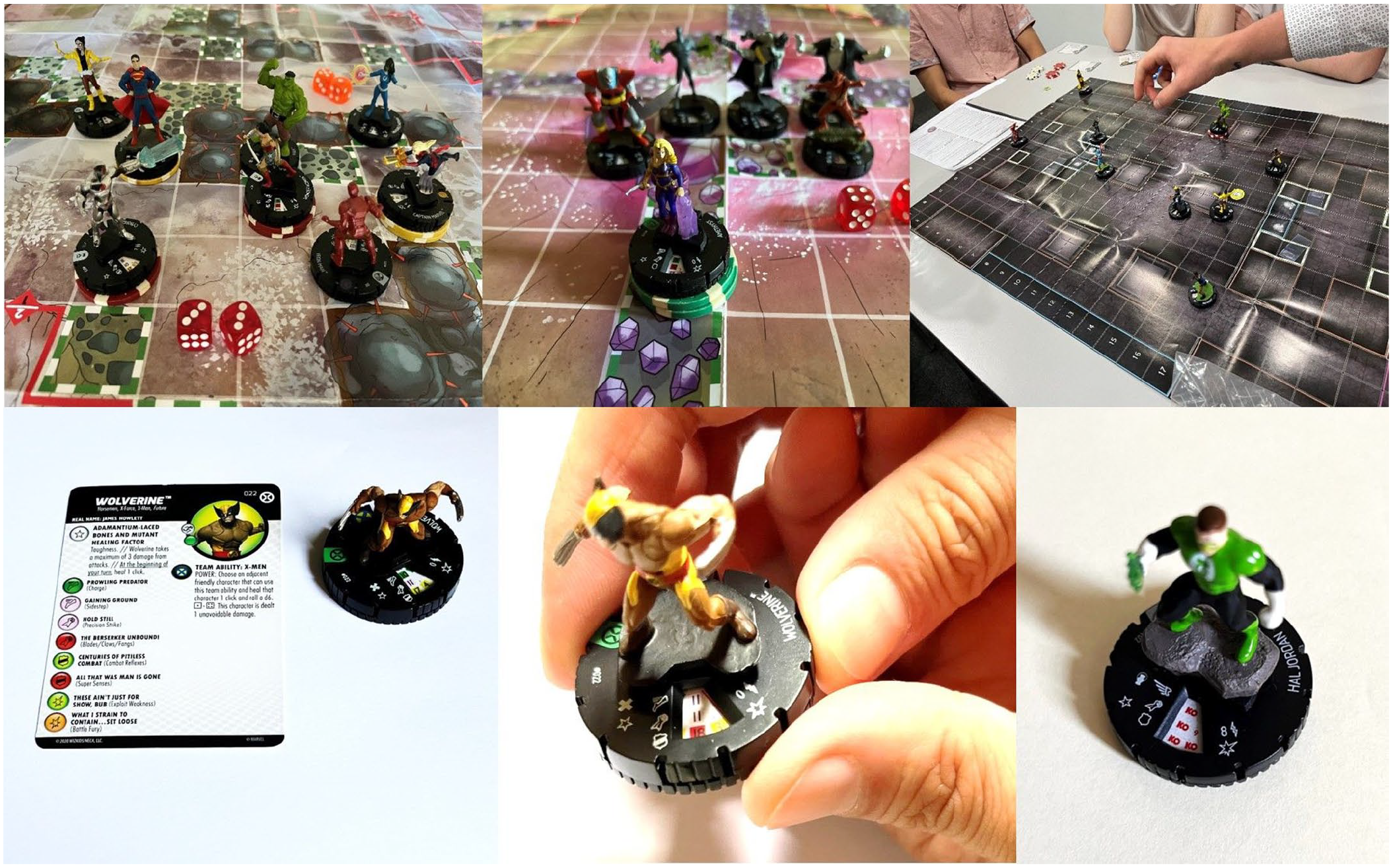
HeroClix® Game Setup and Miniatures.
Separately, action tokens, for example, beads or poker chips, are used to demarcate the number of actions taken by a miniature. Also, a HeroClix® rule booklet and a Powers and Abilities Card (PAC) that summarizes the “speed,” “attack,” “defense,” and “damage” gameplay effects, and various printable game maps, can be downloaded freely from the WizKidsTM HeroClix® website (https://wizkids.com/heroclix/). See Appendix A for the game mechanics. Furthermore, gameplay tutorial videos are available on YouTube (e.g., https://www.youtube.com/watch?v=lKvESNPbte4). The miniatures are sold in secondhand markets affordably. We bought a total of 90 HeroClix® miniatures and several game maps for US$15 from the secondhand market. This helps keep teaching material cost low.
Learning Objectives
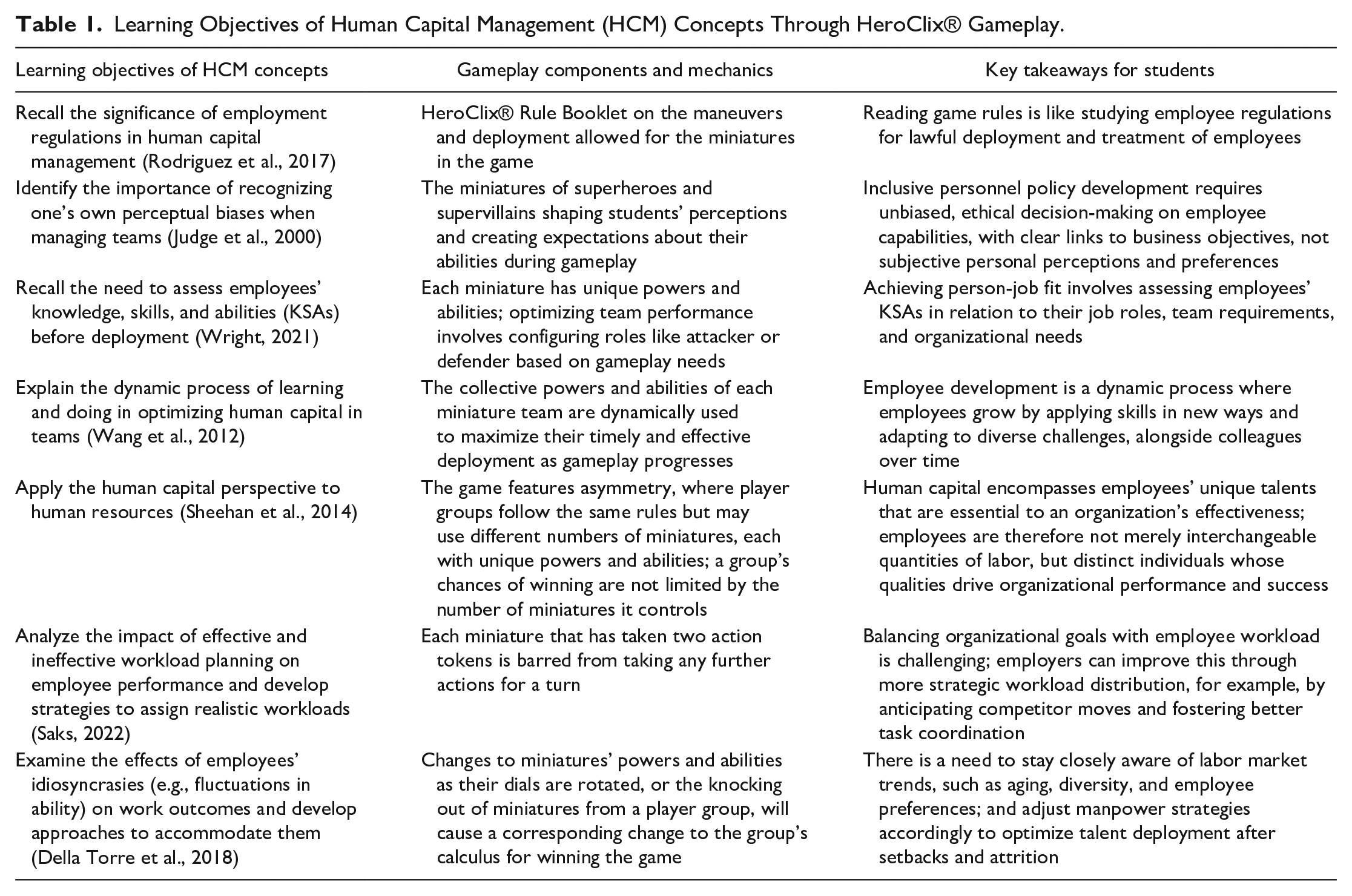
Through the HeroClix® gameplay, students will gain a deeper understanding of various human capital management fundamentals that are identified in research but seldom explored in depth during class. The associated learning objectives, which address these critical yet plausibly overlooked aspects, are aligned with Bloom’s Taxonomy (Anderson & Krathwohl, 2001) and outlined alongside the game mechanics used to convey them and the key takeaways for students; all of which are provided in Table 1.
Learning Objectives of Human Capital Management (HCM) Concepts Through HeroClix® Gameplay.
Preparing the Class
Preparation of Students
Students are informed about the HeroClix® game 1 week before the human capital management class. At this juncture, the rule booklet and PAC are made available to the students for prior reading on a voluntary basis.
Game Preparation for the Class
The HeroClix® game, usually played between two persons, is modified to suit a class size of 25 students (nonetheless, it can also be applied in larger classes; we provide two options for scaling the game in Appendix B). Before the students arrive, the classroom is set up in a cluster seating format with three tables and chairs around each table. A HeroClix® game map is laid on each table for two opponent groups. There are thus altogether six player groups of three to five students each. The instructor pre-packs 30 HeroClix® miniatures, their corresponding character cards, action tokens, six-sided dice, and PACs into six zip-lock bags beforehand. All bags are packed with miniatures of equal build-total, ensuring balanced matches despite varying miniature counts across some bags. See Figure 2 for the bags’ contents and seating arrangement.
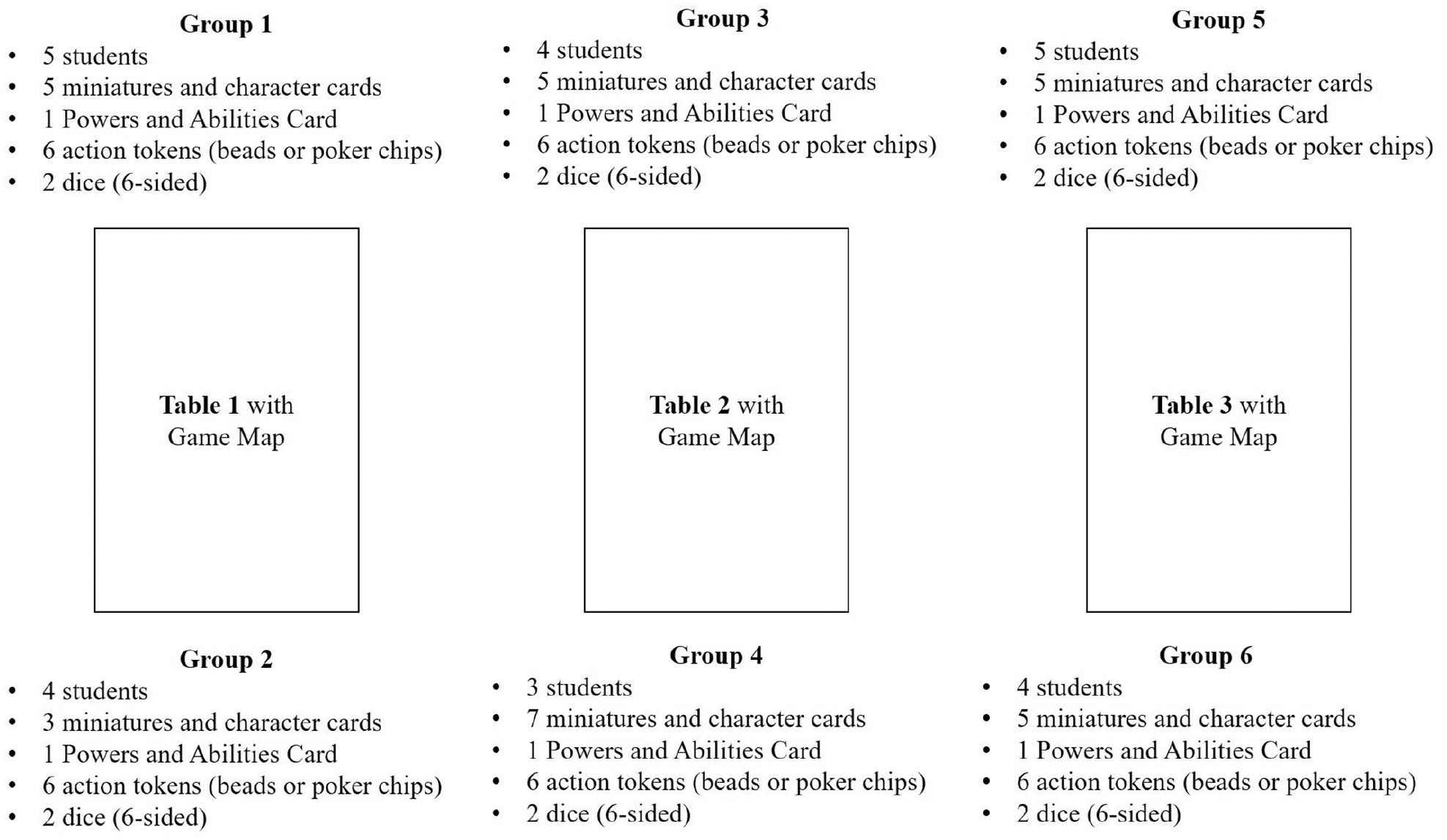
Student Seating Arrangement and Distribution of HeroClix® Miniatures and Accessories.
Running the Class
Pre-Activity Briefing
The instructor gives a lecture on human capital management. This sets the stage for students to learn through the contrast between the thin abstraction of human capital management theories and the thick description of its fundamentals through the subsequent HeroClix® gameplay. The instructor then conducts a brief demonstration of the game.
Gameplay
The opposing student groups are then told to start their HeroClix® games. The game objective is for a student group from each table to win by either knocking out the entire team of opposing miniatures or scoring the most points from knock-outs, within a 50-minute time frame. The students are allowed to refer to the rule booklet and PAC during the game. Meanwhile, the instructor will go around the tables to clarify the game rules should there be questions. Our observations on the students’ typical gameplay are provided in Appendix C.
Debrief
The class debrief reviews the student groups’ game performance and discusses their experience managing the human capital of their HeroClix® miniature teams. The debrief involves having the instructor ask the students guiding questions to help them concretize their game experience, construct reflective observations on the gameplay, explore their abstract game experience, and relate it to real-world management practices.
Debrief for the Game
The link between human capital management and the HeroClix® game is twofold. First, real-world business competition necessitates the pitting of one organization’s human capital, in the form of its employees’ KSAs, against that of another organization. This is analogous to the manner in which one HeroClix® team’s powers and abilities are pitted against that of a competitor’s team. Second, thriving in an evolving business world, where competitors respond dynamically, implies adaptively structuring employees’ KSAs into an optimal mix to compete better. Winning in a HeroClix® game similarly requires adaptively structuring the powers and abilities of one’s miniature team into a favorable combination, in response to internal volatility (e.g., when one’s miniatures take damage and dials rotated) and external changes (e.g., adjustments in an opponent’s strategy).
Debrief on Gameplay Experience
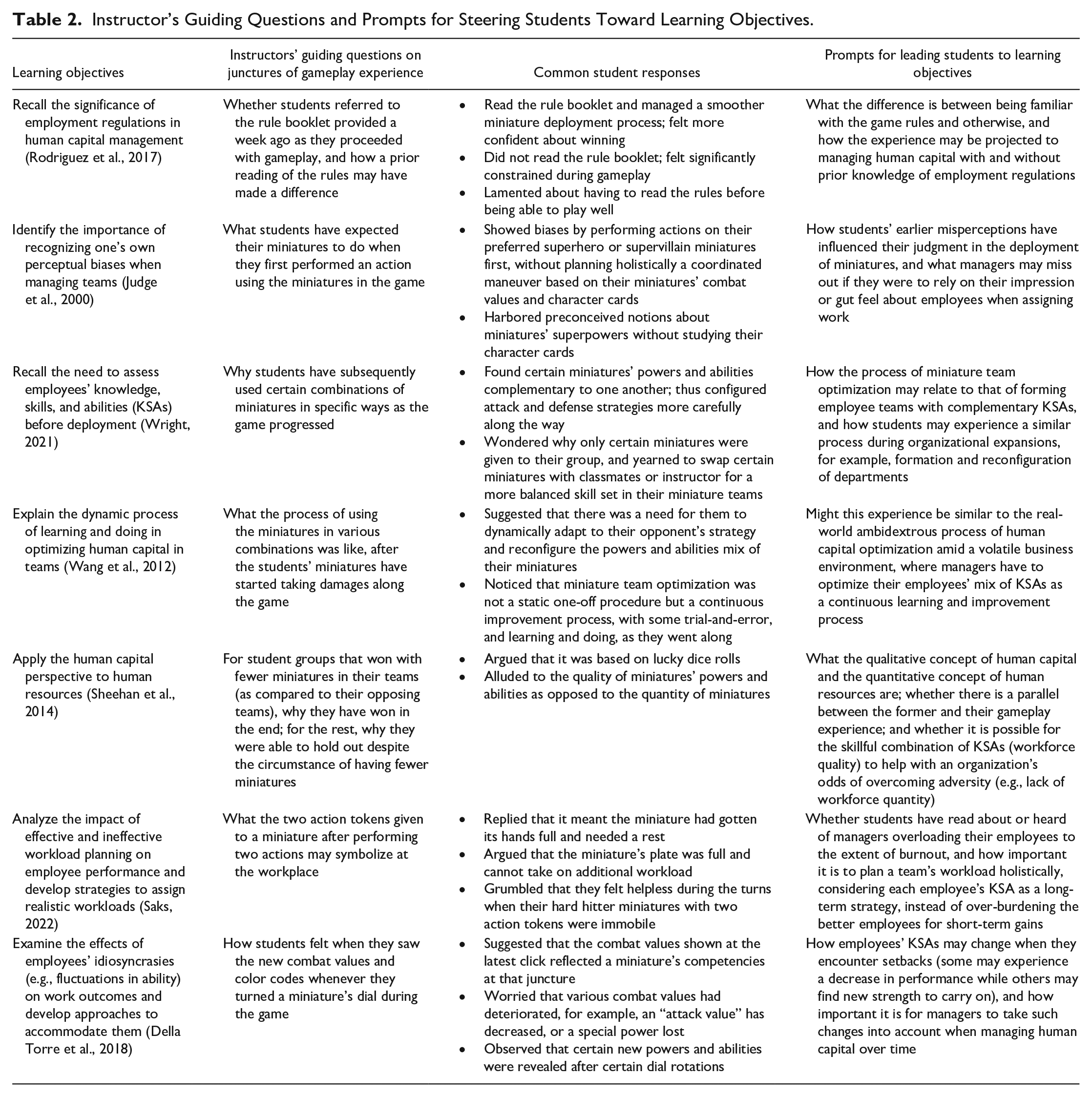
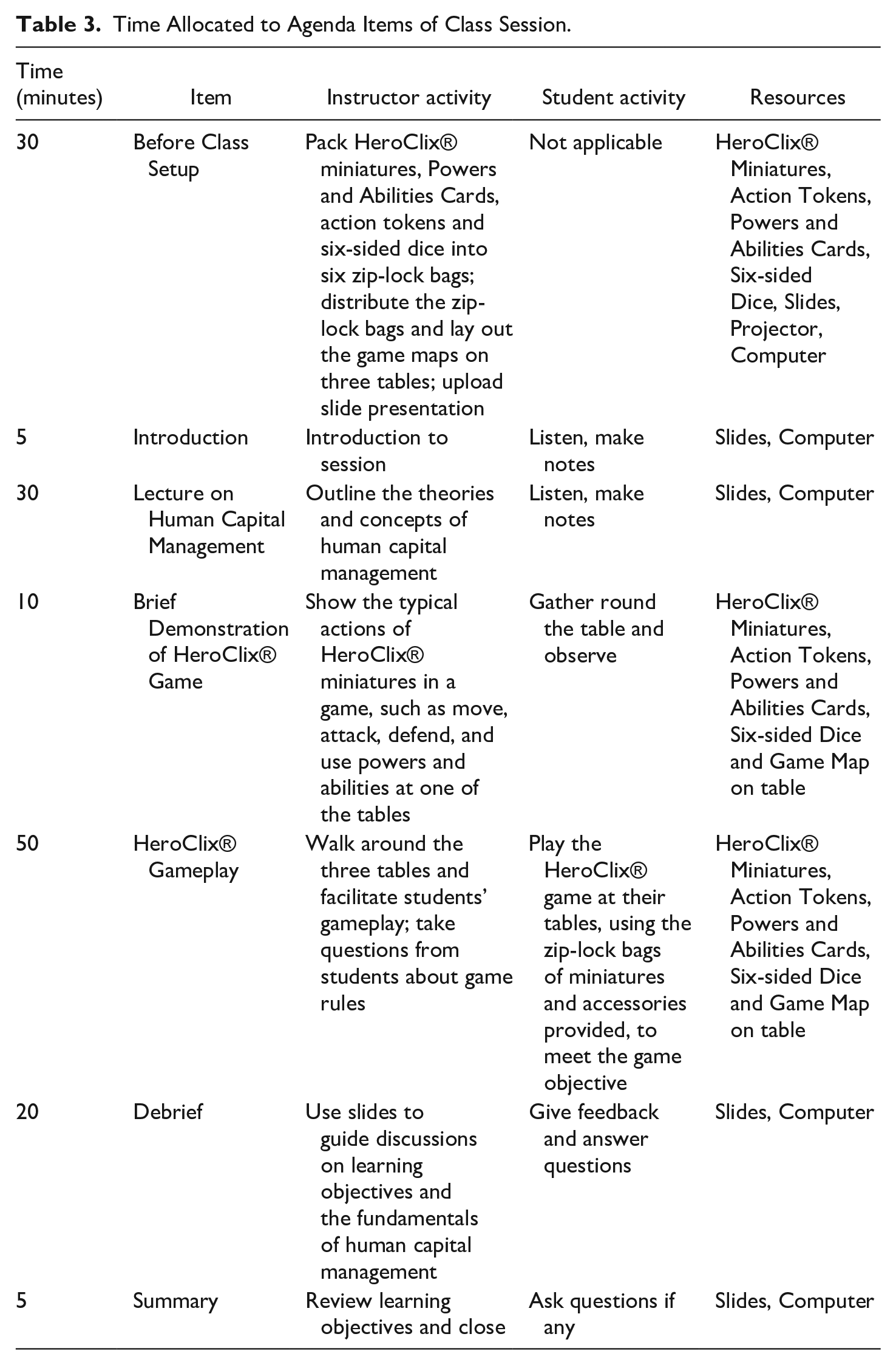
Students are asked to discuss their experience from the different junctures of the game in response to the instructor’s questions. For example, on why the students have subsequently used certain combinations of miniatures in their teams as the game progressed, they may explain that they noticed certain synergistic powers and abilities among certain miniatures within their teams. The instructor can then tap this observation to encourage them to explore real-world management practices where managers combine employees’ KSAs strategically to gain a competitive edge. See Table 2 for the suggested instructor questions and prompts for leading students to the learning objectives and Table 3 for the time allocated to each agenda item during the class.
Instructor’s Guiding Questions and Prompts for Steering Students Toward Learning Objectives.
Time Allocated to Agenda Items of Class Session.
Conclusion
Using games in the classroom has been shown to improve student engagement and focus, especially for the more qualitative management courses (van Esch & Wiggen, 2020). The HeroClix® game allows for an exciting and fruitful learning experience. Its game mechanics offer the potential for students to explore the abstract fundamental concepts related to human capital management and gain a fuller understanding. In our teaching endeavors, students have enjoyed both the learning process and the game, even those without prior exposure or interest in superheroes. This is a sample of student feedback received:
I loved the game and saw many parallels between the game and real-life human capital management. It served me well as a rehearsal of what I would do in an organization managing and deploying precious manpower in a competitive business environment. Most worth mentioning was the way we had to rejig the combination of “employees” when my Iron Man started taking damage from Killmonger. I will recall this lesson whenever I manage people next time.
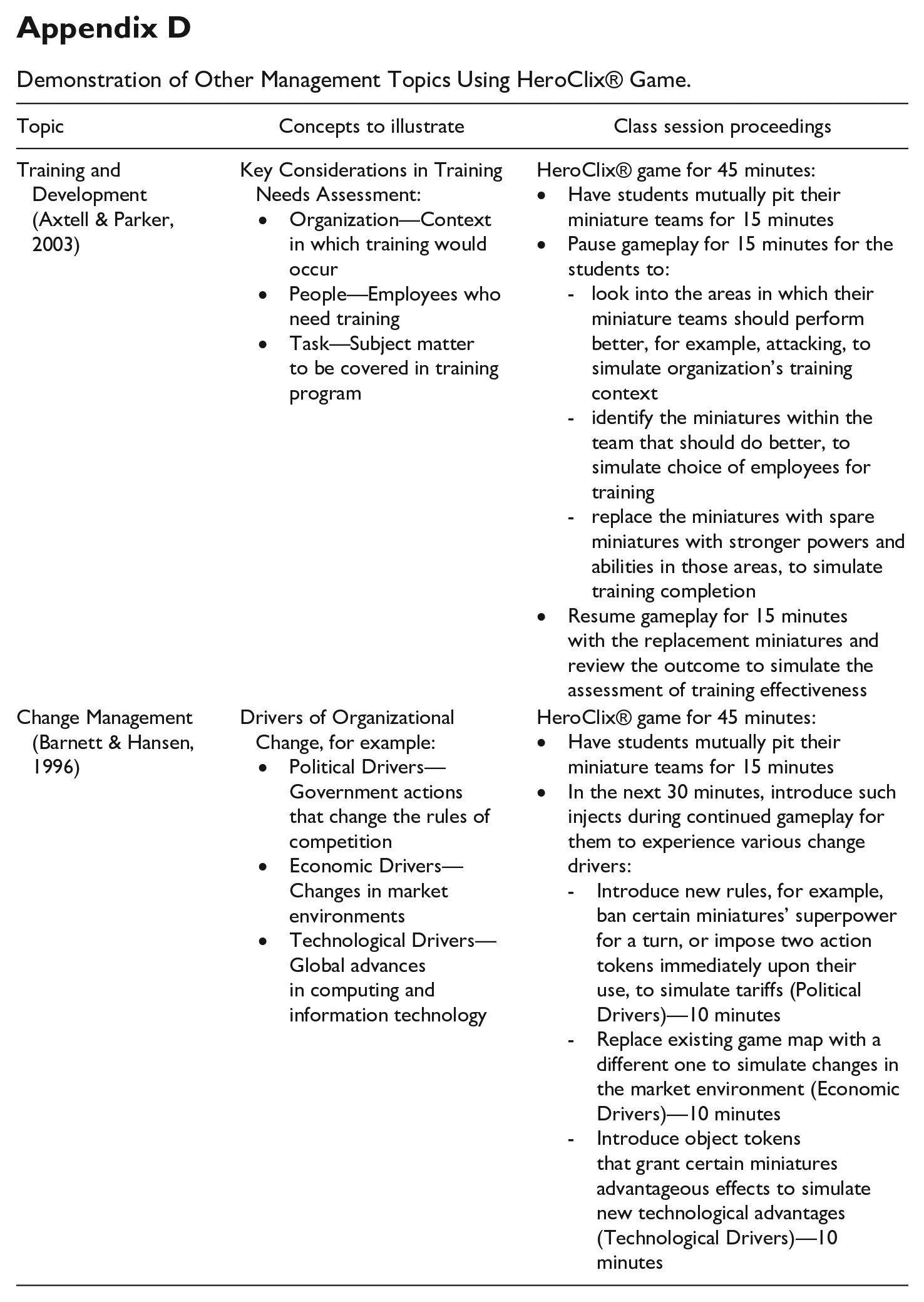
Additionally, the game’s physicality supports information processing, reinforces concept recall, and offers opportunities for knowledge application (see A. Y. Kolb & Kolb, 2005; for a discussion on these science of learning principles). As such, it can be adapted to teach other management concepts too, such as those found in short segments of MBA or graduate-level courses. We suggest two such adaptations in Appendix D. Finally, instructors may wish to clearly outline the learning objectives to students, right at the start, so that they focus more on learning instead of just winning the game.
Footnotes
Appendix A
Appendix B
Appendix C
Appendix D
Demonstration of Other Management Topics Using HeroClix® Game.
| Topic | Concepts to illustrate | Class session proceedings |
|---|---|---|
| Training and Development (Axtell & Parker, 2003) | Key Considerations in Training Needs Assessment: ● Organization—Context in which training would occur ● People—Employees who need training ● Task—Subject matter to be covered in training program |
HeroClix® game for 45 minutes: ● Have students mutually pit their miniature teams for 15 minutes ● Pause gameplay for 15 minutes for the students to: - look into the areas in which their miniature teams should perform better, for example, attacking, to simulate organization’s training context - identify the miniatures within the team that should do better, to simulate choice of employees for training - replace the miniatures with spare miniatures with stronger powers and abilities in those areas, to simulate training completion ● Resume gameplay for 15 minutes with the replacement miniatures and review the outcome to simulate the assessment of training effectiveness |
| Change Management (Barnett & Hansen, 1996) | Drivers of Organizational Change, for example: ● Political Drivers—Government actions that change the rules of competition ● Economic Drivers—Changes in market environments ● Technological Drivers—Global advances in computing and information technology |
HeroClix® game for 45 minutes: ● Have students mutually pit their miniature teams for 15 minutes ● In the next 30 minutes, introduce such injects during continued gameplay for them to experience various change drivers: - Introduce new rules, for example, ban certain miniatures’ superpower for a turn, or impose two action tokens immediately upon their use, to simulate tariffs (Political Drivers)—10 minutes - Replace existing game map with a different one to simulate changes in the market environment (Economic Drivers)—10 minutes - Introduce object tokens that grant certain miniatures advantageous effects to simulate new technological advantages (Technological Drivers)—10 minutes |
Acknowledgements
The authors would like to thank everyone who contributed to this article. In particular, we extend our gratitude to Dr. Gordon B. Schmidt (Co-Editor-in-Chief, Management Teaching Review), Dr. Joe Seltzer (Associate Editor, Management Teaching Review), and the two anonymous reviewers for their insightful feedback. We also thank our students for playing the HeroClix game and sharing their valuable comments on its use in our classrooms. In addition, we are grateful to our families for their unwavering support and to MINT TCG and Singapore’s HeroClix player community for introducing us to this marvelous game.
Authors’ Notes
HeroClix®, Combat Dial™, and WizKids™ are trademarks of NECA/WizKids LLC. No endorsement has been given by, and the parties involved in the authorship and publication of this article have no affiliation with, NECA/WizKids LLC.
All other trademarks such as names and titles of miniatures referenced in this article are the property of their respective owners and the reference of these trademarks is solely for the purpose of commentary and does not imply any affiliation with, or endorsement by, the respective owners.
Declaration of Conflicting Interests
The authors declared no potential conflicts of interest with respect to the research, authorship, and/or publication of this article.
Funding
The authors received no financial support for the research, authorship, and/or publication of this article.
