




Abstract
This article examines gender differences in self-rated occupational prestige in Germany using two indicators: absolute self-ratings and a prestige deviation score that benchmarks self-ratings against societal prestige for the same occupation. Using nationally representative data from the Bundesinstitut für Berufsbildung/Bundesanstalt für Arbeitsschutz und Arbeitsmedizin Employment Survey 2018 linked to Microcensus-based occupation measures, the author estimates multilevel models with individuals nested in detailed occupations and conducts Oaxaca-Blinder decompositions. Men report modestly but consistently higher prestige than women. For absolute prestige, the gap is accounted for largely by structural factors. By contrast, for the prestige deviation score, the gap aligns with an unexplained component in the decomposition, suggesting interpretation processes beyond measured structure. Wages, at both the individual and occupational levels, explain the largest share of the gap, while autonomy and perceived career advancement also raise self-ratings. Agreeableness shows a small positive association. Occupational gender composition follows a U-shaped pattern, with higher prestige in male- and female-dominated fields than in mixed ones. The results suggest that pay structures explain most observable differences in prestige self-ratings, while remaining disparities align with gendered interpretation processes.
Keywords
Gender inequality in the labor market persists well into the twenty-first century. In (West) Germany, occupational sex segregation has remained relatively stable over several decades and plays a major role in the reproduction of gendered inequalities such as wage levels and career trajectories (Kleinert et al. 2023). Although these disparities have been widely examined, particularly with regard to gendered wage gaps (Busch 2020; Kleinert et al. 2023), less attention has been paid to gender differences in occupational prestige. Status construction theory (SCT; Ridgeway 2011) argues that positional inequalities and status inequalities are deeply intertwined and sustained by gender status beliefs, which serve to perpetuate positional inequalities. Gender status beliefs are rooted in shared cultural beliefs that regard men as generally more competent and higher status than women. Is this reflected in a gendered prestige hierarchy? Several studies have examined this question (García-Mainar, García-Ruiz, and Montuenga 2025; Krueger et al. 2022; Magnusson 2009; Valentino 2020). The present study adds a new perspective to previous research by focusing on gender differences in self-ratings of occupational prestige.
Occupational prestige influences how individuals perceive themselves in these roles, affecting their career ambitions, job satisfaction, and overall well-being (Destin, Rheinschmidt-Same, and Richeson 2017; Tan et al. 2020). If women were to consistently assign lower prestige to their own occupations compared with men in equivalent roles, this may contribute to persistent gender disparities in career advancement, wage negotiations, etc. The (self-)undervaluation of women’s work leads to a feedback loop, wherein it reinforces gender stereotypes and influences organizational decision-making, ultimately affecting the distribution of opportunities and resources. This interplay between self-perception and societal reinforcement can thereby perpetuate gender inequalities in professional contexts. In Germany, where the dual education system fosters long-term occupational careers (Hall and Soskice 2001), these evaluations may be particularly consequential.
Despite its potential importance, the role of self-rated occupational prestige in reproducing gender inequalities has not been addressed in current research. Although several studies have focused on self-perception in specific occupations, for example, teachers (Akiba et al. 2023), medical professionals (Janus and Filar-Mierzwa 2019), and law enforcement officers (Alfaro Hudak et al. 2025), national-scale analyses of self-rated occupational prestige as an outcome in its own right remain rare. Although self-rating items appear in some broader occupational evaluation studies, typically as secondary measures (e.g., Newlands and Lutz 2024), I am not aware of prior work in which gender differences in self-rated occupational prestige were systematically examined across the occupational structure.
This study addresses this gap by examining gender differences in self-rated occupational prestige in Germany. Two research questions guide the analysis: (1) Do men and women differ in how they evaluate the prestige of their own occupations? and (2) If a prestige gender gap exists, to what extent do occupational gender composition, work characteristics, and individual dispositions explain these differences? To answer these questions, the analysis considers both absolute self-ratings and deviations from societal prestige scores. Absolute self-ratings tell us where individuals position themselves in the occupational hierarchy, but to understand how these ratings reflect the societal consensus, a relative measure is needed, which I call the prestige deviation score. As prestige is a social construct based on collective evaluations, deviations indicate how individuals’ perceptions diverge from broader societal valuations. Combining both measures provides a more comprehensive understanding of the ways in which gendered perceptions of occupational prestige are formed.
The present analysis contributes to existing research in three ways. First, it focuses on self-perception and analyzes it using a dual perspective by measuring both absolute prestige self-ratings and deviations from societal prestige. Second, it examines gender differences in (self-rated) occupational prestige in Germany, a case characterized by a highly structured labor market. Third, the latest occupational prestige data currently accessible for Germany at representative level are presented here. Existing prestige measurements for Germany up to 2018 are several decades old, such as the German Magnitude Prestige Scale (Wegener 1984), or were not specifically tailored to the German context, as in the case of the Standard International Occupational Prestige Scale (SIOPS; Treiman 1977). 1
The remainder of this article is structured as follows. The next section outlines the theoretical framework and hypotheses. This is followed by the data and methods, including the Oaxaca-Blinder decomposition and multilevel modeling. The results section presents findings on self-rated occupational prestige and deviations from societal prestige (PDS). The conclusion discusses the findings in light of the existing literature and concludes with implications and avenues for future research.
How Individuals Estimate Their Social Position
Occupational prestige can be defined as the societal regard and respect accorded to professions (see Wegener 1992 for a theoretical discussion). This study examines individuals’ self-perception regarding the prestige of their occupations. Research in social psychology has emphasized how individuals position themselves within social hierarchies, often by either self-enhancing or modest self-evaluations (Brown, Collins, and Schmidt 1988; Srna, Barasch, and Small 2022; Tajfel and Turner 1986). However, these accounts overlook the influence of gender on self-assessments.
The present analysis draws on SCT (Ridgeway 2011), which connects culturally shared status beliefs to wider social structures and norms, particularly those related to gender. This perspective offers a theoretical framework for analyzing the impact of gendered expectations on individuals’ assessments of their own occupational prestige (Figure 1). The hypotheses developed in this section focus on how gendered status beliefs shape self-rated occupational prestige on two levels: (1) the gender composition of occupations and (2) individual-level characteristics such as working conditions, career orientation, and personality traits. Although additional structural factors such as occupational income and educational requirements are included as controls because of their known influence on occupational prestige (García-Mainar, Montuenga, and García-Martín 2018; Treiman 1977; Zhou 2005), they are not theorized in detail here. SCT posits that structural inequalities and status beliefs are mutually reinforcing. Therefore, I investigate whether gender differences in job characteristics and individual dispositions help explain observed disparities in self-rated occupational prestige. Remaining differences may be viewed as evidence of gendered meaning-making processes consistent with SCT.

Framework of hypotheses on gendered prestige self-ratings.
Gender Status Beliefs: Gender Gaps in Occupational Prestige Self-Ratings
This section addresses the first research question: Do men and women differ in how they evaluate the prestige of their own occupation? SCT provides a starting point for examining the influence of social hierarchies, including those related to gender, on self-perceptions. SCT suggests that status beliefs emerge from repeated social interactions that favor certain groups over others, and over time, these beliefs translate into cultural norms and organizational structures, thereby establishing enduring social hierarchies that both reflect and reproduce existing inequalities (Ridgeway and Bourg 2004; Ridgeway et al. 2009).
In the context of occupational prestige, SCT emphasizes that it is not simply tied to the content or complexity of occupational tasks but is also shaped by the perceived social value of the individuals typically occupying those roles. As gender is a prominent and visible axis of social categorization, it plays a fundamental role in the formation of status beliefs. Societal status beliefs about gender affect individual perceptions of competence and self-worth, as well as their evaluations of others (Ridgeway and Correll 2004b). As Ridgeway (2001) argued, gender stereotypes function as status beliefs, positioning men as generally more competent and higher status than women in various contexts. These beliefs are not merely descriptive; they are hierarchical, resulting in the internalization of culturally endorsed expectations regarding gender and worth.
When considering self-rated occupational prestige, the theory posits that individuals’ assessments of their own prestige may be influenced by ingrained gender status beliefs. Men, who are culturally associated with higher status and competence, might be more inclined to rate their own occupation as more prestigious, even while occupying similar jobs to women. On the other hand, women may be more modest in their self-assessments because of the diffuse status disadvantage associated with being a woman.
Hypothesis 1: There is a gender gap in self-rated occupational prestige, with men rating the prestige of their own occupation higher than women.
Gender Composition and Occupational Prestige
This section examines the second research question regarding the influence of occupational gender composition, work characteristics, and individual dispositions on the gender gap in self-rated occupational prestige. It will start by describing the occupational context, followed by job-level and individual-level factors.
According to SCT, gender status beliefs in society affect how people view themselves as well as how jobs are valued according to their gender composition (Ridgeway 2011; Ridgeway and Correll 2004b). This means that occupations predominantly held by women may be systematically devalued compared with those dominated by men, regardless of the actual tasks performed. This phenomenon is often referred to as the “devaluation of feminized work” (England 1992). Societal status beliefs, as outlined in SCT, inherently associate male-dominated roles with greater competence and authority, resulting in higher prestige (Ridgeway 2001). In contrast, female-dominated occupations are often perceived as less demanding or valuable, resulting in lower prestige ratings for both the occupations themselves and the individuals employed in them (Bose and Rossi 1983; Charles and Grusky 2004; Ulfsdotter Eriksson 2013; Xu and Leffler 1992).
This devaluation mechanism significantly affects gender inequality within the labor market. Occupations predominantly held by women often present fewer opportunities for advancement, diminished salaries, and reduced access to resources, which consequently perpetuates their disadvantaged position (Cohen and Huffman 2003). Furthermore, individuals in these roles, regardless of gender, may internalize cultural status beliefs that devalue feminized work, resulting in lower self-rated occupational prestige. This creates a feedback loop in which societal devaluation influences objective inequalities and simultaneously reinforces subjective perceptions of lower prestige. The societal valuation of male- versus female-dominated occupations thus acts as a powerful external influence, shaping self-evaluations and reinforcing gender-based hierarchies within the labor market (Ridgeway 2006; Ridgeway and Correll 2004b).
On the basis of this reasoning, this hypothesis posits that women’s concentration in occupations traditionally linked to their gender results in lower evaluations of occupational prestige compared with men.
Hypothesis 2: The overrepresentation of women in female-dominated occupations mediates the relationship between gender and lower self-rated occupational prestige.
However, recent empirical evidence challenges this linear perspective and demonstrates that the relationship between gender composition and prestige may be more complex. Valentino (2020) introduced the concept of a “segregation premium,” suggesting that gender-segregated occupations, whether male or female dominated, receive a higher symbolic value. This U-shaped relationship between gender composition and occupational prestige has also been reported in Germany (Krueger et al. 2022) and in Spain (García-Mainar et al. 2025). These studies showed that gender-segregated occupations, whether predominantly male or female, tend to have higher prestige than those with more gender balance. This indicates that occupational segregation by gender may result in a prestige premium, wherein highly gendered roles are perceived as prestigious in symbolic terms, despite potential wage or resource inequalities. The findings contest conventional devaluation theory by demonstrating that occupations predominantly linked to a specific gender may possess greater prestige, potentially indicating the cultural significance of preserving distinct gender roles.
Other studies found an inverted U-shaped relationship between gender composition and prestige in Sweden (Magnusson 2009) and in Spain (García-Mainar et al. 2018). In these studies, occupations with a balanced gender composition received higher prestige compared with those dominated by either men or women. This nonlinear pattern indicates that although female-dominated occupations may experience symbolic devaluation, gender integration could elevate the perceived value of work in certain contexts. Research conducted in the 1970s and 1980s showed minimal to no correlation between female representation and occupational prestige, resulting in an inconclusive picture of how gender composition influences prestige ratings (Acker 1980; Crino, White, and DeSanctis 1983; Powell and Jacobs 1984; Treiman and Terrell 1975). These findings indicate that gendered occupational segregation and its impact on prestige may differ across national contexts, temporal periods, and the specific dimensions of prestige assessed.
Working Conditions and Self-Rated Occupational Prestige
I now turn to individual-level factors, positing that the gender gap in self-rated occupational prestige is partially influenced by men’s enhanced access to job characteristics relevant to prestige, such as autonomy, wages, and career advancement opportunities.
Perceptions of occupational prestige are significantly influenced by job conditions. Jobs offering better conditions, such as higher pay, greater autonomy, and more opportunities for advancement, are generally seen as more prestigious (Treiman 1977). The quality of working conditions, including factors such as job autonomy, significantly influences societal perceptions of various occupations, thereby affecting individuals’ self-assessment of their status. Studies have demonstrated a relationship between autonomy and job satisfaction (Humphrey, Nahrgang, and Morgeson 2007; Kalleberg 1977), as well as productivity and positive mood (Johannsen and Zak 2020). Furthermore, research demonstrates greater autonomy and better pay are consistently associated with higher occupational prestige (Adler and Kraus 1985; Ganzeboom and Treiman 2003; Treiman 1977; Zhou 2005). SCT highlights how societal status beliefs reinforce hierarchies that privilege certain groups over others (Ridgeway 2011). In the labor market, these beliefs associate competence, authority, and worth with specific job characteristics, such as autonomy, compensation, and opportunities for advancement. This typically provides men with an advantage relative to women.
SCT posits that men are culturally linked to traits such as competence, assertiveness, and leadership, which correspond with the characteristics of professions that provide significant autonomy, opportunities for career advancement, and higher income (Ridgeway and Correll 2004b). As a result, men are more likely to hold and be viewed as entitled to positions that offer favorable working conditions, leading to higher occupational prestige for these roles. The cultural association between masculinity and valued labor market traits reinforces a status hierarchy, wherein predominantly male-held positions receive greater prestige and benefits. SCT further suggests that autonomy, culturally associated with independence and control, is often viewed as a “masculine” trait (Ridgeway 2001). Consequently, men are more likely to occupy roles with greater autonomy, which increases their perception of them as prestigious. Similarly, high wages are an evident indicator of occupational prestige and are typically associated with roles that are regarded as requiring higher levels of skill and competence (Abrassart and Wolter 2020; MacKinnon and Langford 1994; Zhou 2005). SCT suggests that because men are culturally perceived as more competent, they are more likely to be funneled into higher paying roles. This results in higher self-rated occupational prestige among men, as they internalize these status beliefs and see their work as more valuable. Career advancement is another component of occupational prestige. Men are more likely to perceive an upward trajectory in the labor market, partly because of existing status beliefs that portray them as more capable leaders and more committed to their careers (Ridgeway 2011). The perspectives on upward mobility enhance men’s self-perceptions of professional prestige.
Drawing on the theoretical framework, I propose the following hypotheses:
Hypothesis 3: Men are more likely to hold jobs with greater job autonomy, and greater job autonomy is associated with higher self-rated occupational prestige.
Hypothesis 4: Men are more likely to earn higher wages, and higher wages are associated with higher self-rated occupational prestige.
Hypothesis 5: Men are more likely to experience career advancement, and career advancement is associated with higher self-rated occupational prestige.
Gendered Personality Traits and Self-Rated Occupational Prestige
This section examines how individual personality traits and preferences may account for the disparities in self-rated occupational prestige between men and women. A common gender stereotype characterizes men as “agentic,” indicating traits such as assertiveness, ambition, and self-sufficiency. As a result, men’s roles in the labor market are seen as more important because they meet traditional standards for leadership and professional achievement (Cejka and Eagly 1999). Men are often expected to put their jobs first and are viewed as inherently more suited for roles that require these agentic traits, such as leadership positions (Ridgeway 2011). This stereotype is closely associated with career orientation, as societal expectations as societal expectations compel men to prioritize professional success (Cheryan and Markus 2020).
Individuals with a strong career focus often derive significant self-esteem and identity from their professional achievements. In many cultures, career success is a central component of male identity (Connell 2020; Mertehikian and Gonalons-Pons 2022). Consequently, men are expected to prioritize career and status, receiving rewards for such pursuits. Because of this strong link between work success and social approval, men may place a higher value on their occupational prestige. In contrast, women may receive mixed signals about career orientation because of conflicting expectations about balancing career and family roles (Ridgeway and Correll 2004a). Potential discrimination and limited opportunities for advancement can exacerbate these issues (Budig and England 2001).
Women are stereotypically viewed as nurturing, cooperative, and modest (Eagly and Karau 2002). Although these traits are valued in many social settings, they may not align with the confidence and ambition typically rewarded in the workplace. The Big Five personality traits, a widely accepted model in psychology, includes agreeableness, characterized by attributes such as kindness, sympathy, cooperation, warmth, and consideration (Graziano and Eisenberg 1997). Research consistently shows that women score higher than men on agreeableness, particularly on the subtrait of modesty, characterized by humility and a lack of self-promotion (Collischon 2021; Costa, Terracciano, and McCrae 2001; Feingold 1994). Gender differences in agreeableness, particularly in modesty, can affect how women perceive their prestige. Women who embody these traits may be perceived as less suited for high-prestige occupations because of societal expectations that prioritize caregiving and supportive roles over leadership and career advancement (Cuddy, Fiske, and Glick 2004). As a result, women may undervalue their own achievements as well as their occupational prestige.
Empirical studies support the idea that personality traits influence self-evaluations and perceptions of prestige. Research indicates that women exhibiting higher levels of agreeableness often experience diminished success in salary negotiations and career advancement, potentially influencing their perceptions of prestige (Babcock and Laschever 2003). Moreover, Correll (2001) found that women often rate their performance and the value of their roles lower than men. This aligns with the observation that women tend to exhibit greater modesty and agreeableness. Overall, research indicates a gender confidence gap, with women consistently evaluating their performance as inferior to that of equally skilled men (Bleidorn et al. 2016; Exley and Kessler 2022). 2 On the basis of these theoretical frameworks regarding career orientation and agreeableness, I put forth the following hypotheses:
Hypothesis 6: Men are more likely to be career oriented, and higher career orientation is linked to higher self-ratings of occupational prestige.
Hypothesis 7: Women are more agreeable than men, and higher agreeableness is linked to lower self-rated occupational prestige.
Hypotheses 1 to 7 refer primarily to self-rated occupational prestige, but the analysis includes the PDS as a complementary outcome to explore whether similar mechanisms also shape individuals’ evaluations of their occupational status relative to societal norms.
Data and Methods
To test these hypotheses, I used data from a random sample of the German population collected in 2017 and 2018 as part of the German Employment Survey (Hall, Hünefeld, and Rohrbach-Schmidt 2020). 3 The dataset includes information on 9,011 residents of Germany 15 years and older. Each respondent rated the prestige of their own occupation as well as of five randomly selected occupations, corresponding to 380 five-digit occupations from Klassifikation der Berufe (KldB) 2010 (Paulus and Matthes 2013), with ratings given on a scale from 0 (“very low prestige”) to 10 (“very high prestige”).
For the analyses, I focused on a subsample of 4,650 individuals employed in 118 distinct occupations (five-digit KldB occupations). Of the 9,011 surveyed individuals, 7,988 were employed and responded to the Employment Survey. I excluded 1,336 individuals whose occupations were not among the 380 included in the dataset, along with 108 cases in which respondents rated their own occupations twice (once as part of the five randomly selected occupations and again when asked to rate their own occupations). Additionally, individuals who assigned the same rating to all occupations were removed. To ensure a balance between reliable estimates and occupational diversity, the sample was further limited to occupations with a minimum of 15 observations. After excluding cases with missing values on the dependent or independent variables, the final sample consisted of 4,650 individuals across 118 occupations. Although the sample skews toward larger occupations and is slightly more concentrated in the public sector and health care, the overall industry distribution remains relatively proportional, ensuring a representative structure (see Table A1.1 in the Appendix).
The instrument used to measure occupational prestige was validated in several pretests, including a cognitive pretest (Ebner and Rohrbach-Schmidt 2019, 2021) to ensure its validity and reliability. Table 1 provides summary statistics disaggregated by gender.
Summary Statistics, by Gender.

Source: Prestige module of the German Employment Survey 2018.
Note: Unweighted values are presented, with standard deviations in parentheses. KldB = Klassifikation der Berufe; PDS = prestige deviation score.
p < .05. ***p < .001.
Variables and Measures
The dependent variables in this study are (1) self-rated occupational prestige and (2) the PDS, which represents the gap between an individual’s self-rated prestige and the average societal prestige score assigned to their occupation.
Respondents were asked, “How high, in your opinion, is the prestige of your occupation in Germany today?” to measure self-rated prestige on a scale ranging from 0 to 10. 4
Interpreting the PDS as a meaningful gap relies on the assumption that occupational prestige is a socially shared construct. Although individuals’ self-assessments reflect personal placement in the social hierarchy, societal prestige scores capture aggregated collective judgments. Societal prestige scores are calculated by averaging the 0–10 prestige ratings provided by other respondents for each five-digit occupation. The PDS is calculated by taking the difference between the person’s self-rating and the average rating of society (self-rated prestige minus average societal prestige). A positive deviation score indicates that respondents rated their occupation’s prestige higher than the average societal rating, while a negative score indicates an undervaluation (in absolute points on the 0–10 scale). In the data, self-rated prestige ranges from 0 to 10 (mean = 5.6), while societal prestige averages range from approximately 3.4 (lowest ranked occupation) to 8.3 (highest ranked occupation) across occupations. The PDS ranges from about −7.1 to +6.1, reflecting the extent to which individuals under- or overestimate their occupational prestige relative to societal averages. However, despite this variation, the average PDS is 0.37, showing the robustness of prestige hierarchies (see Table A2.1 in the Appendix).
Gender is coded as a dummy variable (1 = female). Occupational gender composition is the percentage share of women in the occupation, measured at the five-digit level of KldB 2010 and calculated using pooled data from the 2016–2018 German Microcensus.
Individual-level variables include monthly wage, career advancement (a dummy variable indicating a perceived upward career trend; 1 = yes), and autonomy in decision-making (an index ranging from 1 to 4, created by combining responses to survey questions on how often respondents can plan and schedule their own work, influence the amount of work assigned, and decide when to take breaks). Agreeableness is measured using the Big Five Inventory Short Version (Gerlitz and Schupp 2005). 5 In this survey, responses are recorded on a scale from 1 (“does not apply at all”) to 5 (“applies completely”). Career orientation was rated on a scale from 1 (“not at all”) to 4 (“very strong”). All continuous variables were centered and z transformed for interpretability.
Table 1 highlights notable gender differences across the variables of interest. On average, men have slightly higher occupational prestige (6.07) compared with women (5.87). This corresponds with higher self-rated occupational prestige scores (5.81 vs. 5.39). The PDS further reveals that women are more likely to rate their occupational prestige below the societal average for their occupations. On average, men’s self-rated occupational prestige deviates from societal averages by only 0.26 points, whereas women show a larger average deviation of 0.5 points. While these numbers may seem small on a 0–10 scale, they represent approximately 10 percent of the effective prestige range (3.4–8.3), making them a nontrivial difference. Overall, the small difference from societal prestige scores indicates that most people estimate their prestige accurately.
Consistent with the hypotheses, the data demonstrate that men are employed in occupations with higher median wages and receive higher individual monthly earnings compared with women. Additionally, men are significantly more likely to report opportunities for career advancement and exhibit greater autonomy in their roles. They also tend to be more career oriented. In contrast, women, on average, score higher on measures of agreeableness compared with men.
The study includes several control variables at both the occupational and individual levels. Occupational-level controls include the median wage and occupation size, measured by the number of incumbents between 2016 and 2018 using data from the German Microcensus. The education level of each occupation is drawn from the KldB 2010 classification, ranging from 1 (no vocational qualification or a one-year vocational training course) to 4 (completed university studies of at least four years). At the individual level, demographic controls include labor market experience (in years), region (1 = East Germany), parental status (1 = has children), and highest level of education (1 = no degree, 2 = completed vocational training, 3 = technician or further education qualification, 4 = university degree). Additional controls account for part-time employment (dummy) and self-employment status (dummy). The other four dimensions of the Big Five (neuroticism, extraversion, openness to experience, and conscientiousness) were also included as controls.
Analytical Approach
The results section begins with a descriptive analysis to put the statistical analysis into some context, to show which occupations are typically over- or undervalued by their holders, and to get an idea of the valuation behavior of men and women. The subsequent analysis combines two complementary methods: an Oaxaca-Blinder decomposition and a set of multilevel regression models. This two-step approach allows us to distinguish between structural and subjective sources of the gender gap and to explore how individual and occupational factors shape prestige ratings across different contexts.
I begin by estimating Oaxaca-Blinder decompositions to quantify the average gender gap in self-rated occupational prestige (absolute ratings) and in the PDS (relative ratings). The decomposition separates each gender gap into an explained and an unexplained component. The explained component can be interpreted as reflecting structural inequalities, while the unexplained component may point to gendered patterns of self-evaluation, unobserved variables, or differential perception of the same job attributes. A large explained component suggests that men and women differ because they work in different jobs or experience different working conditions, as assumed in hypotheses 1 to 7. A large unexplained component suggests that men and women interpret the same conditions differently or that other unobserved factors (e.g., norms, biases) play a role.
Building on the decomposition, I estimate multilevel mixed-effects models with individuals nested in occupations. These models allow us to account for the clustered structure of the data, with separate analyses conducted for each dependent variable: self-rated occupational prestige and the PDS. The intraclass correlation coefficient of the null model indicated that 18.3 percent of the variance in self-rated prestige and 14.6 percent of the variance in the PDS were due to differences across occupations, making multilevel modeling more appropriate than simple regression (Raudenbush and Bryk 2002). The models were estimated using Stata 18 (StataCorp, College Station, TX) via the mixed command. Robust standard errors were applied to address the greater variability in responses among women (shown in the descriptive results), which could violate the assumption of homoscedasticity in regression analysis.
The multilevel models are structured in incremental steps. First, I estimate the gender effect net of controls (model 1). Next, I add hypothesized mechanisms (models 2–7) one by one. Model 2 introduces gender composition, model 3 autonomy, model 4 wages, model 5 career advancement, model 6 career orientation, and model 7 agreeableness. Finally, I combine all factors (model 8), indicating the gender gap net of the individual dispositions and different labor market endowments of men and women.
Results
How Occupational Prestige Self-Assessments Differ by Gender: A First Look
Before presenting the multivariate results, this subsection explores the descriptive statistics on self-rated occupational prestige and examines gender differences in these self-assessments. To illustrate how self-ratings compare to the prestige ratings given by others, Table 2 highlights the five occupations where job holders most frequently over- or underestimate their occupational prestige. Although it provides only a snapshot of the data, it shows that the top “underraters” work in gender-segregated occupations and in health care (with the exception of train drivers).
Occupations with the Greatest Disparities between Job Holders’ Prestige Ratings and External Ratings.

Source: Prestige module of the German Employment Survey 2018.
Note: Occupational means for the top and bottom five occupations with the lowest and highest PDSs. KldB = Klassifikation der Berufe; PDS = prestige deviation score.
On the left side of Figure 2, a box plot illustrates gender differences in the use of the self-rated prestige scale. Men’s scores are more clustered, with a median of 6 (mean = 5.81) and an interquartile range from 5 to 7, while women’s ratings are more variable, with a median of 5 (mean = 5.39) and a broader interquartile range (4–7). Women also use the full scale more extensively (0–10 vs. 2–10 among men), suggesting greater variability and a tendency to rate their own occupational prestige lower. As Table 1 shows, both men and women slightly underestimate their prestige, but the deviation is larger for women.
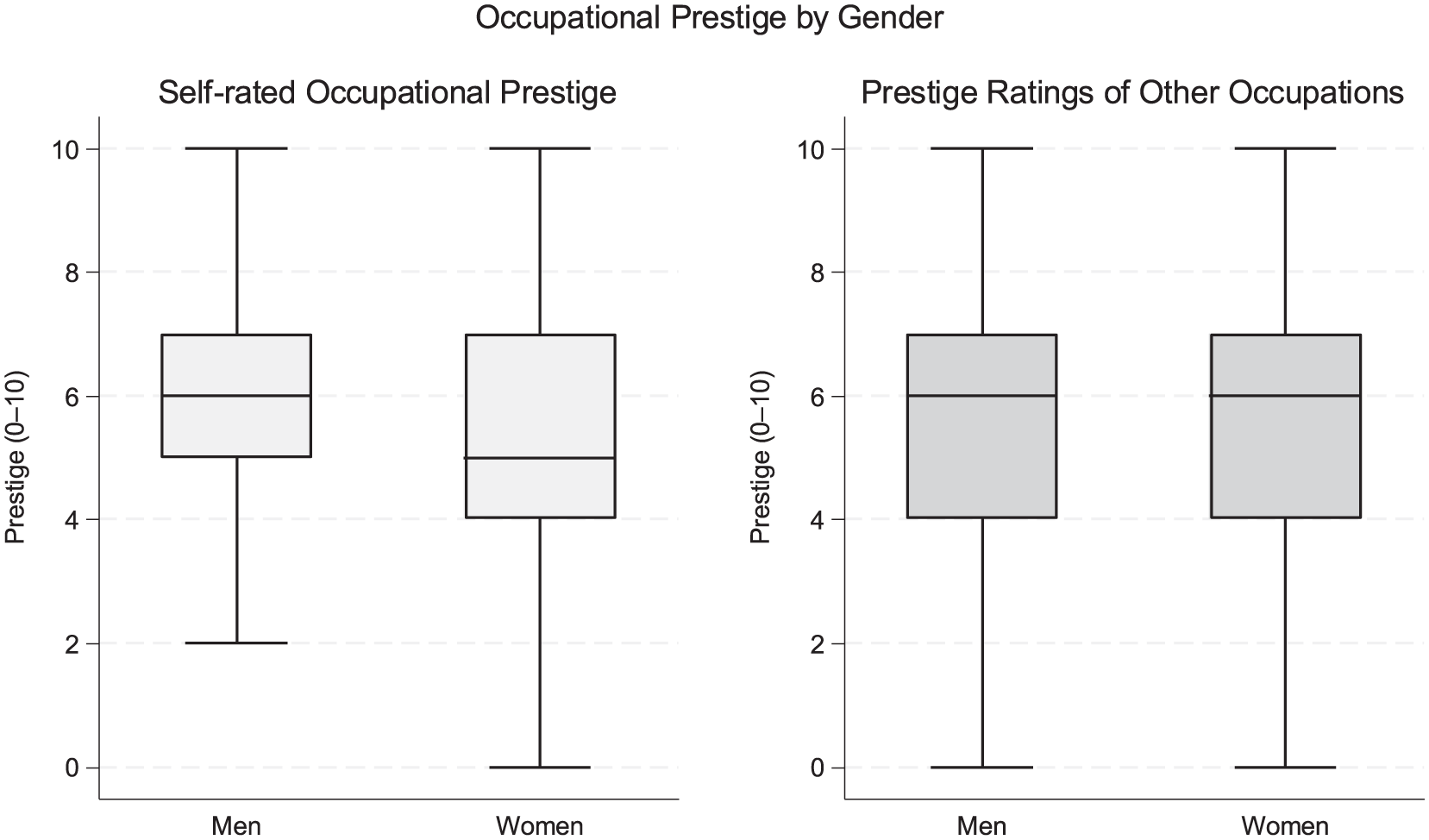
Distribution of self-rated and average occupational prestige scores by gender.
Women tend to use the lower end of the self-rated prestige scale more frequently than men, resulting in a lower average for women. Overall dispersion is comparable by gender (Brown-Forsythe p = .73), indicating a location shift with a modestly heavier lower tail rather than broader variance. The ratings of other occupations exhibit nearly identical means with only a minor difference in dispersion (Brown-Forsythe p = .019; see Table A2.3). The distributional shape, including means and tails, rather than variance alone, aligns with research that considers rater variance and local disagreements as substantively informative (Valentino 2022). This finding is consistent with research indicating that consensus and variation in occupational prestige schemas differ on the basis of rater position and among social groups (Lynn and Ellerbach 2017; Lynn, Shi, and Kiley 2025). The observed pattern aligns more closely with a status-lens account than with a global female response style.
Lastly, summary statistics indicate that men and women are more aligned in prestige estimations for occupations at the high end of the scale, as shown by similar upper percentiles in their ratings. This suggests convergence in perceptions of highly prestigious roles, even as gendered differences exist in overall ratings.
Multivariate Results
The following section examines the factors contributing to gender differences in occupational prestige, addressing hypotheses 1 through 7. Results are presented separately for self-rated occupational prestige and the PDS.
I begin by presenting the Oaxaca-Blinder decomposition results. The explained component of the decomposition corresponds with the mediation hypotheses; however, I also present unexplained components to account for potential differences in the interpretation of similar occupational characteristics by men and women. Figure 3 presents a summary of the contributions of significant variables to both the explained and unexplained components of gender gaps in absolute self-rated prestige and the PDS. For full decomposition results and significance levels, see Table A3. The results show that male respondents rated their jobs higher than female respondents, revealing a statistically significant gender gap of 0.21 points (hypothesis 1). The gender gap, although seemingly minor on a 0–10 scale, is significant given that the majority of respondents rated their occupation between 4 and 8, with a standard deviation of 1.94. The observed gender gap within this range is approximately 5 percent of the effective scale and 0.11 standard deviations. The observed difference is thus interpreted as modest yet systematic. Minor yet persistent gendered assessments correspond with theories of gender status beliefs and may perpetuate symbolic hierarchies over time (Correll 2001; Ridgeway and Correll 2004b). The unexplained component is insignificant; therefore, all differences can be ascribed to observable job or individual characteristics of men and women, with no systematic gender differences identified in the valuation of prestige.

Decomposition contributions.
Occupational gender composition does not significantly influence the explained gender gap. This indicates that either there is no mediating effect or its influence is absorbed by correlated job-level characteristics (e.g., wages, education, autonomy) in the decomposition. However, the significant negative unexplained component suggests that women rate female-dominated occupations less favorably than men with comparable characteristics.
The work characteristics indicate that the explained component is influenced by men’s increased access to positions with higher autonomy and career advancement opportunities, both of which significantly contribute to the gender gap in absolute self-rated occupational prestige. Although individual wage (hypothesis 4) contributes as expected, its effect on the gender gap is not statistically significant. Regarding individual dispositions, career orientation is not significant either; however, women’s higher average agreeableness, contrary to expectations, actually diminishes the gender gap. Interestingly, occupational median wage was the most significant predictor of the explained gender gap in absolute prestige, even though it was included as a control variable.
In contrast, the PDS is not explained by observed characteristics. Although variables such as agreeableness, career orientation, career advancement, and personal wages affect the PDS, they fail to account for the gender gap, as evidenced by the statistical significance of only the unexplained component. Men and women seem to interpret similar job characteristics through different lenses. Autonomy is the only statistically significant indicator, however. These findings point to a clear distinction: the PDS captures gendered differences in how people evaluate their occupational standing in relation to the social hierarchy, whereas absolute prestige reflects structural positioning within that hierarchy. Although the Oaxaca decomposition identifies the general sources of the gender gap, it does not account for variation within occupations or allow for nonlinear relationships between occupational context and prestige perceptions. To examine these dynamics more closely, I estimated multilevel models.
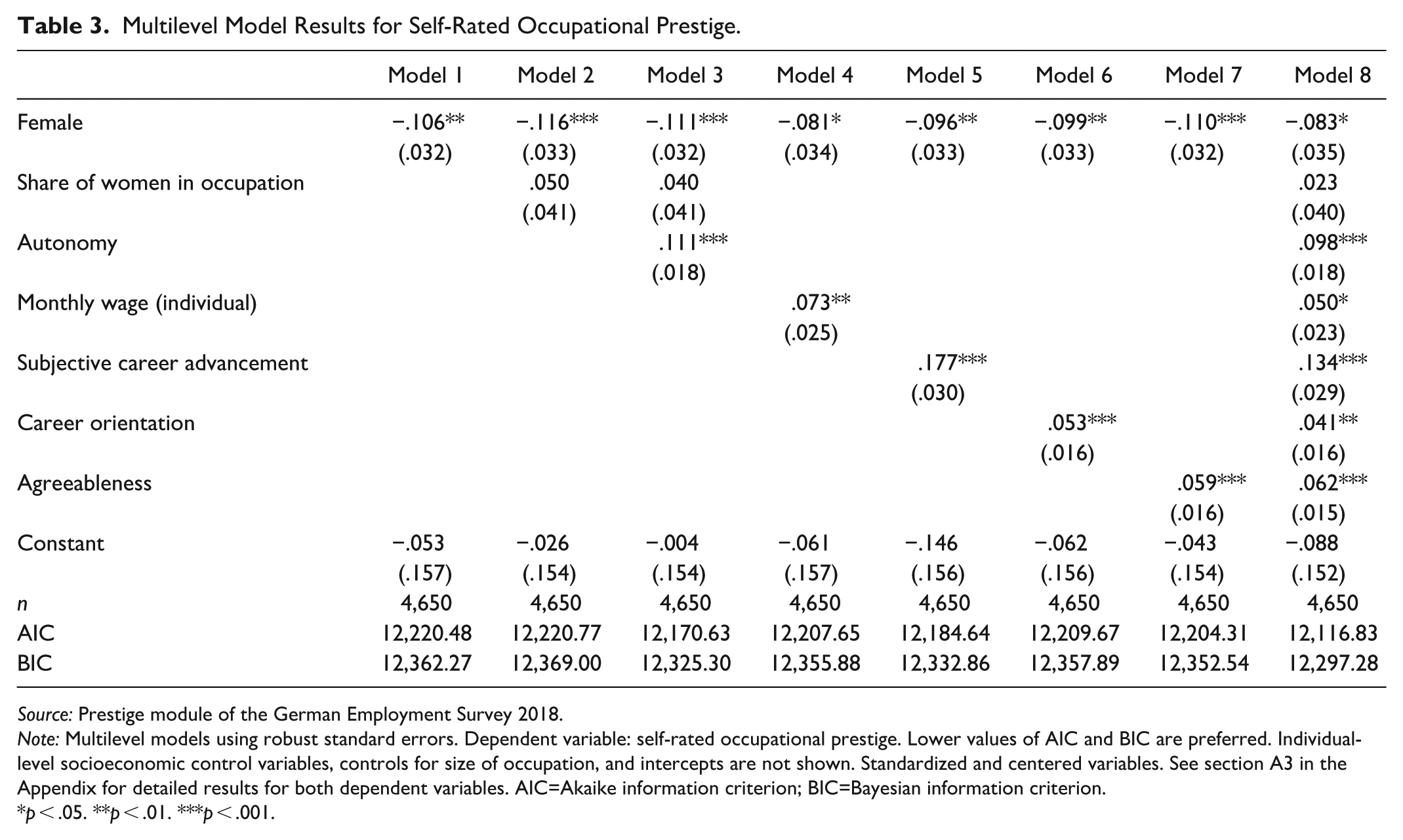
Table 3 presents nested multilevel models that examine the factors influencing self-rated occupational prestige (see Appendix section A4 for full results). The findings validate the prestige gender gap revealed by the decomposition analysis. In all model specifications, the coefficient for women is consistently negative and statistically significant (p < .05), demonstrating a persistent gender gap in perceived occupational prestige, even when accounting for various individual and occupational characteristics. These findings support hypothesis 1, which posits that men assign higher ratings to their occupational prestige compared with women.
Multilevel Model Results for Self-Rated Occupational Prestige.
Source: Prestige module of the German Employment Survey 2018.
Note: Multilevel models using robust standard errors. Dependent variable: self-rated occupational prestige. Lower values of AIC and BIC are preferred. Individual-level socioeconomic control variables, controls for size of occupation, and intercepts are not shown. Standardized and centered variables. See section A3 in the Appendix for detailed results for both dependent variables. AIC=Akaike information criterion; BIC=Bayesian information criterion.
p < .05. **p < .01. ***p < .001.
The analysis indicates that the proportion of women in an occupation has a minimal impact (model 2), and its incorporation does not significantly change the gender coefficient. This suggests that the gender composition of occupations alone does not explain the observed gender gap in prestige ratings. Looking at work characteristics, autonomy is a robust predictor (models 3 and 8) and higher levels of autonomy are associated with significantly higher prestige self-ratings. Subjective career advancement exhibits a strong positive correlation (models 5 and 8), indicating that experienced upward mobility enhances prestige self-ratings. The findings align with the decomposition results and validate hypotheses 3 and 5. Hypothesis 4, which posited a correlation between higher individual wages and increased prestige, could not be substantiated. Among the two individual dispositions analyzed, career orientation and agreeableness, only agreeableness demonstrated statistical significance. Furthermore, in alignment with the decomposition results, a positive correlation with self-rated prestige is observed (models 7 and 8), which contradicts hypothesis 7.
Figure 4 presents the estimated gender coefficients from models 1 to 8 for both overall self-rated prestige and the PDS. The figure illustrates the variation in the gender gap as additional variables are sequentially incorporated. The patterns for both indicators appear nearly identical, indicating that the gender gap remains consistent across the two conceptualizations of occupational prestige. Adding wages (hypothesis 4) reduces the magnitude of the female coefficient by 27 percent (from model 3 to model 4); further adjustments yield little additional change, and the full specification still shows a negative, statistically significant gap.

Coefficient plots for gender (female) for self-rated occupational prestige and the prestige deviation score.
The analysis of occupation-level variables showed that the share of women in an occupation is not significant as a linear predictor of self-rated prestige. Recent research (García-Mainar et al. 2025; Krueger et al. Krueger et al. 2022; Valentino 2020) suggests a nonlinear relationship between gender composition and occupational prestige. Therefore, I conducted a multilevel analysis incorporating a squared term for the percentage of women. This exercise demonstrates a significant U-shaped relationship (p < 0.01). Figure 5 illustrates the nonlinear distribution for both men and women across the two dependent variables. The figure demonstrates a U-shaped link between the share of women in an occupation and self-rated occupational prestige, particularly evident among men. Men consistently perceive their occupations as more prestigious; however, both genders exhibit nonlinear responses to the occupational gender composition. Mixed-gender jobs have lower prestige than male- and female-dominated ones. Women exhibit a flatter and more linear curve, indicating a less favorable perception of male-dominated occupations compared with female-dominated ones. In the PDS, this effect is absent, as both genders exhibit a symmetric reversed U-shaped pattern. When considering societal prestige, both men and women align more closely with societal consensus in mixed-gender occupations and tend to underestimate prestige in gender-segregated roles.
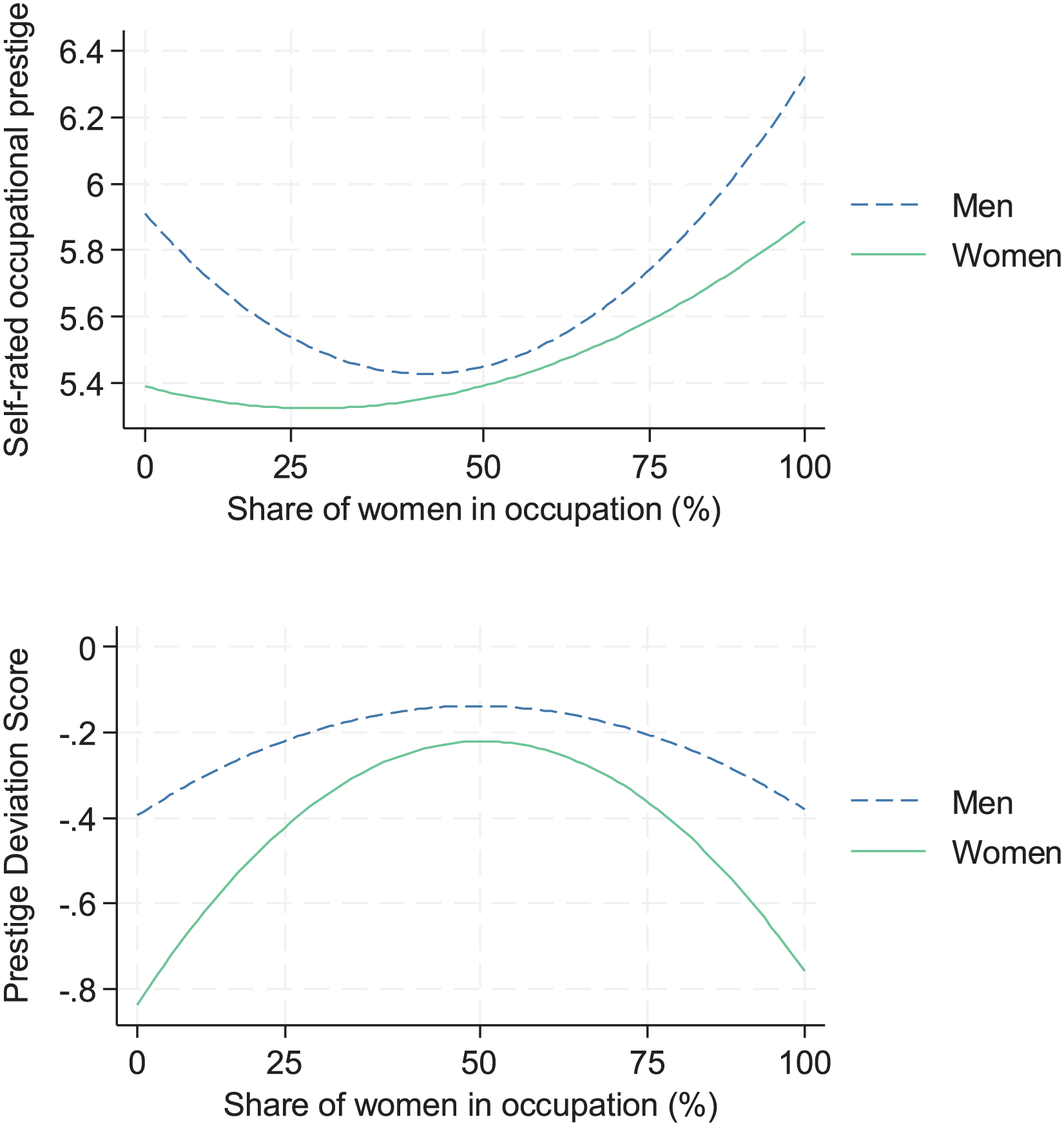
Predicted values of self-rated occupational prestige and prestige deviation score by occupational gender composition and gender.
Overall, the results show a modest but robust gender difference, thereby corroborating hypothesis 1. They do not support hypothesis 2, which posited that male-dominated occupations would be linked to higher self-rated occupational prestige compared with female-dominated ones. Even though the Oaxaca-Blinder decomposition shows a negative unexplained effect for the share of women, the introduction of the quadratic term uncovers a gendered and nonlinear pattern, where both male- and female-dominated occupations receive higher prestige from jobholders after controlling for other occupational and individual characteristics. The relationship between gender composition and prestige perceptions appears to be more nuanced. Regarding the other hypotheses, wage differences account for a meaningful share of the absolute gap (hypothesis 4), supporting a partial mediation as hypothesized, even though the wage coefficient itself is not significant. In the decomposition, the largest contribution comes from occupation-level wages, not individual pay. Autonomy (hypothesis 3) and subjective career advancement (hypothesis 5) are associated with higher prestige self-ratings and contribute to narrowing the absolute gap, but a statistically significant residual remains. Career orientation (hypothesis 6) shows no meaningful association and does not account for the gap. Agreeableness (hypothesis 7) relates positively to higher prestige self-ratings but does not explain much of the gap.
Discussion and Conclusion
The aim of this study was to answer two research questions: first, whether men and women differ in how they estimate the prestige of their own occupation and, second, whether any observed gender gap could be explained by occupational gender composition, work characteristics, and individual dispositions. This analysis presents initial systematic evidence on gender differences in self-rated occupational prestige. I used two operationalizations of self-perceived prestige: absolute self-rated occupational prestige scores and the PDS as a relative measure.
Concerning the first research question, the findings confirm a modest but robust gender gap of 0.21 points in prestige self-ratings. The analysis of the PDS makes the difference more apparent. Overall, jobholders’ self-ratings are close to the mean prestige of their occupations. Irrespective of gender, this finding supports the reliability and validity of occupational prestige scales and highlights the influence of societal status hierarchies that individuals tend to internalize and agree with, consistent with Treiman’s observation of a stable prestige hierarchy. Both men and women generally assess their occupations as slightly below the societal average; however, women’s ratings exhibit a greater deviation. This systematic downward adjustment suggests that gender differences become more visible when self-perceptions are considered relative to occupational benchmarks. Correll (2001) demonstrated that even small gender differences in self-evaluations can lead to significant consequences in career decisions. Similarly, modest gendered differences in prestige self-ratings may similarly contribute to the reproduction of occupational inequality over time.
Answering the second research question is less straightforward. Although the variables included in the model do not fully account for the gender effect (as shown in Figure 4), they nonetheless make noteworthy contributions. Clear differences are observed between the absolute and relative prestige measures. The former is primarily influenced by structural factors, whereas the latter (PDS) is more affected by internalized expectations, beliefs, and individual characteristics.
The gender composition of occupations shows no significant linear correlation with self-rated prestige; instead, it demonstrates a nonlinear U-shaped effect. The prestige associated with occupations is lowest in gender-neutral fields and highest in those dominated by either men or women, with this trend being particularly evident for women. The U-shaped pattern aligns with recent research (García-Mainar et al. 2025; Krueger et al. 2022; Valentino 2020) regarding societal prestige, extending the result to self-evaluations. The PDS indicates that both men and women demonstrate a higher alignment with societal consensus in mixed-gender occupations and tend to underestimate the prestige linked to gender-segregated roles.
At first glance, these results appear paradoxical: self-rated prestige is lowest in mixed-gender occupations, while congruence with societal prestige is most pronounced in that context. I interpret this as evidence that although gender-segregated occupations are associated with clearer cultural signals about prestige, these signals are also filtered through gendered status beliefs, leading women (and to some extent men) to underestimate prestige more strongly. Mixed-gender occupations are likely to involve fewer gendered signals and greater diversity in peer comparisons, resulting in lower prestige levels but more precise alignment with societal evaluations. However, the observed pattern may also indicate correlated occupational characteristics, including the perceived social impact of professions (Freeland and Hoey 2018; MacKinnon and Langford 1994) or associated positive emotions (Freeland 2025).
The present findings indicate that wages are the primary channel through which gender differences translate into absolute self-rated occupational prestige. Although not statistically significant by itself, the introduction of wages results in the highest attenuation of the female coefficient, which is consistent with partial mediation. Autonomy and subjective career advancement are positively associated with prestige and further narrow the gap, but their explanatory contribution is smaller; as is the impact of agreeableness. Crucially, the fully corrected models still show a residual gender difference, and the PDS’s continued disparity highlights an interpretive element that goes beyond observed structural characteristics.
Taken together, the analysis underscores the structural grounding of self-rated occupational prestige. Wages matter both at the individual and occupational levels for how respondents assess their prestige. These results also clarify the gender pattern: because men are more often located in higher-paying jobs and earn more within them, the gender wage gap aligns with a higher perceived prestige among men. Additionally, decomposition analyses indicate that men and women do not differ significantly in the valuation of wages when it comes to prestige. This shows that structural inequalities in occupational sorting and earning potential, not gendered evaluation criteria, explain the observed disparities.
The PDS reveals that the gender gap continues after controlling for observed characteristics, suggesting gendered patterns in self-evaluation. Although wages, autonomy, and career orientation influence the PDS, they do not explain the gap itself. Autonomy is the only factor that shows a significant gender difference, indicating that men and women interpret workplace autonomy and its impact on prestige differently. Overall, absolute prestige ratings indicate structural job attributes, while the PDS reflects gendered interpretations of occupational status in relation to societal benchmarks. This dual perspective indicates that occupational sorting accounts for a significant portion of the gender difference; however, nuanced meaning-making processes related to status beliefs continue to exist even within the same occupations. Because occupation-level wage structures are influenced by gendered cultural feelings, occupational inequality research implies that economic status is not solely structural (Freeland and Harnois 2020). Dignity at work literature views workplace standing as acknowledgment and respect, emphasizing cultural-relational characteristics that cannot be measured by job metrics (Hodson 2009; Roscigno, Yavorsky, and Quadlin 2021). These viewpoints suggest using residual gender variations in PDS as indications of gendered recognition and interpretation.
This study has several limitations. The cross-sectional design limits the ability to draw causal inferences regarding the relationships between gender, occupations, and prestige self-assessments. Mediation language should therefore be read as consistent with rather than probative of causal pathways. Second, the analysis of gender minorities within occupations was limited by small case numbers. Future work should oversample or pool waves to examine minority-status effects on perceived prestige. Qualitative and longitudinal designs, linking careers, earnings trajectories, and meaning-making, would be especially valuable for unpacking the observed U-shape by gender composition and for adjudicating between structural and interpretive mechanisms. As Kleinert et al. (2023) noted, gendered labor market outcomes may stem from occupational attributes correlated with sex composition rather than the composition itself, highlighting a need for future research to clarify this distinction.
A vital field for future research pertains to the informational foundations of prestige judgments. Previous research indicates that individuals’ perceptions of gendered pay are significantly influenced by their own professional experiences (Auspurg, Hinz and Sauer 2017). Men and women may differ in structural positions and in their knowledge or perceptions about gender composition, wage levels, and promotion chances in their occupation, which may affect self-placement and the PDS. Direct measurement of respondents’ knowledge or beliefs regarding occupational pay or segregation was not feasible, thus, residual gender differences may partially indicate heterogeneity in perception or knowledge. Designs that assess or experimentally alter perceived pay, gender composition, and status signals for specific occupations such as information treatments or vignettes could clarify how information and experience influence or mitigate gender disparities in prestige evaluations.
Taken together, these findings show the necessity of analyzing both structural inequalities in occupational sorting and the interpretive processes by which men and women perceive occupational prestige. Expanding this research beyond Germany, especially to more liberal or occupationally fluid labor markets such as the United States, could uncover whether analogous mechanisms function under varying institutional and cultural contexts.
Supplemental Material
sj-docx-1-srd-10.1177_23780231251412640 – Supplemental material for Who Feels Prestigious? Gender Differences in Self-Rated Occupational Prestige
Supplemental material, sj-docx-1-srd-10.1177_23780231251412640 for Who Feels Prestigious? Gender Differences in Self-Rated Occupational Prestige by Sabine Krueger in Socius
Footnotes
Acknowledgements
I would like to thank Kathrin Leuze, Christian Ebner, and Daniela Rohrbach-Schmidt for their helpful comments on earlier versions of this article. I would also like to thank the participants at the 16th European Sociological Association Conference (Porto, Portugal, 2024) and the participants at the Bundesinstitut für Berufsbildung and University of Jena colloquia for helpful comments received. Portions of the manuscript text were refined for clarity using QuillBot (paraphrasing and grammar checks). The author verified all outputs and accepts full responsibility for the content.
Supplemental Material
Supplemental material for this article is available online.
1
For Germany, the SIOPS has not been updated through new surveys but has instead been recoded to match more recent occupational classifications (e.g., International Standard Classification of Occupations 2008, Klassifikation der Berufe 2010). As a result, the German SIOPS scores still rest primarily on the survey data from the 1950s through the 1970s on which Treiman originally based his scale. As  demonstrated in a recent study in Spain (1991–2013), the social valuation of occupations is not fixed but can change over time, underscoring the need for regularly updated prestige measures.
2
3
Data and documentation for the Employment Survey 2018 are available at https://metadaten.bibb.de/en/dataset/detail/123. Documentation for the occupational prestige scale is available at https://metadaten.bibb.de/de/dataset/detail/165. Note that not all occupational evaluation modules from the survey have been publicly released by the data providers to date, including the self-evaluation measures used in this study. The STATA do-files used in this study can be found at .
4
This wording intentionally targets external ascription rather than private utility, consistent with the sociological understanding of occupational prestige as reputational standing assigned by others (Hughes et al. 2024; ). Thus, the measure taps perceived societal ranking, not individual job satisfaction or intrinsic valuation. The German original wording was “Wie hoch ist Ihrer Meinung nach heute das ANSEHEN Ihres Berufs in Deutschland? Bitte denken Sie an den Beruf, den Sie im letzten Interview als Haupttätigkeit angegeben haben. Geben Sie bitte einen Wert von 0 bis 10 an. 0 bedeutet, dass Ihr Beruf in Deutschland ein ‘sehr geringes Ansehen’ hat und 10 ein ‘sehr hohes Ansehen.’”
Author Biography
References
Supplementary Material
Please find the following supplemental material available below.
For Open Access articles published under a Creative Commons License, all supplemental material carries the same license as the article it is associated with.
For non-Open Access articles published, all supplemental material carries a non-exclusive license, and permission requests for re-use of supplemental material or any part of supplemental material shall be sent directly to the copyright owner as specified in the copyright notice associated with the article.
