



Abstract
The aim of the article was to determine whether immigrant women's occupational status reflect a double disadvantage in comparison to immigrant men and inborn women and how patterns are formed by occupational segregation. The study utilised register data for descriptive comparisons of the immigrant and inborn populations in Sweden (n ≈ 4,900,000). Regression analyses were performed on nationally representative surveys of the immigrant (n ≈ 2600) and total (n ≈ 3200) labour force. The results do not support the notion of a double disadvantage. In the immigrant population, only women with primary/secondary education have jobs with lower average prestige than men, reflecting the fact that women are clustered in female-dominated occupations. Among immigrants with higher education, the gender gap is reversed, and men's disadvantage is explained by ethnic segregation. Compared to Swedish-born individuals, prestige gaps are substantially larger for men. After accounting for segregation, the gap is closed among women but not among men.
Introduction
A widespread notion in debates on migration and integration is that immigrant women face a double disadvantage, based on both gender and ethnicity. To date, however, this proposition has been little explored in studies of immigrants’ occupational attainment. In the article, survey and register data are used to examine the occupational attainment of immigrant women in Sweden in comparison to both immigrant men and inborn women. The main focus is on the role of occupational segregation by gender and ethnicity.
With growing numbers of immigrants, societal inequalities have become more complex, and scholars increasingly discuss the interplay between different social statuses. A common reference for such intersectional analyses is the double disadvantage or double jeopardy approach. This hypothesis – originally developed to capture the discrimination of African-American women in the United States – argues that people who belong to multiple subordinate groups encounter more prejudice and oppression than those with only one single subordinate-group identity. Thus, disadvantages accumulate with each of a person's subordinate-group identities (for an overview and criticism see Purdie-Vaughns and Eibach, 2008). More recently, concerns of a double disadvantage have been raised in debates on immigrants’ labour market integration in Europe. It is well documented that both women and immigrants face penalties in the labour market and central statistics suggest that immigrant women are especially disadvantaged. On average, immigrants in Europe are 10 percentage points less likely to be employed than inborn individuals, and the gap is particularly evident for immigrants from countries outside the EU. Immigrant and inborn women have lower employment probabilities than men and the difference between immigrants and the inborn population is larger among women than among men (Frattini and Solmone, 2022). Once employed, immigrant women are disproportionally clustered in low-pay and low-skill jobs. On average, almost one-fourth of the immigrant women in Europe work in elementary occupations, compared to 14% of the immigrant men and 8% of the inborn women (Frattini and Solmone, 2022).
Meanwhile, however, there is limited research on the determinants of immigrant women's double disadvantage. In a review of quantitative European research of immigrant women's labour market integration published between 2000 and 2020 (Schiekoff and Sprengholt, 2021) note that the literature has covered topics ranging from labour force participation, employment, and unemployment to central measures of labour market success (particularly wages). However, most studies have focused on the migrant gap, i.e., the difference in outcomes between immigrants and the inborn population (also referred to as an ethnic penalty), while relatively few have explored gender gaps among immigrants and even fewer have considered gender and migrant gaps in conjunction.
The present article adds to the literature by exploring immigrants’ occupational attainment, with a view to both gender and migrant gaps. The aim of the study is, first, to determine whether immigrant women fare worse than immigrant men and Swedish-born women in their occupational attainment, as proxied by occupational prestige (Standard International Occupational Prestige scale (SIOPS)). Second, we explore whether and how occupational segregation and education provide mechanisms that strengthen and/or counteract such disparities.
In the next section, we present an overview of the literature and highlight the gaps that will be addressed in the study.
Previous research and contribution
Previous research on the occupational attainment of immigrants has focused on comparisons to the inborn population and on immigrants’ trajectories over time. The field has been dominated by the assimilation model developed by Barry R Chiswick (see Chiswick et al., 2005). According to this model, immigrants are likely to start out in low-skilled jobs regardless of their educational level and the occupational position they held in their country of origin, but over time, they will invest in host-country specific skills that allow for upward occupational mobility. The prediction of a u-curve with initial downgrading and subsequent recovery has been confirmed in many studies of immigrants’ occupational trajectories (for an overview, see Duleep (2015)). However, these studies also typically point to an ethnic penalty, i.e., a remaining gap in occupational attainment vis-à-vis the inborn population.
Gender differences in immigrants’ trajectories have been addressed mainly by the family investment hypothesis, in which women are conceived as secondary earners and ‘tied movers’ whose labour market decisions are guided by the overall family utility. According to this logic, immigrant wives are presumed to take low-skilled jobs to support the family while their husbands invest in country-specific human capital. Thus, while men will re-establish their careers, women will remain in low-skilled jobs (or leave the labour market altogether). The family investment hypothesis received some support in early studies, but more recent research finds that married women – immigrant as well as inborn – make labour supply decisions guided by their own opportunities in the labour market rather than conditional on the needs of their spouses (e.g., Adserà and Ferrer, 2016; Basilio et al., 2009; Blau et al., 2003; Duleep and Dowhan, 2002; for an overview see Duleep, 2015). Notably, however, these studies – mainly from North America – have compared the earnings profiles of immigrant wives and husbands to those of inborn wives and husbands. Thus, neither migrant nor gender gaps in occupational attainment have been addressed in this literature. In Europe, some studies have explored migrant gaps in occupational attainment, usually finding that immigrants fare worse than inborn individuals (e.g., Fleischmann and Höhne, 2013; Gorodzeisky and Semyonov, 2017). However, gender differences in ethnic penalties have been little explored. An exception is Fleischmann and Höhne (2013), who find that migrant gaps in occupational attainment are equally large for male and female immigrants in Germany. Furthermore, very few studies has explored gender gaps in the immigrant population (Schiekoff and Sprengholt, 2021; but see Ala-Mantila and Fleischman, 2018; Fleischmann and Höhne, 2013). In sum, then, there is a conspicuous lack of studies examining gender patterns in immigrants’ occupational attainment.
Occupational attainment will be measured here with the Standard International Occupational Prestige scale, SIOPS (Treiman, 1977). Prestige is a measures of occupations social standing based on their general desirability (Goldthorpe and Hope, 1974) and a significant indicator of stratification in society. The SIOPS scale was generated from the rankings of occupations by survey respondents from 60 countries including Sweden. Since then, research has repeatedly shown that the hierarchy is stable both across contexts and over time (for a more recent study from Sweden, see Svensson and Ulfsdotter Eriksson, 2009). Prestige can be seen as a metric of the structural order of occupations according to their amount of power and control over valued resources and rewards in society. Highly prestigious occupations are commonly those with high skill requirements and authority (Treiman, 1977) and prestige is highly correlated with both education and earnings (Wegener, 1992). However, Härkönen et al. (2016) have argued that prestige indicates women's occupational attainment more precisely than socioeconomic indexes since women have higher education but lower wages than men. In sum, then, occupational prestige provides an encompassing indicator suitable for exploring the double disadvantage of immigrant women.
To investigate the emergence of a double disadvantage, we need to consider which mechanisms could contribute to inequality in two dimensions. Here, we will examine the interplay between education and occupational segregation.
Education is a main predictor of labour market success, yet presumably insufficient for explaining gender and migrant gaps in occupational attainment. Over the past decades, women in Europe and the OECD have invested heavily in higher education and while this has improved their position in many ways, they lag behind men in labour market rewards. Similarly, education is a crucial factor for immigrants’ labour market integration. At the same time, a range of studies show that it is insufficient for closing migrant gaps in occupational attainment and wages (e.g., le Grand and Szulkin, 2002; Pichler, 2011). 1 To further our knowledge on immigrant women's situation relative to other groups, we will move beyond the issue of individual human capital to consider also occupational segregation.
Occupational gender segregation has long been discussed as a mechanism for labour market gender inequality. Although the average level has decreased in the 2000s, occupational gender segregation in Europe remains substantial (Almstedt Valldor and Halldén, 2023) and a number of studies show that part of the gender wage gap can be attributed to segregation, as employees with equal qualifications receive lower wages in female-dominated occupations than in occupations dominated by men (e.g., Blau and Kahn, 2017; for Sweden see Hansen and Wahlberg, 2008; Medlingsinstitutet, 2022). In comparison, the relationship between occupational gender segregation and prestige has received scant attention and results are less clear-cut. In fact, the measure was largely abandoned since the earlier literature often failed to find a significant correlation between the share of females in an occupation and occupational prestige scores (e.g., England, 1979). More recently, however, there has been a revival of interest in occupational prestige (e.g., García-Mainar et al., 2018; Grönlund and Magnusson, 2013; Magnusson, 2009). These studies suggest that the lack of correlation was partly due to a misspecification as the relationship between segregation and prestige was found to be non-linear. For Sweden, Magnusson has shown that gender-mixed occupations (with 40–60% females) have considerably higher prestige scores than both male- and female-dominated occupations. Nevertheless, the lowest level of prestige is found in the female-dominated occupations (cf. Grönlund and Magnusson, 2013; and, for Spain, García-Mainar et al., 2018).
However, occupational segregation also has an ethnic dimension. Research shows that the average immigrant is employed at a workplace where foreign-born individuals are strongly overrepresented and ethnic segregation is negatively correlated with both employment and wages (e.g., Elliot and Lindley, 2008; for Sweden see Åslund and Nordström Skans, 2010). Presumably, accounting for both gender and ethnic segregation is important for understanding the gender and migrant gaps in occupational prestige. For example, it can be noted that, in Europe, the level of gender segregation is particularly high in low-skilled occupations (Almstedt Valldor and Halldén, 2023), in which immigrants tend to be overrepresented. Generally, however, the literature on immigrants’ labour market outcomes has not considered gender segregation while that on ethnic segregation has lacked a gender perspective.
In sum, then, virtually no research has explored gender gaps in immigrants’ occupational attainment. Further, the importance of gender segregation has been little considered in the literature and to our knowledge the interplay between gender and ethnic segregation has not been analysed. The present study will address both these dimensions.
Clearly, however, the challenges of being an immigrant woman could vary depending on the barriers and opportunities provided in the new country. We focus on the case of Sweden and below we describe the relevance of this context and specify our arguments regarding the double disadvantage.
The Swedish case and the double disadvantage
The Nordic context – and specifically Sweden – provides an interesting case for exploring the notion of immigrant women's double disadvantage. The Nordic dual-earner model, based on an encompassing welfare state and extensive family policies, has incorporated women and mothers into the labour market at internationally high rates (e.g., Korpi et al., 2013). As a result, the countries have been perceived as international champions of gender equality. In terms of migration, however, the Nordic countries display crucial differences. Since 1990, two-thirds of the population increase in the Nordic countries has been generated by migration and Sweden has received the largest number of immigrants both in absolute numbers and on a per capita basis (Calmfors and Gassen, 2019). Currently, the share of foreign-born residents in Sweden is not only larger than in other Nordic countries but among the largest in Europe. In comparison, the share of immigrants in Denmark and, particularly, Finland is low while Norway takes a middle position (Frattini and Solmone, 2022). Also, migration policies differ substantially between countries, even within the Nordics. In 2020, Sweden and Finland 2 were among the top countries of the Migrant Integration Policy Index regarding, e.g., labour market mobility, anti-discrimination measures and educational policies (MIPEX, 2020). In all cases, Denmark and Iceland scored substantially lower while Norway took a middle position.
In sum, Sweden stands out as a country with a substantial immigrant population and extensive policy support in areas relevant to immigrants’ labour market attainment, as well as to gender equality. Presumably, then, Swedish institutions could provide immigrant women with opportunities that mitigate the emergence of a double disadvantage. At the same time, certain characteristics of the Swedish labour market (e.g., the high skill requirements) could pose barriers to integration. In Sweden, employment gaps between the foreign-born and the native-born population are large by international comparison, particularly among women (Frattini and Solmone, 2022; OECD, 2016). Notably, however, these gaps largely reflect the high employment rates of inborn women. In absolute terms, the employment rates of immigrant women in Sweden are above the OECD average (OECD, 2016) and thus, it is a relevant context for a study of immigrant women the labour market.
As discussed, gender inequalities in the working population have often been attributed to occupational segregation (and the underlying causes of such segregation). In the ‘welfare state paradox’-literature this mechanism has been put forward to explain the rather puzzling inequalities in the Nordics, the main claim being that policies that bring women into the labour market at a large scale also relegate them to family-friendly occupations with limited career prospects (e.g., Mandel and Semyonov, 2005). However, gender segregation has decreased over time though at a different pace in different countries and currently, the level of occupational gender segregation in Sweden is no higher than the European average (Ellingsæter, 2013). Further, it should be noted that country-level measures of segregation may conceal complex changes at the occupational level. Several occupations undergo rapid changes in their gender mix and it is primarily in prestigious occupations requiring higher education that women have gained ground (e.g., England, 2010; for Sweden see Ulfsdotter Eriksson et al., 2022). Thus, a main reason why gender-mixed occupations display the highest level of average prestige is that in Sweden highly educated women have increasingly entered previously male-dominated occupations such as lawyer and medical doctor. Meanwhile, the strong gender segregation in occupations with lower prestige has endured (Ulfsdotter Eriksson et al., 2022) and, as mentioned, the lowest average prestige scores are found in female-dominated occupations.
In the analysis below we set out to explore the mechanisms that may hamper the occupational attainment of immigrant women in the Swedish context – as well as factors that could mitigate their double disadvantage. Our main proposition is that occupational gender segregation will hold immigrant women back, as they are likely to be particularly concentrated in female-dominated occupations. In central labour market theories, occupational gender segregation has been attributed to women's larger family responsibilities. The underlying assumption is that care-related work interruptions (e.g., parental leaves and part-time work) are more difficult in certain occupations than in others (Polavieja, 2008) and the Nordic context is regarded as particularly problematic since family policies allegedly have institutionalised female work interruptions (Estévez-Abe, 2005; Mandel and Semyonov, 2005). In Sweden, gender gaps in wages and careers – including occupational prestige – are still accentuated following parenthood (Blau and Kahn, 2017; Bygren and Gähler, 2012; Härkönen et al., 2016). At the same time, the division of unpaid work in Sweden is more equal than in many other countries. Thus, many immigrants arrive from comparatively more gender-traditional countries and a large literature has established that gender norms from the country of origin affect women's labour market outcomes in the new country (for Sweden, see Grönlund and Fairbrother (2022)). Based on this reasoning, we expect that immigrant women would be more stronger clustering in ‘family-friendly’ female-dominated occupations. Presumably, then, occupation gender segregation would depress the average prestige of immigrant women compared to both immigrant men and born women.
Importantly, however, education could moderate such outcomes and counteract the double disadvantage – at least for immigrant women with higher education. Sweden is a high-skill labour market where most jobs require at least secondary education (OECD, 2016) and arguably, immigrants lacking these credentials could be confined to low-skilled occupational ‘ghettos’ with limited possibilities for upward mobility. At the same time, education is comparatively accessible in Sweden –- for example, university education is free of charge and Sweden outperforms other countries in supporting immigrants’ education (MIPEX, 2020). Arguably, access to education and validation of pre-migration credentials can provide a leverage for immigrant women, even those from countries that still favour the education of boys and men. Thus, we expect that tertiary education will mitigate the gap in occupational prestige, between immigrant women and men and in relation to inborn individuals. This equalising effect may run through occupational segregation, which is generally lower in high-skilled jobs. However, tertiary education can also allow immigrant women to reach more prestigious jobs within the female-dominated cluster of occupations.
Finally, also ethnic segregation must be considered. As discussed above, immigrants tend to be employed in jobs with a disproportionate share of foreign-born individuals and, to a large extent, such jobs are characterised by lower skill requirements and prestige. While such jobs can be a stepping-stone to more prestigious and well-paid work (cf. Chiswick et al., 2005), ethnic segregation could also hamper the acquisition of country-specific human capital such as language skills and social networks and complicate upward mobility (cf. Behtoui and Neergaard, 2010).
Arguably, ethnic segregation could cut through both female- and male-dominated sectors of the labour market but, to our knowledge, the interplay between ethnic and gender segregation has not been studied and it is not obvious that ethnic segregation would primarily disfavour immigrant women in Sweden. For example, a recent study from the Nordic context shows that of inborn women are leaving the most devalued types of care work and are replaced by immigrants – both women and men (Østbakken et al., 2023).
In sum, Sweden constitutes a relevant context for exploring mechanisms that may sustain and mitigate the double disadvantages placing immigrant women at the bottom of societal hierarchies.
Analytical steps and research questions
Based on the reasoning above, we proceed with the analysis in three steps using complementing data from population registers and nationally representative surveys.
The first step comprises descriptive analyses of register data for the immigrant and the inborn population. Here, we explore whether
occupational gender segregation is stronger in the immigrant population such that immigrant women are more strongly concentrated in female-dominated occupations (RQ 1a) gender differences in occupational prestige are larger in the immigrant population and if they vary between female-dominated, male-dominated and gender-mixed occupations (RQ 1b) average prestige scores are lower for immigrant women than for immigrant men and if the difference arises through occupational segregation by gender and/or ethnicity (RQ 2a) tertiary education moderates gender gaps in average prestige among immigrants and if such an interaction is explained by differences in occupational segregation (RQ 2b) the migrant gap is larger among women than among men and to what extent these gaps are formed by individual education and occupational segregation (RQ 3) the overall gender gap in prestige is larger in the immigrant population, amounting to a double disadvantage for immigrant women (RQ 3)
The second step utilises survey data for the immigrant population. This step involves regression analyses of individual-level correlations between gender, occupational segregation and prestige which will determine whether
In the third step, regressions are performed on pooled survey data that allow comparisons with Swedish-born individuals. Here, we investigate whether
Data and method
To study the hypothesis of a double disadvantage on the labour market for immigrant women, we use a combination of register data and cross-sectional survey data. The analysis includes three steps and builds on three different datasets. Step 1 is descriptive and shows the share of inborn and immigrant men and women in occupations with different gender composition as well as the average occupational prestige in these occupations. Register data from Statistics Sweden's database STATIV from 2010 is used. STATIV is a longitudinal database developed to provide a basis for studying the integration of immigrants in different areas of society. All individuals living in Sweden between 16 and 65 years of age who have an occupation are included in the analysis, resulting in a total number of 4 829 614 individuals (2 435 525 men, 2 394 089 women).
The individual-level regression analyses of occupational prestige (Step 2 and Step 3) are based on Swedish Level of Living surveys from 2010. Step 2 concerns gender gaps in occupational prestige in the immigrant population and utilises data from the Level of Living Survey for Foreign-born and their children (Migrant-LNU). Migrant-LNU contains detailed information about the respondents’ lives both before and after migration. The data was collected by Statistics Sweden in 2010–2012 through retrospective interviews. The sample was a representative random sample of the immigrant adult population 3 in Sweden (18–75 years old) who had lived at least five years in the country prior to data collection. To allow for comparisons between different regions of origin 4 and obtain representativeness of the whole population, the sample was stratified into seven regions and three age categories. Every stratum contained 350 individuals, totally 7 350 individuals. The response rate was 60.6%, of which 10.6% only responded to a shortened version of the questionnaire. We included all respondents who had information about occupation (SSYK-code, see below), which resulted in a final subsample of 2 660 individuals. In the analysis, we use post-stratification weights that account for the stratified sampling technique, as well as differing non-response rates across the 21 strata and key demographic variables (Karlsson and Tibajev, 2014).
In Step 3, migrant-LNU is complemented with data from the Swedish Level of living Survey (LNU) to study gaps in prestige between Swedish-born and foreign-born individuals. LNU is a national representative survey of the Swedish population between the ages of 18 and 75 that has been conducted regularly since 1968. For the analysis we used LNU 2010, which had a response rate of 61.7%. We extracted a subsample of Swedish-born individuals applying the same inclusion criteria as in Step 2 and merged the two data materials. The final dataset comprises 3 598 respondents.
Variables and analytical strategy
In all regression analyses, the dependent variable is occupational prestige, measured with the well-established SIOPS developed by Treiman (1977) (for further description, see the ‘Previous research and contribution’ section). The analyses will proceed as follows.
In Step 1, we start out by exploring whether occupational gender segregation is stronger among immigrants than in the Swedish-born population, and especially if immigrant women are more clustered in female-dominated occupations. Second, we compare gender differences in occupational prestige in the Swedish-born and immigrant population and compare gender patterns across occupational categories with different levels of segregation. Specifically, we measure mean levels of occupational prestige by occupational gender segregation category (male-dominated, female-dominated and gender-mixed, see definitions below).
In Step 2, ordinary least squares (OLS) regressions are used to analyse gender differences in occupational prestige among immigrants and to explore the extent to which such differences are explained by occupational gender segregation and ethnic segregation. The dependent variable is occupational prestige measured as SIOPS (see above) and calculated for each respondent on the basis of the standard for Swedish occupational classification (SSYK, the national adaption of ISCO). Occupational gender segregation measures the share of women in the occupation and is divided into three categories: female-dominated, male-dominated and gender-mixed based on information from STATIV 2010 (see above). Gender-mixed occupations are those comprising 40/60% of either gender. This the is definition used in, e.g., official Swedish statistics and has been applied in research to capture non-linear effects of segregation (e.g., García-Mainar et al., 2018; Grönlund and Magnusson, 2013; Magnusson, 2009).
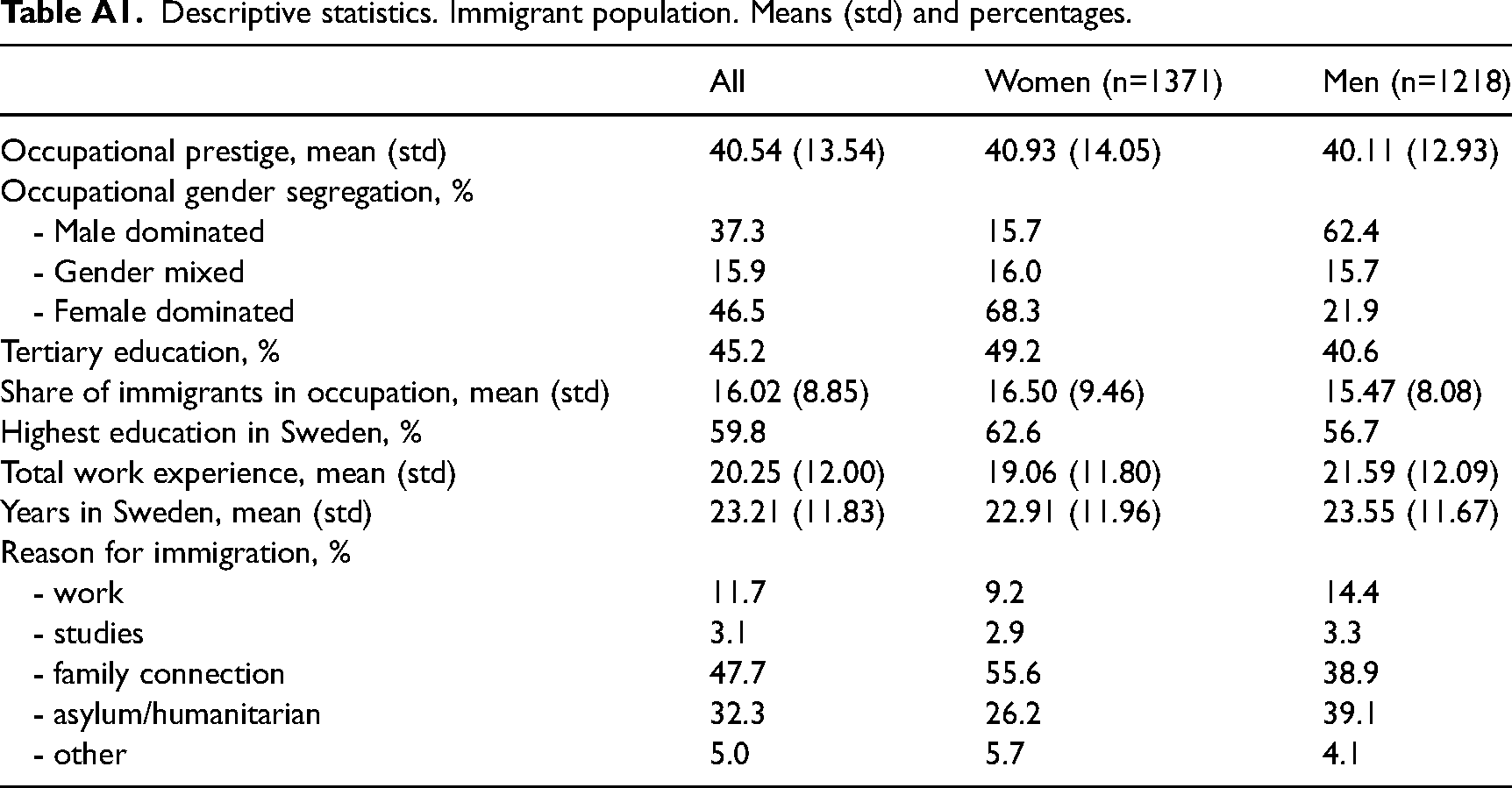
Occupational ethnic segregation is a continuous variable of the share of immigrants in the occupation, based on information from the STATIV register data of 2010. To determine whether education moderates the gender gaps in average prestige, we include an interaction term between education and occupational segregation. Education is a measure of the respondent's highest level of education, dichotomised into tertiary education and primary/secondary education. For individuals who only responded to the shortened version of the questionnaire information about their education comes from register data. To control for country-specific human capital, which is particularly important to immigrants’ labour market integration (Åslund and Rooth, 2007), we include three variables: years in Sweden, highest education completed in Sweden (rather than in any other country) and finally total work experience, including both experience in Sweden and years of work before immigrating. We also control for the reason for immigration (work, studies, family connection, asylum/humanitarian and other reason), another factor affecting immigrants’ occupational attainment (Chiswick et al., 2005). For descriptive statistics, see Appendix Table A1.
In step 3, we study migrant gaps, that is gaps in occupational prestige between immigrants and the Swedish-born population. We first conduct within-gender comparisons with separate OLS regression for women and men, then performed pooled regressions for all groups with Swedish-born men as the reference category. The analyses allow us to determine whether the ethnic penalty is larger among women than among men and to see how such gaps are formed by occupational segregation. Independent variables in this part of the analysis are the respondents’ immigration background (foreign-born, Swedish-born), education, occupational gender segregation, occupational ethnic segregation, work experience and years in Sweden.
Results
Below, we present the results from the three steps of the study: first, the descriptive overview of the immigrant and the Swedish-born population; second, the regression analyses of gender and gender-education gaps in the immigrant population and, third, the comparison of these gaps to those in the Swedish-born population.
Step 1: descriptive overview
In the first step of the analysis, we compare patterns of occupational gender segregation and prestige for foreign- and Swedish-born men and women, based on register data comprising the total population.
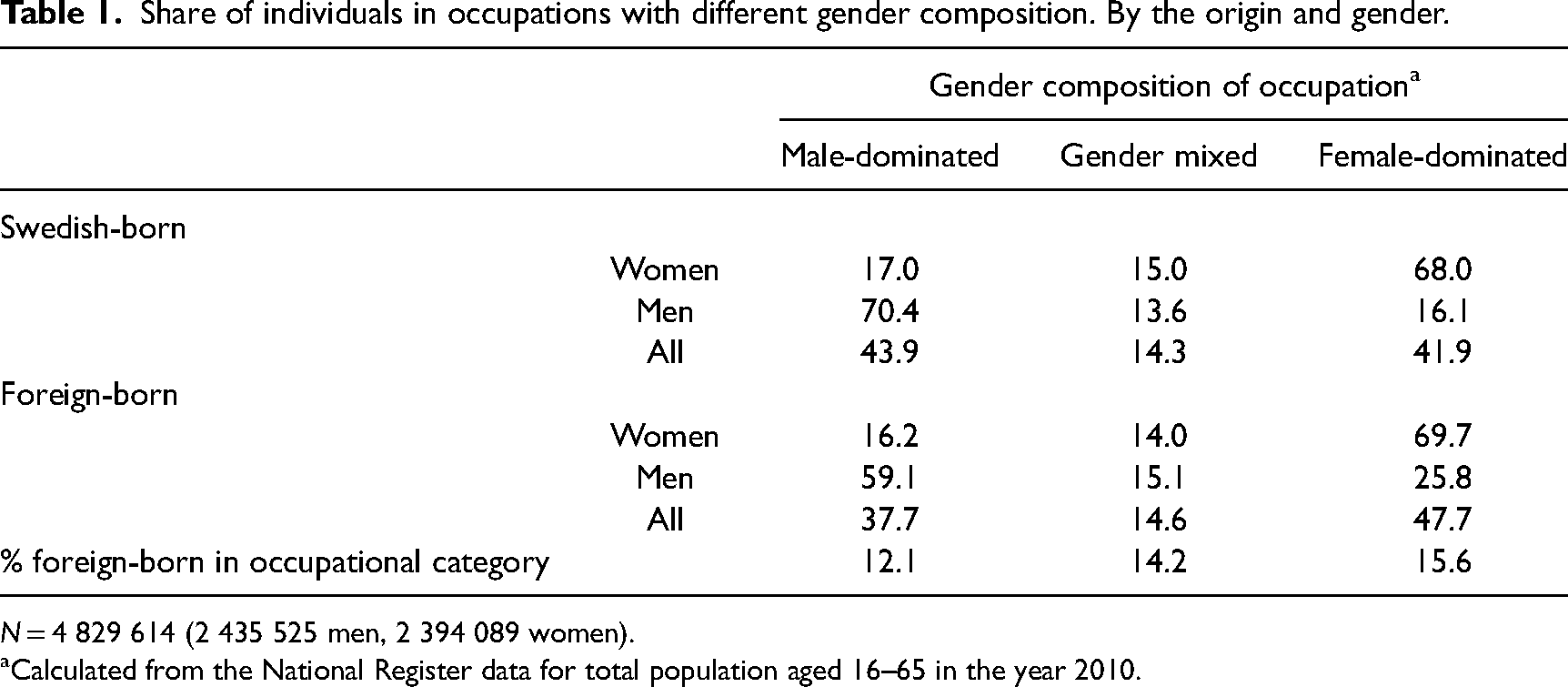
In RQ 1a we asked whether gender segregation is stronger in the foreign-born population; in particular, if immigrant women are more clustered in female-dominated occupations. Table 1 displays the distribution of the labour force, across three categories of occupations: male-dominated, gender-mixed and female-dominated occupations. As shown, most occupations on the Swedish labour market are numerically dominated by one gender. However, while female- and male-dominated occupations comprise about equal shares of the Swedish-born labour force, the distribution of the immigrant labour force is more skewed, with about 48% working in female-dominated occupations and only 38% in occupations dominated by men.
Share of individuals in occupations with different gender composition. By the origin and gender.
N = 4 829 614 (2 435 525 men, 2 394 089 women).
Calculated from the National Register data for total population aged 16–65 in the year 2010.
Clearly, however, segregation has different meanings to women and men. To fully interpret the percentages in the table, we must acknowledge that, out of the 112 occupations in the Swedish labour market in 2010, 61 were male-dominated and only 27 female-dominated. Thus, women – who comprise 50% of the labour force – are considerably more clustered in a limited number of occupations than are men. As shown in the table, the share of women working in a female-dominated occupation is somewhat higher among immigrants than among Swedish-born individuals, however the difference amounts to less than two percentage points. Meanwhile, 26% of immigrant men work in female-dominated occupations (largely in elementary occupations such as domestic helpers or cleaners, restaurant services workers and personal care workers), while 59% work in a male-dominated occupation. For Swedish-born men, the comparative figures are 16% and 70%. In sum, then, gender segregation is only slightly stronger among immigrant women than among Swedish-born women, while segregation is considerably weaker among immigrant men than among men born in Sweden. All in all, the share of immigrants is higher in female-dominated occupations than in gender-mixed and, particularly, male-dominated occupations.
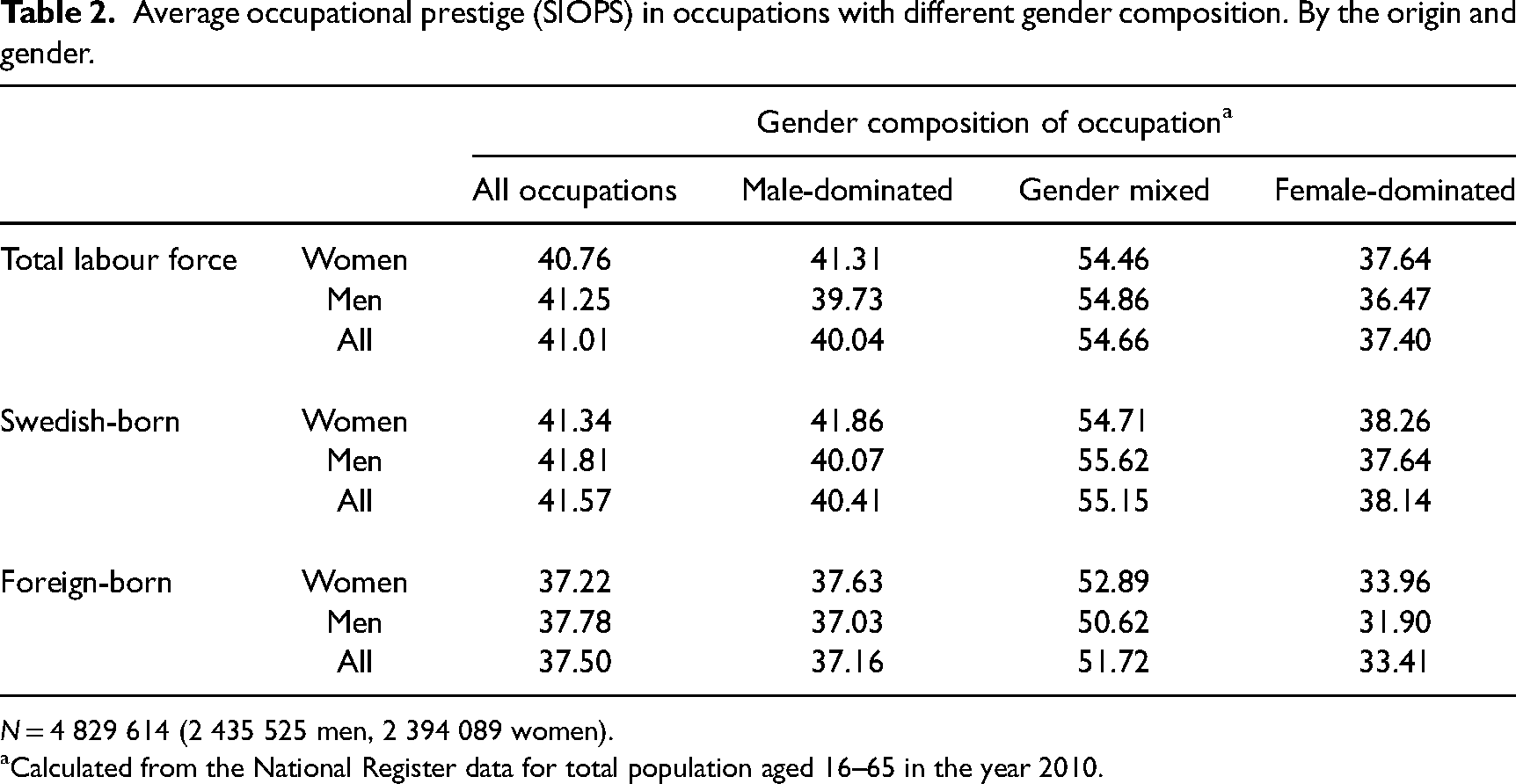
In response to RQ 1b, Table 2 displays the average levels of occupational prestige by gender and gender segregation and allows us to compare the patterns among immigrant and Swedish-born individuals. Considering first the total population, we find that women on average have lower occupational prestige than men. However, this pattern largely reflects the fact that women are more clustered in female-dominated occupations for which average prestige scores are lower than for male-dominated and gender-mixed occupations. When we consider the gender gaps within each of these occupational categories, the picture changes. Now, women in fact display higher average prestige than men in both male- and female-dominated occupations. In gender-mixed occupations women have somewhat lower prestige than men, but the gender difference is very small.
Average occupational prestige (SIOPS) in occupations with different gender composition. By the origin and gender.
N = 4 829 614 (2 435 525 men, 2 394 089 women).
Calculated from the National Register data for total population aged 16–65 in the year 2010.
However, both the levels and the gender/occupational patterns differ substantially between foreign- and Swedish-born individuals. On average, immigrants have jobs with lower occupational prestige than do Swedish-born individuals. This migrant gap appears in all three occupational categories but is particularly clear in female-dominated occupations. Meanwhile, the gender patterns also differ between the foreign- and the Swedish-born population. Immigrant women have higher prestige than men in all occupational categories, but particularly in female-dominated occupations. For Swedish-born women, the advantage is largest in male-dominated occupations while women in gender-mixed occupations have lower prestige than men. The lowest level of prestige is found among immigrant men working in female-dominated occupations and the gap vis-à-vis Swedish men is particularly large in this category and in gender-mixed occupations. For women, the prestige gap between immigrant and Swedish-born individuals is comparatively small in gender-mixed occupations.
In conclusion, the descriptive statistics show that immigrant women, on average, are more clustered than other groups in female-dominated occupations. These occupations also have the lowest levels of prestige; however, within occupational categories women tend to have higher prestige than men. Thus, occupational gender segregation appears to be a crucial factor for understanding differences between groups. Presumably, however, ethnic segregation – captured here with the share of immigrants in the occupation – may also play a role. The population register data confirms that the Swedish labour market is indeed segregated by ethnicity: In 2010, immigrants constituted 14% of the labour force, but the share of immigrants by occupation varied from 2 to 47%. Finally, ethnic segregation appears to be stronger among immigrant men, 59% of whom are employed in occupations with more than 14% immigrants. For women, the corresponding figure is 52%.
In the next step, we will consider both types of segregation as we explore the individual-level predictors of occupational prestige among immigrants.
Step 2: gender gaps in occupational prestige among immigrants
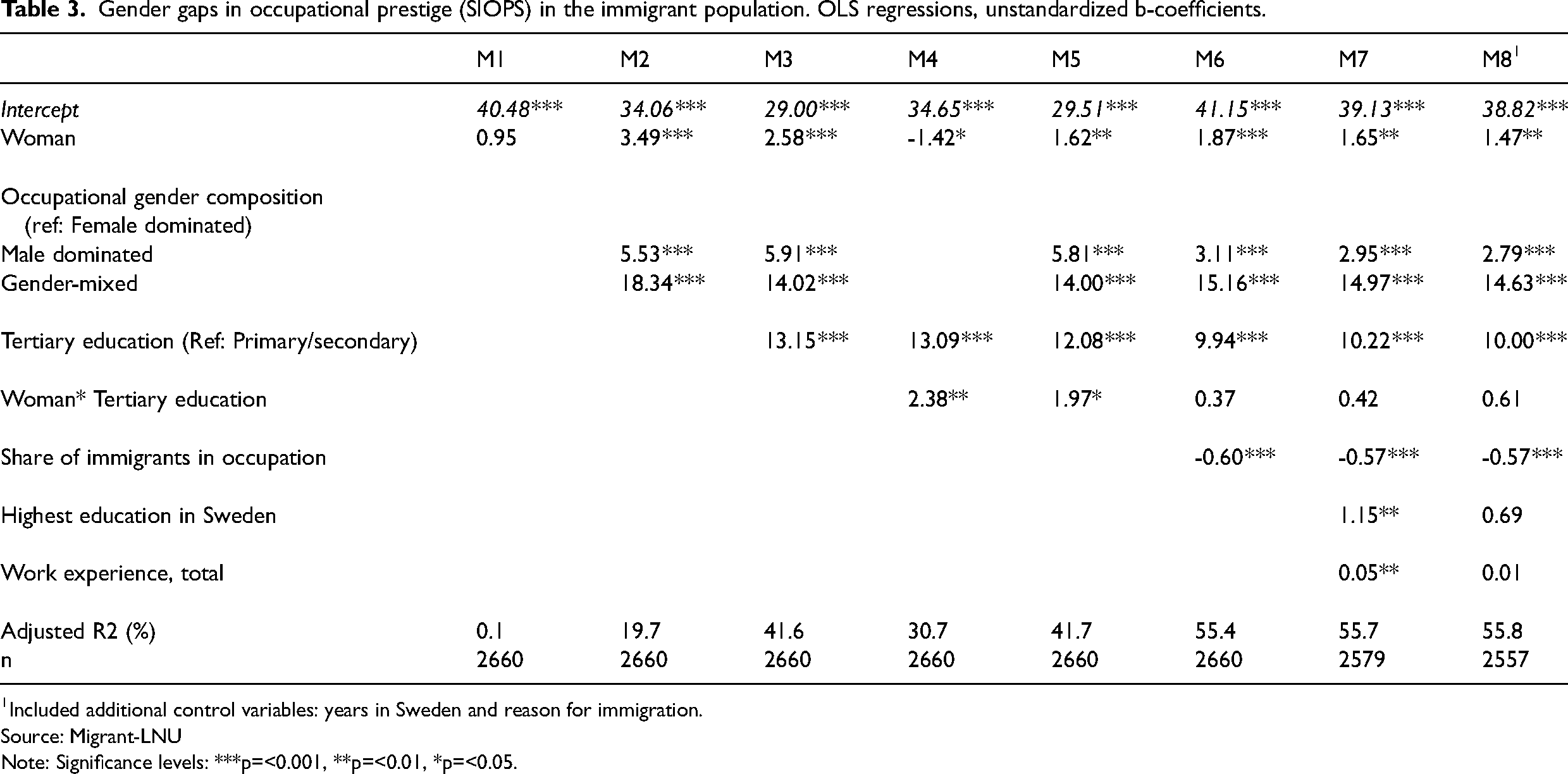
To explore gendered patterns in immigrants’ occupational attainment, we performed OLS regressions on Migrant-LNU survey data. The results are displayed in Table 3.
Gender gaps in occupational prestige (SIOPS) in the immigrant population. OLS regressions, unstandardized b-coefficients.
Included additional control variables: years in Sweden and reason for immigration.
Source: Migrant-LNU
Note: Significance levels: ***p=<0.001, **p=<0.01, *p=<0.05.
The first question (RQ2a) was whether immigrant women had a generally lower level of occupational prestige than immigrant men but as demonstrated in Table 3, model 1 this is not the case. The woman coefficient is positive but non-significant in this model, however it increases substantially and becomes statistically significant when the indicator for occupational gender composition is entered in model 2. This finding, which remains robust after controlling for education (in model 3), suggests that women's overall level of occupational prestige is suppressed by the fact that they are more clustered in female-dominated occupations which generally have lower prestige than male-dominated and, especially, gender-mixed occupations. However, there is reason to further consider the role of tertiary education. Potentially, the lack of an overall gender gap in the first model could mask divergent patterns among individuals with and without tertiary education.
To explore these issues, raised in RQ2b, an interaction term woman*tertiary education is entered in model 4. As shown, the interaction term is positive and statistically significant, showing that education is more decisive for the occupational prestige of immigrant women than it is for men. Moreover, the woman coefficient – now signifying the gender gap among individuals without tertiary education – has turned negative and is statistically significant. Thus, there is a gender gap to women's disadvantage among individuals without tertiary education, whereas women with tertiary education have a higher level of occupational prestige than men.
An interesting question, then, is whether occupational segregation has different implications for women with and without tertiary education. When controlling for occupational gender composition in model 5, we note that the woman coefficient changes signs from negative to positive and remains statistically significant. Meanwhile, the gender gap to women's advantage among immigrants with tertiary education remains largely unaffected. Thus, the suppressing effect of occupational gender segregation discussed above appears to concern mainly women with primary/secondary education.
To further explore the advantage of highly educated women, we control for the ethnic dimension of segregation, measured as the share of immigrants in the occupation. As seen in model 6 this variable is negatively and significantly related to occupational prestige. As shown, the level of prestige decreases with 0.6 percentage point as the share of immigrants increases with one percentage point. Put differently, one standard deviation in the share of immigrants is associated with a 5 percentage-point difference in occupational prestige (cf. Table A1, Appendix). Further, we note that the woman*education interaction term decreases and loses statistical significance. Thus, immigrant men with tertiary education have lower prestige than women because they work in occupations with a higher share of immigrants. In model 7, we further control for human capital, including country-specific human capital, with measures of education in Sweden and total work experience (before and after immigration). As shown, both have a positive association with occupational prestige, however the coefficients lose statistical significance after accounting for time in Sweden and reason for immigration in model 8. More importantly, however, the main results remain robust to these controls. Further analyses of gender gaps within occupational categories (not displayed) clarify that the gender gap in prestige among immigrants with primary/secondary education reflects the fact that women are more clustered than men in female-dominated occupations. Within this category, women with primary/secondary education do not have a lower level of prestige than comparable men and women with tertiary education have significantly higher prestige than men. In male-dominated and gender-mixed occupations women have an advantage over men in both educational groups.
Summing up, we find that in terms of occupational prestige immigrant women are not generally disadvantaged vis-à-vis immigrant men. Instead, gender gaps differ crucially between groups with and without tertiary education and these gaps reflect different dimensions of occupational segregation. Specifically, women lacking tertiary education have jobs with lower prestige than men because they are more strongly clustered in female-dominated occupations. Meanwhile, highly educated men are disadvantaged vis-à-vis women due to ethnic segregation.
Next, we will explore how gender patterns among immigrants compare to those in the Swedish-born population.
Step 3: migrant gaps in occupational prestige by gender
In the final step of the analysis, the migrant-LNU was pooled with LNU 2010 survey data to explore if the migrant gap (i.e., the difference in occupational prestige between immigrant and inborn individuals) is more pronounced among women than among men and to what extent these gaps are explained by education and occupational segregation. Also, we compare the overall gender gaps in the immigrant and the Swedish-born population (RQ3).
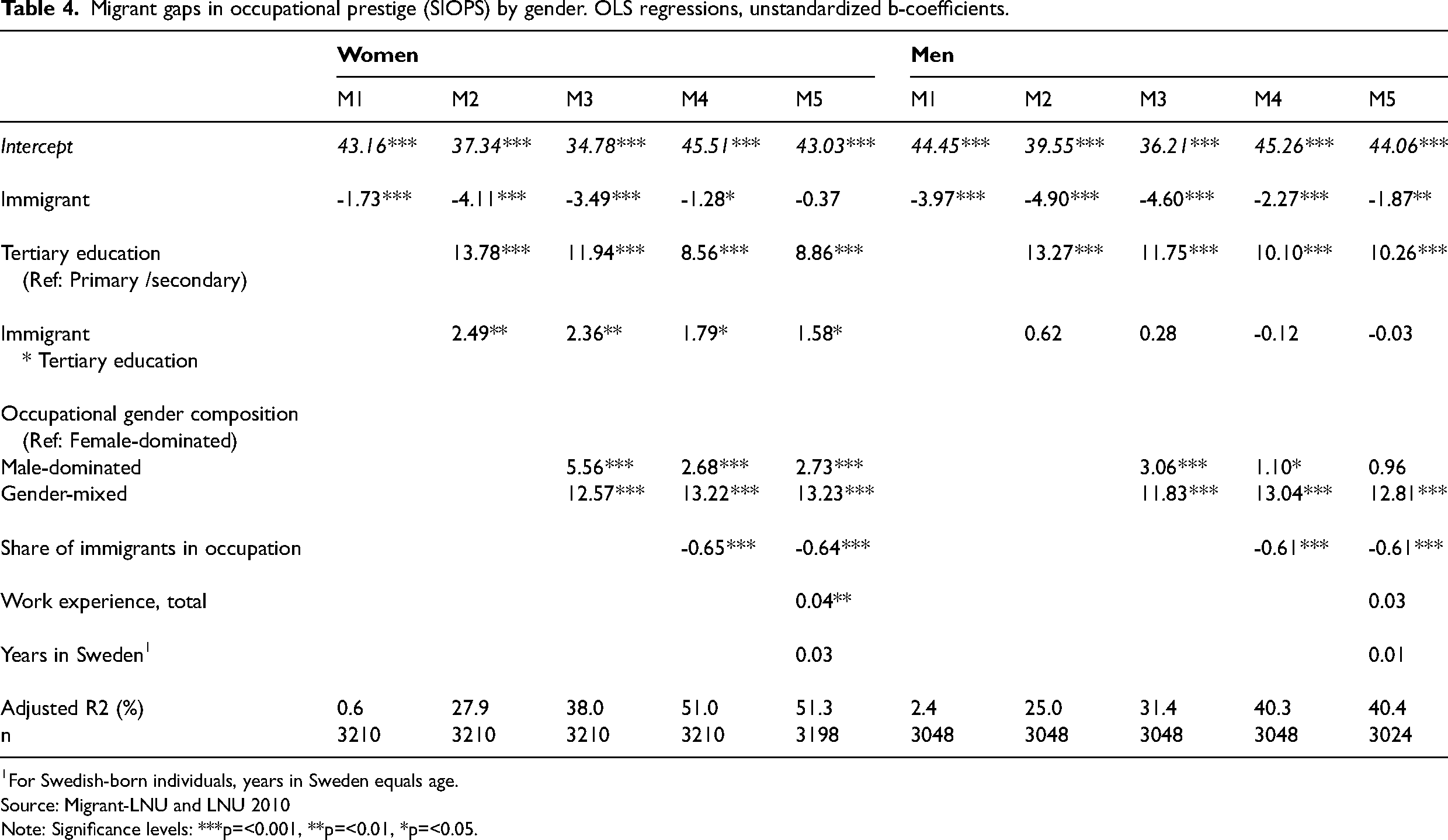
The results from the regressions, performed separately for men and women, are displayed in Table 4. In model 1, a comparison of intercepts indicates that Swedish-born women have a lower level of occupational prestige than Swedish-born men. Meanwhile, the migrant gap, i.e., the difference in occupational prestige between immigrant and Swedish-born individuals, is more than twice as large among men as it is among women.
Migrant gaps in occupational prestige (SIOPS) by gender. OLS regressions, unstandardized b-coefficients.
For Swedish-born individuals, years in Sweden equals age.
Source: Migrant-LNU and LNU 2010
Note: Significance levels: ***p=<0.001, **p=<0.01, *p=<0.05.
After entering the immigrant*education interaction term in model 2, we find that the migrant gap is significantly smaller for women with tertiary education than for those without. Among men, however, the size of the migrant gap does not vary with education. After controlling for occupational segregation in models 3–4, migrant gaps in prestige decrease with about 70% among women without tertiary education and is more than halved among men without tertiary education. Among women with tertiary education the migrant gap is closed. Most of the reduction in the migrant gaps occurs after accounting for ethnic segregation, but for women gender segregation also makes a difference. When controlling for work experience in model 5, the migrant gap is closed also among women without tertiary education. For men, a gap of about 2 percentage points remains in the final model.
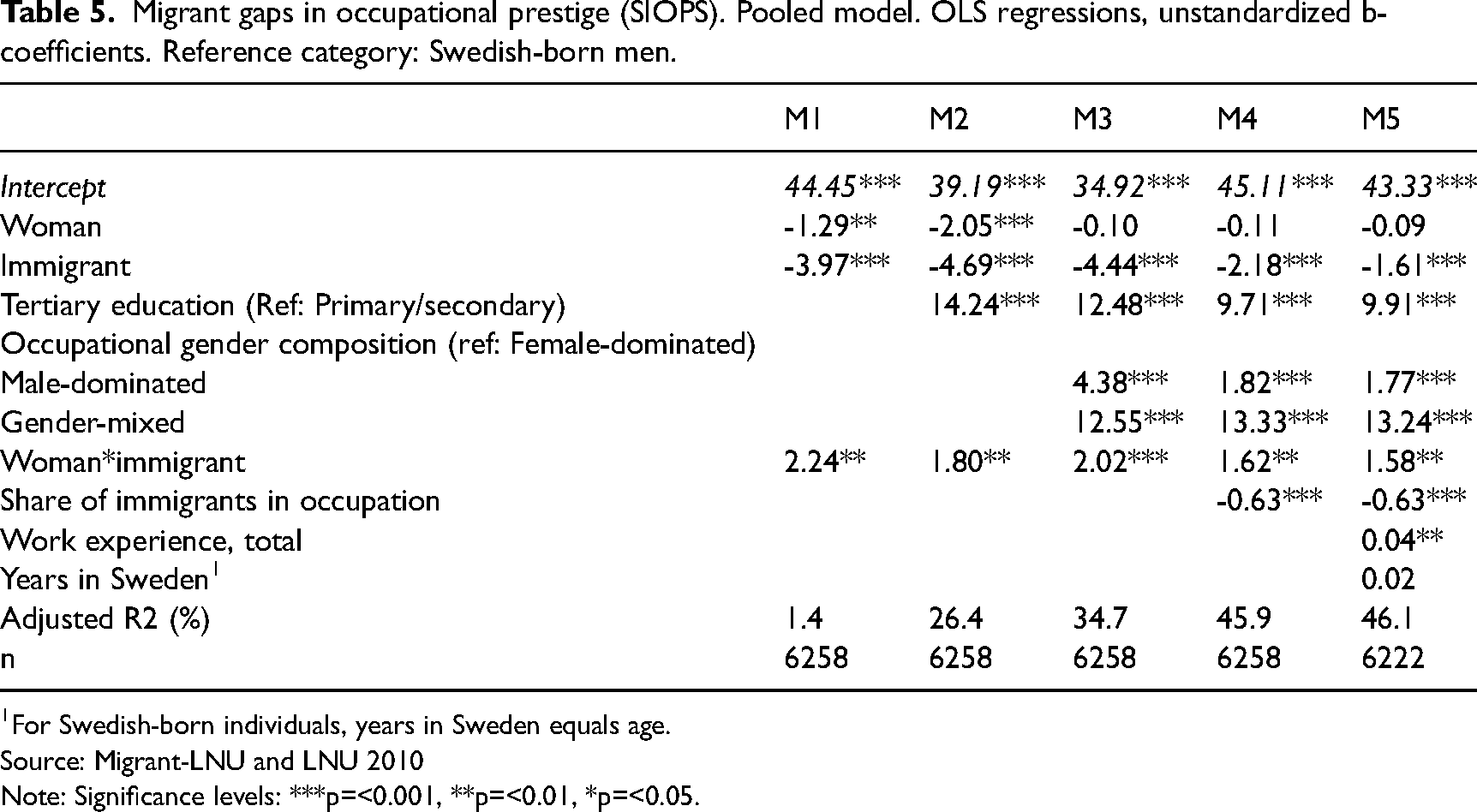
To get a more complete picture of the double disadvantage, the size of gender gaps in prestige will be compared between the immigrant and the Swedish-born population. Table 5 displays the result of pooled regressions including a gender*immigrant interaction term. As shown, the results confirm that Swedish-born men (used as reference category) have a higher level of prestige than other categories. As shown in model 1, Swedish-born women have a significantly lower level of prestige than Swedish-born men. Meanwhile, the difference in average prestige vis-à-vis inborn men is 3% for immigrant women and about 4 percentage points for immigrant men. After accounting for education, in model 2, the gap increases to about 5 percentage points for both immigrant men and immigrant women, indicating a lower pay-off to education for immigrants. Entering the indicator of occupational gender composition, in model 3, the gender gap in the Swedish-born population loses statistical significance while the gap between immigrant women and inborn men is reduced to about 2 percentage points. For men, this indicator does not further explain the migrant gap in prestige, however after controlling for ethnic segregation in model 4, the gap between immigrant and inborn men is more than halved. In this model, the gap between immigrant women and Swedish-born men is virtually erased and controlling for work experience in model 5 closes the gap completely.
Migrant gaps in occupational prestige (SIOPS). Pooled model. OLS regressions, unstandardized b-coefficients. Reference category: Swedish-born men.
For Swedish-born individuals, years in Sweden equals age.
Source: Migrant-LNU and LNU 2010
Note: Significance levels: ***p=<0.001, **p=<0.01, *p=<0.05.
In sum, the analysis shows that, in comparison to the inborn population, immigrant women do not fare worse than immigrant men in terms of average prestige. This holds both for within-gender comparisons and for comparisons to inborn men. Further, the importance of education for immigrant women stands out also regarding the migrant gaps – as was the case regarding gender gaps among immigrants in Step 2 – and in both cases immigrant women with only primary/secondary education fare worse than other groups. Finally, the analysis of migrant gaps further points to the importance of segregation for explaining the variation in outcomes. Gender segregation explains part of immigrant women's lower prestige in comparison to Swedish-born women and men. Ethnic segregation similarly affects the migrant gaps for men and women in relation to Swedish-born men.
Discussion
The thrust of the study presented above was to determine whether immigrant women's occupational attainment reflects a double disadvantage in comparison to immigrant men and inborn women. To date, research on gender patterns in immigrants’ occupational attainment is scarce and very few scholars have considered gender and migration in combination. We add to the literature by addressing both dimensions and exploring the importance of occupational segregation.
The findings – based on population registers and survey data from Sweden – provide little support for the notion of a double disadvantage. In the immigrant population there is no statistically significant gender gap in occupational prestige. However, this overall pattern masks crucial differences between educational groups. Immigrant women with primary/secondary education have jobs with lower average prestige than men, but among immigrants with tertiary education women have an advantage vis-à-vis men.
In turn, these different gender gaps reflect different dimensions of occupational segregation. The disadvantage of women without tertiary education reflects the fact that they are more strongly clustered in female-dominated occupations for which average prestige scores are lower than for other occupations. Meanwhile, women's advantage among the highly educated is explained by the fact that men with tertiary education are employed in occupations with a higher share of immigrants. Thus, gender segregation has a suppressing effect for women lacking tertiary education while ethnic segregation provides an obstacle to highly educated immigrant men.
Comparisons with the Swedish-born population also do not comply with the double disadvantage-perspective. Contrary to expectations, the gaps in occupational prestige between immigrant and inborn individuals are substantially larger among men than among women. However, education makes a crucial difference for women also regarding the migrant gap. Among groups with primary/secondary education, the migrant gap does not differ by gender, but among those with tertiary education it is considerably smaller for women than for men.
In the Swedish context, then, tertiary education stands out as a tool by which immigrant women can mitigate disadvantages related to gender and, to a large extent, also those associated with ethnicity. At the same time, the fact that immigrant women are more clustered in female-dominated occupations constitutes a disadvantage in relation to Swedish-born women as well as to immigrant men. After accounting for occupational segregation and work experience the migrant gaps are closed for women, both in relation to Swedish-born women and to Swedish-born men, while a gap of about 2 percentage points remains among men.
All in all, these findings – the smaller migrant gap in prestige among women, the lack of a general disadvantage for immigrant women in comparison to immigrant men and the comparatively advantageous outcomes for highly educated immigrant women – seem unexpected, given the widespread notion of a double disadvantage. In future research, these findings could be corroborated and expanded with other data. Previous studies show that women receive lower wages than men for jobs with similar skill requirements and prestige (e.g., Frattini and Solmone, 2022, Magnusson 2009) and it is quite possible that a double disadvantage would appear with wage indicators. Another limitation of the study presented here is the cross-sectional design which does not allow for causal inferences. As in other countries, employment levels in Sweden are lower among immigrants, particularly among low-educated immigrant women. Arguably, then, migrant gaps and potentially also gender gaps could be underestimated due to a positive selection of (female) immigrants. Longitudinal studies could shed further light on this issue but also provide important knowledge about segregation processes. Regardless of educational level, gender segregation hampers the occupational attainment more for immigrant women than for Swedish-born women and an interesting question is whether such a difference can be explained by larger family responsibilities. Meanwhile, the varying role of ethnic segregation for men and women could reflect several processes. Ethnic networks could facilitate the labour market entry of immigrant men while simultaneously relegating them to low-prestige jobs. Discrimination is another factor that may explain men's stronger presence in occupations with a large share of immigrants – for example, evidence from Swedish field experiments suggests that hiring discrimination poses a greater obstacle for immigrant men than for immigrant women (Arai et al., 2016).
More generally, the study presented here underlines the importance of empirically scrutinising the interacting disadvantages of gender and immigrant status. In times of profound societal change neither outcomes nor mechanisms are self-evident. Women's heavy educational investments have improved their access to prestigious jobs and contributed to occupational de-segregation and in Europe even immigrant women are now more well-educated than men, although women's advantage is larger in the inborn populations (Frattini and Solmone, 2022). Meanwhile, polarisation of OECD labour markets has led to a growth of low-prestige jobs, not least among men (Ulfsdotter Eriksson et al., 2022). As illustrated above, many of these jobs are held by immigrants and thus, ethnic and gender segregation must be considered in tandem.
To better understand how cumulative disadvantages can be avoided it is important to also consider the institutional context. Clearly, a single-country study cannot determine whether Swedish institutions – particularly the encompassing support for gender equality – have mitigated the disadvantages facing immigrant women. To date, country-comparative research of migrants’ occupational attainment is limited, and the role of policy remains unclear. According to Pichler (2011), immigration policies do not explain the differences in occupational attainment between migrants and majority populations across Europe and broader welfare policies mainly explain the more adverse situations that migrants face in Mediterranean countries. In the future, also the gender dimension should be explored in studies from different contexts, as well as in comparative studies. Ideally, these should consider not only policy but also labour market structure – notably occupational segregation. Obviously country comparisons can be complex due to the varying characteristics of immigrant populations as well as in female labour force participation. Here, a comparison of the Nordic countries, which share central features regarding social inclusion and women's empowerment but differ in terms of migration policies and occupational segregation (Grönlund et al., 2017) could provide further insight about the ways in which the inequalities facing immigrant women and men can be diminished.
Footnotes
Funding
The author(s) disclosed receipt of the following financial support for the research, authorship, and/or publication of this article: This work was supported by the Swedish Research Council for Health, Working Life and Welfare, FORTE (grant 2017-00226).

Notes
Author biographies
Appendix
Descriptive statistics. Immigrant population. Means (std) and percentages.
| All | Women (n=1371) | Men (n=1218) | |
|---|---|---|---|
| Occupational prestige, mean (std) | 40.54 (13.54) | 40.93 (14.05) | 40.11 (12.93) |
| Occupational gender segregation, % | |||
| - Male dominated | 37.3 | 15.7 | 62.4 |
| - Gender mixed | 15.9 | 16.0 | 15.7 |
| - Female dominated | 46.5 | 68.3 | 21.9 |
| Tertiary education, % | 45.2 | 49.2 | 40.6 |
| Share of immigrants in occupation, mean (std) | 16.02 (8.85) | 16.50 (9.46) | 15.47 (8.08) |
| Highest education in Sweden, % | 59.8 | 62.6 | 56.7 |
| Total work experience, mean (std) | 20.25 (12.00) | 19.06 (11.80) | 21.59 (12.09) |
| Years in Sweden, mean (std) | 23.21 (11.83) | 22.91 (11.96) | 23.55 (11.67) |
| Reason for immigration, % | |||
| - work | 11.7 | 9.2 | 14.4 |
| - studies | 3.1 | 2.9 | 3.3 |
| - family connection | 47.7 | 55.6 | 38.9 |
| - asylum/humanitarian | 32.3 | 26.2 | 39.1 |
| - other | 5.0 | 5.7 | 4.1 |