




Abstract
With increasing global mobility, scholars have debated whether immigration undermines welfare states. So far, no conclusive evidence of a consistent association between immigration and social policy support has emerged. This might be due to treating immigrants as a monolithic mass. To begin addressing this, the authors account for the gender composition of immigrant populations. Drawing on research on attitudes toward immigration, immigration policy, and gendered tropes of immigrants, the authors develop two hypotheses detailing how the share of women among immigrants moderates that population’s impact on individuals’ social policy support. Testing these hypotheses on International Social Survey Programme and United Nations data, the authors find no evidence of a predominant demographic or coexisting immigrant threats. Instead, the results show a consistent pattern between immigration and social policy support aligning with a dominant trope of “deviant immigrant men” posing a criminal threat. Specifically, increasing immigrant populations predict reduced support as the share of women among them decreases.
As immigration becomes a widely shared phenomenon across democracies (Baldassarri and Abascal 2020), scholars have predicted that the ensuing racial and ethnic fractionalization would undermine support for social policy in these societies (Brooks and Manza 2008; Sainsbury 2012). This prediction has spawned an expansive literature investigating this hypothesis, which posits that immigration undermines social policy support, sometimes referred to as the “generic hypothesis” (Brady and Finnigan 2014). In cross-sectional regional comparisons (Dahlberg, Edmark, and Lundqvist 2012; Eger 2010; Eger and Breznau 2017), single-country, longitudinal studies (Auspurg, Brüderl, and Wöhler 2019, Schmidt-Catran and Spies 2016, 2019), and cross-national comparisons (Alesina and Glaeser 2004; Brady and Finnigan 2014; Breznau et al. 2022; Kulin, Eger, and Hjerm 2016; Steele 2016), some evidence supports the hypothesis, whereas the majority of results reveal no or even a positive relationship between immigration and social policy preferences. This points to the potential that multiple, countervailing mechanisms might link the two instead of the single negative mechanism posited by the generic hypothesis.
Rather than rejecting a negative relationship outright, some have suggested that the mixed findings might be explained by qualifying the generic hypothesis (Brady and Finnigan 2014). This line of theorizing finds support in research on immigration attitudes which has shown that not all immigrant populations are perceived and received the same. This literature has documented an unwritten hierarchy of acceptance including variation according to skills (Hainmueller and Hopkins 2015; Helbling and Kriesi 2014), reasons for migration (Bansak, Hainmueller, and Hangartner 2016; Blinder 2015; Czymara and Schmidt-Catran 2016), and demographics (Bessudnov 2016; Ford 2011). Among demographic predictors, the gender of immigrants forcefully shapes their acceptance (Bansak et al. 2016; Kreft and Agerberg 2023; Ward 2019). This is in part connected to immigration policies selecting on gender (De Haas, Natter, and Vezzoli 2018; Golash-Boza and Hondagneu-Sotelo 2013; Hondagneu-Sotelo 2013), but more importantly because the gender of immigrants activates tropes conditioning their acceptance among the native population (Gereke, Schaub, and Baldassarri 2020; Schaeffer 2013; Ward 2019). Given these insights, accounting for the gender composition of immigrant populations offers a promising route for qualifying the generic hypothesis that might resolve the inconclusive findings in the literature.
In this study, we develop a framework detailing the moderating role of the immigrant population’s gender composition on the association between immigration and social policy preferences and test its predictions empirically. We contribute to the literature on immigration and social policy support by incorporating research on gendered immigration policy and gendered acceptance of immigrants and expanding the empirical focus to 40 democratic countries from all six continents. Our results reveal a consistent pattern linking immigration and policy preferences that aligns with a dominant trope of “deviant immigrant men” posing a criminal threat that explains when immigration undermines social policy support.
We proceed in three stages. First, we review the literature on the link between immigration and support for the welfare state outlining its inconclusive state. Bringing in the literature on immigration attitudes, we argue that the mixed findings might be due to a lack of attention to demographics of the immigrant population, specifically its gender composition. Combining this insight with scholarship on immigration policy, we develop two competing hypotheses about how the gender composition of immigrant populations might moderate the relationship between immigration and social policy support, and outline how the native population likely learns about this composition. Second, we introduce the International Social Survey Programme (ISSP) and United Nations (UN) data, which we use to test these hypotheses and detail our data handling and analysis strategy, combining multiple imputation, hybrid regression models, and bootstrapping. Third, we present the results showing that, when modeling the immigrant population’s gender composition as a moderator of its stock, increasing shares of immigrant men lead to immigration consistently, negatively predicting support for social policy. We discuss these results in the context of the mixed findings in the literature, outline their limitations, and close by discussing their implications for research on social policy support, immigration, and related scholarship.
Theoretical Background
Immigration, Welfare States, and Public Opinion
A long-standing comparative literature on welfare state expansiveness points to the role of population homogeneity to support strong social policy (Alesina and Glaeser 2004; Lipset and Marks 2000). As post–World War II migration increased diversity also in former emigration societies, scholars predicted an alignment of European social policy preferences with lower levels of support in the United States (Brooks and Manza 2008; Sainsbury 2012). Early empirical evidence comparing U.S. states (Fox 2004), Swedish regions (Eger 2010), and Western countries (Larsen 2011; Mau and Burkhardt 2009) bolstered this “generic hypothesis,” which posits that immigration is negatively related to support for the welfare state.
Subsequent work using broader geographic and longitudinal data challenged these findings (Auspurg et al. 2019; Brady and Finnigan 2014; Schmidt-Catran and Spies 2016, 2019; Sumino 2014), prompting work revisiting the generic hypothesis and investigating competing mechanisms (Alesina, Harnoss, and Rapoport 2021; Burgoon 2014; Eger and Breznau 2017; Haderup Larsen and Schaeffer 2021; Mewes and Mau 2013). Recent reviews and meta-studies highlight the ongoing debate (Breznau et al. 2022; Elsner and Concannon 2020), which may advance particularly through the development of “more qualified . . . hypotheses about immigration and the welfare state” (Brady and Finnigan 2014:36). We draw on work documenting the connection between immigration attitudes and welfare attitudes (Burgoon and Rooduijn 2021; Garand, Xu, and Davis 2017) to develop two such qualifications of the generic hypothesis and test them empirically.
The literature on attitudes toward immigration and immigrants provides two valuable insights to begin to qualify the generic hypothesis (see Fussell 2014 and Hainmueller and Hopkins 2014 for reviews). First, natives’ concerns about immigration are primarily sociotropic, meaning about the effects on society rather than the individual (Dancygier and Laitin 2014; Hainmueller and Hopkins 2015; Helbling and Kriesi 2014; Hjerm and Nagayoshi 2011). Second, immigrant characteristics condition these concerns with a general consensus about which immigrant characteristics are desirable and which are not (Bail 2008; Bansak et al. 2016; Bessudnov 2016; Ford 2011; Hainmueller and Hopkins 2014). As the welfare state is a key pillar of developed societies, the immigrant characteristics triggering sociotropic concerns also plausibly condition how immigration shapes social policy preferences.
While the literature points to various immigrant characteristics that affect natives’ reactions (Adida, Laitin, and Valfort 2010; Ford 2011; Hjerm and Nagayoshi 2011), immigrant gender plays a consistent and pivotal role in the reception across societal contexts (Adida, Lo, and Platas 2019; Bansak et al. 2016; Czymara and Schmidt-Catran 2016; Hainmueller and Hopkins 2015). Importantly, this applies both in concrete situations with individual immigrants (Dahl and Krog 2018; Gereke et al. 2020; Tjaden, Schwemmer, and Khadjavi 2018) and in more abstract, mediated cases, in which natives consider immigrants as a group (Kreft and Agerberg 2023; Ward 2019). We therefore argue that examining whether and how the gender composition of immigrant populations moderates the link between immigration and welfare state support offers a promising way to qualify the generic hypothesis.
For such qualifications of the generic hypothesis to be plausible, requires that the public can ascertain the immigrant population’s gender composition and changes in it. This may happen through two pathways: (1) directly through personal contact and (2) indirectly through media reporting. The immigration attitudes literature provides evidence for the primacy of the mediated pathway (Frey 2020; Legewie 2013; Valentino, Brader, and Jardina 2013), especially for knowledge about the immigrant population size and composition (Herda 2010, 2015). Additionally, social policy preferences appear to be more closely linked to mediated, national-level than immediate, local immigration (Hainmueller and Hopkins 2014; Weber 2015), though in the labor market context, direct exposure may play a similarly prominent role (see Alt and Iversen 2017; Burgoon, Koster, and van Egmond 2012). This may be because segregation limits direct exposure in many contexts (Flippen and Farrell-Bryan 2021; Hall 2013), whereas the media constantly cover immigration (Van Klingeren et al. 2014).
The mediated pathway is likely especially important for knowledge about changes in the immigrant population’s gender composition. These may be easily missed in daily life, as they tend to be small in relative terms, but feature prominently in the media (Silber Mohamed and Farris 2020), as they tend to result from larger migration movements with often skewed sex ratios (Dyson 2012). Recent examples of this are the refugee movements in connection with the wars in Syria and Ukraine, including predominantly men or women and children, respectively (CARE 2022; Wolfensohn et al. 2016), which featured prominently in the media (Cock et al. 2018; Kim 2025; Lind and Meltzer 2021). Importantly, media coverage of immigration beyond refugee movements is also frequently gendered (Helbling 2014; Roggeband and Vliegenthart 2007; Silber Mohamed and Farris 2020) with media representations tending to reflect and even overdraw the immigrant population’s gender composition (Liu 2021).
Immigrant Gender Composition and Welfare State Attitudes
Considering the prominent role of immigrant gender in public and media reception, a plausible qualification of the generic hypothesis renders it conditional on the share of women and men among the immigrants. In other words, the gender composition of the immigrant population moderates the connection between immigration and welfare state support. The specific shape of this interaction, however, is less clear, as it draws on historically shifting gendered perceptions of immigrants (Golash-Boza and Hondagneu-Sotelo 2013; Hondagneu-Sotelo 2013). Specifically, the relevant tropes of immigrant threat for native societies have developed from perceptions of “overfertile immigrant women” posing a demographic threat to “deviant immigrant men” posing a criminal threat. Whether this development represents a substitution or an emergence and coexistence of tropes is unclear.
Demographic Threat and Immigrant Women
One line of reasoning suggests that a growing share of women among the nonnative population might increase the detrimental link between immigration and social policy. This reasoning derives from the trope of “overfertile immigrant women” posing a demographic threat to receiving societies (Hondagneu-Sotelo 2013). Although the potential to have children presents a threat to the homogeneity of a society’s population thus undermining support for social policy, similar effects arise from perceptions that these women are not joining the labor force but rely on welfare benefits instead (Grødem 2017). This trope has been well documented in U.S. immigration scholarship documenting policy restrictions on women and targeted recruitment of immigrant men (Golash-Boza and Hondagneu-Sotelo 2013, Tyner 1999). Similar policies existed in other immigration societies (Badkar et al. 2007; Fincher 1997), and even nontraditional destinations show evidence of demographic concerns in restrictions on intermarriage (Herrera 2013). In Europe, labor shortages after World War II led to guest worker programs targeting men (Pettigrew 1998), a prioritization that persists in gendered classification of highly skilled immigration in contemporary European policies (Kofman 2014).
This suggests that the demographic threat of “overfertile immigrant women” might dominate how people perceive immigration and, accordingly, the share of women among the immigrant population increases the negative association between immigration and welfare state support by fostering concerns about redistribution to a population becoming less and less homogeneous. This argument thus predicts that the gender composition of the immigrant population moderates the association between immigration and support for social policy as detailed in the first hypothesis:
Hypothesis 1 (Immigrant Women as Demographic Threat): Larger immigrant populations reduce support for social policies as the share of women among the immigrant population increases.
Criminal Threat and Immigrant Men
Another line of reasoning holds that the share of men among immigrant populations reinforces negative associations between immigration and social policy support. This argument draws on the emerging trope of “deviant immigrant men.” In Western democracies, this trope is exemplified by perceptions of “young immigrant men” (Schaeffer 2013:164) as troublemakers, media portrayals of immigrants as primarily criminal men (Silber Mohamed and Farris 2020), and rejection of immigrant groups that include them (Kreft and Agerberg 2023; Ward 2019). This has spurred laws targeting perceived criminal threats from immigrant men, who populate the public imagination as drug traffickers, gang members, and potential terrorists (Hondagneu-Sotelo 2013). The “deviant immigrant men” trope also exists in non-Western democracies, motivating tightening of immigration policy in Latin America (Fouratt 2014) and connecting immigration and social policy debates (Noy and Voorend 2016). Although the trope has primarily been documented to influence immigration policy and attitudes, its impacts extend to social policy support. Heightened prejudice reduces support for redistribution by raising perceptions of undue use of services (Burgoon and Rooduijn 2021; Ford 2006) and by undermining solidarity (Garand et al. 2017; Larsen 2011).
This suggests that the criminal threat associated with the trope of “deviant immigrant men” might dominate people’s perception of immigration. Consequently, an increase in the share of men among the immigrant population might intensify the negative association between immigration and welfare state support as heightened prejudice undermines support for redistribution. To maintain argumentative symmetry, we formulate hypothesis two regarding the possible moderation of the association between the immigration and social policy preferences on the basis of the share of women:
Hypothesis 2 (Immigrant Men as Criminal Threat): Larger immigrant populations reduce support for social policies as the share of women among the immigrant population decreases.
Both qualified generic hypotheses concern the impact of fluctuations in the immigrant stock within a country rather than cross-sectional differences between countries, in line with the mechanism via the media who tend to focus on current events and emerging evidence in the immigration attitudes literature (Czymara 2020; Meuleman, Davidov, and Billiet 2009; Steele 2016). Besides the hypotheses motivated by each of the gendered tropes, there may also be no moderation effect at all if both tropes coexist or do not play a role in shaping public opinion about social policy.
Data and Measures
Individual-level data for this study come from the ISSP Role of Government module, which includes questions about attitudes toward government involvement in six broad policy areas. This module has been administered in waves 1996, 2006, and 2016 (ISSP Research Group 2023) and is a key pillar of the literature. Country-level data on the immigrant population come from the UN International Migration Database (UN 2019), with country-level controls drawn from the World Bank World Development Indicators (World Bank 2020) and the Standardized World Income Inequality Database (SWIID) (Solt 2020). Data for an out-of-sample replication are from the European Social Survey (ESS 2020) and Eurostat (2021).
We use a broad sampling strategy including all 40 UN-recognized countries in the ISSP classified as either full or flawed democracies (EIU 2021), which allows the most conservative test of our hypotheses, in line with arguments that the generic hypothesis should be relevant in all democratic contexts not just Europe and the United States (Brady and Finnigan 2014). Robustness checks produce substantially similar results with more delimited country samples (see further in the following). Table 1 presents descriptive statistics for the full, pooled sample of 117,793 respondents from the three ISSP waves. 1
Descriptive Statistics for Pooled International Social Survey Programme Data from 40 Democratic Countries, 1996, 2006, and 2016.

Note: GDP = gross domestic product; USD = U.S. dollars.
Dependent Variables
The dependent variables for the analyses come from a battery assessing welfare state policy preferences. Introduced with the prompt “On the whole, do you think it should or should not be the government’s responsibility to,” the items ask whether the government should “provide a job for everyone who wants one” (jobs), “provide healthcare for the sick” (health care), “provide a decent standard of living for the old” (retirement), “provide a decent standard of living for the unemployed” (unemployment), “reduce income differences between the rich and the poor” (income), and “provide decent housing for those who can’t afford it” (housing). We follow the extant literature in using these as separate, binary outcomes indicating whether an item should be the government’s responsibility (1 = “Definitely should be” and “Probably should be”) or not (0 = “Probably should not be” and “Definitely should not be”) testing alternative specifications in the “Robustness Checks” section.
The mean of the dependent variables thus represent the share of respondents considering each item to be the responsibility of the government. The two items most widely perceived as the government’s responsibility across waves and countries are health care and retirement, at 95.8 percent and 95.1 percent, respectively, whereas fewer than three quarters of respondents think the government should be responsible for providing a job for everyone (jobs). Opinions on unemployment, income, and housing fall between these two at 74.6 percent, 74.8 percent, and 82.1 percent respectively. Tables A.2 to A.4 in the Supplementary Material list country-year means for each of the dependent variables highlighting the limited variation in the health care and retirement outcomes that might mute any potential relationship between immigration and these policies.
Country-Level Predictors
Country-level data include the focal immigrant population’s relative size and gender composition as well as economic and demographic controls identified by previous research. The independent variables are immigrant stock (percentage foreign born), following Brady and Finnigan (2014), and the female share among immigrants (percentage female of foreign born) taken from the UN International Migration Database (UN 2019; see Tables A.5 and A.6 in the Supplementary Material). 2 Data to control for compositional confounding include the share among immigrants who are of working age (percentage working age of foreign born) or prime working age (percentage prime working of foreign born) and come from low-income (percentage low-income countries of foreign born) or less developed countries (percentage less developed countries of foreign born), and these data come from the same database. Additional data for robustness checks to confounding from country characteristics come from the World Bank (2020), SWIID (Solt 2020), and the OECD (2025). From the former, we collect gross domestic product (gross domestic product per capita, ×1,000), unemployment rate (percentage unemployed), female share of the population (percentage female), and female labor force participation (labor force participation rate, female); SWIID provides information on postredistribution income inequality (Gini coefficient [disposable income]); and as a proxy of welfare state regimes, we retrieve social expenditures as a share of gross domestic product from the Organisation for Economic Co-operation and Development. All country-level predictors are lagged by 1 year, representing data from 1995, 2005, and 2015. Robustness checks control for the exact time lapse between survey and country-level data. 3
Individual-Level Predictors
Controls at the individual-level factor in self-interest, social status, and proxy ideology (Blekesaune and Quadagno 2003), following the standard in the literature and available data in the ISSP (Brady and Finnigan 2014). 4 Age (decades) and age (decades) squared are measured continuously in decades. Sex of the respondent is indicated by the variable female (1 = female). Three dichotomous variables measure respondent’s educational background: less than secondary, secondary (reference category), and university or above. We control for employment status using indicators for not in the labor force, unemployed, part-time employment, full-time employment (reference category), and self-employment. Finally, income (z score) is income standardized within country-year.
Analytic Sample
Levels of missing data across all individual-level predictors range from 0.2 percent for female to more than 21 percent for income (z score), as shown in Tables A.16 to A.18 in the Supplementary Material. To avoid losing relevant variation, we follow a multiple imputation, then deletion strategy to handle missing data (Von Hippel 2007). That is, we use all cases to impute missing responses separately by country via chained equations and then remove cases with missing values on the outcome for each model. This yields analytic samples of sizes between 110,041 and 115,192 for the models. To ensure efficient point estimates and stable standard errors, we set the number of imputations to 195 as determined by the two-stage procedure (desired precision of standard errors at 0.05, significance level for a conservative fraction of missing information) described by Von Hippel (2020). In the “Robustness Checks” section, we report an alternative listwise deletion specification.
Analytic Strategy
We account for the growing evidence that effects of immigration are primarily driven by changes in the population (Czymara 2020; Meuleman et al. 2009; Steele 2016) and incorporate recent best practices in random effects model specification and interpretation. We combine hybrid regression models (Allison 2009), with stepwise random-effects specification procedures (Heisig, Schaeffer, and Giesecke 2017), and bootstrapping (Efron and Tibshirani 1994; Mooney and Duvall 1993). We model the binary outcomes using generalized multilevel random effects models (Gelman and Hill 2007; Raudenbush and Bryk 2002) with hybrid specifications decomposing country-level effects into “within” effects (WE) and “between” effects (BE) (Allison 2009). That is, we include the country mean and the deviation from this mean for time-varying variables, estimating the effects of the size and composition of the immigrant population and within-country variation in either separately. This modeling strategy is designed so that the BE and WE coefficients capture, respectively, how average differences between countries and over-time deviations from the average within a country relate to changes in policy preferences. Given the potential for broader global shifts over the 20-year study period, we also include year dummies to account for general time trends left unaccounted for.
From a causal modeling perspective (Morgan and Winship 2015), the hybrid modeling strategy offers varying leverage for recovering the true effects of the independent variables given observational data (see Winship and Morgan 1999). The models estimate the effect of variation in the immigrant population within countries (WE) net of any confounding that is due to time-constant heterogeneity at the country level. To probe the robustness of these estimates, we therefore focus on controlling for other time-varying compositional characteristics of the immigrant population such as their origin and age distribution. The estimates for differences in the immigrant population between countries (BE), on the other hand, might be confounded by omitted variables of between country differences. To begin addressing this, additional robustness models control for major structural differences between countries such as income inequality and women’s participation in the labor market.
The results reported below come from multilevel logistic regression models with dedicated random effects structures for each outcome fit to the 195 imputed datasets. Identifying the empirically supported random effects specification ensures precise country-level estimates (Heisig et al. 2017) and involves an iterative process which we detail in the Supplementary Material. The model tables present estimates from the imputations combined following Rubin’s rule (see Miles 2016). Given that comparisons of effect sizes across models are unwarranted for logistic regression models (see Allison 1999), we present and discuss the results with a focus on the pattern among coefficients across models, their direction, and substantive implications of the estimates. For the former, we attend to the significance of estimates as conventionally accepted statistical signals. To corroborate the substantive interpretation of the estimates, we derive and visualize robust predicted probabilities from these models using bootstrapping to account for variation at all levels of the data and modeling strategy, including the imputation of missing values.
Results
Main Results
We begin by assessing the proportion of variance in the six dependent variables that is accounted for by grouping individuals in countries. Null models with random intercepts for countries reported in Table 2 show that between 10.9 percent and 18.6 percent of participants’ attitudes toward the different welfare policies is explained by country membership, supporting the use of multilevel models with random intercepts for countries (Snijders and Bosker 2012). We therefore use two-level models with random country intercepts throughout our analyses.
Multilevel Logistic Regression Models of Welfare State Attitudes with Random Intercept Only in 40 Democratic Countries, 1996, 2006, and 2016.
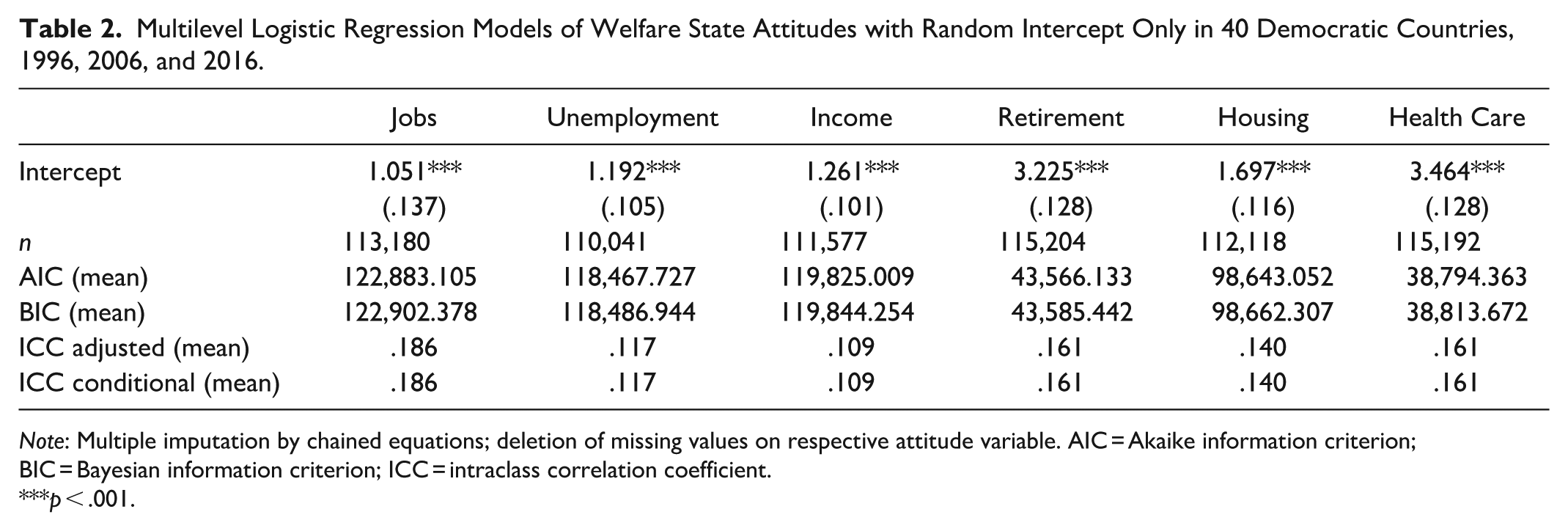
Note: Multiple imputation by chained equations; deletion of missing values on respective attitude variable. AIC = Akaike information criterion; BIC = Bayesian information criterion; ICC = intraclass correlation coefficient.
p < .001.
Next, we gauge variation in the two main independent variables. Figure 1 presents the percentage foreign born among the population and the percentage female of the foreign born in 1996, 2006, and 2016 for each of the 40 democratic countries participating in the respective ISSP wave. The share of the foreign-born population ranges from less than 1 percent (e.g., 0.4 percent in Bulgaria in 1996, 0.3 percent in the Philippines in 2006) to close to 30 percent (e.g., 29.1 percent in Switzerland in 2016, 28.1 percent in Australia in 2016). Similarly, around the 50.2 percent average for the female share of the immigrant population, there is substantive variation, ranging from a low of 39.3 percent in the Dominican Republic in 2006 to a high of 60.8 percent in Latvia in 2016.
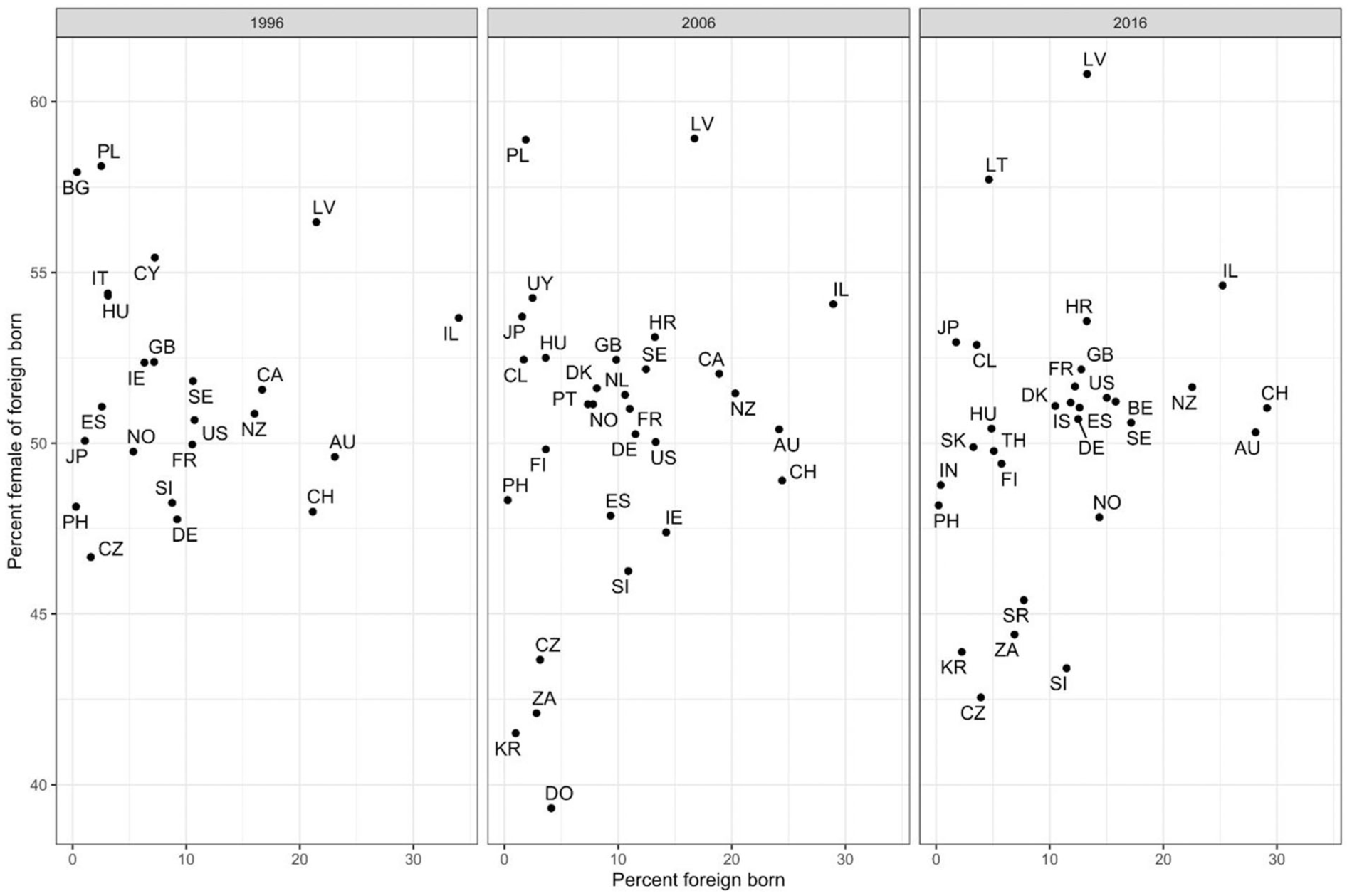
Percentage foreign born and percentage female of foreign born for 40 democratic countries, 1996, 2006, and 2016.
Figure 1 also illustrates that the size and composition of the foreign population varies substantially within countries. Although this variation is largely along one variable for some countries (e.g., Australia in 1996, 2006, and 2016, respectively: percentage foreign born, 23.1 percent, 24.2 percent, and 28.1 percent; percentage female of foreign born, 49.6 percent, 50.4 percent, and 50.3 percent), other countries experience variation along both variables (e.g., Latvia in 1996, 2006, and 2016, respectively: percentage foreign born, 16.7 percent, 21.5 percent, and 13.3 percent; percentage female of foreign born, 58.9 percent, 56.5 percent, and 60.8 percent). This also applies on a smaller range to the United States in 1996, 2006, and 2016, respectively: percentage foreign born, 10.7 percent, 13.3 percent, and 15.0 percent, and percentage female of foreign born, 50.7 percent, 50.0 percent, and 51.3 percent. On the whole, there is sufficient variation in the main independent variables to test the hypotheses both from a cross-sectional and a longitudinal, within-country perspective.
Turning to the models, we first test whether the inconsistent associations between the size of the immigrant population and support for social policy reported in the literature replicate in our expanded sample. Using multilevel logistic regression hybrid models, we predict each of the six outcomes from the country average of percentage foreign born (BE), deviations from this mean (WE), and the individual level controls and year indicators. In each model, we include a set of random slopes for relevant individual-level predictors determined by an iterative process to ensure the efficiency of the country-level predictors (Heisig et al. 2017). We present and discuss the process and the slopes in the Supplementary Material.
Table 3 shows the estimates from these models. The first set of focal coefficients is the within-country estimates (WE) for percentage foreign born. Half of these coefficients point in a negative and half in a positive direction. Only one of each reaches levels of statistical significance as conventionally defined with magnitudes between a tenth and a third of the effect of one standard deviation in income. This contrasts with the between-country estimates (BE) for percentage foreign born for which coefficients uniformly point in a negative direction. However, also the majority of these fail to attain statistical significance. In sum, these models align with the mixed results in the existing literature that do not support the uniform negative effect of immigration on social policy support as originally posited by the generic hypothesis.
Multilevel Logistic Regression Models of Welfare State Attitudes on Percentage Foreign Born, Individual-Level Predictors, and Year Fixed Effects in 40 Democratic Countries, 1996, 2006, and 2016.

Note: Multiple imputation by chained equations; deletion of missing values on respective attitude variable. AIC = Akaike information criterion; BE = between effects; BIC = Bayesian information criterion; WE = within effects.
p < .05. **p < .01. ***p < .001.
The question motivating our hypotheses is whether and how the immigrant population’s gender composition moderates the association between immigration and social policy support. To begin addressing this question, we test whether the immigrant population’s gender composition might confound this association. As Table 4 shows, adding the percentage female of the foreign-born population as within and between predictors to the models does not alter the general trends observed for the coefficients for percentage foreign born. Moreover, the coefficients for percentage female of foreign born resemble those of the percentage foreign born in that there are both negative and positive estimates and most fail to attain statistical significance. This suggests that the mixed results for the association between percentage foreign born and social policy preferences reported in the literature do not seem to be due to confounding by the gender composition of the immigrant population.
Multilevel Logistic Regression Models of Welfare State Attitudes on Percentage Foreign Born, Percentage Female of Foreign Born, Individual-Level Predictors, and Year Fixed Effects in 40 Democratic Countries, 1996, 2006, and 2016.

Note: Multiple imputation by chained equations; deletion of missing values on respective attitude variable. AIC = Akaike information criterion; BE = between effects; BIC = Bayesian information criterion; WE = within effects.
p < .05. **p < .01. ***p < .001.
The two qualified hypotheses we develop advance the arguments that the share of women among immigrants should increase the detrimental effect of immigration on support for the welfare state (hypothesis 1, immigrant women as demographic threat) or decrease it (hypothesis 2, immigrant men as criminal threat). To test these hypotheses, we add the interaction of the immigrant population’s size and its gender composition as within and between coefficients in the models. The corresponding results in Table 5 provide strong support for the intuition that the gender composition of the immigrant population moderates the association between immigration and welfare state support. The within coefficients for percentage foreign born, percentage female among foreign born, and their interaction together consistently predict the six policy preferences, revealing evidence of a uniform relationship between immigration and support for social policies. Failing to account for the moderating role of the gender composition obfuscates this relationship. The results also lend further support to the earlier indication from Table 3 that within-country variation in immigrant populations across time more consistently predicts individuals’ social policy preferences than those between countries. 5
Multilevel Logistic Regression Models of Welfare State Attitudes on Percentage Foreign Born, Percentage Female of Foreign Born, Interaction of Both, Individual-Level Predictors, and Year Fixed Effects in 40 Democratic Countries, 1996, 2006, and 2016.

Note: Multiple imputation by chained equations; deletion of missing values on respective attitude variable. AIC = Akaike information criterion; BE = between effects; BIC = Bayesian information criterion; WE = within effects.
p < .05. **p < .01. ***p < .001.
As a whole, these results support the idea that the immigrant gender composition is moderating the association between the immigrant stock and social policy preferences as both within coefficients and their interaction have consistent directions across all six models. However, the raw coefficients from these models do not allow an intuitive assessment of whether increasing shares of women among immigrants strengthen or, conversely, reduce the negative association between immigration and social policy support as posited by hypotheses 1 and 2, respectively.
To assess the substantive impact of the interaction effect and thus adjudicate between the immigrant women as demographic threat and immigrant men as criminal threat hypotheses, we compute predicted probabilities. To offer a realistic interpretation, we limit predictions to the area of empirical support defined by the variation observed in both percentage foreign born and percentage female of foreign born between waves. We set categorical covariates to their modes and continuous ones to their means, considering the case of a 48.6-year-old, full-time employed, female respondent with secondary education and mean income from the United States, as an exemplary case, in 2006. The Supplementary Material provides alternative visualizations for Sweden and Germany. On the basis of this specification, we derive predicted probabilities and standard errors from 5,000 bootstraps that encompass all sources of error in our sample preparation and analysis from imputing missing values to model fitting.
Figure 2 shows the mean predictions for supporting each of the six social policies across the observed change in percentage foreign born between waves (−5.06 percent and 7.91 percent) for two scenarios corresponding to the observed maximum increasing (+3.64 percent, black) and decreasing (−4.98 percent, gray) percentage female of foreign born. The prediction lines for the two scenarios diverge noticeably, reflecting the interaction effect between the size of the immigrant population and the share of women among that population. The 95 percent confidence intervals based on the bootstrapped standard errors corroborate this interpretation. This also demonstrates that the results from Table 5 hold within the area of empirical support.
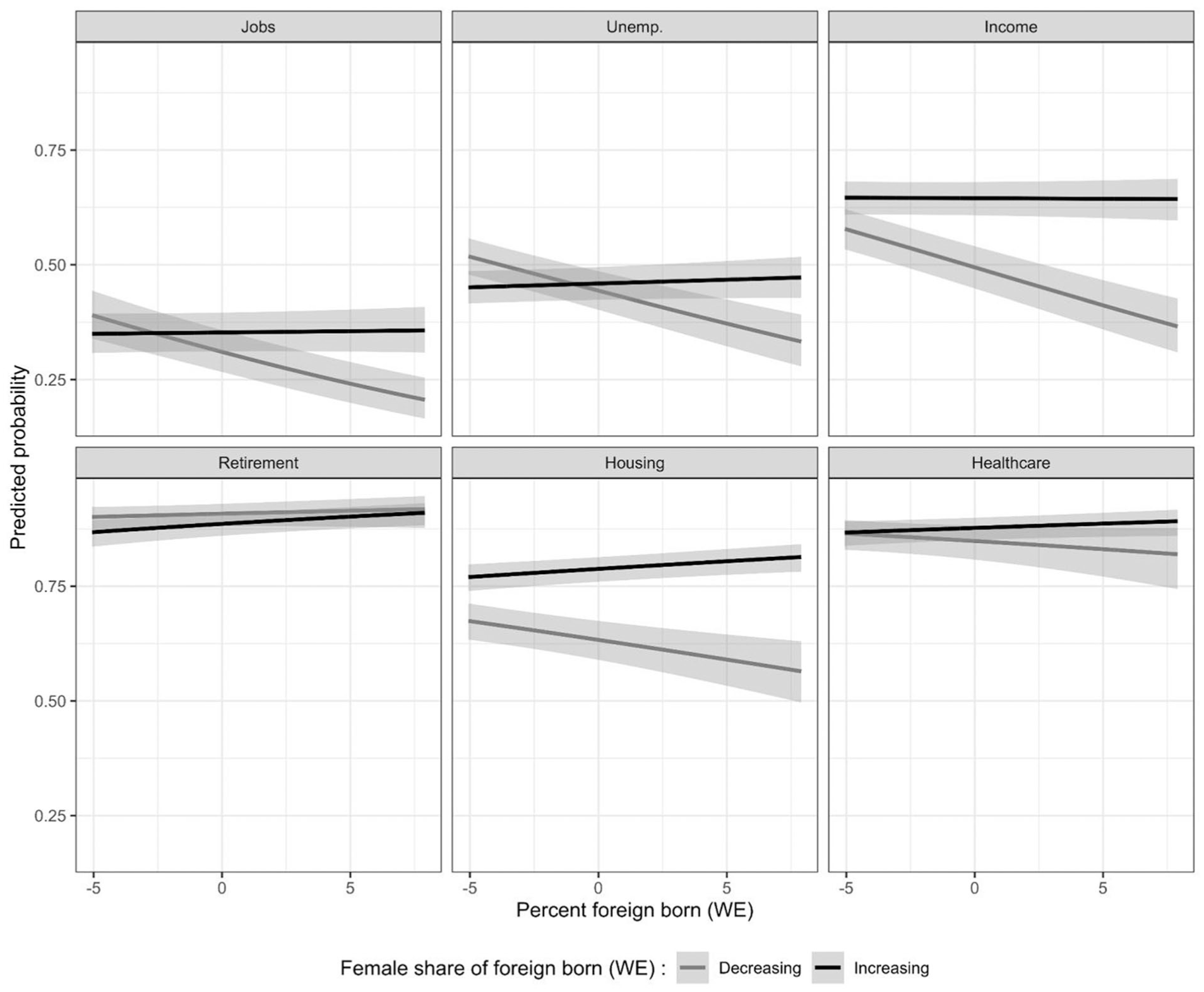
Predicted probabilities of welfare state attitudes at minimum and maximum of observed change between waves of female share of foreign born.
Focusing first on the scenario where the share of women among the immigrant population increases (black lines), we observe that increases in the percentage foreign born (>0) lead to slightly higher predicted probabilities, whereas decreases (<0) lead to slightly lower predicted probabilities for supporting social policies for all but one outcome. This provides evidence against hypothesis 1 (immigrant women as demographic threat). Substantively this translates to, for example, an approximately 78 percent probability of supporting the government providing a decent standard of housing for those who cannot afford it when the share of women among immigrants increases while the overall share of immigrants remains unchanged, compared with an approximately 81 percent probability when the share of immigrants increases by 5 percent, an increase seen in several countries over the study period, including the United States, Norway, and Spain. This pattern is less pronounced but still noticeable for support for government provision of health care which increases from about 88 percent to 90 percent probability in this scenario.
Conversely in the scenario of a decreasing share of women among the immigrant population (gray lines), increases in the percentage foreign born predict lower probabilities of supporting social policies and decreases higher predicted probabilities for five of six outcomes. Taking support for the government ensuring a decent standard of living for the unemployed as an example, we find a decrease from approximately 47 percent to 37 percent as the share of immigrants increases by 5 percent and the share of women among them decreases. Under the same conditions, support for the government providing job opportunities declines from about 31 percent to 24 percent. In sum, although the magnitude of the effect varies depending on the specific policy, with especially the retirement outcome least affected, the predicted probabilities from our models provide consistent support for hypothesis 2 (immigrant men as criminal threat), which holds that larger immigrant populations predict reduced support for social policies as the share of women among the immigrant population decreases.
Robustness Checks
We conduct several robustness checks of our main results from Table 5. We test the sensitivity of our results to confounding from potentially relevant individual- and country-level characteristics and compositional characteristics of the immigrant population related to their potential labor market involvement, the welfare state capacity of their origin countries, and cultural compatibility (Figure A.2); the potential of confounding by welfare state regimes (Table A.16); the possible influence of country outliers (Figure A.3); estimating models with only rich democracies (Table A.11); probing the assumed homogeneous time trends across countries, accounting for possibly diverging trends in the former Eastern bloc (Table A.12); varying model specifications (social policy support as six ordinal items and continuous factor scale, Tables A.14 and A.15) and estimating alternative, two-way fixed effects models (Table A.13); and replicating the analysis in European Social Survey data showing substantively similar results (Table A.9). We detail these results in the Supplementary Material.
Discussion
Analyses of ISSP data from 40 democratic countries reveal that inconsistent findings on the generic hypothesis, which suggests that immigration weakens welfare state support, can be clarified in part by considering the gender composition of immigrant populations. Previous research found mixed associations between immigration and social policy preferences, but when allowing the gender composition to moderate that association, a consistent pattern emerges. This pattern aligns with concerns over “deviant immigrant men,” with larger immigrant populations predicting reduced social policy support as the share of women among them decreases. Earlier mixed results for the generic hypothesis might thus partly be explained by an increasing share of immigrant women in line with the “feminization of migration” thesis (Donato and Gabaccia 2015).
The results we present shed further light on the link between immigration and welfare state support. First, we find that within-country variation in the immigrant population size and composition affects social policy support, while differences between countries do not. This aligns with previous efforts using two-way fixed-effects models to isolate the effect of immigration on social policy preferences (Brady and Finnigan 2014; Breznau et al. 2022), but only becomes evident in the hybrid models used here. Within-country variation in the immigrant population consistently predicts social policy support, whereas differences between countries appear as largely unrelated to it. This suggests that people primarily respond to changes in their own country’s immigrant population rather than to absolute levels or comparisons with other countries (Czymara 2020; Meuleman et al. 2009; Steele 2016).
Second, not all social policy preferences are equally susceptible to immigration across all countries, pointing to the potential role of targeting (Skocpol 1992) and deservingness schemas (Fox 2004). Support for most policies declines markedly with growing immigrant populations that become more male. This trend is particularly pronounced in labor market contexts aligning with some prior work (cf. Alt and Iversen 2017; Burgoon et al. 2012) but less so for health care and old age care provision. This difference might stem from preferences for universal social policies benefiting the broader population over policies targeting specific vulnerable subgroups (Brady and Bostic 2015; Korpi and Palme 1998). In line with this, health care and old age care are the two social policy areas for which respondents most widely and consistently favor a role for government with above 80 percent across almost all countries and waves (see Figure A.1) which might limit the analytic power to recover immigration’s impact on them.
Beyond the breadth of beneficiaries, these differences may also reflect cultural beliefs about deservingness (Bloemraad et al. 2019; van Oorschot 2006) and how people become beneficiaries of these policies (Brady 2019; Homan, Valentino, and Weed 2017). Exploring heterogeneity among social policies across countries along these and other lines—by for example, also expanding the scope to include policies targeting university students 6 —could offer further insights into immigration’s connection to social policy support and broader notions of solidarity.
Although our results help clarify inconsistencies in the existing literature, they have limitations. First, participants with a personal or family migration background, either themselves or through their parents, might react differently to immigration in ways influenced by the gender composition of immigrant populations. This could be especially pertinent if the prevalence of such individuals in the survey mirrors the share of the immigrants in the population. Unfortunately, ISSP data lack information on respondents’ migration backgrounds. However, using ESS (2020) data, we replicated our results and ascertained their robustness in models accounting for participants’ immigration backgrounds (see Table A.9). This does not rule out that respondents’ migration backgrounds could affect the relationship between immigration and social policy preferences, but gives us confidence that this potential confounding does not substantively shape our results.
Second, we carefully specified our models to regress social policy preferences on immigrant population characteristics from the year prior. This supports the interpretation that the associations we find reflect effects of immigration on social policy preferences rather than the reverse. However, because of the observational nature of the data, we cannot completely discount the possibility that individuals’ social policy preferences might directly or indirectly influence immigration patterns. Insofar as individuals that prefer a more supportive state also favor open migration policies, our results could be seen as a conservative estimate of the effect of male-skewed immigration on social policy support.
Third, our models assume uniform time trends in immigration and social policy preferences across countries (Auspurg et al. 2019). However, it is possible that events like the Great Recession influenced preferences in different countries differently or that larger migration events affected some countries more than others. In examining our outcomes and systematically limiting the country sample (see “Robustness Checks” in the Supplementary Material), we found some variation across countries meriting further investigation but no evidence supporting concerns of broadly differing timing trends. Interestingly, when focusing on only rich democracies, our main results pattern becomes even more pronounced (see Table A.11). Although we thus cannot dismiss the potential impact of differing time trends, the indications we find suggest they might actually dampen rather than drive the association between immigration and social policy support.
Fourth, although our analyses produce the patterns predicted by the immigrant men as criminal threat hypothesis, our measures of immigration share and composition do not directly capture perceived immigration preventing us from disentangling the role of gendered immigrant tropes. The literature we reviewed suggests that perceptions of immigration influence policy preferences and that media representations more so than in-person contact shape these perceptions in line with official statistics (Herda 2015; Lind and Meltzer 2021). However, the data are not suited to distinguish between these mechanisms. Similarly, the lack of measures of immigrant tropes in the ISSP limits our insights to the impact theoretically associated with the predominance of the “deviant immigrant men” trope. Future research should use data on perceived immigration and immigrant tropes from dedicated surveys or public discourse (cf. Blinder 2015; Van Klingeren et al. 2014) to investigate how people make sense of its societal impact, and consider the role of both personal and mediated exposure to immigration in shaping the pattern we report.
Despite these limitations, our results have important implications for the scholarship on immigration and welfare state support, for broader scholarship on immigration, and for social and immigration policy. First, we offer a theoretically grounded explanation for the inconsistent findings in the literature, showing a consistent link between immigration and social policy support across democratic societies. Specifically, larger immigrant populations predict reduced support for social policies as the share of women among the immigrants decreases. The scholarship informing the immigrant men as criminal threat hypothesis would suggest that this negative association is driven by gendered tropes posing distinct immigration threats and our results support this interpretation. Although supporting the role of conflict as a relevant mechanism linking immigration and welfare state support, it prompts reconsiderations of whether racial and ethnic fractionalization is the primary driver as originally theorized (Alesina and Glaeser 2004; Brooks and Manza 2008).
In addition to illuminating immigration’s impact on social policy support, our findings carry implications for broader immigration research. Scholars often use overall numbers or proportions of foreign-born individuals to measure immigration. However, as our results demonstrate, treating immigration as a monolithic phenomenon can yield inconclusive results by overlooking relevant heterogeneity of the immigrant population. This might help explain why studies on the size of immigrant populations and perceived threat or anti-immigration attitudes have not found consistent connections (Hjerm 2007; Pottie-Sherman and Wilkes 2017) or why the ethnic competition hypothesis for radical right voting has limited support (Rydgren 2008). Importantly, gender is only one dimension that this scholarship should consider. Other factors include age (Bansak et al. 2016; Schaeffer 2013), education or skills (Hainmueller and Hopkins 2015), cultural or religious background (Adida et al. 2019; Bansak et al. 2016), and migration motive which gender may proxy (Herrera 2013).
Finally, our results point to potential unintended consequences and important reference points for immigration and social policy. Recent shifts in immigration policy favor skill-based over family-based immigration in both traditional immigrant societies such as Canada and Australia (Boucher 2007) and newer destinations such as Europe (Kofman 2014). This trend could lead to imbalanced immigration streams with more immigrant men, as male-dominated fields tend to receive favorable evaluations (Kofman 2014). Our results suggest that such imbalances could weaken welfare state support, potentially compromising social cohesion despite economic gains. Policymakers should consider monitoring how their policies affect gender balances in immigration, not only for equity but also to prevent possible negative societal consequences.
Conclusion
The rise in international mobility has increased foreign-born populations living in democratic countries worldwide. Theoretical predictions that this diversification of populations might undermine popular support for social policies have led to an expanding, yet inconclusive literature. We integrate research on this generic hypothesis with scholarship on immigration attitudes and gendered social and immigration policy. From this integration, we derive theoretical motivations for two qualified hypotheses regarding how the share of women among immigrant populations might moderate the relationship between immigration and social policy support.
Our analyses of three waves of ISSP data from 40 democratic countries indicate that the mixed findings in the literature on the association between immigration and social policy support likely stem from a neglect of the moderating role of the immigrant population’s gender composition. We show that accounting for this role reveals a consistent pattern aligning with a dominant trope of “deviant immigrant men” posing a criminal threat. Specifically, increasing immigrant populations predict reduced support for social policies as the share of women among the immigrant population decreases. This highlights the potential for immigration to undermine necessary welfare policy support, contingent on the demographic composition of immigrant populations
Supplemental Material
sj-docx-1-srd-10.1177_23780231251400402 – Supplemental material for Immigration and Public Support for Social Policy: Accounting for the Gender Composition of Immigrant Populations
Supplemental material, sj-docx-1-srd-10.1177_23780231251400402 for Immigration and Public Support for Social Policy: Accounting for the Gender Composition of Immigrant Populations by Achim Edelmann, Friedolin Merhout and Amie Bostic in Socius
Footnotes
Acknowledgements
The authors would like to thank Merlin Schaeffer, Peter Thisted Dinesen, Mads Meier Jæger, and Stephen Vaisey, the editor and reviewers for constructive comments and suggestions as well as the organizers and participants of the 2022 ASA Session on Parameters of Support for the Welfare State, the University of Copenhagen Quantitative Methods Club, and the MZES “European Societies and their Integration” Colloquium for productive discussions.
Authors’ Note
Achim Edelmann and Friedolin Merhout contributed equally to this work.
Supplemental Material
Supplemental material for this article is available online.
2
Whereas the theoretically relevant concept is gender, data are available only for the sex composition of immigrants. Although this is an imperfect solution, we therefore must take the latter as an indicator of the former.
3
We thank a reviewer for this suggestion.
4
The theoretical mechanisms outlined above pertain primarily to native respondents. Inconsistent availability of this information in the ISSP prevents us from accounting for this. Insofar as immigrants’ own social policy preferences can be expected to be less responsive to immigration dynamics, the focal estimates should be considered conservative. Additionally, robustness checks controlling for respondents’ immigration background on the basis of European Social Survey data suggest that confounding due to this is negligible (see  ).
).
5
In contrast to only 3 between coefficients, 15 of 18 within coefficients attain conventional levels of statistical significance. For the within coefficients that do not meet conventional cutoffs, this seems to relate to ceiling effects as the comparison with multilevel ordinal logistic regression results suggests (cf. ).
6
We thank a reviewer for this point.
Author Biographies
References
Supplementary Material
Please find the following supplemental material available below.
For Open Access articles published under a Creative Commons License, all supplemental material carries the same license as the article it is associated with.
For non-Open Access articles published, all supplemental material carries a non-exclusive license, and permission requests for re-use of supplemental material or any part of supplemental material shall be sent directly to the copyright owner as specified in the copyright notice associated with the article.
