



Abstract
Conventional views of turnover intentions emphasize job dissatisfaction as a fundamental determinant. The authors investigate how generalized perceptions of most other workers’ quality of working life moderate the relationship between job satisfaction and turnover intentions. Using two nationally representative surveys of American workers from November 2023 and June 2024 (n = 7,500), the authors confirm a negative association between personal job satisfaction and turnover intentions. The authors then discover, however, that the generalized perceptions of the quality of working life attenuate that negative association. The likelihood that satisfied workers report turnover intentions increases when they perceive that most others have high job satisfaction, good management-employee relations, secure jobs, fair pay, and meaningful work. These patterns hold net of personal job qualities. The authors discuss the implications of these findings for turnover cognitions and action and interpret the patterns within the frame of social comparison processes and generalized perceptions of the labor market.
“Taking everything into consideration, how likely is it you will make a genuine effort to find a new job with another employer within the next year?” For decades, social scientists have posed that question to workers to gauge their attachment or commitment to the organization, as well as their aspirations for job mobility (Bolt, Winterton, and Cafferkey 2022; Geurts, Schaufeli, and Rutte 1999; Halaby 1988; Halaby and Weakliem 1989; Lee 2009). The answers to that question tend to reflect the latter stages of a cognitive process associated with workers’ personal calculation of the likelihood of voluntary turnover (Steel and Ovalle 1984). Moreover, turnover intention is ultimately a strong predictor of actual job exit (Aquino et al. 1997; Griffeth, Hom, and Gaertner 2000; Hendrix et al. 1998). Organizations and employers therefore find themselves in a more favorable position to enhance retention when their employees respond “not at all likely” to the question of whether they are seriously contemplating their own departure.
The dynamics surrounding turnover, and narratives about its key determinants, reached a fever pitch during the period from 2021 through 2023. That was the period of the so-called great resignation, a term Anthony Klotz, a professor of management at University College London’s School of Management, coined to describe the steep upward trend of workers leaving their jobs (Cohen 2021). This era unfolded within a rapidly transforming labor market characterized by the rise of remote work, the growth of the gig economy, and a general shift toward more fluid employment relationships (Ashford, George, and Blatt 2007; Eni et al. 2023; Glavin, Bierman, and Schieman 2021). In such a context, where traditional organizational ties may be weakening, we argue workers may rely more, not less, on generalized perceptions of the external market to calibrate their own career decisions. Yet much of the turnover literature is built on models developed in an era of more stable, conventional employment.
In the turnover literature, a set of central “push factors” (e.g., bad management-employee relations, job insecurity, inadequate compensation, lack of meaningful work) are often touted as predicting the likelihood of a job change (Trevor 2001). But scholars have also identified job satisfaction as ultimately playing the most consequential role (Dickter, Roznowski, and Harrison 1996; Lee et al. 1999; Mobley et al. 1979). Tett and Meyer (1993) observed that job satisfaction involves “one’s affective attachment to the job viewed either in its entirety (global satisfaction) or with regard to particular aspects (facet satisfaction: e.g., supervision).” The main thesis is that unfavorable job conditions reduce job satisfaction. In turn, dissatisfied workers are more likely to contemplate a job change (Hom and Griffeth 1995; Steel and Ovalle 1984; Tett and Meyer 1993). It seems logical then for employers to expect greater retention when their employees express high levels of satisfaction.
Most of the narrative related to the personal causes of the Great Resignation identified job dissatisfaction as the main culprit, suggesting that most workers were discontented and eager to make a change (Gallup 2021; HR Executive 2021; Pew Research Center 2022). A counterargument, however, is that the great resignation was driven largely by relatively satisfied workers seeking better opportunities (Kruse and Tata-Mbeng 2023; Thompson 2021; Weinstein and Hirsch 2023). To our knowledge, most models of turnover tend to overlook this possibility because they focus on how favorable labor market contexts unshackle dissatisfied workers. Although the traditional turnover literature emphasizes the unemployment rate as a proxy for job availability, this approach neglects another potentially crucial dimension: employees’ perceptions of the quality of working life in the broader labor market. Our research therefore shifts the focus to these subjective assessments, providing a novel test of how individuals’ perceptions of most other workers’ evaluations of their job qualities influence the relationship between individuals’ personal job satisfaction and their turnover intentions.
This perspective reveals an alternative dynamic in which highly satisfied employees, rather than their dissatisfied counterparts, may be more aware of and sensitive to perceived improvements in working conditions across the labor market. Potentially driven by upward social comparisons, these satisfied workers may exhibit a greater propensity to consider a job change in pursuit of even better opportunities. This pattern contrasts sharply with traditional models of turnover, where job dissatisfaction is typically characterized as the primary catalyst for departure intentions, especially in favorable labor market contexts (Trevor 2001). In their classic formulation of turnover, for example, March and Simon (1958) identified job dissatisfaction as the core driver behind what they called the “perceived desirability of movement” in the processes of greater voluntary turnover. As we describe below, however, our discovery that dissatisfied workers are less responsive to broader market quality perceptions suggests different mechanisms may be at play than those proposed in conventional job availability/perceived desirability frameworks. Our study therefore contributes to knowledge about the long-standing relationship between personal job satisfaction and turnover intentions by investigating the role of individuals’ estimates of the generalized quality of working life in the population. We see a crosswalk here to what Halaby (1988) described as the “search decision process” in which workers’ initial screen of potential jobs shapes their propensity to exit: “Few would contest the idea that the decision to change jobs is guided by the information available [italics added] to workers about their job and market position” (p. 22). Halaby’s phrase “information available” is central to our thinking about the potential relevance of individuals’ perceptions of most other workers’ experience. More favorable perceptions potentially signal that individuals imagine a higher quality of working life “out there” in the population that corresponds to a better job market (Trevor 2001).
With this background in mind, we organize our study as follows. First, we replicate the well-established negative association between job satisfaction and turnover intentions, showing that people who are satisfied are the least likely to contemplate a job change, while those who dissatisfied are most likely to be considering an exit. Then we extend the scope of analyses by asking: How do generalized perceptions of job qualities modify that association? We evaluate five aspects of the generalized perceptions of the quality of working life: (1) job satisfaction, (2) the quality of management-employee relations, (3) job security, (4) pay evaluations, and (5) meaningful work. Figure 1 summarizes the basic analytical framework that guides our study. Our argument predicts an interactive model in which individuals’ perceptions of the overall quality of working life moderate the association between personal job satisfaction and turnover intentions. To test our ideas, we developed novel survey items and fielded them in two nationally representative surveys of working Americans with assistance from the public opinion research firm YouGov in November 2023 (n = 5,000) and June 2024 (n = 2,500).

Analytical framework.
Theory and Hypotheses
Turnover decisions are influenced by a combination of individual, organizational, and external labor market conditions (Bolt et al. 2022). At the individual level, employees’ psychological attachments through job satisfaction and job embeddedness fundamentally influence retention, while organizational factors such as work culture, leadership, and human resources practices create the context within which these individual decisions unfold. External labor market conditions can amplify or constrain these individual and organizational factors (Trevor 2001). During periods of economic expansion, low unemployment rates and abundant job opportunities may lower the perceived risks of job transitions, encouraging employees to act on any level of dissatisfaction with their current position (Hom et al. 1992). Conversely, economic downturns and limited job alternatives may lead employees to remain in their positions despite organizational dissatisfaction, a phenomenon known as “job lock” (Huysse-Gaytandjieva, Groot, and Pavlova 2013). Yet this emphasis on objective market measures may overlook employees’ subjective perceptions of the quality of working life. Despite its potential significance in shaping turnover intentions, this perceptual aspect of labor market evaluation remains understudied.
For us, the question becomes: For whom do these perceptions of the broader quality of working life matter most—the personally satisfied or the personally dissatisfied? Drawing from social comparison theory, we argue that the perceived quality of working life matters most for satisfied workers. Social comparison theory, first proposed by Festinger (1954), posits a fundamental human drive to evaluate one’s own opinions and abilities by comparing oneself to others. Although this foundational work focused on the drive for accurate self-evaluation, subsequent scholarship revealed that individuals also engage in social comparisons for motives of self-improvement and self-enhancement (Buunk et al. 1990; Gerber, Wheeler, and Suls 2018; Zuckerman and O’Loughlin 2006).
We propose that these different motives become salient depending on workers’ own level of job satisfaction. For dissatisfied workers, the immediate focus is on their current negative circumstances, making them less sensitive to broader market perceptions. For satisfied workers, however, who have already met their basic job needs, the motive for comparison may shift from mitigating dissatisfaction to pursuing aspirational growth. They are in a better position to make comparative evaluations about what they might attain in the broader labor market. For these workers, perceiving that most others have high-quality jobs can trigger upward social comparisons aimed at self-improvement: a “fear of missing out” (FOMO) on even better opportunities. This perspective reframes the turnover impulse among the satisfied not as an escape, but as a form of status striving. In some respects, this scenario might also reflect a job-specific version of FOMO. Despite their favorable personal evaluations of their own job qualities, a high level of job satisfaction does not necessarily prevent this group from perceiving a relative gap between their own situation and an idealized standard of quality in other workplaces. Perceiving most others as having equally or even better working conditions might trigger a sense of status striving or FOMO on potential advantages like better pay, more benefits, or enhanced work-life balance. By extension, rather than experiencing relative deprivation as social comparison theory might predict (Olson and Hazelwood 2014), individuals with higher job satisfaction may engage in upward social comparisons as a means of self-improvement and growth (Wood 1989). For these workers, their own high level of job satisfaction might facilitate a view beyond immediate needs to consider aspirational possibilities in the broader labor market. And when they perceive a more generalized set of favorable conditions, it signals optimism.
We recognize, however, that the relationship between generalized perceptions and job satisfaction is not unidirectional. Perceptions of others’ positive work experiences can shape one’s own satisfaction by altering expectations and reference points, a dynamic central to self-discrepancy theory (Higgins 1987; Jiang, Klein, and Saunders 2011) and classic definitions of job satisfaction (Locke 1969). It follows that perceiving a thriving external market might heighten one’s expectations, potentially reducing personal satisfaction if one’s current job falls short. Although our model tests a specific moderating pathway (see Figure 1), we acknowledge that job satisfaction is itself a dynamic evaluation, susceptible to the very market perceptions we study.
We see this perspective as reflecting more of an “opportunity-pull” process than an “escape-push” process. Workers who are personally satisfied but still consider making a job change might reflect a degree of status striving—and their estimates of a positive quality of working life and job market amplify those aspirations for getting more. In some respects, not making a job change may fuel a form of status enhancement FOMO. Thus, although relative deprivation (via upward social comparisons) is more commonly found among disadvantaged groups (Olson and Hazelwood 2014), in the context of turnover-related processes, upward social comparisons may be more likely among satisfied workers, fueling a subtle form of relative deprivation and a drive for even better circumstances. This may make satisfied workers more sensitive to generalized perceptions of the quality of working life compared with those who are potentially pondering an exit of poor conditions. On the basis of these ideas, we propose the following:
The optimistic job prospects hypothesis: More favorable generalized perceptions of the quality of working life will attenuate the negative relationship between personal job satisfaction and turnover intentions.
This optimistic job prospects hypothesis is a more positive vision of turnover (“opportunity-pull”) than the one that is often portrayed in the media (“escape-push”). On the other side of this equation, however, perceptions of the generalized quality of working life might matter less for dissatisfied workers in poorer job conditions. Workers who are personally dissatisfied with their own job may be less likely to engage in such comparative assessments; the processes of upward social comparisons may matter less to them. Their focus might instead be more directed to escaping current unfavorable circumstances than on weighing nuanced quality differences in external opportunities. In other words, personal job discontent might override any influence of the estimation of what most other workers think or feel about their job. Some prior theory and evidence reinforce this idea, finding that the dissatisfaction-turnover relationship is attenuated but still evident when regional unemployment is low (Bannister and Griffeth 1986; Hom, Griffeth, and Sellaro 1984). We therefore suspect that for those with high dissatisfaction and who perceive their own jobs as having more unfavorable job qualities (e.g., poor management-employee relations, job insecurity, feeling underpaid, and the lack of meaningful work), relative deprivation may have less weight in turnover considerations. Stated more concretely within the framework of our focal associations, among personally dissatisfied workers with poorer personal job qualities, the generalized perception of how most other workers feel about their job might matter less. On the basis of these ideas, we hypothesize the following:
The dissatisfaction override hypothesis: The influence of the generalized perceived quality of working life will matter less for turnover intentions among workers who themselves have less favorable qualities in their own working life.
Methods
Samples
To test our hypotheses, we analyze data from our two Measuring Employment Sentiments and Social Inequality studies (MESSI I and MESSI II). We fielded MESSI I (n = 5,000) from October 26 to November 27, 2023. We then fielded MESSI II (n = 2,500) from May 30 to June 21, 2024. We contracted the services of the public opinion research firm YouGov to help lead our data collection efforts. For both samples, YouGov began by matching respondents to a target sampling frame separated into strata of gender, age, race, education, and voting registration. The target sampling frame is a stratified random sample of employed residents in the United States from the 2019 American Community Survey public use microdata file. To ensure representativeness of population on at least one characteristic, the voting behavior of the sampling frame is supplemented by public voter file records, the 2020 Current Population Survey Voting and Registration supplements, the 2020 National Election Pool exit poll, and the 2020 Current Employment Statistics surveys, including demographics and 2020 presidential vote. These supplementary surveys allow a more accurate representation of the expected 2020 presidential vote choice, employment status, and demographics of the population. For each member of the target sample, YouGov selected one or more matching members from their pool of opt-in respondents who are as similar as possible by employing a proximity matching method. This method calculates the overall distance between the attributes of respondents in their pool and the target frame to select the respondents closest across a range of attributes. These matched respondents in YouGov’s pool constitute the actual sample of workers we analyze.
We also use the probability weighting constructed by YouGov analysts to adjust for any deviations of our sample from the sampling frame. The weights are constructed by using logistic regression to estimate the propensity score of age, gender, race/ethnicity, years of education, and region in predicting inclusion in the sample. The propensity scores were grouped into deciles of the estimated propensity score in the frame and poststratified according to these deciles. The weights were then poststratified on the expected 2020 presidential vote choice, employment status, as well as a four-way stratification of gender, age, race, and education of employed workers, to produce the final weights. For the analyses presented here, we combined the two samples for a total analytical sample of 7,500. Some analyses reported below use data from the combined two samples (in those instances, we adjust for the survey wave). Other sections of our analyses, however, use either MESSI I or MESSI II data depending on whether the focal variables of interest were included in those respective questionnaires.
Measures
We focus on five core facets of job quality: job satisfaction, management-employee relations, job security, pay, and meaningful work. Our selection was theoretically driven, as these dimensions are consistently identified in the sociological and organizational literatures as fundamental components of overall job quality and key drivers of work-related attitudes, including turnover (e.g., Kalleberg 2011; Spector 1997). We selected established items from well-regarded national and international surveys, including the General Social Survey (GSS) and the International Social Survey Programme (ISSP).
Turnover Intentions
We asked a single item that has been included in a range of different surveys, including the GSS (National Opinion Research Center 2018) and the National Study of the Changing Workforce (Families and Work Institute 2008): “Taking everything into consideration, how likely is it you will make a genuine effort to find a new job with another employer within the next year?” Response choices are “not at all likely,” “somewhat likely,” and “very likely.” We created a dichotomous variable such that “not at all likely” is coded 0 and “somewhat likely” and “very likely” are combined and coded 1. For ease of interpretation in our interaction models, we present results using this dichotomous variable. In separate analyses, however, we demonstrate that the pattern of results holds when using the original polytomous scale in supplementary ordinal logistic regression models (see Table A in the Appendix).
Job Satisfaction
We asked a single-item standard measure of job satisfaction that originally appeared in the classic Quality of Employment Surveys in the 1970s (Quinn et al. 1974) and has appeared every four years since 2002 in the GSS’s Quality of Worklife Module (National Opinion Research Center 2018). It asks, “All in all, how satisfied would you say you are with your current job? Would you say very satisfied, somewhat satisfied, not too satisfied, or not at all satisfied?” We combined responses to “not too satisfied” and “not at all satisfied” and label those individuals as “dissatisfied,” comparing them to the “very satisfied” and the “somewhat satisfied.”
Using the same wording as the personal job satisfaction item, to measure generalized perceptions of others’ satisfaction, we then asked,
How satisfied do you think most American workers are with their job? Even if you’re unsure, we’re interested in your best guess. Would you say most American workers are very satisfied, somewhat satisfied, not too satisfied, or not at all satisfied?
In our questionnaire, we positioned the personal job satisfaction and most others’ job satisfaction items adjacent to each other but randomized the order in which they appeared.
The Quality of Management-Employee Relations
We used a single item from the Work Orientations module of the ISSP to measure the quality of management-employee relations: “In general, how would you describe relations in your workplace between management and employees?” Response choices are: “very good,” “quite good,” “neither good nor bad,” “quite bad,” and “very bad” (ISSP Research Group 2015). To ease comparisons in our analyses, we recoded responses into the following dichotomy: “neither good nor bad,” “quite bad,” and “very bad” (coded 0) versus “quite good” and “very good” (coded 1). We then followed up with another question about the generalized perception of the quality of management-employee relations in the working population with the following question: “How do you think
Job Security
We used a single item from the Work Orientations module of the ISSP that asks, “How much do you agree or disagree with this statement? My job is secure.” Response choices are: “strongly agree,” “agree,” “neither agree nor disagree,” “disagree,” and “strongly disagree” (ISSP Research Group 2015). To facilitate comparisons in our analyses, we recoded the responses into the following dichotomy: “neither agree nor disagree” “disagree,” or “strongly disagree” (coded 0) versus “agree” or “strongly agree” (coded 1). We then followed up with another question about the generalized perception of the job security in the working population with the following question: “How do you think
Pay Evaluations
We used a modified item adopted from the GSS (National Opinion Research Center 2018) that asks, “When you think about the pay you get for your work, do you feel you are . . . .” Response choices are “underpaid a lot,” “underpaid a little,” “paid about right,” “overpaid a little,” and “overpaid a lot.” To ease comparisons in our analyses, we recoded the responses into the following dichotomy: “paid about right” (coded 0) versus “underpaid a little” and “underpaid a lot” (coded 1). We then followed up with another question about the generalized perception of pay evaluations in the working population with the following question: “How do you think
Meaningful Work
We used a single item from the GSS to measure respondents’ perceptions of meaningful work: “I find my work to be very meaningful.” Response choices are: “strongly agree,” “agree,” “disagree,” and “strongly disagree” (National Opinion Research Center 2018). To facilitate comparisons in our analyses, we recoded the responses into the following dichotomy: “disagree” and “strongly disagree” (coded 0) versus “agree” and “strongly agree” (coded 1). We then followed up with another question about the generalized perception of meaningful work in the working population with the following question: “How do you think
Control Variables
We adjust for a standard set of control variables that include gender (men = 0, women = 1), race (dummy coded as White versus Black, Hispanic, other), age (coded in years), marital status (comparing married and common-law vs. nonmarried), education (comparing less than college with those with a BA degree or more), personal income (coded in income brackets shown in following tables), occupation (comparing professional and technical occupations with a range of other categories such as higher administration, clerical, sales, service, production and labor, and farming), salaried (vs. hourly or paid some other way), and union status (coded 1 for member of union or collective agreement vs. 0 for not).
Plan of Analyses
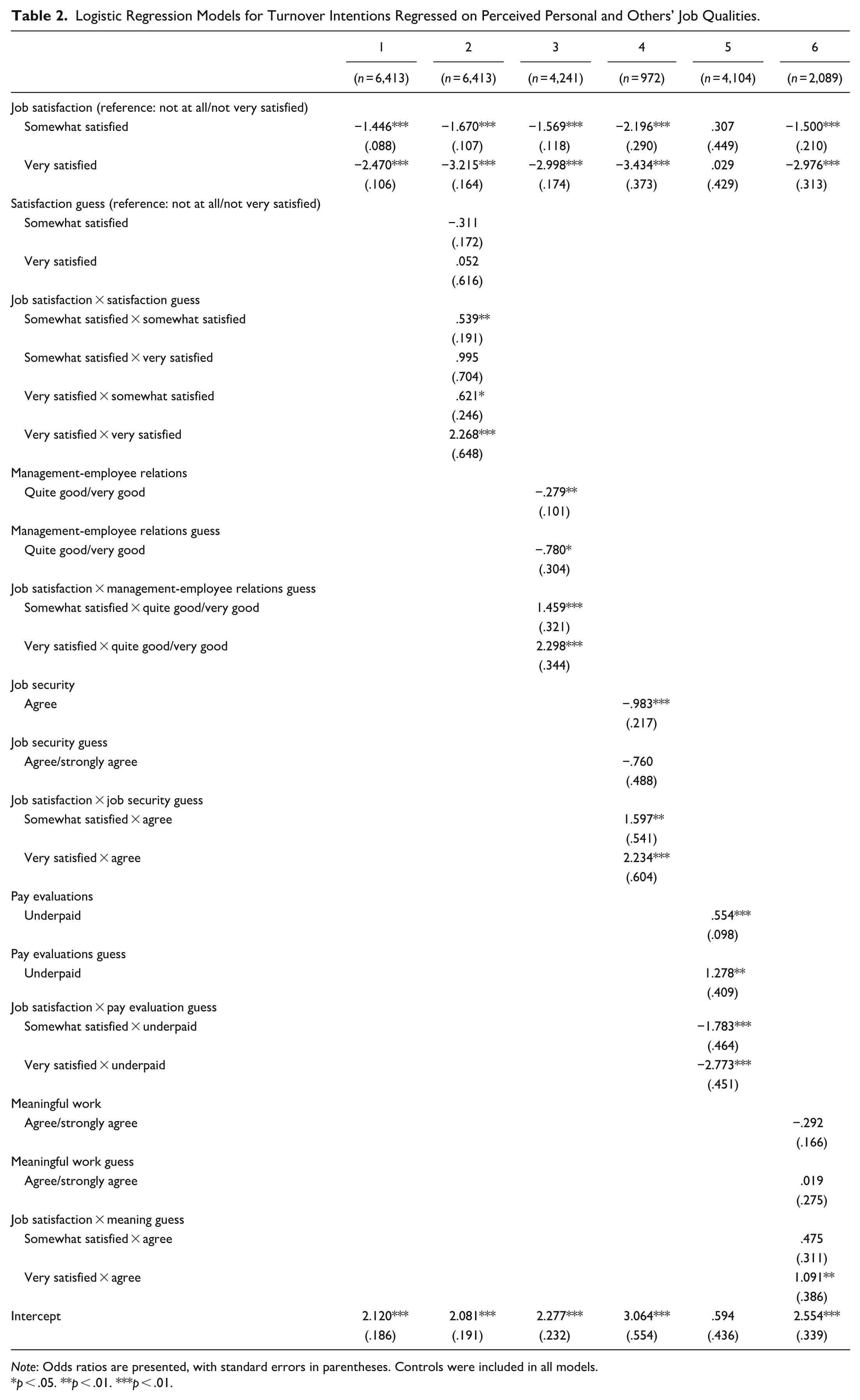
We first present a summary of the descriptive statistics for the focal variables in our study. Then, moving to the multivariate analyses to test our hypotheses, we present our findings in a series of columns in Table 2. Note that these are not sequential models but rather separate sets of analyses based on different segments of the two samples. With turnover intentions as a dichotomous dependent variable, we use logistic regression techniques to test our models, all of which include the full set of control variables. For the sake of brevity and ease of presentation of all the interaction coefficients, however, we do not show the results for the control variables (available in online appendices). In the first model of the presented results, we replicate the strong negative association between personal job satisfaction and turnover intentions. We include this baseline model to establish the overall focal association from which we assess the influence of our hypothesized set of moderators. Then, we turn to a set of models in which we test interactions between personal job satisfaction each of the following perceptions or estimates of the quality of working life in the general working population: job satisfaction (model 2), the quality of management-employee relations (model 3), job security (model 4), pay evaluations (model 5), and meaningful work (model 6).
As we mentioned in our description of the samples, when we fielded MESSI I and MESSI II, we did not include all the questions about each of these estimates in both surveys. Only MESSI I and MESSI II included the perceptions of most other workers’ level of job satisfaction, which therefore allows us to test the interaction term in both surveys. By contrast, in MESSI I only, we included the questions about individuals’ perceptions of most others workers’ quality of management-employee relations and pay evaluations. In MESSI II only, we included the questions about individuals’ perceptions of most other workers’ job security and meaningful work. Note that the analytical sample size for job security is smaller because we only asked a random half of the MESSI II sample the perception of most other workers’ job security. We use a series of figures to present each interaction effect, illustrating how the generalized perceptions moderate the negative relationship between job satisfaction and turnover intentions.
Results
Descriptive Summary of Focal Variables
Table 1 provides the basic descriptive statistics for all study variables. First and foremost, it shows that 59.1 percent of workers were not at all likely or not very likely to consider a job change, while 40.9 percent were somewhat likely or very likely to make a change. As expected, moving further away from the 2021–2023 period of the Great Resignation, the percentage of workers who were considering a job change was slightly lower at 38.1 percent in June 2024 (MESSI II) compared with 42.9 percent in November 2023 (MESSI I).
Weighted Proportions by Survey.

Note: MESSI = Measuring Employment Sentiments and Social Inequality.
Table 1 shows that overall levels of job satisfaction are mostly stable between the two different surveys, with 29.2 percent of the total describing themselves as “very satisfied” and another 50.4 percent saying that they are “somewhat satisfied.” Only 20.4 percent of American workers report being either “not too satisfied” or “not at all satisfied” with their job. By contrast, however, most study participants perceive that most other American workers are not as satisfied: 48.8 percent perceive that most other workers are “not too satisfied/not at all satisfied,” while only 6.8 percent perceive that most others are “very satisfied.” These statistics confirm what others have documented about the sizable gap between how people feel about their own jobs compared with what they perceive most others feel about their jobs (Glavin and Schieman 2025).
Moving down the list of the quality of working life, Table 1 shows that most workers (56.7 percent) characterize the quality of management-employee relations in their workplace as “quite good” or “very good,” while a small minority (21.9 percent) perceive that most other workers would characterize the quality of management-employee relations as positively. Similarly, most workers (70.5 percent) “agree” or “strongly agree” that their own job is secure, but fewer (32.6 percent) perceive that most other workers share this same level of job security.
Although 61.8 percent of workers personally feel underpaid in their own workplace, 89.3 percent perceive that most others feel underpaid; conversely, while 33.9 percent feel paid appropriately, a meager 9.4 percent perceive that most others share that same sentiment. And for meaningful work, we document a similar perception gap: 75.3 percent “agree” or “strongly agree” that their own work is very meaningful, but only 51.1 percent perceive that most other workers would respond similarly to the question about meaningful work.
Multivariate Analyses and Hypotheses Tests
The results shown in column 1 of Table 2 reinforce the well-established negative association between job satisfaction and turnover intentions, with those who report personally being “somewhat satisfied” or “very satisfied” with their job as significantly less likely to be contemplating turnover compared with those who are “not too satisfied/not at all satisfied” (the omitted reference category in all analyses). Figure 2 illustrates a pattern that is consistent with prior research. As a side note, MESSI I and II show similar associations between personal job satisfaction and turnover intentions, so we only report the overall pattern in the pooled sample.
Logistic Regression Models for Turnover Intentions Regressed on Perceived Personal and Others’ Job Qualities.
Note: Odds ratios are presented, with standard errors in parentheses. Controls were included in all models.
p < .05. **p < .01. ***p < .01.

The relationship between personal job satisfaction and turnover intentions.
From this baseline model, one might conclude that the “very satisfied” are the least likely to contemplate a job change, but that conclusion is qualified once we consider individuals’ perceptions of most other workers’ experience of the quality of working life. Columns 2 through 6 test each of the five perceptions about the generalized quality of working life as moderators.
Starting with column 2 in Table 2, we find a statistically significant interaction between personal satisfaction and the perceived estimate of most other workers’ job satisfaction level (labeled “satisfaction guess” in the table). Although three of the four interaction terms shown in column 2 are statistically significant, the personal/most others “very satisfied” interaction term stands out as the strongest. To facilitate the interpretation of these interactions, we illustrate the predicted patterns in Figure 3. First, among those who perceive that most other workers are “somewhat satisfied” or “not too/not at all satisfied,” we observe the same strong negative association between personal job satisfaction and turnover intentions that we documented in column 1 and Figure 2. By contrast, however, we document a significantly weaker negative association between personal job satisfaction and turnover intentions among those who perceive that most other workers are “very satisfied,” as indicated by the top (weaker) slope in Figure 3. Also note that among those who are “not too satisfied/not at all satisfied,” perceptions of others’ satisfaction do not matter for differentiating their predicted levels of turnover intentions.

The relationship between personal job satisfaction and turnover intentions across levels of generalized perceptions of others’ job satisfaction.
In column 3 of Table 2, we observe a statistically significant interaction between personal job satisfaction and perceptions of the quality of management-employee relations. Both interaction terms with personally “somewhat satisfied” or “very satisfied” are significant, with the stronger effect observed for those who are personally “very satisfied” and perceive good quality management-employee relations. Figure 4 confirms the negative association between personal job satisfaction and turnover intentions among those who perceived that most other workers have bad or ambiguous management-employee relations. By contrast, however, the perception that most other workers have good management-employee relations weakens the negative association between personal job satisfaction and turnover intentions, as indicated by the top (weaker) slope in Figure 4. Also, once again, among those who are “not too satisfied/not at all satisfied,” perceptions of most others’ quality of management-employee relations do not matter for differentiating their predicted levels of turnover intentions.

The relationship between personal job satisfaction and turnover intentions across levels of generalized perceptions of others’ management-employee relations.
Next, in column 4 of Table 2, we observe a statistically significant interaction between personal job satisfaction and generalized perceptions of job security. Both interaction terms for the “somewhat satisfied” and “very satisfied” by good job security are significant. This indicates that the generalized perception that most other workers have good job security weakens the negative association between personal job satisfaction and turnover intentions. Figure 5 illustrates how these findings further reinforce the other patterns that we have reported thus far.

The relationship between personal job satisfaction and turnover intentions across levels of generalized perceptions of others’ job security.
As shown in column 5 of Table 2, the significant interaction between personal job satisfaction and generalized perceptions of pay evaluations indicates that believing most other workers are paid appropriately weakens the negative association between personal job satisfaction and turnover intentions. As before, however, among individuals who think most others feel underpaid, the negative association between job satisfaction and turnover intentions manifests. Figure 6 illustrates the patterns.
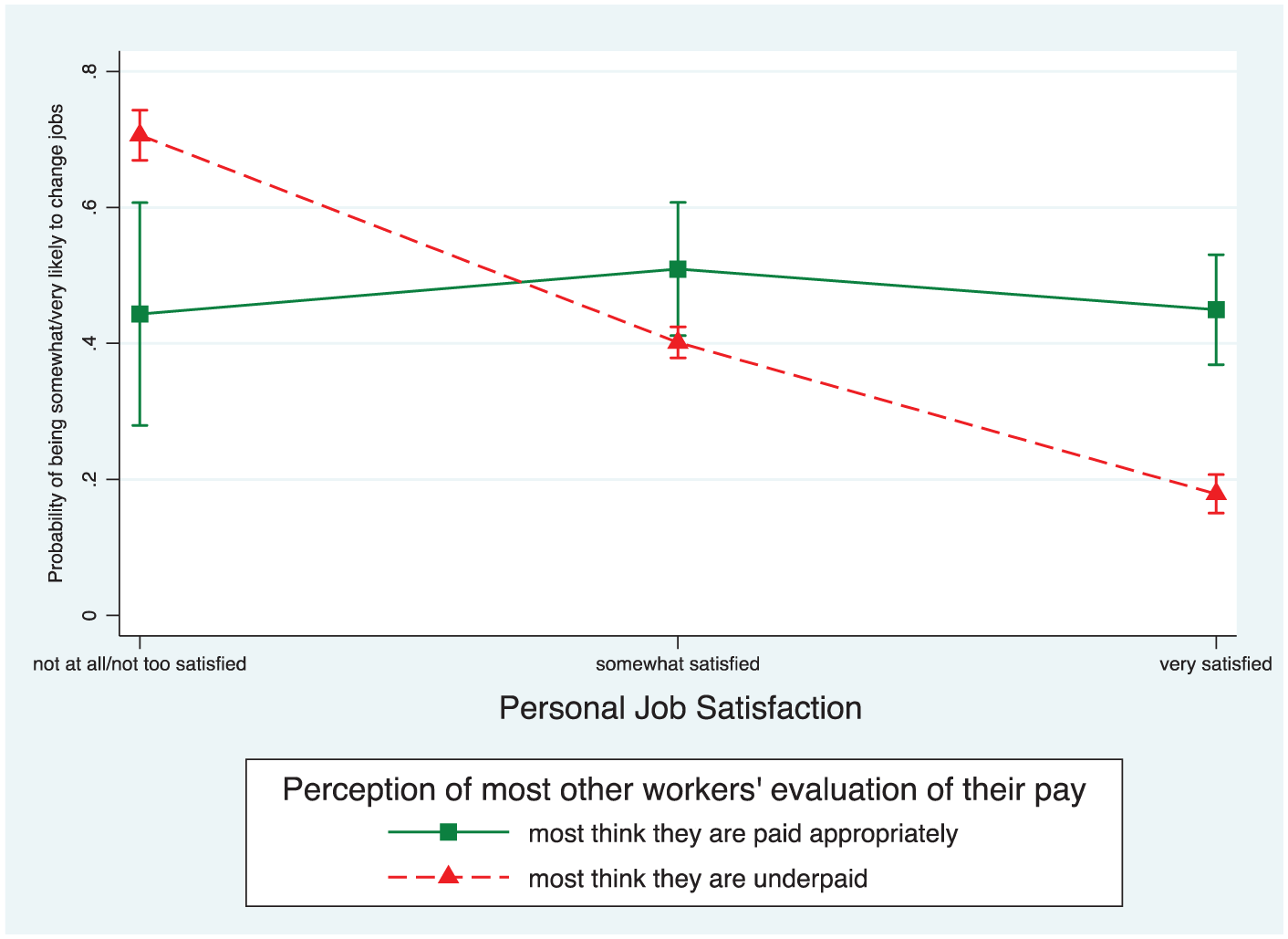
The relationship between personal job satisfaction and turnover intentions across levels of generalized perceptions of others’ evaluations of their pay.
Finally, as shown in column 6 of Table 2 and Figure 7, we replicate the negative association between personal job satisfaction and turnover intentions among those who hold the generalized perception that most others do not have meaningful work. By contrast, however, the generalized perception that most others find their work meaningful weakens that negative association between personal job satisfaction and turnover intentions.
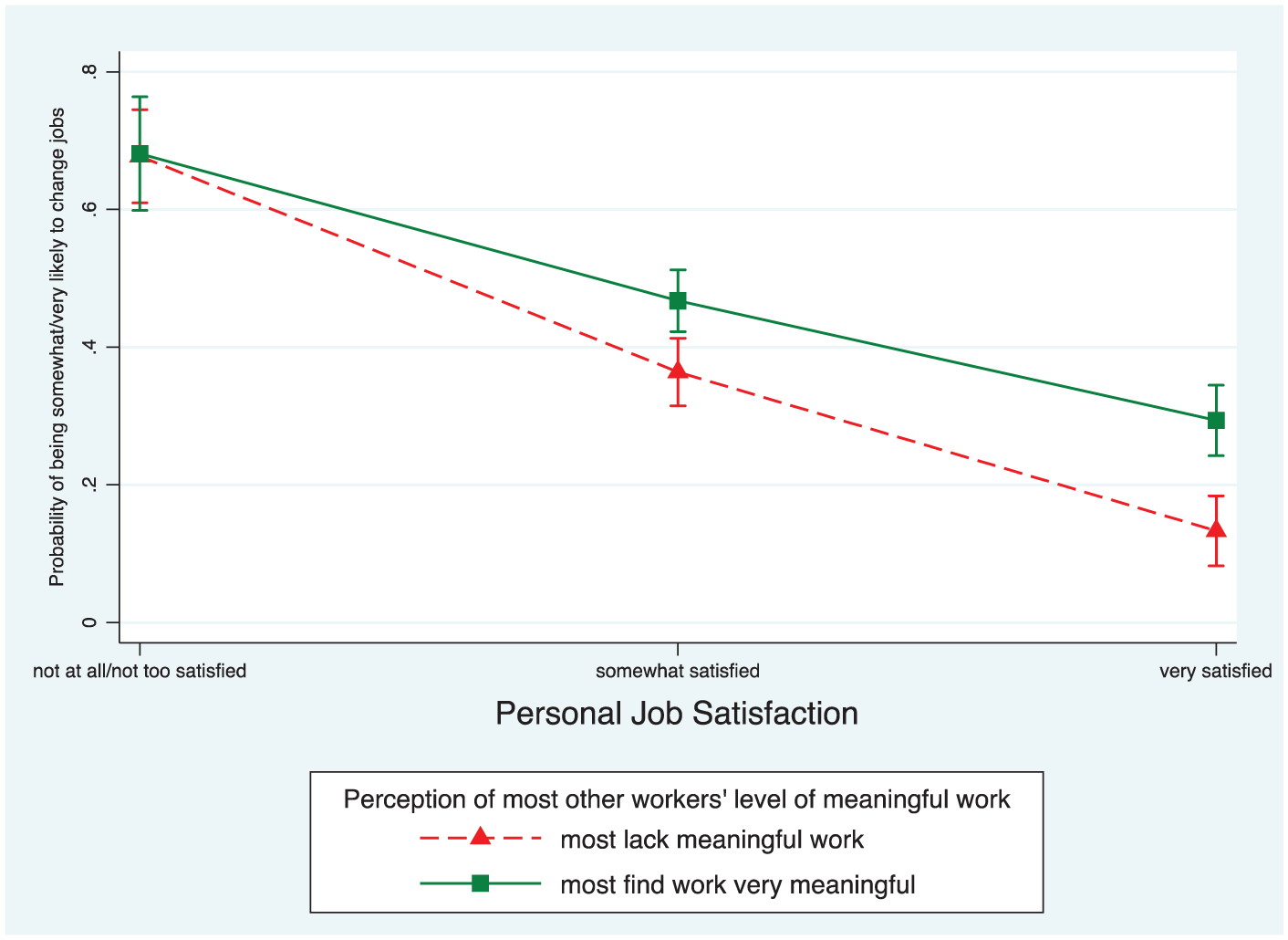
The relationship between personal job satisfaction and turnover intentions across levels of generalized perceptions of others’ meaningful work.
Collectively, our findings demonstrate that workers who are personally “somewhat satisfied” or “very satisfied” with their jobs tend to have an elevated likelihood of considering a job change if they believe most other workers tend to experience the following: (1) high job satisfaction, (2) good management-employee relations, (3) more job security, (4) appropriate compensation, and (5) meaningful work. As a set, these patterns demonstrate that individuals’ perceptions of the generalized quality of working life have important implications for the dynamics involved in turnover intentions. On average, satisfied workers who think that most other workers experience these favorable qualities of working life are themselves more likely to consider a job change. Importantly, in each instance, the interaction terms held relatively steady even when we adjusted for personal levels of each of those other job qualities and the generalized perception of job satisfaction levels in the working population.
Discussion
Prior research demonstrates a clear and strong relationship between personal job satisfaction and turnover intentions, and we replicate that overall pattern here. Simply put, more satisfied workers tend to be less likely to consider making a job change. From an employer’s standpoint, that signals the importance of keeping employee satisfaction high. Our study, however, makes a novel contribution to this well-established association by situating it within a set of other perceptions, mainly, the ways that individuals estimate how most other American workers experience a variety of different indicators of the quality of working life. We find that the overall negative association between personal job satisfaction and turnover intentions is weakened among individuals who report more favorable estimates about how most other workers would rate each of the following: job satisfaction, quality of management-employee relations, job security, pay, and meaningful work. Importantly, each of these patterns holds net of individuals’ personal experiences/ratings of these qualities in their own jobs as well.
From one perspective, we might characterize a favorable view of the quality of working life as something positive: in contemporary parlance, that there are generally “good vibes” about work. And that stands in opposition to the so-called “vibecession” that found its way into popular narratives about generalized perceptions of work and economic life. If most people estimate that most other workers are embedded in work roles with good management-employee relations, decent job security, fair pay, and meaningful work, and that most people are satisfied with their job, then that represents a better overall quality of life in society. And yet, as our study demonstrates, these same favorable perceptions play out in ways that might also be seen as negative if we define higher turnover intentions as an undesirable outcome. Most of the literature frames high turnover in this negative light given its association with a range of other negative outcomes (Spector and Jex 1991; Trevor 2001). Moreover, given the costs of worker attrition, employers might understandably seek to minimize it, especially if they have invested resources to boost worker satisfaction. We therefore discover an important dynamic: The generalized perceptions of a good quality of working life represents the desirability of other jobs in the labor market, but that ultimately can have consequences related to the retention of satisfied workers. To be sure, however, we are not suggesting that the elevated turnover intentions among the highly satisfied translate into actual job change. The degree that those who express turnover intentions actually end up exiting is beyond the scope of this study.
Overall, job satisfaction is associated with lower turnover intentions, but that link is weakened when highly satisfied workers hold certain perceptions about the quality of work for most others. On one hand, it might seem like an unfavorable circumstance when highly satisfied workers are more seriously contemplating their departure from an organization. On the other hand, the willingness of highly satisfied workers to leave when they are optimistic about quality work likely depends on the capacity of other employers to persuade them to stay or to leave. Hence, the higher turnover among these workers may not be a negative dynamic but rather one driven by a market capacity to provide attractive job opportunities. This dynamic reflects a notable shift in the psychological contract between workers and employers. Decades ago, less flexible work arrangements and more linear career paths may have fostered greater organizational loyalty (Kalleberg and Marsden 2015). In today’s more fluid labor market, characterized by remote work, portfolio careers, and project-based “gigs,” workers are arguably more attuned to external market signals (Sultana and Malik 2019). Their willingness to leave a good job for a potentially better one suggests that employers are not just competing with each other for talent, but with an increasingly transparent and attractive open market.
We alluded to the possibility of social comparison dynamics being relevant in the processes behind our discoveries. This is only speculative because we did not measure explicit social comparison dynamics but rather infer them, for example, from the juxtaposition of personal job satisfaction evaluations and the generalized perceptions of how most other workers would evaluate their own job satisfaction. In this framework, downward social comparisons (e.g., personally feeling very satisfied but estimating that most others are dissatisfied) should diminish turnover intentions. The downward social comparison translates into a more negative impression of the generalized quality of working life—and the desirability of the job market. In the case of workers who report being very satisfied but also perceive a broadly favorable quality of working life, it is possible that subtle upward comparisons are still operating in the ways that we described earlier as an instance of FOMO and status enhancements. Again, however, more research is needed to further understand those underlying dynamics and their ultimate outcomes. In this respect, the social comparison element of our argument parallels our characterization that generalized perceptions of the quality of working life reflect the desirability of the labor market and optimism about status enhancement in the event of an actual job change.
Before concluding, a few study limitations deserve mention. First, the data that we analyze are cross-sectional, so we are unable to make definitive claims about causal ordering. Second, and as we alluded to above, because the association between turnover intentions and actual job exits is generally moderate in strength (Cho and Lewis 2012; Cohen, Blake, and Goodman 2016), we should not assume that very satisfied workers who express greater turnover intentions will actually leave their jobs. It might be that this group has a lower propensity to actually leave their current job given their job contentment. A longitudinal design would help determine the nature of these dynamics over time. Third, our study measures perceptions of a generalized reference group (“most American workers”). Social comparison theory, however, suggests that comparisons with more proximal reference groups—such as colleagues in the same occupation, industry, or social circle—may exert an even stronger influence on attitudes and behaviors. Future research should measure perceptions of more specific reference groups to test whether the effects we identify are heightened, as such comparisons would provide more directly relevant information for an individual’s “search decision process” (Halaby 1988). Fourth, our model could be expanded to account for other contextual factors. For instance, one might argue that job insecurity is a primary driver of turnover intentions, regardless of satisfaction levels. To address this, we conducted supplementary analyses controlling for workers’ job insecurity and found our main interaction effects remained robust and statistically significant (see Table A). Nevertheless, future research should explore how the dynamics we identify might differ across sectors with different levels of employment stability. Fifth, our study does not account for nonwork factors that could shape turnover, such as family needs and dual-career household negotiations. Future research that integrates work-family dynamics might enhance understanding of how job mobility interacts with other key domains. Finally, any discussion of the “vibecession” and gaps between personal-public perceptions, and their links to how people behave, would be improved by an integration of broader economic conditions or perceptions of the economy. In separate analyses (not shown), we have tried to address this by also assessing evaluations of individuals’ own personal financial circumstances (e.g., financial strain) versus how they perceive most other American workers are faring, as well as cost of living measures more generally. Interestingly, neither of these elements played out as moderators in the same way as the five indicators of the quality of working life do in our analyses. We see the next step in our own research as doing a deeper analytical dive into different elements of personal and public economic circumstances, as well as a range of social inequality indicators, to evaluate the ways that people think and behave when it comes to turnover.
Conclusion
Our findings complicate the prevailing assumption that voluntary turnover is chiefly the province of the dissatisfied. By introducing generalized perceptions of the quality of working life into the turnover literature, we show that the negative association between personal job satisfaction and turnover intentions is contingent on how workers think most other workers are faring. In favorable perceptual climates—where most others are believed to enjoy high satisfaction, good management relations, job security, fair pay, and meaningful work—the apparent protective effect of personal satisfaction against turnover intentions diminishes. The implication is not that satisfaction ceases to matter, but that its influence is refracted through a worker’s perception of the work situations of those around them or in the population more generally.
This reframing highlights a shift from a primarily “push” model of turnover, rooted in the relief of dissatisfaction, toward an “opportunity-pull” model that is equally relevant for the already contented. In doing so, it underscores the interaction between individual attitudes and collective perceptions. The satisfied worker, far from being insulated from mobility considerations, may be especially attuned to upward social comparisons and aspirational opportunities in an era where labor market signals are more visible, credible, and immediate than in earlier periods of more stable employment.
For employers, this is both a warning and an opportunity. Retention strategies that rely solely on internal improvements to job quality risk overlooking the pull of an attractive external market. In contexts where high-quality opportunities appear abundant, even well-treated employees may contemplate departure, not because of internal failings but because the broader market offers plausible pathways for further improvement. Addressing this challenge requires more than satisfaction maintenance; it demands engagement with the external reference frames through which employees evaluate their options. This may involve transparent career progression pathways, proactive communication about competitive positioning, and the cultivation of organizational identities that are not easily replicable elsewhere.
Theoretically, our study connects turnover research to social comparison processes in ways that suggest new avenues for inquiry. We have inferred rather than directly measured social comparison mechanisms, but the pattern we observe is consistent with subtle upward social comparisons—what we have described as a form of status striving or FOMO—that can emerge even among those who express high satisfaction with their current roles. Future work should unpack these dynamics by measuring social comparison orientations explicitly, considering more proximate reference groups, and tracking how market perceptions interact with job satisfaction over time to shape actual mobility. In a labor market characterized by high transparency, fluidity, and porous organizational boundaries, the loyalty of satisfied employees can no longer be assumed. Retention, in this context, is as much about managing the allure of “elsewhere” as it is about eliminating the discontent within organizations.
Supplemental Material
sj-docx-1-srd-10.1177_23780231251397743 – Supplemental material for It’s Not You, It’s the Market: When Satisfied Workers Contemplate Quitting
Supplemental material, sj-docx-1-srd-10.1177_23780231251397743 for It’s Not You, It’s the Market: When Satisfied Workers Contemplate Quitting by Scott Schieman, Alexander Wilson and Paul Glavin in Socius
Footnotes
Funding
The authors disclosed receipt of the following financial support for the research, authorship, and/or publication of this article: Social Sciences and Humanities Research Council of Canada (435-2020-1125; PI: Scott Schieman).

Supplemental Material
Supplemental material for this article is available online.
Author Biographies
References
Supplementary Material
Please find the following supplemental material available below.
For Open Access articles published under a Creative Commons License, all supplemental material carries the same license as the article it is associated with.
For non-Open Access articles published, all supplemental material carries a non-exclusive license, and permission requests for re-use of supplemental material or any part of supplemental material shall be sent directly to the copyright owner as specified in the copyright notice associated with the article.
