




Abstract
Military veterans are a population granted special status and access to programming when entangled in the criminal legal system. Given this preferential treatment, the author evaluates whether veteran status is associated with risk for recidivism after a focal incarceration spell and whether racial/ethnic identity mediates this association. Using more than 15 years of population data (n = 58,028) from the Pennsylvania Department of Corrections (2007–2022), the author fits Cox regression models to evaluate if veteran status is associated with recidivism risk. Bivariate results show that veterans have an 18 percent lower hazard of recidivism than nonveterans (p < .001). When full controls are added, the veteran indicator is insignificant, suggesting that selection characteristics and institutional experiences explain most of the differences in reintegration success. However, interacting veteran status and racial/ethnic identity results in a statistically significant higher hazard of recidivism for Hispanic veterans compared with all other groups (p < .001). These findings suggest that veteran status uniquely disadvantages Hispanic people, such that the probability of avoiding prison readmission looks similar to or worse than that of Black people, a group that suffers disproportionate system contact. In conclusion, this study uses military veterans as a case for understanding how “special populations” navigate systems contact and reentry.
Among individuals with criminal legal system involvement, military veterans are considered to be a “special population” deserving of preferential treatment (Jones 2014). System actors contend that veterans are uniquely traumatized during service, which begets social precarity and subsequent system contact (Piehowski 2025). In other words, more immediate causes of criminal legal system contact—including substance abuse, mental health crises, and aggressive behavior—are thought to result from military service. Because criminal behavior is framed as a negative consequence of a social good, redress is thus considered a social obligation (Finlay et al. 2019; Rowen 2020).
Veterans are thought to be uniquely vulnerable to systems contact because of service-related trauma (Piehowski 2025), but this claim is not clearly substantiated by the research literature. Research consistently finds mixed results when measuring the association between military service and police contact or self-reported offending, even among those with a history of antisocial behavior in adolescence (Bouffard 2005, 2014; Bouffard and Laub 2004; Craig and Connell 2015; Teachman and Tedrow 2016). Although some research reports null effects of military service on any subsequent incarceration (Bruhn et al. 2024; Tsai et al. 2022), others still find that military service is associated with increased risk (Culp et al. 2013).
Scarce research has investigated a separate but related line of inquiry: how quantity of prison time may differ between military veterans and civilians (Logan et al. 2022). The context of incarceration is different for veterans, for two reasons. First, double selection, by the enlistee and the institution, into military service and the timing of service presupposes that veterans may be characteristically different from the typical profile of an incarcerated individual (Wolf, Wing, and Lopoo 2013). Second, veterans may be treated more favorably by the criminal legal system than civilians with criminal convictions. Leniency toward veterans has been institutionalized through various system levers, including diversion to veterans treatment courts and access to reentry services through the Veterans Justice Program (VJP) (Piehowski 2025). This preferential treatment may limit some of the most onerous and long-term effects of criminal legal system contact, including inability to socially reintegrate (Western and Harding 2022).
In this study, I revisit this question, asking: is military service associated with lower hazard of recidivism? I use more than 15 years of population-level data from the Pennsylvania Department of Corrections (PADOC) to fit Cox proportional-hazards regressions. Bivariate results demonstrate that veteran status is significantly associated with an 18 percent lower hazard of recidivism compared with nonveterans (p < .001). After inclusion of covariates, veteran status is no longer associated with recidivism hazard at traditional levels of statistical significance. I also evaluate if these impacts are mediated by race and ethnic identity. When race/ethnicity is interacted with veteran status, Hispanic veterans have significantly higher recidivism risk than all other groups (p < .001). These findings suggest that veteran status may not protect against subsequent criminal legal system involvement and instead may increase risk for certain racial/ethnic groups. Given limited preexisting evidence of veterans’ experiences navigating incarceration and reentry, this study is itself novel and calls for further research attention to subpopulations afforded special status while entangled in the penal state.
Background
In 2022, the Council of Criminal Justice convened the Veterans Justice Commission, tasked with assessing veterans’ system involvement and the efficacy of system responses (Veterans Justice Commission 2023). Chuck Hagel, chair of the commission and former U.S. secretary of defense, explained the commission’s focus on veterans in a press release:
We are prosecuting and imprisoning veterans while denying them the care and consideration they need and deserve—despite the fact that their criminal justice involvement is often due, at least in part, to their willingness to fight for their country. (Veterans Justice Commission 2023)
This quotation and the aims of the commission exemplify a notion embraced by many policymakers, advocates, and bureaucrats within the criminal legal system: veterans are a special population in the criminal legal system that society is obliged to rehabilitate (Finlay et al. 2019; Piehowski 2025; Rowen 2020). System actors believe veterans are owed redress because their criminal behavior results from service-related traumas, producing a higher “latent risk for offending” compared with nonveterans (Piehowski 2025:1). This belief has so permeated justice system proceedings that veteran status has been formalized as a special class of criminal defendants. For example, legislation at various levels—municipal, state, and federal included—considers military service history a mitigating factor at sentencing (Jones 2014). This social duty of care for so-called traumatized veterans is highly antagonistic to the broader framing of crime in the contemporary judicial system, which places blame on the individual and attributes to them moral failing (Piehowski 2025).
Although policymakers consider veterans to be uniquely vulnerable to systems contact, research has found somewhat mixed results. Of course, much of the relationship between service and later criminal behavior is highly variant by cohort, largely due both to different enlistment standards at time of joining and distinctive features of service during various conflicts (MacLean and Elder 2007). However, once selection characteristics are accounted for, the impact of military service is often null or highly variant across different samples from the same cohort. Research on place-based cohort samples who served in Vietnam has revealed null impacts (Bouffard and Laub 2004) or incompatible results across samples (Bouffard 2014) on the likelihood of any police contact, though service is significantly related to fewer police contacts overall (Bouffard 2003). Research on an early–all-volunteer force (AVF) sample has revealed similar null effects of service on self-reported offending (Bouffard 2005; Bouffard and Laub 2004). Among individuals with histories of youth offending, service at the turn of the century has no impact on later criminal behavior (Craig and Connell 2015). However, Teachman and Tedrow (2016) found that military service during this same period has no effect on arrest and conviction for violent crimes, but significantly reduces that for nonviolent ones, an association driven primarily by those men with prior arrest histories.
Most research on deeper criminal justice involvement like incarceration evaluates how aspects of military service may influence lifetime or later risk for any imprisonment. For example, deployment to combat zones during Operation Iraqi Freedom and Operation Enduring Freedom has no impact on later incarcerations (Bruhn et al. 2024). A nationally representative sample pooled from several cross-sections (1985–2004) demonstrated that service during the AVF era is associated with more than double the odds of incarceration than those with no service, though combat service during the AVF or draft era was found to halve the odds (Culp et al. 2013). Another national sample from 2012 to 2013 revealed null effects of service on lifetime risk for incarceration, though no cohort-specific effects were evaluated (Tsai et al. 2022).
Thus, although veterans are considered a special population particularly vulnerable to criminal legal system contact, a considerable body of research does not firmly substantiate this claim for outcomes of police contact, conviction, and incarceration. However, hardly any research addresses a related question: are veterans, given their preferential status and access to unique resources once entangled in the criminal legal system, better able to evade secondary system contact? A systematic review of empirical research on incarcerated veterans from 2000 to 2022, however, produced no evidence of a “veteran effect” for postrelease outcomes such as recidivism (Logan et al. 2022). Yet as admitted by the authors, there was scant research to be reviewed, as only two studies assessed recidivism by veteran status (Logan, McNeeley, and Morgan 2021; MacDonald et al. 2022). One of these studies was purely descriptive (MacDonald et al. 2022) and included roughly 15,000 men admitted to federal prison facilities between 2014 and 2018. The other used three years (2014–2017) of administrative data from Minnesota (Logan et al. 2021) and revealed no statistically significant difference in recidivism between veterans and a randomly selected nonveteran group of equal size. However, that study was limited by a small dataset; in total, only 673 veterans were released during the period in question, resulting in a sample size of 1,346 matched individuals (Logan et al. 2021). As the authors pointed out, Minnesota has a lower incarceration rate and a less punitive criminal-legal system compared with other U.S. states.
In this study, I revisit this question with a larger state-level sample. I ask, is veteran status associated with risk for recidivism? This research question warrants a revisit given the rapid adoption of veteran-exclusive rehabilitative programming, discussed below, which is presumed on their distinctiveness (Baldwin and Brooke 2019; Rowen 2020). As Logan et al. (2021) noted in their review, “despite the commonly held assumption that ex-servicemembers are ‘unique,’ the body of scholarship used to defend this assertion among veteran inmates is far from resolute” (p. 2). This research strengthens this literature by evaluating if there is a statistically identifiable difference between veterans and nonveterans—a “veteran effect”—in their ability to avoid prison readmission after a focal stint.
Furthermore, a larger dataset also allows me to test a second but related question: does race and ethnic identity mediate the impact of veteran status on recidivism? This question is relevant given that racial/ethnic groups have different underlying risk of military joining and capture by the criminal legal system (Sykes and Bailey 2020). Since the last quarter of the twentieth century, the military has become less personnel intensive and more technologically advanced, requiring fewer soldiers with more skilling (Asoni et al. 2022; Lundquist, Pager, and Strader 2018). As a result, many of the young people who might have previously joined the service—including those with less than high school education, who are disproportionately people of color—no longer have this opportunity. Instead, these people are experiencing incarceration in these early years, which then precludes them from later service (some individuals are granted felony waivers, but these instances are rare; Lundquist et al. 2018; Sykes and Bailey 2020). For the past several decades, Hispanic and Black men have been more likely to experience incarceration than serve in the military by age 25 (Robey, Massoglia, and Light 2023). As a result, military service seems to have the greatest protective effect against any incarceration for those people of color who do serve (Sykes and Bailey 2020), given high relative risk for incarceration in the general population (Tsai, Rosenheck, et al. 2013). Whether people of color experience larger protective effects of military service against a subsequent incarceration has yet to be investigated.
I posit that veterans have an overall lower recidivism hazard than nonveterans, for two reasons. First, veterans are afforded preferential treatment given their special class status in the criminal legal system. As a result, two rehabilitative resources are exclusively available to them. The first, veterans’ treatment courts (VTCs), are county-level diversionary pathways modeled after drug treatment and other “problem-solving” courts (Douds et al. 2017; Huskey 2015). Although VTC programming varies across municipalities, VTCs generally require participants to enter into a guilty plea and agree to intensive probation for approximately 6 to 36 months, which includes regular drug tests and court appearances (Tsai et al. 2018). Although policy experts suggest that specialty courts such as VTCs are best suited to “high-risk” individuals, most served would be considered relatively low risk (Piehowski 2025). VTCs predominantly serve white, middle-aged men with histories of substance abuse or mental illness (McCall, Tsai, and Gordon 2018). Although not every municipality has a VTC, they are fairly common. By December 31, 2022, there were 537 VTCs operating throughout the country, and only four states (Connecticut, Vermont, New Jersey, and Mississippi) had none (National Treatment Court Resource Center 2023).
Although individuals diverted to VTCs for a focal offense are not included in the risk set of my sample, their exclusion may produce differences between the typical offense profile of an incarcerated veteran and nonveteran. Veterans who are tried, convicted, and sentenced to prison may have more serious criminal convictions (or histories) than their nonveteran counterparts, given those with lower risk are diverted to VTCs. Those convicted of violent offenses typically have lower rates of recidivism (Alper, Durose, and Markman 2018), so incarcerated veterans, though they have more serious offense profiles, may be less likely to experience a second prison spell. The limited existing comparisons between veterans and nonveterans suggests that indeed, incarcerated veterans are more likely to have been convicted of violent offenses than counterparts (Maruschak, Bronson, and Alper 2021).
Veterans also benefit from the VJP, an initiative housed in the Veterans Health Administration that partners with judicial systems. The VJP connects justice-involved veterans with necessary social support services, either after incarceration or in lieu of it (Finlay et al. 2016). The VJP consists of two elements: the Veterans Justice Outreach Program (VJO) and Health Care for Re-Entry Veterans (HCRV) (Blonigen et al. 2017; Finlay et al. 2016). The VJO and HCRV serve similar purposes in different settings: in veterans’ treatment courts and jails and in prisons, respectively. Commonly, the VJO works in tandem with VTCs or other problem-solving courts but may act independently if a VTC is unavailable (Tsai et al. 2017). HCRV “provides outreach, assessment, reentry planning, linkage to care services, and time-limited case management with veterans in state or federal prisons, and up to four months after release from these facilities” (Blonigen et al. 2017:793). As of December 2021, VJO specialists served in 623 VTCs or veteran-focused court programs (U.S. Department of Veterans Affairs 2025b), and in 2014, HCRV served incarcerated veterans in 81 percent of U.S. prisons, suggesting that real material resources are assigned to these efforts (Blonigen et al. 2017). Furthermore, Blonigen et al.’s (2017) interviews with 63 VJP specialists demonstrate that resources in navigating substance abuse, joblessness, relationship dysfunction, and antisocial activity are almost universally available across program regions. Research demonstrates that access to adequate social services—such as health care, housing, and employment—are pivotal to reducing criminal legal contact (Hawks et al. 2022; Western 2018). Given that veterans may have more robust access to social services during the reentry period, they may be less likely to recidivate.
Of course, these two examples—the release valve of the VTCs and HCRV programming—are not the only pathways by which preferential treatment for veterans may be occurring. As mentioned previously, veteran status is codified as a mitigating factor at sentencing for many jurisdictions (Jones 2014). Discretionary preferential treatment could be occurring throughout a veteran’s interaction with the criminal legal system, as consequence of the aforementioned privileged class status afforded to them (Jones 2014; Piehowski 2025; Rowen 2020). For example, a veteran might be sanctioned to a halfway house instead of revocation when severe parole violations do occur. These outcomes, in accumulation, could influence the duration and intensity of punitive stays and their later life consequences, such as subsequent incarceration (Anderson et al. 2025). Unfortunately, less material preferential treatment is virtually impossible to detect and so cannot be empirically tested directly. I mention this to better articulate what exactly veteran status is measuring in my study: I use veteran status as a proxy by which to measure preferential treatment of many types, including both tangible rehabilitative services and discretionary decision making.
Second, I posit that veterans are characteristically dissimilar than nonveterans in important dimensions. Although I cannot directly test if alternative reintegration pathways influence recidivism risk, I can test if selection characteristics such as age, race/ethnicity, and criminal offense capture all differences in recidivism between veterans and nonveterans. As previously mentioned, veterans sent to prison may have more serious offense profiles, which may lead to lower recidivism rates. In addition, the typical timing of service may mechanically limit risk for criminal legal system contact. Military service typically occurs at the same time as an individual’s risk for criminal activity is highest. Criminological age-crime curves consistently show that an individual’s likelihood of committing a crime peaks in late adolescence or early adulthood (between 19 and 23 years), after which risk wanes considerably (Farrington 1986; Sampson and Laub 1990). By age 40, risk for committing a new crime is relatively low (Alper et al. 2018). An individual serving in the military has a lower underlying risk for capture by the civilian criminal legal system than a nonmilitary counterpart, not only because of strict surveillance and deprivation of freedoms endemic to military life (Goffman 1961) but also because the military may address crimes during service through its own judicial procedures. The military’s power to adjudicate with sovereignty is exemplified by their record of abstention from trying sexual assault cases (Warner and Armstrong 2020). For this reason, veterans will likely be older at first incarceration than nonveterans and thus older at release than civilian counterparts (if criminal profiles and sentencing are similar). Similar to offense type, age has been shown to be highly predictive of likelihood of recidivism (Piquero et al. 2015).
Finally, I posit that Hispanic and Black veterans will have a lower likelihood of recidivism than their nonveteran counterparts. Research shows that people of color face disproportionate risk for imprisonment (Pettit and Western 2004; Robey et al. 2023). Given that veteran status offers a “protective effect” against any incarceration for young Black men (Sykes and Bailey 2020), it may too protect against subsequent incarceration. More specifically, services offered via the VJP may prove especially vital to people of color, who often come from and reenter historically disadvantaged neighborhoods and communities (Massey 1990).
Data and Methods
The dataset I use is quite novel in its size and time span. I use administrative datasets from PADOC of all prison admissions between January 1, 2007, and October 24, 2022. These datasets, obtained via a data sharing agreement between Boston University and PADOC, include information on incarceration admissions, releases, and institutional outcomes through December 31, 2022. These data include personal-level information on demographic characteristics, offense type and severity, and institutional experiences, including facility transfers, misconduct tickets, administrative custody stays, solitary confinement, and parole hearings (Simes, Western, and Lee 2022). The outcome of interest is recidivism, defined as either prison readmission for a new offense or for violation of supervision conditions.
There are many reasons Pennsylvania serves as an appropriate data source for this research question. On the most basic level, there is a lack of published, state-level incarceration data with measures for veteran status. The most commonly referenced data on incarcerated veterans comes from the Survey of Prisons Inmates, a cross-sectional survey most recently collected almost a decade ago (2016). Less the data reported by Logan et al. (2021) for Minnesota, I know of no other research which provides longitudinal information on incarcerated veterans in a single state. More data of this sort allows interesting interstate comparisons. Furthermore, national data may have inconsistencies (e.g., what counts as a disciplinary sanction or administrative custody may vary across states). The relative uniformity of Pennsylvania administrative data provides a clearer picture of how variables are measured and documented and thus how they should be interpreted.
The state of Pennsylvania is fairly representative of the United States in many respects, and for this reason, may be considered a generalizable “case.” It is the fifth most populous state in the country and slightly whiter than the greater United States, as there are fewer people who identify as Asian or Latino than the national average (U.S. Census Bureau 2025). The Pennsylvania prison system is also large. It was the sixth largest prison system in the country in 2018, though its incarceration rate was relatively close to the national median (366 per 100,000 state residents), a trend consistent with incarceration statistics over the preceding decade (Carson 2020; Simes et al. 2022). The population prevalence of veterans in Pennsylvania is slightly higher than that of the national population in 2017, equaling a little less than 8 percent (U.S. Census Bureau 2025). Last, as of this writing, Pennsylvania has 24 VJP specialists assigned to serve justice-affected veterans in a number of counties and at U.S. Department of Veterans Affairs medical centers (U.S. Department of Veterans Affairs 2025a), suggesting that these reentry services are widely available to incarcerated veterans. In these ways, Pennsylvania is appropriately unexceptional and can be suggestive of larger national patterns and populations.
To model the likelihood of recidivism, I use survival analysis methods, which allow time to be treated as a continuous variable and solves issues of censoring endemic to standard event-history procedures (Allison 1984). First, I create Kaplan-Meier curves to descriptively illustrate the differences in time to recidivism for incarcerated veterans versus nonveterans. Second, I use Cox proportional hazards regressions, a semiparametric modeling strategy commonly used to estimate recidivism, to include additional explanatory variables (for examples, see Logan et al. 2021; Sugie and Newark 2023; and Uggen 2000). To avoid possible endogeneity as a consequence of including multiple incarceration spells in the analysis, I do not use a recurrent event framework. Instead, the analysis estimates time to recidivism after an individual’s release from the first observed incarceration spell only. I estimate the hazard of secondary incarceration as

where hazard ratio, h(t), is a function of a nonparametric baseline hazard over time t (h0[t]), and an exponentiated function of linear predictors. The key predictor for these models is v1, a binary indicator of veteran status. 1 Z′ is a vector of predictors, including demographic characteristics, criminal conviction, and institutional outcomes. I include indicators for racial identity as coded by prison officials (white, Black, Hispanic, or other); a categorical variable for age at release; offense category (drug, property, violent, or other; coded as the most serious offense for which the individual was convicted); history of serious mental illness or intellectual disability (identified through a four-day screening process performed by the PADOC Psychology Department at time of intake; see Simes et al. 2022); and total (logged) years incarcerated. Institutional outcomes include a categorical variable for number of institutional misconduct charges; a binary indicator of ever experiencing solitary confinement (as either an administrative or behavioral sanction); and a binary indicator of release to parole (vs. unsupervised release). I include these variables given the interrelated nature of behavioral reprimands while incarcerated, likelihood of early release to parole, and the net-widening effect of said supervision (Anderson et al. 2025).
To evaluate if race and ethnicity mediate the impact of veteran status, I interact them with veteran status in a sensitivity analysis. The model is specified as

where v1 is still a binary indicator of veteran status and X′ a vector of predictors, but r1 is a factor variable for racial/ethnic identity. For this model, I exclude those individuals coded as “other” for racial/ethnic identity (n = 358) because of extremely low cell counts for veterans. This exclusion allows me to estimate counterfactual survival probabilities with bootstrapped confidence intervals, which are far more intuitive than those conditional estimands shown for Cox regression coefficients. I report both regression coefficients and adjusted survival probabilities.
Given the small number of female veterans in the population, as well as the fact that military service is still relatively uncommon for women, I limit my sample to men. I further restrict my sample to individuals who did not die during the prison stay and were not transferred to or from other prison systems (e.g., other states or the federal system; n = 28,319 transfers or deaths). Unfortunately, a large number of observations (n = 33,585, about 37 percent of the remaining sample) are missing veteran status. This missingness appears to be at random, but I drop all cases missing on veteran status in an effort to be conservative. In addition, 0.33 percent of my sample (n = 305) is missing offense category, and 0.19 percent is missing parole status (n = 170); these cases are also dropped. These procedures result in a final sample of n = 58,028.
As a robustness procedure, I retain all cases using multiple imputation, imputing m = 30 datasets using R package mice (Buuren and Groothuis-Oudshoorn 2011). This process results in n = 91,766 individuals in the sample. Results, as shown in Appendix Table A1, are consistent across samples.
Findings
Descriptive characteristics of complete cases are reported in Table 1. Descriptive statistics of veteran and nonveteran populations in a total state prison system are alone novel, as preexisting data only reports veteran and nonveteran populations across all state prison systems in the United States (except see Logan et al. 2021; Maruschak et al. 2021). Veterans constitute approximately 7 percent of the sample, on par with recent estimates of state (7.9 percent) and federal (6 percent) prison facilities, as well as national population prevalence (6 percent in 2022) (Bureau of Justice Statistics 2022; Maruschak et al. 2021; Schaeffer 2023). 2 Veterans and nonveterans are characteristically dissimilar on many dimensions. Veterans are more likely to have been incarcerated for a violent charge and less likely for a drug charge than their counterparts. Notably, the veteran population is whiter and older at release as well, consistent with national estimates of incarcerated veteran profiles (Greenberg and Rosenheck 2012; Maruschak et al. 2021). Few veterans in the sample are below the age of 25 at release (a little less than 7 percent), consistent with typical time frames at which young people serve in the military. Almost two thirds of veterans in the sample are 41 years or older at the time of release, whereas the large majority (71 percent) of the nonveteran sample is 40 years or younger.
Descriptive Statistics of Veteran and Civilian Men Released from Pennsylvania State Prison Facilities, 2007 to 2022.

Source: Pennsylvania Department of Corrections, 2007 to 2022.
Note: SMI = serious mental illness.
Mean (standard deviation) is reported for continuous variables, and percentages reported for categorical variables.
Wilcoxon rank-sum test and Pearson’s χ2 test are reported for continuous and categorical variables, respectively.
Although more veterans have serious mental illness or intellectual disability diagnoses, this difference might be resultant of better continuity of and access to mental health services—increasing rates of diagnosis and improving consistency of medical records—rather than differential prevalence of mental illness. 3 Veterans have fewer misconducts, on average, but are no less likely to experience a stay in solitary confinement for any reason (administrative or disciplinary). Interestingly, veterans are significantly less likely to be released to parole, perhaps because Pennsylvania reduces minimum sentences for individuals with nonviolent offenses should they serve good time, and veterans are more likely to have violent offenses (Commonwealth of Pennsylvania 2025).
Table 2 shows means for the outcome variables. Twenty-nine percent and 35 percent of veteran and nonveterans, respectively, recidivate during the period of observation. Figure 1 shows Kaplan-Meier curves, which descriptively graph cumulative survival at time t by veteran status. In the time period of observation, veterans recidivate at lower rates than civilians. Consistent with prior literature, survival probability declines most steeply in the first year after release (Alper et al. 2018). After approximately one year, the curves show greater divergence. The curves flatten around t = 2,000 days, at which point survival probability hovers at about 70 percent and 62 percent for veterans and nonveterans, respectively. A log-rank test yielded a χ2 statistic of 39.2, meaning that the higher cumulative survival rate for veterans versus nonveterans is statistically significant (p < .001). Thus, descriptive results show a clear difference between rates of prison readmission between veterans and nonveterans.
Recidivism of Veteran and Civilian Men Released from Pennsylvania State Prison Facilities, 2007 to 2022.

Source: Pennsylvania Department of Corrections, 2007 to 2022.
Pearson’s χ2 test is reported.

Kaplan-Meier survival functions of prison readmission by veteran status.
Table 3 reports estimated hazard ratios from Cox regression models for my nested main analysis. Nested models include a bivariate model, a model with demographic characteristics and offense type and length, and another with additional controls for institutional experiences. Hazard ratios for veteran status should be interpreted as the average association over the period of observation (Allison 1984). Model 1 estimates that veteran status is associated with a 18 percent lower recidivism hazard; in other words, veterans’ risk for recidivating compared with counterparts is .82 (p < .001). Magnitude and precision of the estimate are attenuated when additional covariates are added into the model. Once selection characteristics and conviction information are added in model 2, the veteran indicator is null. The addition of institutional experiences in model 3 does little to change the coefficient estimates from model 2, but goodness of fit is improved, as shown by the lower Akaike information criterion. Clearly, the veteran indicator in the bivariate model (model 1) reflects omitted variable bias, capturing some of the association between differing profiles (age, race/ethnicity, offense type, etc.) of veterans and civilians and recidivism likelihood. These dimensions are, in fact, the ones driving descriptive differences in survival between nonveterans and veterans.
Cox Regression Models Predicting Time to Prison Readmission.
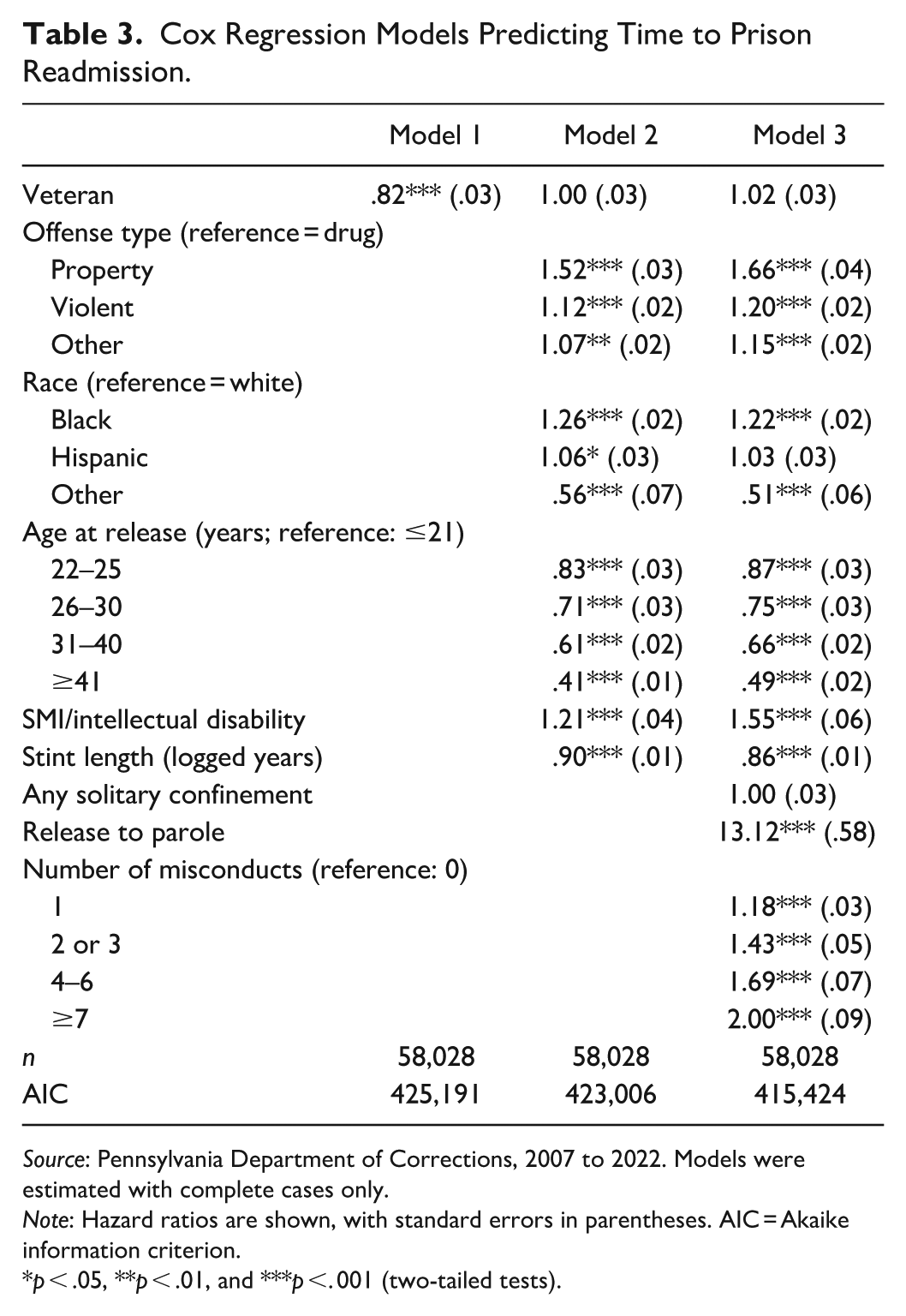
Source: Pennsylvania Department of Corrections, 2007 to 2022. Models were estimated with complete cases only.
Note: Hazard ratios are shown, with standard errors in parentheses. AIC = Akaike information criterion.
p < .05, **p < .01, and ***p <. 001 (two-tailed tests).
Interaction effects are reported in Table 4. One interaction effect is statistically significant, that of Hispanic veterans (p < .001). Hispanic veterans have a 69 percent higher risk of recidivism compared with white nonveterans, the reference category. However, given the conditional nature of Cox regression coefficients, it is difficult to understand how the nonreference groups compare with one another, as well as how these differences change over time. To improve interpretability of these findings, I plot adjusted survival probabilities over time by veteran and racial/ethnic strata. Adjusted survival probabilities are calculated by fitting the model on counterfactual data. Each observation holds its values for covariates, but produces six fitted values by manipulating the interaction term. In other words, a fitted value is produced for the observation’s original veteran and racial/ethnic values, as well as all counterfactual combinations. Fitted values are then averaged within each strata to produce an average predicted probability. Given that Cox regressions are a function of time, this process is done at specified time increments to produce adjusted survival curves. This procedure was completed using R package marginaleffects (Arel-Bundock, Greifer, and Heiss 2024). In addition, traditional methods of estimating uncertainty consider only that which relates to the coefficient, but Cox regressions inherently have additional prediction uncertainty due to variability in the baseline hazard (h0[t]). To accommodate this, I produce 95 percent confidence intervals via nonparametric bootstrapping using the R package rsample (Frick et al. 2025). These confidence intervals are far more conservative than those produced via normal t-tests.
Cox Regression Model Predicting Time to Prison Readmission, Race/Ethnicity × Veteran Interaction (Reference: Nonveteran, White).

Source: Pennsylvania Department of Corrections, 2007 to 2022.
Note: Observations include complete cases only (“other” race/ethnicity category was excluded because of low cell counts). Model estimated with full covariates but select hazard ratios shown, with standard errors in parentheses.
p <. 001 (two-tailed tests).
Figure 2 shows plots survival probabilities across four points in time—the first day of release and years 1, 2, and 3, the period during which most individuals recidivate—producing a smooth curve. At each year since release, Hispanic veterans have a lower predicted probability of survival than other groups. However, the bootstrapped confidence interval is larger than those for all other groups and does overlap slightly with that for Black veterans. The estimate for Hispanic veterans is noisier than the others because they are the smallest strata by far (n = 200). Notably, the band does not overlap with that of Hispanic nonveterans, who seem to fare similarly to white veterans and nonveterans alike. A conservative interpretation of these findings is that veteran status among Hispanics is associated with a higher risk for prison readmission on par with Black individuals. Veteran status seems to uniquely disadvantage those of Hispanic ethnic identity, a phenomenon which is thus far unaccounted for in the research literature. Thus, my hypothesis that veteran status advantages people of color in my sample can be firmly rejected.

Predicted probability of survival from prison readmission by veteran status and race.
Discussion
This analysis uses statewide population data for a 15-year period to estimate the effect of prior military service on recidivism, measured as prison readmission. Research on military populations consistently grapples with the methodological dilemma of accounting for double selection, by which both an enlistees opts in and the military chooses among recruits (Wolf et al. 2013), an issue compounded when one considers that incarceration, too, has its own “selection” process. For these reasons, I include a number of controls that account for differential selection into incarceration, to analyze if there is a “veteran effect” above and beyond characteristic differences between subpopulations (Logan et al. 2022). Bivariate results are precisely estimated (p < .001) and show that veterans have an 18 percent lower hazard risk than nonveterans. Once full controls are added, veteran status is not associated with recidivism risk. Null findings from multivariate models cannot tell us anything definitive about a “veteran effect”; I cannot reject the null hypothesis that veteran status is not associated with prison readmission. However, it does suggest that either veteran status is a poor proxy for measuring preferential treatment or that this preferential treatment has no discernible impact on cyclical criminal legal system contact.
A sensitivity analysis suggests that military service does affect racial/ethnic groups differently. Hispanic veterans have a 69 percent higher risk for recidivism compared with white nonveterans. When adjusted survival probabilities are plotted across time and grouped by veteran and race/ethnicity strata, Hispanic veterans and Black veterans and nonveterans are shown to have consistently lower likelihoods of survival. Interestingly, Hispanic nonveterans seem to fare similarly to white reentering people, suggesting that there is a veteran penalty among Hispanic people only. These findings emulate those of Bouffard (2005), which finds that Hispanics with military service have a significantly higher likelihood of committing a violent offense compared with white nonveterans. The military interaction was insignificant for other racial categories (Bouffard 2005). In combination, these results strongly depart from my hypotheses about the protective effect of veteran status, for the general population and particularly for people of color.
The veteran penalty for Hispanics could be driven by several factors. Most simply, Hispanic veterans may be a very distinctive group on dimensions not included in my models. Also, if veteran status is an appropriate proxy for reentry supports, then these findings might substantiate theory that additional state surveillance, despite its rehabilitative intent, operates as a trip wire back to incarceration for people of color and a true alternative for white people (Phelps 2018). Phelps (2018) found that individuals who are incarcerated for violating probationary conditions look similar to other incarcerated people, but successful probationers are relatively advantaged in socioeconomic terms and more likely to be white. Thus, would-be rehabilitative resources like probation may be more onerous for the socially marginalized, resulting in delayed incarceration rather than acting as a substitute for it (Harding, Western, and Sandelson 2022; Lopoo, Schiraldi, and Ittner 2023; Phelps 2018). Similarly, though veteran-specific reentry supports may have rehabilitative intent, the accompanying increased surveillance may be particularly difficult to navigate for Hispanic individuals given intersecting disadvantages.
These data are novel, and I am not aware of another study that uses such a long period of population data from a statewide prison system to examine this question. As mentioned previously, state-level, longitudinal data on system-involved veterans are rare. To my knowledge, a no other study evaluates how race and ethnic identity mediate the relationship between veteran status and recidivism – a research gap likely caused by data inaccessibility.
Despite obvious advantages of using data on the full population of incarcerated men in Pennsylvania over a 15-year period, these data have limitations. First, there is a lot of missing data. Thirty-seven percent are missing data on veteran status, the key predictor. Second, I do not have any data on duration and period of service, so I cannot identify cohort-specific risks for recidivism. I also do not have data on combat deployments. Access to these data could help disentangle whether some dimensions of the veteran experience, such as exposure to violence or posttraumatic stress disorder, could be salient dimensions to understanding recidivism (Blonigen et al. 2016). However, I argue that because preferential treatment is allocated on the basis of veteran status alone, this broad categorization is the most appropriate key indicator to use to answer my research question-not exposure to combat, branch of service, or other dimensions of the military experience.
Additionally, my analysis does not disentangle reincarceration for parole revocation versus a new crime, and instead treats the two as the same. This is problematic given that parole revocations can occur for technical violations, not just new criminal charges (Lopoo et al. 2023). Data availability prevents me from disentangling returns to prison for technical violations from that of new charges or convictions. Finally, the data do not include information on experiences during reentry, including the extent to which veterans used available services. Although veterans are eligible for unique benefits, it is possible that accessibility or stigma prohibit their use. A 2013 national sample revealed that across race/ethnicity groups, many incarcerated veterans were eager to use services such as mental health care, medical care, residential treatment, sociovocational assistance, and case management services provided through the Department of Veterans Affairs during reentry (Tsai, Kasprow, and Rosenheck 2013). This eagerness, although promising, was not universal, and tells us little about how accessible services are for veterans who seek them out, let alone why some declined case management. Veterans report in other contexts that they do not use targeted services because of associated stigma or organizational barriers to use (Kim et al. 2011).
Importantly, this article serves as a clarion call for future research evaluating how populations deemed “unique” navigate social reintegration after prison. In the case of system-affected individuals, classification schemes do more than just reify in-group identity; they also determine eligibility for preferential treatment (Lara-Millán 2021). On a practical level, policymakers and researchers should pay particular attention to how resource eligibility relates to use and, in turn, to reentry success or failure. Jurisdictions have been quick to adopt veterans-specific programming, though legal scholars caution that sentencing alternatives like VTCs may produce improperly privileged status and discriminatory practices (Baldwin and Brooke 2019; Jones 2014). In fact, veterans themselves may not demand veteran-specific programming. One study of individuals eligible for VTC programming in Pennsylvania demonstrated that individuals often declined VTC programming because their veteran status and systems involvement felt at odds with one another, a discrepancy which produced intense shame (Ahlin and Douds 2020). Research should evaluate if programs aimed at “special populations” not only are desirable to would-be beneficiaries and legal, but also tangibly improve social reintegration. Although well intended, these efforts may be ineffective or, at worst, harm populations deemed worthy of receiving this special attention.
Footnotes
Appendix
Cox Regression Models Predicting Time to Prison Readmission, Full Cases Retained with Multivariate Imputation.

| Model 1 | Model 2 | Model 3 | |
|---|---|---|---|
| Veteran | .84*** (.02) | 1.02 (.03) | 1.02 (.03) |
| Offense type (reference: drug) | |||
| Property | 1.42*** (.02) | 1.42*** (.02) | |
| Violent | 1.03* (.01) | 1.02 (.01) | |
| Other | 1.06*** (.02) | 1.06*** (.02) | |
| Race (reference: white) | |||
| Black | 1.11*** (.01) | 1.10*** (.01) | |
| Hispanic | 1.00 (.02) | .99 (.02) | |
| Other | .53*** (.05) | .53*** (.05) | |
| Age at release (years; reference: ≤21) | |||
| 22–25 | .80*** (.02) | .80*** (.02) | |
| 26–30 | .66*** (.02) | .66*** (.02) | |
| 31–40 | .56*** (.01) | .56*** (.01) | |
| ≥41 | .38*** (.01) | .39*** (.01) | |
| Number of misconduct violations (reference: 0) | |||
| 1 | 1.12*** (.02) | ||
| 2 or 3 | 1.17*** (.03) | ||
| 4–6 | 1.14*** (.03) | ||
| ≤7 | 1.06 (.03) | ||
| Observations | 91,766 | 91,766 | 91,766 |
| Imputations | 30 | 30 | 30 |
Source: Pennsylvania Department of Corrections administrative data, 2007 to 2022.
Note: Coefficients were obtained by pooling model estimates from imputed datasets (m = 30) using the R package mice. Hazard ratios are shown, with standard errors in parentheses.
p < .05 and ***p <. 001 (two-tailed tests).
Acknowledgements
I thank Andrew V. Papachristos, Claudia N. Anderson, and Christine Percheski for their comments on earlier drafts. A special thank-you to Bruce Western and Jessica T. Simes, principal investigators of the Pennsylvania Solitary Study, for their feedback throughout this project and generous thought partnership. I also thank participants of Northwestern University’s Applied Quantitative Methods Workshop, Urban and Community Workshop, and 2nd-Year Paper Seminar, as well as the Society of Social Research’s 2024 Spring Institute at the University of Chicago, for their generative feedback. This article also benefited immensely from a presentation at the 2024 Law and Society Association annual meeting in Denver. Last, I extend immense gratitude to partners at PADOC, without whom I could not have completed this project.
Funding
The authors disclosed receipt of the following financial support for the research, authorship, and/or publication of this article: This project was supported by the Project on Race, Class and Cumulative Adversity at Harvard University funded by the Ford Foundation and the Hutchins Family Foundation; National Science Foundation Grant SES-1823846/1823854; and grants from Arnold Ventures, the Robert Wood John Foundation, and the Russell Sage Foundation.
