




Abstract
Building on prior theorization of the prison–military complex and critiques of Foucault’s claim of similarities between the prison and the military, this article uses the example of ex-military personnel as prison staff to consider the nature of this relationship. In a UK context in which policy discourse speaks of ‘military’ methods as an aspiration for the Prison Service but where critical prison scholars use this term more pejoratively, it draws on a unique survey of current and former prison staff to explore the perceived characteristics of ex-military personnel, and the relationship between military service and prison staff culture. The article finds that although some ‘military’ characteristics recall more negative ‘traditional’ cultures, others point towards more professional and compassionate attitudes, challenging the notion that ‘militarism’ necessarily engenders authoritarian and punitive prison regimes.
Introduction
Foucault’s (1991: 228) often-cited observation that ‘prisons resemble factories, schools, barracks, hospitals, which all resemble prisons’ draws attention to perceived similarities between these kinds of institutions. Indeed, ‘military’ discipline is promoted in contemporary public and policy discourse as a solution to the ‘ills’ of the prison system. However, ‘military’ is an extremely difficult term to define and although there is some consensus about what it means in relation to the prison (Kennan et al., 1994), there has been little critical analysis of this discourse. When used by criminologists this term often conveys a troubling propensity for rigidity, harshness, authoritarianism and punitivity (e.g. Jewkes and Johnston, 2007), with ‘less-militaristic’ prisons perceived to be friendlier and more relaxed (e.g. Young, 1987: 32). By contrast, some policymakers see military methods as a means to gain control of ‘unruly’ establishments and enforce much-needed ‘discipline’. In this article, we unpack these interpretations of the military and consider the ways in which prior military experience on the part of prison staff might influence prison staff culture.
The employment of ex-military personnel is likely to be widespread in prison systems in the Global North (Moran et al., 2019), and it is likely that the UK-based research presented here has some wider resonance in this region. Further afield, and beyond the immediate scope of this article, there is also post-conflict prison employment in the Global South where, for example, ex-combatants were employed in the Prison Services of Namibia (Metsola, 2006) and Zimbabwe (Musemwa, 1994). More broadly still, there are contexts of more explicit prison–military convergence, such as dark sites and rendition prisons (Brown, 2005) in which prison–military connections may also involve movements of staff. While these contexts all offer potential avenues for exploration, this article primarily addresses the UK Prison Service and its staff cultures in relation to political and policy changes in this jurisdiction over time. We hope that in initiating exploration of the relationship between military service and prison staff culture, we go some way towards opening up a fruitful and productive avenue of exploration for future research into the ‘prison–military complex’ (Moran et al., 2019).
Building on theorization of the ‘prison–military complex’, this article explores the experiences and opinions of prison officers about previous military service. Drawing on a unique survey dataset, we consider how military experience is perceived, and the characteristics that ex-military personnel are considered to exhibit. We first explore the relationship between prison and the military as one facet of the ‘prison–military complex’, and consider the ways in which criminological literatures have tended to deploy the term ‘military’ in relation to the operation of prisons. Next, we focus on the employment of ex-military personnel as prison officers as one specific interface between prisons and the military, summarizing the scarce prior scholarship on this topic, and drawing it together with recent theorization of prison staff cultures. We then move to discuss the surveys whose data provide the empirical basis for the remainder of the article, critiquing the notion that military service necessarily predisposes prison personnel to punitive attitudes and negative forms of prison staff culture, before concluding with reflections and suggestions for future research.
Foucault and the prison–military complex
Foucault’s famous observation about prisons and barracks is partially based on his view of the military as the foundational laboratory of disciplinary power (McSorley, 2014) and of the soldier as central to both sovereign and disciplinary apparatuses, being both subject and object of power. Although enormously influential, this observation has been critiqued in recent years (for example by Powel, 2017), with calls for a critical rethinking of the portrayal of the military in works such as Discipline and Punish, through which Foucault (1991) advanced notions of discipline, governmentality and biopolitics. Critics note that although Foucault had intended to extend his analysis, his scrutiny of the evolution of the military ended at the 18th century (Foucault, 1980: 77)—an oversight to which they ascribe his erroneous claim (in late 1970s lectures) that military apparatus had ‘hardly changed’ since (Foucault, 2007: 354). Pointing out the inaccuracy of that statement, Powel (2017: 853) noted that militaries ‘were and are far more heterogeneous’ than Foucault had suggested.
It is worth pausing to reflect on Foucault’s discussion of the military. This is because, as Smith (2008: 275) noted, it was arguably the military, rather than the prison, that was his ‘vanguard institution in the arrival of a disciplinary society’. The notion of the ‘docile body’ was fundamental to Discipline and Punish but, rather than originating in discussion of the prison, the docile body emerges in relation to analysis of military power, the practice and rehearsal of prescribed movements known as military ‘drill’, and Foucault’s contention that, in the army, the self was replaced by the automaton. In his chapter on the ‘docile body’, it is to military drill that Foucault turned to exemplify the instrumentally-regulated body that he then deployed as a prototype for modes of social control in institutions such as prisons. In this chapter, Foucault described a young military cadet rising from his bed and metronomically putting on his uniform as the start of his ‘infinitesimally choreographed daily routine’ (McKinlay, 2013: 139). Drill, along with ‘the experience of the barracks, the subjection and indoctrination into instruments of controlling time and space such as precise time-tables, the division of the day into discrete tasks, the habit of answering to orders and for some learning to transmit them’, facilitated development of ‘the disciplined factory worker, the overseer’ (Angstrom and Haldén, 2019: 182) and, as the argument extends, the prisoner. As Smith (2008: 276) summarizes: when repeated often enough, drill would end in the formation of the trained docile body, at once more powerful because it was more efficient and autonomous in the exercise of power, and yet also more obedient and pliable to authority.
Outlining the implications of Foucault’s narration thus, Smith (2008: 276) noted: ‘the military and its soldiers have by and large become machine-like, rational institutions more or less devoid of subjectivity, myth and wider civic cultural inputs. They instantiate, in other words, the features of the disciplinary society more widely conceived.’
Foucault was not alone in seeing soldiers as automatons. Writing at around the same time, Weber (1978: 1149, cited in Smith, 2008: 277) also perceived a shift from the military as charismatic warriors to ‘trained and order-following functionaries’. But based on close examination of military history, Smith (2008) contended that military rationalization was far more complex than either Weber or Foucault appreciated, in its influence on both subjectivities and organizational forms. The power of routinized military drill, military training and military organization, Smith (2008: 276) argued, comes not from ‘the erasure of the self, the erosion of subjectivity, the triumph of individuation and the end of signification’ as both Weber and Foucault concluded, but ‘quite the reverse’. Taking issue specifically with Foucault’s interpretation of the effect of drill, Smith (2008: 283) posited that it is ‘not so much about individuating in the service of a new capillary power but rather generating a sense of fusion with the group that starts to occlude egoism’.
Critiques of Foucault’s portrayal of the military as a vehicle for the creation of docile automatons argue that he neglected both the need for meaning in military organisations and the need for ‘cultural perspectives that capture the intense group solidarity and existential dimensions of military life’ (Angstrom and Haldén, 2019: 182). Rather than seeing the military simply as wielder of coercive power after Foucault, contemporary theorists now argue for a focus on the collective meanings produced in military organizations which underscore the military as ‘a producer of collective power’ (Angstrom and Haldén, 2019: 182).
Foucault’s notion of governmentality rests on a triangle of powers including discipline and military apparatus but, if, as Angstrom and Haldén (2019), Powel (2017) and Smith (2008) argue, the military was not what Foucault claimed it was, then there are wider implications for understandings of the prison. As Moran et al. (2019: 221) noted, though, very little scholarly attention has been paid to the relationship between the military and the prison. They developed the term ‘prison–military complex’ to describe ‘the deep-rooted, long-standing, widespread, and diverse connections between prisons and the military’ (Moran et al., 2019: 221), such as senior leadership by ex-military personnel; military contingency planning for prisons; the incarceration of military veterans; military prisons; military ranks and quasi-military insignia in prisons; ex-military personnel employed as prison staff, and so on. They argued that both these individual phenomena and the prison–military complex as a whole are under-researched and their significance underestimated. Critically, they draw attention to the lack of research exploring how the military and the prison intersect with one another, calling into question prison-based assumptions about the military that currently shape impressions of these intersections and their potential implications. Accordingly, they advance a research agenda that deploys the prison–military complex as a conceptual tool directing attention to ‘how and with what implications prison and the military are associated with each other’, and requiring that ‘prison scholars go beyond “common-sense” notions of the meaning of “militarism” and “the military” as these relate to prison’ (Moran et al., 2019: 222). The meaning of ‘military’ terminology is of critical importance and, although we discern a difference between use of this terminology in public and policy discourse and its deployment by critical prisons researchers, there is very little analysis of the intended connotations of this terminology in these two contexts.
Power, authority and the military
The very small number of relevant studies largely bear out this perception of the drilled, disciplined, detached ex-military prison officer wielding coercive power, and position these personnel squarely as unsuitable for prison work. In the 1960s, Morris and Morris (1963: 77) described ex-military personnel as ‘authoritarian’; ‘martinets who have merely exchanged a khaki uniform for a blue one’. They argued that they may in the 19th century have ‘provided ideal material out of which to make a warder’ in that the experience of ‘handling men’ in the Armed Forces might have been ‘a considerable advantage in a prison where so much of the activity consists of locking and unlocking, counting and recounting, and telling prisoners what to do next’ (Morris and Morris, 1963: 76). However, they questioned whether they were really equipped to ‘carry out the aims of rehabilitation and reform’ characterizing the 1960s prison, or to ‘deal with complex human relationships in which the crude exercise of coercion is not enough’ (Morris and Morris, 1963: 76). Crawley (2013: 14) similarly argued that soldiers are ‘often too inflexible and discipline-oriented to rise to the challenges of the “modern” prison officer role’, and Shefer and Liebling (2008: 272), argued that ‘punitiveness and hostility against prisoners’ could be related to officers’ military backgrounds.
The perception of the characteristics of ex-military personnel is perhaps key here. Because criminologists have paid little attention to the nature of the military more generally, or to the previous military experience of prison staff in particular, we know very little about whether they really are as metronomic, punitive and inflexible as Crawley (2013), Foucault (1991), Morris and Morris (1963) and Shefer and Liebling (2008) suggest. Stereotypical assumptions about rigidity, harshness, authoritarianism and punitivity tend to be deployed with very little critical reflection (Moran et al., 2019), and the terminology of ‘militarism’ is often used pejoratively as a shorthand for austere environments, impersonal interactions, authoritarian drill and unrelenting discipline (e.g. Cullen et al., 2005: 57). Bennett and Shuker (2010), Kelly (2014) and Sim (2008), for example, all perceive a trade-off between militaristic tendencies and the propensity for prison officers to show empathy towards prisoners. For Carrabine and Longhurst (1998: 170) the ‘strong staff subculture of militarism’ helped explain prison staff reactions during the Strangeways riot and, for Wortley (2002: 73), ‘militaristic paraphernalia’ such as staff uniforms precipitate prisoner violence. For Sim (1991: 118, see also 2008), prison officer brutality observed in the 1970s–1980s was symptomatic of the ‘militarisation of the prison service’. During this period, disorder in prisons was frequently met with violence on the part of some prison staff, a circumstance recognized in the Woolf report (Woolf, 1996), and by the Prison Service itself in later publications that announced significant management changes (Sim, 2008).
This use of ‘militaristic’ as a shorthand for authoritarian and punitive arguably collapses together two institutions that deploy power and authority differently, and towards different subjects of power. Simply put, in the military, the drill and discipline described by Foucault are exercised by higher ranks towards lower ranks, as a means to enable both to combat an enemy towards whom minimal empathy is extended. In the prison, there is a similar line of command from senior staff to prison officers but, as Foucault makes clear, the principal target of disciplinary power is the incarcerated population. The critical use of ‘military’ in criminological discourse, therefore, and in particular the perceived incompatibility of militarism and empathy, seems to refer to a situation in which prison officers dispassionately wield disciplinary power over prisoners they view as an ‘enemy’ to be defeated and controlled. And, whereas the military might ‘close ranks’ against a common foe, in the prison there is more divergence in attitudes towards prisoners, with senior staff sometimes more concerned for their welfare than are some prison officers.
Although criminologists have not yet considered whether actual military service precedes the practices that they perceive as ‘militaristic’, we gain considerable insight into prison officers’ attitudes to prisoners, and their use of power and authority in explorations of different prison staff cultures. The critical appraisal of the use of power presented by Crewe et al. (2014: 388) nuances a previously pervasive sense of association of power with coercion, and counters ‘an enduring view among critical penal scholars that power, and its application, is always dangerous and objectionable’. ‘Traditional’ prison officer culture was defined by Liebling (2007) as ‘them and us’, with negative attitudes towards both prisoners and senior managers, and a preoccupation with safety. Crewe et al. (2011: 111) further divided this category into negative and positive forms: negative where culture is ‘traditional-resistant’ (cynical, petty, disrespectful and preoccupied with control) and positive where it is ‘traditional-professional’ (confident, boundaried, clear, vigilant and knowledgeable). They argued that although a ‘traditional’ culture may not be ‘sympathetic’ towards prisoners, it could deliver high levels of safety, fairness and service. Accordingly, this would produce contexts in which prisoners ‘“knew where they stood”, were confident that officers could use their authority if they needed to, and recognized that when officers under-used their power, this was deliberate, rather than a mark of fear or avoidance’ (Crewe et al., 2011: 109) (as could be the case where prisons are operated by less experienced staff or those operating under a more benign staff culture). These models of behaviour bear some resemblance to the ‘old school’ officers of Tait’s (2011) characterization; seen as reliable and trustworthy, and viewed by prisoners as responsive and straightforward. Although providing limited emotional support, they could be counted on to show genuine commitment to helping prisoners.
Hitting the right point on the ‘heavy–light’ and ‘absent–present’ continuums (Crewe et al., 2014: 398), where enough clear and consistent authority is shown by prison officers who are self-assured and confident, seems to be key. Rather than the exercise of power being necessarily objectionable, Crewe et al. (2014) argued that although prisoners preferred officers to use informal means where possible, the knowledge that further measures could be used when warranted was reassuring. Although problems can undoubtedly be caused by an excess of institutional power and an oppressively-punitive atmosphere—as in the case of prison officer violence and brutality—deficits in institutional power can also be problematic. The use of power is, in other words, ‘necessary, desirable, and legitimate’ (Crewe et al., 2014: 401).
While critical scholars may oppose ‘militaristic’ prisons, based on an impression of military personnel as inflexible and punitive, perhaps aligned to notions of traditional-resistant or overly heavy staff cultures, ex-military staff seem to hold a certain appeal for policymakers. The 2016 White Paper Prison safety and reform proposed that among 2500 new prison officers would be men and women ‘from the ranks of our armed forces’ with ‘a sense of duty and discipline’ and ‘skills in leadership and people management as well as the strength of character to strike the balance . . . between discipline and support’ for prisoners (Ministry of Justice, 2016: 6, 56). Two years later, the then Prisons Minister Rory Stewart declared himself ‘very comfortable with prisons that are run in a very old-fashioned military way’, adding that he supported ex-Army personnel joining the Prison Service because of their ‘fantastic ethos and self-discipline’ (Tominey, 2008: np). Reporting on the development of prison leadership, Her Majesty’s Prison and Probation Service (HMPPS, 2020: 33–34) noted that senior leaders had ‘participated in the Ministry of Defence’s week-long Command Leadership and Management programme . . . developing their leadership skills alongside an international cohort of military personnel’. The policy direction articulated is relatively simple: the prison needs reform, and military characteristics in the form of ex-military prison officers and military-style leadership would help deliver it. Albeit giving scant insight into the rationale for these policies, the characterization of the military in these statements displays a degree of nuance, in that military methods and personnel are seen to bring more than merely ‘discipline’ to the Prison Service.
Whatever the motivation behind stereotypical military characterizations, these have long been recognized as outdated and in need of revision (Jordan, 2007; Scarborough, 1993). In contemporary military scholarship, military organizations and culture are described rather differently. Rather than aligning with Foucauldian tropes of disciplined and disciplining automatons, this work characterizes military influence in relation to the notions of collective meanings and collective power described by his critics. Burland (2018: 149) emphasizes its potential to foster ‘social cohesion and positive personal traits such as altruism, humility and self-discipline’. Lutze and Lau (2018) argue that the military has moved away from ‘stereotypical’ tactics of humiliation, aggression and coercion, towards a ‘military philosophy’ of motivating internal change and reinforcing positive behaviour by recognizing accomplishments, rather than by punishing failures. In other words, although there remains a sense in which the military seeks to mould individuals, according to military theorists it does this in a way that diverges from those pejorative descriptions deployed by criminologists, aligning more closely to politicians’ perceptions of militarism as a balance between discipline and support.
These divergences between what the military is perceived to be, and specifically the appropriateness of adopting military methods and employing (ex-)military personnel in the prison, are indicative of what Shaw (2012) described as military forms being ‘carried’ into the civilian sphere, through mentality, attitudes and social practices. This may suggest that ex-military staff have a particular aptitude for the use of authority. Despite claims of their unsuitability for prison work (Crawley, 2013; Morris and Morris, 1963), we estimate that, at various times during the 20th century, up to 75% of prison officers in England and Wales have previously served in the military (Moran and Turner, in press). In this article we explore both perceptions of prison work, and the impressions formed about ex-military personnel by colleagues who do not share their military experience, considering how military experience may align different prison staff cultures.
Methodology
We utilize data generated via two self-completion, anonymous online surveys: one for current prison officers employed at six establishments, and another for former prison officers (individuals who were previously, but are no longer, employed in the Prison Service). Together, these surveys collected the views of 228 respondents. Although administered separately, the two surveys were identical in all respects, and both were designed to be completed by respondents both with and without a history of military service. Participation was voluntary and anonymous.
The link to the online survey for current staff was disseminated by email to staff at six prisons within the public sector, under the terms of research access granted by the National Research Council for Her Majesty’s Prison and Probation Service. These establishments together represented the majority of the male estate—Cat A/B, Cat B ‘local’, Cat C ‘training’ and adult/Young Offender Institutes (YOI). 1 They also covered a range of geographical regions, and were governed by individuals both with and without military experience. Omitted from the study for reasons of research access were the women’s estate, the open/Cat D estate, the private sector and British prisons outside of the jurisdiction of HMPPS (i.e. in Scotland or Northern Ireland)—although this did not mean that respondents lacked prior experience of those types of establishments.
For the former-staff survey, links to a hosting website were posted on social media using a dedicated Twitter account. Respondents self-identified as having previously worked in the Prison Service in the UK, either in the public or private sectors. As is the case with all non-password-controlled online surveys, it was impossible to verify that all respondents were genuinely former UK prison employees.
Survey questions covered basic demographic data, including gender; route into prison work; training; career path; duration of employment; non/operational status; expectations and experiences of prison work; and future plans. ‘Question logic’ routed respondents depending on their answers, presenting questions on military service only to those who had declared military experience. In this article we draw largely on responses to ‘open-ended’ questions. These questions asked respondents to proffer explanation after having completed a set of ‘tick-box’ questions about the characteristics, experiences and contributions of ex-military personnel in the Prison Service. The majority of respondents answered at least one of these questions, providing sometimes lengthy insights (i.e. of several hundred words) into the experiences and opinions which lay behind their answers. We acknowledge that researching prison staff culture through a survey is challenging. Joinson (1999) showed that anonymous online surveys show lower levels of participant social desirability bias, compared with pen-and-paper and non-anonymous methods, so the complete anonymity and online nature of our method is likely to have reduced the social desirability effect. However, we are still keenly aware of the need not to take survey responses at ‘face-value’.
The current-staff survey ran for six months in 2019, and the former-staff survey for 12 months across 2019–2020. For the current-staff survey, N = 83. The six establishments together employ about 1700 eligible staff, and the response rate of 4.88%, although low, is in line with expectations for an untargeted (i.e. not personally addressed) online survey distributed by an employer on behalf of an external organization. For the former-staff survey, N = 145. Since the number of potential participants is unknown, no response rate can be calculated. In both surveys, the majority of respondents (58%) had had military experience (defined here as a period of full-time employment in any capacity within the UK Army, Royal Air Force (RAF) or Royal Navy, prior to joining the Prison Service; excluding reservists/Territorial Army—unless a full-time role had also been served). Seventy per cent of current-staff, and 51% of former-staff respondents disclosed military experience. The majority within both groups had seen combat (current 59%, former 65%). Further summary statistics are presented in Table 1. Because of likely self-selection bias (i.e. the survey appealing most to those with military experience) we cannot directly extrapolate from these figures to the prison workforce as a whole, but in more detailed analysis (Moran and Turner, in press) we estimate that at present up to one-quarter of prison officers have previously served in the military. When presenting survey responses, we give in parentheses participants’ gender (M/F), age and ex-military/non-military status; e.g. (F30, non-military).
Summary of Armed Forces experience and Prison Service joining profiles of respondents with military experience by employment status.
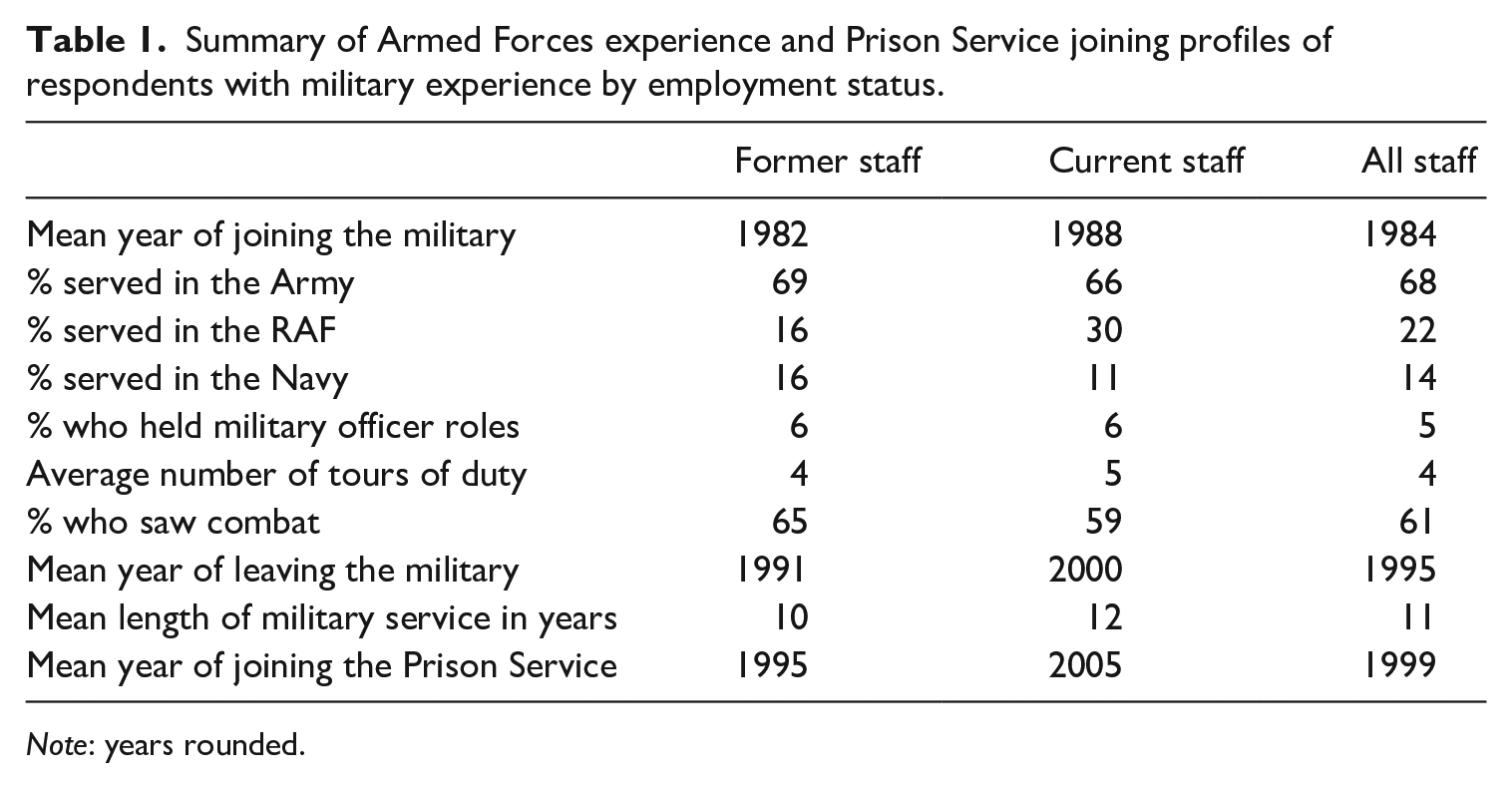
Note: years rounded.
‘Military’ characteristics and punitive opinion
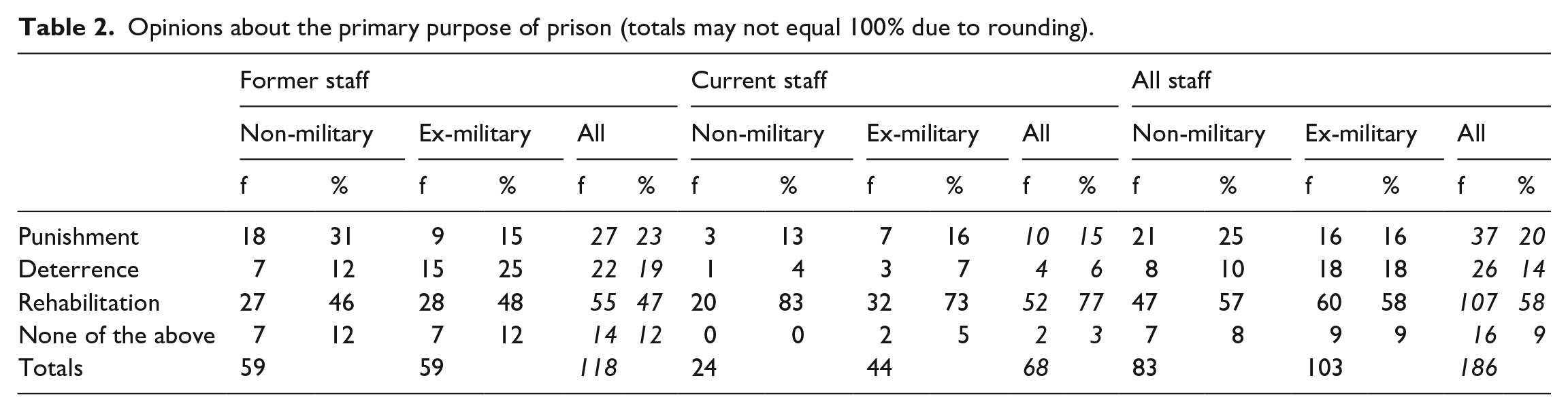
As we have seen, criminological literatures have drawn connections between militarism and impersonal interactions, drill and discipline (e.g. Cullen et al., 2005: 57); have argued that militaristic tendencies preclude empathetic responses to prisoners (Bennett and Shuker, 2010; Kelly, 2014; Sim, 2008); and have suggested that militarism precipitates violence (Carrabine and Longhurst, 1998; Sim, 1991, 2008; Wortley, 2002). If we were to translate these tendencies into a position on the ‘purpose’ of prison, we might expect militarism to correspond to a tendency to see prisons as being primarily for punishment, rather than for rehabilitation. However, when we asked our respondents about the main purpose of prison (selecting one answer from a list of punishment, deterrence, rehabilitation or none of the above), this was not quite what we found.
Table 2 shows some interesting and contradictory results in relation to military service and punitive attitude. On the one hand, we find that the overall percentage of all current staff (i.e. both ex-military and non-military) perceiving the prison to be for rehabilitation is much higher than the percentage of all former staff (77% compared to 47%, respectively) holding this opinion. A two-way chi-square test indeed revealed that responses seem to be related to employment status, χ2(3, n = 186) = 17.16, p < .001. This indicates that opinion has become more rehabilitative over time in a shift we might attribute to changing values in the Prison Service. However, when we disaggregate staff according to military experience, we find very little difference between the percentages of ex-military and non-military personnel holding this view (57% vs 58%). The same test to consider whether response was related to prior military service showed no significance, χ2(3, n = 186) = 4.25, p = .236, NS. No significance was also reported when disaggregating by employment status. In other words, military service seems to make little if any difference to punitive opinion.
Opinions about the primary purpose of prison (totals may not equal 100% due to rounding).
These numerical data suggest a considerable degree of nuance in the views of survey respondents and, to explore this, we first consider the characteristics that prison officers themselves perceived to be bequeathed by military service.
Military heterogeneity
Foucault (1991) himself, critics of his characterization of the military and criminologists who have observed ex-military personnel within the prison workforce have tended towards generalizations about what or who ‘(the) military’ is/are. By contrast, many survey respondents stressed the importance of heterogeneity, diversity and individuality. As the following excerpts highlight, multiple respondents argued that military service does not necessarily generate the same set of skills or inclinations in all who serve: The job is personality driven, being a good infanteer/engineer/combat medic doesn’t mean you will make a good prison officer. A lot of military training is able to be adapted easily to the job. HOWEVER this depends on the individual’s capability to do so. We need staff with the attributes ex forces normally have already. However not all ex-forces will make good officers. The two jobs are different and [they] need the ability to adapt and change. Some ex-military staff are keen to run the jail like a military camp whilst others do not want to talk about their time in HMF [Her Majesty’s Forces].
Running counter to Foucault’s assertion of the homogenizing nature of drill and the creation of military automata, and challenging the notion that military experience and by extension militarism are homogeneous, these respondents instead drew attention to both the diversity of military roles and experiences (with different levels of suitability or adaptability to the Prison Service) and to the varied ability or inclination of individuals to adapt their military experience to prison work.
Military experience and ‘traditional’ staff culture—resistant or professional?
Despite this emphasis on heterogeneity, many respondents still listed ‘stereotypically military’ characteristics such as discipline, punctuality and respect for rank as qualities of ex-military prison staff. One respondent summed up as follows: ‘The wearing of uniform, discipline, and a formal rank structure. Also being able to take orders from others’ (M57 ex-military); and another like this: ‘Have group discipline, respect rank, can work as a team, have excellent leadership skills, very resilient, used to working unusual hours, can work under pressure, have good personal hygiene and discipline skills’ (M58 non-military). Others emphasized what might arguably be described as quite mechanistic and lower-order military qualities and skills such as turning up on time, getting the basics of the job done and maintaining ‘control’.
Many ex-military respondents presented their views in terms of the qualities that they felt were lacking in the Prison Service more generally, expressing these as challenges that ex-military recruits would face. Again, these frequently referred to respect for discipline and rank: They would respect the rank structure which is lacking in today’s Prison service. The Prison Service needs discipline no matter what the do-gooders say, it’s about time this was brought back as it has been eroded over the years by non-military staff and governors who just haven’t got a clue. The current service is no longer a disciplined service and military personal would struggle with the lack of discipline and control.
One respondent argued that ex-military staff ‘should be filtered into a place of influence and authority to change the civilian element [of senior management] which is inefficient, corrupt and inept at constructing a working system that tackles the issues that arise on a daily basis’ (M28 ex-military).
At face value, these views seem to suggest an orientation on the part of ex-military personnel towards the ‘traditional’ models of prison staff culture described by Liebling (2007), with a strong sense of ‘them and us’ expressed via negative attitudes towards both prisoners and senior managers, and a preoccupation with safety. The opinions expressed here seem to position prison officers between, on the one side, a prisoner population presenting a threat which must be dealt with through discipline and, on the other, inept senior management that ‘haven’t got a clue’ and do not, in participants’ minds, provide the structures necessary to support officers in providing that discipline. Arguably the culture suggested in these responses leans towards the cynical, petty, disrespectful and control-obsessed ‘traditional-resistant’ model described by Crewe et al. (2011: 111).
However, our respondents also provided several examples of ways in which ex-military staff contributed to a different kind of ‘traditional’ staff culture—the more positive ‘traditional-professional’ type described by Crewe et al. (2011: 111) as confident, boundaried, clear, vigilant and knowledgeable. As one non-military respondent asked to consider the potential value of military personnel among prison staff reflected: The prison is run on routine and disciplined ex armed forces have an air of authority, are consistent, work well with routine and present a good role model for personal standards and professionalism to prisoners who have often not witnessed this before.
In relation to the same questions, others highlighted skills relevant to handling crisis situations: ‘Ex-service personnel will have been trained not to panic in conflict situations. Panic is not an appropriate response on those occasions when prisoners do “kick off”’ (M59 non-military).
As Crewe et al. (2011) suggest, traditional-resistant and traditional-professional are adjacent rather than binary categories. We saw evidence of overlap between them, with elements of some individuals’ views aligning to both positions, suggesting that the effects of military experience are difficult to disentangle. Some awareness of military stereotypes was also evident, with some respondents tackling these directly in comments that also resonated with a ‘traditional’ orientation. For example: ‘Military is not being aggressive, it’s direct, professional behaviour, working together and taking pride in the role’ (F43 ex-military). For this respondent, there was an evident tension between this ‘professional’ conduct and the disdain for management characteristic of the more ‘traditional-resistant’ model, as she later described some ex-military staff being ‘disappointed when [they] get to an establishment as there is a lack of “Military” behaviour in the service’. This absence of military behaviour is characterized as an environment without clear leadership and goal-orientation: ‘No challenge, no pride, no direction which they have been used to. Frustration at knowing that if there was more Military ways of working, it would be safer and run better.’ In this comment, while acknowledging that being ‘military’ in part means taking direction, this respondent also emphasized the sense of pride and common purpose resonant both of Smith’s (2008: 283) description of the military as engendering ‘a sense of fusion with the group that starts to occlude egoism’, and of Angstrom and Haldén’s (2019: 182) discussion of collective rather than coercive power.
Among our respondents were a small number of ex-military personnel occupying senior management roles, who offered a very similar view, albeit from the other side of ‘them-and-us’. Intriguingly, one such participant described the relationship between prison governors and prison officers through the metaphor of a dysfunctional military unit: I had a perception that the leadership, organisation and teamwork [in prison] would be on a par with the armed forces but the standards were shockingly lower. It was as if a uniform was just a work outfit like a supermarket employee would wear. Very little pride in it and a huge gulf between the leadership and management of the organisation and those of the landings. I have never experienced a place where the officers were so detached from the troops [sic] and exhibited so little leadership and care for them and where the troops resented and distrusted their leadership. It’s completely dysfunctional. Managers need to understand that if they take care of the staff the prisoners will take care of themselves. The motto of Sandhurst is ‘serve to lead’, this is how I aim to live my professional life.
For this respondent, a traditional-resistant staff culture meant that the prison lagged some way behind the modern military in management and leadership. Rather than portraying a machine-like institution, lacking in subjectivity, and characterized by obsession with rank, order and top–down rule-following, he described a compassionate military in which ‘officers’ exhibited care for ‘troops’, where mutual trust and respect were fundamental to functional operations—and where the cynicism with which some prison officers view senior management had dissipated. Articulating these observations in relation to ‘shockingly lower’-than-expected standards, he advocated that a ‘dysfunctional’ Prison Service should aspire to resemble the military—insofar as the leadership team earned the trust and respect of prison officers, and enabled them to operate in a ‘traditional-professional’ manner. The clear frustration evident in his response is perhaps also related to the lack, in the Prison Service, of a sense of a ‘common enemy’, which, as noted earlier, might characterize the military.
There was a strong sense from our respondents that where ex-military prison officers were considered successful in the traditional-professional mould, much of this was to do with the confidence that came with experience. There was often an implicit assumption that since this experience was gained while in the military, military experience was what mattered. For example: ‘They have the life experience and outlook to change offenders, being adaptable to situations and treating others decently whilst having a good sense of discipline and fairness’ (M55 ex-military). For others, life experience equated to the possession of a certain degree of confidence perceived to be lacking in younger and non-military staff, which in turn enabled ‘order’ to be kept through engendering respect, and without use of the physical prowess (although ex-military personnel were also valued for this skill). As one former military respondent explained: [The Prison Service] are recruiting some very young staff with no life experience. They therefore do not have the confidence to challenge or even encourage prisoners as they should be doing. The camaraderie one experiences in the forces helps to cope with the way prisoners can sometimes try to ‘take the piss’ or push the boundaries. Ex-forces people usually deal with this with humour but have the confidence to let prisoners know they should not do it and so respect is built.
Connectedly, another respondent emphasized the propensity for ex-military personnel to be able to draw on their prior experience of adversity, and thereby their ability to withstand prison work: ‘Working in a prison environment can be a challenge requiring both physical and moral courage. Ex-military personnel have often been tested in challenging circumstances before and seem marginally more resilient’ (M43 ex-military). These comments speak directly to Crewe et al.’s (2014) argument that successful prison officers use informal means where possible, keeping further measures in reserve until necessary, and therefore avoiding the overt excess of institutional power that can generate an oppressively punitive atmosphere. The confidence that enables some ex-military personnel to enforce boundaries—and the resilience to do this consistently despite adversity—perhaps enables them to deploy ‘necessary, desirable, and legitimate’ power (Crewe et al., 2014: 401).
While most respondents volunteered impressions of the positive effects of military service seemingly without questioning whether military service itself delivered these benefits, one was more ambivalent about the causal link between military experience and expertise in prison work. He pointed out that whereas these skills might have been developed in the services, they might also have already been present within those individuals: I think there is an overlap of skills that the military train[ing] and skills that are required to become a good or very good Prison Officer . . . In my experience, there is an over representation of ex-military staff in my good and very good operational staff. Whether this is because they were good before recruitment by the military or because of military training I am unable to say.
By extension, one could argue that it was perhaps the presence of qualities, which were later to make these individuals ‘good or very good operational staff’, which had originally led to their recruitment into the military. The difficulty of disentangling desirable qualities from military training and experience also arose in relation to the issue of ‘life experience’. This was another quality often attributed to ex-military prison officers; one particularly prized in the context of recent outflow of older and more experienced staff, increased recruitment of younger personnel and challenges in staff retention (Atkins et al., 2019; HMPPS, 2019).
Further research is necessary to delve more deeply into what is really meant by ‘life experience’. Ex-service personnel are perhaps just older, on average, when they join the Prison Service than are other recruits, since the minimum age to leave military service is 20, 2 whereas civilians can join the UK Prison Service from the age of 18. However, while such maturation might naturally come with age, it is also observed within the wider literature that many ex-military personnel actually lack ‘life experience’ relevant or similar to that encountered in the civilian environment previously occupied by many incarcerated persons. Although most ex-military personnel regard themselves as physically and mentally well and equipped with the necessary experience to manage their transition from military to civilian life and employment (Ashcroft, 2014; Herman and Yarwood, 2014; Walker, 2013), a wealth of research stresses the impacts of barracks life where liminal military identities become the ‘legacies’ of military service (Herman and Yarwood, 2014: 49). Higate (2001: 444–445) suggests that military training often results in ‘intense military socialization’ leading to institutionalization and ‘limited opportunity for expression’, which could be ‘dysfunctional’ in civilian life. In addition, Atherton’s (2009) study found that in addition to periods of absence from family life during deployment, some experiences encountered by men in the Armed Forces hampered the emotional obligations of being a father or spouse, even after their military careers. Further research would be needed to probe in more detail what prison officers’ military ‘life experience’ is good for, in the prison context.
Military experience and empathy
Crewe et al. (2011) argued that although it had the potential to deliver high levels of safety, fairness and service delivery, a ‘traditional’ culture may not be ‘sympathetic’ towards prisoners. If military experience is predictive of ‘traditional’ staff culture, then this would align with the views of other authors who have argued that militarism discourages empathy. However, our data do not entirely bear this out. There were many respondents whose interpretations of military service diverged from usual stereotypes, much more closely resembling the social cohesion, altruism and humility of the military as described by Burland (2018). For example, this respondent segued from the familiar appreciation of rank, rule and use of restraint, to an ability to show empathy and compassion: [Ex-military staff] understand how to work in a rule-based command structure, they have appropriate prior training that assists with the control and restraint of prisoners, as required. They are often able to show compassion to prisoners at times of bereavement, having perhaps experienced the loss of colleagues in theatres of war; and for the same reason they tend to appreciate the importance to prisoners to take an active part in funerals, wherever possible.
Our survey only asked about empathy for incarcerated persons where a military background was shared—that is, interactions with Veterans-in-Custody (ViCs)—but there was ample evidence of compassionate and empathetic responses towards these individuals. When asked if they felt disappointment in ViCs, one respondent answered ‘I only feel disappointed because it is sad that they have probably been let down by the system after leaving the forces’ (M53 ex-military), and another commented that: Many veterans are damaged by their service and it doesn’t seem that enough is being done to help support those troops whilst in the Forces and (most significantly) after they leave . . . I do feel obligated to at least attempt to redress this balance when dealing with veterans in custody but accept that in practice this doesn’t deliver much.
Conclusion
The relationship between the prison and the military is complex and unclear. On the one hand, although this is seldom a topic of extended discussion, criminologists tend to view ‘militaristic’ prisons negatively. This perspective possibly arises from Foucault’s depiction of the military and the practice of drill, which he positions as instrumental in the production of the docile body; or potentially derives from observations made in prisons—perhaps of the kind that informed the scant sources summarized earlier. On the other hand, scholars of the military have disputed both the historical accuracy of Foucault’s work and his interpretation of the effect of drill. They consider it to produce collective rather than coercive power, and have drawn attention to the evolution of the modern military into an institution more characterized by cohesive, empathetic and constructive support for individuals than by punitive and metronomic rule-following.
The few criminologists who have briefly attended to ex-military prison staff seem to position them at the heart of the tension between these two perspectives. Perceiving them a poor ‘fit’ for the modern Prison Service, they point to inflexibility and obsession with control and discipline as evidence of the differences between the prison and the military as institutions. But at the same time, the fact remains that many thousands of ex-military personnel have worked as prison staff and they are still actively targeted for recruitment today. This suggests that at least some of their qualities are in fact desired by the prison system and, presumably, indicates that the Prison Service, if only by virtue of having employing significant numbers of ex-military personnel, already draws upon military expertise and experience and has likely been shaped by their contributions.
As Moran et al. (2019) have argued, scholarship of the prison–military complex is woefully underdeveloped, with a dearth of studies uncovering the nature of the relationship between the prison and the military. While our article cannot fully address this lack, it does identify some of the complexity of this relationship. We certainly find evidence that some ex-military personnel are seen to conform to Foucault’s description of the soldier-automaton. Certain qualities considered by our respondents to be characteristic of military service align with ‘traditional’ prison staff cultures (after Liebling, 2007). However, just as military service did not predict respondents’ perceptions of the purpose of prison, ‘military’ qualities appear not to predict an exclusively ‘traditional-resistant’ staff culture—pointing just as often to a ‘traditional-professional’ culture (Crewe et al., 2011: 111) through which the use of power was necessary and legitimate. In addition, we found important evidence that militarism and empathy are by no means mutually exclusive, given that certain ‘military’ qualities also facilitate more emotional capabilities including understanding of bereavement, aligning with the care and compassion described for the modern military by Burland (2018) and Lutze and Lau (2018). It is possible that there is a temporal dimension to these tendencies towards traditional-resistant and traditional-professional models. Ex-military staff who joined the Prison Service some decades ago perhaps exhibit a more discipline-orientation than those who enrolled more recently—perhaps reflecting a move within the military itself towards a more ‘modern’ and compassionate organization. However, when we analysed the perceived ‘purpose’ of prison, although we found a change in discipline-orientation over time in general (between all former and all current staff), ex-military staff did not exhibit such a shift. And, in the qualitative excerpts presented above, we see examples of traditional-professional orientation from some of the oldest respondents to the survey. This temporal dimension could sustain further research.
What seems clear is that we need to know more both about the military itself, about how military forms are ‘carried’ into the prison through mentality, attitudes and social practices (after Shaw, 2012) which then influence prison staff cultures, and about how this has changed over time. If, for example, predominant attitudes about military influence reflect an ‘old-fashioned’ military more likely to engender the cynicism and punitivity of traditional-resistant culture, whereas the ‘modern’ military prefigures the more positive traditional-professional—and even compassionate—model, then resistance to the introduction of military mentality, attitudes and practices may be misplaced.
Our research methodology meant that we could not pursue these lines of questioning with respondents in person, but our conclusions suggest that there are fruitful avenues of exploration for subsequent study. There is much more work to do in exploring the potential contribution of ex-military personnel to the Prison Service and the detail of their role as prison officers, particularly in relation to the value of military ‘life experience’. The incarcerated themselves are of course missing from our research and the insights of prisoners both with and without military experience would be critical to future analysis of the ‘military’ nature of the prison and the role of ex-military prison officers.
Footnotes
Funding
The author(s) disclosed receipt of the following financial support for the research, authorship, and/or publication of this article: This research was supported by funding from the School of Environmental Sciences, University of Liverpool.
