



Abstract
Prior research into military–civilian transition has suggested that the Prison Service may be a popular destination for Armed Forces leavers, but the experience of former military personnel within the prison system as prison staff (rather than as Veterans in Custody) has so far been overlooked. As a result, we know very little about their route into prison work. This article reports on a UK study investigating the experience of prison personnel who have previously served in the military and presents the first set of empirical evidence addressing these critical questions. Whilst our findings mirror prevailing assumptions of a relatively seamless transition to post-military careers (and, in particular, those within Protective Service Occupations), few had intended a career in prison work specifically. Such trajectories may influence personal military–civilian transitions, as well as job performance in prison work and, by extension, the everyday lives of prisoners and other prison staff.
Military personnel experience a multitude of ‘transitions’ during their military career, such as change in job role, deployment overseas or promotion to higher ranks. The most significant transition for many, however, is the return to civilian life and, in particular, to civilian employment. Most ex-military personnel who are physically and mentally well go on to have second careers. They transition relatively seamlessly and require no assistance with aspects of unemployment, debt, homelessness, relationship breakdown or poor health (Ashcroft, 2014; Walker, 2013). Nevertheless, whether leaving is pre-planned (such as at the end of a service contract) or unexpected (through ill health or dismissal), military experience inevitably influences the subsequent evolution of post-military identities (Cowen, 2005; Riley & Bateman, 1987; Walker, 2018). Although ‘pathologising’ military–civilian transition risks positioning military experience as an affliction from which individuals need ‘rehabilitation’, even those ‘successfully’ transitioning face ‘significant cultural, social and spatial changes’ and perform liminal identities via the ‘legacies’ of military service (Herman & Yarwood, 2014, pp. 41–42, p. 49).
These circumstances are well known. Wide-ranging research tracks the post-military careers of personnel leaving the armed forces, including various studies of specific destination professions. Research into post-military careers has tracked former military personnel into teaching (Gordon & Newby Parham, 2019; Robertson & Brott, 2013); police work (Ivie & Garland, 2011; Johnson, 2013; Olson & Gabriel-Olson, 2012; Patterson, 2002); the fire service (Bartlett et al., 2020); corporate careers (Benmelech & Frydman, 2015; Gagliardo, 2020; Kaur & Singh, 2018; Koch-Bayram & Wernicke, 2018); and entrepreneurship (Heinz et al., 2017; Kerrick et al., 2014). Across these and other studies, researchers find that military experience is to some extent predictive of professional performance, being variously associated with more conservative and ethical behaviour in business, better management of occupational stress, high levels of resilience and, in teaching, a greater likelihood of remaining in the profession compared to conventionally–trained teachers. Accordingly, these insights are expanding our understanding of military–civilian transition and post-military careers. However, one significant workplace – the prison – has thus far escaped the attention of researchers.
Despite a now extensive body of research into prison staff and prison management, we know very little about ex-military prison staff and their transition to the Prison Service. This is surprising given that new research (Moran & Turner, forthcoming) suggests that historically ex-military personnel have comprised up to 75% of the prison officer workforce. In England and Wales, a key report published by HMIP in 2014 found that former military personnel constituted 7% of the prisoner population (HMIP, 2014) where they are often termed ‘Veterans in Custody’ or VICs. This much-cited statistic justifiably underpinned extensive subsequent research related to this cohort (e.g. Albertson et al., 2017; Fossey et al., 2017; MacManus & Wood, 2017; Phillips, 2020). Whilst we do not suggest that VICs are undeserving of the considerable research attention they have attracted, this percentage is self-evidently only a fraction of that constituted by ex-military prison officers within their own workforce. In addition, without some sense of the possible patterns in the profiles and experiences for former military personnel in the Prison Service, it is difficult to develop further work around crucial aspects of both their job performance within the prison environment and their own personal military-to-civilian transitions.
Drawing on a UK-based study of current and former Prison Service employees, this article reports the first purposively generated data exploring the experience of ex-military personnel employed as prison staff. The article develops as follows. First, we survey the limited prior literature considering the prison as a workplace for ex-military personnel – as distinct from the experiences of VICs. Having reviewed the methodology for our study, we then present exploratory empirical data responding to working hypotheses that consider the motivations, prior knowledge, and expectations about the Prison Service on the part of former military personnel currently or previously employed within the UK Prison Service.
Ex-Military Personnel and the Prison System
Most research connecting former military personnel with the prison system considers the fate of those whose military–civilian transition has been problematic – the incarcerated (see, for example, Murray, 2013, 2014, 2016; Saxon et al., 2001; Taylor, 2010; Treadwell, 2010; Wainwright et al., 2017). It tends to focus on the mental and physical health problems that can lead to crime and incarceration (see Brewin et al., 2011; Hatch et al., 2013; Iversen & Greenberg, 2009; Iversen et al., 2007; Mansfield et al., 2011). As well as a lack of pre-set structure and routine in civilian life (Wainwright et al., 2017), it is argued that familiarity with the ‘management and deployment of violence’ developed via military training results in an ‘intense military socialization’, which poses further challenges (Higate, 2001, pp. 444–445). Many ex-military personnel are reported to find emotional expression uncomfortable (Atherton, 2009) and to encounter difficulties in finding jobs, sustaining family relationships and maintaining housing. That said, incarceration is experienced by only a minority of military service leavers. A military career ‘significantly improves life opportunities’ (HMIP, 2014, p. 3); reduces the likelihood of involvement with the criminal justice system (Fossey, 2010); and renders the ex-military ‘less likely to be incarcerated than the general population’ (HMIP, 2014, p. 3). There is no apparent pre-disposition to criminal behaviour; in both the US and UK, veterans are less likely than non-veterans to have a criminal record (Greenberg & Rosenheck, 2012; RBL, 2014). However, although ex-military personnel may be less likely to offend than the general population, they remain the largest occupational group in prison (Wainwright et al., 2017, p. 741). As Treadwell (2016, p. 335) noted, when ex-military personnel do offend, their offences are more serious and violent; and they receive longer sentences, served in higher security facilities.
Research into VICs offers some rare glimpses of the other ex-military personnel in prisons: prison officers. For example, Bonnett et al. described ex-military staff supporting ‘their former comrades-in-arms’ (2014, p. 37). Similarly, Iversen and Greenberg (2009) suggested that VICs may prefer assistance from those with military backgrounds and may benefit from interaction with fellow armed forces leavers who are experiencing their own transition from the military. The brevity of such mentions is characteristic of a dearth of knowledge about ex-military prison staff, identified in previous work (Moran et al., 2019).
Despite this, researchers have, for some time, commented in passing on the high proportion of prison officers thought to have joined after military service. In 1914, for example, a ‘large proportion of ex-soldiers’ were thought to be thus employed (Todd, 1914, p. 484). King (2013) claimed that in the 1960s, ex-military personnel were ‘preferred’ recruits and Crawley and Crawley argued that by the 1980s they made up ‘the vast majority’ of prison officers (2008, p. 14). Although all of these observations were presented without empirical foundation, recent survey-based findings suggest that historically between one and three quarters of prison officers in England and Wales had military experience, with recruitment appearing to track both military downsizing – that is, when large numbers of ‘demobbed’ personnel required alternative employment – and periods of expansion of the prisoner population (Moran & Turner, forthcoming). Though the level was higher in the past, the estimation that one in four prison officers today is ex-military suggests that more research into their experiences is warranted.
Although we know that substantial numbers of ex-military personnel work as prison officers, we know very little about why. It is argued that the Prison Service valued their discipline, punctuality, obedience and smart appearance (Crawley & Crawley, 2008; Matthews & Pitts, 1998). Yet, even in rigorous and respected criminological studies of prison officers’ public and private lives (e.g. Bennett et al., 2008; Crawley & Crawley, 2008; Liebling et al., 2011), we learn relatively little about their own motivation for this work. In work on post-military careers in general, Higate argued that the ‘obvious next-step’ after military service is driven by more than accustomed workplace regime and preference for uniform. Ex-military personnel, Higate contended, tend to move into professions ‘characterized by high degrees of continuity with the armed forces not only in terms of the transferability of skill capital, but crucially as masculinized institutions’ (2001, p. 455). This cohort frequently ‘look to (often uniformed) occupations they instinctively assume will provide ontological or emotional security within a recognizably gendered cultural milieu’ (2001, p. 456). We might reasonably place the prison in this category. Along the same lines, Tait suggested that those ‘with military experience… sought similar camaraderie, discipline and job security’ in the prison system (2011, p. 448). Indeed, the Ministry of Defence’s “Career Transition Partnership” – an optional service which assists Forces leavers with finding new careers – found that, in 2019–2020, around 6% of their service users were employed within Protective Service Occupations (PSOs) 6 months after leaving the Forces and 65% of those were from the Army. 10% of users working within PSOs were employed as prison officers (MoD, 2021) 1 . The suggestion that protective roles are highly sought after by individuals with military experience merited further investigation.
In view of the similarities between PSOs and the military, it is prudent to suggest that ex-military personnel might find fewer obstacles in the transition to Prison Service employment. In the 1960s, Morris and Morris described ex-military personnel as ‘authoritarian’ and ‘martinets who have merely exchanged a khaki uniform for a blue one’ (1963, p. 77). In the 19th century, they argued, they might have ‘provided ideal material out of which to make a warder’ and, by the 1960s, the experience of ‘handling men’ in the Armed Forces was still ‘a considerable advantage… [for] locking and unlocking, counting and recounting, and telling prisoners what to do next’ (1963, p. 76).
These brief mentions, presented as anecdotal observations rather than conclusions drawn from purposive data generation, are characteristic of the lack of research into ex-military prison staff. There are passing mentions of their presence, sometimes with generalisations about their motivations or conduct, but empirical data – either quantitative or qualitative – are almost entirely absent. It is our understanding that there are no consolidated data providing information about Her Majesty’s Prison and Probation Service (HMPPS) employees’ previous military experience and no data of this kind has been published. HMPPS’ human resources management systems may contain anonymised information about employees’ previous Armed Forces experience. However, these tend to be live, dynamic systems not designed for use in presenting consistent statistical figures or for generating historical data and, as far as we are aware, HMPPS' human resources data have never been analysed to locate this information.
Given the dearth of data, we deploy this study with a two-fold purpose. First, we cautiously add to the descriptive knowledge-base for this cohort. Second, building upon the model introduced by Casula et al. (2020), we present exploratory findings that respond to four working hypotheses emergent from the literature review:
WH1: The Prison Service attracts ex-Armed Forces personnel (hereafter termed ‘ex-AF’) with similar military career- and military exit profiles;
WH2: Ex-AF deliberately target Protective Service Occupations and, in particular, the Prison Service after leaving the military;
WH3: Ex-AF are comfortable with ‘military-like’ Prison Service training;
WH4: Ex-AF demonstrate similar career profiles within the Prison Service.
We next turn to our methodological approach before outlining some responses to these central questions.
Methodology
We draw here upon two parallel, online, self-completion, anonymous surveys conducted with current and former prison staff in the UK. Operating as separate instruments, other than slight modifications appropriate to the work status of respondents (i.e. referring to their current or their former employment), the two surveys were identical in all respects.
For the former-staff survey, links to a hosting website were posted on social media using a dedicated Twitter account. Respondents self-identified as having previously worked in the Prison Service in the UK, either in the public or private sectors. Any respondents declaring that they were current prison employees were directed to a thank-you/exit page and were not able to complete the former-staff questionnaire. As is the case with all online surveys which are not password-controlled, it was not possible to guarantee that all respondents were genuinely former prison employees or that they were all former employees of prisons in the UK.
Research access to currently–employed prison staff requires approval from the National Research Council (NRC) for HMPPS. This was applied for and granted. Under the terms of access, neither social media nor groups representing prison officers (such as their trade union) could be used to recruit respondents. Instead, six named prison establishments within the public sector were identified as participating institutions. Although this unavoidably limited the number of potential respondents, the establishments selected together represented a range of establishments within the male estate – Cat A/B, Cat B ‘local’, Cat C ‘training’ and adult/Young Offender Institute (YOI) 2 . They also covered several geographical regions and represented prisons governed by individuals both with and without experience in the Armed Forces. Omitted from the study for reasons of research access were establishments in the women’s estate, the open/Cat D estate, the private sector, and British prisons outside of the jurisdiction of HMPPS (i.e. in Scotland or Northern Ireland) – although this did not necessarily mean that respondents had no prior experience of working at those types of establishments. All staff at participating establishments received emails from their senior management team containing the online survey url via their work email addresses. This was followed by two reminders to encourage completion. Participation was voluntary and the research team had no access to contact information. To mitigate risks of participation outside of the intended population, recruitment emails contained a clearly–worded request not to distribute the link.
Survey questions covered basic demographic data including gender and a variety of open, closed and Likert-scale responses (1 = Strongly agree to 5 = Strongly disagree) regarding experience of training; level of entry; career path; duration of employment; non/operational status; banding; expectations and experiences of prison work; and future plans. Skip logic was applied in relation to prior military experience. Where participants indicated that they had had military experience, questions covered: previous military service (type of service, roles of employment, ranks achieved, length of service, etc.) and route into prison work. Where they indicated no military experience, these questions were not posed. The current-staff survey was open for 6 months in 2019, and the former-staff survey for 12 months across 2019–2020. Upon completion, results were analysed using a variety of SPSS tools including cluster analysis and non-parametric testing.
Considering both surveys, N = 228 3 . The majority of respondents had military experience (57.7%, n = 127), defined as having had a period of full-time employment in any capacity within the UK Armed Forces, that is, the British Army, Royal Air Force (RAF) or Royal Navy, prior to joining the Prison Service. This definition excluded reservists – unless they had also served in a full-time role. In the remainder of the article, the analysis is predominantly directed towards respondents who indicated prior military experience; although comparative analysis with respondents who did not have prior military experience (hereafter ‘non-AF’) is included where available. In terms of the demographic characteristics of respondents, 63.6% were current and 36.4% were former prison staff (who had on average left the Prison Service in 2012). Taking both groups together, the mean year (rounded to nearest year) for joining the Prison Service was 1999. Former prison staff comprised a larger percentage of our non-AF cohort (non-AF: 73.1% former, 26.9% current; ex-AF: 55.9% former, 44.1% current). Among ex-AF, the vast majority of those stating a gender identity were male (86.5%, with 9.6% female, 2.9% undeclared, 1% other gender identity). This mirrors the wider demographics of the Forces themselves (e.g. as of 1 April, 2020, 10.9% of the UK Regular Forces was female [Defence Statistics, 2020]). However, the gender composition of non-military staff was slightly different (66.3% male, 33.1% female, 2.4% undeclared). Respondents were aged between 28 and 86 (mean year of birth 1966). Non ex-AF respondents were slightly younger, with a mean birth year of 1969. Further demographic aspects and, in particular, those related to military service are presented in the following sections.
Results and Discussion
WH1: The Prison Service Attracts Ex-AF With Similar Military Career- and Military Exit Profiles
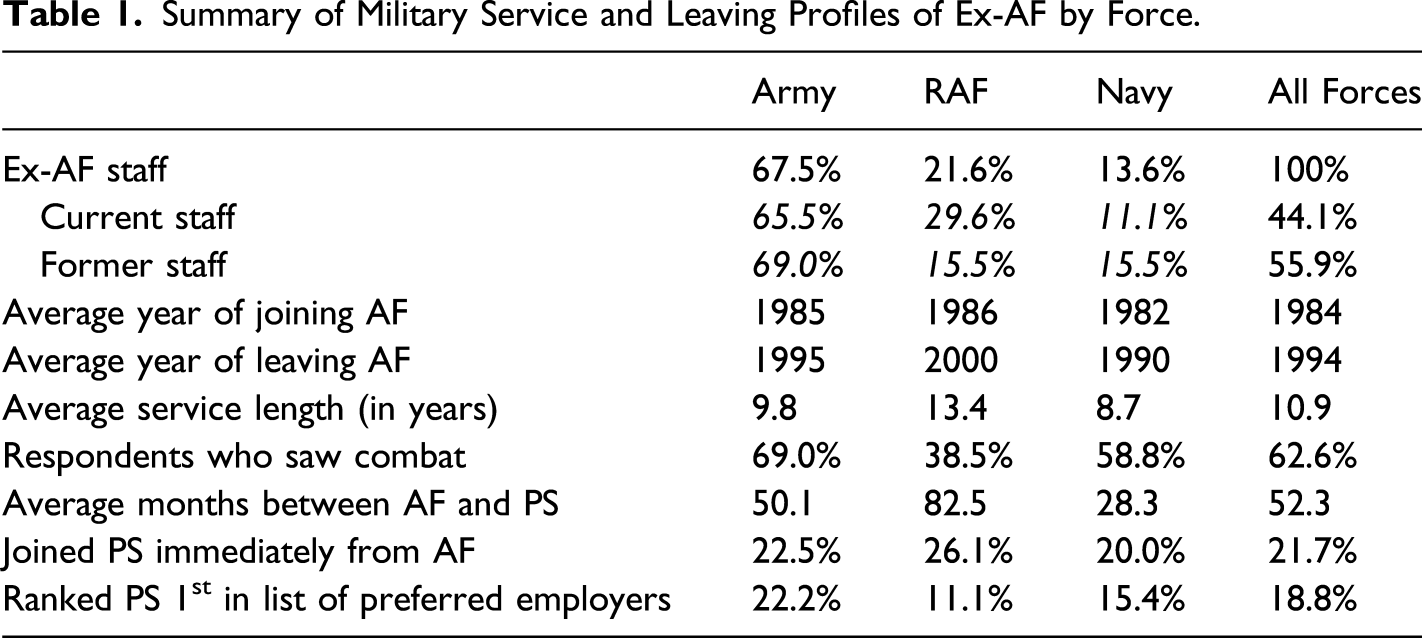
Summary of Military Service and Leaving Profiles of Ex-AF by Force.
Combat experience
More than 60% of our ex-AF respondents had seen combat, although this percentage was much smaller for ex-RAF than for ex-Army or ex-Navy. Determining whether these proportions mirror the role composition of service leavers as a whole is challenging, as specific data relating to their combat experience is extremely scant. Instead, we used Defence Statistics data reporting role composition in the active Forces, although, because this data is available only for the Army, our scope for analysis is limited. Nevertheless, we find that more than half of our ex-Army respondents had occupied combat roles (e.g. infantry), whereas consistent trends from 1991 to 2014 (Defence Statistics, 2015, p. 3) indicate that this experience is shared by only about one-third of Army personnel as a whole – suggesting that the Prison Service is disproportionately attracting and/or employing individuals with combat experience.
Lack of consistent role composition data for the UK Forces context makes comparison difficult, but the US perhaps offers some insight. In Maclean’s (2011) study of US Armed Forces combat exposure, approximately 30% of male respondents reported that they had ‘fired a weapon against the enemy or come under enemy fire’, thus indicating participation in combat. Clearly, the composition of the UK and US Forces differ but, in the absence of similar UK data, if we take this figure of 30% as an approximation of the proportion of Armed Forces personnel as a whole who have seen combat, then this experience is almost twice as common amongst our ex-AF personnel. Could the Prison Service be as susceptible to the ‘medal effect’ (Iversen et al., 2005) associated with military combat experience, as are other employers? Clearly, we cannot infer from our data whether the apparent tendency for the Prison Service to employ ex-AF personnel who have seen combat is a product of the applicant pool, the selection procedures, and/or period of recruitment, and further research would seem to be merited to explore the possible implications of this personal history for performance in prison work.
Time served and military rank
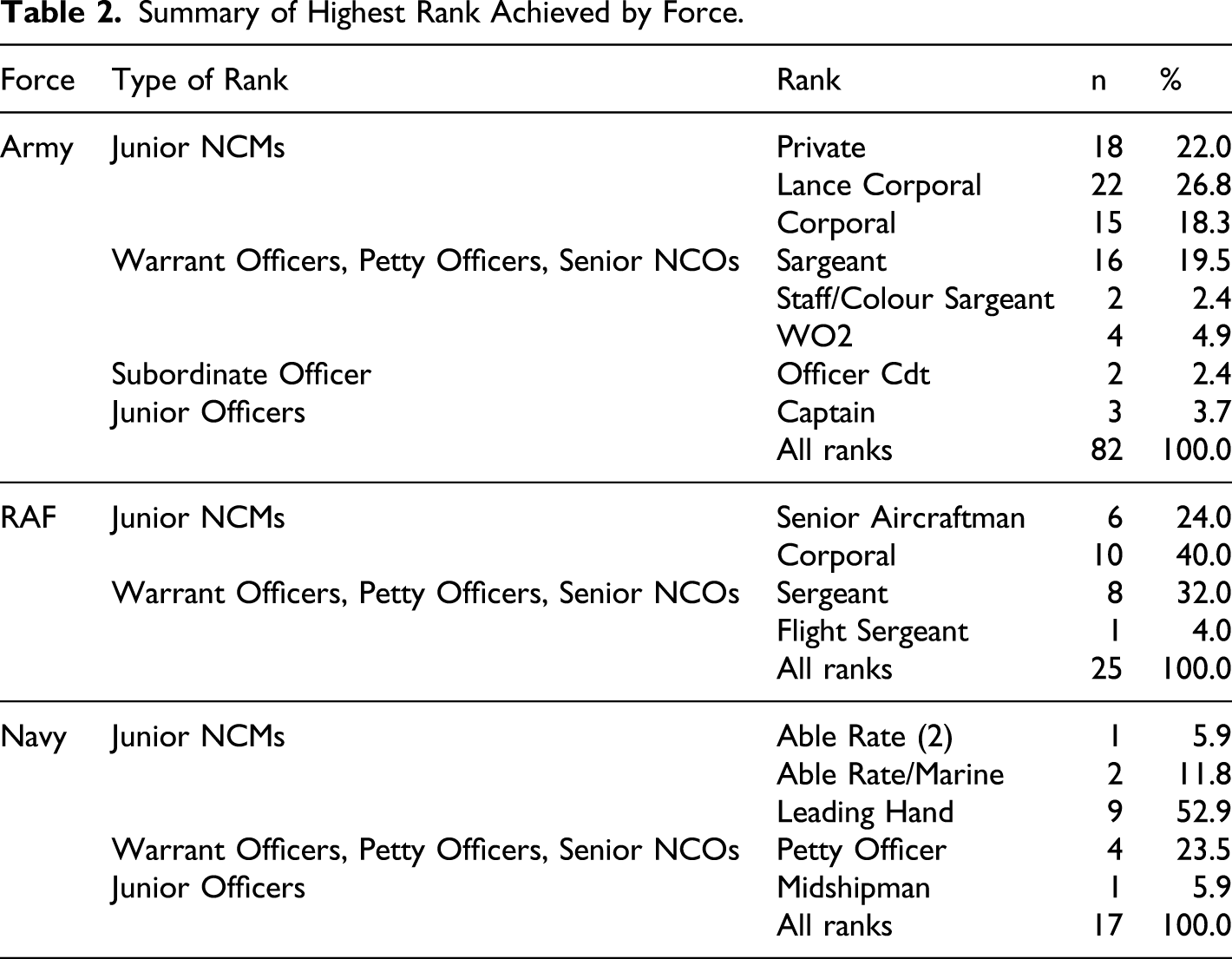
Summary of Highest Rank Achieved by Force.
Outflow from the Armed Forces
Our data suggest that ex-AF prison staff may differ from service leavers as a whole in their mode of outflow from the Armed Forces. We found that 47.2% of respondents left the Forces due to Time Expiring – that is, they had reached the end of an engagement or commission period. 37% had left through Voluntary Outflow (VO); that is, they had chosen to leave the Forces before the end of the agreed engagement or commission period (also known as Premature Voluntary Release or PVR). 13.4% indicated an ‘Other reason’ (which could include, for example, medical reasons or compassionate grounds, misconduct or dismissal). This breakdown between time expiring and VO seems to differ significantly from the modes of outflow of service leavers in general. Rates of VO have increased consistently over the last decade, from 41.1% of all service outflow in 2008/9 (DASA, 2012, p. 7) to 60.8% by 2018 (cf 12.6% after Time Expiring and 26.6% for other reasons [Defence Statistics, 2018, p. 8]). Our cohort spans a much wider range of leaving years but, when we filter our sample for 2008–2018, we find that only 30.4% left via VO.
Considering next the motivation for Voluntary Outflow, Defence Statistics indicate that ‘there is no single reason why personnel leave [in this manner]’ (2018, p. 8) but the UK Regular Armed Forces Continuous Attitude Survey (Defence Statistics, 2017) cited the impact on personal and family life, as well as potential for other opportunities outside of the military. Our respondents who exited via VO largely align with these findings, the majority citing as their reasons for leaving ‘to be with family’ (44.7%), ‘wanting a new challenge’ (27.7%) and ‘because it felt like the right time’ (21.3%). Although a certain level of early exit is necessary to create opportunities for promotion (MoD, 2008), high levels of VO of trained personnel is a concern for the Armed Forces because it jeopardises productivity and military readiness (Day & Bridger, 2012). Attempts to understand the reasons for VO have pinpointed low commitment to the organisation as a key reason, itself symptomatic of comparatively lower resilience to the stresses of military life, and tendency to respond to external stressors (such as family issues) by leaving the military (Day & Bridger, 2012). The fact that our ex-AF respondents seem much less likely than service leavers in general to have left before the end of their commission period might suggest that they have a high level of commitment to their organisation, a high degree of resilience to workplace stress, and/or a tendency to retain a commitment to the organisation despite workplace or external stressors. Since the prison is known to be an extremely stressful workplace (Tewksbury & Higgins, 2006), these characteristics might be extremely valuable. The Prison Service does not systematically collect data about the longevity of service of prison personnel in relation to their prior employment so we have no way of knowing whether ex-AF prison staff tend to stay in prison work longer than their non-AF colleagues. However, if they do, it is likely that this trend will have been observed at individual prisons and by individual prison governors, who may, in turn, factor this into their hiring decisions.
WH2: Ex-AF Deliberately Target Protective Service Occupations and, in Particular, the Prison Service After Leaving the Military
Most of our ex-AF respondents had, regardless of particular Force, generally agreed that they were ‘sorry to leave’ the military. Although ex-Naval participants were neutral, ex-Army and ex-RAF respondents expressed at least some anxiety about the future. Most lacked either a new job to go to, or a plan for the job they wanted to do next. Although lacking career direction, only those leaving the Navy reported being confident about entering civilian life. Compared to the 84% of 2017/18 UK Service leavers who reported being employed within 6 months (Defence Statistics, 2019, p. 1), only 56.6% of our ex-AF respondents were in full-time employment between leaving the Armed Forces and joining the Prison Service (again with the caveat that our respondents left the Armed Forces across a range of different years). Of those in work, most (59.2%) indicated that this was a ‘stop gap’ position, compared to around a third (31.6%) who intended for that employment (which had frequently involved ‘driving’ or ‘security work’) to be their new career.
Relatively few – only 21.8% – of the Armed Forces leavers we surveyed had left the Forces intending to join the Prison Service; a figure that varied by Force, with higher rates in the Army (24.4%, vs. 20.0% RAF, 13.3% Navy). Across all Forces, more than half (53.3%) had not even considered the possibility of prison work. This is consistent with our finding that, on average, service leavers spent 4 years out of the military before joining the Prison Service (see Table 1), suggesting that the majority had first pursued other career plans. 78.2% had considered applying to the Police (the preferred employer for 58.7%), the Fire Service (preferred by 23.8%), the Border Agency, private security firms or rail companies. Of those, the Prison Service was the preferred employer for only 18.8%. These data suggest that rather than seeing the Prison Service as a potential employer, most of our ex-AF respondents had ‘drifted’ into prison work having hoped or intended to do something else. In the US, Keeling et al. (2018) reported that many former service personnel felt that they must ‘start over’ in entry level jobs paying minimum wage, perhaps due to lack of educational qualifications or the ‘challenges transferring military skills and experience to civilian jobs’ (2018, p. 66). Within our sample, over half of participants with military experience only held a qualification at the level of GCSE/O Level-equivalent and very few held an Undergraduate (14.4%) or Masters degree (5.8%) (compared to 19.5% and 11.0% of the non-military cohort). It is plausible that they also sought new careers that seemed similar to the military, particularly those with no qualification requirement (as is the case with the Prison Service, ‘where personal qualities are more important’ [HMPPS, 2021, np]).
Giving their reasons for applying to the Prison Service, a substantial majority chose ‘job security’ (74.5%). Other material benefits included ‘pension’ (50.4%), ‘salary’ (44.1%) or ‘opportunities for progression and promotion’ (19.7%). The appeal of ‘being in Crown Service’ mattered to many (30.7%), as did ‘the opportunity to be a role model’ (25.2%), or ‘the opportunities for leadership’ (17.3%). Lack of Armed Forces attitudinal data for the years of service of our respondents unavoidably means that we deploy more recent data as a comparator. However, as far as we can tell, issues of pay, pension, appraisal and promotion, and opportunities for personal and professional development, are important issues in military employment – with promotions being of particular importance for non-officer ranks (Defence Statistics, 2017, p. 7–10) who make up the majority of our ex-AF respondents.
WH3: Ex-AF Are Comfortable with ‘Military-Like’ Prison Service Training
Summary of Opinion Responses Related to Joining the Prison Service.
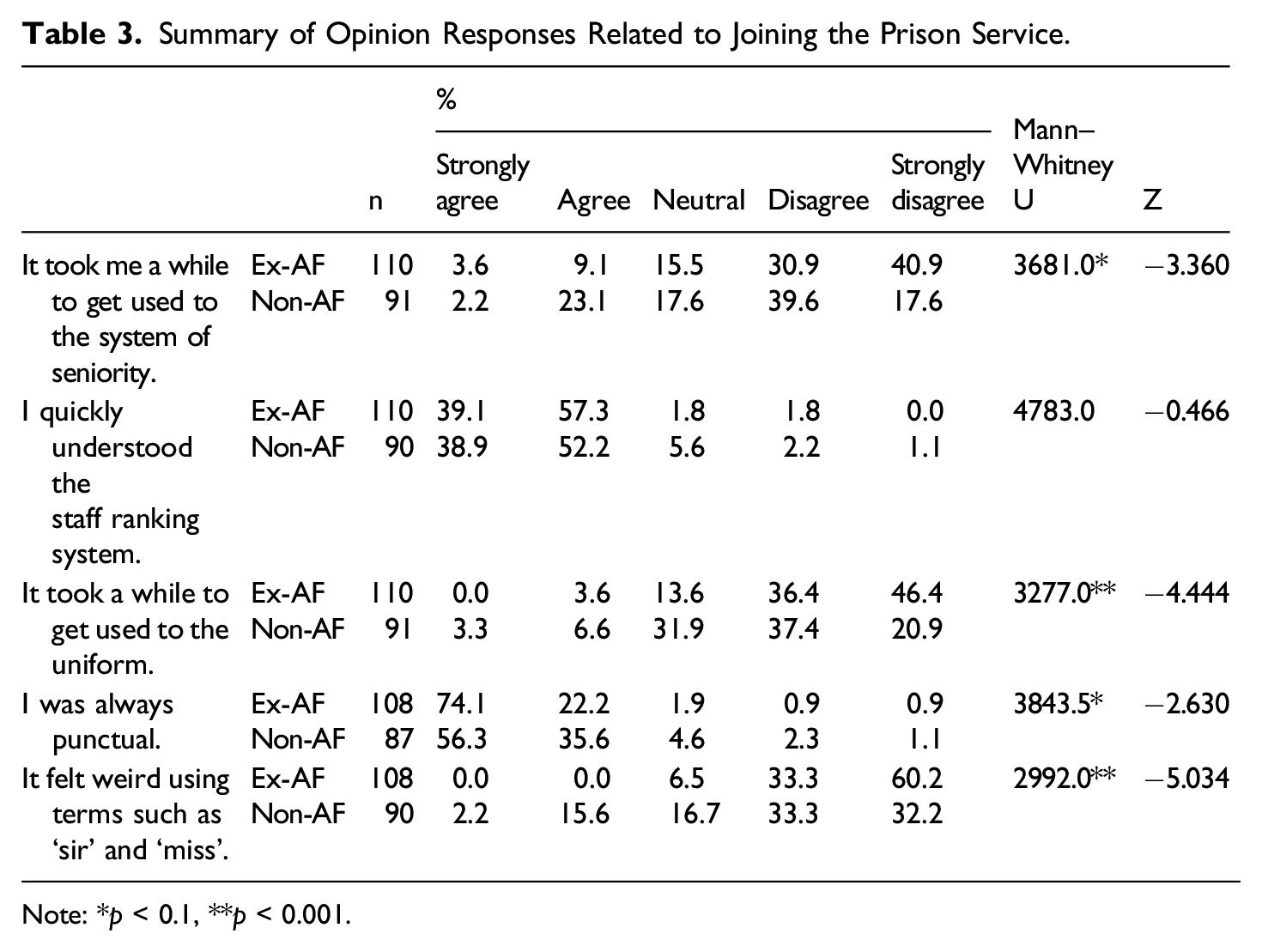
Note: *p < 0.1, **p < 0.001.
WH4: Ex-AF Demonstrate Similar Career Profiles within the Prison Service
Ex-AFs’ experience had been in the prisons which make up the majority of the UK carceral estate and was broadly similar to those without military experience: 91.8% had only worked in prisons for men (89.9% non-AF); and 89% had only worked in the public estate (83.9% non-AF). Fewer than 1 in 10 had worked in a dedicated VICs unit but this was more common than for non-AF (where it was approximately 1 in 40).
The reported job roles were varied and included a full range of ranks from operational support grades to the highest level of grades 9–11 senior managers (based on current equivalents). Since the titles of job roles have changed over time, for the purposes of analysis, we divide the various operational roles within the Prison Service into two broad categories – ‘basic’ and ‘advanced’ – where the ‘advanced’ category comprises positions ‘with responsibility’, entailing supervision of prison wings and oversight of ‘basic’ staff. Advanced roles align with the current Supervising Officer or Custodial Manager function (and the now defunct roles of Senior or Principal Officer). More than a third of our entire ex-AF operational cohort (40.3%) indicated that they held (or had held) an ‘advanced’ role with responsibility. More ex-Navy respondents (had) held ‘advanced’ roles (56.3%). However, ex-Navy respondents had also been employed longer than their ex-Army and ex-RAF counterparts, which might explain their increased likelihood of holding roles with more responsibility. Although ex-Army and ex-RAF demonstrated similar percentages of advanced roles, ex-RAF staff had typically been employed for 2 years less than their ex-Army counterparts, perhaps indicating a quicker route to promotion.
Interpreting these data is challenging. Within our sample, a slightly higher number of staff without a military background (46.3%) had held ‘advanced’ roles. In the Prison Service, as a whole, in 2020, 16.6% of the operational workforce held what we would term ‘advanced’ roles, with the remainder at ‘basic’ levels (NOMS, 2021) and our whole sample demonstrates significantly more ‘advanced’ staff. A chi-square test of independence showed that there was no significant association between military background and highest rank in the Prison Service X2 (1, N = 206) = .654, p = .419, which would appear to reject a hypothesis that ex-AF personnel’s apparent propensity to attain advanced roles in the Prison Service is somehow a function of their military training and experience. However, as noted earlier, our UK ex-AF respondents generally lacked advanced educational qualifications and, since they were just as likely to hold ‘advanced’ roles in the Prison Service, we may speculate that their military experience may compensate for lower formal educational levels. Nonetheless, the precise nature of this influence cannot be determined from our survey since our sample represents both current and past Prison Service staff. Further research would also be necessary, to distinguish the effect of military experience in particular from, for example, the effect of having had a similarly lengthy prior career of any kind.
Conclusion
Military–civilian transition has been widely researched on account of the complex and often profound impacts that leaving a career in the armed forces can have. Despite the breadth of research, which extends to a variety of post-military experiences including incarceration, none has yet explicitly and intensively focused upon military personnel who choose the Prison Service for further employment. This is surprising, given research indicates that former military personnel look to uniformed (often Protective Service-) occupations (Higate, 2001; MoD, 2021) and reports high numbers of prison staff with military backgrounds (Moran & Turner, forthcoming). Accordingly, this study offers new empirical insights into the experiences of ex-AF personnel employed as prison staff. Although limited in geographic location, scale and breadth, nonetheless, by deploying results from our working hypotheses in conjunction with existing theories of military–civilian transition emergent from the literature, we are able to address a significant lacuna in studies of post-military careers, and of prison personnel. We summarise our conclusions hereafter.
Much of the literature that focuses on military–civilian transition is grounded in the recognition that leaving the military can have significant short- and longer-term negative impacts upon daily life, including health, wellbeing, family and employment, among others. However, despite the wealth of literature that focuses on the propensity for negative or unsuccessful transitions for some, it is widely reported that most ex-military transition fairly seamlessly to civilian life (Ashcroft, 2014; Walker, 2013). Working within an institution such as the Prison Service could be itself considered a measure of successful transition to civilian employment. Indeed, our findings suggest that ex-AF personnel seem to excel in this environment, with a general level of comfort during early moments in this role. Furthermore, ex-AF prison staff were just as likely as their non-military counterparts to achieve roles with responsibility. Such findings support the aforementioned prevailing notion of successful post-military careers and corroborate the range of literature that has tracked former military personnel into successful careers in other professions, such as teaching and business management. In line with prior research, our participants demonstrate a propensity towards post-military careers in PSOs. That said, despite research that suggests both a substantial number of ex-AF within the Prison Service (Moran & Turner, forthcoming), and which indicates that former military personnel are often the choice recruits for this profession (King, 2013; Morris & Morris, 1963), our study indicates that the Prison Service was generally not the first choice PSO. Such findings are among several indicators that point towards the nuances in transition to Prison Service careers. It is certainly the case, when we consider the mode of outflow from the Forces, that ex-AF prison staff were much less likely than service leavers in general to have left by VO before the end of their commission period, which could indicate a high degree of commitment and resilience. Such qualities may be wider indicators of the aforementioned ‘seamless’ military–civilian transition, but may also directly shape performance in the job role within the Prison Service.
Post-military identities are shaped by and evolve in light of military experience (Cowen, 2005; Riley & Bateman, 1987; Walker, 2018). Indeed, Armed Forces staff reported greater comfort levels with ‘military-like’ aspects of the entry period into the Prison Service than prison staff without a military background. To that end, our cohort do appear to be well-suited to the routinised, regulatory and organisational functions of Prison Service employment – just as Morris and Morris (1963) proposed. Further to this, a higher percentage of our ex-AF cohort had directly worked with VICs than their non-military counterparts, which seems to suggest that their background could be valued. The notion that post-military identities are hinged upon military experience is of further interest here. Iversen and Greenberg (2009) suggested that VICs may prefer assistance from those with military backgrounds and may benefit from interaction with fellow service leavers who are experiencing their own transition from the military. Although our study does not draw upon the opinions of VICs themselves, it certainly seems that ex-AF staff (perhaps through their acceptance of roles that involve working with the VIC cohort) and/or the Prison Service itself (in its decision to appoint ex-AF to positions within VICs units) agree with Iverson and Greenberg’s assumption of their value. Future research trajectories could explore this.
As noted, we present our findings here with caution. Given our relatively small sample size and the potential for self-selection bias (i.e. the survey appealing most to those with military experience) we cannot directly extrapolate from these figures to the prison workforce as a whole. Given our cohort includes a range of military-service leavers from a broad timescale, there are also limitations of this work in terms of the transferability of findings to patterns among current Armed Forces leavers and Prison Service joiners. However, in line with the work of scholars who acknowledge the value of analytic frameworks as the basis for generalisability (Mookherji & LaFond, 2013; Yin, 2013), our findings are offered in conjunction with, and in juxtaposition to, the scant literature on military personnel in the Prison Service, and the research on military–civilian transitions more widely. It also offers a platform for further important work in this area. Indeed, given our specific interest in military personnel within the Prison Service (and avenues of particular thematic and conceptual interest directed towards this cohort), our results establish further rationale for the focus on this particular group. Whilst our findings mirror prevailing assumptions of a general seamless transition to post-military careers (and, in particular, those within PSOs), there are clear nuances in the career trajectories to the Prison Service as one among other, more favourable, occupations. Such trajectories may influence personal military–civilian transitions, as well as job performance in prison work and, by extension, the everyday lives of prisoners and other prison staff.
Accordingly, both the findings and the research limitations offer scope for further study. Since our study demonstrates that the Prison Service was not as highly prioritised by ex-AF as other Protective Service Occupations, this warrants further attention among service leavers more widely since perceived career success may have a bearing upon effective military–civilian transition and, potentially, job performance (Vigoda-Gadot, 2010). It is also prudent to consider the link between military background and approach to the job. In addition to interrogating the role of military personnel as prison staff and the general prisoner response to their working practice, there is a clear rationale for exploring how working with prisoners with military experience impacts ex-AF staff and, particularly, their own military–civilian transition. Such work is currently under development via an ongoing longitudinal study that interrogates the impact of military experience (and, in particular, traumatic military experience) upon the delivery of correctional roles in the Canadian context. Additionally, findings that indicate comfort with particular ‘military-like’ aspects of the job raise the question of whether such behaviour is something that is likely to translate into broad-scale patterns of behaviour among prison staff throughout their careers. Although recent work (Moran & Turner, 2021) addresses the assumption that militaristic qualities deliver negative associations (both within and without the Prison Service), the style of working could be usefully explored. In this sense, the study could also be expanded to other geographical contexts where there are different relationships between society and military practice, such as in countries with (recent) obligatory military service, which would result in higher numbers of prison staff with military experience as standard.
Footnotes
Acknowledgements
The authors would like to thank the anonymous reviewers of Armed Forces & Society and the Editor, Patricia M. Shields, for their generous and insightful comments.
Declaration of Conflicting Interests
The author(s) declared no potential conflicts of interest with respect to the research, authorship, and/or publication of this article.
Funding
The author(s) disclosed receipt of the following financial support for the research, authorship, and/or publication of this article: This research was supported by funding from the School of Environmental Sciences, University of Liverpool.
