



Abstract
The authors report the results of an intervention designed to trigger cultural change in science, technology, engineering, and mathematics academia. Drawing on Dobbin and Kalev’s managerial engagement approach, the authors mobilized faculty members as change agents by teaching them to deliver a prosocial bystander intervention curriculum to their students. Observations and in-depth interviews with faculty members reveal how opportunities to commit the content to memory, share examples from their own lives, and articulate its value to students increased accountability to the material. This led faculty members to expand their definition of bystander intervention beyond direct, in-the-moment confrontation and recognize past instances in which they had been prosocial bystanders, which boosted their confidence to intervene in the future. Interviews with nonfacilitating faculty members and a small, randomized experiment suggest that leading an activity creates greater readiness than merely attending a training. With universities currently under government pressure to eliminate programs that historically signaled compliance with civil rights mandates (e.g., diversity and sexual harassment trainings), it is important to identify more sustainable strategies for cultural change. The present findings chart potential pathways for building prosocial bystander readiness when the risks of intervening and the costs of not intervening may be increasing.
Individuals from groups that have been historically underrepresented in science, technology, engineering, and mathematics (STEM) often encounter unwelcoming academic climates. Studies reveal that gender harassment, racially biased behaviors, and incivility are relatively common (Inclusion and Climate Committee 2020; National Academies of Sciences, Engineering, and Medicine 2018b). Hierarchical and dependent relations between faculty members and students, postdocs, and lab assistants discourage reporting and create a perception of impunity, which contributes to abuse (Fitzgerald et al. 1997; Kabat-Farr and Cortina 2014; National Academies of Sciences, Engineering, and Medicine 2018b).
At the same time, many standard operating procedures—including processes for hiring, tenure and promotion, and awarding grants—put historically minoritized groups at a disadvantage. Evaluation criteria usually emphasize narrow, quantitative criteria of success and impact, such as number of publications, number of grants, citation counts, and journal Impact Factors (Heckman and Moktan 2020; Lindner, Torralba, and Khan 2018; Smaldino and McElreath 2016). These criteria, as well as emphasis placed on the prestige of the PhD-granting institution, reward incremental findings and social connectedness. Historically marginalized groups, out-of-the-box approaches, and work on the margins of—and that poses challenges to—scientific disciplines earn less recognition (Clauset, Arbesman, and Larremore 2015; Jensenius et al. 2018; Mitchneck, Smith, and Latimer 2016). As a result, women and racially and ethnically minoritized scholars tend to receive fewer grants and citations; these gaps persist even when we control for other potentially relevant factors such as institution type, time since degree, and rank (see, e.g., Dion, Sumner, and Mitchell 2018; Erosheva et al. 2020; Ginther, Kahn, and Schaffer 2016; Hoppe et al. 2019; Teele and Thelen 2017).
There is emerging consensus among scholars, private corporations, government agencies, and advocacy groups that creating inclusive climates requires more than programs that help individuals navigate existing systems (Sturm 2006). Recruitment, mentoring, and networking efforts are insufficient to shift historic and institutionalized norms. The National Science Foundation launched its ADVANCE program in 2001 with the idea that boosting women’s presence in scientific research and leadership is not about fixing women but transforming institutions (Stewart and Valian 2018:xiv). ADVANCE and other programs to promote diversity in STEM fields require that grantees execute strategies to change institutions and cultures (see, e.g., Directorate for STEM Education 2021). Similarly, National Academy of Sciences reports on combating sexual harassment, improving graduate education, and advancing antiracism advocate systemic cultural changes (National Academies of Sciences, Engineering, and Medicine 2018a; National Academies of Sciences, Engineering, and Medicine 2018b, 2023).
At the same time, higher education is facing unprecedented pressure to eliminate diversity, equity, and inclusion (DEI) programs or risk the loss of federal and state funding (Gretzinger et al. 2025). In the wake of the anti-DEI movement, how can organizations, including institutions of higher education and private corporations, enact equality through systemic cultural change? In this article, we report results from an intervention designed to trigger cultural change in STEM academia. We built our intervention around the insights supplied by Frank Dobbin and Alexandra Kalev’s “managerial engagement” approach to organizational change (Dobbin and Kalev 2022; Dobbin, Schrage, and Kalev 2015). Dobbin and Kalev’s research on 800 U.S. corporations over 30 years shows that common strategies to foster inclusion and more diverse leadership frequently fail. Instead of controlling, blaming, and shaming, Dobbin and Kalev recommend engaging organizational leaders in new activities and behaviors. They suggest that effective strategies empower leaders, create opportunities for them to develop solutions, and then hold leaders responsible for outcomes.
We operationalize Dobbin and Kalev’s managerial engagement strategy by engaging STEM faculty members as agents of cultural change and we measure the effects. We consider faculty members as organizational leaders in STEM higher education, analogous to the role of managers in private sector organizations. Our hypothesis is that involving faculty members in an activity in which they assume responsibility and play the role of expert builds their awareness, develops their skills, and fosters their commitment to the goals of the activity. Leading an activity creates greater readiness and willingness to be a change agent than merely participating in an activity led by someone else, such as a workshop or training.
We adopt a sociological definition of organizational culture that emphasizes the taken for granted norms and shared understandings that shape social relationships in organizations (Ouchi and Wilkins 1985). Individuals in an organization reproduce cultural norms when they behave according to existing practices, but they also enact cultural change by challenging them (Ridgeway 1997). We focus on activating leaders as prosocial bystanders. Prosocial bystanders are able and willing to intervene when they witness and identify harassment, incivility, racial biases, discrimination, exclusion, and other problems. Prosocial bystanders help the targets of harmful behaviors, fortify norms of civil and respectful conduct in the workplace, and create more inclusive organizations. By displacing taken-for-granted rules and practices, prosocial bystanders serve as cultural change agents (Banyard, Moynihan, and Crossman 2009; Banyard et al. 2018; Moynihan et al. 2015; Potter and Moynihan 2011; Potter and Stapleton 2012). However, people often face incentives not to intervene as bystanders, even when they confront emergency situations (Latané and Darley 1969). Gaining confidence and knowing how to intervene effectively to help others are skills that need to be taught.
Our research question is, Why and how does facilitating a prosocial bystander curriculum increase prosocial bystander awareness, behavior, and commitment (“bystander readiness”) on the part of the facilitator? We begin by presenting results of a small, randomized experiment that shows that passively consuming a prosocial bystander curriculum is not significantly associated with changes in bystander readiness. We then present evidence from qualitative interviews with STEM faculty members who learned to facilitate and then delivered a bystander intervention curriculum in their classes. Analysis of these interviews shows that assuming the responsibilities and conducting the duties involved with facilitation gives faculty members more confidence to intervene, offers lower risk strategies to their intervention toolkit, gives them an opportunity to reflect on past experiences where they did and did not intervene, and motivates them to engage in prevention, which in turn increases their bystander readiness. In addition, we present evidence from interviews with a subset of faculty members who passively consumed the curriculum but did not facilitate it in their classes.
Taken together, our data suggest that leading an activity is more likely to create a change agent than merely joining an activity led by someone else. Having opportunities to commit the content to memory, share examples from their own lives, and articulate its value to students increased accountability, which boosted their confidence to intervene in the future. Our research contributes to a growing body of evidence implying that much of the work large organizations impose to comply with federal civil rights mandates—such as brief, one-shot diversity and/or sexual harassment trainings—is insufficient and that new strategies are needed (DeGue et al. 2014; Dobbin et al. 2015; Edelman 2016; Htun et al. 2022; Tinkler 2012, 2013). Our findings are promising because they offer a more sustainable approach to cultural change, particularly in an environment where the risks of prosocial intervening and the costs of not intervening may be increasing. We end this article with specific suggestions about how university leaders can incorporate lessons learned from this research at a time when they are facing uncertain budgets and increasing polarization on campus.
Background: The Movement for Cultural Change in STEM Academia
Most STEM fields, especially in engineering, lack diversity, defined with reference to the proportional presence of major social groups in the United States. Although STEM is diverse internationally—temporary visa holders earned almost 60 percent of PhD degrees in engineering and computer science in 2019 (National Science Board, National Science Foundation 2022)—shares of women and U.S.-origin underrepresented minorities (including African American, Hispanic-Latino, Native American, Alaskan Native, and Pacific Islander), remain relatively low. Low numbers of underrepresented groups in STEM and especially engineering raise concerns about the relevance of scientific research and the adequacy of its findings (National Academy of Sciences, National Academy of Engineering, and Institute of Medicine 2011). Without the infusion of different perspectives, even high-ability scientific teams may fail to solve complex problems. Diversity, by contrast, facilitates novelty and innovation (Hewlett, Marshall, and Sherbin 2013; Hofstra et al. 2020; Hong and Page 2004). Diverse scientific communities promote more objective reasoning and call out problematic assumptions and biases (Intemann 2009).
Even if diverse representation increases, it may be insufficient to achieve the benefits of diverse thinking. As several National Academy of Sciences reports affirm, the organizational culture of science—its value hierarchies, patterns of recognition, processes for hiring and promotion, incentive systems, and everyday behavior—hinders inclusive participation (Dotson 2014; Ginther et al. 2016; Hofstra et al. 2020; Hoppe et al. 2019; Settles et al. 2020). Cultural change in a community depends on enough members altering their behavior and practices to constitute a tipping point toward norm change, that is, toward expecting negative sanctions for behaviors that used to be socially rewarded (Andreoni, Nikiforakis, and Siegenthaler 2021). Thus, changing departmental norms in STEM requires a substantial number of faculty members across rank and other power hierarchies to change their behavior.
Findings about Organizational and Cultural Change Efforts
How can organizations reduce uncivil behaviors and change their cultures to promote inclusion? Frank Dobbin and Alexandra Kalev’s research on 800 U.S. corporations over 30 years reveals that programs to promote diversity in leadership and inclusive organizational cultures frequently fail. People tend to resist the imposition of well-intended mechanisms to rein in bias and discrimination, such as performance evaluations and hiring tests, and often circumvent them. Often, people resent diversity training, especially when it is mandatory and legalistic (Dobbin and Kalev 2022; Dobbin et al. 2015). A common feature of many change strategies is that they “blame and shame” managers. By framing leaders as part of the problem, diversity promotion programs discourage them from joining the solution.
Dobbin and Kalev’s blockbuster findings resonate with conclusions of other works about efforts to comply with the 1964 Civil Rights Act and related provisions. Many organizations attempted to comply with federal rules about nondiscrimination and equal opportunity by hastily erecting “symbolic structures,” or policies and programs that create an appearance of compliance but produce little practical effects, and sometimes make things worse (Edelman 2016). Programs that are merely lip service reduce liability and serve as a shield from legal liability (Bisom-Rapp 2018; Edelman 2016; Gertner 2018).
Instead of performative programs and other symbolic structures, Dobbin and Kalev recommended a different approach. They found that organizations that succeed in creating more inclusive climates involve organizational leaders in task forces, recruitment drives, and other methods that engage them in searching for solutions and hold them accountable for results (Dobbin et al. 2015). Even when managers are initially hostile to diversity efforts, their involvement in diversity-promoting activities triggers cognitive dissonance and fosters greater commitment as they adjust attitudes to align with their actions (Dobbin et al. 2015). Dobbin told a story about a white male manager who, tasked with leading the recruitment of minority graduates, became a champion of the program. Once his recruits entered the organization, he made sure they were sponsored and connected, so that his recruits would be the best recruits. The Dobbin-Kalev “managerial engagement” approach succeeds because it cultivates the internal motivation of organizational leaders to act as change agents.
Prosocial Bystander Intervention as a Cultural Change Strategy
In Dobbin and Kalev’s research, cultural change work appears as a formal, organized activity. However, actors can also contribute to normative and cultural change through their behavior in informal, everyday contexts. Often, people find themselves in the role of bystanders faced with choices about whether to intervene, such as conversations in hallways, decisions in committee meetings, or encounters or emergencies in the street. In these situations, however, people need to overcome the “bystander effect,” or the dominant incentive to sit back and do nothing.
Latané and Darley’s bystander intervention paradigm (Darley and Latané 1968; Latané and Darley 1969) explains the bystander effect, or why people frequently fail to intervene to help others in life-threatening emergencies such as violence, fires, and drowning. One key insight is that the presence of other bystanders triggers a diffusion of responsibility: it cues people to assume others will intervene, inhibiting helping behavior. As bystander intervention is often socially and personally costly and can require people to step out of their typical roles, it is easy for people to rationalize that others in the setting are better equipped to intervene.
The decision about whether to intervene as a bystander is not one but rather a sequence of decisions. Barriers at any stage in the process reduce the likelihood that people intervene to help others (see, e.g., Bennett, Banyard, and Garnhart 2014; Burn 2009). Training programs have the potential to address barriers at multiple decision stages and activate bystanders to intervene when they witness sexual assault, violence, and bullying, among other problems (Banyard et al. 2009; Polanin, Espelage, and Pigott 2012). Bystander trainings have succeeded in increasing participant knowledge, confidence, and ability to intervene as active bystanders in the event of sexual assault on college campuses, high schools, and in the U.S. military (Banyard, Moynihan, and Plante 2007; Cares et al. 2015; Coker et al. 2016; Moynihan et al. 2015; Potter and Moynihan 2011; Potter and Stapleton 2012).
The prosocial bystander intervention approach builds on insights of social norms theories: by intervening to resolve problems as bystanders, people help change social norms about acceptable behavior (Banyard et al. 2009). Bystander training programs have the advantage over forms of legal redress that require targeted and/or harmed individuals to report wrongdoing in that they shift the locus of responsibility for changing the culture from those who are marginalized to the entire community (National Sexual Violence Resource Center 2013). When community members intervene to disrupt harassing, racially biased, and uncivil behaviors, they normalize bystander intervention activities and help fortify norms of respectful conduct. As this suggests, activating prosocial bystanders is a potentially useful way to generate broad normative, cultural, and institutional change toward inclusion. Prosocial bystander intervention resembles Dobbin and Kalev’s managerial engagement approach in that both strategies empower all community leaders as change agents (Berkowitz 1994; Fabiano et al. 2003; Gidycz, Orchowski, and Berkowitz 2011).
Our Approach
Our research develops and analyzes a strategy to activate STEM faculty leaders as prosocial bystanders and cultural change agents. The main intervention we analyze in this study adds a twist to both managerial engagement and bystander intervention approaches. Dobbin and Kalev (2019) considered training managers in bystander intervention to constitute leader engagement. In our view, leader participation in a passive training, even one oriented toward prosocial bystander action, seems inadequate to motivate behavioral change. Our hunch is that a successful intervention needs to give leaders more responsibility and put them in a position to be held accountable. As we describe, we begin by reporting the results of a randomized experiment analyzing the effects on STEM faculty members of passively listening to a prosocial bystander curriculum led by a professional, conducted at one of the universities. We then report the results of the main intervention in which we asked participants in our study not just to learn a prosocial bystander curriculum but to teach the curriculum to their students. Using interview data with the engineering faculty members, we then explore the mechanisms through which teaching rather than passively consuming the curriculum appeared to lead to more meaningful change.
Study Setting and Procedures
Our study sites consisted of two engineering colleges at public research 1 (R1) universities in two different states. In the first stage of the project, which we do not report here, we conducted semistructured interviews with more than 100 engineering students, faculty members, and staff members. Our goal was to learn more about the types of harmful behaviors people experience in engineering workplace, their perceptions of the climate as welcoming or unwelcoming (and why), and the features of the workplace and organizational context.
On the basis of the first stage of research, we modified an existing prosocial bystander intervention curriculum to apply specifically to engineering and STEM workplaces. For example, we changed scenarios in the curriculum to resemble situations that would be familiar to people in engineering academia. This meant broadening the scope of harmful behaviors to include forms of social exclusion and incivility along a variety of status and power dimensions (e.g., age, nationality, religious, and race based), not just gender. We described these problematic behaviors as forms of harassment and incivility that people in engineering routinely encounter.
We invited engineering faculty members to participate in the interventions we analyze here. There were some differences in our recruitment practices between the two colleges. At one university, we invited all faculty members to participate (universal recruitment), whereas at the other university we invited faculty members identified by academic leaders as likely to be willing to participate (targeted recruitment). We discuss differences in recruitment, and their consequences, in detail elsewhere (Tinkler et al., 2025), but we note that the different recruitment strategies led to similar levels of faculty participation across the two colleges and similar demographic patterns (by gender, race, and tenure status).
Our outcome of interest is engineering faculty members’ commitment to act as change agents. We probe their willingness to enact change in everyday situations they encounter by serving as prosocial bystanders themselves, which we define as “bystander readiness.” According to bystander intervention theory, these everyday acts contribute to the consolidation of new norms of conduct that discourage harmful behavior from happening at all (Banyard et al. 2009).
Experiment
In the experiment, the treatment is a training in which research participants are passive recipients of the information. We arranged for a professional trainer in prosocial bystander skills to facilitate a workshop in daylong annual retreats organized by each academic unit in the engineering college at one of the R1 universities. The trainer has 20 years of experience leading bystander workshops in various educational contexts, including higher education, secondary education, the military, and private corporations. During an allotted time in each annual retreat, the professional trainer presented an abbreviated portion of the curriculum to the assembled faculty members as a group. The faculty members listened as the trainer spoke and showed slides, they responded to questions posed by the trainer, and they contributed their perspectives when prompted.
The training offered in the experiment often did not meet ideal criteria for effective training, but it represented what department heads could feasibly ask of their faculty members. The sessions were relatively short (ranging from 45 to 90 minutes), and in some but not all retreats, department chairs did not allocate enough time on the agenda for the trainer to present all the curriculum or for full discussion of each discussion prompt. For example, instead of meeting in small groups to discuss moments when participants did or did not step up as prosocial bystanders, the trainer asked participants to reflect on their own, or asked the large, assembled group to raise their hands with examples. In all sessions, however, faculty participants discussed two scenarios of potential intervention familiar to engineers. The trainings met the minimum criteria to communicate the principal theory of prosocial bystander intervention in STEM and engineering contexts.
Our research team randomly assigned all the engineering faculty members at this R1 university into two groups: “pre” and “post.” We invited the “pre” group to take a survey in the weeks before the annual retreats (n = 18), and we invited the “post” group to take the survey following the annual retreats (n = 18).
We administered the survey through Qualtrics and offered respondents a monetary incentive to complete the survey. It contains three clusters of questions (see Appendix 3 for the full survey). The first cluster is an adapted scale intended to tap respondents’ sense of bystander readiness (Cronbach’s α = .92). It asks, “Please indicate your degree of confidence that you would behave this way in the situation described.” Respondents mark a scale that ranges from 0 (“not at all confident”) to 100 (“very confident”). Among the 14 items, examples include “express my discomfort if I see a colleague being repeatedly interrupted and/or ignored while speaking,” “ask a colleague who looks very upset if they are OK or need help,” “do something if I see a woman or person of color disproportionately assigned to service roles with less status,” “get help or resources for a colleague whom I suspect to be the target of harassment or microaggressions.”
The second scale measured the respondent’s sense of empowerment to enact positive changes in their organization (Cronbach’s α = .70). There are four items, and respondents indicate their degree of agreement (e.g., “I feel I have the power to change things in my department,” “I feel my opinions and ideas are taken seriously by others in my department”).
The third scale assesses participants’ perceptions of the work environment and the willingness of their colleagues to engage in actions to improve the institutional climate (Cronbach’s α = .69). Respondents indicate their degree of agreement with statements such as “most of my colleagues feel a sense of responsibility to bring about positive change at work” and “most of my colleagues feel responsible for increasing the participation of underrepresented minorities in engineering and computing.”
It is reasonable to expect that participating in learning the curriculum would increase bystander readiness, as the curriculum’s goal is to motivate prosocial bystanders, increase their awareness, and give them skills and strategies to intervene. Although changes in behavioral intentions are associated with relatively small changes in behavior (Mesmer-Magnus and Viswesvaran 2005; Webb and Sheeran 2006), bystander readiness is likely a necessary ingredient for broadscale change.
It is also plausible to imagine that the workshop participation would increase people’s perceived ability to enact change, as an implication of their willingness to improve the institutional climate as prosocial bystanders. Finally, it is possible that participating in the workshop as an academic unit, a context in which faculty saw one another digesting the curriculum, would alter their perceptions of their colleagues as change agents (cf. Chwe 2013; Mackie 1996).
As Figure 1 shows, receiving the professional abbreviated prosocial bystander training is not associated with any significant changes in respondents’ bystander readiness, their sense of empowerment, or their perceptions of their colleagues and the work environment. Although we do not wish to capitalize on chance, it also worth noting that bystander readiness is lower after training (the effect size is medium to large: Cohen’s D = .72, p = .051).

Comparison of engineering faculty members’ bystander readiness, empowerment, and climate perceptions before and after prosocial bystander training.
How can we account for our insignificant findings, given that other studies demonstrate changes in readiness after bystander training? It is possible that participants who took the survey prior to the training had an inflated sense of confidence in their willingness to intervene in potentially harmful social situations, and that the training, by sharing information about actual bystander experiences, raised awareness of intervention’s risks. Other studies have shown that single session trainings produced undesirable effects (e.g., by inducing women to say that they are less willing to report assault) perhaps because training raised awareness about risks involved with reporting (Holland, Rabelo, and Cortina 2016; Htun et al. 2022; Smith and Freyd 2014).
Following a similar logic, it is also possible that the abbreviated bystander training caused faculty members to feel more powerless. A couple of the trainings led to tense discussions among the faculty members about uncivil behavior in their departments. The abbreviated format may have exposed them to the curriculum without providing sufficient time to think about and discuss strategies for positive intervention. As a woman replied when asked months later whether she thought the training helped her department, “I’ve heard people refer to the awkwardness about the conversation at the retreat. But that’s it. . . . So I don’t know that just picking open a scab is enough.”
Finally, it is possible that variability in aspects of program implementation across sessions—such as communication from department heads prior to the session, session length, fidelity to interactive and skills building curriculum components, inconsistency in presentation examples—influenced the lack of effectiveness. We contend that this variability, though not ideal, realistically reflects the challenges of delivering an interactive, in-person, mandatory training to busy university faculty members.
Faculty-Facilitated Prosocial Bystander Intervention Curriculum
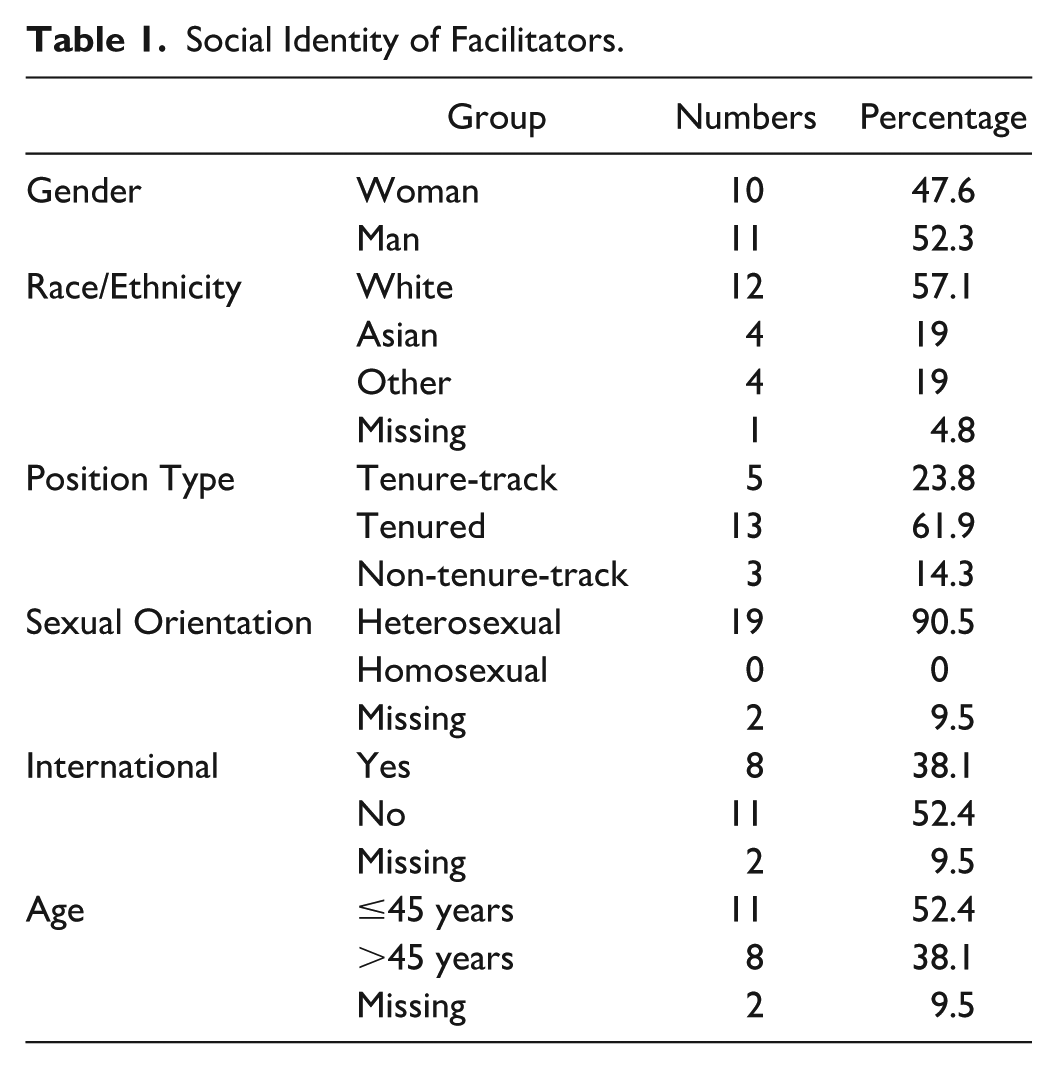
In our main intervention, we recruited engineering faculty members to participate in our project. Twenty-one faculty members facilitated the curriculum. Table 1 reports that approximately half the 21 facilitators are women and half are men; 60 percent tenured (the rest tenure-track or non-tenure-track); 38 percent international (which usually means that their first degree is from outside the United States); and 57 percent identify as white, 20 percent as Asian, and 23 percent as “other.” Participation involved three steps, and participants earned stipends ranging from $1,000 to $2,000.
Social Identity of Facilitators.
First, our team conducted a training session with faculty members to prepare them to deliver the prosocial bystander curriculum. Approximately half of the participants were exposed to the curriculum in their annual departmental retreats (described in the “Experiment” section) and then provided one-on-one training. During the individualized training of approximately one hour, they had the opportunity to explore the materials in greater depth and to ask questions. The other half of the faculty members participated in a four-hour training session in which experts taught them the content of the curriculum and then taught faculty how to deliver the curriculum to their students. The curriculum followed the same structure as the abbreviated curriculum that the faculty members were exposed to in the experiment described previously. The team provided all faculty members with the ready-made slides and a manual with teaching guidance. The second step was for faculty members to facilitate the curriculum themselves. After being trained, faculty members designated a context in which they would lead the curriculum. Most faculty members delivered their curriculum to an undergraduate class, but some arranged meetings of their research groups (involving students, postdocs, and research professors), and some delivered the curriculum in departmental colloquia. The research team observed and took notes on all faculty-facilitated sessions.
The third step was an interview with the research team. We conducted semistructured individual interviews with all faculty facilitators. To ensure that faculty members felt comfortable being honest about their experiences, we kept the research and training teams separate and emphasized at the start of the interview that the research team was not invested in this program’s efficacy, ensured the interviewer was not employed at the same university as the interviewee, and genuinely cared about documenting positive and negative experiences. We asked faculty members about their experiences facilitating; what, if anything, they had learned from teaching the curriculum; and whether they had applied anything they had learned.
We transcribed the interviews using Zoom, other digital transcription services, and human listening and typing. We then used the Atlas.ti platform to code and analyze the transcripts. For the purposes of this study, we were interested primarily in whether and how teaching and leading the prosocial bystander curriculum affected faculty bystander readiness.
We coded and analyzed transcripts using an iterative process that Deterding and Waters (2021) called “flexible coding,” which describes the actual coding methods used by most social scientists working with interview data in theoretically informed research. We began with “index coding,” or classification of the text according to major topics (Deterding and Waters 2021). In our case, the relevant index codes related to the effects of facilitating the curriculum on the participant. Deterding and Waters suggested then undertaking a more refined process of “analytical coding” of specific concepts, some of which may arise during and be reflected in memos produced during the index coding stage. Discussion among our research team members involved in the index coding process revealed several ways in which teaching the curriculum affected participants, which guided the analytical coding process.
Bystander Readiness among Faculty Facilitators
How did the experience of facilitating a prosocial bystander curriculum shape the overall bystander readiness of faculty members? Our interview analysis reveals that almost all participants (19 of 21 interviewed [90 percent]) said that, because of their experience with our program, they became more willing to intervene and gained more confidence. One faculty member said, “Before, I was passive. Now I know that I have a role and I will take action.” A second recalled, “For me it was very effective. It gave me confidence. It empowered me.” A third participant described how the training helped overcome Latané and Darley’s (1969) bystander effect:
After this training . . . I feel more responsible. One idea could be like, somebody else will take care of this later, but if everybody thinks that, nobody takes care of the situation. After the training that we had, it came to my mind that everybody technically has a role.
In addition, almost all faculty participants (19 of 21) were able to recall a specific time they used skills they had gained through participating in our intervention. This is an impressive number, as most of the interviews were conducted within one month of their classroom delivery. Most incidents occurred in professional contexts. For example, Christophe (all names here are pseudonyms) described how he intervened to help a visiting woman scientist feel more included when a male-dominated group visited his lab. He said,
It was like 12 dudes and one woman. And I noticed that she sort of hung back and let these dudes do their thing. . . . But I felt it was important, just to ask her, “What would you like to do?” actually be a little proactive and not to put her on the spot, but to ask what part of this she wanted to do. . . . And so I made sure that she got to do what she wanted to do, even though she wasn’t as vocal and noisy as some of the guys. This was not a hostile situation, but it is emblematic of the culture where people can be marginalized, unintentionally. But I think this really emphasizes the fact that small or less obvious . . . situations can aggravate the damaging culture that we have, and if we’re prosocial, we can help reverse some of that culture.
Christophe’s narrative reflects deep engagement with the curriculum. The training slides included an example scenario in which a female student was excluded and marginalized in her male-dominated study group. Christophe’s intervention involved recognizing similar processes in his own lab and his narrative displays an understanding of how subtle forms of exclusion negatively affect a department’s climate.
After examining what participants said about their experiences, the team met to generate concepts for analytical coding of different ways that facilitation activated faculty members as cultural change agents (cf. Deterding and Waters 2021). We generated these concepts inductively, meaning they emanated from diving into the data and not from our theoretical expectations. Consistent with pedagogy research (Duran 2017), faculty members reported that they developed greater expertise with the material by having to learn it to teach it. One man said,
I always tell my graduate students that the best way to learn is to teach a thing. . . . Certainly preparing myself for delivering [the prosocial bystander curriculum] . . . was very helpful. Because . . . that forced me to read through in depth and understand the concept in a way that I can answer a question.
Another woman explained,
I think the more I’m exposed to this, especially after I taught it once . . . like once you have taught something once or a couple of times, you become more familiar with that and more willing to use it. . . . For me, after teaching it once, I think I am more aware of the method . . . and I feel more comfortable using it.
As we describe later, assuming responsibility for teaching compelled faculty members to develop (1) a new approach to intervention or new skills; (2) self-reflexivity, or improved awareness about their own bystander experiences and attitudes; and (3) the desire to intervene to prevent harmful situations in the future.
New Approach to Intervention
Many participants said that they learned new strategies that improved over their past approaches. The curriculum involves participants being asked to think about specific incidents in which they did or did not intervene and then to brainstorm about what prosocial bystanders could have done before, during, and after the situation. Faculty members were encouraged to prepare their own examples to share with their class to get students thinking about their personal experiences. This required deep engagement with the material and led many faculty members to develop a broader set of strategies for intervention. As Catherine, a tenured professor, says,
Now that I’ve taken the program, the epiphany, it seems so obvious. . . . Before this training, I always thought if you don’t act before or during, you’ve lost your chance. But the obvious fact that you can always circle back and address something that you didn’t see at the moment, or you didn’t know how to respond at the moment, that was a personal internalized epiphany for me. I find it very invaluable. I feel more empowered to not just forget about it, shrug my shoulders and sweep it under the rug.
This sense of empowerment seemed to come, in large part, from learning that direct confrontation is not the only way to be a prosocial bystander. Consider the following quotations:
“The biggest lesson I got, which was just so counterintuitive to me. . .is that direct confrontation is not the best way to go. There are lots of ways you can have an effect as a bystander [such as] talking afterward or listening to somebody afterward. It doesn’t have to be heroic actions.”
“I feel like after having the training, I have more skill sets to use to address those issues. I think before it was fairly blunt, just charging into something—you know, there’s other ways to defuse issues than taking them on directly.”
“My ability to intervene doesn’t have to be with a big white sword that I come in and change it. It can be a small word or a discussion, saying, if you’re uncomfortable with this, you can come talk to me.”
“The training has helped me realize that it’s not always a slash and burn that you have to do that can make a difference.”
As the quotations illustrate, the use of violent imagery (e.g., “slash and burn,” “big white sword,” and “just charging into something”) to contrast their prior perceptions to their new understandings suggests that participants perceived considerable risks associated with bystander intervention. Participants did not report feeling more comfortable with direct confrontation after facilitation, but instead, reported feeling empowered to learn that lower risk strategies are effective. As one male tenured faculty member reported,
I’m still uncomfortable doing direct intervention. [The training] helped tell me there are other ways too. Now if something like that happens, instead of just saying, okay, I stay back, and let others come in, maybe I will find alternative ways.
Faculty members gained a bigger skill set, or toolkit, of potential ways to intervene that were not obvious to them before they participated in our program. As we discuss later, another source of faculty members’ sense of empowerment came from being able to put a label to past experiences as well as recognizing that they had engaged in bystander intervention in the past. This recognition made intervening in the future seem more doable.
Self-Reflexivity
One of the most common themes involved how facilitating the prosocial bystander curriculum gave faculty concepts, labels, and a new perspective to apply to their past experiences and present activities. For example, one woman stated, “I don’t feel like I learned a lot of new things. It was more putting names to things.” Another woman noted, “I was thinking about it, and I was like, Huh! That’s happened to me a lot and I haven’t felt good about that. That’s why I didn’t feel good about that.”
A man described a situation in which he did not intervene and noted that prior to teaching the curriculum, he would not have noticed that he was not intervening:
In the past, if I didn’t intervene, I didn’t know that there was something I could have done that I didn’t, it was just normal life. But now, when things come up and I don’t intervene, it’s just a little bit in your mind now. You are kind of upset at yourself, that you didn’t.
The increased awareness led faculty members to see problem behavior in a new light and many also reported feeling better prepared to respond. Part of the increased confidence came from realizing that they had intervened in the past. By labeling their prior responses to harmful situations as bystander intervention, some faculty members reported greater self-efficacy. As one man said,
Well, I think [the program] validates a lot of my approach. There have been times when I worry, “Do I do enough in these situations?” Maybe yes, maybe not but at least [the program], I think, validates what I have done and encourages me to do more of it, which is, be present for impacted folks afterwards and try to shape the community values ahead of time. And those are important parts of it. It’s not about, fisticuffs in the moment. . . . And I think this training gives voice to that idea. So I like seeing that.
The realization that direct confrontation is not the best or only strategy allowed faculty members to label some of their past behaviors as bystander intervention. Adding lower risk strategies to their toolkit and realizing they had already used some strategies in the past were empowering sources of self-efficacy.
Prevention
Teaching the prosocial bystander curriculum motivated project participants not just to intervene during and after the moment but to take preventive action to change their organizational cultures. As one male participant put it, “Prevention is better than handling the situation that has already happened or is trying to happen. If we have the chance to prevent something, we should do that.” Another emphasized the importance of “trying to short circuit some of these issues before they become problems by recognizing them early, and understanding what kinds of things you can do to defuse those situations.”
Several faculty members said that, during their experience facilitating, they gained awareness about empowering other people to act as prosocial bystanders to improve their own lives. For example, one faculty mentioned that she had been an effective prosocial bystander in the past but learned that she wanted to be aware of “people’s agency” and “[making] sure that I’m not stepping on somebody’s free will, because they’re making a decision to do something.”
A department head discussed the importance of preempting conflicts by making sure resources are equitably distributed: “If there is a structural problem, if we design a lab that’s got six students and five instruments; we poorly designed a lab and that needs to be fixed.” She went on to say that when possible,
I would rather empower the junior faculty or the students to make the change than do it for them . . . if there are other things to empower people that you don’t have to do, I don’t want them to feel it only works when I’m in the room, or when someone else is in the room.
One male faculty member spoke about the possibility of doing prosocial bystander education
every year for graduate student orientation . . . that way, it kind of becomes a little bit part of the culture as incoming students are coming in, as well as at the end of their programs, to remind them not to forget about the skills that are important in the real . . . world, too.
Another woman discussed how, after the training, she gathered her graduate students and told them they need to look out for each other, especially when they are out in the field and at conferences. A third faculty member talked about preemptively recognizing the difficulty of coursework for international students, given variation in their prerequisites across countries. By flagging the issue first, she said, she was thinking ahead about a possible harm and trying to prevent it “by being part of the conversation.”
Our study suggests that getting faculty members to practice and teach interactive curriculum, rather than scroll through PowerPoint slides or watch online training videos, is a potentially effective way to motivate cultural change work. Taking a position of authority on the prosocial bystander curriculum induced a shift in perspectives, which is more likely to generate behavioral change than passive exposure to prescriptive texts or content (Mezirow 1978).
Interviews with Nonfacilitators
Our main intervention did not systematically compare participants who facilitated with a control group of nonfacilitators. In this way, our design resembles a phase 2 study in clinical research, in which all participants in a study typically receive the treatment with the goal of assessing whether a new drug works to control disease. Although phase 2 studies lack a control group, they are still an essential precursor to later stages of research by showing whether an intervention, clinical or nonclinical, is worth continued investment of resources.
We performed a robustness check, which we hope will inspire more confidence that the experience of learning and then facilitating the curriculum is responsible for growth in bystander readiness. We interviewed five faculty members who were exposed to the content of the curriculum but did not go through the full program of learning and teaching it in their classes. Two faculty members observed their colleagues deliver the curriculum in their classes and three attended a one-hour bystander training delivered by a professional during a retreat in their academic unit (see Appendix 2 for information about their social identities).
If our main hypothesis is correct, we would expect that non-facilitators would present less bystander readiness than faculty members who participated fully in our main intervention. We asked both nonfacilitators and facilitators about their willingness to intervene in the face of hostile or harmful behavior. As expected, nonfacilitators tended to express less confidence about intervening than facilitators, with one exception. One nonfacilitator of the five characterized himself as very direct and said he would be “fairly comfortable” intervening in the moment if he saw one colleague mistreating another and “very comfortable” reaching out to the target after the fact.
The other four nonfacilitators conveyed less confidence. When we asked Don, who called himself a “semiwoke,” “middle-aged white guy” who “never experienced discrimination” how comfortable he would be intervening in a situation where he saw a colleague being mistreated, he said:
I can’t really think of any [such] situation, and this was part of the training. [They asked] “does anybody have a situation where they said something?” I don’t think that I’ve ever been in that situation. Maybe I’m lucky that I’ve never been in a situation where I had to step in or felt the need to. Yeah, I guess I don’t know how comfortable I am. I would like to think that I would say something or do something, but I don’t know. I just don’t.
Don’s lack of confidence in his willingness to intervene contrasts to the narratives from faculty members who facilitated the bystander curriculum, almost all of whom described varied strategies they could use to address harmful situations. When delivering the curriculum to their students, faculty members were encouraged to discuss their prior responses to harmful incidents. Without the opportunity to engage in this exercise, Don did not recall having observed a harmful situation, nor did his answer reflect having learned strategies for intervention before, during, or after an incident.
A skeptic might interpret the difference between faculty members who facilitated bystander intervention and Don to be driven largely by selection effects; that is, perhaps faculty members who facilitated were already more aware of culture and climate challenges, more inclined to learn from the bystander material, and more willing to apply it in practice. In three of our five interviews, however, nonfacilitating faculty members demonstrated a keen awareness of racism, sexism, and incivility.
George, for example, was very supportive of the bystander program and expressed a commitment to making the climate in his unit more inclusive. When we asked why he agreed to have the curriculum taught, he replied,
Since coming to [this] university, seeing what some of our students of color have gone through, and again what some of our female engineering students have gone through. “Victimization” is not a good word, but I’ve seen what students have gone through. I know it’s real. . . . So I was glad to have it in my class.
Yet compared with the faculty facilitators, George expressed more concerns about negative effects of the program. When asked whether he believed the bystander program could change his department, he replied,
Caution is advised, because as soon as students pick up on any insincerity, which I suspect there would be—like if every faculty member were told that this has to be something that you help your students with—I think there’d be some eye rolling, and that could actually be detrimental.
As this suggests, nonfacilitating faculty members were likely to mention the risks of intervening. Veronica said that prior to deciding to intervene, she would calculate the risks of offending certain people and getting on their “bad side.” Unlike facilitating faculty members, who talked about diverse strategies to intervene, most nonfacilitating faculty tended to reduce bystander intervention to the act of “calling people out” in the moment. As Esther put it, “I’m not a confrontational person in general and this requires actively confronting something.” Although both Veronica and Esther received training at their departmental retreats and were actively involved in DEI committees in their colleges, they failed to recall the training’s emphasis on less confrontational (i.e., less socially risky) ways to intervene. This is consistent with previous studies that have found that the content of one-shot training is often misremembered and forgotten (see, e.g., Dominguez 2024).
The fact that the abbreviated portion of the training was relatively short, did not involve an interactive component in which the professional trainer helped faculty members prepare to teach it, and did not hold faculty members accountable for describing their personal experiences or answering students’ questions led them to miss the content that facilitating faculty members found most effective. Whereas facilitators felt empowered by the knowledge that direct confrontation is not the only or even the best form of bystander intervention, those who simply watched the training came away with a narrower understanding of the options.
Conclusion
Through qualitative research involving interviews and participant observation, we show that teaching prosocial bystander theories and intervention techniques, as opposed to listening to a professional teach it, increased the bystander readiness of almost all participants. In the small, randomized experiment, we discerned no significant impact on bystander readiness among faculty members who attended a workshop as passive recipients of an abbreviated prosocial bystander curriculum. In contrast, participating in our intervention helped motivate engineering faculty members to become agents of inclusive organizational change. By facilitating a prosocial bystander curriculum to their students, faculty committed more of it to memory, spent time thinking about specific examples of when they did or did not intervene, and brainstormed strategies for intervention before, during, and after an incident. Nearly all faculty members expressed greater bystander readiness and reported deploying specific intervention strategies within a month of teaching their students. Interviews with a small number of nonfacilitators provide additional evidence for the robustness of our claims. Although they tended to demonstrate awareness of culture and climate problems in the workplace, almost all the nonfacilitators expressed less confidence to intervene to help targets of harmful behaviors than facilitators.
We need more research to validate the claims of this study. We did not compare the behavior and attitudes of participants in our main intervention (faculty-facilitated curriculum) with a control group who did not receive the treatment. Our data consist of self-reported changes in actions and perspectives gleaned through individual semistructured interviews with participants, participant observation of instructional sessions, and observation of the climate of the two engineering colleges. In addition, only 21 people across two large engineering colleges (~300 faculty members were technically eligible) participated in the full intervention. In another paper (Tinkler et al., 2025), we explore selection effects and show that people who participated in our intervention had more prior experience doing cultural change work (e.g., had served on DEI committees, mentored underrepresented students, served in administrative roles) than those who did not volunteer. Thus, the changes in mindsets and behavior that we document may not be generalizable to all faculty members. Future research should investigate how variation in preexisting bystander readiness moderates the effect of the intervention.
Practical Implications
We completed the research for this study before the second Trump administration enacted executive orders to eliminate DEI in higher education. Nonetheless, we see our intervention as not only compatible with but especially important for organizations facing political polarization and threats to their mission. Changes in law and the federal funding landscape will require creativity from university leaders. One advantage of our intervention is that initial recruitment can engage a small number of faculty facilitators and then be scaled up by involving the first cohort in training their colleagues. This means that universities facing budget constraints can initiate this program at low cost. To scale the intervention, emphasis should be placed on targeted recruitment. To lend credibility and status to the intervention (e.g., Sturm 2006), upper administrators should be involved in recruitment and should start by identifying one or two faculty members who are thought leaders in their departments (i.e., accomplished researchers or teachers known for their investment in departmental citizenship). Effective preparation for faculty facilitators includes both structured “train-the-trainer” programs (with manuals) and individualized coaching. Curriculum should emphasize intervention opportunities before, during, and after harmful incidents and the inclusion of context-relevant scenarios. Trainings must allocate adequate time for content delivery, discussion, and skill-building. Engaging faculty members as leaders and incorporating participant experience sharing are key to fostering accountability and sustained application of bystander strategies.
We expect that the activation of more prosocial bystanders will help promote the recruitment, retention, and advancement of engineers who are minoritized in the field (cf. National Academies of Sciences, Engineering, and Medicine 2018b). Seeing prosocial bystanders in action helps legitimize the act of intervening. Intervening in one harmful episode has a broader normative impact, for it paves the way for others to intervene in additional contexts. Prosocial bystanders can intervene to stop harassment and incivility as well as work to change hiring, tenure, and promotion practices. Fortunately, the strategies that work best to diversify the recruitment pool and reduce attrition (e.g., broader faculty searches, mentors for junior faculty members, work-family policies) are not the ones being undermined by anti-DEI laws (Dobbin and Kalev 2025). Once activated, prosocial bystanders may help promote changes to outdated processes and practices, or at least raise enough questions to get change started.
Supplemental Material
sj-docx-1-srd-10.1177_23780231251391861 – Supplemental material for Enacting Equality in Organizations: How Facilitating a Prosocial Bystander Intervention Curriculum Turned Engineering Faculty Members into Agents of Change
Supplemental material, sj-docx-1-srd-10.1177_23780231251391861 for Enacting Equality in Organizations: How Facilitating a Prosocial Bystander Intervention Curriculum Turned Engineering Faculty Members into Agents of Change by Mala Htun, Justine Tinkler, Melanie Sayuri Sonntag, Amir Hedayati, Sharyn Potter, Elizabeth Moschella, John Wagner and Rashida Jeduah in Socius
Footnotes
Authors’ Note
This article is dedicated to the memory of Dr. Mala Htun, who passed away on January 24, 2025.
Funding
The authors disclosed receipt of the following financial support for the research, authorship, and/or publication of this article: This material is based upon work supported by the National Science Foundation under grant 2000448.

Supplemental Material
Supplemental material for this article is available online.
Author Biographies
References
Supplementary Material
Please find the following supplemental material available below.
For Open Access articles published under a Creative Commons License, all supplemental material carries the same license as the article it is associated with.
For non-Open Access articles published, all supplemental material carries a non-exclusive license, and permission requests for re-use of supplemental material or any part of supplemental material shall be sent directly to the copyright owner as specified in the copyright notice associated with the article.
