



Abstract
Can organizational culture be intentionally changed? And if so, what are the pathways to success versus failure? We address these questions by employing a configurational perspective, which allows us to examine the impact of multiple combinations of employee perceptions and traits on planned organizational culture change. Although employees have long been the focus of culture change research, the complex interactions of factors affecting their reactions have been largely ignored. With such a focus, the study empirically identifies pathways to successful versus failed organizational culture change, drawing rare empirical evidence from 59 interviews and secondary data from one of the longest surviving examples of industrial democracy, John Lewis Partnership, which underwent change geared away from a ‘civil-service’ towards a high-performance culture. Applying a fuzzy-set qualitative comparative analysis (fsQCA), we identify multiple equifinal combinations of employee perceptions and traits (e.g., perceived organizational support, empowerment, and tenure) associated with successful or failed organizational culture change. Interestingly, we find more pathways leading to positive (i.e., ‘comparing’, ‘acquitting’, and ‘tolerating’) versus negative (i.e., ‘disillusioning’ and ‘dissociating’) reactions to culture change. We leverage these findings to show that employee reactions are more complex than currently considered, illustrating the value of a configurational perspective in such efforts.
Keywords
Introduction
Culture has been a central concept in organizational studies for several decades, with most theorists agreeing that it is a multi-layered, pervasive, and socially constructed phenomenon (Pettigrew, 1979) relating to values, stories, frames, toolkits, and categories (Giorgi et al., 2015). Although contemporary views that treat culture as the single most important element for organizational effectiveness may be exaggerated, there is consensus that culture is one of the crucial factors that can enable or obstruct key organizational factors such as strategy implementation, competitive advantage, and employee motivation (Alvesson and Sveningsson, 2016). Given the centrality of the concept, it is not surprising that organizations still attempt to ‘manage’, ‘shape’, or ‘change’ their cultures through various initiatives. These managerial attempts are consistent with the functional perspective, which views culture as a ‘tool’ that solves problems of external adaptation and internal cohesion. According to this perspective, top management, with sufficient skills and resources, can manage and change culture (Schein, 2010). The functional perspective, which we adopt in this study, is historically based on Schein’s (1990: 58) definition of culture as ‘the collective or shared learning of that unit as it develops its capacity to survive in its external environment and to manage its own internal affairs’, which gradually turns into deeply held assumptions.
However, numerous studies have questioned the functional perspective or the possibility of intentionally changing organizational culture (Gover et al., 2016; Ogbonna and Harris, 2002; Ogbonna and Wilkinson, 2003). These studies reflect two additional perspectives offered in culture change research (Alvesson and Sveningsson, 2016). The first is the interpretive perspective (Smircich, 1983), which suggests that given the multitude of values and meanings, and the unpredictability of employee responses to change, culture change is very difficult, even if senior managers are an influential group. The second is the critical perspective, which views culture as beyond any managerial control and any related change efforts as a managerial fantasy of omnipotence, doomed to have limited impact (Willmott, 1993).
Despite the pluralism of perspectives, advances in the field of culture change seem to have stalled, and the question ‘can culture be intentionally changed, and if so, how?’ remains unanswered (Kim et al., 2022; Schneider et al., 2017). Although scholarly research closer to the tradition of the functionalist view (e.g., Peccei and Rosenthal, 2001) has identified several factors that can re-orient employee cognitions and enable positive reactions to culture change (such as inspirational leadership, line management support, and values-based training), it has generally been criticized for its lack of sensitivity to the existence of multiple views or subcultures, and for examining surface-level cultural artefacts that do not capture the richness of cultures (Alvesson and Sveningsson, 2016). Importantly, as we argue in this article and discuss in more detail below, that stream of research has been based on ‘net effects’ or ‘linear reality’ thinking (e.g., Belschak et al., 2020; Gover et al., 2016), which emphasizes the unique contribution of individual factors in bringing about employee reactions by themselves (Furnari et al., 2021).
With this lacuna in mind, addressing the question of whether and how culture can be intentionally changed might serve as a holy grail to many organizations, which are increasingly concerned about the management of culture. For example, a recent cross-cultural survey of 3200 C-suite executives and board members found that 67% believed that culture is an important topic for senior leadership (up from 51% in 2013), and 66% reported that culture is even more important than the firm’s business strategy and operating model (PwC, 2021). Changing forms of organizing and organizations, evidenced in research work on hybrid organizations and start-up firms, further increase interest in the management of culture (Giorgi et al., 2015). Against this backdrop, we posit that a functionalist approach based on configurational theorizing can advance the field by accommodating the causal complexity characterizing employees’ (positive and negative) reactions to planned organizational culture change efforts and addressing, at least partly, some of the criticisms that accompany the functionalist tradition.
In particular, we posit that a configurational perspective to planned culture change advances the field in four ways. First, it fundamentally embraces conjunctural causation, whereby conditions that lead to a given outcome do not operate in isolation but rather in combination (Slager et al., 2021). By attending to combinations of antecedents to culture change, such as managerial support, empowerment, and training, and in contrast to ‘net-effects thinking’ or the study of independent effects of variables (e.g., Belschak et al., 2020; Fiss, 2011), we complexify and enrich our understanding of how such factors may be linked to affect employee reactions. In addition, conjunctural causation can be used to identify combinations of factors linked not only to negative but also to positive reactions to culture change, hence allowing for a more balanced appreciation of employee reactions to culture change, which have been predominantly portrayed as negative (Gover and Duxbury, 2018). Second, a configurational perspective allows examination of equifinality (Katz and Kahn, 1978), and can thus enrich functionalist perspectives by uncovering multiple paths that are linked to the same positive and negative employee reaction to planned culture change. Third, configurational analysis allows asymmetrical causation (Misangyi et al., 2017), which can be used to illustrate whether and how positive versus negative employee reactions to culture change can be explained by different conditions.
Taken together, configurational theorizing carries the potential to enrich functional approaches to planned culture change programs in a manner that is rather sensitive to the causal complexity inherently characterizing both negative and positive employee reactions to such change. By embracing complex explanations to employee reactions to planned culture change, configurational theorizing facilitates the integration of some of the criticisms that the interpretive and critical perspectives offer against the functionalist tradition, namely that managers, ‘as a resource-strong group, do have an impact on the direction of changes, although in a more complex and multifaceted way’ (Alvesson and Sveningsson, 2016: 52). In this respect, our analysis offers fresh insights and possibly ‘a third way’ that advances the arguably stagnant debate regarding the potential to change organizational culture. Finally, by employing a configurational analytical approach, we address calls for the use of less traditional research methods in planned organizational culture change (Giorgi et al., 2015). Building on the above, we attempt to answer the following question: How do employee perceptions and traits combine to explain positive or negative employee reactions to planned organizational culture change programs?
To address this question, the study offers rare evidence from John Lewis Partnership (JLP), a distinctive organization that attempted to change from a ‘civil-service’ type of culture to a high-performance culture. Organizations are confronted with such balancing acts on an ongoing basis, as external forces continuously create new challenges owing to changing stakeholders’ expectations (Dunn and Jones, 2010). Organizations that do not manage to adapt to such dynamics risk failure (Tracey et al., 2011). Hence, we need a clearer understanding of how they can effectively manage their transition, and crucially, take their employees on board (Rafferty et al., 2013). In this context, we employ fuzzy-set Qualitative Comparative Analysis (fsQCA) (Ragin, 2008) to offer a finer-grained understanding of how perceptions of psychological contract (PC), perceived organizational support (POS), perceived supervisor support (PSS), human resource management practices (HRM), and individual trait factors influence employee reactions to culture change in a nonlinear, configurational way. 1
We use fsQCA because the first stage of our inductive analysis revealed complex, nonlinear interactions between individual perceptions and traits, which combined to influence in various ways employees’ positive and negative reactions to planned culture change. Therefore, in the second stage of our analysis, rather than examining the net impact of these individual factors we utilized a configurational perspective to examine how they interacted to produce the outcome of interest (Furnari et al., 2021), namely employees’ affective commitment, an indicator of planned culture change effectiveness. Through this analysis, we found three configurations (or ‘recipes’) associated with high levels of affective commitment and successful culture change, and two configurations related to low affective commitment and failure. The former recipes were labelled ‘comparing’, ‘acquitting’, and ‘tolerating’, evoking the essence of each pathway, while the latter were labelled ‘disillusioning’ and ‘dissociating’ (Furnari et al., 2021). These configurations represent distinctive variants of the central organizing theme, which along with employee individual traits, it captures employee perceptions of the process, context, and content of planned culture change, shaping altogether employee reactions.
In addition to the methodological contributions of the study, our findings contribute to the planned culture change literature in three ways. First, we contribute to the very limited research examining the ability of organizations to create intended cultures (Kim et al., 2022; Schein, 2010). Contrary to most studies showing failed attempts (Schwarz et al., 2021), our work offers that planned culture change can be successful through three pathways or recipes. However, two recipes, involving resistance to culture change and failure, underline the need to embrace pluralism in the study of culture change efforts. Second, building from the broader organizational change literature that examines employee reactions to change (Armenakis and Bedeian, 1999), we argue and show that functionalist perspectives (e.g., Schein, 2010) of organizational culture change require complexification. Although all pathways indicated that context and content conditions (i.e., POS and empowerment respectively) were critical for the effectiveness of planned culture change, peripheral conditions residing in other categories (i.e., process conditions and individual traits) were also vital to this analysis. Therefore, embracing complex interactions among salient factors should be central to planned culture change research. Third, while current work highlights the value of specific factors in the process of culture change (Gover et al., 2016), our findings show that in some recipes, conditions can substitute or complement each other. For example, successful culture change is possible even in the absence of high levels of participation or PSS, as long as other peripheral conditions are in place. Such trade-offs carry important practical implications for organizations engaging in culture change initiatives.
Theoretical background
Unlike the unanimity regarding the importance of organizational culture (e.g., Johnson et al., 2016), the topic of intentionally changing organizational culture has always been controversial. Some scholars adopt a functionalist approach, viewing organizational culture as an organizational property or variable (Smircich, 1983) and focusing on its utility for survival (Schein, 2010). For functionalists, such as Schein, change is not about altering visible artefacts or mere behaviours, but rather the organization’s deeply held assumptions. Indeed, some authors have found that employee attitudes may be re-oriented and organizational culture can change (Gebhardt et al., 2006). More recently, in line with this tradition, some scholars speak of designing and implementing the right culture that adapts to the external environment, an issue that is more important than individual talent (Ulrich and Brockbank, 2016).
By contrast, other scholars adopt an interpretive perspective and conceptualize culture as a rich set of meanings that are continuously recreated: something an organization is (Smircich, 1983). For them, changing culture in a predictable manner is improbable, fraught with difficulties, and possibly an excursion into the unknown (Ogbonna and Wilkinson, 2003). Given employees’ reinterpretation of leaders’ actions and the ensuing unpredictability of their responses, planned culture change is difficult, even if senior managers represent an influential group. Alongside various forms of psychological defence, such as resistance and resigned compliance, counter (sub)cultures may persist, regardless of homogenization attempts (Gabriel, 1999). Research has shown that attempts to dominate subcultural dynamics were met with dissenting voices, inconsistent with senior management wishes (Ogbonna and Harris, 2007). Hence, culture is beyond managerial control and change efforts are doomed to have limited impact (Willmott, 1993).
In this study, we adopt a functionalist perspective. Like Schein, we believe that it is crucial for organizations to adapt their core logic to fit the changing external environments, and doing so, first and foremost, requires employees to accept those adaptation efforts. While successful and (most commonly) failed organizational change can be attributed to many factors, ‘few issues are as critical as employees’ attitudes’ in planned organizational change (Rafferty et al., 2013: 111). These can include explicit change reactions (e.g., change readiness) as well as indirect consequences (e.g., organizational commitment) (Oreg et al., 2011). Our focus in this study is on the underlying drivers of those reactions (Gover et al., 2016), which is consistent with the socio-cognitive foundations upon which the functionalist perspective builds.
With this focus in mind, we draw from the broader organizational change literature and the work of Armenakis and colleagues, who identified four major categories relevant to employee psychological reactions to change processes: content factors, process factors, context factors, and individual attributes (Armenakis and Bedeian, 1999). This taxonomy captures factors that can be influenced by managerial decisions – and are hence of practical significance and in alignment with a functionalist perspective to change – and has received empirical support (e.g., Holt et al., 2007). We use this taxonomy as our guiding framework in studying antecedents of employee reactions to planned culture change efforts.
Content factors
Content factors capture employee perceptions of what is changed, encompassing views of the utility, necessity, and consequences of the change process (Straatmann et al., 2016). The extent to which employees favourably respond to culture change initiatives depends on employee concerns regarding the content and benefits – personal and organizational – of change (Battistelli et al., 2014). Planned change, for example, can produce a sense of empowerment among employees, a fundamental aspect of their working lives, which is conducive to employees reorienting their cognitions (Peccei and Rosenthal, 2001).
Process factors
Process factors relate to employee perceptions of how things are changed, encompassing management practices such as communication or participation opportunities (Straatmann et al., 2016). Participation in decision-making, for example, reduces resistance to change and increases commitment to it by influencing employees through affective mechanisms such as higher morale (Armenakis and Bedeian, 1999), as well as through cognitive mechanisms stressing information-sharing (Park, 2012). The combination of communication and participation appears particularly powerful, as it has been found to influence intentions to support a change program (Jimmieson et al., 2009).
Context factors
Context factors relate to employee perceptions about the organizational environment in which the change occurs. Notable factors studied under this rubric include PSS, POS and PC. PSS – defined as the extent to which employees believe their supervisors value their contributions and care about their well-being (Eisenberger et al., 2002) – is a distinct and impactful factor during change processes (Oreg et al., 2011) and has been linked to employee commitment to change (Neves, 2011). In addition, POS – defined as employees’ beliefs concerning the degree to which organizations value their contributions and care about their welfare (Rhoades and Eisenberger, 2002) – has also been linked to employees accepting change (Self et al., 2007). Indeed, a supportive organizational environment has been found to be a key factor during the pre-change internal context. Finally, PC – defined as an employee’s belief regarding the terms of a reciprocal exchange agreement between that employee and the employer – is consequential during periods of change (Rousseau, 1995). PC breach captures the feelings of betrayal that emerge when unfavourable employee treatment conflicts with organizational promises (Aselage and Eisenberger, 2003).
Individual attributes
This category includes internal factors, such as status, age, and hierarchical position (Harris and Ogbonna, 1997; Holt et al., 2007). In the planned culture change literature, in particular, individual attributes include organizational tenure (Harris and Ogbonna, 2000), as well as work unit (Ogbonna and Harris, 2007). Accounting for those attributes is important because it allows accommodating for the cultural heterogeneity commonly found in organizations (e.g., in different departments), and hence addresses criticisms against the functionalist perspective and its view of culture change as a ‘grand technocratic project’ (Alvesson and Sveningsson, 2016).
Notwithstanding the identification of several factors affecting the failure or success of organizational change across these four categories, research in the broader field of employee reactions to organizational change is criticized, most prominently because it has yet to contribute ‘recipes’ leading to successful organizational change with organizations commonly dealing with failure during change (Schwarz et al., 2021). The (limited) literature studying employee reactions to planned culture change faces similar challenges, with empirical evidence indicating programs’ limited effectiveness (Ogbonna and Wilkinson, 2003), and a process of successfully managing culture change remaining elusive (Martins, 2011).
In view of the foregoing, we argue that the field can benefit from the adoption of a configurational perspective (Fiss, 2011; Halme et al., 2020; Slager et al., 2021). The factors included in the four categories described above are usually examined with the linear and symmetric paradigm in mind, although planned culture change is a phenomenon exhibiting causal complexity for which variance-based studies cannot account. Current quantitative approaches are limited because they specify a consistent relationship between independent and dependent variables (Fiss, 2011), while some qualitative perspectives, such as Yin’s (2014) six-step research process, are iterative but also linear.
We go beyond traditional linear or interaction theories towards configurational thinking to study planned organizational culture change for three reasons. First, there may be conjunctural causation, where ‘multiple causal attributes combine into distinct configurations to produce an outcome of interest’ (Misangyi et al., 2017: 257). For example, given that employee reactions to culture change programs are unlikely to have a single cause, which combinations of personal benefits, participation in change, POS, and tenure lead to positive reactions? Second, there may be equifinality, whereby multiple paths lead to the same outcome. For instance, a positive reaction to culture change could be achieved through a high degree of participation, high PSS, and low empowerment; but also through low participation, high PSS, and high empowerment. Third, there may also be asymmetrical causation, suggesting that different combinations of factors lead to positive versus negative reactions to culture change. For example, the drivers of employees’ negative reactions to culture change (e.g., PC breach with low POS and low participation) might not be the inverse of those driving positive reactions (e.g., PC fulfilment with high POS and high participation).
Methods, context, and data
To access rich data about an organization’s culture, management initiatives, and importantly employees’ reactions to a planned cultural change effort, we used a case study research design (Yin, 2014). Such a design helps to unravel change dynamics and develop a richer understanding of factors driving employees’ positive or negative reactions (Creswell, 2013). We studied the relationship between employee traits, perceptions, and reactions to planned cultural change initiatives in the context of a unique UK retail organization, JLP. Our focus on the specific organization was not only owing to its distinctiveness (more on this below) but also because it embarked upon a major culture change program, aiming to move away from what was often described as a paternalistic, complacent, bureaucratic culture, originally rooted in community logic, towards a high-support, high-performance culture rooted in market institutional logic (Lee and Lounsbury, 2015). Expectations were explained in a ‘values statement’ that also outlined core behaviours and related principles (see online Appendix 1). The values statement was signed by all employees alongside the employment contract, it was shown during induction, emphasized in training sessions, and reinforced on a continuous basis: We will look after you, we will support you, we will give you training, we will care about you, one will value your opinion, we will be interested in what you have to say, we will offer you pay and a good benefits package that we believe is one of the best in the market, but in return for that, this is what we expect. (35, General Manager, Store A)
Specifically, in exchange of working for an employer that aimed to offer satisfying work, employees were expected to prioritize customer service, treat stakeholders respectfully, and take initiative at the workplace. In turn, most employees expected JLP to sustain its reputation as a fair, respectful, and supportive employer. However, employee expectations varied; those with longer tenure anticipated JLP to support family values, uphold its promises for life-long employment, and retain its distinctiveness; those recently hired or working part-time were not as cognizant or interested in such issues.
Case context
John Lewis was an entrepreneur who acquired his own premises in Oxford Street, London in 1864. His son, John Speedan Lewis, entered his father’s business at the age of 19, whereupon he realized the disparity between the benefits accruing to the Lewis family and to those working for them. In 1906, he and his brother shared an annual profit of £26,000, while the annual wages of 300 employees aggregated to £16,000. He thought that greed would eventually turn against them (Reed, 1995). In a 1957 BBC interview, the ‘founder’ reflected upon his early thoughts: [I]t was soon clear to me that my father’s success had been due to his trying constantly to give very good value to people who wished to exchange their money for his merchandise; but it also became clear to me that the business would have grown further, and that my father’s life would have been much happier, if he had done the same for those who wished to exchange their work for his money. (Macpherson, 1985: 9)
John Speedan Lewis created the JLP in 1929, when he set out his vision of a co-owned business, inspired by the move from imperialism towards liberalism, the democratic changes occurring in Britain, and the Periclean democracy. He established the ‘constitution’ as the ‘basic law’ of the JLP, which defines who should exercise power and how. The pillars for bringing this vision into life are seen in the widest possible sharing of profit, knowledge, and power (John Lewis Partnership, 2003). All JLP employees are called partners.
Almost three-quarters of a century later, the organization was at crossroads. In the early 1990s, profits fell for four consecutive years and a new dual logic started to emerge: the need to preserve industrial democracy while competing in a ferocious market (Reed, 1995). Discourse about the latter had never been so intense. Organizational reflections led JLP to realize that it was too rigid relative to its competition, with far too many rules, even for washing one’s hands! Lifelong job security led to signs of complacency. Some partners questioned the fairness of the bonus based on percentages, since some get ‘£120 a week and some £300,000 a year’ (Reed, 1995). From a market-based logic, JLP was seen as slow to react, since any changes affecting employees had to be considered in the employee councils. For instance, when Britain abolished the ban on Sunday trading, it took JLP one year to switch over from five-day to seven-day trading, while competitors gave their employees three months’ notice.
Given the declining profits until the early 2000s, the need for major changes in the JLP reached a climax. In 2003, a JLP strategy was launched, called ‘Compete to Win’ (C2W), and a new high-performance culture was envisaged (Daly, 2004). Analysts reported that the 2000–2005 JL managing director, Mr Mayhew, was employed to turn the civil-service-like culture into a market-based culture (Voyle, 2004). Signs of innovation and openness included the first ever partners’ surveys, TV advertising campaigns, and the first ever JLP credit card. Together with its modernization efforts, and to maintain its reputation as one of the best employers in the retail market, a JLP-wide project was launched, aiming to express JLP’s commitment to being an employer of distinction (Street, 2004). JLP’s Director of Personnel argued for the link between this concept and commercial success. In the internal newspaper, The Gazette, he claimed that how partners feel about the employer brand was a key determinant of partners’ happiness and of commercial success (Street, 2004).
Within this context, we collected data from two JLP department stores. Store A had relocated from the city to its outskirts, while Store B was a well-established city centre shop, similarly sized to the first. These stores were among the first to implement changes to the organization’s deep-rooted culture. The aims of the change programmes at both stores, as well as their HRM goals and policies, were almost identical. As such, the two cases presented many similarities, and the second store served almost as a replication study (Yin, 2014), enriching and confirming the patterns observed in the first.
Data collection
The first author (hereafter ‘the researcher’) was given access to two branches of the organization and conducted all fieldwork over a period of three months. Fieldwork involved interviews, the collection of archival data, and observation of various meetings (see online Appendix 2). Prior to his visit to the organization, a letter from the researcher, along with his photograph, was published in the organization’s internal newsletter, informing employees about the academic purpose of the study and the code of conduct regarding anonymity and confidentiality issues (Creswell, 2003). In addition to primary data, the researcher collected several press articles covering JLP from 1990 until 2006 to examine organizational dynamics over a long period of time. The wealth of data allowed us to examine the events as they unfolded and improved our overall understanding of the organizational culture, business strategy, HRM strategy and practices at both organizational and store level. Upon completion of data collection and analysis, results were presented at a senior management meeting and two management meetings at the stores.
Interviews
Interviews were the principal data collection method. The researcher conducted 34 semi-structured interviews in store A and 25 in store B, with members across all hierarchical levels, to gain a rich understanding of the planned culture change. Most interviewees worked in customer-facing (selling) areas, which comprised the largest part of the workforce in both stores. Selling support employees were located at warehouses and carried out storage and transportation activities. Unlike the female-dominated customer service areas, warehouse buildings were male-dominated and interactions with customers were far less frequent. Interviewees at both stores worked in the same sections. Interviews were conducted over a period of three weeks, lasted between 45 and 75 minutes each, and were held behind closed doors. All participants but one provided permission to record the discussions with a digital voice recorder. Interview questions for managers were divided into three areas: (a) the organization and the main changes; (b) the purpose and nature of HRM practices; and (c) employee outcomes. Employee questions were based on the same categories and focused on perceptions of the culture change program, the enacted HR practices, and participants’ attitudes towards their jobs and the organization. All interviews were transcribed using voice recognition software and transferred to NVIVO for analysis. 2
Observations
The researcher attended two senior management team meetings, taking extensive notes and typing them within the same day. To further familiarize himself with the organization, besides spending 14 full working days at these branches to conduct the interviews, he took every opportunity to have lunch with managers and employees, speak with them informally during breaks, and keep notes in the form of a diary at the end of each working day. In this ethnographic fashion, the researcher was able to further understand the changes attempted and the perceptions of various stakeholders.
Archival documents
One of the strengths of our study is the collection of archival documents, including over 25 internal JLP-wide newspapers (Gazettes), as well as 48 branch-specific newspapers (Chronicles), spanning the period from 1999–2004. These included information regarding strategic decisions, management practices, anonymous letters written from partners that required responses within 21 days, and success stories, offering insight into the organization’s culture and the intended management changes. The researcher was also given access to HRM policies, various workforce metrics, and the results of the two latest internal engagement surveys.
Data analysis
The analytic process was not linear and involved iterations among data collection, analysis, and literature in order to generate insights (Eisenhardt et al., 2016). Results were initially written as two rich case studies that integrated the various sources of data. 3 These included a detailed description of cultural changes attempted at each store and the identification of key themes regarding employee perceptions and reactions to changes. Analysis proceeded in two stages: (a) ‘traditional’ qualitative analysis; and (b) fsQCA.
‘Traditional’ qualitative analysis was conducted in line with the steps suggested by Miles and Huberman (1994). The initial step involved an examination of the transcripts and preliminary coding. As several codes were developed, the transcripts were re-read to ensure coding accuracy. Codes were cross-examined and any that overlapped were integrated or deleted. Respondent traits (e.g., tenure) were noted to assist subsequent analysis. The next step involved theme identification based on grouping codes into broader categories and comparisons within and across cases (Eisenhardt et al., 2016). Iterations between empirical themes and relevant literature, in some cases drawing on established constructs, enabled us to move from first-order to second-order themes (Gioia et al., 2013). For example, employee interpretations that the organization had failed to fulfil its obligations were labelled as ‘PC breaches’ and were attributed to different factors such as disruption or reneging (Rousseau, 1995). Other second-order themes were created with the logic of positive versus negative employee attitudes towards an HRM practice. The coding framework, which includes first- and second-order themes along with indicative quotes, is presented in online Appendix 3.
Within-case and cross-case examination of themes led to the realization that employees’ reactions differed based on two parameters. Consistent with more locally grounded scholarly perspectives challenging the managerial ‘hyperculture’ and accounting for the existence of subcultures (Alvesson and Sveningsson, 2016), the first factor that distinguished employees’ reactions was their tenure – whether they had experienced the previous status quo. Partners who had been employed within the last four years had experienced changes but not the ‘old JLP’ (pre-2000) as intensely as their longer-serving colleagues. The second factor, working area, was important because jobs in selling areas were more secure, attracting more organizational attention and resources, while non-selling areas were more severely affected by restructuring. Online Appendices 4 and 5 present a summary of the responses of all 32 non-managerial employees across themes, categorized according to their tenure.
fsQCA
Given the advantages of configurational theorizing – notably causal conjunction, equifinality, and asymmetrical causation – and to overcome several of the criticisms often associated with qualitative analysis, such as the difficulty in isolating variables, predicting phenomena, and producing replicable truths (Roberts and Povee, 2014), we employed fsQCA, which combines fuzzy sets and logic principles, with Qualitative Comparative Analysis (QCA) (Ragin, 2008). This approach, which builds on set theory, enabled us to examine each case (individual) as a set of attributes (conditions), and the extent to which configurations of these conditions led to the studied outcomes (Fiss, 2011). Each employee was examined with respect to their degree of membership in different combinations of causal conditions. Indicatively, in our study, an employee may (not) be satisfied with POS (they are [not] part of the set of organizationally supported employees). By focusing on the analysis of cases, we were sensitive to multiple employee perspectives, as in the emic approaches (Gover et al., 2016). The selection of 32 cases ensured familiarity with the details of each individual case, essential for small-N fsQCA, offering the basis for theorizing about the differences between configurations (Slager et al., 2021). Analysis at this stage built on the inductive qualitative analysis of the first stage and our in-depth case contextual knowledge to derive the set of eight conditions, namely PC, POS, PSS, empowerment, training, representation, tenure, and working area. Cases of employees were assigned to conditions and outcomes assuming values between 0 and 1, where 0 stood for ‘fully not a member of the set’ and 1 stood for ‘fully a member of the set’. FsQCA drops cases whose values are exactly 0.5, which limits the richness of the data. Thus, we opted for a four-value scheme that allowed for gradations in membership (0, 0.33, 0.67, 1), setting 0.33 for ‘mostly out’ and 0.67 for ‘mostly in’.
Based on Boolean algebra, fsQCA identifies combinations of attributes or configurations, often termed ‘causal recipes’, that lead to the studied outcomes. This allows identification of both necessary and/or sufficient (combinations of) conditions that explain the outcome. Following the estimation of recipes, we returned to the empirical data collected to interpret the configurations from the fsQCA analysis. This stage is recommended as best practice in small-N QCA research (Greckhamer et al., 2018). Here, we re-examined the full evidence related to the cases assigned to each configuration.
Overall, our analysis is consistent with the three-stage, iterative, configurational theorizing process recently offered by Furnari et al. (2021). Specifically, initial ‘traditional’ qualitative analysis involved scoping, in which we identified relevant attributes that formed part of the configurations and jointly brought about an outcome (i.e., conjunction). The second stage involved linking, referring to how or why attributes were connected to each other, resulting in configurations. Using fsQCA, we estimated combinations of conditions linked to positive and negative attitudes to culture change. The third stage involved naming, aiming to capture the central theme of each configuration. This involved developing a narrative, and meaningful labels that communicated in an accessible way the complex patterns that formed the essence of each configuration. In addition to evoking the essence of each configuration, we also focused on thinking across configurations to ‘capture the whole’ (Furnari et al., 2021). In what follows, we describe the steps taken to manually calibrate the data.
Calibration
The calibration of the outcome and of all conditions was theoretically and empirically grounded, building on the coding process conducted at the stage of ‘traditional’ qualitative analysis (online Appendix 3). Specifically, 92 empirically derived first-order themes were grouped into 31 second-order themes, which in turn corresponded to eight aggregate dimensions or conditions, each representing a theoretical construct. 4 To ensure that all these conditions were theoretically grounded and externally valid, that is, they matched the intended concepts, the main first order-themes were compared to the definitions as well as survey questions measuring the constructs. For example, first-order themes capturing ‘supportive organization’, ‘caring employer’, ‘acknowledging contributions’ lay at the heart of definitions and measurements of POS (Shantz et al., 2016). As another example, ‘attachment’, ‘belonging’, and ‘indifference to the organization’ are first-order themes capturing the notion of affective commitment (Kim et al., 2016).
The second-order themes were then utilized to develop calibration benchmarks. Initially, calibration benchmarks were developed at three levels (e.g., high, medium, low), and additional iterations led to benchmarks developed at four levels to better capture the richness of the data. Within each set, benchmarks reflected differences in magnitude (e.g., high vs. low POS) or differences in kind (e.g., PC evaluated as violated, breached attributed to reneging, breached attributed to disruption, or fulfilled). The calibration process was undertaken by the first author, who was most familiar with the data. Online Appendix 6 shows the calibration table of the outcome and the explanatory conditions. Online Appendices 4 and 5 summarize the calibrated data.
Calibration of the outcome
We focused on affective commitment (AC) as the focal employee reaction to culture change, as this construct captures the degree to which employees are attached to the organization, share its values, and identify with it. Thus, it serves as a highly appropriate indicator of employee acceptance of the newly promoted values and culture. Indeed, AC is often studied as an implicit employee reaction or consequence to organizational change (Oreg et al., 2011). We focused on AC and not on other possible outcomes, such as job engagement, because the latter may be more closely related to occupational identity, hence not serving as an equally useful indicator of planned culture change effectiveness. In our study, AC could range from ‘low’ to ‘moderate-low’ to ‘moderate-high’ and ‘high’.
Indicatively, we calibrated employees’ AC in the first category (low) when they expressed a strong negative attitude towards JLP, such as psychological detachment, cynicism, or indifference: ‘You’ve got an underlying feeling that people don’t really give a toss’ (E10, Stock Handler, Services Building, 16 years of service).
The next category (moderate-low) included employees who were not attached to JLP, but who nonetheless expressed a rationale of continuance commitment or mixed feelings towards the firm, albeit with a generally negative attitude towards it: The problem is times have changed, and they do, but I think it’s a shame . . . the way people get treated. People work long hours, and it doesn’t always tie with your family life. If you don’t like it, you can find another job, but that’s not always easy, is it? (E9, Stock Handler, Services Building, 10 years)
The third category (moderate-high) captured employees with an ambivalent, yet generally positive attitude towards JLP, as well as those who were committed, although at lower levels compared with the past: I just think that when you look at how you feel about working here, you have to look at the whole thing. Alright, maybe you think that we should have more money, more time off, or you wish we didn't do such long hours . . . but overall I think we get quite a good deal really. (E22, Customer Service Advisor, Fashion Accessories, 3 years)
Finally, we calibrated employees in the fourth category (high AC) when they expressed a strong sense of belongingness, connection, pride, or even admiration towards JLP, as in the following statement: ‘I am proud to be a partner. I love John Lewis, but then I always did like John Lewis: I was one of the John Lewis devoted customers’ (E23, Sales Assistant, Self-Selection, 1.5 years).
Calibration of explanatory conditions
We included eight conditions – PC, POS, PSS, empowerment, training, representation, tenure, and working area – all of which emerged from the ‘traditional’ qualitative analysis (scoping). Three conditions referred to the context of change (Armenakis and Bedeian, 1999), two of which captured the quality of the employment relationship. Specifically, PC was included because it captured employee perceptions regarding change per se and the attributions behind (potentially perceived) breaches, while POS captured support – a core value promoted by JLP during change, and a dominant theme in the analysis. The third contextual condition, PSS, was important because department and section managers in the eight sections studied influenced employees’ interpretations of the organizational changes, including the meanings of practices such as empowerment.
Two conditions referred to the process of change, namely representation and training. Representation (i.e., indirect participation) is a core aspect of JLP’s distinctive structure, whereby representative committees at the organizational and local levels provide room for two-way communication. Their existence and effectiveness formed another frequently discussed practice. Training was discussed as a practice that affected partners’ abilities to cope with change and adjust to new roles where needed.
We also uncovered one condition relating to the content of change, namely empowerment. This condition reflected employee satisfaction with autonomy to make decisions at work, opportunity to use initiative, and application of skills in new working areas. These are practices that lie at the heart of culture change and affect employees’ working lives on a daily basis.
Finally, two conditions referred to individual attributes and also emerged from traditional qualitative analysis. The first was working area, which was coded as a crisp set (1: selling areas, 0: selling-support areas). The second was organizational tenure, which was also coded as a crisp set. We set four years as the tenure cut-off point because it emerged from the qualitative analysis that although change was ongoing and everyone experienced it, those who had been employed for more than four years had experienced the ‘old’ JLP culture more intensively; they had lived the change process from its beginning.
Obtaining the solutions
We analysed the calibrated data set using the fsQCA 3.0 software (Ragin and Davey, 2016) to derive the configurations of conditions linked to the main outcome of the study. For the analysis, we followed existing guidelines and best practices (Greckhamer et al., 2018; Pappas and Woodside, 2021; Ragin, 2008). FsQCA produces a truth table of 2 k rows, with k representing the number of causal conditions and each row representing every possible combination of causal conditions. The truth table should be sorted based on frequency and consistency. Frequency refers to the number of observations for each possible combination, and consistency refers to ‘the degree to which cases correspond to the set-theoretic relationships expressed in a solution’ (Fiss, 2011: 402)
To ensure a minimum number of observations for the assessment of the relationships, we set a frequency threshold following recommended best practices on fsQCA application, ensuring that at least 80% of the cases were included (Greckhamer et al., 2013). As we had a small sample, we set the frequency threshold to 1. Next, the raw consistency threshold was set at 1, over the minimum of 0.80. Furthermore, we used the Proportional Reduction in Inconsistency (PRI) consistency, which is an alternative measure of consistency that is based on quasi-proportion reduction in error calculation (Ragin, 2008). In essence, it helps to avoid simultaneous subset relations of configurations in both the outcome and the absence of the outcome (i.e., negation). PRI consistency scores should be high and close to raw consistency scores (e.g., 0.7–0.8), while configurations with PRI scores below 0.5 indicate significant inconsistency (Greckhamer et al., 2018). The PRI consistency threshold was also set at 1. In our case, the observed raw and PRI consistency scores that passed the recommended threshold (0.8) were all equal to 1. Online Appendix 7 presents the truth table.
Next, the truth table was logically reduced using Boolean algebra. The truth table rows were reduced to simplified combinations. FsQCA can compute three sets of solutions (i.e., complex, parsimonious, and intermediate). We conducted the ‘Standard analysis’ (the recommended procedure), as this is the only way to derive the intermediate solution, along with the parsimonious solution (Ragin and Davey, 2016). The complex solution includes all possible combinations of conditions when traditional logical operations are applied, which are then simplified into parsimonious and intermediate solutions. The parsimonious solution presents the most important conditions that cannot be omitted from any solution, also called ‘core conditions’ (Fiss, 2011). While core conditions appear in both parsimonious and intermediate solutions, the conditions that are eliminated in the parsimonious solution and appear only in the intermediate solution are called ‘peripheral conditions’ (Fiss, 2011). Core conditions are ‘decisive causal ingredients’ while peripheral conditions are ‘contributing’ conditions (Greckhamer et al., 2018). In the parsimonious solution, any logical remainder 5 that can lead to a logically simpler solution is used either as an ‘easy’ or a ‘difficult’ counterfactual case. Counterfactual cases are the absent combinations of causal conditions: thus, those not observed in our data. An easy counterfactual case is consistent with empirical evidence and theoretical knowledge, while a difficult one is consistent with empirical evidence, but not with theoretical knowledge (Greckhamer et al., 2018; Ragin, 2008). To compute the intermediate solution, the software performs counterfactual analysis based on information about causal conditions supplied by the user. Here, all conditions were set to be either ‘Present’ or ‘Absent’ when calculating the intermediate solution.
Findings – configurations
First, we conducted an analysis of necessity (AoN) to examine if any of the conditions are necessary for the outcome to occur, based on their consistency to explain the outcome. Consistency is a measure showing the extent to which empirical evidence is in line with a set relation. A condition with a perfect consistency of 1 would always be a subset of the outcome. Since this measure is quantifiable (0–1 range) it shows how much a condition departs from a perfect consistency (Oana et al., 2021). The findings (Table 1) show that POS, empowerment, training, and working area, exceeded 0.9 consistency, a commonly recommended necessity analysis threshold (Schneider and Wagemann, 2012). However, since this is the minimun acceptable, it means that it could be set higher. Thus, the aforementioned conditions may be considered necessary for high AC. No condition exceeded 0.9 consistency for low AC, thus, none is considered necessary. However, conditions exceeding 0.9 consistency are not automatically meaningful necessary conditions for the outcome, but instead testing for trivialness is required (Oana et al., 2021). To this end, we computed the Relevance of Necessity (RoN) indicator (Schneider and Wagemann, 2012). Results show that the uncovered necessary conditions were non-trivial (all with values over 0.6). We next proceed with the sufficiency analysis, to identify sufficient combinations of conditions that explained the outcome and its negation.
Analysis of necessity.
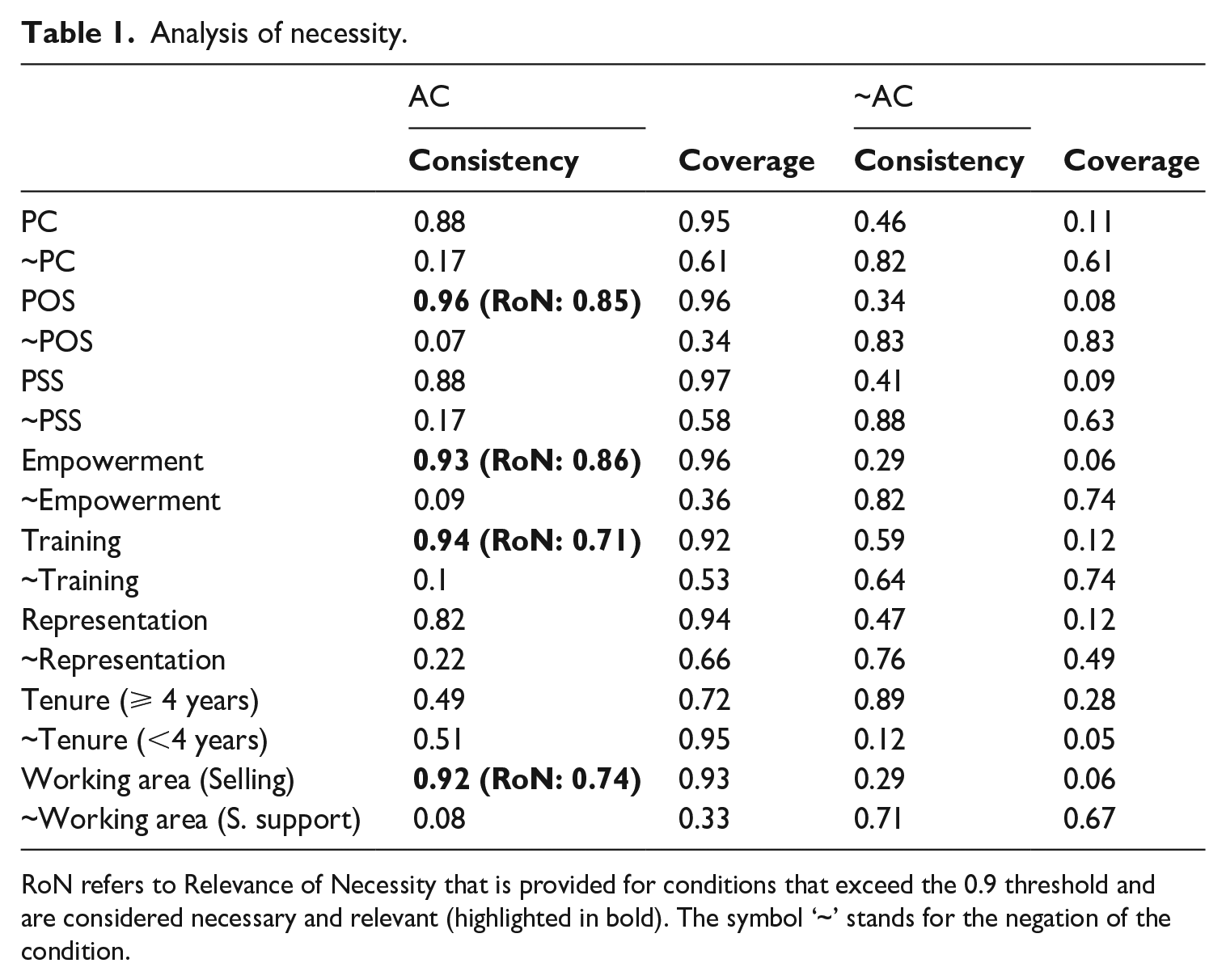
RoN refers to Relevance of Necessity that is provided for conditions that exceed the 0.9 threshold and are considered necessary and relevant (highlighted in bold). The symbol ‘~’ stands for the negation of the condition.
In Table 2, we present the fsQCA results including measures of consistency and coverage for each individual configuration or recipe. Coverage measures how much of the outcome is explained by each recipe and by the solution as a whole. Specifically, five recipes are associated with high AC and three recipes are related to low AC. POS and empowerment are core conditions, indicating their importance for high AC. Both are necessary conditions, and appear in all recipes, though they are not sufficient to produce high AC. Low POS and low empowerment are also core conditions for low AC.
Solutions.
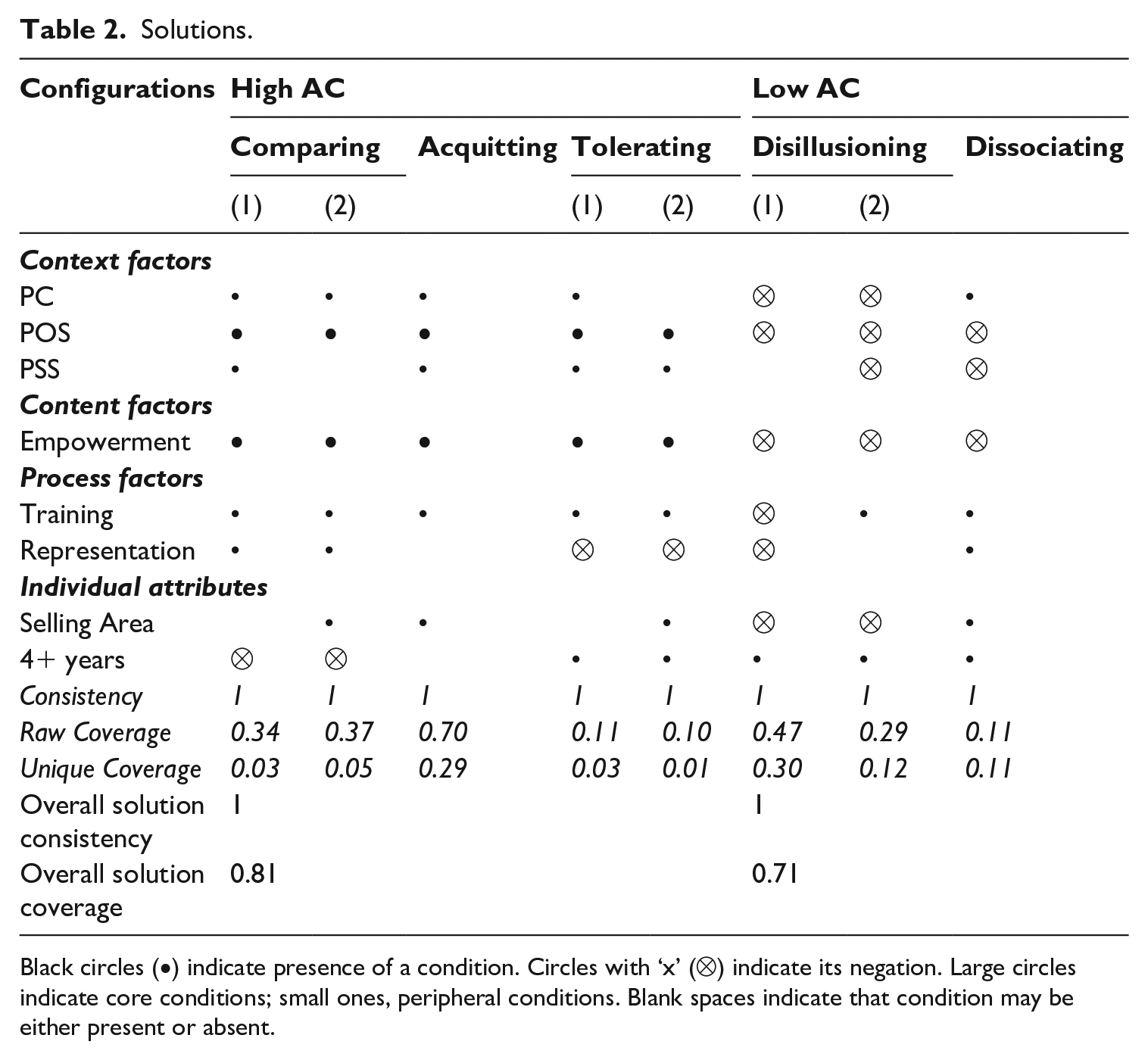
Black circles (•) indicate presence of a condition. Circles with ‘x’ (⊗) indicate its negation. Large circles indicate core conditions; small ones, peripheral conditions. Blank spaces indicate that condition may be either present or absent.
Based on theoretical and empirical knowledge we expect that all the conditions can be either present or absent. Setting as simplifying assumptions the necessary conditions to be present did not change the results for the presence of the outcome. For the absence of the outcome, we did not observe any necessary conditions, however we tested those with consistency close to 0.9. The findings did not change either. We view working in selling areas as an ‘almost always necessary’ condition (AoN consistency 0.92, present or don’t care condition in the analysis of sufficiency). The truth table reveals that selling and selling support are part of different configurations explaining high AC. By simplifying these configurations, the software offers one in which Working Area becomes a don’t care condition. Increasing frequency higher than 1, could eliminate this issue (Greckhamer et al., 2013: 54). Since we have unique cases in our sample, we kept the frequency at 1. Indeed, 2 configurations refer to 2 different persons, who worked at selling support area but had high AC. Employing fsQCA helped us uncover these unique cases.
We examined both the outcome and its negation (or absence). Owing to causal asymmetry, the conditions that appear as present for the outcome could still appear for its negation, if combined with other conditions. We examined if the sufficient combinations of conditions for the outcome are also present for the negation of the outcome (Fiss, 2007). For example, given that the combination of PC, POS, PSS, empowerment, training, and representation for employees with fewer years of tenure is sufficient for high AC, then an examination of cases that do not exhibit high AC shows no cases with the same combination of conditions. In what follows, we analyse each recipe using exemplary cases.
Configurations related to high AC
The five identified configurations implicating positivity towards change shared two core conditions, POS and empowerment. However, they also shared some peripheral conditions in terms of perceptions or traits. Thus, as is customary in configurational theorizing, they were grouped into three main configurations that included variants, as discussed below. Aiming to evoke the essence of each configuration (Furnari et al., 2021), we labelled them as ‘comparing’, ‘acquitting’, and ‘tolerating’.
Configuration 1: Comparing
This configuration consists of variants 1 and 2 (see Table 2). Variant 1 includes 11 employees (i.e., 19–27, 30, 32). Variant 2 also includes 11 cases (i.e., 19–24, 26, 27, 30–32).
6
We grouped these two variants because they substantially overlap in terms of cases, they share the same core conditions (perceptions of PC, training, and representation) and consist of employees who had relatively fewer years of tenure (4+ years was a negated condition). We label this configuration ‘comparing’ because these relatively new employees often compared working conditions and changes at JLP with their previous employers: that is, they utilized an external frame of reference. Reflecting the importance of POS, a core condition, these partners described the organization as a fair and exceptionally supportive workplace that displayed concern for employee needs related to work-life balance, health issues, and diversity, underlining the co-ownership structure and democratic orientation. These employees drew comparisons with past experiences, which invariably favoured their current employer: In other places I have worked, I suffered, because I'm from an ethnic minority, some kind of racism . . . or having the language barrier . . . but you don’t have this problem here, there is lots of support being a partner, other retailers don’t offer you this. My marriage broke down and I nearly had a nervous breakdown, but the partnership was extremely good. If I was working for anybody else, I wouldn’t have been treated the way I have been in the partnership. (E26, Customer Service Advisor, Fashion Accessories, 3 years)
Although they experienced many of the ongoing changes, they were not as affected as their longer-serving colleagues. These employees had been exposed to stories of ‘the way things used to be’ and understood the negative emotions of some colleagues; yet they experienced changes as ‘the way things work’, rather than broken promises: I think it’s beginning to be, as a company, realising that they have to become more competitive. Not ‘would you like it?’, but ‘how would you pay for it?’ . . . it is ‘Americanization’, globalization. You’re either in it or you get swallowed by it, and as a company, they have to be in it. (E27, Customer Service Advisor, Fashion Accessories, 1 year)
Employees in the ‘comparing’ configuration overwhelmingly endorsed the recently introduced practice of empowerment: a ‘buzzword’ in the organization, which afforded employees more autonomy to make decisions at work. It signalled an important cultural change, away from the logic of tight managerial controls and towards the exercise of discretion, manifested in the demonstration of creativity (e.g., in the display of merchandise), operation with fewer restrictions (e.g., having more ‘natural’ interactions with customers), and overall higher levels of self-direction.
In addition to these core factors, employees in this configuration praised training and representation, both appearing as peripheral conditions (see Table 2). Training took place before they were sent to the shop floor, enabling them to perform their duties effectively and adapt to the ongoing changes. It was reinforced through stories regarding excellent service published in the Gazette, and recognition and reward schemes. Representation was implemented through committees that informed them about organizational changes (e.g., in store working hours or opening days) and provided opportunities to voice concerns and engage in constructive debate rather than passively accepting management’s prerogative. Partners perceived representation as a channel for voicing personal and collective problems – hence indicating respectful and fair employee treatment – and safeguarded employees’ interests against potential managerial abuse. Overall, these partners were immersed in the newly promoted ‘high-support and high-performance’ culture. Reflecting the mutuality JLP attempted to create, they appreciated values such as support and togetherness, and endorsed the introduced high performance culture, which required strong customer service orientation and an explicit focus on competitiveness and increasing sales for JLP: ‘It’s just a group thing, we are all one, doing the same thing, being out there to earn as much money for John Lewis as we can, we are all there to help customer service’ (E19, Customer Service Advisor, Womenswear, 1 year).
Variants 1 and 2 present two differences in their peripheral conditions. Specifically, PSS was present in variant 1 and indifferent in variant 2. Broadly, PSS was high since managers were described as open, trustworthy, compassionate, supportive, approachable, and knowledgeable, yet in the context of change and empowerment, they were also required to uphold additional duties. In turn, they delegated work to lower levels, which in some cases affected the quality of management-employee relationships: The relationship between management and partners can vary. It doesn't take long for a partner to realize if a manager is talking bullshit or not. Unfortunately, we have some managers in these positions. If the manager knows what he's talking about, then there is a better relationship. If there is a manager who is taking a chance, the respect disappears. I would say that the managers here are not the standard office lots; when it comes to Christmas, they will be behind the tills as well, and I think that partners appreciate that. (E24, Customer Service Advisor, Self-Selection, 3.5 years)
Partners in variant 2 worked exclusively in selling areas, where PSS was not a peripheral condition. This suggests that some employees were positively oriented towards the change program irrespective of PSS, as long as the other core and peripheral conditions were in place.
Configuration 2: Acquitting
This configuration has the highest coverage and includes 20 employees (i.e., 1–8, 11, 12, 14, 19–24, 26–28). Employees in this group were working in selling areas and tenure was not a decisive factor (see Table 2). Hence, it also includes long-serving partners. These employees had experienced some or all changes including restructuring, redundancies, and outsourcing, and most attributed them to factors beyond organizational control (i.e., market forces, competition, and need for survival). They reasoned that the organization had to trade-off between some of the current needs of employees and those of the business (hence this configuration is labelled ‘acquitting’), offering a pragmatic understanding of the external environment, as reflected in the following quote: I think where there is change, if you are not in control of the change yourself, then perhaps sometimes you don't like the idea of it. But you have to be competitive in a business like us, otherwise I wouldn't have a job, would I? So I have to change with the business . . . We couldn't possibly stay as we were when I first came here. We had a barber's shop, we had a florist, we had an undertaker, we had a removal service. That's all gone. (E14, Cashier, Ladies’ Fashion, 25 years)
However, even if changes and the PC breach were attributed to disruption, for some of these long-serving partners, they were painful, upsetting, and even shocking – especially the abandonment of the no-layoff policy: ‘At one time if you worked for [this organization] you had a job for life . . . But of course, with restructuring, to be competitive, they had to go down that way’ (E5, Shelf Filler, Fashion Accessories, 7 years).
Despite being unsettled, partners in the ‘acquitting’ configuration still perceived JLP as a highly supportive organization (POS): a core condition. They acknowledged that the organization tried to implement changes with a fair and just mindset: for example, offering employees whose positions became obsolete the opportunity to work elsewhere at the store or receive a generous outplacement package. Others compared current with past levels of POS and were somewhat less praising. Being less affected compared with their colleagues in non-selling areas, these employees generally welcomed the content of change, such as empowerment, a sign of trust towards their capabilities, and the emphasis on mutuality of expectations; especially those who were critical with their low-performing, complacent colleagues, often described as ‘dead wood’. In conclusion, this configuration captures the transitioning process, during which some embraced the changes gradually and others more quickly.
Configuration 3: Tolerating
This configuration has a small coverage and consists of two variants. The first variant includes two employees (6 and 15) and the second variant employees (6 and 16) all with several years of service. In this configuration the positive aspects were highlighted, importantly the high degree of empowerment and POS (both core conditions: see Table 2), capable line managers (PSS is a peripheral condition), and the relaxation of formal rules. Crucially, these partners held negative views regarding representation. We term this configuration ‘tolerating’, to illustrate that while these partners accepted changes, they were sceptical about the usefulness of indirect participation committees and processes. While other JLP employees appreciated the opportunity to voice their concerns, some found the process old-fashioned, bureaucratic (e.g., slow, time-consuming), or deemed it was window-dressing, given that decisions had already been made, or even implemented, with the business’s interest in mind: I think (committees) are a good idea, I don't know if they are effective. The general feeling is that decisions are made already before you have a vote. It's only representatives that get to vote, not everybody gets to vote individually. (E15, Stock Keeper, Goods Handling, 10 years)
Despite their critical stance, these partners accepted change via affective commitment to the organization. Variant 1 includes people working in selling and non-selling areas, indicating that acceptance of change is possible (even if it is tolerated) in both areas. In variant 2, PC was an indifferent condition. Although this variant has low coverage, it is theoretically important because it includes a case of PC breach that was attributed not to disruption, but to the firm. For this partner, the negative aspects of change – such as longer opening hours, working on Sundays, and short-staffing – were vehemently criticized and were attributed to senior management: It's getting more and more like the high-street shops, which I don't think is a good thing . . . Sometimes, sadly, I think we don't have enough staff to serve customers properly . . . Once you came in there was always an assistant to help you. It's not like that anymore . . . Now people seem to come and go. I think it's because of the hours, a lot of it. Sunday working, late nights, and pay is not that brilliant either. (E16, Customer Service Advisor, Childrenswear, 11 years)
Configurations related to low AC
All three configurations related to negative reactions to change shared the negation of POS and empowerment as core conditions. A close inspection of the cases and the peripheral conditions shared, suggested grouping them in two configurations, labelled as ‘disillusioning’ and ‘dissociating’.
Configuration 1: Disillusioning
This configuration includes two variants; the first comprises of employees 9 and 17, and the second consists of employees 10 and 18. These partners worked in selling support areas, and had several years of tenure. For these employees, the context of change was deleterious, and they used the term ‘disillusioned’ to reflect their feelings about JLP’s direction. For them, JLP embodied an ideal, with which partners had formed a deep psychological relationship. It stood out for its unique characteristics, such as the co-ownership structure, its democratic values, and the no-layoff policy. This was traumatized. The distinctive attributes that had previously characterized the organization were eroding, and partners’ perceptions were fuelled by pain and disappointment with the new era: Things have changed dramatically I think, really. Probably on the larger picture we have gone from a caring, sharing [organization] to perhaps a non-caring, and non-sharing, really. We have gone from being a unique organization to perhaps not a unique organization. Things have changed rather dramatically, and of course, with the new opening hours, they are going to change even more . . . Sometimes for people like me at my age, who have been here a long time, we find it difficult to square the circle, so to speak. We move with it because we have to. (Ε18, Stock Handler, Goods Handling, 34 years)
Indeed, the absence (negation) of POS was a core condition in this configuration. The organization had shifted its priorities from employee well-being to profit. Longer trading hours demonstrated low concern for family values and work-life balance. Restructuring and outsourcing were interpreted as cost-cutting activities that failed to recognize employees’ contributions and service. Notably, job insecurity and anxiety were more intense in these areas, since they carried a greater risk of redundancy. Far from the centre of organizational attention, these employees felt neglected by leadership: People in head office, I feel, sometimes they haven’t got a clue what we’re actually doing . . . Their managers at the shop don’t even know where the building is, they don’t visit us very often, they haven’t got much idea of what goes on. (E9, Stock Handler, Services Building, 10 years)
Changes signified JLP’s failure to fulfil its longstanding obligations. Lifelong employment and not working on Sundays represented broken promises (i.e., a psychological breach owing to reneging: the negation of PC), and were attributed to greed that infiltrated JLP’s management thinking, as emphatically illustrated below: Five odd years ago, suddenly, it was almost as if someone at head office had thrown a switch and said, ‘We’ve got to cut overheads, get rid of some staff’, and the whole service aspect has gone downhill . . . they are also asking us to work New Year's Day this year! For heaven's sake! Half of people can't even get here because buses don't even run. So the whole thing is just greedy . . . greed, greed, greed! They don't care about making people redundant here now. (E17, Stock Handler, Goods Handling, 9 years)
The other core condition in this configuration was low satisfaction with empowerment. Partners resented empowerment, which was associated with functional flexibility, partly because employees could not possess all the skills necessary to carry out a variety of tasks, but crucially, because it led to a reduction of overtime pay.
In terms of the other conditions, the two variants presented some differences. In variant 1, cynicism was expressed regarding training, which was considered ineffective and irrelevant to warehouse work. Participation in representative committees was perceived as futile, since senior managers imposed the business viewpoint at the expense of employee wellbeing. Interestingly, PSS was absent from this configuration, suggesting that for those individuals, support from line supervisors might be good to have but did not make much difference to how they felt (disillusioned).
In variant 2, managers were seen as ‘too young’, ‘hands-off’, inconsiderate towards partners’ needs, improperly trained, and untrustworthy (see the negation of PSS in Table 2). Interestingly, at times, they acknowledged some of the organization’s positive attributes, such as the quality of training (i.e., training is present in this configuration, although it has a weak, tempering relationship with the negative outcome), that committees could occasionally be effective, or the existence of a bonus. However, at the heart of this configuration lies disillusionment: a word that captured the pain felt following the loss of the ‘loved object’: ‘. . . disillusionment, the way things are, people probably had enough and that’s why they leave. Myself, I’m just seven years away from retirement, so I can’t see me doing anything, really’ (Ε18, Stock handler, Goods Handling, 34 years).
Configuration 2: Dissociating
This configuration includes one employee, 13. Despite the low coverage, such solutions can point to theoretically important cases (Schneider and Wagemann, 2012). Specifically, the dissociating configuration captures perceptions of an employee in the selling area who did not feel supported; primarily by JLP (the negation of POS is a core condition) but also by her managers (weakly; the negation of PSS is a peripheral condition). Feeling disheartened and disconnected from the organization, she lacked the motivation to accept the culture change. Empowerment was also criticized, specifically the aspect related to functional flexibility, as it often led to accepting uninteresting tasks. Despite criticism towards changes (especially extending opening hours) in this configuration, however, we observe an appreciation for the quality of training and representation: both present (albeit peripheral) conditions. Interestingly, PC was not felt to have been breached (although peripheral in its relationship with the negative outcome): If they ask me, ‘Do you want to go to the fitting room all day?’ I would say no . . . but if you say no that is taken into account, it’s ‘Oh, she's not been very flexible’ sort of thing . . . You could do six days here at work. By the time you go home you have something to eat, you watch a little bit of telly, you get up, you go to work, it just goes on like that . . . I don't see my friends as much as I used to. (E13, Sales Assistant, Fashion Accessories, 4 years)
Discussion
This study set out to examine how employee perceptions and traits combine to produce positive or negative employee reactions to planned organizational culture change programs. It was conducted in JLP, a highly distinctive organization that underwent a long-term, planned culture change program that targeted the gradual transformation of a bureaucratic, paternalistic, and complacent culture into a dual, more balanced culture, emphasizing high support and high performance. To examine the effectiveness of this program, we built on research that examines perceptions (Gover et al., 2016) and antecedents of culture change (Armenakis and Bedeian, 1999), arguing for the need to study this phenomenon using a configurational perspective. Configurational theorizing requires specification of the central organizing theme – that is, the common subject shared across configurations – to clarify their underpinning logic and help ‘capture the whole’ (Furnari et al., 2021: 790). In our study, this central theme was the interplay between (a) employee perceptions of the process, context, and content of planned culture change, alongside (b) individual traits, that combine in causally complex ways to shape (c) employee reactions.
Through inductive qualitative research and fsQCA, our research revealed five configurations of employee perceptions, traits, and reactions, offering novel evidence that culture change success or failure is causally complex. These five configurations represented variants of the central organizing theme, illustrating different ways through which organizational culture change interventions can succeed or fail, and are labelled to increase specificity and ‘evoke their essence’ (Furnari et al., 2021: 791). Specifically, the ‘acquitting’ configuration, demonstrating the highest coverage among all recipes, captured employees’ pragmatism, namely their acceptance of the need to change despite the emotional upheaval. The distinguishing feature of the ‘comparing’ configuration that shaped the reactions of relatively new recruits was the favourable contrasting of JLP with past employers. The ‘tolerating’ configuration illustrated that culture change can still be successful despite perceived ineffective participation processes. The ‘disillusioning’ configuration, the main pathway associated with low AC, captured the loss of the organizational ideal (Carr, 2001) among the long-serving employees in selling support areas, underlining the importance of certain individual characteristics. Finally, the ‘dissociating’ solution indicated that interventions can fail if employees lack the socioemotional resources that are much needed in times of change.
In this quite unique empirical context, we have contributed by examining the question of whether culture can (successfully) change and through what recipes. This represents an important contribution, given the surprising lack of theory and empirical research supporting the assumption that organizations are able to create intended cultures (Kim et al., 2022), especially given that researchers have long advocated the importance of creating functional cultures (Schein, 2010). By focusing not only on ‘whether’ but also on ‘how’ culture can change, we have contributed to the limited body of research on the pathways to successful versus failed culture change efforts (Schneider et al., 2017). Finally, we have demonstrated the value of configurational theorizing in the study of planned culture change, which has hitherto been examined through ‘net effect’ thinking (Gover et al., 2016). To this end, we have addressed calls for complexifying (versus simplifying) theorizing in organizational studies (Tsoukas, 2017).
Can culture be intentionally changed, and if so, how?
Responding to the question we posed at the outset of this article, notwithstanding the limitations of any empirical study, this planned culture change program was relatively successful. Interestingly, there appeared to be more pathways to successful change than to failure. Despite the variation across the three higher-order configurations (i.e., ‘acquitting’, ‘comparing’, ‘tolerating’) and their variants, from a pragmatic lens, empirically uncovering those solutions through qualitative insight and fsQCA indicated the effectiveness of planned culture change at JLP. This is because these partners endorsed the ‘high support – high performance’ logic, irrespective of the different paths followed, and shared organizational values. Endorsing this dual logic and JLP’s expectations (e.g., prioritizing customer service, taking initiatives, emphasizing achievement) was not a mere surface-level change. Instead, it represented a re-orientation of attitudes and enacted values at work. In the cases of long-serving employees, this change shook deeply held assumptions (e.g., no layoffs). Hence, although we agree that it would be difficult to change the entirety of organizational culture owing to its tacit and complex nature (Reed and DeFillipi, 1990), a new logic was adopted, and fundamental attitudes were re-oriented. This classifies JLP as an example of the design and implementation of the ‘right’ culture, which is instrumental to organizational adaptation to a rapidly changing external environment (Ulrich and Brockbank, 2016). Contrary to the majority of culture change studies, which tend to showcase failed attempts (Schwarz et al., 2021) and resistance to culture change (Kim et al., 2022), evidence from this distinctive organization’s multi-annual efforts indicates a relatively successful intervention.
However, we also found evidence of failure by uncovering localized interpretations of the planned changes, and different meanings across employees and departments (Alvesson and Sveningsson, 2016). In line with the critical perspective and research indicative of the limited effectiveness of culture change programs (Ogbonna and Wilkinson, 2003), the ‘disillusioning’ and ‘dissociating’ con0urations illustrate perceived lack of organizational support and cynicism towards managerial practices such as empowerment. The overall resentment of the market logic and the ‘high support – high-performance’ culture was accentuated in the ‘disillusioning’ configuration where PC violation occurred.
In terms of ‘how’ planned culture change can be effective, all recipes – including the ‘acquitting’ configuration that represents the highest coverage – displayed strong connections to two core, necessary, and complementary factors: POS and empowerment. Complementary effects are conceptualized as facilitative interactions that occur when ‘doing (more of) any one of them increases the returns of doing (more of) the others’ (Milgrom and Roberts, 1995: 181). This complementarity makes theoretical sense, given that empowerment – a practice that fulfils employee needs related to self-direction, growth, and purpose at work – is a valuable socio-cognitive resource that potentially serves as an antecedent of POS (Eisenberger and Stinglhamber, 2011). Conversely, employees who feel supported by the organization are also more likely to view the delegation of additional duties in a positive light: hence, POS facilitates empowerment. Our evidence is in line with past research in the broader field of organizational change research, adding to accounts of POS as a basis for social exchange relationships (Eisenberger and Stinglhamber, 2011) positively impacting important employee outcomes such as AC (Kim et al., 2016). These findings support the buffering role of POS in the context of change (Hobfoll and Leiberman, 1987), and justify a versatile view of POS (Shantz et al., 2016), especially for some of the long-serving ‘acquitting’ and ‘tolerating’ partners whose PC had been breached. POS helped them to cope with new job demands (Demerouti et al., 2001) but also compensated for lost valuable resources such as the organizational ideal (Carr, 2001).
Contrasting the ‘acquitting’ to the ‘comparing’ and ‘tolerating’ recipes not only indicates equifinal pathways to culture change but also neutral permutations. Neutral permutations are different constellations of peripheral conditions surrounding the core conditions that lead to the same outcome (Fiss, 2011), revealing that some conditions appear to act as substitutes. For example, the ‘comparing’ configuration (variant 2) shows that in the absence of PSS, the contributing peripheral factors of training and representation, in combination, lead to a favourable contrast with past employers. As another example, the ‘tolerating’ configuration indicates that even if employees do not believe they are very involved in changes, they are likely to endorse them as long as POS, empowerment, and some additional peripheral conditions such as PSS are in place. Hence, beyond the core conditions, a certain level of job resources needs to be offered, if employees are to accept culture change (e.g., a mixture of emotional support through PSS and the opportunity to voice concerns through representation). Overall, these culture change recipes reveal important complementarities and substitute effects.
An important theoretical implication of our study is that the analysis of functional perspectives on organizational culture change requires complexification. Drawing from Armenakis and Bedeian (1999), our central organizing theme included conditions pertaining to context factors (e.g., POS, PSS), content factors (e.g., empowerment), process factors (e.g., participation), and individual traits (e.g., tenure). Although the five (higher-order) recipes indicated that context and content conditions (i.e., POS and empowerment) are core to the success and failure of culture change interventions, peripheral conditions residing in other categories (i.e., process conditions, individual traits) were also essential to this analysis. This finding indicates the need for future research to be more attentive to uncovering complexified solutions. For example, the examination of demographic factors such as short organizational tenure represents a core condition in the ‘comparing’ configuration (variants 1 and 2): it seems that the use of an external frame of reference based on recent employment experiences was an indispensable aspect of those employees’ thought process. Similarly, the combination of working in a selling support area alongside long tenure was an important condition for the ‘disillusioning’ configuration. Far from the ‘shop’ and the centre of organizational attention, these employees felt anger and betrayal, mirroring the survivor syndrome (Morrison and Robinson, 1997), as some of the problems (e.g., distant leadership) were perceived as signs of indifference towards selling support areas, while others (e.g., redundancies) represented broken promises made 10 or 20 years earlier. Although these individual traits did not have a deterministic effect on employees’ stances, they underline several localized interpretations of culture change initiatives (Alvesson and Sveningsson, 2016). Overall, these examples highlight the importance of considering combinations of conditions and embracing complexity in culture change research.
The value of configurational theorizing for culture change research
We argue that employee reactions to planned culture change, which have hitherto been examined mainly in a linear fashion, can be better understood using configurational theorizing: the idea that the ‘whole’ is best understood from a systemic perspective, as a constellation of interconnected elements (Fiss et al., 2013). While studies examining the ‘net effect’ of factors are helpful – for example, showing that those with perceived control are more likely to have a more positive view of culture change, or that years in job are related to perceptions of culture change (Gover et al., 2016) – a configurational approach focuses on the conjunction of those often numerous perceptions. The simultaneous or conjunctural examination of various parameters related to the context, content, and process of change, as well as individual traits, represents a more externally valid and nuanced approach to understanding culture change, appreciating its complexity and favouring realism over elegance (Furnari et al., 2021).
In addition, the focus on equifinal recipes offered by a configurational approach reveals not only multiple paths towards the same outcome, but also the varying degrees of importance of the same condition across solutions. For example, in the present study, across the configurations linked to a positive stance towards change, representation was a ‘present’, ‘indifferent’, and ‘absent’ condition. This suggests that for some employees, participation might be helpful, but not essential in accepting culture change. Also, configurational theorizing can shed light on asymmetrical causation regarding positive and negative reactions to culture change. Although we did not find such evidence in terms of core conditions, we found support in relation to the peripheral conditions. For example, tenure did not make a difference for partners in the ‘acquitting’ configuration, but working for more than four years was present in the ‘disillusioning’ solution.
The configurational approach we offer is conducive to a more pluralistic perspective on the study of planned culture change effectiveness. In line with the functionalist tradition (Schein, 2010), we have drawn on configurational theorizing, fsQCA and rich qualitative case insight, and have thus advanced the culture change literature by identifying three recipes that are linked to high AC and two linked to low AC – an indicator of planned (culture) change effectiveness (Oreg et al., 2011). Through this multitude of recipes, we are sensitive to the interpretive and critical traditions, contributing to calls to embrace competing perspectives (Giorgi et al., 2015).
Practical implications
A configurational approach to planned culture change can enable managers to understand the mindsets of various employees in a more realistic manner. By first identifying and then considering different core and peripheral conditions in conjunction, managers may gain insights into how different types of employees are likely to react to planned change interventions. Understanding the variety of configurations should help them to tailor their actions across subpopulations, and improve the effectiveness of cultural change programmes. In addition, managers can consider the trade-offs involved (e.g., PSS vs. representation) and optimize their decisions accordingly. More broadly, our findings provide considerable support for the view that planned culture change interventions can be effective. Managers should appreciate that culture change initiatives are more likely to be successful if employees experience high levels of POS and interpret empowerment in a positive light, which can be difficult if potential drawbacks are not addressed (e.g., loss of income). Simultaneously, managers should appreciate pluralism and be prepared to face diverse reactions from various employee groups.
Limitations and future research
The results of the study should be considered in light of some limitations. First, we focused on a retail organization with highly inimitable governance, ownership system, and culture. The distinctiveness of the organization limits the ability to generalize findings to other firms. Although our case study research strategy can lead to new research questions and directions, extension and generalization of the study’s findings requires research in more organizations across different industries. Second, the current study was conducted in England with informants from different sections and diverse demographics. We encourage researchers to examine our questions in various cultures and consider how employee reactions vary accordingly. Third, future research based on configurational theorizing should seek additional conditions and explain how they interrelate in the configuration to produce outcomes of interest beyond AC.
Fourth, as is usual in small-N QCA, we acknowledge that the data in our sample were positively skewed. We also acknowledge that a small-N fsQCA raises the issue of limited diversity, especially in light of the several conditions used in the configurational analysis. However, our small-N inductive qualitative approach (which allows the development of a richer account of comparative cases), coupled with current research in culture change (i.e., Armenakis and Bedein, 1999; Oreg et al., 2011), enhances our confidence in using more rather than fewer conditions. Although we recognize that obtaining access to rich qualitative culture change data at the employee level is difficult, we encourage future research that will collect more observations. Fifth, interviews – the principal method used in this study – only allow for the assessment of conscious cognitive processes (Breuer et al., 2020). Although this limitation was partially offset in the present study through the use of a wealth of data, which enriched our understanding of the case, future research could consider unconscious, implicit factors affecting employees’ reactions to such programs.
Conclusion
This is one of the first studies to adopt a configurational approach to study the drivers of employee reactions to planned culture change. Based on configurational theorizing (Slager et al., 2021) and by applying QCA, we sought to explain causality in complex real-life phenomena through multiple-conjunctural causation: that is, a ‘nonlinear, nonadditive, non-probabilistic conception that rejects any form of permanent causality and that stresses equifinality, complex combinations of conditions and diversity’ (Berg-Schlosser et al., 2009: 17). We moved away from correlational thinking and probabilities, since in fsQCA a variable (or statement) receives a truth value, instead of the probability values that are typical in traditional correlational methods, offering complex yet realistic accounts of what employees experience during culture change. Our study revealed three and two recipes associated with positive and negative reactions towards the change program, respectively, which can help organizations to understand why culture change programs are likely to succeed or fail. Configurational theorizing is highly pertinent for the study of numerous interconnected factors pertaining to the context, content, and process of culture change, as well as individual traits, in a pluralistic manner, warranting future research in the field.
Supplemental Material
sj-docx-1-hum-10.1177_00187267231183305 – Supplemental material for Employee reactions to planned organizational culture change: A configurational perspective
Supplemental material, sj-docx-1-hum-10.1177_00187267231183305 for Employee reactions to planned organizational culture change: A configurational perspective by Konstantinos Tasoulis, Ilias O Pappas, Pavlos Vlachos and Emeka Smart Oruh in Human Relations
Footnotes
Acknowledgements
Konstantinos Tasoulis is grateful to his mentor, Professor John Purcell, to the John Lewis Partnership, and all Partners who participated in the study.
Correction (July 2023):
The paper has been updated to include funding information for open access by the Onassis Scholars’ Association.
Funding
The author(s) disclosed receipt of the following financial support for the research, authorship, and/or publication of this article: Konstantinos Tasoulis acknowledges the generous support of the Alexander S. Onassis Public Benefit Foundation. The open-access publication of this article was supported by the Onassis Scholars’ Association. Pavlos Vlachos wishes to acknowledge the generous support of the Theodore Papalexopoulos Chair in Sustainability Fund.

Supplemental material
Supplemental material for this article is available online.
Notes
References
Supplementary Material
Please find the following supplemental material available below.
For Open Access articles published under a Creative Commons License, all supplemental material carries the same license as the article it is associated with.
For non-Open Access articles published, all supplemental material carries a non-exclusive license, and permission requests for re-use of supplemental material or any part of supplemental material shall be sent directly to the copyright owner as specified in the copyright notice associated with the article.
