



Abstract
Although gender inequality in the workplace has improved in recent decades, researchers continue to struggle to disentangle the contributions of gatekeeping, socialization, and embodiment. The author argues that video games offer a novel site for exploring gender inequity in labor, including pink-collar careers and the second shift. Video games significantly reduce the impact of gatekeeping and embodiment, making it possible to observe the influence of socialization on role selection when players are disembodied and anonymous. Using 2,665 survey responses and 53 interviews with gamers, the author analyzes how gender identity, gender expression, and sexuality shape gamers’ selection into feminized and carework roles in three genres of video games. After reporting significant relationships for all three identity categories using logistic regression models, the author presents emergent themes related to motivations for playing supportive roles among video gamers. The author finds that fulfilling group needs, a preference for nurturing, and ease of access are typical rationales for selecting these types of labor. This illustrates that even when embodiment and gatekeeping are reduced, and players can frequently reselect roles, the impacts of socialization are strong enough to filter feminine and feminized groups into care-centric, social, and subordinated labor fields.
Despite advances in gender equity, gender continues to be a key determinant for outcomes of social stratification (Tutchell and Edmonds 2018), including college major decisions (Dunlap and Barth 2019), industry and occupational selection (England 2014), and the division of labor in households (Hochschild and Machung 2012). Even in the fields 1 of leisure and sports, scholars have observed that women are relegated to less prestigious roles, positions, and pay. Furthermore, intersectional approaches reveal how race and sexual orientation, among others, intensify and complicate these disparate outcomes. The persistence of these inequalities, even while gender equality seemingly continues to advance, implies that there are unseen forces that sort life chances—opportunities each individual has to improve their quality of life—on the basis of gender (Weber and Tribe 2019).
Scholars have identified three primary and complementary theoretical mechanisms to account for the generation and reproduction of gender inequality. First, women and feminized groups may be excluded from access to or pushed out of highly socially rewarded positions, which are monopolized, to varying degrees, by men and masculinized groups (England 2014; England et al. 1994). Second, scholars argue that people undergo a long period of socialization into “gender-appropriate” roles and behaviors, which leads girls and women to choose more flexible roles that require more carework and are ultimately less rewarded in terms of prestige or remuneration (Chodorow 1999; England, Budig, and Folbre 2002; Thorne 1993). Third, some gendered outcomes may originate in average physical stature or strength differences between men and women. One explanation for the U.S. women’s labor market gains in the past few decades has been the increasing mechanization of industries requiring physical strength (such as farming, manufacturing, and extractive industries) and concomitant growth in industries that rely primarily on intellectual and social abilities, such as within technology and service industries (Balka et al. 2024).
The fundamental problem with studying how these general causal mechanisms influence inequality is that they are intertwined. Even something as seemingly objective as physical strength is not as simple as it might initially appear. Scholars must parse to what extent women, on average, are less physically strong than men because of innate biological differences and to what extent those differences are shaped by the disparate socialization of men and women, which encourages them to invest in different activities that build physical strength (Lorber and Moore 2002). Furthermore, researchers must also consider the extent to which the way bodies are defined—as either strong and aggressive or soft and nurturing—determines people’s choice of roles and others’ acceptance of those choices as legitimate. The interconnectedness of these causal mechanisms of gender inequality presents at least two barriers to scholars. First, in many spheres of social life, the visibility of physical bodies enables the operation of exclusionary forces, such as gender-based discrimination in hiring and promotion or the relegation of women to less prestigious roles in groups of choice, such as volunteer organizations or recreational sports leagues. Second, lifetimes of socializing forces and the cost of skill acquisition for alternate occupations or roles result in a low likelihood of subverting or opting out of traditional gender roles.
I argue that a sociological understanding of the causes of gendered inequity in role selection would be aided by the analysis of a field in which (1) physical strength is irrelevant; (2) gender displays are voluntary, which limits the potential for discrimination and gatekeeping; and (3) the costs of training and skill development are relatively low. In such a field, role selection could be based on current tastes and preferences, so the only external variable influencing role selection would be socialization. I propose that one such analytical field is online video games.
Video games are an advantageous site for reanalyzing aspects of gender stratification studied offline because they frequently require selection into roles with varying activity levels and prestige. However, the “labor” 2 performed in the games is virtual and, therefore, requires low levels of physical strength, eliminating one potential source of gender-based inequity in role selection. More important, the anonymity afforded to gamers means that biological sex and gender identity and expression are only as evident as the gamer wishes to make them. Finally, unlike college majors, careers, or family planning choices, which are only made a few times in a lifetime, people can choose to play different video games or different roles within the same video game at any moment, with low transition costs. The presence of anonymity and low cost of transition between roles means that stratification-generating mechanisms such as gatekeeping, career tracking, and discrimination are less likely to be present than in offline spaces where bodies and gender are visible.
In this study, I investigate whether and to what degree gender identity and expression shape people’s selection into different roles within video games. Through this analysis, we can understand whether gender strongly influences how people select, enjoy, and perceive different roles within online video games. Understanding the impact of gender on seemingly small decisions within online video games can inform how gender influences much broader behaviors and choices. This study contributes to understanding the friction between socialized gendered agency and constraints by significantly relaxing the latter. The reduced visibility of gender in this space relaxes the impact of external policing, allowing me to assess the extent to which role choice and selection into unequal social positions may result from agency and preference.
In this study, I use a mixed-method dataset of 2,665 survey responses and 53 interviews with adults who play video games to conduct my analysis. My analysis begins by reporting estimates of the extent to which women, feminine, and feminized gamers prefer roles in games characterized by carework relative to their masculine counterparts. I find that even with a reduction in the presence of bodies and visibility of gender, women, feminine, and feminized gamers select into work roles within video games that are characterized by carework and are subordinated. I complete my analysis by exploring what motivations lead feminine and feminized groups to pursue these video game roles.
My findings illustrate how gendered roles, expectations, and preferences exist even within people’s involvement in online video games, despite the loosening of social ties within online anonymity. These decisions and preferences can inform our understanding of gender’s influence on more impactful decisions than those in video games because, unlike career or college major choices, which most people make a few times, these decisions are easily changed. In online video games, feminine and feminized people are, on average, selecting into these roles and playstyles daily, implying that gender socialization and gendered preferences also occur within gender categories and may shape our more significant life decisions and can constantly sort us into gendered forms of labor.
Theoretical Background
I use video games to understand the unseen processes that may lead to gender inequality within work and leisure spaces. I aim to elucidate how gender identity or expression shapes people’s selections into stratified work roles within online video games. In this section, I first suggest the importance and reach of video games as a field. I then outline how gendered roles and subsequent inequity manifest within the workplace and the home. Finally, I review the literature on roles within video games and illustrate how workplace and home roles seep into this leisure space.
Video Games as a Field
Video games have become a popular way for people to spend leisure time. The Entertainment Software Association (2024) estimated that 65 percent of Americans play video games for at least one hour weekly, spending nearly $57 billion in 2022 alone. The average gamer is 32 years old, has been playing for 21 years, and is more likely to be white (72 percent). 3 Although stereotypes may imply that the average gamer is a man, only 53 percent of gamers are men, with 46 percent being women 4 (Entertainment Software Association 2024; Paaßen, Morgenroth, and Stratemeyer 2017). Despite the broad reach of video games, few sociologists have researched the social impacts and underpinnings of video games.
Video games are a novel field because they reduce the impact of many causal factors for career selection. They are a field that minimizes the importance of embodiment, increases social distance through anonymity, and reduces boundaries between work roles. Previously, I outlined the most cited causes for gendered role selection into different fields: embodiment, discrimination, and socialization. This section will not review past findings on the predictors of role choices; instead, it aims to cover the relevant literature on the traditional mechanisms that shape our work role choices and suggest how these may be modified within this unique field.
The advancement of technology has reduced the importance of embodiment in career or role selection, which has reduced much of the physical labor and, thus, the need for laborers with specific types of bodies. Video games further reduce embodied differences because, although quick and accurate movements and decisions are necessary for success, video games eliminate the need for physical strength. Although gendered strength likely results from cultural expectations, the speed at which we move a mouse or a joystick is less entrenched in our gendered expectations. Removing physical strength from video games should eliminate the impact of gendered bodies on role selection. In video games, women and men attain skills at a similar rate (Shen et al. 2016). However, men and boys often have an earlier entry into video games because of how men may benefit socially from video games in a way that is denied to women and girls (Paaßen et al. 2017; Shaw 2012).
Gendered Roles at Work
To better understand the role of discrimination and tracking within work role selection, I use the literature on pink-collar careers. In the workplace, women disproportionately select into fields characterized by care because of socialized preference, career tracking, lack of opportunity, and discriminatory hiring practices (Cohen and Huffman 2003; England 2014). These become pink-collar careers, feminized, and rewarded with lower pay and prestige (Cohen and Huffman 2003; England 2014; Riegle-Crumb and King 2010). Sociologist Jerry Jacobs (1989) introduced the social control perspective, arguing that women internalize pressures to pursue female-dominated positions in a process that is reinforced and recreated throughout young adulthood and continues into the labor market. The pooling of women in undervalued positions and fields manifests from three central social pressures: (1) gendered educational tracking and hiring discrimination (Dwyer 2013; England et al. 1994; Fuller and Hirsh 2019), (2) gendered career preferences and the societal gendering of careers (Cech 2013), and (3) harassment into and out of certain career tracks through hostile educational and workplace environments (Whitcomb and Singh 2020; Wilson 1998). These factors create many constraints that women must maneuver in selecting a career and workplace.
Even when women occupy comparable jobs with similar levels of experience, they still receive lower pay than men (Cha and Weeden 2014; Tutchell and Edmonds 2018). This is especially true for Black women, who make less than white and Black men and white women (Budig, Lim, and Hodges 2021). These pay gaps also exist between gay men, a feminized group, and heterosexual men (Elmslie and Tebaldi 2014; Tilcsik 2011). As a further illustration of the subordination of women and femininity in the workplace, trans women tend to earn less, and trans men experience an increase in income compared with their income before their transition (Bolin 1987; Brody 1979). This illustrates ways in which society undervalues women, feminine, and feminized groups in the field of work compared with men and masculinity. This implies that workplace discrimination is a gender issue that extends beyond binary sex categories.
Gendered Roles at Home
To understand socialization’s impact on role choice, I focus on another field where women experience diminished power and increased responsibilities compared with men: the home. Philosopher Ann Ferguson (1989) argued that men control women’s emotional labor in the home the same way that capitalists control the production of labor in the workforce, but instead are producing domestic maintenance, children, nurturance, and sexual orientation. Women in heterosexual relationships are responsible for more work around the house, even when both partners work full-time jobs, in what Hochschild calls the “second shift” (Hochschild and Machung 2012). Partnered women are also more likely to be saddled with the responsibility of managing their family through coordinating children’s activities, health and medical appointments, and education (Bolton 2000; Hochschild and Machung 2012; Reczek et al. 2018).
This phenomenon extends beyond heterosexual and cisgender relationships, occurring also within queer couples. Generally, queer relationships are more egalitarian with their division of labor, but gendered patterns still emerge that support gender norms within couples. Gay men divide work by specializing in certain types of work, while lesbians cooperate and share similar work in the home (Hochschild and Machung 2012; Kurdek 2007). These studies illustrate that even between differently gendered same-sex couples, gendered trends emerge. However, masculinity still appears to affect how same-sex couples divide labor in the home. Pfeffer’s (2010) study on how trans men maneuver domestic tasks may indicate how gender identity affects the second shift. Although lesbian partnerships are typically more egalitarian than their heterosexual counterparts, Pfeffer’s study shows that if one partner comes out as a trans man and begins to transition, the distribution of work may change. The man will start to take on fewer responsibilities at home as he progresses through his transition. These studies show that women or the more feminine person frequently do more work around the home, implying that additional labor expectations are associated with both relative femininity and gender identity categories.
Much of the burden of the second shift is a consequence of the expectation that women are caregivers. Caregiving is “an activity encompassing both instrumental tasks and affective relations . . . caregivers are expected to provide love as well as labour, ‘caring for’ while ‘caring about’” (Abel and Nelson 1990:4). Caregiving is so incorporated into the role expectations of women that these expectations extend into the types of jobs that women prefer and are expected to fill. Carework generally manifests in four ways: as unpaid services, unpaid work that meets subsistence needs, informal market work, or through formal paid employment that involves care (Folbre 2006). Although, these care roles come with consequences beyond additional gendered expectations. Whether women work in carework careers (e.g., teachers, nurses, childcare, therapy) or perform carework at home, they see a wage penalty (England et al. 2002). Additionally, women in relationships with men who work long hours are more likely to quit or limit work hours to dedicate themselves more to working around the home. This demonstrates how the burden of carework may affect formal jobs (Cha 2010). Furthermore, women are expected to accommodate the leisure time of others while having very little leisure themselves (Deem 1986).
The expectation that women will fulfill carework costs women money, time, and effort to upkeep the emotional and physical states of others. These robust research areas illustrate how discrimination and socialization cause women to fill different work roles within the home and at work. This leads many women and feminized people into undervalued, undercompensated, or uncompensated work, especially carework.
Work Roles in Video Games
In video games, there are fewer barriers to access or movement between fields than in careers. This is because video games allow anyone who can afford them to play them. While in the workplace, people are likely to pursue a career based on prior work experience, relevance to a degree chosen earlier in life, gender demographic of people in the field, or gendered expectations. At home, women or the more feminine partner may find themselves filling carework roles or taking on higher domestic workloads because of cultural expectations and gendered socialization. Instead, in video games, the invisibility of gender introduces the potential to circumvent internalized and external gendered expectations. Therefore, we may expect people to more equitably select games and roles on the basis of preference rather than their gender or previous life decisions.
Although video games offer the potential to liberate ourselves from the struggles of our everyday lives, they also replicate some aspects of offline spaces. First, it appears that women may play in ways that reflect their socialized preferences and expectations, which perhaps we should not separate from play and enjoyment. Many women seem to avoid playing violent and heavily competitive games and instead select games characterized by carework (Chess 2017). Women seem to be drawn to games such as family and farming simulators, interactive dramas, and exploration and matching games (Yee 2017). These types of games are likely appealing to women because they are often developed aesthetically and thematically for women (Chess 2017) and because they offer a low-stakes, low-difficulty, and solitary gaming experience that is interruptible and requires lower time investment (Juul 2010). Second, many video game spaces are overtly sexist to women when their gender identities are revealed, as exemplified by gamergate. Gamergate was a harassment campaign against the encroachment of political correctness and women in the gaming industry under the guise of a push for the journalistic integrity of game reviewers (Salter 2018). This harassment may lead women to change the way that they play games, often to avoid or mitigate harassment (Cote 2020).
Although video games are leisure activities, they can offer insights into workplace, home, and leisure inequality processes. Many cooperative games have a classic division of labor where players can choose different and complementary work roles contributing to a common goal. A popular division of labor in video games is organized and divided into the roles of tank, damage, and healing and support. Tank roles involve taking the damage for a team and are typically masculinized. Damage roles involve dealing damage to enemies to defeat the target and are less gendered than the other roles but are still assumed to be men. Healing and support roles focus on healing and increasing the strength of the party and are feminized roles. Researchers draw conflicting conclusions about how gender may influence player selection into these roles. Psychologist Nick Yee et al. (2011) and Yee (2006) found that although women are associated with healing/support roles, creating characters whose gender aligned with their in-game roles, such as healing, was more important than playing video game roles that align with the player’s gender, such as women playing healing roles. Yee found no evidence that women were more likely to play healer roles. Other studies have not fully explored but have suggested that healing roles are associated with women players and not simply women characters (Cote 2020; Eklund 2011; Nardi 2010; Ratan et al. 2015). Jessica Austin’s (2022) study interrogated this directly, revealing that women play healer roles in video games more often; her findings showed that this is due to preference, obligation, and as a result of gendered socialization. These contradictory findings may be due to the difficulty of disentangling the causal factors because (1) women seem to prefer playing as women characters, and (2) when creating characters in the healing role, both players and developers often make the characters women (Condis 2018; Yee et al. 2011). The disparate findings of these researchers necessitate further exploration.
With this research, I aim to expand the literature on pink-collar careers, the second shift, and gender in video games by asking, Do gender and sexual orientation shape our work role selections within online video games? And if so, to what extent? Video games can illuminate the importance of socialization in work role choice because the two other entangled causal factors—discrimination and embodiment—are reduced.
Data and Methods
Data
To answer my research questions, I collected a mixed-methods dataset designed to capture how gender affects game and role preference. I used a sequential model mixed-methods approach consisting of a survey with qualitative follow-up interviews. For the quantitative dataset, I distributed a survey using Typeform on the social media platforms Twitter, Facebook, and Reddit 5 between January and April 2023. The survey comprised 68 multiple-choice or open-ended questions to capture participant demographics, preferences for video game genres and roles, views on video game prestige, and factors limiting their involvement. The survey took an average of 18 minutes to complete and received 6,464 unique responses that met the study criteria and provided consent. After dropping participants with duplicate e-mail addresses (n = 85) and those exhibiting bot-like behavior (n = 2,108), I had 4,271 unique responses. 6 For this work, I also dropped participants who did not respond to control variables (n = 26), independent variables of gender identity, gender expression, and sexual orientation (n = 120), and dependent variables of role selection in selected games (n = 1,460), 7 leaving an analytic sample of 2,665 full survey responses.
For the qualitative dataset, I sampled 53 participants who indicated their willingness to participate in a follow-up interview (n = 2,483). To show a breadth of experiences with gender across different racial and ethnic backgrounds, I recruited for interviews with a stratified random sample across gender identity and racial/ethnic identity. 8 Between April 2023 and January 2024, I performed video-optional interviews with participants via Zoom. Although about half of the participants used video for these interviews, I left my video on for all interviews and included my pronouns in my Zoom name. Therefore, my identity as a white, queer, nonbinary interviewer who was assigned male at birth likely affected my interactions with participants. The semistructured interviews lasted between 20 and 100 minutes and focused on accounts of the impacts of social identity on video game preferences, motivations, experiences, and harassment. I was forthcoming with my insider status as a gamer, which allowed me to build rapport and avoid surface-level explanations of video games. However, I also used my outsider status as someone who did not always participate in the same types of games that they played to get a general understanding of stereotypes for different games and roles within these games.
Analysis
Interviews were transcribed using voice recognition software and then corrected by an undergraduate research assistant with insider video game knowledge. All transcripts were double verified and then coded using NVivo qualitative software. Interviews were coded using concept coding to identify emergent concepts, followed by axial coding to compare emergent concepts and refine my coding scheme (Saldaña 2016). I edited quotations to remove verbal tics (e.g., uh, umm), improve readability, and protect participant identities. Some participants requested to have their real first names used in publications. Those using pseudonyms either chose or were assigned pseudonyms that mimic gamertags—an online username or account name used in video games—to illustrate the cultural context in which these experiences occur.
For the quantitative analysis, I estimated logistic regression models to assess the impact of gender identity, gender expression, and sexual orientation on participant’s preference for roles within video games. In the preliminary qualitative analysis, participants identified healing and support roles as feminized and associated with nonmen, feminine players, and queer players. 9 As such, the dependent variables of the quantitative analysis measure self-reported preference for support or healer roles within three popular video games/genres: massive multiplayer online role-playing games (MMORPGs) generally (n = 1,531), the first-person shooter (FPS) game Overwatch 2 (n = 1,497), and the multiplayer online battle arena (MOBA) game League of Legends (n = 586). 10 These games were chosen because although they include drastically different playstyles, they use similar distribution of labor into some variation of damage, tank, and healer and support roles. Logistic regression analysis is appropriate because it allows the analysis of binary outcome variables: preference for a role versus not preferring it. Coefficients are interpreted as the relationship between the independent variables and the likelihood of choosing the role coded 1 on the dependent variables. Therefore, the analysis will determine what variables predict participants’ propensity to prefer the specified role. Models control for participant age, their age of entry into video games, and the hours that they play video games weekly.
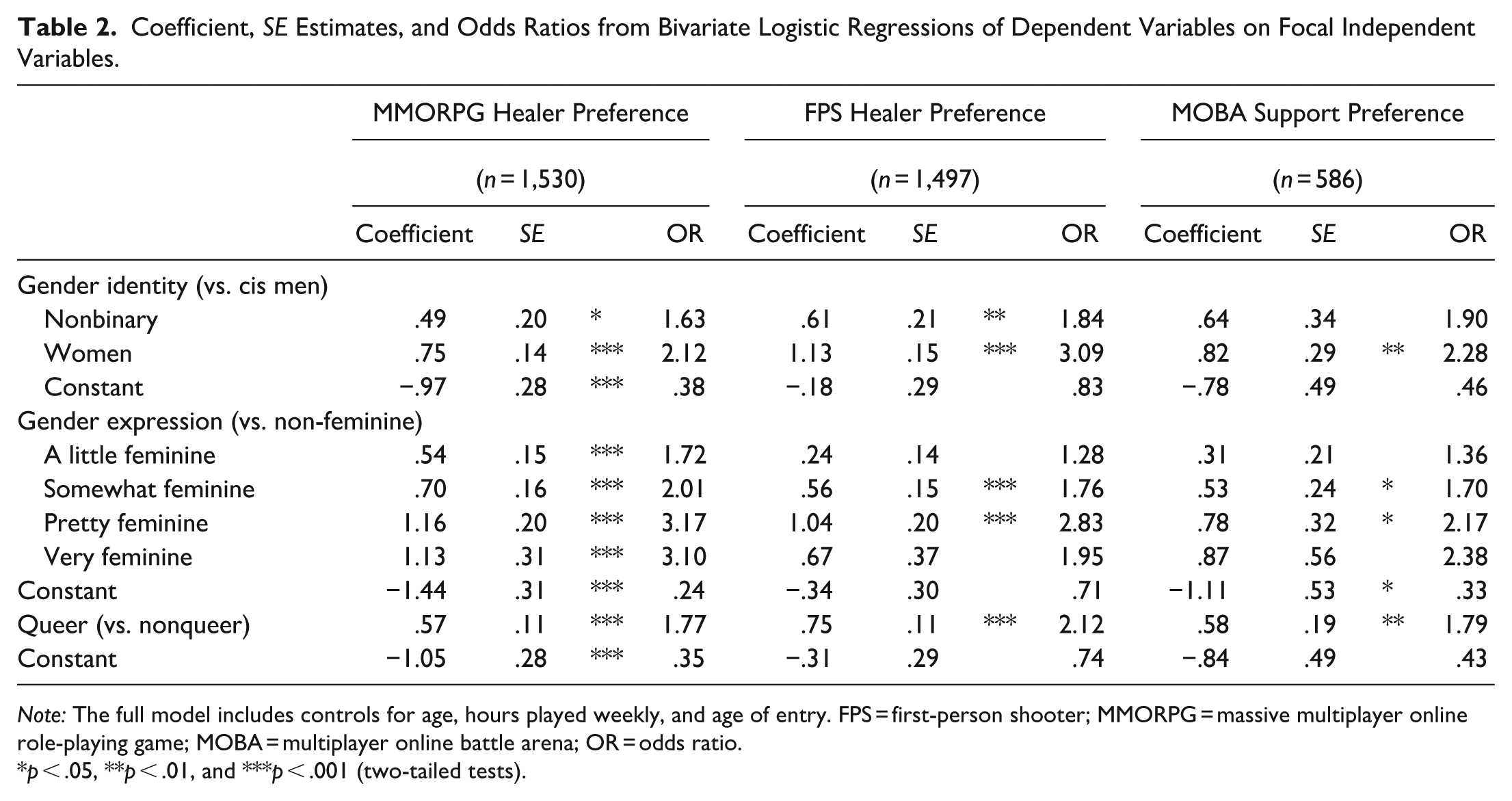
Table 1 reports the demographics of survey participants segregated by their preference for a support or healing role for the three dependent variables. Table 2 shows bivariate logistic regression models for respondent likeliness to prefer playing support or healing roles across all three dependent variables by gender identity, self-reported femininity, and sexual orientation. Figures 1 to 3 show predicted probabilities generated from Table 2 for each independent variable.
Descriptive Statistics of the Independent Variables, Total and by Category of the Dependent Variable.

Note: The p values denote significant differences in the distributions or means of the independent variables by category of the dependent variable using χ2 analysis. Racial demographics were captured only for U.S. and Canadian residents.
p < .05. **p < .01. ***p < .001.
Coefficient, SE Estimates, and Odds Ratios from Bivariate Logistic Regressions of Dependent Variables on Focal Independent Variables.
Note: The full model includes controls for age, hours played weekly, and age of entry. FPS = first-person shooter; MMORPG = massive multiplayer online role-playing game; MOBA = multiplayer online battle arena; OR = odds ratio.
p < .05, **p < .01, and ***p < .001 (two-tailed tests).

Predicted probabilities with 95% confidence intervals for support or healer preference in each genre by gender identity.
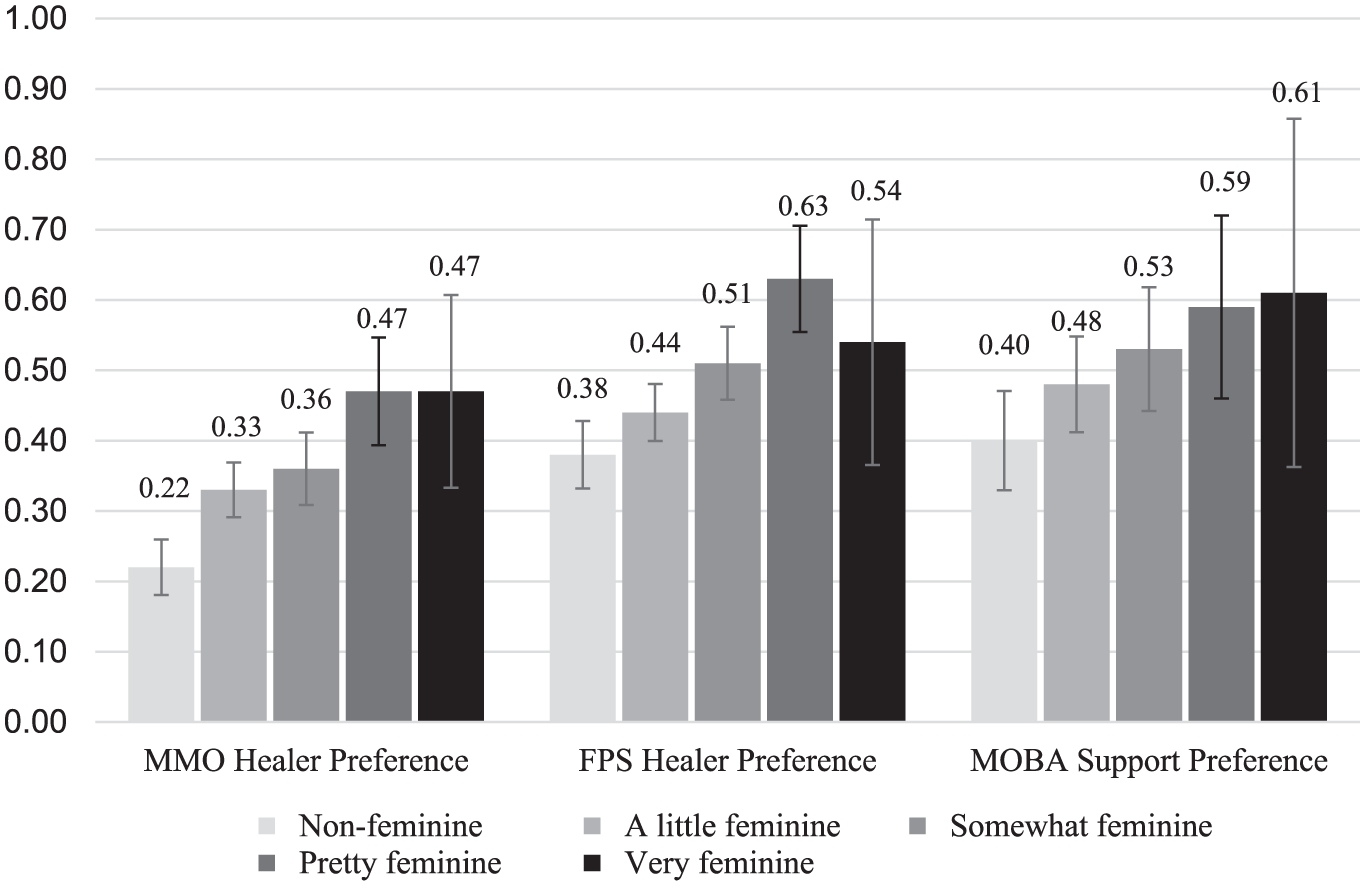
Predicted probabilities with 95% confidence intervals for support or healer preference in each genre by gender expression.

Predicted probabilities with 95% confidence intervals for support or healer preference in each genre by sexual orientation.
Measures
Dependent Variables
This analysis uses branching logic based on participant responses to the survey question: “Do you play any of the following game types? (If you play multiple, please choose your top three most-played game types).” Participants could choose from six game types, three of which have been selected for this analysis: MMORPGs, MOBAs, and FPS or third-person shooter games. Most MMORPGs rely on a standard role distribution, so I asked participants, “Which role do you prefer to play?” with the response options tank, damage, healer or support, and no preference. For shooter and MOBA games, I asked participants about specific games they play because games from these two genres are less stable in the presence and types of roles available. I chose the most popular responses for these games as a proxy for the genre, that is, Overwatch 2 for shooters and League of Legends for MOBAs. I asked participants who played the appropriate games: “When playing Overwatch 2/League of Legends, which role do you prefer to play?” For Overwatch 2, participants could select from tank, damage, healer, or no preference. For League of Legends, they could “choose up to two” from top, jungle, middle, bottom, support, fill, and no preference. 11 For each of these three groups, I coded preference for healer or support as 1 and no preference for healer or support as 0.
Focal Independent Variables
I use three focal independent variables from survey participants’ self-identified demographic information. For gender identity, I use participant responses to “How would you identify your gender?” Participants could select only one, and I coded this as 0 = man, 1 = nonbinary, and 2 = woman, with nonbinary including participants who identified as nonbinary, genderqueer, demiboy/man, demigirl/woman, and two-spirit, as well as people who filled in another response. For gender expression, participants were asked, “In everyday life, how feminine/masculine would you consider yourself?” They could respond with “very,” “pretty,” “somewhat,” “a little,” or “nonfeminine or masculine,” as appropriate. For this analysis, I use only the responses to how feminine people consider themselves, coded as 0 = “nonfeminine,” 1 = “a little,” 2 = “somewhat,” 3 = “pretty,” and 4 = “very.” Finally, for sexual orientation, I condensed participant responses to the question “Which of these best describes your sexuality/sexual orientation? (Select up to two)” into queer = 1 and nonqueer = 0, and any participants who identified themselves as lesbian, gay, bisexual, queer, asexual, pansexual, or demisexual were coded as queer.
Control Variables
I used three control variables for this analysis: age, age of entry, and weekly hours of play. Age is the participant’s self-reported age, ranging from 18 to 71 years. Second, I coded the age of entry with participant responses to the question “How old were you when you started playing video games regularly? 1 = 1–5, 2 = 6–10, 3 = 11–15, 4 = 16–20, 5 = 21–25, 6 = 26–30, and 7 = 30+.” Finally, weekly hours of play are coded from “In an average week, how many hours of video games do you play?” This variable was coded as follows: 0 = less than 1 hour, 1 = 1–5 hours, 2 = 6–10 hours, 3 = 11–20 hours, 4 = 21–30 hours, 5 = 31–40 hours, and 6 = more than 40 hours.
Findings
At the beginning of this article, I argued that video games would be a novel field for analyzing gendered role selection because they limit two of the three entangled factors (embodiment and legibility of gender) that contribute to gender inequality in the workplace, while the impact of socialization remains. The reduced time and financial costs of transitioning between roles within online video games should further disrupt how gender structures our work role selection in these spaces. Therefore, if we continue to see gendered role selection in video games, it is due to the impact of socialization. In my interviews, I found emergent narratives that associate femininity and support and healing roles. To analyze this stereotype, I present findings from logistic regression of preferences for support and healing roles on gender identity, gender expression, and sexual orientation. Finally, I return to the qualitative data to understand why players choose their roles and the impact of embodiment, discrimination, and socialization.
Testing Stereotypes
To test the reported association between gender/sexual orientation and people’s roles, I estimated logistic regressions for gender identity, gender expression, and sexual orientation. Although interviewees reported the stereotypical association between women and queer men and support or healer roles, many believed it to be fictive. However, there were significant associations between both gender and sexual orientation in each game genre.
Table 1 shows the demographic information for all participants, segregated by their preference for playing a support or healing role in any of the three selected genres. In the rightmost column, a low p value and asterisks indicate a significant association between the demographic variable and a preference for playing any support role. This illustrates that there are significant associations between preference for support and healing roles and gender identity, gender expression, sexual orientation, nationality, and certain racial categories. It is worth noting that although younger white men dominate my sample, the Entertainment Software Association publishes annual demographic reports of American gamers, which show that in 2023, 72 percent of American gamers were white (compared with my 76 percent) and 53 percent were men (compared with my 76 percent), and gamers were on average 32 years old (compared with my 27.5 years). This is likely due to a divergence between who is playing games and who is participating in online social media related to gaming, such as my recruitment sites, but could also be affected by international eligibility to participate in my study. Table 2 depicts the estimated logistic regression analysis for each of our three dependent variables and our three focal independent variables, displayed as both unstandardized logistic regression coefficients and odds ratios. I review these in depth in the following sections for the focal independent variable, each featuring a figure depicting predicted probabilities generated from the models in Table 2.
Before reviewing people’s propensity to play support or healer roles by game genre, I should introduce the distinct characteristics of each of these genres for the uninitiated. First, MMORPGs are commonly immersive, third-person games with customized avatars, such as World of Warcraft and Final Fantasy XIV, that take place in fictional realms. In these realms, players can group or play solo, but as in everyday life, they will encounter strangers (other players) working on their own quests. Group play requires that groups of tanks, damage, and healer roles collaborate in groups of varying sizes, depending on the content. Next, in FPS games, for which most gamers will probably think of Call of Duty, players are soldiers running around with a variety of guns, shooting player opponents. Representing this genre is Overwatch 2, a first-person “hero shooter” in which players choose premade characters (heroes) with distinct skillsets and play collaborative and competitive matches between teams of five, composed of players assigned to roles: two damage, two healers, and one tank. Finally, MOBAs are represented by their frontrunner game, League of Legends. This is a top-down game in which two teams of five compete to destroy each other’s base. As in Overwatch 2, these are mirrored teams, where players are assigned “lanes” that act as roles: top, jungle, middle, bottom, and support. Hopefully, this adequately illustrates that each of these games is a distinct genre, but each necessitates similar team-based mechanics requiring healer and support roles but in slightly different formats.
Gender Identity
I find significant associations between gender identity and preference for healer and support roles in the three genres. In the MMORPG genre, nonbinary people and women’s odds of playing a healer role were 1.63 and 2.12 times greater than men’s odds, respectively. This trend continues in the other genres, with nonbinary people being 1.84 and women being 3.09 times more likely to prefer playing healer roles in the FPS genre and nonbinary people being 1.90 and women 2.28 times more likely to play support roles in the MOBA genre. Women’s higher propensity to prefer playing support and healer roles was significant at the .001 level in each of the three categories, even while controlling for age, age of entry, and weekly hours of play. Although this association weakens slightly with nonbinary participants, the association is still strong and is significant in the first two genres and approaches significance in the third (p = 0.06). This lack of significance in the MOBA genre is likely because of the smaller number of participants who played this genre (n = 586) and who identified as nonbinary (n = 199), leaving very few participants who fit both of these demographics (n = 40).
Gender Expression
The second focal independent variable, gender expression, is also significantly associated with the preference for playing healer and support roles in each genre. Generally, as femininity increases, so does the propensity to prefer playing these roles. For the MMORPG genre, people who were a little feminine were 1.72 more likely to prefer playing healer roles, which increased up to 3.10 times more likely for those who were very feminine, compared with those who indicated they were nonfeminine. FPS and MOBA genres were less consistently significant, but all indicate an impact of gender expression on support and healer role preference and approach significance. For the FPS genre, people who were a little feminine were 1.28 times more likely to prefer playing a healer role. This preference increases up to 2.83 for pretty feminine and 1.95 for very feminine.
For the MOBA genre, those who were a little feminine were 1.36 increasing up to 2.38 for very feminine times more likely to prefer playing support roles. These odds ratios show a linear trend in increasing likeliness to prefer support and healer roles as femininity increases relative to nonfeminine players. However, these findings are less significant for very feminine players (n = 73) because of the smaller number of participants who identified as such for each genre (MMORPGs, n = 52; FPS games, n = 32; MOBAs, n = 15). These findings illustrate that support and healer role preference is also associated with gender expression, meaning that regardless of gender identity and sexual orientation, feminine players are more likely to play support and healer roles compared with their more masculine counterparts.
Sexual Orientation
Finally, my third dependent variable, sexual orientation, is also significantly associated with role selection in each of the three genres. Participants who identify as queer are significantly associated with the preference for playing support and healing roles at an α level of .001. Queer participants were 1.77 times more likely in MMORPGs, 2.12 times more likely in FPS games, and 1.79 times more likely in MOBAs to prefer playing healer and support roles compared with participants who reported exclusively heterosexual identity.
To better understand why women, feminine, and feminized groups may be disproportionately selected for these healer and support roles, I returned to the interview data, seeking participant explanations of play preferences. I explore the three causes for work role selection within the labor market mentioned previously: embodiment, discrimination, and socialization.
Impacts of Socialization on Role Selection
Although I found no impacts of discrimination or embodiment on role selection, I found three primary themes in why people play support or healer roles: meeting group needs, preference for nurturing, and accessibility. These themes were difficult to disentangle because many participant narratives contained multiple aspects of these simultaneously. Although these themes overlap, in the following section I attempt to lay each out individually.
Meeting Group Needs
Of the participants who preferred playing support or healing roles in video games, some reported that they did so in a preference for meeting the group’s needs. This theme primarily captures players’ preference for collaboration paired with a desire to fulfill roles that are both necessary and not as desired by other players. Most participants presented their preference as a matter-of-fact extension of who they are in everyday life, as Jenna explains:
I’m a very passive person, so that’s why I really enjoy the support role because I like supporting people. I’m just not an aggressive person, and I prefer staying in the back and helping the team. And that’s also why I don’t play tank because tanks are supposed to kind of like lead and carry the momentum. It’s just not for me. So that’s why I don’t play it. But, yeah, that’s why I started playing Mercy because I think her kit kind of embodies what’s most suited for me. (Jenna, 18, Chinese, straight, female, she/her)
First, Jenna equates her offline passivity to her online role choices, demonstrated by her preference for avoiding conflict and assisting the team. Aggression and leadership, even within fictive environments, are not appealing to her. Therefore, she avoided the tank role for its association with leadership and the damage role for its association with aggression. These associations between tank with leadership and damage with aggression were shared across many participants I interviewed. Instead, she prefers to play characters embodying the roles she is “best suited” for. The character she mentions is also meaningful because Mercy is a character from Overwatch 2 with very little incentive to play aggressively. Instead, this character requires players to apply their abilities to their teammates, either to heal or empower them. This requires the player to constantly follow that character and keep them on screen to maintain the effect. Mercy was a recurring character mentioned in my interviews and was heavily associated with and assumed to be played by women and gay men. However, there is variation in the gendering of roles, even between healer roles in games such as Overwatch 2. Unlike Mercy, other healer characters were not as strongly related to women and queer men. Other healer or support characters that required more aim to positively affect the team were not commonly mentioned in a negative light. This shows that there is variation in the feminization and diminishment of perceived skill between different characters within the support and healing roles. Some healer and support characters are viewed as more prestigious than others, but they are likely still viewed as lesser than their damage and tank counterparts.
Another reason women and queer men seem to occupy support roles disproportionately is due to flexibility or willingness to fulfill undesirable roles that are left vacant by other players. It appears that women and queer people may be the most likely to adjust their playstyle to better suit the needs of the team. This finding is also reflected in the survey data, with women and feminine players being significantly more likely to accommodate the team’s needs over their individual desires. It is likely that the preference and emphasis on collaboration mentioned earlier also manifest in an increased willingness to fill less desirable roles necessary for success. Michael (24, white and Hispanic, bisexual, nonbinary, he/him) demonstrates this:
It feels like a lot more men tend to play tank either because they want to be the bruiser, like the protector . . . a lot of women tend to play healer either because maybe it’s a little less mechanically demanding or because maybe, uh, it’s easy to fill into that last slot as a healer if like, you know, your mainly [damage role] friends, like bringing you along, or whatever.
So, kind of like a mix of ease and accommodation?
I think it’s mainly an accommodation thing. Yeah.
I selected this discussion because although the implication is present in Michael’s initial response, when I probed to learn more, he acknowledged that he thinks accommodation is the most crucial factor for women’s tendency to play healer and support roles. Again, Michael illustrated that the roles of healer and support are associated with women, and the role of protector, the tank, is associated with men. This discussion illustrates how feminine and feminized groups may both prefer to play in collaborative ways but also may be more willing to fill the unmet needs of the group, in this case by filling less desired or prestigious support and healing roles.
Inclination toward Nurturing
Second, and closely related to the preference for collaboration, is the inclination of feminine and feminized groups toward nurturing others. Many participants suggested that seemingly natural or societal inclinations toward nurturing, helping, or caring for others shaped either their own or others’ role preferences. Interestingly, although this association was most associated with women, many feminine nonwomen players also resonated with a desire to help and care for others.
With more, like, [masculine gamers], I guess I see it as like they’re trying to be a little bit more devoid of emotion, or there isn’t necessarily as vital a relational or societal component to those, a component of wanting to take care of people. I guess another way I kinda see it in my head is like, I, I feel like a lot of like feminine traits would be considered like helping or nurturing. (Ballerina, 36, white, straight, female, she/her)
Like many others, Ballerina’s quotation illustrates many aspects of the complex relationship between feminine and feminized groups and healing and support roles. First, she links the societal expectation for men to suppress emotions with a lack of empathy necessary to care for others. Instead, she associates femininity with societal expectations and a relational commitment to caring for those around her. In Ballerina’s interview, she expressed that women are both expected to fill these roles and feel called to fill them. This illustrates how societal expectations of people may manifest in video games, even when they are a space that could exist beyond the reach of these structures.
Another pattern in interviews often paired with the inclination toward nurturing others was the desire to be self-sufficient in-game. Cow illustrates this paired desire for helping others and independence:
I do also enjoy playing healers in like other settings as well. Um, just in general, I feel like I just like being able to rely on myself and being able to like, help people out. Like when we play D&D [Dungeons & Dragons] I typically play a cleric or a bard with healing spells, um, that kind of thing. (Cow, 22, Afro-Latino, gay, trans masculine, he/him)
Again, Cow’s quotation illustrates the complex desire to help others and not need help from others. But, he also bridges the connection between playing with anonymous people in online spaces and playing with familiar people face-to-face in a game such as Dungeons & Dragons. This implies that feminine and feminized groups who disproportionately fulfill healing and support roles in online video games may also fill these roles in other games or offline spaces.
Accessibility
The final rationale for why players in my sample preferred supporting or healing roles is that they suggested that some characters may be mechanically easier to play. This was one of the least referenced rationales, with few participants citing this as their reason for getting into healing and support roles. This is likely the least cited rationale because my interview guide focused on current preferences for video games rather than previous engagement with roles. Thus, accessibility may be a significant reason feminine and feminized groups play support or healing roles, because it became a recurring theme, even without my asking any questions focusing on engagement with roles over time.
I have the most hours on Mercy in Overwatch, and I hate that because I used to play a lot of competitive, and she was just by far the easiest to succeed with. But I freaking hate that. I hate the idea of a guy going on my Overwatch profile and seeing that I have the most hours on Mercy. I have thought about e-mailing Blizzard and asking them to, like, remove my Mercy hours. (Prismatic, 26, Dominican/white, pansexual, female, she/her)
Prismatic points out that for her, the easier access to success through playing the character Mercy allowed her to succeed early on in a way that other characters would not. Later, she specified that Mercy’s character did not require aim, an essential skill for a shooter game such as Overwatch. Although most boys and men had spent their childhood playing video games, she had only started playing them in high school. Therefore, early players may need to play an “easier” character to participate and succeed in the game. The healing and support roles, or more specifically, the more accessible characters within this role, may be a good option for people who get into video games later in life but still want to be able to contribute to the team in ways other than accuracy or hand-eye coordination. However, Prismatic offers another perspective: stigma is associated with playing support and healer roles, especially characters associated with both women and easy play, such as Mercy. After she had advanced to a more mechanically complex character (Ana), she began to worry about how other players may interpret her public profile and game time. Specifically, she may be criticized or used to justify negative stereotypes about women playing easy characters. She worried about this so much that she often considered contacting Blizzard, the parent company of Overwatch 2, to have them delete these hours.
Somewhat to the contrary, many players had no desire to play more difficult roles, and instead chose based on the characters that they most enjoyed. Some even refute Prismatic’s quotation, arguing that healer is not easier it just has a different type of required still. Instead, many players invested in a different skill set, which required the management of people’s ability cooldowns, 12 people’s in-game positioning, and health. This concept is reflected in PeachyGem’s quotation, “I have met a lot of women who like playing support, and honestly, I find it so hard, so I’m always like, great, I’m so happy.” This seems to indicate that the role of healer or support may not be more accessible for all players, while both Nomar and Prismatic consider these roles easier. I posit that they are either more accessible roles for these players or require skillsets that are divergent from the mainstream expectation of the game genre.
Discussion
One may suspect that there would be a much more uniform distribution of role choices by a broad gender spectrum because of the increased freedom and the reduced visibility of gender online. However, these data indicate the contrary, suggesting that the forces of gender socialization, exogenous to role selection, are so powerful that the liberatory potential of online video games remains unrealized. Role selection is heavily skewed along gender identity, gender expression, and sexual orientation. Rather than a more equitable and gender egalitarian distribution of labor, women, feminine, and feminized groups disproportionately select into less prestigious roles that are feminized and characterized by carework.
These findings have four significant theoretical implications. First, even within spaces where our bodies are not visible, and our gender is easily concealed, socialization shapes our selection into a hierarchical distribution of labor through gendered skillsets and preferences. Women, feminine players, and feminized players were significantly more likely to select healing and support roles despite being shielded by anonymity from the social expectations of others. This likely demonstrates an internalized preference for or acceptance of these roles. Unlike the workforce, where people only make a few career choices over their lives because of the considerable time and financial costs of changing careers, these roles are chosen each time players log in to play. Thus, although some of the pooling of feminine and feminized groups into specific occupational fields may result from early life choices, this research illustrates that the preference for these types of work may be stable over time.
However, in video games without distinct roles or with less clear connections between roles and carework, there is less stereotyping, even while feminine playstyle preferences continue to exist. Role-playing games, FPS games, and MOBAs have the strongest stereotypes and associations between femininity and specific playstyles. For instance, in the two similar FPS games Valorant and Overwatch 2, although each has a character that was heavily associated with feminine and feminized players—Sage for Valorant and Mercy for Overwatch 2—there was a much stronger association between feminine groups and healing roles in Overwatch 2 than in Valorant. This occurs because in Valorant, there is no healer or support role, so there are fewer expectations for feminine players. This is likely because healing and support looks different in each game. In Overwatch 2, healers are expected to heal constantly; in Valorant, the characters who can heal do so at most two or three times per three-minute round. Still, characters who can heal in Valorant have stronger feminine stereotypes, depending on how central healing is to their toolkit. The flattening of role differentiation in Valorant likely lessens both preferential selection and stereotyping of women into roles. Although this article focuses on carework roles in video games, I want to caution readers from assuming that healing or supporting alone structures feminine and feminized players’ choices in online video games. I also observed gendered trends in preferences for character types and fighting styles in fighting games, goals for play in survival sandbox games such as Minecraft, and gun preferences and engagement styles in FPS games.
Second, I echo Austin’s (2022) claim that healing and support roles in video games are forms of carework that occur within our leisure activities. Although my findings differ from those of Austin’s study, with my participants reported a desire to meet group needs, whereas she found that women felt an obligation to fulfill this work, we both come to the same conclusion. This type of labor is carework, is disproportionately done by feminine and feminized groups, and means that women are disproportionately called to care for others, even within their digital leisure activities. Carework encompasses caring for others and includes unpaid care for family members such as friends and paid care for others (Folbre 2006). Although the labor in video games may not seem like caregiving, I argue that it fits the previously cited definition of “caring for” and “caring about” because healing and supporting people is caring for them. The way people who play healing roles ground their preference in empathy, nurturing, and collaboration demonstrates that they also care about others (Abel and Nelson 1990). This provides a valuable framework for understanding how carework may occur within other leisure activities and third spaces. Linking this type of work role to the workplace and the home can bolster our framework and understanding of how feminine and feminized labor is treated within leisure activities by introducing a large body of research previously considered unassociated. For example, gender and work literature can elucidate why feminized labor in video games receives less respect and is treated as less skilled.
Third, the propensity to perform carework even within virtual and leisure activities illustrates an extension of Hochschild’s concept of the second shift. For example, a heterosexual woman is more likely to do carework in the workplace, where she is undercompensated and undervalued. Then, she may return to a home where she does more domestic labor than her partner. Finally, at the end of a long day consisting of two shifts of work, she may sign into video games to relax and find herself once again doing necessary but undervalued carework labor, disproportionately for men. The second shift can help us understand the burden placed on women by this labor and its associated expectations, and this association can help explain why women may find themselves filling these roles in the household, even while people’s relationships claim to be increasingly gender egalitarian. These findings suggest that feminine people are likely to select subordinated labor, that may come with additional social responsibilities, because they want to be collaborative, recognize that their socialized skills and expectations set them up for these types of work, and, to a lesser extent, enjoy the independence afforded by taking on the labor themselves. Furthermore, by moving beyond a gender-binary framework, this research illustrates how gender identity, expression, and sexual orientation seemingly structure our selection into various types of second-shift work. As Ridgeway (2011) theorized, gender is relative, and consequently, the more feminine player likely assumes these carework roles and second-shift labor burdens, regardless of gender identity or expression.
Fourth, the agentic and preferential selection of women, feminine, and feminized people into feminized and carework roles within play allows a new conceptualization of feminine play. Most play that adults can participate in is masculine because our society generally structures leisure activities and sports around men. This results in the masculinization of women who participate in activities such as sports and video games. Although men can participate in extensions of play they may have engaged in during adolescence, girls are expected to abandon play when they transition to womanhood. Instead, women are often associated with hobbies such as sewing, cooking, or reading. But with women’s increasing equality in modern times, there is a proliferation of feminine types of play, especially in nerd cultures, where women increasingly participate in activities such as video games, comic books, tabletop role-playing games, and more. Therefore, healing and support in video games is a form of feminine play akin to cosplay, where women can play in ways similar to how girls play, while cosplay may be the extension of dress-up, healing and supporting could be the extension of things such as playing house. These types of play are not only associated with feminine people, but they are uniquely playing with femininity or feminine goals. They are enjoyed by feminine people in ways that have previously not existed.
Conclusions
With this study, I provide theoretical contributions to the fields of work, home, and leisure. First, I complicate the relationship between gender and workplace preferences by analyzing a space that begins to disentangle the connectedness of embodiment, socialization, and gatekeeping/harassment to workplace inequality. I demonstrate that even when we mitigate the effects of embodiment and gatekeeping or harassment, the impact of socialization remains strong enough to recreate offline patterns of inequity in online play. Second, I argue that video games become yet another field where feminine and feminized people are performing necessary but subordinated labor for men and masculine people. Feminine and feminized players are both expected to and disproportionately prefer to fill these roles. Third, I theorize that feminine play is an understudied but natural extension of feminine people’s increased ability to enter leisure activities. Although women, feminine players, and queer players are attacked in these spaces, both because of their gender/sexual orientation and their work role preferences, they are making these choices not solely because of external pressures but also because of feminine agency and joy.
My findings suggest that online video games are neither a complete escape from the gendered politics of work, home, or other leisure activities, nor entirely structured by external social forces. Although video games could theoretically be a postgender utopia, they are instead another arena for gender inequity. Video games are an extremely gendered space, dominated by cisgender heterosexual white men. This research finds that gender influences the types of games we play and the roles we play within games. Other players also notice these trends, and often infer people’s gender, sexuality, or race through the types of games they play, the way they play, or the roles they fill—sometimes to identify and harass or demean marginalized groups (Brenner-Levoy 2023). I hope that future research aims to understand how femininity manifests within play spaces and further interrogate the scholarly implications of both digital spaces and play spaces to the mainstream fields of sociological study. Scholars neglect spaces where joy happens, either because they view them as unsociological or because they fail to consider them at all. However, the forces we study in other fields also manifest within spaces characterized by play and joy. Above all else, these findings present the friction between play and work, gender expectations, and gender agency. However, as Macharia (2019) posited, these frictions can cause both pain and pleasure. With this article, I argue that we can better understand the frictions that lead to adverse outcomes by studying the frictions that lead to pleasure.
Footnotes
Funding
The authors disclosed receipt of the following financial support for the research, authorship, and/or publication of this article: This project was funded by the Charles Phelps Taft Research Center, Kunz Center for Social Research, and Graduate Student Government at the University of Cincinnati.
1
I use Pierre Bourdieu’s concept of field to indicate that these areas of work, home, and play are a system of social positions structured by the rules of the field and a person’s role, habitus, and capital. I occasionally use terms such as realm or arena to diversify language and to illustrate the aspects of competition and play that are more present or explicit in certain fields ( ).
).
2
Labor discussed in this article refers to the labor done within video games and virtual worlds through the work roles that players choose as part of their play. However, there is also a robust amount of paid and unpaid labor that also comes with video games, through development, streaming, e-sports competitions, and occasionally the sale of virtual content.
3
Of the Entertainment Software Association’s participants, 10 percent were Hispanic, 8 percent Black, 6 percent Asian/Pacific Islander, and 4 percent “other.”
4
One percent of the Entertainment Software Association’s participants either did not respond or selected “other.”
5
I recruited participants in groups or hashtags that surrounded gaming generally, certain popular games, and the intersections of gaming and identities. Reddit was the most successful recruitment site, as both Facebook and Twitter posts received little engagement.
6
I identified bot responses using what I called a “red flag system,” in which I assigned a red flag to responses that used duplicate network identifiers, used duplicate open reactions, had the top and bottom 10th percentile of submission times, and had high densities of similar e-mail addresses (>60 percent of proximate responses also having a Gmail or Hotmail contact) or high proximal proportions of gender or ethnic identity options (>50 percent of proximate responses also marking as gender diverse or ethnically Hispanic, Jewish, or Romani). I used proximate responses to identify bots using random answering, which leads to specific lower likelihood categories being selected at much higher rates by bots (e.g., a higher proportion of trans or Romani respondents than is likely). However, to avoid removing legitimate responses, I assigned green flags to non-bot-like behavior (such as including a phone number for contact) and removed only responses that exhibited more than one “red flag” behavior.
7
Participants with missing data on the dependent variables did not play the games included in this analysis.
8
Because I grounded my racial categorization within a U.S. context, only those who lived in the United States and Canada were asked about their racial/ethnic backgrounds. Therefore, because I stratified my random selection of interviewees by race, all come from either the United States or Canada.
9
I use queer here to specifically reference queer sexual orientation and not queer gender. Although femininity and gender identity are dependent variables in my logistic regression models, I do not include controls for trans identity. As such, trans women and men are not differentiated from cis women and men.
10
MMORPGs were included broadly because they nearly all rely on a cooperative playstyle that uses tank, damage, and healer roles. However, I used the specific games of Overwatch 2 and League of Legends because of their popularity and reliance on these three roles. In contrast, their general genres of FPS games and MOBAs do not always use these similarly. Thus, by identifying and targeting these games directly, I could control for some of the errors that would be introduced through different organizations of roles in other games within these genres (i.e., not all FPS games have healers or tanks, and some MOBA games use multiple support types at the same time or support is optional).
11
Participants were allowed to choose two roles for League of Legends, because when playing the game players must choose two roles before searching or queueing for a game. Available roles are top, middle, bottom/attack damage carry, jungle, and support. Each of the directional lanes goes to their corresponding three “lanes,” while jungle moves between the lanes in the jungle, and supports assist the bottom/attack damage carry.
12
In many video games, players have access to different abilities that cany be used once before going on “cooldown” for a predetermined amount of time. This helps developers balance the strength of abilities by limiting the frequency that players can use them.