




Abstract
The global race to attract (highly) skilled or educated migrants (SEMs) has fueled significant scholarly interest, yet the evolution and collaboration patterns within SEM research remain underexplored. The authors address this gap by using computational methods (dynamic topic modeling, network analysis, and named entity recognition) to analyze 985 SEM-related studies published from 2000 to 2023 and to understand the temporal evolution of research themes. The findings reveal a rapid expansion of SEM research since 2010, with increasing scholarly engagement across diverse disciplines and countries, suggesting that intellectual proximity no longer dominates in this research field. Although key topics such as SEMs’ roles in international trade and integration challenges are gaining attention, most topics evolve slowly, revealing that the field is transitioning from a “reconfiguration” to a “normal” period, as theorized by Andrew Abbott. Research gaps persist, particularly in understanding SEMs’ social impacts and the role of nonpublic sectors in their migration and integration. This study provides a systematic analysis of SEMs’ research, identifying trends, gaps, and collaboration patterns. It demonstrates the value of combining machine learning methods with sociological theoretical frameworks in exploring migration studies, offering a methodological framework for other interdisciplinary domains.
Keywords
(Highly) skilled or educated international migrants (SEMs) are driving knowledge-based social and economic development and attracting much attention from both scholars and policymakers. Although there is no consistent definition or measurement for SEMs, these migrants are generally defined as international migrants with tertiary education (Peri and Sparber 2011) or above-average education in their local labor market (Fong 2023) or skill levels (Ackers 2005). Thus, keywords including skilled and educated are most cited in current research on SEMs (Weinar and Klekowski von Koppenfels 2020). A key reason contributing to the definition inconsistency is that the conceptualizations for SEMs that are used are not necessarily to be found in the available data, and hence, the specific measurement for SEMs used by different studies usually depends on the purposes of individual studies (Weinar and Klekowski von Koppenfels 2020). For example, those who focus on policies on SEMs tend to follow the definitions used by policies in their interested countries (Weinar and Klekowski von Koppenfels 2020). With their higher human capital levels, including education, managerial skills, and professional experience, SEMs significantly contribute to improving technological advancements, competitiveness, and productivity in economies (Nathan 2014). Rich evidence from current literature has shown that these migrants not only potentially help low-income countries achieve economic development and escape poverty but also address demographic challenges like aging populations and labor shortages faced by developed economies (Poutvaara 2021).
While governments in developed economies have implemented various policies to attract and retain SEMs, including extending working and residency permits and tax concessions (Kvashnin 2022), policymakers in developing countries, particularly in fast growing economies in East Asia and Southeast Asia, also joined the global competition for SEMs by introducing incentives such as tax exemptions, permanent residency options, and study loans to attract SEMs and encourage the return of skilled workers from abroad (Cerna and Czaika 2021).
Despite the welcoming attitude of worldwide governments toward SEMs, these migrants still face challenges such as discrimination from native communities, wage penalties for mismatched employment, and limited access to social resources in both their host and home countries. The reasons behind these challenges are complex and vary across countries, but key contributing factors include insufficient strategies that regulate the recruitment and management of SEMs, limited understanding of the unique characteristics and migration decisions of SEMs, and opportunities for social interactions between these migrants and native populations (Andreouli and Howarth 2013; Geddie 2012).
As the global competition for SEMs intensifies, an increasing number of studies have begun to examine this group of international migrants. However, there is a lack of comprehensive reviews that map the available evidence and research themes generated by existing studies, hampering a complete understanding of SEMs and future research directions and policy design (Bauder 2016). Existing studies reviewing the literature on SEMs tend to focus on narrow topics, such as the economic impacts and integration of SEMs, and involve a relatively small number of studies through scoping reviews (e.g., Crowley-Henry, Connor, and Al Ariss 2016; Faggian, Rajbhandari, and Dotzel 2017; Farashah et al. 2022; Han, Gulanowski, and Sears 2022). Although these studies provide detailed insights into specific aspects of SEMs, our understanding of the broader research trends, themes, and connections in skilled migration worldwide remains limited. Furthermore, existing analyses of studies on SEMs predominantly concentrate on talent destinations in Western and developed regions, leaving our understanding of SEMs and related policies in non-Western countries incomplete. This knowledge gap is unfortunate, considering the rising power of creating and non-Western economies, particularly those in East Asia and Southeast Asia, in the global talent race (Ewers et al. 2022). The research development on skilled SEMs in and to non-Western regions over the past two decades remains unknown. We hence address these critical knowledge gaps by using dynamic topic modeling (DTM), named entity recognition (NER), and network analysis on abstracts from 985 studies related to SEMs published during 2000 and 2023.
Our review of the field of SEMs is guided by the work of Collins (1998), Abbott (1988, 1999, 2001), and Farrell (2001) regarding how ideas develop and emerge through networks defined by intellectual or geographical proximity. Through the authorship information exploration, the topic modeling and network analysis on SEM-related research developed over the past two decades, this study empirically depicts the scholarly collaborations across disciplinary and geographical boundaries and the associated evolution of SEMs research. Thus, our study not only filled the aforementioned knowledge gap in the research on SEMs by offering an overview of the research landscape but also revealed how intellectual fields fragment and assemble in response to both internal scholarly dynamics and shifting external realities. Moreover, this study extends Collins’s and Abbott’s frameworks in an empirical domain by providing a data-driven illustration of their arguments. Aligning with their conclusions, our analysis revealed that it is the complex interplay of external forces, such as political interests on SEMs, globalization, and technology advancement, and collaborative circles and disciplines that potentially drive topic formation and development in studies on SEMs. The SEMs research field, after two decades of development, is nearing a more stable and structured stage and attracts the contribution of scholars from different disciplines.
This study will make several significant contributions. First, it represents the first systematic attempt to map research trends and authorship patterns in the study of SEMs. As SEMs gain increasing attention from scholars and policymakers worldwide, this study serves as a resource for future research by identifying key thematic evolutions, potential research gaps, and implications for scholarly collaboration and policy development. Second, this study represents the first work combining sociological theoretical frameworks and multiple machine learning methods in systematically exploring one of the frontiers of the research field in international migration studies. Integrating different computational techniques, this study overcomes the limitations of prior literature reviews on SEMs, which focus mainly on a few studies exploring the economic integration of SEMs or the subjective evaluation and perception of the developments of the field. Beyond its immediate focus on migration, this study also serves as a methodological guide for future research in the social sciences. It demonstrates how diverse machine learning approaches can be combined with sociological frameworks to analyze complex and interdisciplinary topics through a less subjective and more empirically grounded perspective. Finally, although we focus on the review, one of our work’s important supplementary contributions is to empirically demonstrate the network of ideas within SEM studies and offer a dynamic and systematic perspective to view this field, which is necessary for future knowledge production, as suggested by Abbott (2001). In the following sections, we describe how we used the machine learning approach to understand the trends of studying SEMs. Using work on network and knowledge development, we discuss in detail how we use machine learning as the approach can be applied to review other fields in immigration studies.
Theoretical Framework
Our discussion of the development of the field is grounded in the work of Collins (1998) and Abbott (1988, 1999, 2001) as well as Farrell (2001). These scholars offered powerful lenses for understanding the emergence and evolution of “ideas” and emphasized the importance of networks in shaping which topics are discussed and which are not. These scholars suggested that individual research, instead of being seen as a product of individual actors, is a product of collaboration and interaction among scholars within the same networks, on the basis of intellectual and geographical proximity.
Such a position is supported by a number of researchers. Collins (1998) elaborated this idea that the development of ideas is not attributable to a single researcher or culture; instead, the growth and transformation of intellectual discourse arise from the patterns of interaction and competition within “networks of thinkers.” As Collins noted, “if one can understand the principles that determine intellectual networks, one has a causal explanation of ideas and their changes” (p. xviii). He argued that because “thinkers” within the networks influence each other through debate on new issues and problems, cooperation, and citations, the development of ideas is not isolated but rather happens in forms of interconnected “chains of arguments” whereby earlier ideas cascade and are reshaped, redefined or challenged by later thinkers (Collins 1998). Similarly, through exploring the group dynamics of six collaborative groups, Farrell (2001) also suggested that innovative ideas in the arts and sciences are generated by “the collaborative circles,” rather than a lone genius. The creativity of each member within these circles was drawn out and sustained by their frequent and continuous interactions, support, and competitions (Farrell 2001). Therefore, on the basis of Farrell, the productivity of collaborative groups could be positively influenced by cultural or geographical proximity and agglomeration, which enables more frequent, direct, and timely feedback and interactions among thinkers, facilitating the creativity of members in these groups. Abbott (1988) further evaluated the effect of competition between different occupational or disciplinary groups on the creation of “disciplinary jurisdictions” dividing the expert labor. He emphasized that because the disciplines are interdependent and in continuous competition, the boundaries or “jurisdictions” claimed by different research fields or disciplines are not static but dynamically formed and revised through negotiation (Abbott 1988, 2001). According to his framework, knowledge structures can display two periods, namely “normal periods” and “reconfiguration periods” (Abbott 1988). As each discipline constantly expands its jurisdiction through innovations while avoiding being cannibalized or redefined by other disciplines, the jurisdictions of disciplines are commonly in a “chaotic” phase or “reconfiguration periods” when disciplines contest their jurisdictions and try to capture new problems (Abbott 1988). The development path of ideas, hence, is not linear but bursting (Abbott 1988, 2001) before it reaches the “normal” period when each field has its domain and methods, and changes in each field are either minor or slow to evolve (Abbott 1988). Therefore, he emphasized that a systematic and dynamic perspective is much needed to understand the production and evolution of knowledge (Abbott 2001), which is what we hope to build in this study for understanding the important yet underexplored field of SEM-related studies. Moreover, by analyzing the 100-year history of the sociology department of the University of Chicago, Abbott (1999) demonstrated that the development of the “school of sciences” depends not only on knowledge innovation but also on the institutional factors such as recruitment policies and discipline reputation.
Although the aforementioned scholars do not explicitly discuss the importance of the context that shapes the development of intellectual discourse, their emphasis on networks implicitly highlights the role of context, as most scholarly networks are deeply embedded in their cultural, economic, political, and social environments. The context includes the society in which the author resides and the scholarly networks in which the author is involved. They together provide, at the same time, limits and a list of potential topics for discussion. Taken together, although the context offers a set of possible topics, it is the intellectual networks that determine which topics are discussed. Building on these understandings, our analysis of the development of skilled and educated international migration research focuses on the authors’ locations and disciplines, which largely reflect their research networks. In the latter part of this article, we directly examine the “networks” of the study to explore how these works are interconnected.
Data and Method
Data Collection
We gleaned data by searching a series of word intersections of the keyword matrix, including skilled, highly skilled, educated, and highly educated, and the keyword matrix, including immigrant and migrant. According to current definitions in research and policies related to SEMs, these words are commonly used by scholars and policymakers to describe SEMs (Weinar and Klekowski von Koppenfels 2020). Apart from directly borrowing these keywords centering on SEMs, we also manually checked the similar words in the abstract and titles of references obtained. We noticed that keywords such as talent and occupations of SEMs such as inventors and doctors also exist in research on SEMs. However, further search based on these words did not yield more relevant studies on SEMs compared with the most oft-cited words, namely “skilled” and “educated.” It is important to highlight that because the term skilled migrant is deeply rooted in policy contexts and consistently used across countries, even though its specific definition may vary (Weinar and Klekowski von Koppenfels 2020), this term is also universally used by studies on SEMs. Thus, by basing our data collection on this policy-driven term rather than predefined keywords from individual disciplines involved in SEM-related studies, we effectively account for the potential evolution of disciplines and their interconnections. We initially obtained 5,330 English-language research articles covered by the Web of Science Science Citation Index Expanded and Social Science Citation Index 1 from 2000 to 2023. Given our focus on SEMs, we limited the search range to title, abstract, and keywords to better ensure the relevance of search results. Full abstracts of 985 articles are included in this study. 2
NER and Information Extraction
To offer an overview of geographical focuses and authorship collaboration patterns in current SEM research, we used NER, a natural language processing technique pinpointing data into predefined entity categories such as “organization” and “location” (Çetindağ, Yazıcıoğlu, and Koç 2023). We first used the NER to identify geographical locations mentioned in each abstract. To further ensure the accuracy of the NER classification results, especially for articles mentioning more than one country or location, we read through the locations mentioned and identified by NER and manually coded and judged the migration destinations on the basis of the corresponding abstract. After the manual validation and judgment on migration destinations tagged by NER, we classify studies into three categories 3 : Western (i.e., studies focusing on immigrants in and to Western countries), non-Western (i.e., studies focusing on immigrants in and to non-Western countries), and unspecified (i.e., studies with no clear indication on specific study areas). Six hundred fifteen abstracts were classified as Western, 173 as non-Western, and 197 as unspecified. We then extracted the addresses of authors’ affiliated departments and followed the same strategy as described previously to label studies with authors from multiple disciplines as multidisciplinary collaborations and those involving authors from multiple countries as international collaborations.
DTM and Topic Evolution Analysis
To capture the main research themes in current studies focusing on SEMs and explore the topic development over time, we used DTM to analyze our data. Like traditional topic modeling methods such as latent Dirichlet allocation (LDA), DTM can also learn and summarize topics from documents by assigning the document with different weights to topics on the basis of the distribution of words in the topics and the distribution of topics in documents (Kherwa and Bansal 2019). However, beyond traditional methods, DTM can condense themes of unstructured texts and consider the topic changes over time (Blei and Lafferty 2006), enabling us to track the temporal changes of topics over long periods.
To prepare the document data for DTM, we followed the steps of prior studies (e.g., Yang et al. 2023) to tokenize the raw texts, remove stop words, and perform word lemmatization, which produces more linguistically precise results compared with stemming (Khyani et al. 2021). Following established practices (Kherwa and Bansal 2019; Yao and Wang 2020; Zhang 2021), we used the coherence score to determine the optimal number of topics, with a higher coherence score indicating more coherent words within each topic (Gurdiel, Morales Mediano, and Cifuentes Quintero 2021). The optimal number of topics in our study is 16.
Since the primary goal of our study is to understand the research trends and temporal evolution of topics in the research of SEMs in past decades, we used DTM rather than LDA in our analysis. Research indicates that traditional topic models such as LDA require at least 100 documents to yield significant outcomes (Schmiedel, Müller, and Vom Brocke 2019). The interpretability of results improves as the document count increases, but the benefits taper off beyond 1,000 documents (Nguyen 2015). The requisite number of documents for LDA reduces with longer document lengths (Wheeler et al. 2021). Given that abstracts in this study exceed five full sentences, the benchmark for necessary documents would be lower. Moreover, DTM, which accounts for temporal variations in topic evolution, is more adaptable and accurate with smaller text samples compared with LDA (Blei and Lafferty 2006). Thus, although this study explores a relatively limited body of studies, the number of documents available for DTM analysis is sufficiently large.
Results
Authorship Analysis
As the frameworks from (Abbott 2001; Farrell 2001) imply, intellectual proximity is commonly found in collaborative work. Geographic and cultural proximities facilitate the development of networks and generate similar research topics and focuses among scholars. Therefore, we first examined intellectual proximity through the lens of geographic locations. We analyzed the geographical information of the authors of publications related to SEM in Western and non-Western regions. The findings show that the number of publications focusing on SEM in both Western and non-Western regions increased in the past two decades and surged significantly after 2010 (Figure 1). The significant expansion of SEM-related research since 2010 may indicate that easy access to publications worldwide after entering the 2010s, when technological advancements occurred (Pedro 2022), facilitates the widespread and rapid sharing of ideas. These advancements have systematically reduced the barriers imposed by geographical distance, enabling researchers to engage in more frequent interactions and fostering the growth of collaborative circles across geographical regions, as theorized by Farrell (2001). Thus, the foregoing findings suggest that intellectual proximity is no longer the dominant trend in the study of SEMs as an increasing proportion of published work involves cross-regional collaborations. Besides, this expansion of SEM-related studies after 2010 also reflects the nonlinear and “bursty” dynamics of knowledge development conceptualized by Abbott (2001). The number of publications examining SEM in and to non-Western countries is noticeably less than that of those focusing on immigrants in and to Western countries. This may reflect the political context of recruiting SEM researchers in Western countries, where such policies have been important in many regions, and the positions of these countries, such as the United States and Australia, as long-welcomed talent destinations.
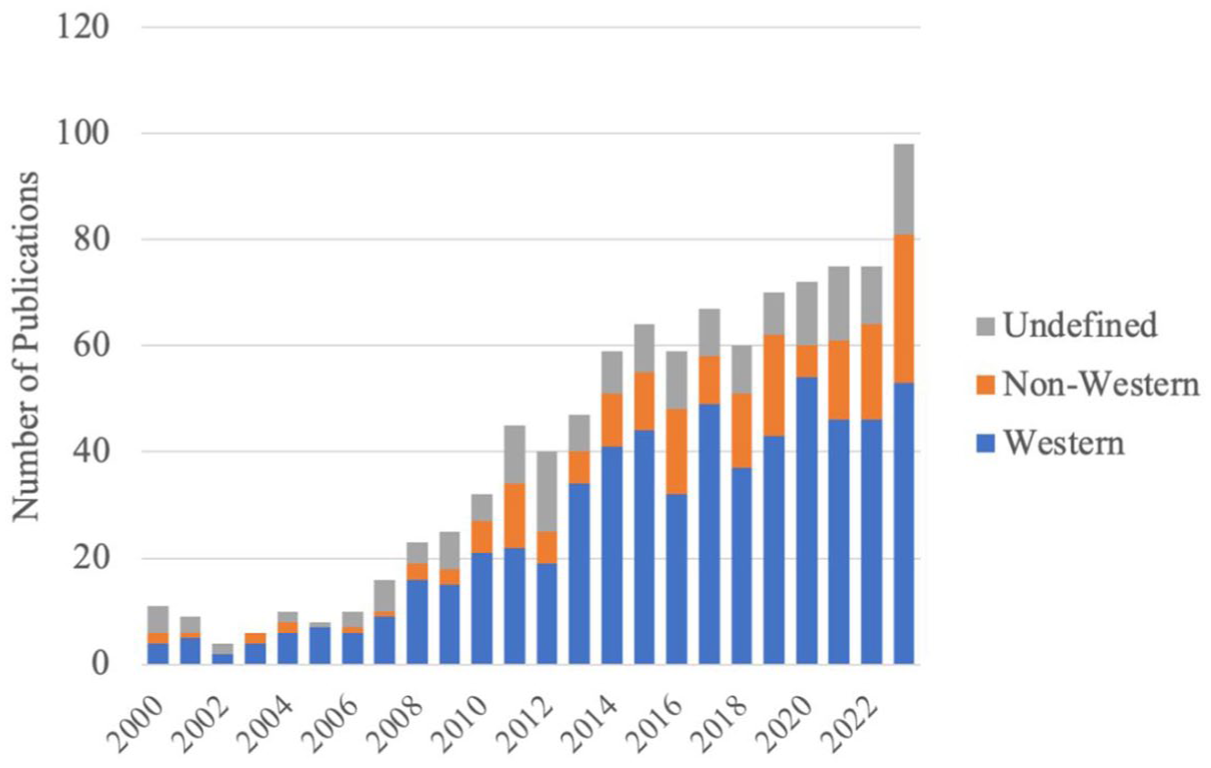
The number of selected studies focusing on Western, non-Western, and unspecified regions from 2000 to 2023.
Intellectual proximity is reflected through collaboration among authors within the same discipline. To further understand the relationship between scholarly networks and the development of SEM studies, as stated earlier, we extracted and analyzed the addresses of the affiliated departments and disciplines of authors in the selected publications. Given the inconsistency of naming rules of authors’ affiliated departments worldwide, we combined subdisciplines with similar research scopes into broader disciplinary categories. One hundred seventy-two publications are identified as publications with authorship from different disciplines, and 257 publications are identified as international work.
The number of publications from international collaborations focusing on SEM in Western regions increased noticeably in the past two decades (Figure 2), while those focusing on SEMs in non-Western regions only witnessed a slight growth. The number of studies about SEMs in Western areas, which were contributed by multidisciplinary collaborations, also increased rapidly, especially after 2010 (Figure 3). The cooperation among different disciplines reflects the complexity of migration that requires multidisciplinary efforts to disentangle the observed patterns. It is also possible that the availability or support of multidisciplinary networks for authors focusing on SEMs in Western countries facilitates interdisciplinary collaboration. As suggested by (Collins 1998) and Abbott (1999), institutional context, such as regional research priorities, sociopolitical factors, and the settings of research institutions, can shape the research focus and diffusion of ideas. Moreover, the significant growth of international or interdisciplinary collaborations seen in studies focusing on Western regions and the associated high number of publications revealed that more frequent interactions and collaboration among thinkers from different fields can encourage knowledge development, as Farrell (2001) argued.

The number of publications from 2000 to 2023 contributed by international collaborations.

The number of publications from 2000 to 2023 contributed by multidisciplinary collaborations.
To understand the disciplines of authors involved in the multidisciplinary teams for research on SEM, we mapped the disciplinary connections revealed by authors’ affiliated departments (Figure 4). This information can shed light on cross-network disciplinary collaboration. Our findings reveal that SEM research is driven by multidisciplinary collaborations primarily involving scholars from sociology, economics, business and management, geography, education, and public policy. These disciplines serve as major hubs with extensive interconnections, highlighting SEM’s strong relevance to social and economic development and policymaking. Moreover, the results demonstrate that SEM studies not only integrate knowledge from various social science disciplines but also draw from fields such as medicine and computer science. Together with the noticeable growth in the number of cross-disciplinary works shown in Figure 3, this reflects the interdisciplinary nature of SEM as a relatively new subfield of migration studies, attracting researchers from different disciplines to actively contribute ideas to claim jurisdictions in this field, as Abbott (2001) theorized, and potentially leading to shifts in disciplinary boundaries. Similarly, the growth in collaboration across geographic boundaries indicates shared research interests among scholars from different countries. This can enhance creativity and knowledge development through collaborative circles suggested by Farrell (2001) and enables scholars to address migration-related issues from diverse perspectives.
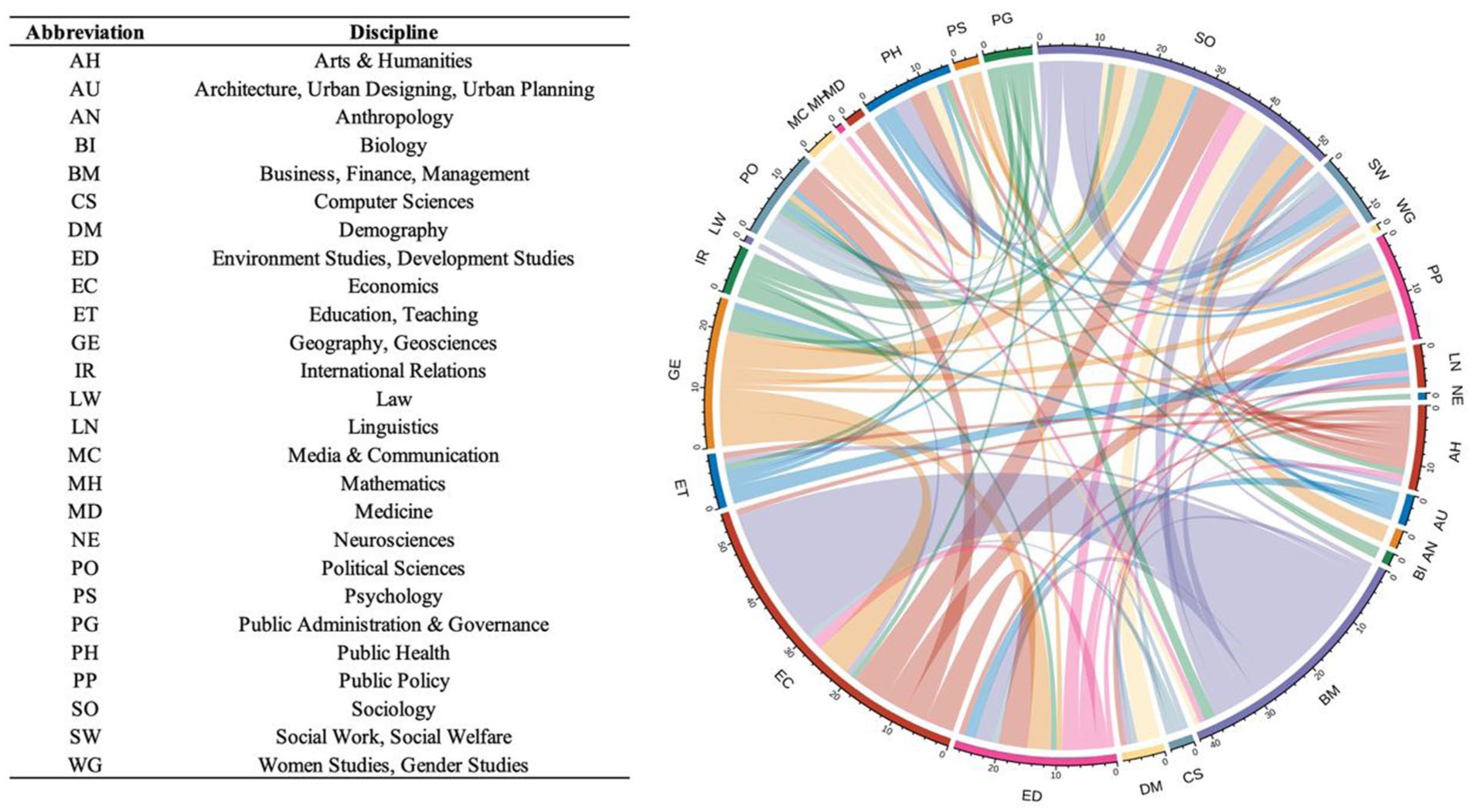
Patterns of discipline integration are demonstrated by publications contributed by multidisciplinary collaborations.
Taken together, the findings suggest that intellectual proximity is no longer the dominant trend in the study of SEMs. Instead, a growing proportion of published work involves cross-regional and cross-disciplinary collaborations, and this pattern is more salient among studies focusing on the Western contexts. This may reflect the increasing emphasis on interdisciplinary approaches by many funding agencies and the recognition among researchers of the benefits of such collaboration, which opens new avenues for research.
Topic Interpretation and Evolution
With an understanding that the field is increasingly characterized by a growing number of scholars from both Western and non-Western regions engaging in significant interdisciplinary collaboration, we now turn to the key topics studied within the field. This information provides insight into the scope and focus of the field, highlighting the specific networks of authors across different locations and disciplines mentioned earlier. Before presenting the content of each topic, we will discuss the statistics of the 16 key topics identified by DTM to better appreciate their relative importance. Table 1 presents the top keywords for each of the 16 topics generated through DTM. Although the topic number and top keywords with a high probability of appearing in each topic are generated by DTM, the name of each topic needs to be manually decided. The authors independently analyzed abstracts with the topic having the highest distribution probabilities and synthesized and decided the themes of corresponding abstracts for each topic (further detailed explanations of each topic are provided later). In Figure 5, we display the proportions of these topics calculated by dividing the number of articles corresponding to a specific topic (on the basis of the highest distribution probability generated by the DTM) by the total number of articles (985) included in the analysis. For example, if a document has a distribution probability of 97.53 percent for topic 14 and significantly lower probabilities for other topics (e.g., 0.164 percent), it is assigned to topic 14.
Topic Themes and Top 10 Keywords with High Probabilities Appearing in Each Topic, Calculated Using Dynamic Topic Modeling.

Note: Only the keywords extracted from the stem were noted, and the full term is completed in parentheses for the integrity of the meaning. The dynamic topic modeling was performed using the Python library ldaseqmodel. Top 10 keywords are the words with high probabilities appearing in each topic calculated by the dynamic topic model on the basis of all 985 abstracts. SEM = skilled or educated migrants; T = topic.

Proportions of the 16 topics in (highly) skilled or educated migration research identified via dynamic topic modeling.
Notably, topic 2 emerges as the most dominant topic, accounting for 57 percent of the selected documents. This means that more than half of the articles in the analysis have topic 2 as their highest probability topic. The dominance of topic 2 suggests that a significant majority of current studies on SEMs extensively explore themes related to policy expectations and migration dynamics. This pattern is not surprising, given that many countries are competing to attract SEMs, which has led to increased political attention on the topic. Thus, the definitions and studies of SEMs are often policy driven, as highlighted by scholars such as Weinar and Klekowski von Koppenfels (2020). This pattern can also reveal Collins’s (1998) concept of “chains of argumentation,” which posits that scholarly discourse is influenced by earlier ideas that can be shaped by external conditions such as political discourse. In this context, the growing competition among countries to attract SEMs contributes to a global “network of attention,” where earlier studies relating to the SEM-related policies direct future academic inquiries toward policy-relevant issues. Our later analysis on the temporal evolution of topics further supports this potential explanation (see more details later). However, the prominence of topic 2 does not necessarily mean that most abstracts only focus on policies and migration of SEMs; instead, it reflects the important role of migration policies in the emerge of other topics on SEMs, such as the migration patterns, experiences, and outcomes of SEMs.
To analyze the temporal evolution of topic popularity, we plotted the distribution probability of each topic in all documents published in each year (solid lines) and regressed this distribution probability over time using the ordinary least squares method (dashed lines) in Figure 6. Topics with positive slopes with p values <.05 are marked in red as “hot topics,” signifying a generally increasing trend of the topic popularity over the past two decades. Topic 5 (trade flows and migration of SEMs) and topic 16 (political and spatial segregation as obstacles to SEMs’ integration) are hot topics. However, the relatively small values of their slopes (0.0016 and 0.0017) also reveal that the increase in the scholarly attention attracted by these two topics is only slightly higher than that for the other 14 topics. No topic within the SEM-related research field shows a significant decline in its popularity. These findings collectively indicate that SEM research has likely reached what Abbott (1988) described as a “normal period,” where most topics evolve steadily within established norms, without drastic changes or disruptions. This conclusion is reinforced when comparing the trends over the past two decades to earlier years. Between 2000 and 2005, many topics exhibited significant fluctuations in popularity, as evidenced by the volatile solid lines in Figure 6. This earlier period aligns more closely with Abbott’s concept of a “reconfiguration period,” characterized by rapid shifts and transformations in the field.

The occurrence probability and popularity trendline of each topic generated by dynamic topic modeling from 2000 to 2023.
To further explore how the diversity of topics or “ideas” emerged in the field of SEMs change over time and when the overall field transit from “reconfiguration” to “normal” stages from the framework of Abbott (1988), we calculated Simpson’s index (see more details about this calculation in the note for Figure 7), which has been widely used to measure the diversity of groups (e.g., Liu and Fong 2025; Saha, Goswami, and Saha 2021). We also analyzed the number of publications corresponding to each topic for each year from 2000 to 2023. Figure 7 demonstrates the results. The chestnut-colored line in Figure 7 illustrates how topic diversity changed over time. From 2000 to 2005, diversity fluctuated dramatically between the upper bound (about 0.8) and the lower bound (<0.2). Between 2006 and 2012, these fluctuations narrowed to a range between 0.75 and 0.5. Finally, after 2019, topic diversity stabilized at around 0.70 to 0.75. Furthermore, after 2010, the dominant position of topic 2 became more evident and consistent, while the number of publications focusing on the other 15 topics also showed signs of stabilization after 2020. These patterns suggest that the SEM research field has entered a “normal period,” from the “reconfiguration period,” confirming the findings from the analysis shown in Figure 6. Such a transition also signaled that the ideas in the research field have become more integrated, resulting in established and relatively stable topics that were contributed by intellectually proximate collaboration circles or scholars.

Temporal evolution of topics generated by dynamic topic modeling from 2000 to 2023.
Having a picture of the relative importance of the 16 topics, we will outline the discussions on each topic in the following sections. Because of space constraints, we report only the first six topics. The main discussion points of the remaining topics are outlined in Table 2. These summaries aim to offer a comprehensive insight into the key discussions surrounding SEMs. By delving into these discussions, we aim to paint a clear picture of this research landscape.
Major Discussion Issues and Example Findings for Topics 7 to 16.
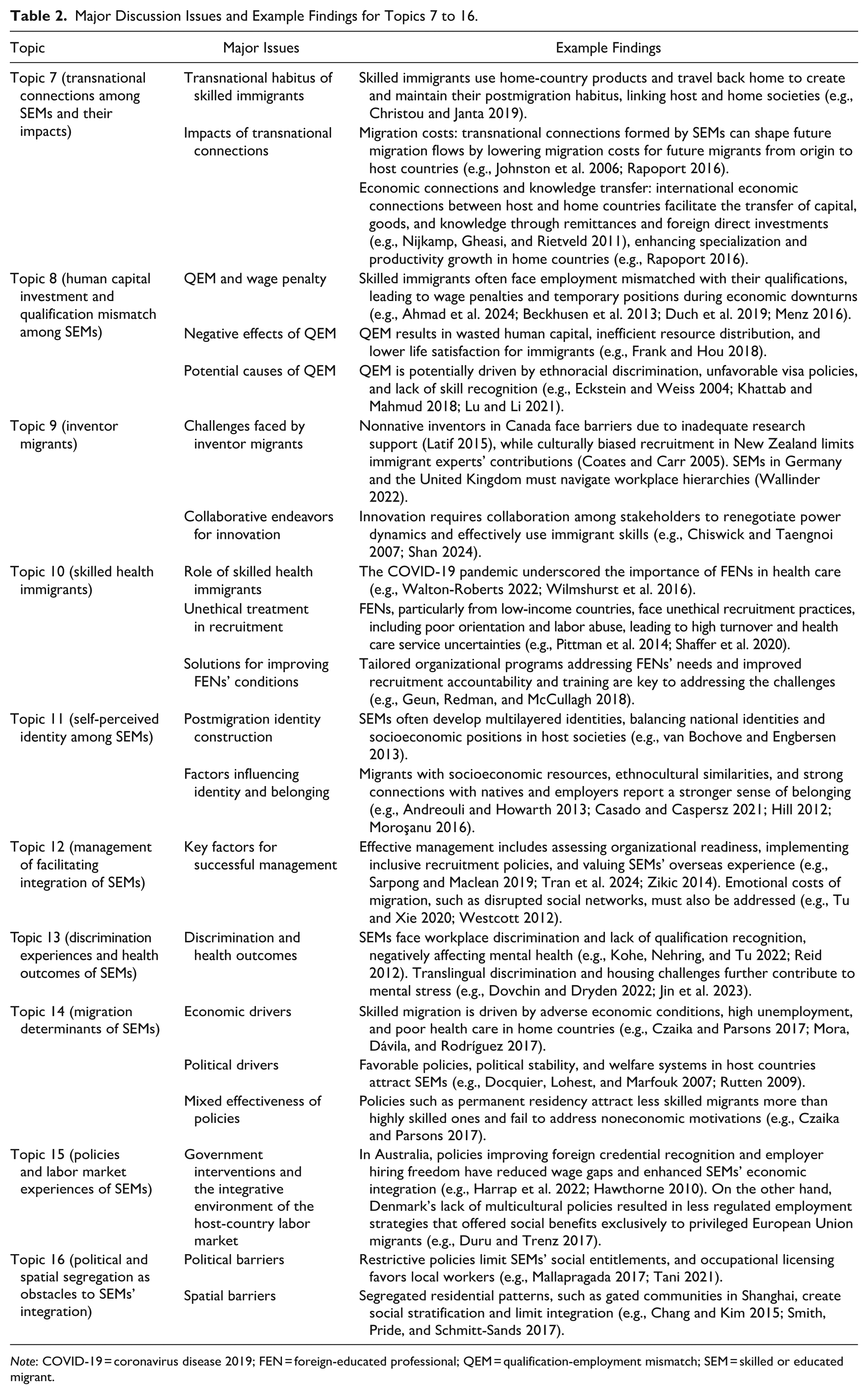
Note: COVID-19 = coronavirus disease 2019; FEN = foreign-educated professional; QEM = qualification-employment mismatch; SEM = skilled or educated migrant.
Topic 1 (Attitudes and Perceptions toward SEMs)
Research on this subject underscores that despite the global welcome extended to SEMs, these immigrants encounter obstacles in gaining complete acceptance from the native populations of their host countries. This is one of the important topics in immigration literature, reflected in the diverse backgrounds of authors, including economics, political science, and geography, as well as from different geographic regions. Without benefiting from their high human capital, similar to immigrants in general, skilled immigrants frequently encounter discrimination from the natives, largely because of their cultural minority identity (Ho and Ley 2014). Such discrimination can be exacerbated by insufficient legislation and citizenship laws (Koh 2015; Lindsay Lowell 2010), as well as ineffective eligibility assessments in the host countries. At the same time, natives’ negative perceptions of skilled immigrants are affected by the ethnocultural identities and legal status of the group (España-Nájera and Vera 2020; Ho and Ley 2014). For example, España-Nájera and Vera (2020) found that California’s voters’ favoritism toward immigrants decreased when these voters were informed that immigrants are Hispanic. Natives’ negative views on SEMs can also be shaped by unfavorable media portrayals of immigrants (Blinder and Jeannet 2018). Despite these challenges, studies suggest that SEMs actively establish themselves by using different cultural capital in the new society rather than accepting their marginalized positions (Yanasmayan 2016). For example, highly educated migrants from Turkey redefine their postmigration identities by strategically homogenizing other Muslim communities in the receiving countries while emphasizing diverse sources of their individuality (Yanasmayan 2016).
Topic 2 (Expectations of Policies and Migration of SEMs)
Not only do studies explore the negative experiences of SMEs, but they also discuss the “negative aspects” of policies. Instead of being explored solely by political scientists, the topic also involves geographers and economists in the discussion. As Portes and Rumbaut (2006) emphasized the importance of immigrant adjustment policies, researchers are also focusing on how these talent attraction policies influence the integration of SEMs (Ouaked 2002). Considering the significance of employment-related factors in influencing immigrants’ migration choices (Cohen 2013; Petersen and Puliga 2017), strategies such as relaxing residency requirements, issuing work permits, and offering economic incentives (Boyd 2014) are commonly used to attract SEMs. Nevertheless, there are doubts regarding the effectiveness of these policies in accurately capturing the traits and movements of SEMs. Some suggested the ineffectiveness of the policies is related to the scarcity of comprehensive data reflecting the actual impacts of SEMs on the host countries and the lack of consideration on the potential conflicts among different talent attraction policies and stakeholders given the competition for limited resources in host countries (Ahmad et al. 2024; McKenzie and Yang 2015) as posited by the conflict theory. Although many talent attraction policies treat SEMs as individuals who swiftly respond to opportunities for work, research has revealed that their migration is driven by multifaceted motivations such as marriage or partnership relationships and gendered expectations, rather than work-related reasons (Ackers 2004; Aure 2013). Policymakers should also consider future childcare prospects, access to innovative knowledge, and high-quality human resources (Murakami 2009; Peixoto 2001). Last, this body of research highlights that despite the widespread belief that SEMs are wealthy individuals who can seamlessly adapt, studies show that SEMs are not always high earners who can quickly blend into host societies (Triadafilopoulos 2013).
Topic 3 (Benefit and Risk to Local Economy of SEMs’ Migration)
Another major topic of studying SEMs is the economic benefits and risks of their migration to the local economy. This is another key topic in immigration studies. We demonstrate that authors with diverse academic backgrounds from both Western and non-Western societies have engaged in the discussion. This differs from studies focused on the general immigrant population, which were mainly conducted by researchers from the broader field of social sciences (Scholten, Pisarevskaya, and Levy 2022). Studies have repeatedly shown that the influx of high-skilled immigrants positively influences the international and domestic markets of host countries by increasing exports from host countries and enhancing the return on native-owned capital because of the complementary relationship between capital and these migrant workers (Ben-Gad 2008; Proyer et al. 2022; Vandor 2021). Thus, SEMs can help host economies reduce the risk for falling into a middle-income trap (Fan and Li 2019).
Although SEMs can support the overall stability and growth of host economies, studies, largely conducted by economists, also point out that realizing these potential economic benefits requires a more careful assessment of the risks associated with these economic benefits (Kimura and Canagarajah 2020) For example, on the basis of a cross-country analysis, Facchini and Mayda (2012) reported that employing SEMs can arouse negative sentiments among more educated natives who perceive skilled immigrants as competitors in the labor market. Such findings echo the broader immigration literature on the general immigrant population (e.g., Igarashi and Laurence 2021; Tomberg, Stegen, and Vance 2021). Furthermore, recruiting more SEMs also comes with higher financial burdens for host-country governments and firms, which can significantly delay the upgrading of local firms (Narayanan and Lai 2014). Among various studies, a group of researchers comparing the economic benefits and risks of SEMs suggests that more comprehensive policies are needed that host countries of SEMs should include more measures to raise the skills of native labor and entice the SEMs to help with the skill-upgrading process of native workers and firms (e.g., Facchini and Mayda 2012; Narayanan and Lai 2014). The discussion reflects the influence of the neo-classical economic model. Yet these studies go beyond conventional economic explanations and point out that without policies that facilitate skill sharing and collaboration, SEMs may be seen as threats rather than contributors.
Topic 4 (Retention Intention of SEMs)
Given that SEMs are highly competitive in the migration market, it is unsurprising that the retention of SEMs is a key topic in the field, but it has received less discussion in the context of the general immigrant population. Although macro-level economic conditions of home and host countries play a significant role in driving the immigration decision of skilled immigrants, their impact on the retention decisions of these individuals is relatively limited (Liu-Farrer 2023). Instead, a broader range of individual-level factors influences the intentions of SEMs to stay in a particular location. These factors include the migrants’ career aspirations and development (Clarke et al. 2018; Gu, Guo, and Lin 2022), family-related considerations and lifestyles (Harvey 2009), and health insurance status (Kao et al. 2010) in their host countries. The recognition of SEMs in their professional hierarchies and higher levels of gender equality in their employment institutions have been found to positively contribute to SEMs’ intention to stay in many Asian countries (Holbrow and Nagayoshi 2018; Ullah et al. 2021).
A set of studies on this topic compared the factors shaping the social participation of skilled and unskilled and revealed that the factors affecting the engagement and retention of SEMs are more complex than their unskilled counterparts (Harvey 2008). For example, unlike less-skilled migrants who tend to stay in host countries with more economic opportunities and actively use their coethnic social networks for job-seeking and social integration (Drivas et al. 2020), highly educated migrants in the United States can be highly selective in using expatriate social networks (Harvey 2008). Their decisions to build social connections with natives can be affected by the expected costs and benefits from these connections, which are related to diverse factors such as the cultural differences between them and the native population, the length of time spent in the US, and the size of the expatriate group (Harvey 2008). These findings reflect the cost-benefit calculations that SEMs consider when deciding to stay in a location. The work strongly aligns with the long-standing discussion within the neoclassical economic model regarding the reasons why people move (Cook and Rice 2006).
Furthermore, recent findings from Southeast Asian countries suggest that many highly skilled migrant talents often perceive themselves as independent outsiders, setting themselves apart from native employees and less-skilled migrants (Ullah et al. 2021). Although these factors play a significant role in their integration, they can also have contrasting effects. For example, although less integrative self-positioning somehow helps SEMs retain and handle employment setbacks, such as occupational downgrading, from a more positive and adaptive perspective (Fernando and Patriotta 2020), this may lower their intention to stay and integrate into their host country.
Topic 5 (Trade Flows and Migration of SEMs)
Over the past decade, there has been a notable increase in both international trade flows and the migration of SEMs due to rapid globalization (Iranzo and Peri 2009), leading to a surge in related studies largely by economists. Research from various countries has demonstrated that a rise in skilled migrant flows can positively affect both the quantity and quality of production inputs originating from the migrants’ home countries to the receiving nations (Ariu 2022; Du et al. 2023). This trend is supported by the networks established by SEMs, which promote the import of goods from their home countries that have a comparative advantage in their production (Giovannetti and Lanati 2017). Furthermore, the increase in high-quality trade flows driven by SEMs can benefit not only their host countries but also enhance the range of products and technologies available to meet the needs of local consumers in the migrants’ home countries (Du et al. 2023; Iranzo and Peri 2009). These studies align with globalization, which connects different economies and explains the growing interdependence through transnational linkages of the world’s economies, cultures, and populations, brought about by the movement of SEMs and information. Although these studies are primarily discussed in economic terms, the importance of transnational ties has been emphasized in the discussion.
Topic 6 (Job-Seeking Barriers among SEMs)
Although SEMs are highly sought after in the migration market, they face barriers to economic integration as the general immigrant population, specifically securing skilled jobs and fulfilling their employment aspirations in their host countries (Risberg and Romani 2022). Job acquisition for all immigrants, including SEMs, is crucial to their economic survival. Therefore, studies have been devoted to exploring different employment-related difficulties faced by SEMs. Sources of barriers can be grouped into two levels. At the macro level, barriers arise from unfavorable socioeconomic conditions in the host countries of SEMs. These conditions include limited facilities and employment opportunities for using their human capital, high levels of racialization and protectionism (Aobdia, Srivastava, and Wang 2018; Mickleborough and Martimianakis 2021; Zhang and Wang 2023), constraints on SEMs’ mobility, rights, and welfare, and challenges in obtaining citizenship (Breakey, Ransome, and Sampford 2021). At the individual level, discrimination based on immigrant identities and the devaluation of their skills by employers (van Riemsdijk 2013), and limited human and social capital in their receiving countries are key barriers faced by SEMs (Müller and König 2018). SEMS, despite their high level of human capital, still encounter various obstacles to securing desirable jobs. No doubt, these studies suggest that SEMs face similar challenges related to economic integration as the general immigrant population.
Because of the space limitation, the remaining topics, the major discussion issues, and finding examples are presented in Table 2 for reference. Overall, on the basis of the 16 topics, current literature on SEMs has centered around policies attracting and managing these SEMs and the impacts and postmigration experiences of SEMs. Further details on the connections among topics are presented later.
Topic Network Analysis
To go one step further in understanding the connections among topics, we conducted a network analysis on the basis of DTM-generated topics. Network analysis has been widely used by researchers to examine relationships between various study targets (e.g., Isfandyari-Moghaddam et al. 2023). The importance of a node was quantified using eigenvector centrality, a metric that considers not only the node’s direct connections but also the centralities of other connected nodes, providing a more accurate assessment of node significance and influence within the network (Yang et al. 2023). To assess similarities among topics, cosine similarity, a standard measure for comparing the orientation and magnitude of term frequency–inverse document frequency vectors, was calculated on the basis of the top 50 highest probability keywords generated by DTM. Louvain detection modeling, one of the most used algorithms in community detection in networks (Dugué and Perez 2022), was then applied to identify latent conceptual clusters.
The network analysis results (Figure 8) indicate the following patterns. First, despite two distinct clusters being identified, these two clusters still gathered closely, suggesting that topics in studies on SEMs remain strongly connected. From the perspective of Abbott’s (2001) framework, such a pattern signals a field transitioning into a “normal period,” where topics are stabilizing and ideas are building upon shared norms. The relatively limited diversity of topics observed in this network further supports this conclusion, as cohesion often characterizes the normal periods in Abbott’s model.
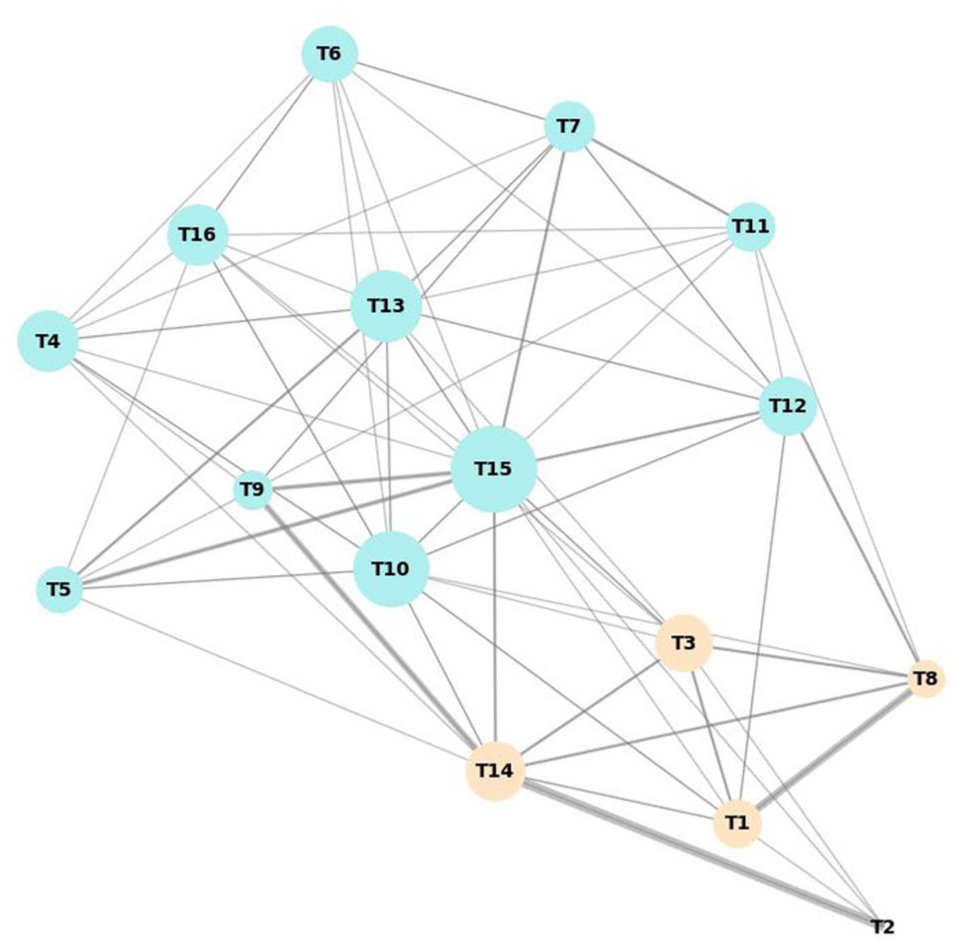
Topic network of the 16 topics generated by dynamic topic modeling.
However, certain elements within the network suggest that aspects of the field are still evolving and differentiating, as characterized by the “reconfiguration” period. This is not puzzling as the research on SEMs was not much developed until the 2010s, and this field is still in the phase where ideas are competing and synchronizing. For instance, topic 15 (policies and labor market experiences of SEMs) is the most structurally interconnected within the literature about SEMs. These patterns reveal that organizational issues in the labor market included in topic 15 may become a “hub problem” in this field, which attracts intellectual competition and interdisciplinary engagement and aligns with the framework of Abbott (1988). In contrast, topic 2 (expectations of policies and migration of SEMs) is more distant from other topics, except for its strong connection with topic 14 (migration determinants of SEMs). This reflects that the policy-related factors are also commonly investigated or discussed by research focusing on the migration drivers for SEMs and mirrors Abbott’s insights on “specialization” boundaries, where distinct topic domains emerge and consolidate their unique identities.
The network analysis further groups the 16 topics generated from DTM into two major clusters, suggesting that current literature on SEMs can be categorized into the following two research lines. To provide a deeper understanding of these clusters, we will link the network analysis with sociological theories in the following discussion.
The first cluster (orange nodes) is about international migration patterns and integration of SEMs, encompassing topics 1, 2, 3, 8, and 14. These topics explore how policy-related factors influence the host countries’ abilities to attract SEMs and use the human capital of these migrant workers, and how international migration patterns and integration of SEMs are shaped by economic and political factors in sending and receiving countries. These studies reflect the neoclassical migration model, emphasizing the costs and benefits of migration between sending and receiving countries (DeWaard, Kim, and Raymer 2012; Tagliacozzo, Pisacane, and Kilkey 2024). Moreover, migration flows are shaped by a complex interplay of push and pull factors in both sending and receiving countries. For example, host-country policies, such as talent attraction programs (topic 2), lower migration costs for SEMs, while adverse conditions in sending countries, like limited opportunities or political instability (topic 14), increase such costs, prompting SEMs to leave. Inflows of SEMs can also have mixed impacts on their host and home countries, such as boosting productivity and innovation and causing negative sentiments and discrimination in their receiving societies (topics 1 and 3) and bringing remittances and economic returns to their home societies (topic 14). This bidirectional relationship highlights migration’s systemic nature as suggested by migration system theory, arguing that migration flows are shaped by interconnected factors (e.g., political and economic conditions) in origin and destination countries of migrants (Tagliacozzo et al. 2024). Despite their qualifications, SEMs often occupy secondary labor markets, facing inefficient resource allocation and lower life satisfaction because of political issues like restrictive visa policies and discrimination (topic 8). These findings, reflecting the segmented labor market theory and consistent with studies on migrant adaptation (e.g., Cheng et al. 2020; Ersanilli and Koopmans 2010), underscore the importance of structural reforms to improve integration and harness SEMs’ potential, benefiting both migrants and host countries.
The second cluster focuses on the impacts of SEM migration, which is a natural discussion because of the high human capital of SEMs. The topics (blue nodes) consist of topics 4 to 7, 9 to 13, 15, and 16, mainly investigating the postmigration impacts. Two lines of research can be identified within this cluster. The first line of research focuses on the transnational networks and the resultant economic and social impacts of the SEMs. Transnationalism emphasizes the processes by which immigrants build links bridging their country of origin and their country of settlement, and these links (e.g., familial, economic, social, and political relations across borders) can evolve and contribute to the migrants’ plural identities and behaviors (Tedeschi, Vorobeva, and Jauhiainen 2020). For example, topics 5 and 7 explore how SEMs establish transnational networks that facilitate trade flows, knowledge transfer, and cultural exchange between their home and host countries. These networks not only enhance economic integration but also foster a sense of dual or multilayered belonging among SEMs, as they navigate their roles in both societies (topic 11). This dual identity allows SEMs to act as cultural and economic bridges, leveraging their networks to benefit both their home and host countries.
The second research line examines, similar to studies in immigration literature, the economic and social integration of SEMs and the local responses to their presence, which is a major topic in migration literature. Topics 9, 12, and 15 focus on the economic contributions of SEMs, emphasizing the need to reduce employment-related barriers. These topics highlight how SEMs’ integration into host-country labor markets can drive innovation, productivity, and economic growth. However, SEMs often encounter significant structural challenges, such as occupational downgrading, devaluation of foreign credentials, and discrimination, which hinder their full economic potential. In addressing these economic integration challenges, topics 6, 10, and 13 focus on realizing economic benefits through effective management strategies and migration policies. They highlight the need for systemic reforms to evaluate SEMs’ social and cultural capital and create an environment conducive to their integration. Such reforms are essential for removing barriers and ensuring equitable opportunities. Topic 16 examines local responses that hinder SEMs’ integration, such as negative public attitudes, ethnocultural biases, and residential segregation. These factors foster social exclusion, limiting SEMs’ sense of belonging and access to resources. This intergroup dynamic extends beyond the workplace, reinforcing their marginalization in daily life.
Conclusion and Implications
Although SEMs have become highly welcomed immigrants by worldwide governments and an increasingly popular research focus, a systematic understanding of the research landscape of SEMs is still absent. This study is rooted in the frameworks from Collins (1998) regarding intellectual networks and chains of argument, Abbott’s (1988, 1999, 2001) scholarship on disciplinary jurisdictions and chaotic dynamics of knowledge, and Farrell’s (2001) analysis of collaborative circles and uses data-driven methods, including NER, DTM, and network analysis, to offer the first systematic analysis on 985 abstracts from studies on SEMs and their authorship details.
Our analysis of the geographical focus of each abstract and the authorship information revealed several noteworthy patterns. First, scholarly attention to SEMs, particularly in non-Western regions, has increased since the 2010s. This echoes the growing significance of non-Western countries such as Singapore and Hong Kong in the global competition for SEMs, which reshapes the global human capital distribution and hence attracts more scholarly attention (Fong 2023). As argued earlier, this diffusion of research beyond traditional Western destinations is further enabled by the improved Internet accessibility after 2010, supporting Collins’s (1998) perspective that increased connectivity worldwide fosters intellectual exchange networks and the development of knowledge. Second, despite the marked growth in studies focusing on non-Western regions, the SEM research center of gravity remains in Western contexts, where both cross-country and interdisciplinary collaborations cluster. This dominance reflects the long-standing attraction of Western economies such as the United States to SEMs, but also signals, in line with Farrell (2001), how institutional resources and priorities in the West continue to nurture productive collaborative circles. Third, our findings from the analysis of the disciplines of the author indicated a broadening scope of disciplinary participation outside the range of social sciences. This trend, coupled with the significant growth in the multidisciplinary and international collaborations, demonstrated that intellectual fields are increasingly shaped by negotiation and competition among collaborative groups, as Abbott (1988) and Collins (1998) argued. Thus, the migration studies, which are traditionally claimed by social scientists, may now draw the attention of researchers from medicine and computer science, indicating that the intellectual proximity is unlikely the dominant trend in this research field. In summary, the surge in research on SEMs reflected Abbott’s model of nonlinear, “bursty” growth of ideas and illustrated the theories of Collins and Farrell that external drivers (globalization, policy shifts, technological change) and internal dynamics (disciplinary competition and collaboration) are both at play to create more scholarly discourse and collaboration circles. However, the continued dominance of Western countries as the primary research focus potentially highlights the enduring influence of institutional power. This dual process of rapid expansion of SEM-related research with “unbalanced” development revealed by studies on Western and non-Western regions unpacked the dynamic yet hierarchical nature of intellectual fields.
Results from the DTM indicate that none of the 16 identified topics has notably decreased in popularity, echoing the rapid growth of the research on SEMs from the foregoing analysis, whereas topics related to trade flows and migration of SEMs (topic 5) and the integration barriers of SEMs (topic 16) are gaining slightly more attention. This increase in attention on the former group of topics may be due to the scale and scope of globalization and the growing international trade of the emerging market, while the latter group of topics is related to the interest in postmigration experience (topics 6, 9, 10, 12, and 13). Although a diverse set of topics commands scholarly attention, discussions around policies for attracting SEMs (topic 2) appear especially dominant. This pattern highlighted the central role of governmental strategies and public policy interventions in shaping SEM flows. As Collins (1998) argued, initial phases of discussion and attention on a given topic can create a cumulative advantage, wherein early research perspectives set the agenda for subsequent scholarly focus, demonstrated in the prominence of policy-oriented debates in this field. Moreover, through further analysis on the evolution of the topic diversity, our study revealed the research landscape of SEMs likely entered into a “normal” stage, according to the framework of Abbott (1988), where the topics in the field become stable and expand slowly. However, the popularity of topics 5 and 16 continues to grow, indicating that the field is not fully in the “normal” period.
Our network analysis on the connections among the 16 identified topics further supports the foregoing findings by showing two clear yet closely connected clusters of topics. Although two separate clusters were identified, this suggests that the research field is relatively structured rather than in a “chaotic” phase described by Abbott (1988), the integrated network displayed by the overall field where the connections among many topics are complex also demonstrated that the SEM-research landscape is yet to fully transit into the “normal” period. For example, on the one hand, topic 2, in particular, evolved into a distinct research focus that is strongly linked with topic 14 and distant from other topics, revealing a specialized topic group relating to the migration determinants and policy-driven factors. On the other hand, the network analysis also documented that topic 15 is well linked with many topics in the field and the ongoing attract attention from scholars. These patterns can potentially bring future changes in the topic clusters and also suggest that while the overall field tends to stabilize, specific topics can evolve before forming their unique clusters, and hence in a “reconfiguration” period.
Limitations and Future Research Directions
This study used machine learning methods to offer the first analysis of research trends and authorship in the growing field of SEMs. However, as one of the beginning explorations of this underexplored research area, this study faces some limitations. First, it focuses on identifying key topics and mapping their temporal evolution and the interconnections, while providing relatively limited explanations for the underlying mechanisms driving these trends. Although our analysis and discussion were guided by the foundational frameworks of Collins (1998), Abbott (1988, 1999, 2001) and Farrell (2001), and the robustness of the observed patterns is supported by the convergence of results from different analyses, our findings could benefit from further verification and enrichment through qualitative methods such as interviews with scholars specializing in SEMs or participatory observations in research centers focused on educated migration studies. These approaches can provide deeper insights into the mechanisms behind the observed trends. Future research could also use other data-driven methods, such as structural topic modeling, to incorporate metadata for validation and explore how the topics are related to the covariates (e.g., journal, the economic conditions of publisher locations) of documents and potential drivers of trends observed from this study. Additionally, although the DTM and NER can process the text information in a less subjective way, their results may also vary with preprocessing techniques. It is also worth noting that the NER method may fail to distinguish the sourcing locations from the receiving ones. Although the location information from the NER and destination classifications were manually checked, the interpretation should be made cautiously because of the limitations of these methods.
Second, in the analysis of the authorship and research areas of articles, we categorized the research geographical areas into Western and non-Western. Although this Western versus non-Western dichotomy commonly appears in studies on SEMs and reflects the geographic categorization of different regions, it can overlook nuanced classifications on the basis of cultural (e.g., collectivistic vs. individualistic societies), economic, or institutional differences (e.g., Organisation for Economic Co-operation and Development countries vs. nonmember countries). Future studies could move beyond this dichotomy to explore regional variations shaped by cultural, economic, and institutional factors.
Third, the study relies on abstracts from articles indexed in the Web of Science, which tend to overrepresent research written in English, potentially marginalizing studies published in non-English languages. Thus, future studies may expand the dataset to include other sources such as Scopus, EBSCO, or regional databases to better mitigate regional and language biases.
In addition to the limitations of the study, there are still a few research gaps that are evident. First, the results suggest that cross-country and interdisciplinary collaboration research focusing on SEMs in non-Western regions is significantly limited, hindering the development of ideas through competitions among disciplinary jurisdictions and collaborative circles suggested by Abbott (1988) and Farrell (2001). However, as many non-Western regions are welcoming more SEMs entering or returning to their countries (Fong 2023), the geography of worldwide human capital shifts with this newly emerged pattern, potentially offering more research opportunities. Future studies could further explore South-South migration and compare the SEMs’ attributes, impacts, and drivers in rising talent hubs in the developing and non-Western regions with those in well-developed immigrant destinations in the Global North.
Second, although structural factors such as political and spatial segregation have been identified as barriers to SEMs’ integration, subjective factors such as their willingness to integrate remain underexplored. Such focus is important as studies in topics 4 and 11 suggest that some SEMs may prefer to remain as “outsiders.” This could hinder the SEMs’ social and economic integration, which is a two-way process requiring the mutual adaptation of natives and migrants (International Organization for Migration 2006). Future research should delve into the subjective dimension of integration of SEMs, examining how postmigration experiences, such as discrimination experiences, and psychological factors like perceived cultural identity influence their integration outcomes and willingness for integration.
Third, although topic 2 extensively covers government policies and their role in attracting SEMs, the role of nonpublic sectors in the process of introducing and retaining SEMs within and outside professional settings remains unclear. Private institutions, such as recruitment agencies and information platforms, and community-level organizations or groups, could play a critical role in shaping SEMs’ migration decisions and access to local resources (Groutsis, van den Broek, and Harvey 2015; Harrap et al. 2022) and hence their further settlement decision-making. Future research should explore how these private entities interact with public policies to influence skilled mobility and SEMs’ access to local information and resources.
Finally, current studies on SEMs are predominated by case studies or analyses on a small group of countries on the basis of census or survey data, especially in the western and developed regions, while there is limited exploration tracking the migration flows worldwide or further comparing the migration patterns of SEMs with that of their less-educated counterparts whose migration decisions may be driven by different constraints and benefits. This lack of a systematic understanding of skill mobility may hinder our full comprehension of SEMs and their distinct migration decision making. Future studies may take advantage of the technological advancements in the 2020s, where digitally traced data, such as that from social media platforms, may offer big datasets with higher frequencies to enrich our knowledge on the global talent movement and settlement.
Policy Implication
Our study has a few important policy implications. First, the findings highlight the need for targeted and data-driven approaches to understand and attract SEMs whose skills align with national priorities. Policymakers should invest in comprehensive data systems to track the profiles, skills, and career trajectories of SEMs. By developing more effective measurements for the qualifications and skills of SEMs, policymakers can minimize the mismatch between policy expectations and actual migrant profiles, ensuring and maximizing the contribution of SEMs. Moreover, the limited cross-country and multidisciplinary collaborations contributing to studies on SEMs in non-Western countries also revealed the need for policymakers to address the institutional obstacles impeding the interactions among scholars in these regions and encourage the formation of distinct collaborative circles facilitating the idea development and diffusion among non-Western economies.
Second, to reduce the potential costs and financial burdens associated with attracting SEMs, policymakers should develop strategies effectively mobilizing the private sector in attracting SEMs and hence lowering the high dependency of the talent-attraction schemes on public and government expenditures.
Furthermore, studies have repeatedly suggested that SEMs are facing difficulties in finding desirable jobs and bringing economic contributions because of the untransparent recruitment procedures, management policies, and deep-rooted hierarchies in their workplaces. Therefore, managerial frameworks that assess organizational needs and readiness for a skilled immigrant workforce and balance the distribution of power and interests among various stakeholders are important for the effective integration and skill use of SEMs. For instance, policymakers should implement more transparent recruitment frameworks and anti-discrimination measures to ensure fair access to employment. Additionally, as suggested by studies in topics 1 and 16, SEMs are facing obstacles to social integration, such as negative public attitudes toward their arrivals and segmented residential spaces and labor markets. Policymakers should design community engagement programs to foster positive societal attitudes and enhance SEMs’ sense of belonging. For example, mentorship programs with local mentors to facilitate social and professional integration of SEMs may be a potential approach for addressing the integration difficulties of SEMs (Chevrier et al. 2023).
Footnotes
Funding
The authors disclosed receipt of the following financial support for the research, authorship, and/or publication of this article: The research is supported by the National Natural Science Foundation of China (Grant number 72074179).
1
The Science Citation Index Expanded and Social Science Citation Index are widely used by academic reviewers focusing on social sciences journals from various disciplines to control the quality of selected publications (e.g., Fan, Wang, and Zhang 2021;  ).
).
2
Among all collected studies, 2,449 were excluded for exploring the skills, wages, and education levels of different types of migrants; 1,207 were excluded for examining low-skilled migrants and refugees or both; 656 were removed for examining internal migration; and 33 were deleted for incomplete author and abstract information.
3
This classification is based on the classification of World Population Review, which is built on definitions of “West and non-West” from multiple trusted sources such as the Lexico by Oxford, Science Daily, and the meaning of “Western countries” contributed by the Foreign Policy Research Institute ().